
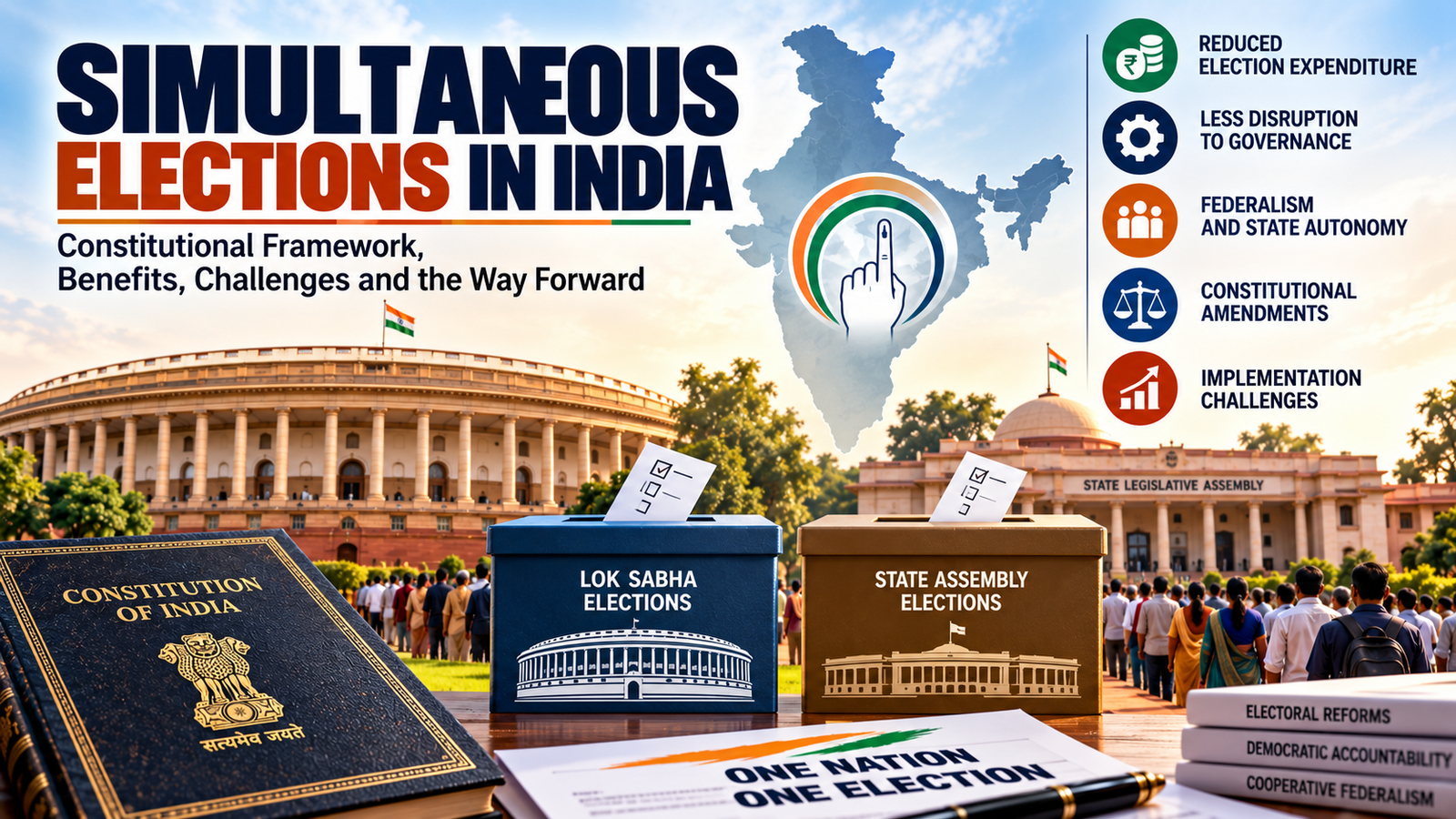
India’s proposal for “One Nation, One Election” seeks to synchronise elections to the Lok Sabha and State Legislative Assemblies. Supporters argue that it could reduce election expenditure and repeated disruptions to governance. Critics raise concerns about federalism, regional representation, constitutional design and what happens when an elected government loses its majority before completing its term.
As of 13 October 2026, the Constitution (129th Amendment) Bill, 2024 and the Union Territories Laws (Amendment) Bill, 2024 remain under consideration by a Joint Parliamentary Committee. The committee’s tenure was extended into the Winter Session of 2026; the proposal has therefore not yet become law.
PRS Legislative Research
+1
1. What are simultaneous elections?
Simultaneous elections refer to holding elections to the Lok Sabha and State Legislative Assemblies together, rather than conducting them at different times as their terms expire or governments fall.
The proposal does not necessarily mean voting throughout India on one single day. Polling can take place in multiple phases, with the objective of aligning the election cycles.
It is also important to distinguish between two ideas:
- Simultaneous Lok Sabha and Assembly elections: the central proposal addressed by the 2024 Bills.
- Simultaneous elections to all three tiers: a broader model that also envisages local-body elections to Panchayats and Municipalities within a defined period.
The distinction matters because local-body elections operate under a separate constitutional framework and are administered by State Election Commissions.
2. Historical background: India once had synchronised elections
India broadly followed a common electoral cycle for the Lok Sabha and most State Assemblies during the early decades after Independence. General elections were held together in 1951–52, 1957, 1962 and 1967.
This pattern gradually broke down because some State Assemblies were dissolved prematurely, political governments changed, and the Lok Sabha itself was dissolved before completing its full term.
The result was a staggered electoral calendar. Today, elections take place at different times across States, alongside periodic Lok Sabha elections and local-body polls.
The historical experience demonstrates that synchronisation is possible, but it does not by itself establish that restoring it would be constitutionally or administratively straightforward.
3. The constitutional and legal framework
The proposal has implications for several constitutional provisions.
| Provision | Relevance |
|---|---|
| Article 83 | Duration of the Houses of Parliament, including the Lok Sabha |
| Article 85 | Summoning, prorogation and dissolution of the Houses of Parliament |
| Article 172 | Duration of State Legislatures |
| Article 174 | Summoning, prorogation and dissolution of State Legislatures |
| Article 356 | President’s Rule in a State in specified circumstances |
| Article 324 | Superintendence, direction and control of elections by the Election Commission of India |
The core challenge is not merely to choose a common polling date. It is to reconcile fixed electoral cycles with the parliamentary system, in which the executive must retain the confidence of the elected House.
India’s constitutional system permits a government to fall before the normal end of its term. Any synchronisation model must explain how elections, caretaker arrangements and the tenure of newly elected Houses would operate in such circumstances.
Students should also connect this debate with the principles of parliamentary democracy, federalism and constitutional supremacy discussed in the Indian Polity and Constitution study hub.
4. What do the 2024 Bills propose?
The Constitution (129th Amendment) Bill, 2024 and the Union Territories Laws (Amendment) Bill, 2024 were introduced in the Lok Sabha on 17 December 2024 and referred to a Joint Parliamentary Committee.
PRS Legislative Research
+1
The principal features of the constitutional proposal include:
- A mechanism to commence the synchronised cycle through a notification following a general election to the Lok Sabha.
- Alignment of the terms of State Legislative Assemblies with the Lok Sabha’s electoral cycle.
- Provision for elections when the Lok Sabha or a State Assembly is dissolved prematurely, with the newly elected House serving the remainder of the synchronised term.
- A mechanism to defer an Assembly election where the Election Commission considers simultaneous polling infeasible, subject to the proposed constitutional framework.
These provisions aim to establish a common cycle without removing the possibility of early dissolution. However, they also raise a fundamental question: what does democratic accountability mean if a newly elected government may have to face another election after serving only a shortened term?
The final legal effect would depend on the text ultimately enacted, any amendments made during parliamentary scrutiny, and the arrangements adopted for implementation. The proposal should not be treated as an operative constitutional rule while it remains a Bill.
5. Why is simultaneous elections being proposed?
A. Reducing election expenditure
Frequent elections require deployment of security personnel, polling staff, transport, electronic voting machines and other logistical resources. Political parties and candidates also incur substantial campaign expenditure.
Synchronisation could reduce some recurring administrative costs. However, savings should not be assumed automatically: a simultaneous election would require extensive logistical capacity, and campaign expenditure might remain high or become concentrated in a single national electoral period.
B. Minimising repeated disruptions to governance
The Model Code of Conduct (MCC) applies during election periods and restricts certain activities by governments and political parties to preserve electoral fairness.
Supporters argue that frequent elections can delay announcements and decisions, divert officials from routine administration and encourage short-term political calculations. The Election Commission has clarified, however, that the MCC does not prohibit the continuation of existing schemes or all routine government activity.
PRS Legislative Research
Therefore, the relevant question is not simply how to eliminate the MCC, but how to reduce avoidable administrative disruption while preserving fair elections.
C. Improving administrative coordination
Synchronised elections could enable governments and election authorities to plan security deployments, polling personnel and logistics through a common framework. It might also reduce the frequency with which public servants are reassigned to election duties.
D. Encouraging longer-term policymaking
A common election cycle could reduce the frequency of campaign-driven political activity. Yet governments must remain accountable throughout their tenure. The absence of an imminent election cannot substitute for effective legislative scrutiny, transparency or citizen participation.
6. Major concerns and challenges
A. Federalism and State autonomy
State elections concern regional leadership, language, agriculture, public services and other issues that may differ substantially from national political priorities. Simultaneous polling could make it harder for State-specific issues to receive independent attention if national campaigns dominate the electoral debate.
This concern relates directly to India’s federal structure and the constitutional distribution of powers between the Union and States.
B. Premature dissolution and shortened terms
Parliamentary governments may lose their majority. If a government falls between synchronised elections, the system must determine whether another government can be formed, whether a confidence-and-supply arrangement is possible, or whether fresh elections are necessary.
Under the proposed model, an early election could produce a House that serves only the remainder of the common term. Such shortened terms may create uncertainty for governance and voters.
PRS Legislative Research
C. Voter choice and nationalisation of State elections
Voters may evaluate national and State governments differently. A common election date could increase the influence of national-level narratives on Assembly contests, although the actual effect would depend on political conditions, campaign strategies and voter behaviour.
The objective should be to protect the ability of voters to make distinct choices for different levels of government.
D. Constitutional and institutional questions
Aligning the terms of legislatures requires constitutional amendments and careful consideration of the relationship between the executive and legislature. The proposed power to defer an Assembly election also raises questions about safeguards, permissible grounds, duration and the authority responsible for governing during a delay.
These issues demand precise constitutional drafting rather than reliance on administrative arrangements alone.
PRS Legislative Research
E. Logistics, personnel and equipment
Simultaneous elections would require sufficient electronic voting machines, voter-verifiable paper audit trail units, secure storage, polling staff, transport and security arrangements. The Election Commission would need to coordinate elections across a very large and diverse country.
Implementation would require transparent capacity assessments, phased procurement and contingency planning.
7. Does simultaneous polling necessarily save money?
The economic case needs careful evaluation. Costs should be assessed across at least three categories:
- Direct public expenditure: election administration, equipment, security and personnel.
- Political expenditure: spending by parties and candidates, including campaigning.
- Indirect economic effects: administrative diversion, disruption to selected public activities and uncertainty for implementation.
The 2015 Parliamentary Standing Committee and subsequent discussions examined the cost and administrative implications of frequent elections. PRS also notes that direct government election expenditure has historically represented a relatively small share of GDP, although party and candidate spending adds to the overall cost.
PRS Legislative Research
A sound assessment should compare the full lifecycle costs of both models, including the extra capacity needed for synchronised elections. Cost reduction is a legitimate objective, but it should be demonstrated through transparent estimates rather than treated as an automatic outcome.
8. International experience: useful, but not directly transferable
Some democracies synchronise elections at different levels of government, while others hold them at separate times. Their arrangements depend on their constitutional structures and political systems.
For example, Sweden holds national and local elections together, while Belgium has constitutional arrangements for synchronised elections at multiple levels. These examples illustrate possible approaches, but their political and institutional contexts differ from India’s.
PRS Legislative Research
India must account for its own parliamentary system, federal diversity, multi-party competition and constitutional provisions. International comparisons should inform design choices rather than serve as proof that one model will work identically everywhere.
9. The way forward: reforms and safeguards
A sustainable approach should balance administrative efficiency with democratic accountability.
- Build political consensus: Consult States, political parties, constitutional experts and election administrators. Federal cooperation is essential for a reform affecting State legislatures.
- Define clear rules for premature dissolution: Specify procedures for government formation, confidence votes, caretaker arrangements and elections for the remainder of a term.
- Protect State-specific electoral choice: Preserve space for regional issues and ensure that simultaneous campaigns do not diminish the independent significance of Assembly elections.
- Set strict safeguards for postponement: Establish objective grounds, clear time limits, parliamentary oversight where appropriate, and safeguards against prolonged absence of an elected legislature.
- Publish a detailed cost-benefit assessment: Compare administrative savings with the costs of equipment, personnel, security, storage and implementation.
- Strengthen the Election Commission’s capacity: Undertake logistical audits, improve training, assess equipment requirements and establish robust contingency plans.
- Consider phased implementation: If adopted, the transition should be based on a transparent and constitutionally valid timetable rather than arbitrary curtailment of elected terms.
- Retain accountability between elections: Strong parliamentary scrutiny, legislative debate, access to information and public participation must continue irrespective of the election calendar.
These reforms should be examined through the parliamentary process, including the committee’s scrutiny of the proposed Bills. The official parliamentary record and the PRS bill analysis provide useful starting points for following the legislative debate.
10. Significance for UPSC Civil Services Examination
The topic connects with several parts of the UPSC syllabus:
- Prelims: Constitutional provisions concerning the duration and dissolution of legislatures, the Election Commission, the Model Code of Conduct and constitutional amendments.
- GS Paper II: Parliament and State Legislatures, electoral reforms, the Representation of the People framework, federalism and constitutional bodies.
- GS Paper II — Governance: Administrative efficiency, transparency, institutional accountability and citizen participation.
- GS Paper IV — Ethics: Democratic accountability, fairness, public interest and responsible use of public resources.
- Essay: Democracy versus efficiency, federalism, electoral reforms and institutional design.
It also connects with the broader questions of Indian constitutional governance and fiscal federalism in India, especially the need to balance national coordination with the autonomy of States.
Conclusion
Simultaneous elections could reduce repeated administrative mobilisation and create a more predictable electoral calendar. However, these potential benefits must be weighed against constitutional complexity, federal concerns, shortened legislative terms and the risk of weakening the distinct character of State elections.
The central principle should be that electoral efficiency must strengthen, not dilute, democratic accountability. Any reform must preserve the voter’s ability to hold governments accountable, ensure that elected legislatures remain constitutionally legitimate and provide clear safeguards for political instability. A carefully designed and broadly accepted framework would be more durable than a reform driven primarily by the promise of lower costs or fewer elections.
Prelims quick revision
| Question area | Key fact |
|---|---|
| Article 83 | Duration of the Houses of Parliament |
| Article 85 | Sessions and dissolution of Parliament |
| Article 172 | Duration of State Legislatures |
| Article 174 | Sessions and dissolution of State Legislatures |
| Article 324 | Election Commission’s constitutional role |
| 2024 constitutional proposal | Constitution (129th Amendment) Bill, 2024 |
| Legislative status as of 13 October 2026 | Under consideration by a Joint Parliamentary Committee |
UPSC Mains practice questions
- “Simultaneous elections may improve administrative efficiency but pose challenges to federalism and democratic accountability.” Critically examine.
- Discuss the constitutional implications of synchronising elections to the Lok Sabha and State Legislative Assemblies.
- What safeguards are necessary to ensure that electoral reforms strengthen democratic institutions rather than merely reduce administrative costs?
- Examine the relationship between frequent elections, the Model Code of Conduct and governance in India.
Authoritative sources for further reading
- PRS Legislative Research — Bill analysis: Simultaneous Elections
- PRS Legislative Research — Constitution (129th Amendment) Bill, 2024
- Election Commission of India
- Lok Sabha Secretariat — Parliamentary information