
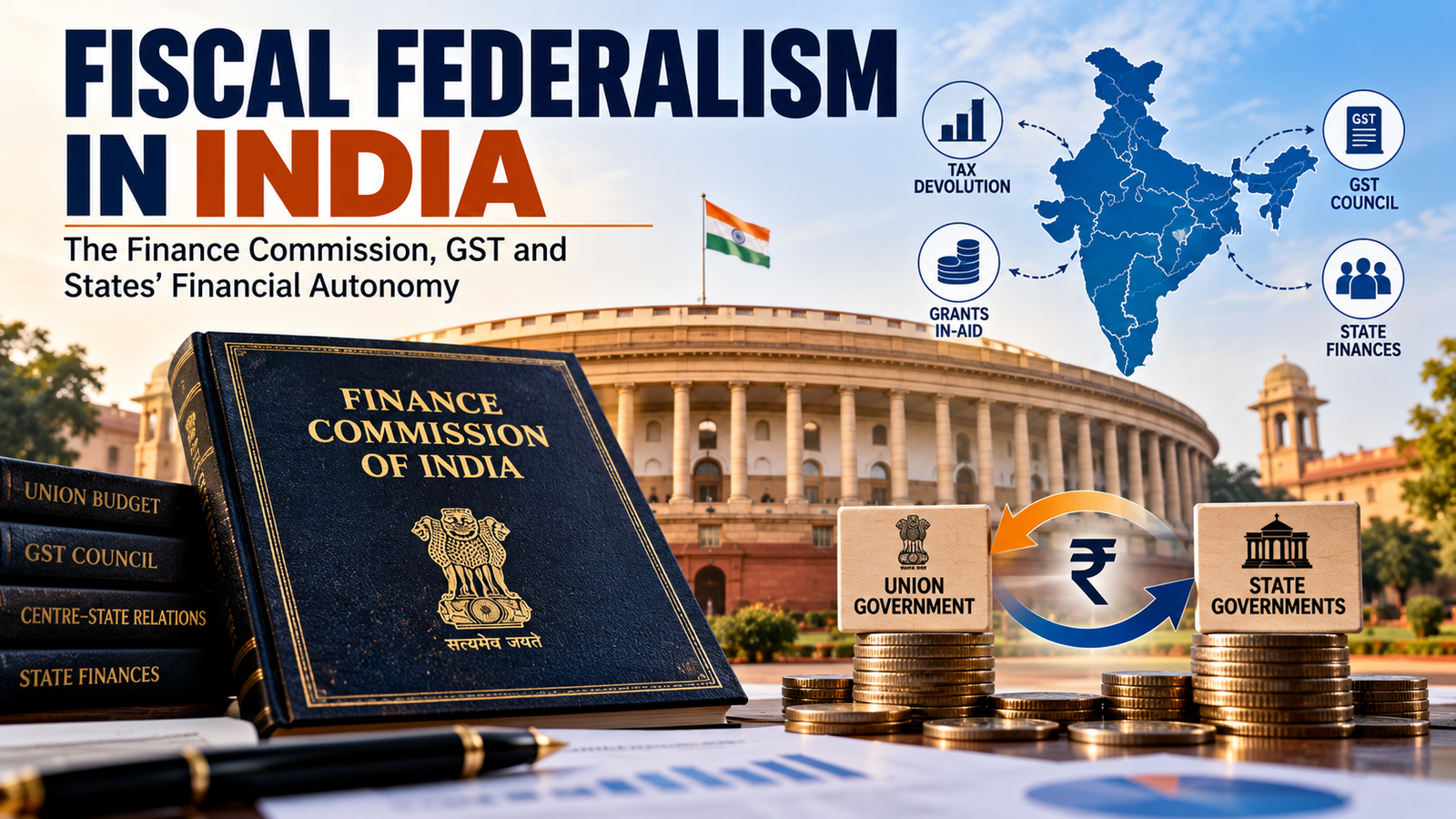
Fiscal Federalism in India: The Finance Commission, GST and States’ Financial Autonomy
Introduction
India’s federal system divides legislative, executive and financial responsibilities between the Union and State governments. While the Constitution distributes powers between the two levels of government, the distribution of financial resources does not always correspond neatly with their expenditure responsibilities.
States are responsible for delivering many essential public services, including public health, agriculture, policing, drinking water, sanitation and significant parts of education and welfare. Yet, the Union government controls important sources of taxation and redistributes a portion of the proceeds to States through tax devolution, grants and centrally sponsored programmes.
This creates a central question for Indian federalism: How can India ensure that States have sufficient financial resources to fulfil their constitutional responsibilities while maintaining national fiscal stability and reducing regional inequalities?
The issue has gained renewed significance with the implementation of the Sixteenth Finance Commission’s recommendations for 2026–31 and continuing debates about the distribution of tax revenues, the role of the Goods and Services Tax (GST) Council and the financial autonomy of State governments. The Sixteenth Finance Commission submitted its report in November 2025, and it was laid before Parliament in February 2026.
Press Information Bureau
+1
1. What is fiscal federalism?
Fiscal federalism refers to the division of taxation powers, expenditure responsibilities, public revenues and borrowing authority among different levels of government within a federal system.
It addresses four principal questions:
- Who taxes? Which level of government has the authority to levy and collect particular taxes?
- Who spends? Which level of government is responsible for providing public services?
- Who receives revenue? How are tax revenues distributed between the Union and the States?
- Who borrows? Under what conditions can governments borrow to finance expenditure and investment?
Fiscal federalism is important because the government closest to citizens may be better placed to understand local needs, while the Union may be better equipped to mobilise certain taxes, redistribute resources across regions and manage national economic shocks.
A well-designed fiscal federal system must balance three objectives:
- Efficiency: Public services should be delivered effectively, with minimal waste.
- Equity: Citizens should have reasonable access to essential services regardless of the State in which they live.
- Autonomy and accountability: Each level of government should have adequate resources and responsibility for its decisions.
Fiscal federalism versus cooperative federalism
Cooperative federalism is the broader principle that different levels of government work together to achieve common objectives. Fiscal federalism is the financial dimension of that relationship.
For example, the GST Council is an institution of cooperative federalism because the Union and States participate in decisions concerning a major indirect-tax system. The Finance Commission is a constitutional institution that addresses the distribution of public resources between the Union and States.
2. Constitutional framework of fiscal federalism
The Constitution of India establishes the framework for taxation, expenditure, intergovernmental transfers and public borrowing.
| Constitutional provision | Significance |
|---|---|
| Article 246 and the Seventh Schedule | Distribute legislative powers, including taxation powers, between the Union and States. |
| Article 246A | Provides special legislative authority for GST to Parliament and State legislatures, subject to the constitutional framework. |
| Article 269A | Governs the levy and collection of GST on inter-State supplies and the apportionment of revenue. |
| Article 270 | Provides for the distribution of specified Union tax revenues between the Union and States. |
| Article 271 | Permits Union surcharges on certain taxes for Union purposes; these are excluded from the divisible pool under the constitutional framework. |
| Article 275 | Provides for grants-in-aid to certain States. |
| Article 279A | Establishes the GST Council. |
| Article 280 | Provides for the Finance Commission. |
| Article 281 | Requires Finance Commission recommendations and the explanatory memorandum on action taken to be laid before Parliament. |
| Article 293 | Governs borrowing by States, including certain conditions applicable where a State has outstanding loans or guarantees involving the Union. |
The official Finance Commission website provides the relevant constitutional provisions, including Articles 270, 275, 280 and 281.
Finance Commission India
Constitutional principle
India has a federal distribution of powers, but it does not have a system in which every State independently controls all the revenue needed to finance its responsibilities. Intergovernmental transfers are therefore an essential part of the constitutional arrangement.
The challenge is to ensure that such transfers support national equity without making State governments excessively dependent on discretionary decisions by the Union.
3. Why does India need intergovernmental financial transfers?
The distribution of taxation powers and expenditure responsibilities creates a situation commonly described as a vertical fiscal imbalance.
The Union government has access to major tax sources, including personal income tax, corporation tax and customs duties. States collect their own taxes, such as State GST, excise duties on specified products, stamp duties and vehicle taxes, but their revenue-raising capacity varies significantly.
At the same time, States must finance a wide range of public services. Their ability to do so differs because of variations in income levels, economic structures, population, geography and administrative capacity.
Three forms of imbalance are important.
A. Vertical fiscal imbalance
This arises when the revenue-raising capacity of one level of government does not match its expenditure responsibilities.
The Union transfers resources to States through tax devolution and grants to address this imbalance.
B. Horizontal fiscal imbalance
This refers to differences in the financial capacity of States. A State with a large industrial and services base may generate more revenue per person than a State with lower incomes or a narrower tax base.
Without a redistributive mechanism, these differences could translate into substantial inequalities in public services.
C. Unequal expenditure needs
Some States face higher costs of service delivery because of difficult terrain, dispersed populations, vulnerability to natural disasters or substantial infrastructure deficits. Equal per-capita transfers alone may not adequately address these differences.
The objective of fiscal transfers is therefore not simply to distribute money. It is to help governments provide essential services, correct regional disparities and maintain macroeconomic stability.
4. The Finance Commission: India’s principal fiscal-transfer institution
The Finance Commission is a constitutional body established under Article 280. The President constitutes it every five years or earlier, as necessary.
Its principal responsibilities include recommending:
- The distribution of the net proceeds of specified Union taxes between the Union and the States.
- The allocation of the States’ share among individual States.
- The principles governing grants-in-aid to States.
- Measures to augment the resources of Panchayats and Municipalities, based on the recommendations of State Finance Commissions.
- Other matters referred to it by the President in the interests of sound public finance.
The Finance Commission’s recommendations are not themselves equivalent to legislation. Article 281 requires the recommendations and an explanatory memorandum on action taken to be placed before Parliament.
Finance Commission India
Vertical devolution and horizontal devolution
These are two essential concepts for UPSC aspirants.
Vertical devolution concerns how the divisible pool of Union taxes is shared between the Union and all States collectively.
Horizontal devolution concerns how the States’ aggregate share is distributed among individual States.
For instance, deciding whether States collectively should receive a specified percentage of the divisible pool is a vertical-devolution question. Deciding how that share should be allocated between a large State with a substantial population and a smaller State with lower fiscal capacity is a horizontal-devolution question.
Why is the divisible pool important?
The divisible pool generally consists of the net proceeds of Union taxes that are shareable under the Constitution. Certain cesses, surcharges and other specified receipts are excluded.
This distinction matters because the proportion of gross Union tax revenue that is actually shareable may differ from the headline percentage recommended for States.
Consequently, two questions must be examined separately:
- What percentage of the divisible pool is allocated to States?
- How large is the divisible pool in relation to the Union’s total tax revenue?
A higher share of a narrower pool does not necessarily produce a proportionate increase in the total resources reaching States.
5. The Sixteenth Finance Commission and the 2026–31 award period
The Sixteenth Finance Commission, chaired by Dr. Arvind Panagariya, was constituted to recommend arrangements for the five-year period beginning on 1 April 2026.
Its report addresses a wide range of subjects, including tax devolution, State finances, local-body grants, disaster management, fiscal stability, electricity-sector reforms, subsidies and public-sector enterprises. The report and the government’s explanatory memorandum are available through official sources.
indiabudget.gov.in
+2
Several themes are especially important for understanding the present phase of fiscal federalism.
A. The States’ share in Union taxes
The Fifteenth Finance Commission had recommended that States receive 41% of the divisible pool, with the special treatment for Jammu and Kashmir’s changed constitutional status reflected in the arrangement.
States have argued that their expenditure responsibilities warrant a larger share. The Sixteenth Finance Commission examined this demand alongside the Union government’s fiscal requirements and the structure of the divisible pool.
indiabudget.gov.in
The important analytical point is that devolution must balance the Union’s national responsibilities with the States’ service-delivery obligations.
B. The criteria for distributing resources among States
Horizontal devolution requires a formula because States differ in population, income levels, fiscal capacity and other characteristics.
Commonly debated considerations include:
- Population and demographic needs.
- Income distance, which reflects differences in economic capacity.
- Geographic area.
- Forest and ecological considerations.
- Demographic performance.
- Efforts to mobilise revenue and improve fiscal management.
Each criterion creates a policy trade-off. A formula that gives greater weight to population may direct more resources to populous States, while one that rewards revenue effort may favour governments with stronger tax-administration systems. A formula focused on income distance can support poorer States, but its design may also influence how States perceive incentives for economic growth.
The central challenge is to combine equity with incentives for sound fiscal management.
C. Revenue-deficit grants and fiscal discipline
A revenue deficit occurs when a government’s revenue expenditure exceeds its revenue receipts. Revenue-deficit grants can help States that face a gap even after tax devolution.
However, repeated grants can raise concerns if they become a permanent substitute for revenue mobilisation, expenditure rationalisation or structural reform.
The Sixteenth Finance Commission did not recommend revenue-deficit grants to States for its award period, emphasising the scope for raising revenues and rationalising expenditure. It also did not recommend sector-specific or State-specific grants in that category.
indiabudget.gov.in
This approach raises a broader question: how should the fiscal system support States with structural disadvantages while encouraging long-term financial sustainability?
The answer requires more than a single grant formula. It also depends on States’ tax effort, the quality of expenditure, the design of transfers and the capacity to deliver public services.
D. Local governments and decentralisation
Fiscal federalism does not end with the Union and States. Panchayats and Municipalities are responsible for many services that directly affect citizens, including local roads, sanitation, water supply and waste management.
Article 280 requires the Finance Commission to recommend measures to augment the resources of local governments, based on State Finance Commission recommendations.
Yet local governments often face limited own-source revenue, delayed transfers, weak accounting systems and dependence on higher levels of government.
A genuinely decentralised fiscal system therefore needs:
- Regular constitution and functioning of State Finance Commissions.
- Predictable transfers to local bodies.
- Stronger property-tax systems and other appropriate local revenue sources.
- Transparent budgeting and audited accounts.
- Greater administrative capacity at the local level.
6. GST and the changing nature of fiscal federalism
The introduction of GST through the 101st Constitutional Amendment transformed India’s indirect-tax system. Many earlier indirect taxes were subsumed into a common framework, with the Union and States sharing legislative and administrative responsibilities.
GST is governed by a distinctive constitutional arrangement. Article 246A provides the relevant legislative powers, Article 269A addresses inter-State supplies, and Article 279A establishes the GST Council.
The Council includes Union and State representatives and provides a forum for recommending GST rates, exemptions and other important aspects of the tax system.
How GST supports cooperative federalism
GST offers several potential benefits:
- Reduces the cascading of taxes across supply chains.
- Supports a more integrated national market.
- Facilitates a common framework for indirect taxation.
- Creates a formal institution for consultation between the Union and States.
- Enables coordinated tax administration and digital compliance systems.
Why GST also creates concerns about State autonomy
Before GST, States had greater independent authority over several indirect taxes, including their own VAT systems. Under GST, important decisions concerning rates and the tax structure are made through a shared institutional framework.
This creates a tension between tax harmonisation and fiscal autonomy.
States may wish to adjust tax policy to respond to local economic conditions or revenue pressures, but their flexibility is constrained by the common GST structure. Their dependence on shared revenues can also make the timing and predictability of transfers especially important.
The debate is not simply whether GST is good or bad. It is whether the institutional design provides adequate coordination, predictable revenue and meaningful participation for every State.
GST compensation and trust between governments
The GST compensation framework was created to address revenue losses that States might experience following the transition to GST, initially for a specified period.
The end of the original compensation period became a major point of debate about States’ revenue security and the balance of responsibilities under GST. The legal framework for compensation is available through the official GST Council and CBIC websites.
Goods and Services Tax Council
+1
The broader lesson is that when governments surrender or pool important taxation powers, the credibility of the arrangement depends on predictable rules, reliable data and transparent dispute resolution.
7. Cesses, surcharges and the divisible pool
One of the most persistent debates in Centre–State financial relations concerns the treatment of cesses and surcharges.
A cess is generally imposed for a specified purpose, while a surcharge is an additional charge on an existing tax. Under the constitutional framework, specified cesses and surcharges are excluded from the divisible pool shared with States.
The issue arises when the share of such receipts in the Union’s overall tax revenue changes. Even if the States’ percentage share of the divisible pool remains unchanged, their effective share of gross Union tax revenue may be affected by the size of the pool.
States have therefore argued for a broader and more predictable sharing arrangement. The Union, meanwhile, must retain resources to meet its own constitutional responsibilities, national priorities and fiscal commitments.
A constructive approach requires transparent reporting of:
- Gross Union tax revenue.
- The amount excluded from the divisible pool.
- Net tax revenue available for devolution.
- Tax devolution and grants received by each State.
- The effective share of States in overall Union tax revenue.
Such disclosure would help Parliament, State legislatures and citizens evaluate the actual distribution of public resources.
8. Major challenges in India’s fiscal federalism
8.1 Mismatch between revenue powers and expenditure responsibilities
States implement a large share of public services, but their ability to raise revenue independently is limited by differences in economic capacity and the constitutional allocation of taxation powers.
This can make States dependent on transfers and reduce the flexibility of their budgets.
8.2 Uneven fiscal capacity across States
States with larger industrial, commercial and services sectors often have stronger tax bases than States with lower per-capita incomes. Some States also face higher costs because of geography, disaster vulnerability or dispersed settlements.
A transfer formula must account for these differences without weakening incentives for States to improve their own revenue mobilisation.
8.3 Conditional transfers and limited spending flexibility
Centrally sponsored schemes can help achieve national priorities, but their conditions may restrict State governments’ ability to adapt expenditure to local requirements.
The challenge is to preserve national standards where necessary while providing States with flexibility to respond to local needs.
8.4 Uncertainty over grants and transfers
Delayed or unpredictable transfers can disrupt State budgeting, public-service delivery and infrastructure projects. Predictability is particularly important for governments with limited cash buffers.
Transfer rules should therefore be transparent, timely and supported by reliable fiscal data.
8.5 Fiscal stress and rising expenditure commitments
States must balance spending on salaries, pensions, interest payments, subsidies, welfare programmes and capital investment. Poorly designed expenditure commitments can constrain future budgets and reduce resources available for health, education and infrastructure.
The Sixteenth Finance Commission’s report devotes specific attention to fiscal stability, power-sector finances, subsidies and public-sector enterprises, demonstrating that fiscal federalism is closely linked to the long-term sustainability of public expenditure.
indiabudget.gov.in
8.6 Weak local fiscal capacity
Municipalities and Panchayats frequently lack sufficient own-source revenue, technical personnel and predictable transfers. As a result, decentralised responsibilities do not always come with the financial capacity needed to fulfil them.
8.7 Political disagreement and institutional trust
Disputes over tax shares, centrally sponsored schemes, compensation and borrowing limits can strain Centre–State relations.
Such disagreements are inherent in a federal democracy. The institutional challenge is to ensure that they are resolved through transparent rules, consultation and constitutional mechanisms rather than prolonged uncertainty.
9. Why fiscal federalism matters for economic development
Fiscal federalism is not merely an accounting arrangement between governments. It has direct consequences for development outcomes.
Human capital
Adequate and predictable State revenues help finance schools, public health systems, nutrition and skill development.
Infrastructure and investment
Stable fiscal resources enable States to maintain roads, water systems, urban infrastructure and other productive assets.
Regional equity
Equalisation transfers can help States with weaker revenue bases provide essential services and reduce regional disparities.
Resilience and stability
Sound fiscal arrangements help governments respond to economic downturns, natural disasters and other emergencies without undermining long-term sustainability.
A well-designed system must therefore pursue both fiscal responsibility and developmental capacity. Excessive dependence on transfers can weaken incentives, but inadequate transfers can leave States unable to provide essential services.
10. The way forward: strengthening fiscal federalism
A. Make fiscal transfers more transparent
The Union should provide clear, accessible information on the divisible pool, cesses, surcharges, tax devolution, grants and the timing of transfers. State governments should publish comparable data on their own revenues, expenditure commitments, liabilities and off-budget borrowings.
Greater transparency would help reduce disputes arising from different interpretations of fiscal data.
B. Strengthen the GST Council
The GST Council should continue to function as a forum for substantive consultation. Its processes should support:
- Timely sharing of fiscal and administrative information.
- Evidence-based assessment of proposed tax changes.
- Clear explanations of decisions and their revenue implications.
- Effective mechanisms for addressing disputes.
- Predictability in the GST framework.
Cooperative federalism is strongest when consultation is meaningful and the interests of both the Union and the States are taken seriously.
C. Improve States’ own revenue mobilisation
States should strengthen tax administration, reduce leakage, improve compliance and rationalise exemptions where appropriate. Property taxation, user charges and other lawful revenue sources should be designed with attention to fairness and affordability.
The objective should not be to maximise taxation indiscriminately, but to build a stable revenue base that supports public services and investment.
D. Improve the quality of expenditure
States should assess subsidies and transfers in terms of their objectives, beneficiaries, fiscal costs and long-term effects.
Better targeting, transparent reporting and periodic evaluation can preserve social protection while reducing waste. Expenditure reviews should distinguish between productive public investment, essential welfare and poorly designed recurring commitments.
E. Strengthen local government finance
State Finance Commissions should be constituted regularly, and their recommendations should receive serious consideration. Municipalities and Panchayats need predictable transfers, professional accounting systems, trained personnel and appropriate powers to raise local revenues.
The aim should be to align functions, funds and functionaries at the local level.
F. Use performance incentives carefully
Transfers may include incentives for improved tax effort, service delivery, transparency, environmental protection and fiscal management. However, performance-based components should not penalise poorer or administratively weaker States so heavily that they lose the resources required to improve.
A balanced formula should combine equalisation with incentives.
G. Improve fiscal coordination and borrowing discipline
The Union and States should coordinate fiscal consolidation while recognising their different expenditure needs and economic conditions. Borrowing rules should be transparent, and off-budget liabilities should be disclosed comprehensively.
Fiscal discipline is important, but it should not become a substitute for adequate investment in public infrastructure and human development.
H. Build a predictable, rules-based system
The strongest fiscal arrangement is one in which governments can plan with confidence. Transfers should follow established constitutional and institutional procedures, and disagreements should be addressed through consultation and credible dispute-resolution mechanisms.
Predictability improves both public-service delivery and investor confidence.
Conclusion
Fiscal federalism is central to the functioning of India’s constitutional democracy. The Union requires adequate resources to fulfil national responsibilities, while States need financial capacity to provide essential services and respond to local priorities.
The Finance Commission, GST Council and intergovernmental transfer mechanisms are designed to reconcile these objectives. Their effectiveness depends on transparency, fair allocation, institutional trust and responsible fiscal management.
The way forward is neither complete centralisation nor unrestricted fiscal autonomy. It is a rules-based and cooperative federal system in which States have predictable resources, incentives for sound governance and sufficient flexibility to address local needs.
Ultimately, India’s fiscal federalism must ensure that the distribution of public money supports not only macroeconomic stability but also balanced regional development, accountable government and equitable access to public services.
11. Relevance for UPSC Civil Services Examination
Syllabus linkage
- GS Paper II: Federalism, devolution of powers and finances up to local levels, challenges in federal structure, and institutions for dispute resolution.
- GS Paper III: Government budgeting, resource mobilisation, public expenditure and fiscal management.
- Essay: Cooperative federalism, decentralisation and inclusive development.
Prelims facts to remember
- The Finance Commission is a constitutional body under Article 280.
- Article 281 deals with placing Finance Commission recommendations and the explanatory memorandum before Parliament.
- Vertical devolution is the distribution between the Union and States collectively; horizontal devolution is the distribution among individual States.
- The GST Council is established under Article 279A.
- Article 246A provides the constitutional framework for GST legislative powers.
- The Sixteenth Finance Commission’s award period is 2026–31.
- Cesses and surcharges specified under the constitutional framework are excluded from the divisible pool.
Mains practice questions
- “Fiscal federalism in India must balance regional equity with the financial autonomy of State governments.” Discuss.
- Examine the role of the Finance Commission in correcting vertical and horizontal fiscal imbalances in India.
- Has GST strengthened cooperative federalism while constraining the independent revenue-raising capacity of States? Critically analyse.
- Discuss the significance of local-government finances in deepening democratic decentralisation.
- Suggest reforms to improve transparency, predictability and accountability in Centre–State fiscal relations.
Official references and further reading
- Sixteenth Finance Commission of India — Official website.
- Government of India — Sixteenth Finance Commission Report, Volume I.
- Press Information Bureau — Report submitted by the Sixteenth Finance Commission.
- GST Council — GST Council official website.
- Constitution of India — consult the official constitutional provisions listed on the Finance Commission’s constitutional provisions page