
GS Paper III | Category: Issues & Analysis | Subject: Energy, Infrastructure and Environment
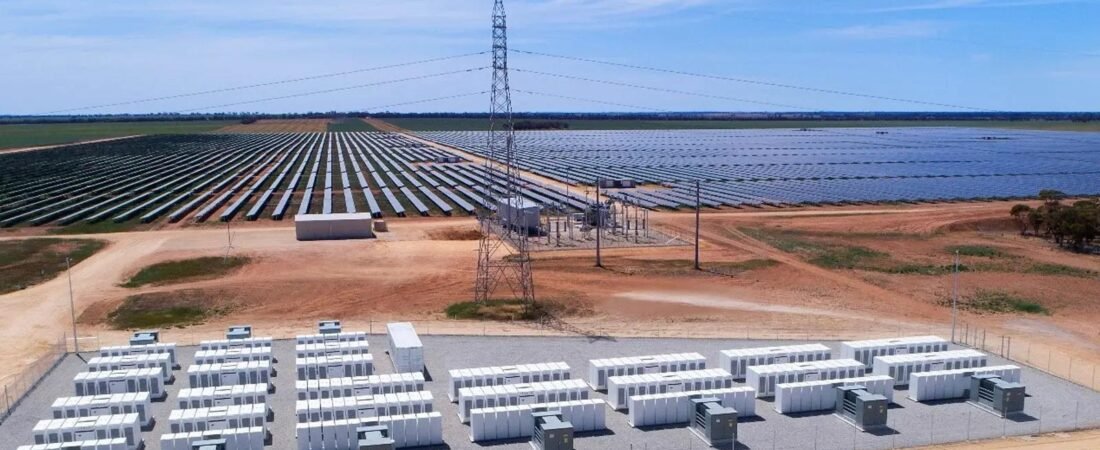
Gujarat Builds 870 MW Battery Backup Network to Stabilise Grid
1. Why is this issue in the news?
On 4 November 2026, the Union Cabinet approved a ₹14,500 crore Viability Gap Funding (VGF) Scheme to promote the development of 92 GWh of grid-scale energy storage capacity in India.
The scheme will support:
- 60 GWh of Hydro Pumped Storage Projects (PSPs).
- 30 GWh of Battery Energy Storage Systems (BESS).
- 2 GWh of emerging energy storage technologies.
The scheme will operate during FY 2026–27 to FY 2030–31 and is expected to attract an estimated investment of ₹97,600 crore.
The government has also prescribed a minimum 40% Domestic Content Requirement (DCR) for battery energy storage projects to encourage indigenous manufacturing.
This initiative is important because India’s transition towards renewable energy is no longer determined merely by how much solar and wind capacity it can install. Increasingly, the challenge is how effectively electricity can be stored and supplied when renewable generation is unavailable.
Sources: Ministry of Power and Prime Minister’s Office. Press Information Bureau+1
2. Understanding the underlying problem: The intermittency of renewable energy
India has made considerable progress in expanding renewable energy, particularly solar and wind power.
However, renewable energy generation has an inherent limitation: it is dependent on natural conditions.
- Solar power generation is concentrated during daylight hours.
- Wind power generation fluctuates according to wind speed and seasonal conditions.
- Electricity demand does not necessarily coincide with the availability of renewable energy.
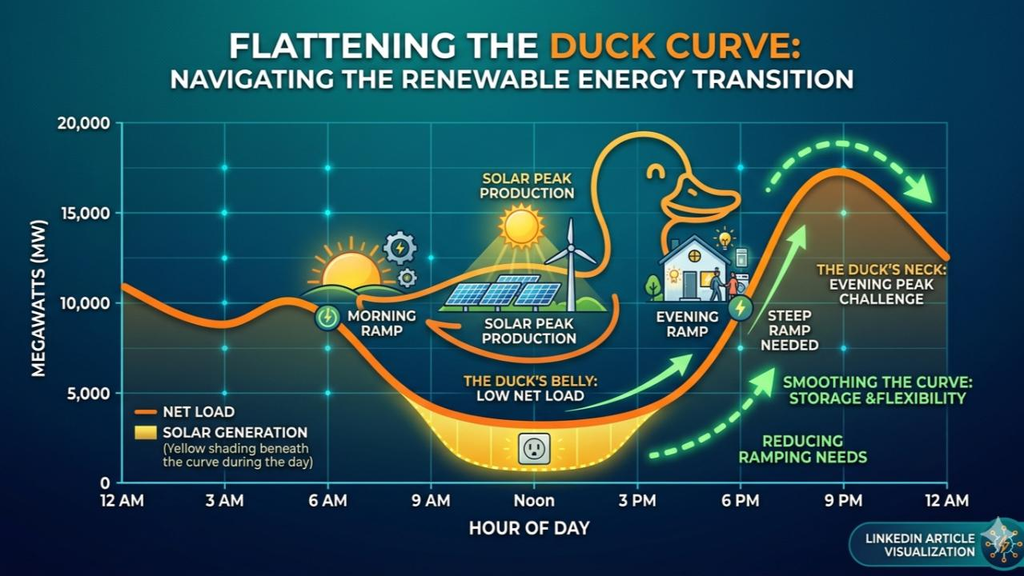
For example, solar electricity generation is generally high during the afternoon, whereas household electricity demand can increase considerably during the evening.
This creates a mismatch between electricity generation and electricity consumption.
The duck curve phenomenon
Solar Battery Payback Calculator UK | Time-of-Use Peak Shift Savings | HeatPumpsAndSolar.co.uk
The duck curve illustrates how increasing solar generation reduces net electricity demand during the daytime but creates a steep rise in demand for conventional generation during the evening.
This creates three major challenges:
- Surplus electricity: Excess renewable electricity may be generated when demand is relatively low.
- Peak demand management: Additional generation is required when solar generation declines.
- Grid stability: Sudden fluctuations in electricity supply and demand can affect grid frequency and reliability.
Energy storage provides a mechanism to address this mismatch.
3. What is grid-scale energy storage?
Grid-scale energy storage refers to technologies that store electricity or electrical energy on a large scale and release it when required.
It acts as a bridge between electricity generation and consumption.
The basic mechanism is:
Surplus renewable electricity
Solar and wind generation
Energy storage system
Batteries / Pumped hydro / Other technologies
Electricity supplied when required
Evening peak demand / Grid balancing
In simple terms, energy storage allows electricity generated at one time to be used at another time.
It is particularly important for an electricity system increasingly dependent on variable renewable energy sources.
4. Major energy storage technologies
India’s proposed scheme recognises three broad categories of energy storage technologies.
A. Pumped Storage Hydropower (PSP)
Pumped storage plants – hydropower plant plus energy storage | Voith
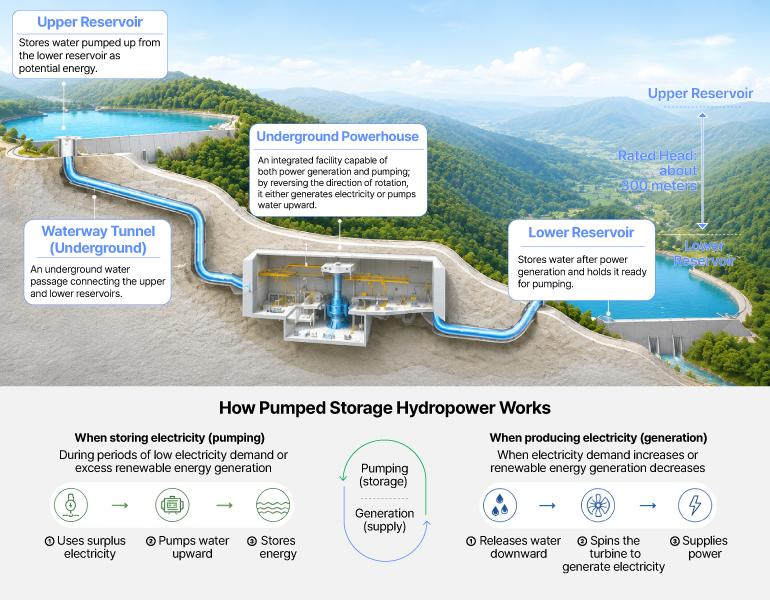
Pumped storage is a form of mechanical energy storage that uses two reservoirs located at different elevations.
Working mechanism:
- During periods of surplus electricity, water is pumped from the lower reservoir to the upper reservoir.
- The water is stored at a higher elevation, possessing gravitational potential energy.
- When electricity demand increases, water is released from the upper reservoir.
- The flowing water drives turbines and generates electricity.
Advantages
- Large-scale electricity storage.
- Long operational life.
- Suitable for balancing fluctuations in renewable energy generation.
- Can provide grid stability and other ancillary services.
Limitations
- High initial capital investment.
- Long construction periods.
- Dependence on suitable geographical locations.
- Land acquisition, ecological and rehabilitation concerns.
- Potential impacts on river systems and local communities.
B. Battery Energy Storage Systems (BESS)
汇能设计院再传捷报–承接四个大型储能电站300MW/600MWh可行性研究报告及勘察设计技术服务项目 – 北京汇能电力设计院有限公司
Battery Energy Storage Systems store electricity in electrochemical form.
Lithium-ion batteries are currently among the important technologies used in grid-scale battery storage.
Working mechanism:
- During charging, electrical energy is converted into chemical energy.
- During discharging, chemical energy is converted back into electrical energy.
- Power conversion systems enable the battery installation to interact with the electricity grid.
Advantages
- Rapid response to fluctuations in electricity demand.
- Modular and scalable installations.
- Can be deployed near renewable energy projects and consumption centres.
- Useful for frequency regulation and peak-load management.
Limitations
- High initial costs.
- Dependence on critical minerals such as lithium, nickel and cobalt in certain battery chemistries.
- Battery degradation over time.
- Recycling and disposal challenges.
- Dependence on imported components and technology.
It is important to note that alternative battery chemistries, including sodium-ion and flow batteries, can reduce dependence on particular critical minerals.
C. Emerging energy storage technologies
The proposed scheme also supports 2 GWh of capacity through alternative storage technologies.
Some important emerging technologies include:
| Technology | Basic principle |
|---|---|
| Sodium-ion batteries | Use sodium ions for electrochemical storage |
| Flow batteries | Store energy in liquid electrolytes |
| Compressed air energy storage | Store energy by compressing air |
| Thermal energy storage | Store energy as heat or cold |
| Hydrogen-based storage | Convert electricity into hydrogen for later use |
These technologies can diversify India’s energy storage ecosystem and reduce excessive dependence on a single technology.
5. Key features of the ₹14,500 crore VGF scheme
| Component | Details |
|---|---|
| Total financial support | ₹14,500 crore |
| Implementation period | FY 2026–27 to FY 2030–31 |
| Total targeted capacity | 92 GWh |
| Pumped storage | 60 GWh |
| Battery storage | 30 GWh |
| Emerging technologies | 2 GWh |
| Estimated investment | ₹97,600 crore |
| Domestic content requirement | Minimum 40% for BESS |
The projects will be allocated through a tariff-based competitive bidding process.
Public and private sector electricity distribution companies will be eligible for VGF support for BESS and pumped storage projects. Projects involving alternative storage technologies will also be implemented by public and private sector entities. Prime Minister of India+1
What is Viability Gap Funding?
Viability Gap Funding is a form of government financial assistance provided to infrastructure projects that may be socially or economically desirable but are not sufficiently financially viable on their own.
Such projects may face difficulties attracting private investment because of:
- High initial capital expenditure.
- Long gestation periods.
- Uncertain revenue streams.
- High perceived investment risks.
Government support reduces the financial burden and makes these projects more attractive to investors.
In the present context, VGF is intended to accelerate investment in energy storage infrastructure.
6. Why does India need large-scale energy storage?
The importance of energy storage extends beyond renewable energy integration. It has implications for India’s economic development, energy security and climate commitments.
6.1 Supporting India’s renewable energy transition
India has committed to achieving 500 GW of non-fossil fuel-based electricity capacity by 2030.
However, installing renewable energy capacity does not automatically ensure reliable electricity supply.
Without adequate storage infrastructure, renewable energy generation may not be fully utilised during periods of surplus production.
Energy storage can help bridge this gap by storing surplus electricity and supplying it during periods of lower renewable generation.
6.2 Ensuring round-the-clock electricity supply
India’s electricity demand is rising due to:
- Industrialisation and urbanisation.
- Expansion of digital infrastructure and data centres.
- Electrification of transport.
- Increasing household consumption.
- Growing demand for cooling and air conditioning.
Energy storage can help meet peak electricity demand without requiring an equivalent increase in conventional generation capacity.
6.3 Reducing dependence on fossil fuels
Coal-based thermal power continues to play a major role in India’s electricity system.
Energy storage can reduce the requirement for conventional power plants to respond to short-term fluctuations in electricity demand.
However, storage alone cannot completely replace thermal power. It must be complemented by flexible generation, transmission infrastructure and demand-side management.
6.4 Strengthening energy security
India’s dependence on imported fossil fuels exposes its economy to:
- International price fluctuations.
- Geopolitical tensions.
- Supply-chain disruptions.
- Exchange-rate volatility.
A combination of domestic renewable energy generation and energy storage can strengthen India’s long-term energy security.
Battery storage also creates an opportunity to develop domestic manufacturing capabilities in the emerging clean-energy sector.
6.5 Supporting electricity distribution companies
Power distribution companies (DISCOMs) face several structural problems, including financial losses, high power procurement costs and peak-demand management difficulties.
Energy storage can help DISCOMs:
- Purchase electricity during periods of lower prices.
- Reduce expensive peak-hour electricity procurement.
- Improve demand-supply management.
- Reduce renewable energy curtailment.
However, these benefits depend on appropriate tariff structures and efficient procurement arrangements.
7. India’s energy storage requirements and the scale of the challenge
The proposed scheme must be understood against India’s projected energy storage requirements.
According to the government’s announcement, India is expected to require approximately 411 GWh of grid-scale energy storage capacity by 2031–32.
The newly approved scheme aims to develop 92 GWh of additional capacity, equivalent to around 170% of the present grid-scale storage capacity.
This indicates the magnitude of infrastructure development required to support India’s energy transition.
The challenge is not simply to install storage facilities. India must establish an integrated ecosystem comprising:
- Renewable energy generation.
- Energy storage infrastructure.
- High-capacity transmission networks.
- Modernised distribution systems.
- Advanced grid-management technologies.
- Domestic manufacturing and recycling facilities.
Energy storage should therefore be viewed as a component of comprehensive electricity-sector reform.
8. Major challenges in developing India’s energy storage ecosystem
Despite its potential, large-scale energy storage faces several technological, economic, environmental and institutional challenges.
8.1 High capital expenditure
Energy storage projects require substantial initial investments.
Battery storage involves expenditure on batteries, power conversion systems, thermal management, control systems and grid connectivity.
Pumped storage projects require substantial civil engineering works, reservoirs, tunnels and hydropower equipment.
Although VGF improves project viability, the long-term sustainability of these projects depends on commercially viable revenue models.
8.2 Dependence on imported critical minerals
Lithium-ion batteries require minerals such as lithium, nickel, cobalt and graphite, depending on the battery chemistry.
India currently faces vulnerabilities in the supply chains of several critical minerals.
This creates strategic risks because the global processing and refining of many critical minerals is geographically concentrated.
India needs to diversify mineral supplies, develop domestic processing capabilities and promote alternative battery chemistries.
8.3 Environmental and social concerns
Energy storage is not entirely free from environmental consequences.
Pumped storage projects may involve:
- Land acquisition.
- Forest diversion.
- Biodiversity loss.
- Displacement of local communities.
- Changes in local hydrological systems.
Battery storage projects may create challenges relating to:
- Mining-related environmental degradation.
- Hazardous waste management.
- Battery recycling.
- Water and energy consumption during manufacturing.
A clean-energy transition must ensure that environmental costs are not merely transferred from fossil-fuel production to mineral extraction and battery disposal.
8.4 DISCOMs’ financial weaknesses
The financial condition of electricity distribution companies remains an important structural constraint.
Weak DISCOM finances can discourage investment in storage projects because they affect the ability to enter into long-term power purchase and storage agreements.
Without credible payment mechanisms, even technically viable projects may struggle to attract investors.
8.5 Grid infrastructure limitations
Energy storage cannot function independently of transmission and distribution infrastructure.
India requires:
- Modern transmission networks.
- Smart substations.
- Advanced forecasting systems.
- Real-time grid monitoring.
- Flexible electricity markets.
- Better coordination between renewable energy generators and DISCOMs.
Inadequate grid infrastructure can limit the effective utilisation of storage capacity.
8.6 Technological and supply-chain vulnerabilities
The battery manufacturing ecosystem is still developing in India.
Important challenges include:
- Dependence on imported battery cells and components.
- Limited domestic technological capabilities in advanced battery chemistry.
- Shortage of skilled personnel.
- Insufficient recycling infrastructure.
- Limited research and commercialisation of alternative storage technologies.
The 40% domestic content requirement is a useful intervention, but domestic manufacturing must become competitive in terms of cost, quality and technological performance.
9. Government initiatives supporting India’s energy storage transition
The new VGF scheme is part of a broader policy framework.
| Initiative | Significance |
|---|---|
| National Electricity Plan | Provides a long-term framework for generation, transmission and storage requirements |
| National Mission on Transformative Mobility and Battery Storage | Supports the development of advanced battery technologies and mobility ecosystems |
| Production Linked Incentive (PLI) Scheme for Advanced Chemistry Cell Battery Storage | Promotes domestic advanced battery manufacturing |
| National Green Hydrogen Mission | Supports hydrogen production, utilisation and associated infrastructure |
| PM Surya Ghar: Muft Bijli Yojana | Promotes distributed rooftop solar generation |
| Green Energy Corridors | Supports transmission infrastructure for renewable energy integration |
| Battery Waste Management Rules, 2022 | Establishes extended producer responsibility for battery waste management |
An important distinction for examination purposes is that energy storage, renewable energy generation and electricity transmission are complementary but different components of the power-sector transition.
10. Critical analysis: Is energy storage the missing link in India’s energy transition?
The new scheme addresses an important structural weakness in India’s renewable energy strategy.
For several years, the emphasis of India’s energy transition has been on expanding renewable energy generation capacity.
However, renewable energy generation alone cannot guarantee electricity availability at every hour of the day.
Energy storage can help address this limitation.
Nevertheless, there are certain concerns that deserve attention.
First, storage is not a substitute for electricity-sector reforms. Persistent DISCOM losses, inefficient tariff structures and inadequate transmission infrastructure can undermine the economic viability of storage investments.
Second, the technology mix matters. Pumped storage and batteries have different operational characteristics. Pumped storage is suitable for large-scale, long-duration storage, while batteries can provide rapid-response services and flexible deployment. India should avoid excessive dependence on one technology.
Third, domestic manufacturing should extend beyond assembly. Genuine technological self-reliance requires domestic capabilities in battery materials, cells, power electronics, battery management systems and recycling.
Fourth, environmental sustainability must cover the entire lifecycle. Mining, manufacturing, operation and disposal should be governed by appropriate environmental and social safeguards.
Finally, the economic benefits of storage must be assessed through system-wide costs. The objective should not merely be to maximise installed storage capacity but to minimise the overall cost of reliable electricity supply.
Thus, the success of the scheme should be evaluated in terms of actual electricity delivered, improved grid flexibility, reduced renewable energy curtailment and financial sustainability.
11. Way Forward
India needs an integrated approach to develop a reliable, affordable and sustainable energy storage ecosystem.
11.1 Develop a diversified storage portfolio
India should promote a combination of:
- Pumped storage hydropower.
- Lithium-ion and alternative battery technologies.
- Sodium-ion batteries.
- Flow batteries.
- Thermal energy storage.
- Green hydrogen for suitable long-duration and industrial applications.
The selection of technology should depend on storage duration, geographical suitability, cost and end-use requirements.
11.2 Strengthen domestic manufacturing
The 40% domestic content requirement should be accompanied by:
- Research and development incentives.
- Domestic production of battery cells.
- Development of critical mineral processing capabilities.
- Technology transfer and international collaboration.
- Support for Indian start-ups and research institutions.
The objective should be to move from assembly-based manufacturing towards a complete domestic value chain.
11.3 Establish a robust battery recycling ecosystem
India should develop a circular economy for batteries through:
- Extended Producer Responsibility.
- Scientific collection and segregation.
- Recovery of valuable minerals.
- Safe recycling technologies.
- Development of second-life battery applications.
Second-life batteries from electric vehicles, subject to appropriate safety and performance assessment, may be useful in stationary storage applications.
11.4 Reform electricity markets
Electricity markets must recognise the multiple services provided by energy storage.
Appropriate market mechanisms should compensate storage operators for:
- Energy arbitrage.
- Peak-demand management.
- Frequency regulation.
- Ancillary services.
- Capacity availability.
Transparent market mechanisms can improve investment attractiveness and reduce excessive dependence on direct government subsidies.
11.5 Strengthen DISCOMs and transmission infrastructure
Financially sustainable DISCOMs and modern transmission infrastructure are essential for the effective deployment of storage systems.
The government should strengthen distribution reforms, improve payment discipline and encourage the adoption of smart-grid technologies.
11.6 Ensure environmental and social safeguards
Pumped storage projects must undergo rigorous environmental assessments and meaningful public consultation.
Battery storage projects must incorporate fire safety, lifecycle management and recycling requirements.
The clean-energy transition should be based on the principles of environmental sustainability, intergenerational equity and energy justice.
11.7 Promote research and innovation
India should strengthen collaboration between:
- IITs and other academic institutions.
- CSIR laboratories.
- Public-sector energy companies.
- Private battery manufacturers.
- Start-ups and technology developers.
Research should focus on reducing storage costs, improving battery life, increasing energy density and developing alternatives to mineral-intensive battery technologies.
12. Conclusion
Energy storage represents a fundamental pillar of India’s transition towards a low-carbon electricity system.
The ₹14,500 crore VGF scheme is an important step towards addressing the intermittency of renewable energy and strengthening grid stability.
However, India’s energy transition cannot be measured merely through renewable energy capacity additions or storage targets.
Its success will depend on the ability to create an integrated electricity ecosystem that combines renewable energy generation, affordable storage, modern transmission infrastructure, domestic technological capabilities and financially sustainable distribution systems.
Ultimately, India’s objective should be to move from renewable energy capacity expansion towards reliable, affordable and round-the-clock clean electricity.
13. UPSC examination perspective
A. Prelims: Important facts to remember
| Concept | Important information |
|---|---|
| VGF scheme | ₹14,500 crore |
| Total storage capacity | 92 GWh |
| Pumped storage | 60 GWh |
| Battery storage | 30 GWh |
| Emerging technologies | 2 GWh |
| Domestic content requirement | 40% for BESS |
| Energy storage requirement | Approximately 411 GWh by 2031–32 |
| Pumped storage | Stores gravitational potential energy |
| BESS | Stores energy electrochemically |
| Duck curve | Illustrates the impact of solar generation on net electricity demand |
Prelims practice question
Consider the following statements regarding grid-scale energy storage:
- Pumped storage hydropower stores energy by pumping water to a higher elevation.
- Battery Energy Storage Systems can provide frequency regulation services.
- Energy storage eliminates the need for transmission infrastructure.
- Sodium-ion batteries are an alternative to lithium-ion battery technologies.
Which of the statements given above are correct?
(a) 1 and 2 only
(b) 1, 2 and 4 only
(c) 2, 3 and 4 only
(d) 1, 2, 3 and 4
Answer: (b) 1, 2 and 4 only.
Explanation: Energy storage complements transmission infrastructure; it cannot eliminate the need for electricity transmission networks.
B. Mains: Syllabus linkage
| GS Paper | Relevant syllabus |
|---|---|
| GS III – Infrastructure | Energy infrastructure and electricity-sector development |
| GS III – Environment | Renewable energy and sustainable development |
| GS III – Science & Technology | Battery technologies and energy storage innovations |
| GS III – Economy | Infrastructure financing and public-private partnerships |
| GS II – Governance | Government interventions and institutional reforms |
C. Probable Mains question
Question (15 marks, 250 words):
“Energy storage is emerging as a critical component of India’s renewable energy transition. Examine the significance of grid-scale energy storage systems in ensuring energy security and grid stability. Discuss the challenges associated with their development and suggest appropriate measures.”
D. Keywords for Mains answer writing
- Energy transition
- Grid flexibility
- Renewable energy intermittency
- Round-the-clock renewable energy
- Pumped storage hydropower
- Battery Energy Storage Systems
- Critical mineral security
- Circular economy
- Energy security
- Atmanirbhar Bharat
Sources and further reading
- Ministry of Power – Official announcement of the ₹14,500 crore VGF scheme.
- Prime Minister’s Office – Grid-scale energy storage scheme.
- Business Standard – Details of the energy storage investment programme.
- Ministry of Power – Parliamentary information on Battery Energy Storage Systems.