
1. Introduction
Outer space, once considered an almost unlimited domain for scientific exploration, communication and national security, is increasingly facing a serious environmental and operational challenge: the accumulation of space debris.
Thousands of satellites, rocket bodies and fragments of spacecraft currently orbit the Earth. These objects travel at extremely high velocities and can damage or destroy functioning satellites even through relatively small collisions.
The problem has become more serious with the expansion of commercial satellite constellations, increasing dependence on satellite-based services and growing participation of private companies in space activities.
On 5 November 2026, the Union Minister of State for Science and Technology announced India’s vision of achieving Debris-Free Space by 2030, highlighting the country’s emerging capabilities in Active Debris Removal (ADR) and in-orbit servicing.
The announcement was made during the inauguration of Base 1, a space robotics facility established by Hyderabad-based startup Cosmoserve Space at VSD Tech Park, Gachibowli, Hyderabad. Press Information Bureau+1
This development is significant because India is moving beyond conventional satellite and launch-vehicle capabilities towards technologies that can support the long-term sustainability of outer space.
However, it is important to understand that India’s Debris-Free Space Missions (DFSM) initiative does not mean that all existing debris in Earth’s orbit will be removed by 2030. Its primary objective is to ensure that Indian governmental and non-governmental space missions avoid generating debris through better mission design, operation and post-mission disposal.
The central issue is how India can develop the technological, institutional and international capabilities required to ensure that outer space remains safe and accessible for future generations.
2. Why in News?
Three important developments have brought space debris management into focus.
2.1 India’s Debris-Free Space Vision 2030
The Department of Space reiterated India’s commitment to achieving debris-free space missions by 2030.
The initiative covers all Indian space actors, including governmental and non-governmental entities.
It seeks to prevent the generation of new orbital debris through:
- Responsible satellite design.
- Reliable launch-vehicle operations.
- Collision avoidance.
- Prevention of accidental break-ups.
- Post-mission disposal of satellites and orbital stages.
- International coordination and information sharing.
India originally announced the Debris-Free Space Missions initiative in April 2024 at the 42nd Annual Meeting of the Inter-Agency Space Debris Coordination Committee (IADC) in Bengaluru. Explained+1
2.2 Inauguration of Cosmoserve Space’s Base 1
The inauguration of Base 1 in Hyderabad represents an important development in India’s private space ecosystem.
The approximately 14,800-square-foot facility is designed to support:
- Space robotics development.
- Orbital rendezvous and capture.
- Microgravity simulation.
- Satellite integration.
- Testing of robotic systems.
- Mission control and in-orbit servicing.
The facility is intended to support the development of technologies for Active Debris Removal and satellite servicing. Press Information Bureau
2.3 Progress in India’s space economy
The announcement also highlighted the expansion of India’s space-startup ecosystem.
According to the Department of Space, India’s space economy has grown to approximately US$9 billion, with a projected potential of US$40–45 billion over the coming decade. The country’s space-startup ecosystem has expanded to nearly 450 enterprises. Press Information Bureau+1
These developments indicate that space sustainability is increasingly becoming an area of participation for private Indian companies.
3. What Is Space Debris?
3.1 Meaning
Space debris, also known as orbital debris or space junk, refers to non-functional, human-made objects in Earth’s orbit or re-entering the Earth’s atmosphere.
These objects no longer serve any useful operational purpose but continue to travel through space.
Space debris includes:
- Defunct satellites.
- Abandoned rocket stages.
- Fragments generated through collisions.
- Fragments resulting from accidental explosions.
- Discarded mission-related objects.
- Components released during satellite deployment and operations.
Natural objects such as meteoroids are not classified as human-generated space debris, although they can pose similar collision risks.
ESA – Debris objects – mostly debris – in low Earth orbit (LEO) – view over the equator
Spacecraft to Remove Orbital Debris | T2 Portal
European Space Agency (ESA) – DW
8
3.2 How is space debris generated?
Space debris is generated through several processes.
A. Satellite retirement
When satellites complete their operational lives, they may remain in orbit if they are not properly de-orbited or moved to a disposal orbit.
B. Rocket-stage abandonment
Launch vehicles often leave upper stages in orbit after placing satellites into their intended trajectories.
C. Accidental explosions
Residual propellant, pressurised systems and battery failures can cause explosions, generating numerous fragments.
D. Collisions between orbital objects
When two objects collide, they can break into hundreds or thousands of smaller fragments.
E. Intentional anti-satellite tests
The destruction of satellites during anti-satellite weapon tests can produce large quantities of long-lived debris.
3.3 Why is space debris dangerous?
Space debris becomes particularly dangerous because of its extremely high orbital velocity.
Objects in Low Earth Orbit can travel at approximately 7–8 kilometres per second.
At such speeds, even a relatively small fragment can damage solar panels, sensors, antennas or other critical satellite components.
A collision may also generate additional debris, creating a chain reaction that increases the risk to other spacecraft.
4. Understanding the Different Orbital Regions
Space debris is not distributed uniformly around the Earth. Its location and orbital characteristics determine the nature and duration of the risks it creates.
| Orbital region | Approximate altitude | Major applications |
|---|---|---|
| Low Earth Orbit (LEO) | 160–2,000 km | Earth observation, space stations, communication constellations |
| Medium Earth Orbit (MEO) | 2,000–35,786 km | Navigation satellites |
| Geostationary Orbit (GEO) | Approximately 35,786 km above equator | Communication and meteorological satellites |
4.1 Low Earth Orbit (LEO)
LEO is one of the most heavily used orbital regions.
It accommodates:
- Earth observation satellites.
- Scientific satellites.
- International Space Station.
- Commercial communication constellations.
- Remote-sensing missions.
The increasing number of satellites in this region has created significant concerns regarding orbital congestion and collision avoidance.
4.2 Medium Earth Orbit (MEO)
MEO is particularly important for navigation satellite systems.
For example, the GPS constellation operates primarily in MEO.
India’s NavIC system also uses satellites in geosynchronous and geostationary orbits rather than the conventional MEO configuration used by GPS.
4.3 Geostationary Earth Orbit (GEO)
GEO is located approximately 35,786 kilometres above the Earth’s equator.
Satellites in this orbit have an orbital period equal to the Earth’s rotation period and appear stationary relative to a point on the Earth’s surface.
This makes GEO particularly useful for communication and meteorological satellites.
Space debris in GEO presents a different challenge from LEO because orbital objects can remain in the region for very long periods.
5. The Kessler Syndrome: The Possibility of a Cascading Collision Effect
One of the most important concepts in space debris management is the Kessler Syndrome.
It was proposed by NASA scientist Donald J. Kessler and Burton Cour-Palais in 1978.
5.1 What is Kessler Syndrome?
Kessler Syndrome describes a situation in which the density of objects in orbit becomes sufficiently high that collisions between objects generate additional debris, increasing the probability of further collisions.
This can create a self-sustaining cascading process.
The sequence can be understood as follows:
How Kessler Syndrome develops
Increasing number of satellites and orbital objects
Higher probability of orbital collisions
Generation of additional debris fragments
Further increase in collision probability
Potential cascading collision environment
5.2 Implications of Kessler Syndrome
If the cascading process becomes sufficiently severe, certain orbital regions may become increasingly hazardous for satellite operations.
Its implications include:
- Increased satellite damage and destruction.
- Higher costs of satellite operations.
- Reduced reliability of communication networks.
- Threats to navigation systems.
- Increased risk to human spaceflight.
- Potential restrictions on the long-term use of certain orbital regions.
However, Kessler Syndrome is a theoretical cascading scenario, not a claim that all orbital regions will inevitably become unusable.
5.3 Why does this matter for India?
India increasingly depends on satellites for:
- Telecommunications.
- Weather forecasting.
- Disaster management.
- Navigation.
- Agricultural monitoring.
- Defence and strategic surveillance.
- Financial and digital connectivity.
A serious deterioration in orbital safety could therefore affect critical national infrastructure.
Space debris management is consequently an issue of both scientific sustainability and national security.
6. How Serious Is the Space Debris Problem?
The growth of satellite launches and commercial constellations has significantly increased the number of objects operating in Earth’s orbital environment.
Space debris can be broadly classified into three categories.
| Category | Characteristics | Risk |
|---|---|---|
| Large trackable objects | Defunct satellites and rocket bodies | Can be monitored and collision risks assessed |
| Small fragments | Objects too small or difficult to track consistently | Difficult to predict and avoid |
| Microscopic debris | Tiny particles and paint fragments | Can damage sensitive spacecraft components |
According to the European Space Agency’s space environment assessments, more than 1.2 million debris objects larger than 1 cm are estimated to be present in orbit, alongside much larger numbers of smaller particles. Such estimates are model-based rather than direct counts. ISRO
India’s own space debris position
According to a parliamentary response in March 2026, India had 129 trackable debris objects originating from Indian space missions still in orbit.
These included:
- 23 defunct satellites in LEO.
- 26 defunct satellites in GEO.
- 40 PSLV rocket bodies.
- 4 GSLV rocket bodies.
- 3 LVM3 rocket bodies.
- 33 fragments generated by the in-orbit break-up of the PSLV-C3 rocket body.
Press Information Bureau+1
This highlights the importance of managing the entire lifecycle of Indian space missions, including their post-mission disposal.
7. India’s Debris-Free Space Missions Initiative (DFSM)
7.1 Background
India announced the Debris-Free Space Missions initiative in April 2024 during the 42nd Annual Meeting of the Inter-Agency Space Debris Coordination Committee held in Bengaluru.
The initiative aims to ensure that all Indian space actors, both governmental and non-governmental, undertake debris-free space missions by 2030.
The initiative is coordinated through the Department of Space, with ISRO’s IS4OM – ISRO System for Safe and Sustainable Operations Management playing a central role. Explained+1
7.2 Major objectives
The initiative focuses on the following areas.
A. Prevention of debris generation
Space missions must be designed to minimise the release of unnecessary objects during launch, deployment and satellite operations.
B. Collision avoidance
Spacecraft must be designed with appropriate reliability, tracking and manoeuvring capabilities to avoid collisions.
C. Prevention of accidental break-ups
Mission designers must consider potential failure modes, residual propellant and other factors that could cause explosions.
D. Post-mission disposal
Defunct satellites and orbital stages must be removed from operational orbital regions through controlled re-entry or de-orbiting.
E. Protection of human spaceflight
Special attention must be given to orbital regions used for human spaceflight missions.
F. International coordination
Data sharing and cooperation between national and international space agencies are essential for safe orbital operations.
7.3 Important technical requirements
ISRO’s DFSM framework provides several measurable requirements.
| Parameter | Requirement |
|---|---|
| Post-mission disposal success probability | More than 99% |
| Residual orbital lifetime after de-orbiting | Less than 5 years for rocket bodies and spacecraft covered by the specified requirement |
| Implementation | Mission planning and design from 2025 |
| Human spaceflight safety | Special consideration for the 400 km ± 30 km orbital band |
Explained
Important distinction: DFSM is primarily a debris-prevention and mitigation initiative. Active removal of existing debris is a complementary technological requirement, not the sole objective of the 2030 commitment.
8. Technologies Used for Space Debris Management
Space debris management requires a combination of preventive, monitoring and removal technologies.
These technologies can be classified into three broad categories:
- Space Debris Mitigation.
- Space Situational Awareness.
- Active Space Debris Removal.
8.1 Space Debris Mitigation
Mitigation refers to measures taken to prevent the generation of additional space debris.
Important measures include:
- Designing satellites with reliable propulsion systems.
- Avoiding accidental explosions.
- Ensuring controlled disposal of defunct satellites.
- Reducing the release of mission-related objects.
- Designing launch vehicles to minimise orbital debris.
- Incorporating sufficient fuel for post-mission disposal.
Mitigation is generally more economical and technically straightforward than removing debris after it has accumulated.
8.2 Space Situational Awareness (SSA)
Space Situational Awareness refers to the ability to identify, track and understand objects and activities in the space environment.
It involves monitoring:
- Active satellites.
- Defunct satellites.
- Rocket bodies.
- Debris fragments.
- Potential collision events.
- Re-entry of orbital objects.
Lockheed Martin Lands $914 Million Space Fence Contract | Space
Major SSA technologies
| Technology | Function |
|---|---|
| Ground-based radar | Detects and tracks orbital objects |
| Optical telescopes | Observes and tracks satellites and debris |
| Space-based sensors | Monitor objects from orbit |
| Laser ranging | Measures distances to suitable space objects |
| Computational models | Predict orbital trajectories and collision probabilities |
SSA is important because a satellite cannot avoid a collision unless the potential threat is detected and assessed sufficiently early.
8.3 Active Debris Removal (ADR)
Active Debris Removal involves the deliberate removal of existing non-functional objects from orbit.
Unlike debris mitigation, which prevents the generation of new debris, ADR seeks to address debris that is already present.
Time to clean up low Earth orbit | Nature Astronomy
Major ADR technologies include:
A. Robotic arms
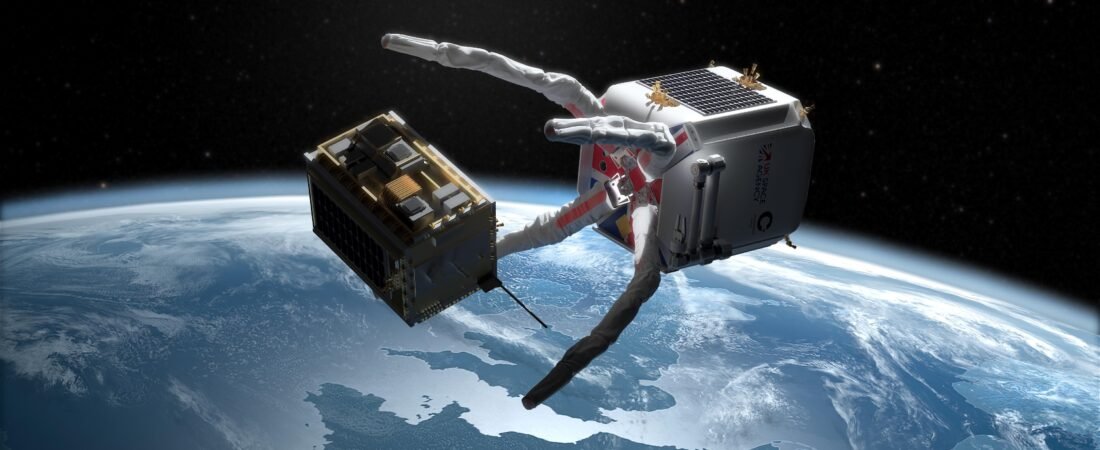
A robotic spacecraft approaches a defunct satellite and captures it using a mechanical arm.
The captured object can then be de-orbited or transferred to an appropriate disposal orbit.
B. Robotic grippers and soft robotic systems
These systems use flexible gripping mechanisms to capture objects with different shapes and surface characteristics.
They are particularly useful where conventional mechanical capture may be difficult.
C. Harpoon technology
A harpoon-based system attaches to a target object and enables a servicing spacecraft to capture or control it.
D. Nets
A net is deployed around the target debris object to capture it.
E. Laser-based technologies
Ground-based or space-based laser systems have been studied for influencing the trajectories of small debris objects. However, these technologies face substantial technical, legal and operational challenges and should not be confused with mature, routinely operational debris-removal systems.
F. Electrodynamic tethers
These systems use electromagnetic interactions with Earth’s magnetic field to generate forces that can help alter a spacecraft’s orbit and facilitate de-orbiting.
8.4 In-orbit Servicing
In-orbit servicing refers to operations performed on satellites while they remain in space.
These may include:
- Refuelling.
- Repair and maintenance.
- Component replacement.
- Orbit correction.
- Life extension.
- Inspection.
- Relocation.
In-orbit servicing and ADR are related but distinct activities. A servicing spacecraft can extend the useful life of a functional satellite, while ADR targets non-functional objects for removal or disposal.
9. India’s Space Situational Awareness Capabilities
India has been progressively developing indigenous capabilities for tracking and monitoring orbital objects.
An important initiative in this regard is NETRA – Network for Space Objects Tracking and Analysis.
9.1 Project NETRA
NETRA is ISRO’s initiative to establish an independent Space Situational Awareness capability.
Its objective is to monitor and protect Indian space assets against potential threats from orbital debris and other space objects.
Its major components include:
- Radar-based tracking systems.
- Optical telescopes.
- Space object databases.
- Orbital prediction systems.
- Collision assessment and warning mechanisms.
9.2 IS4OM
IS4OM stands for ISRO System for Safe and Sustainable Operations Management.
It was established to support the safe and sustainable operation of Indian space assets.
Its functions include:
- Monitoring the space environment.
- Tracking orbital objects.
- Assessing collision risks.
- Supporting satellite manoeuvres.
- Coordinating debris mitigation.
- Monitoring post-mission disposal.
- Supporting implementation of India’s DFSM initiative.
9.3 Indian Space Situational Assessment Report
ISRO publishes the Indian Space Situational Assessment Report (ISSAR) annually.
The report provides information about:
- The space object population.
- Orbital debris.
- Close-approach events.
- Re-entry of space objects.
- Collision avoidance manoeuvres.
- India’s space debris mitigation efforts.
The ISSAR 2025 highlighted approximately 1.6 lakh close-approach alerts during the year, indicating the growing complexity of orbital traffic management.
It also reported ongoing work on optical telescope facilities at Hanle, Ladakh, and an indigenous phased-array radar capability. ISRO
These capabilities are important for developing independent space-monitoring infrastructure rather than relying entirely on external tracking data.
10. Role of ISRO and India’s Private Space Ecosystem
India’s approach to space sustainability increasingly involves collaboration between public institutions and private companies.
10.1 ISRO’s role
ISRO has an important responsibility in:
- Developing debris mitigation technologies.
- Tracking orbital objects.
- Conducting collision avoidance manoeuvres.
- Ensuring post-mission disposal.
- Developing robotic and rendezvous technologies.
- Supporting international space-safety initiatives.
The SpaDeX mission is particularly relevant.
10.2 SpaDeX: A foundation for advanced space operations
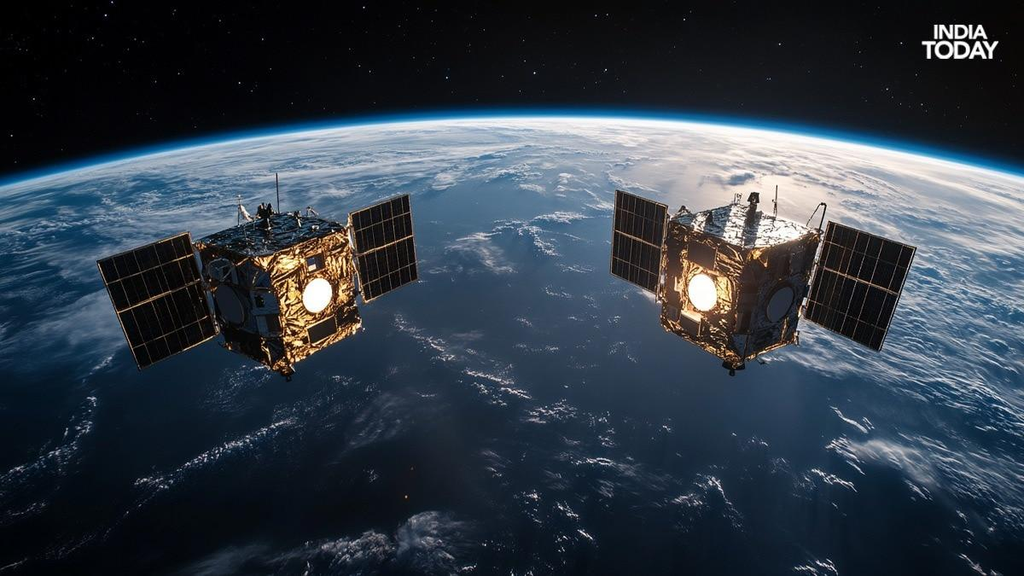
The Space Docking Experiment (SpaDeX) demonstrated India’s capability in autonomous rendezvous, docking and undocking.
The mission was launched in December 2024, and India achieved successful satellite docking in January 2025.
L’Inde réussit son premier rendez-vous en orbite : pourquoi c’est important
Why is SpaDeX relevant to space debris removal?
ADR requires a servicing spacecraft to approach a target object, match its orbital motion, establish proximity and capture or connect with it.
These operations require several capabilities:
- Relative navigation.
- Autonomous rendezvous.
- Proximity operations.
- Attitude control.
- Docking and capture.
- Robotic manipulation.
SpaDeX demonstrated important foundational capabilities in this area.
However, successful docking between cooperative spacecraft does not automatically establish the ability to capture an uncontrolled, tumbling and potentially damaged satellite. That requires additional technologies and mission validation.
10.3 Private-sector participation
The liberalisation of India’s space sector has created opportunities for private enterprises in satellite manufacturing, launch services, space robotics and orbital servicing.
The inauguration of Cosmoserve Space’s Base 1 facility in Hyderabad is an important development in this direction.
The facility brings together:
- Orbital rendezvous and capture laboratories.
- Space robotics innovation facilities.
- Microgravity simulation platforms.
- Satellite integration clean rooms.
- Mission-control infrastructure.
The company’s Mission EMBRACE conducted an in-space test of soft robotic petals in July 2026. Press Information Bureau+1
Such developments indicate that India’s private space ecosystem is beginning to explore specialised technologies beyond conventional satellite manufacturing and launch services.
10.4 Hyderabad’s emerging role
The inauguration of Base 1 also highlights Hyderabad’s growing importance as a space-technology hub.
The city has an established ecosystem of aerospace, defence, engineering and technology enterprises.
The emergence of specialised space robotics and debris-removal facilities can strengthen its position in:
- Advanced manufacturing.
- Space robotics.
- Satellite servicing.
- Aerospace engineering.
- Research and development.
- Private space missions.
This also illustrates the potential of regional innovation ecosystems in supporting India’s national space ambitions.
11. International Framework for Space Debris Management
Space debris is a transboundary problem. An object launched by one country can threaten satellites belonging to several other countries.
Consequently, effective space debris management requires international cooperation.
11.1 Outer Space Treaty, 1967
The Treaty on Principles Governing the Activities of States in the Exploration and Use of Outer Space, including the Moon and Other Celestial Bodies, is commonly known as the Outer Space Treaty.
Important provisions include:
- Exploration and use of outer space shall be carried out for the benefit and interests of all countries.
- Outer space is not subject to national appropriation.
- States bear international responsibility for national space activities, including those undertaken by non-governmental entities.
- States are responsible for damage caused by their space objects under the applicable international framework.
Article VI is particularly important because it establishes the international responsibility of States for national activities in outer space, including private-sector activities.
11.2 Convention on International Liability for Damage Caused by Space Objects, 1972
The Liability Convention establishes rules relating to international liability for damage caused by space objects.
Important provisions include:
- Absolute liability for damage caused on the surface of the Earth or to aircraft in flight.
- Fault-based liability for damage caused elsewhere than on the Earth’s surface, including in outer space.
This becomes relevant when orbital collisions involve space objects belonging to different countries.
11.3 Convention on Registration of Objects Launched into Outer Space, 1975
The Registration Convention requires launching States to maintain and furnish information regarding objects launched into outer space.
Registration helps identify space objects and supports transparency and accountability.
However, registration alone does not guarantee that an object can be tracked precisely throughout its operational life.
11.4 UN Committee on the Peaceful Uses of Outer Space (UNCOPUOS)
UNCOPUOS is an important United Nations body dealing with international cooperation in the peaceful uses of outer space.
It has developed guidelines relating to the long-term sustainability of outer-space activities.
These guidelines cover:
- Sustainable space operations.
- Space debris mitigation.
- Space situational awareness.
- Information sharing.
- International cooperation.
- Capacity building.
11.5 Inter-Agency Space Debris Coordination Committee (IADC)
The IADC is an international forum comprising major national space agencies and related organisations.
It develops technical guidelines and promotes international cooperation in space debris research and mitigation.
ISRO participates in IADC activities.
11.6 Space Debris Mitigation Guidelines
The UN-endorsed space debris mitigation guidelines provide recommendations concerning:
- Limiting debris released during normal operations.
- Preventing accidental explosions.
- Avoiding intentional destruction of space objects.
- Limiting post-mission orbital presence.
- Preventing collisions.
However, these guidelines are generally voluntary and do not constitute a comprehensive, legally binding global treaty specifically governing all aspects of space debris removal.
This creates an important gap in international space governance.
12. Challenges in Space Debris Removal
Although space debris removal is technologically promising, it presents several difficult challenges.
12.1 Technological complexity
A defunct satellite may be tumbling uncontrollably, making it difficult for a servicing spacecraft to approach and capture it.
The operation requires extremely accurate navigation, robotic control and orbital manoeuvring.
12.2 Identification and tracking
Small debris fragments are difficult to detect and track consistently.
Their unpredictable movement creates challenges for collision avoidance.
12.3 High financial costs
ADR missions require specialised spacecraft, sensors, propulsion systems, robotic mechanisms and launch services.
The cost of removing debris may be substantially higher than the cost of preventing its generation in the first place.
12.4 Legal ambiguity
A satellite does not automatically lose its legal identity or ownership merely because it becomes non-functional.
Under the Outer Space Treaty framework, States retain jurisdiction and control over their registered space objects.
Therefore, removing another country’s defunct satellite without appropriate consent can create legal and diplomatic complications.
12.5 Dual-use technology concerns
Some technologies used for ADR can also be adapted for military purposes.
For example, a spacecraft capable of approaching and capturing a satellite could potentially interfere with another country’s functioning satellite.
This creates concerns regarding trust, transparency and strategic stability.
12.6 Lack of a sustainable commercial model
Although debris removal provides collective benefits, it is difficult to determine who should pay for removing debris generated by older missions.
This creates a free-rider problem: individual operators may benefit from a cleaner orbital environment without directly contributing to its maintenance.
12.7 International coordination
Orbital objects frequently cross national boundaries.
Effective debris removal requires cooperation between launching States, satellite operators, tracking agencies and international institutions.
Without common standards and transparent procedures, ADR activities could generate additional disputes.
13. The Way Forward: Towards Sustainable Outer Space
India needs a comprehensive approach combining technological innovation, regulatory reforms and international cooperation.
13.1 Prioritise prevention over removal
Preventing the generation of debris should remain the first priority.
Mission designers should incorporate de-orbiting mechanisms, sufficient fuel reserves and reliable end-of-life disposal systems.
13.2 Strengthen indigenous SSA capabilities
India should expand NETRA through additional radar installations, optical telescopes and space-based monitoring systems.
This would improve independent tracking and collision-warning capabilities.
13.3 Promote indigenous ADR technologies
Greater investment is required in:
- Robotic capture systems.
- Autonomous rendezvous.
- Soft robotic grippers.
- Satellite inspection technologies.
- In-orbit propulsion systems.
- Debris de-orbiting mechanisms.
13.4 Develop a clear regulatory framework
India needs comprehensive regulatory standards governing:
- Post-mission disposal.
- Collision avoidance.
- Debris mitigation.
- Spacecraft identification.
- End-of-life operations.
- Private-sector space servicing.
- Liability and insurance.
13.5 Strengthen public-private partnerships
ISRO, IN-SPACe, academic institutions and private enterprises should collaborate in developing and testing space-sustainability technologies.
13.6 Promote international cooperation
India should work with NASA, ESA, JAXA and other space agencies to strengthen:
- Space situational awareness.
- Data sharing.
- Collision avoidance.
- Joint research.
- Debris removal demonstrations.
- Common technical standards.
13.7 Establish a sustainable financing mechanism
Governments and space operators should explore mechanisms through which debris mitigation and removal can be financed.
Possible approaches include:
- Debris mitigation requirements linked to licensing.
- Operator contributions to orbital sustainability funds.
- International cost-sharing arrangements.
- Public-private financing for demonstration missions.
13.8 Strengthen global space governance
India should support the development of internationally accepted norms governing active debris removal, satellite servicing, consent, liability and transparency.
This is essential to ensure that technologies developed for peaceful space sustainability are not misused.
14. Conclusion
Outer space is becoming increasingly important for economic development, technological advancement, communication, navigation and national security.
However, the growing accumulation of orbital debris threatens the long-term sustainability of space activities.
India’s Debris-Free Space Missions initiative, its investments in space situational awareness, the progress of SpaDeX and the emergence of private-sector space robotics capabilities represent important steps towards responsible space exploration.
The vision of debris-free space by 2030 should be understood primarily as a commitment to prevent Indian space missions from generating additional debris, while progressively strengthening technologies for the removal of existing hazardous objects.
Ultimately, space sustainability cannot be achieved by any single country acting independently.
India must combine technological self-reliance with international cooperation to ensure that outer space remains a safe, accessible and sustainable domain for present and future generations.
15. UPSC Examination Perspective
GS Paper III – Science & Technology and Internal Security
Syllabus linkages:
- Science and Technology – developments and their applications.
- Achievements of Indians in science and technology.
- Space technology and its applications.
- Indigenisation of technology.
- Cyber and space security.
- International cooperation in science and technology.
Important Prelims Facts
| Topic | Important fact |
|---|---|
| Space debris | Non-functional, human-made objects in orbit |
| Kessler Syndrome | Cascading collision effect in orbit |
| DFSM | Debris-Free Space Missions |
| DFSM target | 2030 |
| DFSM announcement | April 2024 |
| NETRA | Network for Space Objects Tracking and Analysis |
| IS4OM | ISRO System for Safe and Sustainable Operations Management |
| SpaDeX | Demonstrated autonomous rendezvous, docking and undocking |
| IADC | Inter-Agency Space Debris Coordination Committee |
| UNCOPUOS | UN Committee on the Peaceful Uses of Outer Space |
| Outer Space Treaty | 1967 |
| Liability Convention | 1972 |
| Registration Convention | 1975 |
Possible UPSC Mains Questions
Question 1 – GS Paper III (15 marks)
The increasing accumulation of space debris poses a serious threat to the long-term sustainability of outer space activities. Examine the causes, consequences and possible solutions to this challenge.
Question 2 – GS Paper III (15 marks)
Discuss India’s Debris-Free Space Missions initiative and examine the role of Space Situational Awareness and Active Debris Removal technologies in achieving sustainable space operations.
Question 3 – GS Paper III (15 marks)
The growing commercialisation of outer space has created new challenges for international space governance. Discuss with reference to space debris management and the need for international cooperation.
Question 4 – GS Paper III (10 marks)
Explain the significance of India’s SpaDeX mission in developing indigenous capabilities for future space servicing and debris removal operations.
Prelims Practice Questions
Q1. With reference to the Kessler Syndrome, consider the following statements:
- It refers to a cascading process of collisions between orbital objects.
- It can increase the amount of space debris in a self-reinforcing manner.
- It is restricted to objects operating in Geostationary Earth Orbit.
Which of the statements given above are correct?
(a) 1 and 2 only
(b) 2 and 3 only
(c) 1 and 3 only
(d) 1, 2 and 3
Q2. Consider the following statements regarding India’s NETRA project:
- It is associated with Space Situational Awareness.
- It seeks to improve India’s ability to track space objects.
- It is primarily intended for tracking underwater objects.
Which of the statements given above are correct?
(a) 1 only
(b) 1 and 2 only
(c) 2 and 3 only
(d) 1, 2 and 3
Q3. Which of the following international agreements establishes the framework for international liability for damage caused by space objects?
(a) Outer Space Treaty, 1967
(b) Liability Convention, 1972
(c) Registration Convention, 1975
(d) Moon Agreement, 1979
Answer key: Q1 – (a); Q2 – (b); Q3 – (b).