
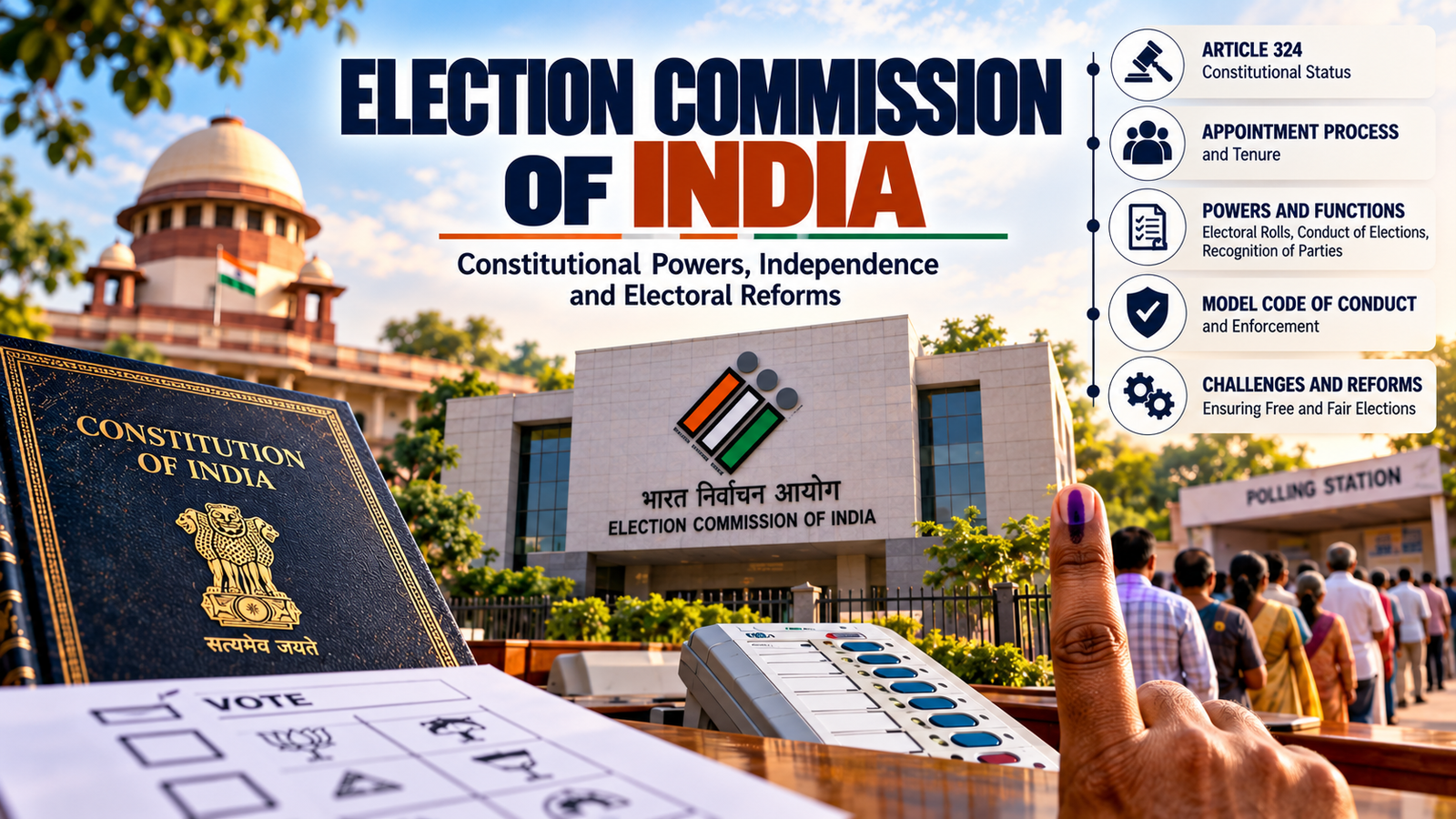
Election Commission of India: Constitutional Powers, Independence and Electoral Reforms
1. Introduction
Free and fair elections are essential to representative democracy. In India, the Election Commission of India (ECI) plays a central role in administering elections to Parliament, State Legislative Assemblies and the offices of the President and Vice-President. Its constitutional position is intended to protect the electoral process from improper interference and help ensure that voters can exercise their choice freely.
Election Commission of India
+1
However, the Commission’s independence, appointment process, enforcement powers and management of electoral rolls have become important subjects of public and constitutional debate. These questions are especially significant in a country with a vast electorate, multiple political parties, diverse regional interests and elections conducted at different levels of government.
Understanding the ECI requires more than memorising Article 324. It requires examining the relationship between constitutional autonomy, statutory law, institutional accountability and public confidence in elections.
2. Constitutional status and composition
The Election Commission is a constitutional body established under Article 324 of the Constitution of India. Part XV of the Constitution, covering Articles 324–329, deals with elections.
Article 324 vests the superintendence, direction and control of electoral-roll preparation and the conduct of specified elections in the Commission. The Constitution provides for a Chief Election Commissioner (CEC) and such number of other Election Commissioners as the President may determine.
Legislative India
+1
The Commission is a multi-member body. Its decisions are taken through its institutional decision-making process, with the Election Commissioners having equal say and decisions capable of being reached by majority vote. This is important because the Commission’s authority belongs to the institution rather than to the CEC acting alone in every matter.
Election Commission of India
Constitutional provisions to remember
| Article | Subject |
|---|---|
| Article 324 | Superintendence, direction and control of elections |
| Article 325 | One general electoral roll; no exclusion on specified grounds such as religion, race, caste or sex |
| Article 326 | Elections to the Lok Sabha and State Assemblies based on adult suffrage, subject to constitutional provisions |
| Article 327 | Parliament’s power to make provisions relating to elections |
| Article 328 | State Legislatures’ power to make provisions concerning elections to their legislatures, subject to the Constitution and parliamentary law |
| Article 329 | Bar to interference by courts in electoral matters except through the constitutionally recognised framework |
These provisions must be read together. Article 324 gives the Commission broad responsibility, but election administration also operates within the framework of laws enacted by Parliament, including the Representation of the People Acts.
3. Appointment of the Chief Election Commissioner and Election Commissioners
The appointment process is central to the Commission’s institutional independence.
The legal framework
The Constitution provides for appointment by the President, subject to parliamentary law. The Chief Election Commissioner and Other Election Commissioners (Appointment, Conditions of Service and Term of Office) Act, 2023 establishes a statutory process for appointments, eligibility, tenure and related service conditions.
e-Gazette
+1
Under the 2023 Act, the selection committee consists of:
- The Prime Minister, as chairperson.
- The Leader of the Opposition in the Lok Sabha, or the leader of the single largest opposition party where the Leader of the Opposition has not been recognised.
- A Union Cabinet Minister nominated by the Prime Minister.
A search committee headed by the Cabinet Secretary prepares a panel of names for consideration, though the selection committee is not confined to choosing only from that panel.
e-Gazette
+1
The Act provides for a term of six years or until the age of 65, whichever comes earlier, subject to its provisions. Reappointment is barred, and the overall tenure is subject to the statutory limits.
PRS Legislative Research
+1
Why has the appointment process been debated?
In Anoop Baranwal v. Union of India (2023), the Supreme Court addressed the absence at that time of a parliamentary law governing appointments and directed an interim arrangement involving the Prime Minister, Leader of the Opposition and Chief Justice of India until Parliament made a law.
Parliament subsequently enacted the 2023 law, replacing that interim arrangement with a selection committee that includes a Union Cabinet Minister nominated by the Prime Minister instead of the Chief Justice of India. Critics argue that this composition gives the government greater influence over appointments; supporters can argue that the process is now established by legislation.
The constitutional question is how to reconcile Parliament’s authority to legislate with the need for an appointment mechanism that commands public confidence and protects institutional independence. The Supreme Court’s scrutiny of challenges to the 2023 law remains an important development to follow.
PRS Legislative Research
+1
4. Powers and functions of the Election Commission
A. Preparation and revision of electoral rolls
The Commission oversees the preparation and revision of electoral rolls for elections within its constitutional jurisdiction. Accurate electoral rolls are foundational to electoral legitimacy: eligible citizens should be included, while ineligible or duplicate entries must be addressed through lawful procedures.
The process must balance accuracy with accessibility. Verification exercises should provide clear notice, transparent criteria, accessible correction mechanisms and effective opportunities to appeal or seek review.
B. Conduct of elections
The ECI administers elections to the Lok Sabha, Rajya Sabha, State Legislative Assemblies and the offices of the President and Vice-President. It announces election schedules, coordinates polling arrangements, deploys election personnel and supervises the counting and declaration process under applicable law.
Election Commission of India
+1
Important distinction: Elections to Panchayats and Municipalities are conducted under the constitutional framework involving State Election Commissions, not the ECI’s ordinary election-management mandate.
C. Recognition of political parties and election symbols
The Commission administers the legal framework governing recognition of political parties and the allotment and reservation of election symbols, under the applicable law and orders. Symbols are especially important in a diverse electorate because they help voters identify candidates and parties.
D. Enforcement of the Model Code of Conduct
The Model Code of Conduct (MCC) provides norms for political parties, candidates and governments during elections. The ECI supervises compliance and seeks to prevent misuse of official machinery, intimidation, bribery and other practices that undermine a level playing field.
Election Commission of India
+1
The MCC developed through political consensus and is not, in its entirety, a standalone statute. Its enforcement draws on the Commission’s constitutional role as well as relevant statutory provisions and judicial decisions. It is therefore important not to assume that every MCC violation automatically constitutes a criminal offence.
E. Monitoring election expenditure and electoral conduct
The Commission monitors candidate expenditure under applicable election laws and deploys measures to detect inducements, bribery and other electoral malpractices. It can issue directions within its lawful authority and refer suspected offences to the appropriate enforcement agencies.
The effectiveness of these measures depends on timely investigations, consistent standards and transparent communication of enforcement outcomes.
F. Advising on disqualification matters
The Constitution assigns the Commission a consultative role in certain disqualification questions. Under Article 103, the President decides questions concerning disqualification of Members of Parliament under Article 102, after obtaining the Election Commission’s opinion. Article 192 establishes a similar role for the Governor in relation to State legislators under Article 191.
This is distinct from saying that the ECI itself decides every question concerning a legislator’s disqualification. For example, disqualification under the anti-defection provisions in the Tenth Schedule is ordinarily decided by the Speaker or Chairman, subject to judicial review. See the related analysis on the anti-defection law in India.
5. Independence of the Election Commission: safeguards and limitations
The Commission’s independence is not merely an administrative convenience. It is necessary because elections determine who exercises political power.
Several safeguards and institutional features support its autonomy:
- Constitutional status: Article 324 establishes the Commission’s core mandate.
- Protection against removal: The CEC cannot be removed except in the same manner and on the same grounds as a Supreme Court judge. Other Election Commissioners and Regional Commissioners cannot be removed from office except on the recommendation of the CEC.
Legislative India
- Statutory service conditions: The 2023 Act regulates appointment, tenure and service conditions.
- Institutional decision-making: The multi-member Commission makes decisions through its established process.
- Judicial review: Actions taken by the Commission remain subject to constitutional and legal scrutiny within the applicable framework.
However, formal safeguards do not settle every question about independence. The credibility of the institution also depends on transparent appointments, professional capacity, consistent enforcement, predictable procedures and public confidence in its decisions.
Is the ECI fully independent?
Institutional independence is best understood as a combination of legal protection and practical autonomy. A body may possess constitutional status yet face concerns about appointment design, administrative dependence, access to resources or the consistency of its decisions.
The objective should not be to insulate the Commission from all scrutiny. It should be to protect it from improper political influence while ensuring that its decisions remain reasoned, reviewable and accountable.
6. Major challenges facing the Election Commission
A. Appointment and perceived impartiality
The composition of the selection committee under the 2023 Act has prompted debate about the balance between the government and the opposition. The larger concern is that the process should be credible to citizens regardless of which party holds office.
A transparent selection process, publicly stated eligibility criteria and clear reasons for selection could strengthen confidence without undermining the constitutional role of elected institutions.
B. Consistent enforcement of the Model Code of Conduct
The Commission must ensure that ruling parties and opposition parties are held to consistent standards. Delayed decisions, unclear reasoning or inconsistent treatment of similar complaints can weaken public confidence.
The answer is not necessarily harsher action in every case. It is timely, evidence-based and proportionate enforcement, with clear communication about the rules applied and the outcome of complaints.
C. Electoral-roll accuracy and voter access
Electoral-roll revision is essential, but errors can have serious consequences for citizens. Eligible voters may be excluded because of migration, documentation difficulties, spelling errors, duplication or administrative mistakes.
Revision exercises must therefore combine verification with accessible notice, correction and appeal procedures. The aim should be both a clean electoral roll and the protection of every eligible citizen’s right to participate.
D. Money power, inducements and opaque political finance
Excessive campaign expenditure and the use of money or material inducements can distort electoral competition. Monitoring is difficult when spending occurs through intermediaries, digital channels or informal networks.
Effective oversight requires better coordination with enforcement agencies, timely expenditure disclosure, strong auditing and transparent rules that apply equally across parties and candidates.
E. Misinformation and digital campaigning
Social media, synthetic media and targeted digital advertising create new challenges for election administration. False information can spread quickly, while determining responsibility and intent may be difficult.
The response must protect electoral integrity without creating an unnecessarily broad power to restrict legitimate political speech. Clear rules, rapid fact-checking, transparency in political advertising and due process are essential.
F. Administrative and logistical demands
India’s elections require large-scale coordination involving polling staff, security personnel, electronic voting machines, voter-verifiable paper audit trail units, transport and secure storage. Simultaneous or closely spaced elections can increase pressure on these systems.
The Commission needs adequate resources, trained personnel, reliable procurement and contingency planning. Administrative efficiency should never come at the cost of voter access or verifiable procedures.
7. Electoral reforms: what should change?
Reforms should strengthen both the Commission’s independence and its accountability.
1. Improve appointment transparency. Publish clear eligibility criteria and strengthen public confidence in the selection process. Any change to the statutory arrangement should follow constitutional scrutiny and broad consultation.
2. Establish transparent enforcement standards. Publish reasoned orders, timelines and complaint outcomes, subject to privacy and due-process requirements.
3. Strengthen electoral-roll safeguards. Make claims, objections and corrections accessible, provide adequate notice and ensure effective remedies against wrongful exclusion.
4. Improve campaign-finance transparency. Strengthen disclosure and auditing mechanisms and coordinate enforcement against illegal expenditure and inducements.
5. Develop safeguards for digital campaigning. Require appropriate transparency for political advertising and establish fair procedures for dealing with demonstrably harmful misinformation.
6. Enhance institutional capacity. Provide adequate staffing, technical expertise, secure infrastructure and resources for election management.
7. Strengthen accountability mechanisms. Make the Commission’s administrative decisions more transparent while preserving legitimate confidentiality and protecting the institution from improper interference.
8. Build consensus on major electoral changes. Reforms affecting electoral cycles, voting procedures or the balance of authority between institutions should be based on evidence, legal clarity and consultation with States and political parties.
These measures should be evaluated against the same core test: do they improve the fairness, accessibility and credibility of elections?
8. Relationship with federalism and democratic governance
The ECI administers elections to both Parliament and State Legislatures. This makes it a key institution in India’s federal democracy.
Its responsibilities include ensuring that national electoral rules are implemented consistently while recognising the distinct political context of each State. A national election schedule should not diminish the importance of State-level issues, and electoral administration must remain impartial irrespective of the party in power.
This connection is particularly relevant to the debate over simultaneous elections in India. Synchronisation may offer administrative advantages, but its success depends on institutional capacity, constitutional safeguards and public confidence in the election process.
More broadly, the ECI’s role illustrates how constitutional institutions help maintain accountability within the democratic system. The principles discussed in the Indian Polity and Constitution study hub provide the broader framework for understanding its place in the constitutional order.
9. Way forward: an independent and accountable election authority
The long-term credibility of the Election Commission depends on a combination of constitutional safeguards, institutional reform and public trust. Independence and accountability should reinforce one another.
A credible reform agenda should focus on transparent appointments, consistent enforcement, accurate electoral rolls, effective expenditure monitoring and safeguards for digital campaigning. The Commission should explain its decisions clearly, while Parliament, the judiciary and citizens should retain their respective roles in scrutinising electoral institutions.
India’s democratic strength depends not only on holding elections regularly, but also on ensuring that voters can participate freely, political competition remains fair and the results command public confidence.
Conclusion
The Election Commission of India is a cornerstone of representative democracy. Article 324 gives it a central role in administering elections, while electoral laws define important aspects of its powers and responsibilities.
Yet constitutional status alone cannot guarantee public confidence. The Commission must combine impartial administration with transparent procedures, consistent enforcement and effective remedies for electoral grievances. Reforms should strengthen its capacity to protect the voter’s choice without weakening democratic accountability or legitimate political freedoms.
The ultimate measure of electoral integrity is not simply whether an election is conducted, but whether citizens can trust that the process is fair, inclusive and constitutionally sound.
Prelims quick revision
| Topic | Key fact |
|---|---|
| Constitutional basis | Article 324 |
| Relevant constitutional part | Part XV, Articles 324–329 |
| Electoral-roll principle | Article 325 |
| Adult suffrage | Article 326 |
| Parliamentary law on elections | Article 327 |
| State legislative power on elections | Article 328 |
| Judicial intervention in electoral matters | Article 329 |
| Appointment law | Chief Election Commissioner and Other Election Commissioners Act, 2023 |
| Removal of the CEC | Same manner and grounds as a Supreme Court judge |
| Local-body elections | State Election Commissions under Articles 243K and 243ZA |
| Model Code of Conduct | Guidelines developed through political consensus; enforcement draws on the ECI’s constitutional role and applicable law |
UPSC Mains practice questions
- GS Paper II: Discuss the constitutional position of the Election Commission of India. What reforms are needed to strengthen its independence and credibility?
- GS Paper II: Examine the appointment process of the Chief Election Commissioner and Election Commissioners under the 2023 Act.
- GS Paper II: How can the Election Commission balance the enforcement of the Model Code of Conduct with freedom of political expression?
- GS Paper II: Electoral-roll accuracy is essential for democratic legitimacy, but verification must not result in the exclusion of eligible voters. Discuss.
- Essay: “Free and fair elections are the foundation of constitutional democracy.”
Authoritative sources
- Election Commission of India — About the ECI
- Constitution of India — Legislative Department
- Chief Election Commissioner and Other Election Commissioners Act, 2023 — Gazette of India
- PRS Legislative Research — Appointment law analysis
- Election Commission of India — Model Code of Conduct