
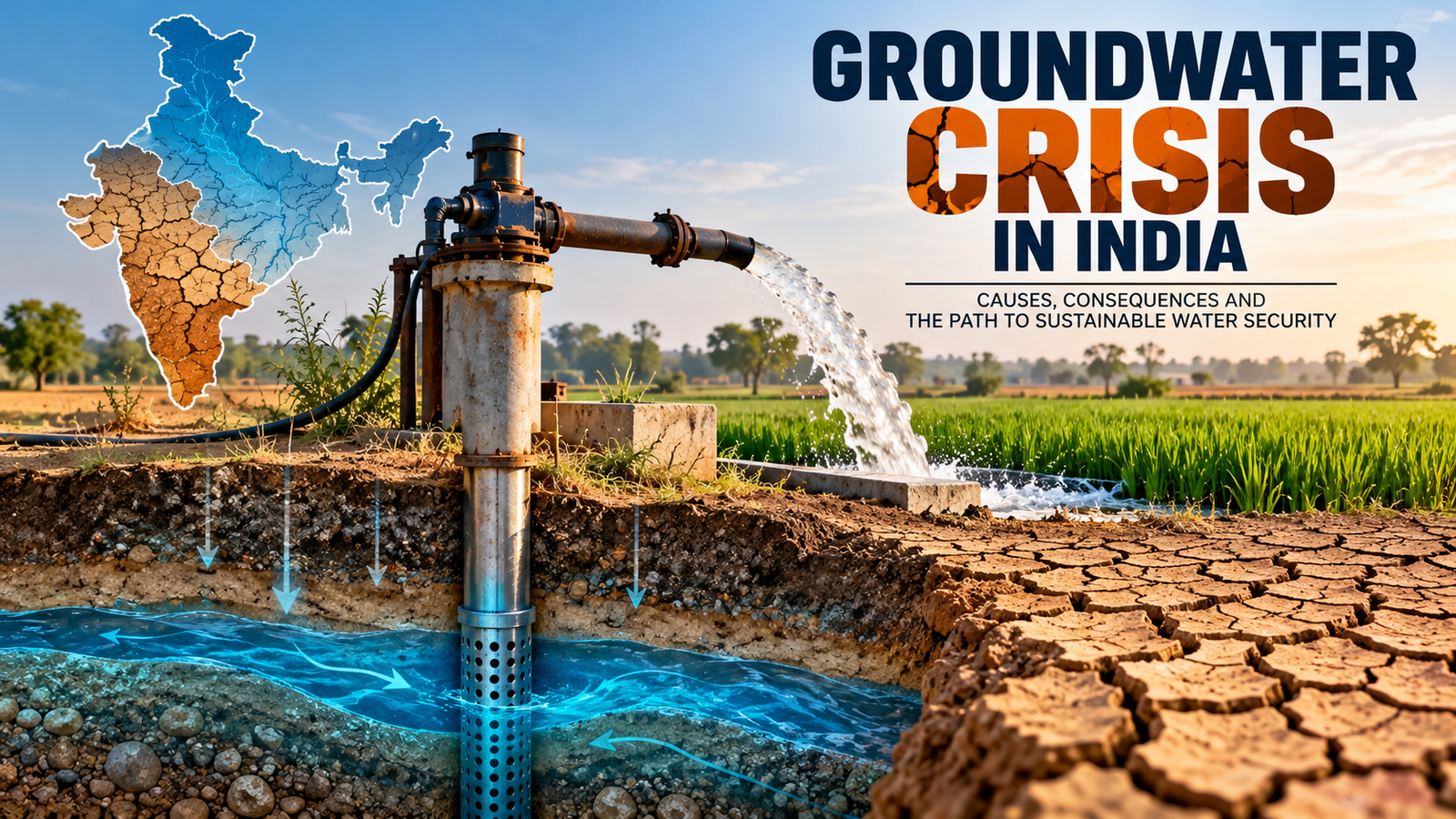
Introduction: India’s hidden water crisis
Water security is one of the fundamental conditions for India’s economic development, agricultural productivity, public health and ecological sustainability. Although rivers, reservoirs and rainfall receive considerable attention in public discussions, a large part of India’s water security depends on a resource that remains largely invisible: groundwater.
Groundwater supports irrigation, drinking-water supply, industrial activity and the livelihoods of millions of households. It is particularly important during dry periods, when surface-water availability declines or becomes unreliable.
However, groundwater is not an unlimited resource. Excessive extraction can lower the water table, increase the cost of pumping, dry up wells and reduce the availability of water for other users. In some locations, groundwater quality also deteriorates because of salinity, fluoride, arsenic, nitrate or other contaminants.
The problem is not uniform across India. Some regions have abundant replenishable resources, while others face severe extraction pressure because of low rainfall, water-intensive agriculture, hard-rock geology or concentrated demand.
According to the Central Ground Water Board’s (CGWB) Dynamic Ground Water Resources Assessment 2025, India’s annual groundwater recharge was estimated at 448.52 billion cubic metres (BCM), annual extractable groundwater resources at 407.75 BCM, and annual groundwater extraction at 247.22 BCM. The national stage of groundwater extraction stood at 60.63%.
Press Information Bureau
+1
These national figures, however, should not create a false sense of security. A national average can conceal severe depletion in particular states, districts and assessment units.
The central question is therefore not simply how much groundwater India possesses, but whether groundwater is being extracted, distributed and replenished in a manner that can sustain future demand.
1. Understanding groundwater and its importance
Groundwater is the water present beneath the Earth’s surface in the pores, fractures and openings of soil and rock formations.
When rain falls, some water runs off into rivers and drains, some evaporates, some is used by vegetation, and some infiltrates the soil to replenish groundwater. The extent of recharge depends on rainfall, soil characteristics, geology, land cover, drainage, water bodies and human activities.

Illustrative concept: rainfall infiltration, groundwater recharge, aquifers and the water table.
1.1 What is an aquifer?
An aquifer is a geological formation capable of storing and transmitting usable quantities of groundwater.
Aquifers differ in their storage capacity, permeability, depth and response to rainfall. These differences are important for water management.
- Alluvial aquifers: Found in extensive river plains, including parts of northern India. They can store substantial quantities of groundwater, although local extraction may exceed replenishment.
- Hard-rock aquifers: Common in peninsular India, including parts of Telangana, Karnataka, Maharashtra and Tamil Nadu. Groundwater is stored mainly in weathered and fractured rock formations, often making storage less extensive and unevenly distributed.
- Coastal aquifers: May be vulnerable to saline-water intrusion when freshwater pressure declines because of excessive pumping.
1.2 Why is groundwater so important to India?
Groundwater has several interconnected economic and social functions.
- Agriculture: It provides a dependable source of irrigation and reduces farmers’ dependence on the timing and variability of rainfall.
- Drinking water: Rural households and many urban settlements depend on groundwater for domestic supply.
- Economic activity: Industries, commercial establishments and service activities require water for different production processes.
- Drought resilience: Groundwater can serve as a buffer when rainfall is deficient or reservoirs are depleted, provided extraction remains sustainable.
- Ecological support: Groundwater contributes to the flow of some rivers and sustains wetlands, springs and other ecosystems.
The same resource, however, may be accessed by households, farmers, industries and municipalities with different levels of financial capacity and legal protection. Sustainable management must therefore address not only hydrology, but also equity, institutions and competing demands.
2. The latest groundwater assessment: What do the numbers reveal?
The CGWB’s 2025 assessment provides a national picture of the relationship between groundwater recharge and extraction.
INDIA’S GROUNDWATER RESOURCES — 2025
Annual recharge
448.52 BCM
Annual extractable resources
407.75 BCM
Annual extraction
247.22 BCM
Extraction stage
60.63%
Source: CGWB, National Compilation on Dynamic Ground Water Resources of India, 2025.
Jal Shakti
2.1 Why are recharge and extractable resources different?
Annual groundwater recharge is the estimated quantity of water added to groundwater reserves during a year. It includes contributions from rainfall and other sources of recharge.
Annual extractable groundwater resources are lower because a portion of groundwater must be reserved for natural discharge and related hydrological requirements. Consequently, annual recharge should not be interpreted as the amount that can safely be pumped out.
This distinction is central to groundwater management: the objective is not to extract all water that enters the aquifer, but to maintain a sustainable balance between extraction, recharge and the needs of dependent ecosystems.
2.2 What does the stage of groundwater extraction mean?
The stage of groundwater extraction is calculated as:
\[ \text{Stage of Extraction} = \frac{\text{Annual Groundwater Extraction}} {\text{Annual Extractable Groundwater Resources}} \times 100 \]
For India in 2025, the national ratio was 60.63%.
Press Information Bureau
This is a resource-assessment indicator, not a direct measurement of the decline in water-table depth. A groundwater extraction stage of 60.63% does not mean that 60.63% of the country’s groundwater has disappeared.
Nor does it mean that every region can safely extract groundwater at this level. The availability of groundwater varies substantially across locations, and a national ratio can conceal local over-exploitation.
2.3 Groundwater extraction is geographically uneven
The 2025 national assessment classified 6,762 groundwater assessment units, generally corresponding to administrative units such as blocks, mandals and talukas.
| Assessment category | Number of units | Share |
|---|---|---|
| Safe | 4,946 | 73.14% |
| Semi-critical | 758 | 11.21% |
| Critical | 201 | 2.97% |
| Over-exploited | 730 | 10.80% |
| Saline | 127 | 1.88% |
Source: CGWB, National Compilation on Dynamic Ground Water Resources of India, 2025.
Jal Shakti
An over-exploited unit is one where groundwater extraction exceeds the assessed annual extractable resource. A critical unit has a stage of extraction between 90% and 100%, while a semi-critical unit falls between 70% and 90%, under the assessment’s classification framework.
The saline category identifies units with predominantly saline groundwater in the assessed shallow aquifers; it is not simply another extraction-percentage category.
The data reveal two important features of India’s groundwater challenge.
First, groundwater stress is concentrated in particular locations rather than distributed uniformly across the country. Second, even where national resources appear adequate, unsustainable extraction at the local level can threaten livelihoods and water security.
3. Why is India facing a groundwater crisis?
The crisis arises from the interaction of agricultural practices, economic incentives, urban demand, uneven recharge, institutional weaknesses and local geological conditions.
3.1 Agriculture and the concentration of groundwater demand
Agriculture is the largest user of groundwater in India.
The Union Ministry of Jal Shakti reported in August 2026, drawing on the 2025 assessment, that approximately 215 BCM, or 87% of total annual groundwater extraction, was used for irrigation. Domestic uses accounted for around 28 BCM, or 11%, and industrial uses for about 4 BCM, or 2%.
Press Information Bureau
These figures explain why groundwater conservation cannot be separated from agricultural policy.
The relationship between irrigation and groundwater depletion is particularly significant in regions where farmers depend heavily on tube wells and borewells. In such locations, agricultural production can become vulnerable to falling water tables even when irrigation initially improves productivity.
3.2 The crop pattern and the water-intensive agriculture problem
Crop choices respond to several factors, including agro-climatic conditions, market prices, procurement arrangements, access to credit, irrigation availability and farmers’ perceptions of risk.
In parts of north-western India, particularly Punjab and Haryana, the combination of paddy cultivation, assured procurement, subsidised electricity and widespread groundwater pumping has contributed to persistent pressure on aquifers.
The underlying issue is an incentive problem. Farmers may have rational economic reasons to grow a particular crop even when its aggregate water requirements are environmentally unsustainable.
For example, a farmer may prefer a water-intensive crop because it has a reliable market, established procurement arrangements and predictable returns. Switching to a less water-intensive crop may be risky if processing facilities, buyers, storage infrastructure or price support are unavailable.
Therefore, crop diversification requires changes in market and policy incentives, not merely instructions to farmers to use less water.
3.3 Cheap or inadequately metered electricity
Electricity is a major input into groundwater irrigation because it powers pumps used to lift water from wells.
Where electricity is heavily subsidised or pumping is not adequately metered, the marginal cost of extracting additional groundwater may be low. This can weaken incentives to invest in efficient irrigation or reconsider water-intensive crops.
However, electricity pricing is not the sole cause of groundwater depletion. Rainfall variability, farm size, well depth, crop choices, irrigation infrastructure and local hydrogeology also matter.
Policy reform must balance three objectives:
- Sustainable groundwater extraction.
- Affordable irrigation for farmers, particularly small and marginal cultivators.
- Financial and operational viability of electricity distribution systems.
Possible measures include reliable power supply, improved pump efficiency, transparent agricultural electricity support and incentives for water conservation. Such reforms must be designed carefully to avoid placing disproportionate burdens on vulnerable farmers.
3.4 Urbanisation and growing municipal demand
Urbanisation increases demand for drinking water, sanitation, housing, commercial services and industry.
When municipal water supply is unreliable, households, apartment complexes and commercial establishments often depend on private borewells or groundwater tankers. In some areas, construction and land-use changes also reduce the infiltration of rainwater.
This creates a dual problem: groundwater extraction rises while the opportunities for recharge may decline.
Concrete surfaces, roads and buildings can prevent rainfall from infiltrating the ground, directing it instead into drains. Poorly planned urbanisation can therefore increase runoff and flood risk while reducing local groundwater replenishment.
Rainwater harvesting, protection of lakes and wetlands, permeable surfaces and scientifically designed recharge structures can help address the problem. However, recharge interventions must be adapted to local geology and water quality.
3.5 Climate variability and uncertain recharge
Groundwater recharge depends partly on rainfall, but the relationship is complex.
Intense rainfall may produce substantial surface runoff without proportionately replenishing aquifers. Longer dry periods can increase irrigation demand, while changes in rainfall timing can affect both recharge and crop-water requirements.
Groundwater can buffer short-term rainfall variability, but prolonged extraction without adequate replenishment weakens that buffer.
Climate change therefore increases the importance of integrated water planning. Water budgets must account for rainfall uncertainty, changing crop requirements, local recharge conditions and the possibility of consecutive drought years.
3.6 Geology and the limitations of hard-rock aquifers
Groundwater depletion is not solely a consequence of poor policy. Natural conditions also influence the availability and reliability of groundwater.
In many parts of peninsular India, groundwater occurs in weathered and fractured hard-rock formations. Storage and transmission capacities can be relatively limited and spatially variable.
A borewell that produces adequate water in one location may perform poorly a short distance away because the underlying fractures and weathered zones differ.
This makes groundwater management particularly challenging in parts of Telangana, Karnataka, Maharashtra and Tamil Nadu. Rainwater harvesting and recharge structures may help, but their effectiveness depends on site selection, geology, soil conditions and the quality of incoming water.
3.7 Fragmented governance and weak local accountability
Groundwater is difficult to govern because extraction is decentralised. Thousands of individual wells may draw from the same aquifer, while the costs of depletion are shared by a much larger community.
An individual user may benefit from pumping more water, but the cumulative effect of many such decisions can lower the water table for everyone.
This is a classic common-pool resource problem: access is dispersed, measurement is difficult, and individual incentives can conflict with collective sustainability.
Groundwater governance must therefore move beyond the regulation of individual wells. It requires aquifer-level planning, transparent data, community participation and coordination among agriculture, electricity, water supply and environmental authorities.
4. Consequences of groundwater depletion
Groundwater depletion affects far more than the availability of water in wells. Its consequences extend to agricultural productivity, household expenditure, public health, ecosystems and regional economic development.
4.1 Rising irrigation costs and agricultural vulnerability
As groundwater levels decline, farmers may have to deepen existing wells, install more powerful pumps or drill new borewells. These measures increase capital and energy costs.
Small and marginal farmers may lack the financial resources to respond. A failed borewell can create substantial debt without guaranteeing access to a reliable alternative.
The result is a potential feedback loop:
Groundwater depletion → higher pumping costs → greater financial pressure → continued dependence on extraction → further depletion.
Groundwater-intensive agriculture can thus become increasingly expensive and vulnerable, even if it initially provides higher and more reliable yields.
4.2 Drinking-water insecurity
Groundwater depletion can reduce the reliability of rural drinking-water sources, particularly during summer and drought periods.
Where shallow wells dry up, households may need deeper borewells, tanker supplies or alternative sources. The burden is particularly serious for households that cannot afford private water access.
Women and children in water-insecure communities may also bear a disproportionate share of the time and physical effort required to obtain water.
Groundwater conservation is therefore not merely an agricultural or environmental concern. It is closely connected to public health, household welfare and social equity.
4.3 Deterioration of groundwater quality
Groundwater depletion and groundwater pollution are related but distinct problems.
Excessive extraction can contribute to saline-water intrusion in coastal aquifers or alter the movement of groundwater in certain geological settings. However, many groundwater quality problems also arise from natural geological conditions and human contamination.
Important contaminants include:
- Arsenic, which occurs naturally in groundwater in some geological environments.
- Fluoride, which can be released from fluoride-bearing rocks under particular hydrogeological and chemical conditions.
- Nitrate, which can enter groundwater through agricultural fertilisers, sewage and other sources.
- Salinity, which may result from natural conditions, irrigation practices or seawater intrusion in coastal areas.
- Microbial contamination, which can arise from inadequate sanitation and contamination of wells.
The CGWB’s national assessment describes groundwater quality as generally potable, while recognising localised contamination problems. National averages should not be used to assume that a particular well is safe.
Jal Shakti
Groundwater quality testing, source protection and appropriate treatment are therefore essential components of water security.
4.4 Ecological impacts
Groundwater contributes to the functioning of springs, wetlands and some river systems. Excessive pumping can reduce groundwater discharge into these ecosystems.
In some locations, falling groundwater levels can affect vegetation and wetland conditions. The magnitude of the impact depends on local hydrology and the degree of connection between groundwater and surface water.
Sustainable extraction must consequently consider ecological requirements rather than treat all groundwater as available for human consumption.
4.5 Regional inequality
Groundwater depletion can reinforce existing inequalities between regions and households.
Areas with favourable geology, greater recharge and stronger infrastructure may retain more reliable supplies. Other areas may face repeated well failures, higher pumping costs and greater dependence on tanker water.
Within a village, households with deeper borewells or greater financial resources may be better positioned to secure water than those relying on shallow wells.
Without collective management, groundwater depletion can therefore turn a shared natural resource into a source of unequal access and livelihood insecurity.
5. Why the national average can be misleading
A major challenge in groundwater policy is the difference between national resource availability and local water security.
India’s 2025 assessment places the national stage of groundwater extraction at 60.63%. Yet the same assessment identifies 730 over-exploited units and 201 critical units.
Jal Shakti
This apparent contradiction is explained by geographical variation.
A region with substantial recharge may have a relatively low extraction ratio, while another region with low recharge or high irrigation demand may extract groundwater beyond sustainable levels.
Groundwater conditions also vary with depth, aquifer characteristics and seasonal fluctuations. An administrative block may contain multiple aquifers with different storage and recharge properties.
For these reasons, policy should move towards aquifer-based groundwater management, supported by local monitoring and scientific assessment.
District- or block-level statistics remain useful for planning, but they should be supplemented with information on aquifer boundaries, water-table trends, extraction patterns and groundwater quality.
6. Government initiatives for groundwater conservation
India has introduced several initiatives that address groundwater assessment, recharge, community participation and drinking-water security. Their effectiveness depends on coordination, maintenance and local implementation.
6.1 Atal Bhujal Yojana
The Atal Bhujal Yojana is a community-oriented groundwater management programme designed to improve sustainable groundwater use through participatory planning, water budgeting and behavioural change.
Its approach recognises that groundwater conservation requires local institutions and users to understand the condition of their water resources and collectively modify extraction practices.
The broader lesson is that infrastructure alone is insufficient. A recharge structure may improve local replenishment, but its benefits can be lost if extraction continues to rise unchecked.
6.2 National Aquifer Mapping and Management Programme
The CGWB’s National Aquifer Mapping and Management Programme (NAQUIM) seeks to improve understanding of aquifers, their characteristics, availability and management requirements.
Aquifer mapping can help identify groundwater storage conditions, recharge potential and local constraints. This scientific information supports more targeted planning than uniform interventions applied across different geological settings.
6.3 Jal Shakti Abhiyan
The Jal Shakti Abhiyan promotes water conservation and rainwater harvesting through measures such as the restoration of water bodies, recharge structures, watershed interventions and public participation.
Its impact depends on whether the interventions are technically appropriate, maintained over time and integrated into local water budgets.
6.4 Mission Amrit Sarovar
Mission Amrit Sarovar promotes the development and rejuvenation of water bodies. Such interventions can contribute to local water conservation and may support groundwater recharge where hydrological and geological conditions are suitable.
However, the creation of a water body does not automatically guarantee effective aquifer replenishment. Design, location, soil permeability, inflows and maintenance matter.
6.5 Jal Jeevan Mission
The Jal Jeevan Mission has focused on household tap-water connections in rural India. Reliable household water supply can improve access to drinking water and reduce dependence on unsafe or inconvenient sources.
Nevertheless, drinking-water infrastructure must be supported by sustainable source planning. Where a scheme depends on groundwater, the long-term availability and quality of the source require monitoring and appropriate management.
6.6 Pradhan Mantri Krishi Sinchayee Yojana
The Pradhan Mantri Krishi Sinchayee Yojana includes measures to improve irrigation efficiency and expand access to irrigation infrastructure.
Micro-irrigation technologies such as drip and sprinkler systems can reduce water application and improve efficiency for suitable crops and farming conditions. However, the actual effect on basin-wide groundwater extraction depends on crop choices, irrigated area and farmers’ subsequent use of any water saved.
The common lesson across these initiatives is that recharge, efficient irrigation, reliable drinking water and community participation must be integrated with measures to manage total extraction.
7. The way forward: From groundwater extraction to groundwater management
India’s groundwater crisis cannot be solved through rainwater harvesting alone, nor can it be resolved by restricting borewells without providing viable alternatives to farmers and households.
A sustainable strategy must address both sides of the water balance: replenishment and extraction. It must also recognise that groundwater management is a local problem requiring coordinated action across multiple policy sectors.
7.1 Prepare local groundwater budgets
A groundwater budget should estimate the water entering an aquifer, the water being extracted, the amount available for sustainable use and the requirements of dependent ecosystems.
Village- and aquifer-level water budgets can help communities understand whether existing extraction patterns are sustainable.
These budgets should be updated using rainfall records, groundwater-level monitoring, crop-water requirements, well inventories and available recharge estimates.
Where extraction exceeds sustainable limits, local plans should identify realistic measures to reduce demand or improve replenishment.
7.2 Reform agricultural incentives
Agricultural policy is central to groundwater conservation because irrigation accounts for the overwhelming majority of groundwater extraction.
A durable reform strategy should include:
- Crop diversification: Encourage crops suited to local agro-climatic conditions and water availability.
- Market development: Improve procurement, storage, processing and marketing facilities for alternative crops.
- Water-efficient irrigation: Promote appropriate drip and sprinkler systems, supported by technical advice.
- Farmer support: Provide transition assistance and reliable market opportunities to farmers shifting away from water-intensive crops.
- Better energy incentives: Improve irrigation efficiency while protecting small and marginal farmers from disproportionate financial burdens.
Crop diversification will succeed only when alternative crops offer credible economic returns. Farmers cannot be expected to bear the entire cost of a transition undertaken for wider environmental benefits.
7.3 Promote community-based aquifer management
Groundwater does not follow administrative boundaries. An aquifer may extend across several villages or blocks, and the pumping decisions of one community can affect neighbouring users.
Local groundwater institutions should therefore be supported with scientific information, transparent monitoring and mechanisms for collective decision-making.
Gram Panchayats, water-user groups, farmers’ organisations and local governments can play important roles in preparing water budgets, protecting recharge areas and resolving conflicts.
Community participation must be meaningful rather than merely consultative. Local users need access to understandable information and a genuine role in determining how shared resources are managed.
7.4 Protect and restore natural recharge systems
Recharge depends on the physical characteristics of the landscape. Measures should therefore be designed around local hydrology rather than implemented through uniform targets.
Appropriate interventions may include:
- Restoration of traditional tanks, ponds and wetlands.
- Protection of floodplains and natural drainage channels.
- Watershed treatment and soil-moisture conservation.
- Rainwater harvesting in buildings and public infrastructure.
- Scientifically designed recharge structures.
- Protection of recharge zones from excessive paving and contamination.
Recharge interventions must also account for groundwater quality. Polluted runoff should not be directed into aquifers without suitable treatment and scientific assessment.
7.5 Improve monitoring and data transparency
Groundwater is difficult to manage when extraction and water-table trends are poorly understood.
India should continue strengthening observation wells, digital monitoring systems, aquifer mapping, water-quality testing and public access to groundwater information.
Remote sensing can help identify land-use changes, drought conditions and other indicators, while field measurements remain essential for validating groundwater conditions.
Technology should support local decision-making rather than replace it. A satellite-based indicator cannot, by itself, establish whether a specific borewell is sustainable or whether its water is safe to drink.
7.6 Regulate extraction according to local conditions
Groundwater regulation should reflect differences in aquifers, extraction pressure and social dependence on the resource.
In severely stressed areas, measures may include stronger controls on new extraction, registration of significant wells, monitoring of commercial users and limits designed around local resource conditions.
Such measures must be implemented carefully. Restrictions that ignore the dependence of small farmers and households on groundwater may encourage informal extraction or create serious livelihood problems.
Regulation should therefore be accompanied by alternative water supplies, demand-management measures, technical assistance and fair enforcement.
7.7 Integrate groundwater with climate adaptation
Groundwater should form a central component of India’s climate-resilience strategy.
Districts and water-stressed regions need plans that consider drought frequency, rainfall variability, crop-water demand, aquifer recharge and the reliability of drinking-water sources.
Climate-resilient water management requires diversified water sources, protection of natural recharge systems, efficient irrigation and realistic limits on extraction.
The objective should be to maintain groundwater as a buffer against climate variability without exhausting the very reserves needed to manage future droughts.
8. Groundwater governance and the federal challenge
Groundwater management raises important questions about India’s constitutional and institutional framework.
Water is primarily a State subject under Entry 17 of the State List, subject to Entry 56 of the Union List concerning the regulation and development of inter-State rivers and river valleys to the extent declared by Parliament to be expedient in the public interest.
Groundwater management also intersects with drinking-water supply, agriculture, electricity, urban planning, environmental protection and rural development.
The result is a complex institutional arrangement involving the Union government, State governments, local bodies and individual users.
The Union government can contribute through scientific assessment, technical standards, financial support, national programmes and coordination. States have important responsibilities for water-resource management and implementation. Local institutions can help translate these policies into community-level action.
A sustainable framework should therefore combine:
- National scientific standards and accessible groundwater data.
- State-specific policies based on local hydrogeology and water demand.
- Local water budgeting and community participation.
- Coordination between irrigation, electricity, agriculture and drinking-water authorities.
- Accountability for the maintenance and effectiveness of conservation investments.
The challenge is not simply to establish more schemes. It is to create a governance system in which the condition of the aquifer influences decisions about cropping, irrigation, urban development and water allocation.
9. A strategic framework for sustainable groundwater security
The relationship between the main challenges and the required policy responses can be summarised as follows.
| Challenge | Strategic response | Intended outcome |
|---|---|---|
| Excessive irrigation extraction | Crop diversification and efficient irrigation | Reduced pressure on aquifers |
| Unsustainable pumping incentives | Better-designed electricity and agricultural policies | More rational water use |
| Urban depletion | Rainwater harvesting and integrated urban water planning | Improved local water resilience |
| Fragmented governance | Aquifer-based planning and community participation | Collective management |
| Groundwater contamination | Monitoring, source protection and treatment | Safer water supplies |
| Climate variability | Recharge protection and drought planning | Greater long-term resilience |
| Unequal access | Reliable public water supply and equitable allocation | Improved water security |
The effectiveness of this framework should be measured through outcomes rather than the number of structures constructed or schemes announced.
Useful indicators include groundwater-level trends, extraction relative to available resources, the reliability of drinking-water supplies, water quality, irrigation efficiency and the economic viability of alternative crops.
Conclusion: Water security requires managing demand, not just increasing supply
India’s groundwater crisis is fundamentally a challenge of managing a shared and unevenly distributed natural resource.
The country possesses substantial groundwater resources, but their availability varies sharply across regions. National averages cannot capture the risks faced by farmers, households and ecosystems in areas where extraction exceeds replenishment or where water quality is deteriorating.
The central policy lesson is that groundwater security cannot be achieved through recharge structures and conservation campaigns alone. It requires changes in agricultural incentives, improved irrigation practices, stronger local institutions, scientific monitoring and coordination across sectors.
Most importantly, groundwater must be treated as a common resource with ecological limits, rather than as an unlimited private source of water.
India’s long-term water security will depend on its ability to align individual incentives with collective sustainability. That means enabling farmers to adopt viable alternatives, ensuring reliable drinking-water access, protecting recharge systems and managing extraction according to local aquifer conditions.
The ultimate objective is not merely to make more groundwater available today. It is to ensure that future generations inherit aquifers capable of sustaining agriculture, livelihoods, public health and economic development.
Frequently asked questions
1. What is the groundwater crisis in India?
The groundwater crisis refers to the unsustainable extraction, uneven availability and localised quality deterioration of groundwater, creating risks for irrigation, drinking-water supply, livelihoods and ecosystems.
2. What is the latest groundwater extraction figure for India?
According to the CGWB’s 2025 assessment, annual groundwater extraction was estimated at 247.22 BCM, against annual extractable groundwater resources of 407.75 BCM. The national stage of groundwater extraction was 60.63%.
Jal Shakti
3. Why is groundwater depletion severe in Punjab and Haryana?
In many areas, groundwater depletion is associated with water-intensive paddy cultivation, irrigation dependence, electricity incentives, procurement arrangements and local hydrological conditions. The relative importance of each factor varies across locations.
4. What is the difference between groundwater recharge and extraction?
Groundwater recharge is the water added to underground reserves. Extraction is the water withdrawn for irrigation, domestic, industrial and other uses. Sustainable management requires extraction to remain compatible with available resources, natural discharge and ecological needs.
5. What is the role of the Central Ground Water Board?
The CGWB undertakes scientific assessment, groundwater monitoring, aquifer mapping and related technical activities. It works with State and Union Territory agencies to assess the country’s dynamic groundwater resources.
6. How can India reduce groundwater depletion?
Key measures include crop diversification, efficient irrigation, community-based aquifer management, rainwater harvesting, restoration of natural recharge systems, improved monitoring and context-specific regulation of extraction.
7. Which UPSC syllabus topics are relevant to groundwater?
The subject is relevant to GS Paper I (geography and water resources), GS Paper II (government policies and federalism), and GS Paper III (agriculture, irrigation, environmental conservation and resource management).
References and authoritative further reading
These sources should be linked contextually in the article, rather than added only as a bibliography.
1. Central Ground Water Board: National Compilation on Dynamic Ground Water Resources of India, 2025. The primary source for groundwater resource estimates and assessment-unit classifications.
CGWB
2. Ministry of Jal Shakti: Dynamic Groundwater Resources Assessment, 2025 — Press Information Bureau. Official summary of annual recharge, extractable resources and extraction.
Press Information Bureau
3. Ministry of Jal Shakti: Average Groundwater Consumption and Its Quality in the Country. Official information on groundwater use by sector and the national extraction stage.
Press Information Bureau
4. Central Ground Water Board: Ground Water Resource Assessment. Background on groundwater assessment methodology and classification.
CGWB