
Indian Economy | UPSC General Studies Paper III | Updated: 16 October 2026
Introduction
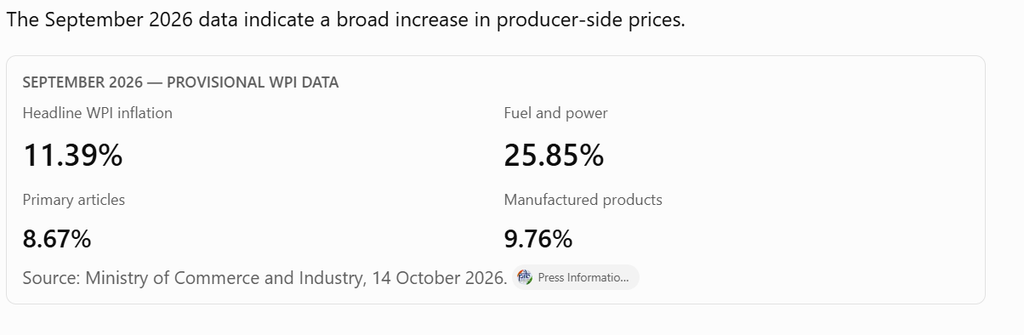
India’s wholesale inflation rose sharply in September 2026, signalling increasing price pressures across the country’s production and distribution systems. According to the official Wholesale Price Index release published by the Ministry of Commerce and Industry on 14 October 2026, the annual rate of inflation measured by the Wholesale Price Index (WPI) increased to 11.39% in September 2026, compared with 9.92% in August.
The increase was particularly pronounced in energy-related commodities, with fuel and power inflation reaching 25.85%. Primary articles and manufactured products also recorded substantial increases, indicating that inflationary pressures extended across several major sectors of the economy.
These developments raise fundamental economic questions. Why are wholesale prices rising? How does wholesale inflation differ from retail inflation? Can higher input costs eventually affect household purchasing power? What are the implications for the Reserve Bank of India’s monetary policy and India’s economic growth?
Understanding these issues requires examining the relationship between commodity prices, production costs, inflation transmission, monetary policy and supply-side constraints.
1. What is wholesale inflation?
Wholesale inflation refers to the rate at which the prices of goods change at the wholesale or producer-side level of an economy over a specified period.
In India, wholesale inflation is measured through the Wholesale Price Index (WPI), compiled by the Office of the Economic Adviser under the Department for Promotion of Industry and Internal Trade (DPIIT), Ministry of Commerce and Industry.
The index captures price movements in commodities such as agricultural products, minerals, fuel, industrial raw materials and manufactured goods.
For example, an increase in crude oil prices can raise transportation and manufacturing costs. Similarly, higher prices of steel, aluminium and chemicals can increase the cost of producing automobiles, construction materials and industrial equipment.
Unlike retail inflation, wholesale inflation does not directly measure changes in the cost of living experienced by households. Rather, it provides information about price movements in the production and wholesale distribution stages of the economy.
The official WPI series, historical data and related producer price indices are available through the Office of the Economic Adviser’s WPI and PPI database.

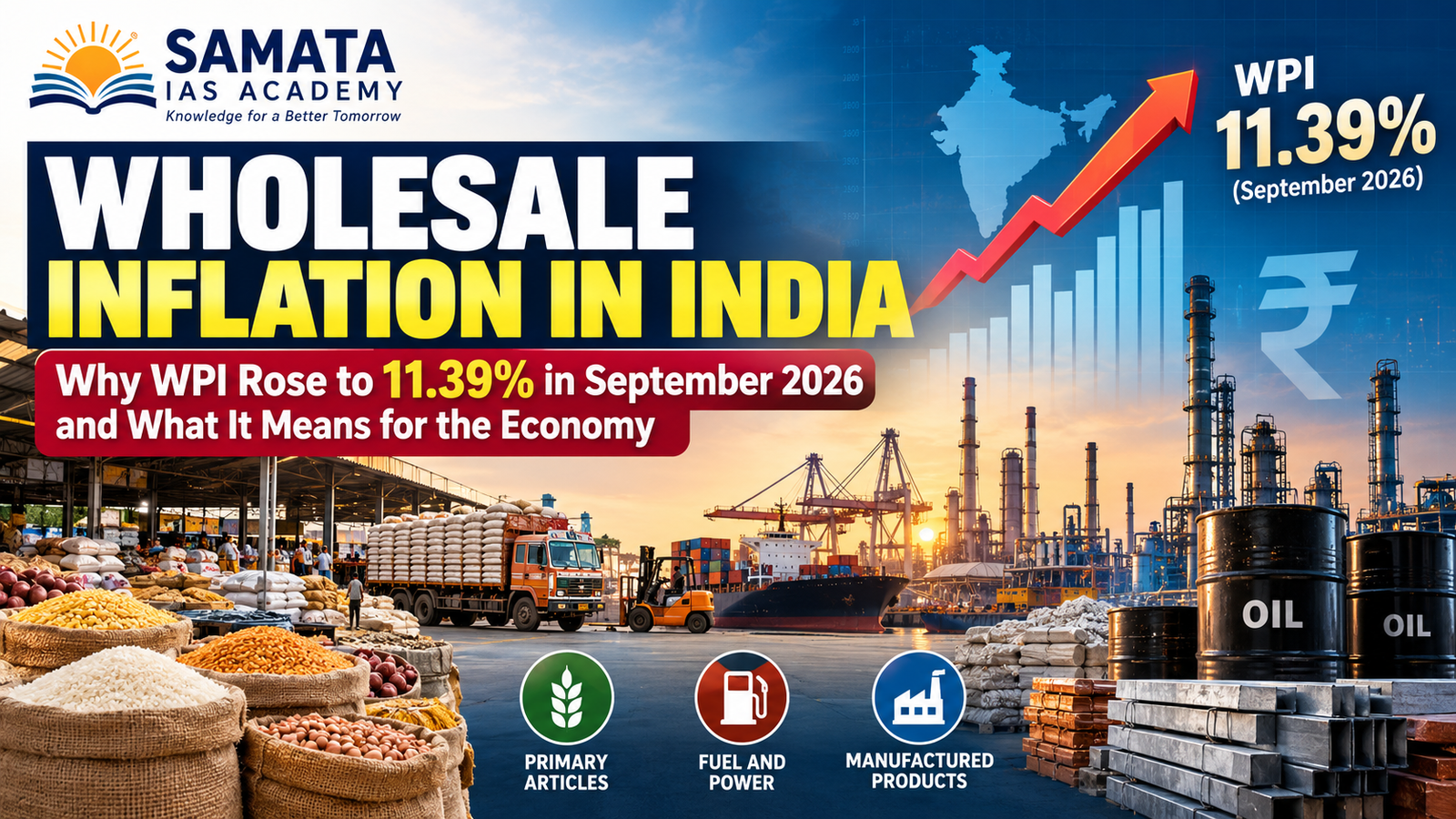
Image 1 — Wholesale markets illustrate the stage at which commodity and producer-side prices are observed. Suggested placement: immediately after the explanation of wholesale inflation.
2. Wholesale Price Index: Structure and methodology
The WPI measures changes in the prices of a representative basket of goods. Its construction involves assigning weights to different commodities according to their economic importance.
Major components of the WPI
The index is divided into three broad categories.
| Component | Major commodities covered |
|---|---|
| Primary Articles | Food articles, non-food articles, minerals and crude petroleum and natural gas |
| Fuel and Power | Coal, mineral oils and electricity |
| Manufactured Products | Metals, chemicals, textiles, machinery, food products and other manufactured goods |
These categories capture different dimensions of inflationary pressure.
Primary articles reflect changes in agricultural and extractive-sector prices. Fuel and power capture important energy-related costs. Manufactured products represent prices of goods produced by industrial establishments.
The relative contribution of each category to headline inflation depends on its weight and price movement.
Revision of the WPI base year
In June 2026, India introduced a revised WPI series with 2022–23 as the base year, replacing the earlier 2011–12 series.
A base year is the reference period against which changes in prices are measured. It is generally assigned an index value of 100.
The revised series incorporates changes in the composition of the economy, updated commodity coverage and improvements in statistical methodology.
The revision is important because an outdated index may not adequately reflect structural changes in production and consumption.
The official FAQs on the revised WPI and Producer Price Index series explain the rationale for the revision, while the official linking-factor methodology provides guidance on comparisons between the old and new series.
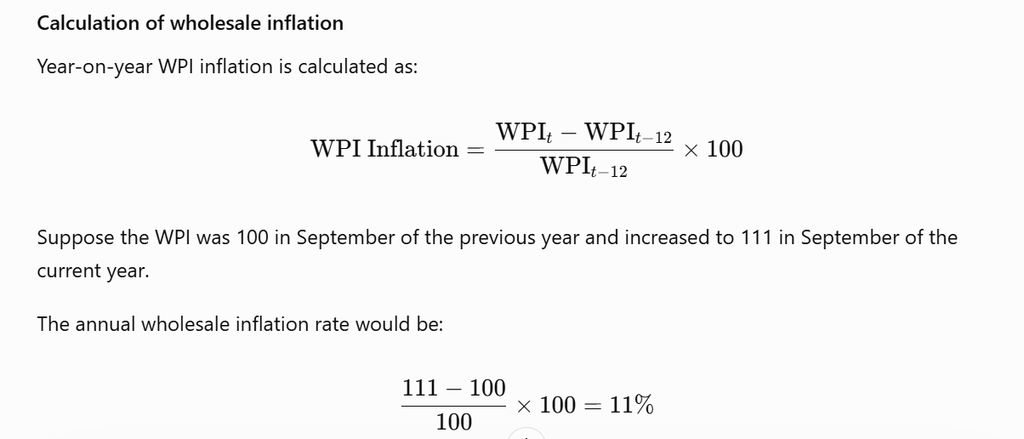
This means that the weighted price level represented by the index increased by 11% over the corresponding period.
It does not mean that the price of every commodity increased by exactly 11%.
3. September 2026 wholesale inflation: Key developments
Inflation across major commodity groups
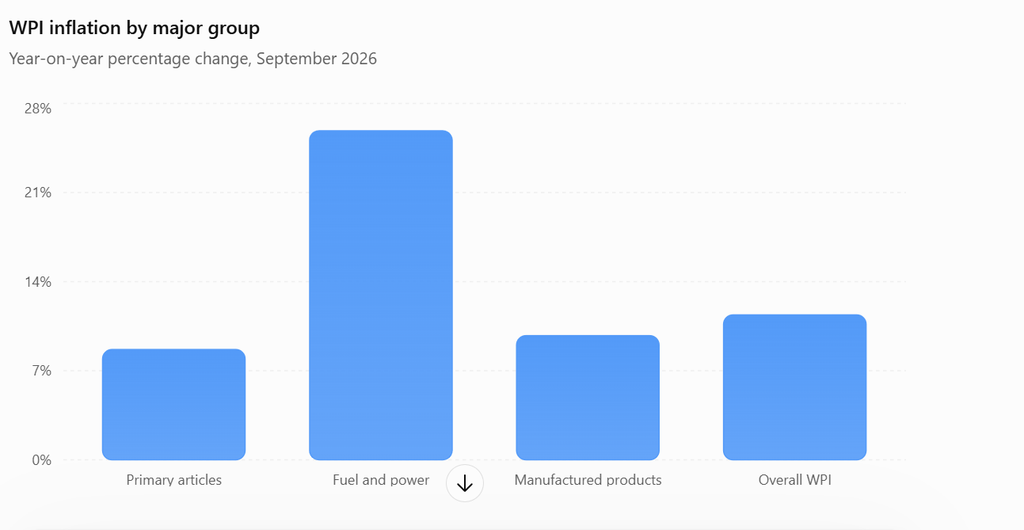
The data reveal three important developments.
First, fuel and power experienced significantly higher inflation than the other major groups, indicating strong energy-related price pressures.
Second, manufactured products recorded inflation of 9.76%, suggesting that higher costs were affecting a wide range of industrial commodities.
Third, primary articles recorded inflation of 8.67%, showing that price pressures were not confined to manufacturing and energy.
The official release also identified mineral oils, food articles, crude petroleum and natural gas, coal and lignite, basic metals, chemicals, textiles, rubber and plastic products, and electrical equipment among the important contributors to wholesale inflation.
The WPI Food Index recorded year-on-year inflation of 8.66%, compared with 7.05% in August 2026.
Press Information Bureau
These figures suggest that the inflationary episode was not confined to a single commodity group, although energy prices remained an especially important source of pressure.
4. Why is wholesale inflation rising in India?
Wholesale inflation may originate from domestic supply constraints, international commodity markets, exchange-rate movements, transportation costs and changes in demand.
The September 2026 figures should therefore be understood through multiple economic channels.
4.1 Rising energy prices
Energy is an essential input in almost every sector of the economy.
Petroleum products are used in transportation, agriculture, manufacturing, construction and logistics. Electricity is essential for industrial machinery, commercial establishments and infrastructure.
When energy prices rise, the cost of producing and transporting goods may increase.
For instance, higher diesel prices can increase the cost of transporting agricultural produce from farms to wholesale markets. Similarly, an increase in industrial fuel costs can raise expenditure for steel, cement, chemicals and other energy-intensive industries.
The September 2026 fuel and power inflation rate of 25.85% illustrates the scale of price pressures in this category.
4.2 Imported inflation and exchange-rate movements
India depends on international markets for crude oil, natural gas and several industrial commodities.
An increase in international commodity prices can raise the cost of imports, even if domestic demand remains unchanged.
Currency depreciation can intensify this pressure.
For example, suppose a commodity costs $100 in international markets.
If the exchange rate changes from ₹85 per US dollar to ₹90 per US dollar, the rupee cost increases from ₹8,500 to ₹9,000, even though the international dollar price remains unchanged.
This phenomenon is known as imported inflation.
Imported inflation is especially important for economies dependent on internationally traded energy and industrial raw materials.
4.3 Higher industrial input costs
Manufacturing involves combining raw materials, labour, energy, capital and intermediate goods.
If the prices of steel, aluminium, chemicals, rubber, plastics or other inputs rise, the cost of producing finished goods may increase.
The impact depends on the proportion of inputs in total production costs and the ability of firms to absorb or pass on the increase.
Industries operating with narrow profit margins may experience greater financial pressure.
4.4 Agricultural supply constraints
Agricultural prices are sensitive to weather conditions, crop yields, storage facilities, transport networks and seasonal demand.
Droughts, floods, crop diseases and disruptions in agricultural supply chains can reduce market arrivals and raise prices.
Food-processing industries may face additional costs when agricultural commodities become more expensive.
However, increases in agricultural prices do not necessarily affect all producers and consumers equally. Farmers selling a commodity may benefit from higher prices, while processors and final consumers may face additional expenditure.
4.5 Global supply-chain disruptions
Modern manufacturing depends on interconnected international supply chains.
Geopolitical tensions, shipping disruptions, export restrictions and shortages of intermediate goods can increase costs for domestic producers.
These disruptions may affect the availability, transportation time and price of commodities.
The resulting inflation is often described as cost-push inflation, because it originates from an increase in production costs rather than an initial increase in aggregate demand.
5. Wholesale inflation versus retail inflation: Understanding CPI and WPI
One of the most important distinctions in macroeconomics is the difference between the Wholesale Price Index and the Consumer Price Index.
The Consumer Price Index (CPI) measures changes in the prices of goods and services purchased by households for consumption.
India’s CPI is compiled by the National Statistical Office under the Ministry of Statistics and Programme Implementation.
The current CPI series uses 2024 as its base year, while the current WPI series uses 2022–23.
The CPI is particularly important because it reflects changes in consumer purchasing power and is used in India’s inflation-targeting monetary policy framework.
Students can consult the official CPI data catalogue on the eSankhyiki portal for the revised CPI series.
Key differences between WPI and CPI
| Basis | Wholesale Price Index | Consumer Price Index |
|---|---|---|
| Price measurement | Wholesale and producer-side prices | Retail prices paid by consumers |
| Coverage | Goods | Goods and services |
| Base year | 2022–23 | 2024 |
| Compiled by | Office of the Economic Adviser | National Statistical Office |
| Principal relevance | Production costs and commodity prices | Cost of living and household purchasing power |
| Monetary policy | Important supplementary indicator | Principal inflation-targeting indicator |
Why can WPI and CPI inflation differ?
The two indices measure prices at different stages of economic activity and have different commodity baskets and weights.
For example, a sharp increase in industrial metal prices can strongly influence WPI inflation without immediately affecting the consumer basket to the same extent.
Conversely, increases in the prices of services such as healthcare, education and certain housing-related services can influence CPI inflation without being directly reflected in WPI.
Differences in taxation, retail margins, distribution costs and business pricing decisions also influence the relationship between the two indices.
Therefore, a higher WPI inflation rate does not automatically imply an equivalent increase in CPI inflation.
Related reading: This section is an appropriate place to insert an internal link to Samata IAS Academy’s article on Consumer Price Index and Inflation in India, once the exact published URL is confirmed.
6. How does wholesale inflation affect retail prices?
Wholesale inflation can influence retail prices through the transmission of higher production and distribution costs.
This mechanism is known as inflation pass-through.
A simplified transmission process is illustrated below.

Image 2 — Illustration of how changes in input costs can be transmitted through production, distribution and retail markets. Suggested placement: at the beginning of Section 6.
Understanding the transmission mechanism
When raw-material prices increase, manufacturers may experience higher production costs.
Businesses can respond in several ways. They may increase selling prices, reduce profit margins, improve production efficiency, substitute inputs or renegotiate supply contracts.
If manufacturers raise their selling prices, wholesalers and retailers may also adjust their prices.
Eventually, consumers may face higher prices for finished goods.
However, the magnitude of the increase depends on several factors.
Market competition: In highly competitive markets, businesses may find it difficult to raise prices without losing customers.
Consumer demand: If consumers are sensitive to price changes, producers may absorb a larger share of the additional cost.
Profit margins: Firms with substantial margins may temporarily absorb input-cost increases.
Government policies: Taxes, subsidies, administered prices and trade restrictions may influence price transmission.
Duration of the shock: Temporary increases in commodity prices may have a smaller impact than sustained increases.
Thus, wholesale inflation is a useful indicator of potential future retail price pressures, but it is not a precise or automatic predictor of consumer inflation.
7. Impact of wholesale inflation on the Indian economy
Wholesale inflation can influence industrial production, business profitability, investment, employment, consumption and economic competitiveness.
7.1 Impact on manufacturing industries
Manufacturing firms depend on raw materials, energy and intermediate inputs.
When input prices rise, the cost of production increases.
Businesses may respond by increasing selling prices or accepting lower profit margins.
If higher costs persist, firms may reduce production, postpone expansion plans or delay capital expenditure.
The impact can be particularly significant for energy-intensive industries such as steel, cement, chemicals and transportation equipment.
7.2 Impact on MSMEs
Micro, small and medium enterprises are particularly vulnerable to sharp increases in input prices because many operate with limited working capital and relatively narrow profit margins.
Unlike large corporations, smaller firms may have less bargaining power when negotiating with suppliers.
They may also face difficulty obtaining affordable credit to finance higher inventory and production costs.
Persistent wholesale inflation can therefore create liquidity pressures and weaken the financial position of MSMEs.
7.3 Impact on household purchasing power
Wholesale inflation affects household welfare primarily when higher producer prices are transmitted to retail markets.
If consumer prices rise faster than household incomes, real purchasing power declines.
This can reduce discretionary consumption and increase the financial burden on households.
Lower-income households are often more vulnerable because essential expenditure accounts for a substantial proportion of their budgets.
However, the direct effect on household purchasing power should be assessed using CPI and income data rather than WPI alone.
7.4 Impact on investment
Inflation creates uncertainty about future costs, revenues and profitability.
Businesses may find it difficult to estimate the cost of long-term projects when prices of raw materials, energy and capital goods are volatile.
This uncertainty can discourage private investment.
On the other hand, sustained input-cost pressures may encourage investment in energy-efficient technologies, alternative materials and productivity improvements.
7.5 Impact on exports and competitiveness
Higher domestic production costs can affect the competitiveness of Indian goods in international markets.
If Indian producers face faster cost increases than their international competitors, they may find it difficult to maintain export prices and profit margins.
However, exchange-rate movements, productivity, product quality and global demand also influence export competitiveness.
Wholesale inflation must therefore be evaluated in conjunction with broader indicators of industrial performance and external trade.
8. Wholesale inflation and the Reserve Bank of India’s monetary policy
The Reserve Bank of India plays a central role in maintaining monetary and financial stability.
Under India’s inflation-targeting framework, monetary policy focuses on consumer price inflation rather than wholesale inflation.
The Monetary Policy Committee determines the policy repo rate while considering inflation developments, growth conditions and the wider macroeconomic outlook.
The RBI’s policy statements, reports and monetary policy resolutions can be accessed through its official website.
Why does the RBI monitor WPI inflation?
Although WPI is not the target index for monetary policy, it provides important information about price pressures affecting producers.
An increase in wholesale inflation may signal that businesses are experiencing higher input costs.
If these increases are passed on to consumers, CPI inflation may subsequently rise.
The RBI therefore examines wholesale inflation alongside consumer prices, inflation expectations, industrial production, commodity markets, credit growth and other macroeconomic indicators.
Can higher interest rates control wholesale inflation?
An increase in the repo rate generally raises borrowing costs and can moderate aggregate demand.
Lower demand may reduce the ability of businesses to pass higher costs on to consumers.
Monetary tightening can also help prevent temporary inflationary shocks from becoming embedded in expectations and wage-price decisions.
However, monetary policy cannot directly increase crude oil supplies, improve agricultural output or resolve international shipping disruptions.
Consequently, interest-rate increases may be less effective against inflation originating primarily from supply constraints.
Excessive tightening may also weaken investment, consumption and employment.
The central policy challenge is therefore to maintain price stability without imposing unnecessary costs on economic growth.
Related reading: Insert a verified internal link to a published Samata IAS Academy article on RBI Monetary Policy, Repo Rate and the Monetary Policy Committee.
9. Cost-push inflation and demand-pull inflation
A proper understanding of wholesale inflation requires distinguishing between two major sources of inflation.
| Feature | Cost-push inflation | Demand-pull inflation |
|---|---|---|
| Main cause | Increase in production costs | Aggregate demand exceeds available supply |
| Common triggers | Energy prices, raw-material costs, supply disruptions | Higher consumption, investment or government expenditure |
| Initial effect | Production becomes more expensive | Demand places upward pressure on prices |
| Output implications | May reduce output and employment | May initially stimulate output when spare capacity exists |
| Policy response | Supply-side measures and appropriate macroeconomic stabilisation | Demand management, including monetary policy |
Why is this distinction important?
The appropriate policy response depends on the underlying source of inflation.
If inflation is caused by excessive demand, monetary tightening can help restore balance between aggregate demand and productive capacity.
If inflation originates from supply disruptions, improving the availability of goods, reducing logistical bottlenecks and strengthening productive capacity may be more effective in addressing the original cause.
However, supply-side inflation can eventually influence inflation expectations and broader price-setting behaviour.
Monetary policy may therefore still be required to prevent persistent inflation, even when the initial shock originates outside domestic demand.
10. Government measures to control wholesale inflation
Managing wholesale inflation requires a combination of short-term stabilisation measures and long-term structural reforms.
10.1 Strengthening energy security
India can reduce its vulnerability to international energy-price shocks through diversification of energy sources, improvements in energy efficiency and the expansion of domestic renewable energy capacity.
A more diversified energy system can reduce exposure to disruptions in particular international fuel markets.
10.2 Improving logistics infrastructure
Transportation and storage costs contribute to the final prices of goods.
Investment in roads, railways, ports, warehousing and multimodal logistics can reduce supply-chain inefficiencies.
Improved connectivity between production centres and markets can also reduce wastage and delays.
10.3 Increasing agricultural productivity
Agricultural productivity improvements can help stabilise food supplies.
Important measures include irrigation expansion, better storage facilities, improved market access, climate-resilient farming practices and more effective agricultural information systems.
These interventions are particularly relevant because weather-related supply disruptions can produce significant price volatility.
10.4 Supporting MSMEs
MSMEs may require improved access to affordable working capital, technology and reliable infrastructure to manage input-cost pressures.
Policies that encourage productivity improvements and efficient resource utilisation can strengthen their competitiveness.
However, support measures should be carefully designed to avoid creating persistent fiscal burdens or inefficient incentives.
10.5 Improving domestic supply chains
Diversifying sources of raw materials and strengthening domestic industrial capabilities can reduce dependence on vulnerable international supply chains.
This is particularly important for strategically significant industrial inputs.
10.6 Coordinating fiscal and monetary policy
Fiscal and monetary policies should operate in a complementary manner.
While monetary policy seeks to maintain price stability, fiscal policy can address specific supply constraints and protect vulnerable groups.
Targeted interventions may be more efficient than broad subsidies that benefit households and firms regardless of need.
11. Challenges in controlling wholesale inflation
Several structural challenges complicate inflation management in India.
Dependence on imported commodities: International price shocks can affect domestic production costs even when domestic demand remains stable.
Climate-related agricultural risks: Variability in rainfall, extreme weather events and crop losses can disrupt food supplies.
Infrastructure bottlenecks: Inefficient storage and transportation can increase the cost of moving commodities.
Limited pricing power of smaller firms: MSMEs may be unable to pass higher costs on to customers.
Global economic uncertainty: Trade restrictions, geopolitical tensions and financial-market volatility can create additional pressures.
Policy trade-offs: Measures intended to reduce inflation may also influence growth, employment, fiscal balances and investment.
These challenges demonstrate why wholesale inflation cannot be managed effectively through a single policy instrument.
12. Way forward: Building a resilient and price-stable economy
India needs a comprehensive strategy that combines short-term inflation management with long-term improvements in productive capacity.
The following priorities are particularly important.
First, strengthen macroeconomic stability. Monetary policy should remain credible and responsive to inflation risks while recognising the differences between demand-driven and supply-driven price increases.
Second, improve domestic productivity. Technological upgrading, reliable infrastructure and efficient resource utilisation can reduce unit production costs.
Third, enhance energy security. Diversified energy sources and improved efficiency can reduce vulnerability to external price shocks.
Fourth, modernise agricultural supply chains. Investments in irrigation, storage, cold chains and market connectivity can reduce price volatility.
Fifth, protect vulnerable households. Targeted fiscal interventions can help mitigate the impact of severe price increases without unnecessarily distorting market incentives.
Sixth, strengthen statistical monitoring. Policymakers should examine WPI, CPI, producer price indices, commodity prices and other economic indicators together to understand the causes and transmission of inflation.
The central objective should be to ensure that temporary price shocks do not become persistent inflationary pressures that weaken household welfare, investment and economic growth.
Conclusion
The increase in India’s wholesale inflation to 11.39% in September 2026 highlights the importance of monitoring price pressures across the production and distribution systems of the economy.
The sharp increase in fuel and power prices, together with inflation in primary articles and manufactured products, indicates the significance of energy costs and wider commodity-price movements.
However, wholesale inflation and retail inflation measure different stages of economic activity. An increase in WPI does not necessarily produce an equivalent increase in CPI.
The transmission depends on market competition, consumer demand, production structures, profit margins, taxes and government policies.
For India, the policy challenge is to manage inflation without undermining economic growth and employment.
A sustainable solution requires credible monetary policy, resilient supply chains, energy security, productivity improvements and targeted social protection.
Ultimately, effective inflation management is not merely about controlling prices. It is about creating an economy capable of maintaining price stability while supporting investment, employment, competitiveness and improvements in living standards.
UPSC examination relevance
Preliminary Examination
- Wholesale Price Index and Consumer Price Index.
- WPI base year 2022–23 and CPI base year 2024.
- Institutions responsible for compiling price indices.
- Cost-push inflation and demand-pull inflation.
- Imported inflation and exchange-rate movements.
- Monetary Policy Committee and inflation targeting.
Mains Examination — GS Paper III
Syllabus: Indian Economy and issues relating to planning, mobilisation of resources, growth, development and employment; inclusive growth and associated issues.
Practice question (15 marks, 250 words):
“The divergence between wholesale and retail inflation reflects the complexity of price transmission in the Indian economy.” Examine the factors responsible for this divergence and discuss the implications for monetary and fiscal policy.