

Introduction
The changing geopolitical environment in the Indo-Pacific has increased the strategic importance of partnerships among countries that seek a stable, rules-based and open regional order. Among India’s important bilateral relationships in this context is its partnership with Japan.
India and Japan share democratic political systems, significant economic complementarities and converging strategic interests. Their relationship has evolved from a primarily economic and development-oriented partnership into a broad strategic engagement encompassing defence, maritime security, critical technologies, infrastructure, supply-chain resilience and regional cooperation.
The Fourth India–Japan 2+2 Foreign and Defence Ministerial Meeting, held in Tokyo on 19 November 2026, represents another important step in this evolution. The meeting brought together the foreign and defence ministers of both countries to review bilateral cooperation and discuss regional and global security challenges.
The joint statement highlighted cooperation in maritime security, defence industrial collaboration, cyber security, artificial intelligence, space, critical minerals, resilient supply chains and the Indo-Pacific. It also reaffirmed the commitment of both countries to a free, open and rules-based international order. Press Information Bureau+1
The latest developments provide an opportunity to examine the strategic significance of India–Japan relations, their contribution to India’s foreign policy objectives and the challenges that could constrain the partnership.
1. The Fourth India–Japan 2+2 Dialogue: Major Outcomes
防衛省・自衛隊:浜田防衛大臣の動静|2022(令和4)年9月
The 2+2 dialogue is a mechanism that brings together the foreign affairs and defence ministers of two countries. It enables diplomatic and military perspectives to be considered together while discussing strategic and security issues.
The fourth India–Japan 2+2 meeting was held in Tokyo on 19 November 2026.
Major outcomes
| Area | Key development |
|---|---|
| Indo-Pacific | Commitment to a free, open, inclusive and rules-based Indo-Pacific |
| Defence exercises | Greater complexity in bilateral and multilateral exercises, including integration of unmanned systems |
| Military training | Letter of Intent on the use of Indian firing ranges by Japan Self-Defense Forces |
| Defence industry | Cooperation under the framework of Design with Japan, Make in India |
| Maritime security | Cooperation in maritime domain awareness, search and rescue, information sharing and HADR |
| Naval cooperation | Exploration of joint naval shipbuilding and design |
| Digital connectivity | Cooperation on secure and resilient undersea cable networks |
| Cyber security | Greater cooperation in AI-enabled cyber security and protection of critical infrastructure |
| Space | Cooperation in Space Situational Awareness and the use of space for maritime domain awareness |
| Economic security | Resilient supply chains in semiconductors, critical minerals, ICT, clean energy and pharmaceuticals |
| Artificial intelligence | Expansion of cooperation under the Japan–India AI Cooperation Initiative |
| United Nations | Mutual support for permanent membership of a reformed UN Security Council |
One particularly significant development was the Letter of Intent concerning the use of Indian firing ranges by the Japan Self-Defense Forces. It envisages Japanese forces conducting live-fire training in India, including training involving surface-to-ship missiles.
The two countries also agreed to accelerate arrangements concerning the UNICORN naval communication antenna system and work towards India’s Acceptance of Necessity by February 2027.
The meeting further highlighted cooperation in naval shipbuilding, mine countermeasures, undersea communication infrastructure and maritime information sharing. Press Information Bureau+1
Significance: The dialogue indicates that India–Japan relations are moving beyond diplomatic coordination towards greater operational, technological and industrial cooperation.
2. Evolution of India–Japan Relations
India and Japan have enjoyed historical cultural connections, particularly through Buddhism. In the modern period, however, their relationship has been shaped by economic cooperation, strategic convergence and shared concerns about regional stability.
A. Historical foundations
- Diplomatic relations between India and Japan were established in 1952.
- Japan began providing Official Development Assistance (ODA) to India in 1958.
- Economic cooperation gradually expanded into infrastructure, industrial development and technology.
- The two countries developed closer political and strategic relations after the end of the Cold War.
B. Strategic and Global Partnership
In 2006, India and Japan elevated their relationship to a Strategic and Global Partnership.
The partnership was subsequently upgraded to a Special Strategic and Global Partnership in 2014.
This reflected a growing recognition that bilateral relations should extend beyond trade and development assistance to include regional security, defence cooperation and global governance.
C. Major milestones
| Year | Development |
|---|---|
| 1952 | Establishment of diplomatic relations |
| 1958 | Commencement of Japanese ODA to India |
| 2006 | Strategic and Global Partnership |
| 2008 | Joint Declaration on Security Cooperation |
| 2011 | India–Japan Comprehensive Economic Partnership Agreement (CEPA) entered into force |
| 2014 | Partnership upgraded to Special Strategic and Global Partnership |
| 2015 | Agreement on Transfer of Defence Equipment and Technology Cooperation |
| 2017 | India–Japan Act East Forum established |
| 2020 | Agreement on Reciprocal Provision of Supplies and Services between armed forces signed |
| 2022 | India and Japan reaffirmed their five-trillion-yen investment and financing ambition |
| 2025 | Updated security cooperation framework and Joint Declaration on Security Cooperation |
| 2026 | Fourth 2+2 Ministerial Dialogue held in Tokyo |
The evolution demonstrates a gradual transition from economic engagement to a comprehensive strategic partnership. For XP(1).docx+3
3. Strategic Importance of Japan for India
Japan occupies an important position in India’s foreign policy because of its economic strength, technological capabilities, geographical location and strategic influence in the Indo-Pacific.
A. A major Indo-Pacific partner
The Indo-Pacific has emerged as a central arena of global economic and geopolitical competition.
The region contains:
- Important international shipping routes.
- Major manufacturing and technology centres.
- Critical energy transportation corridors.
- Significant maritime chokepoints.
- Several major and emerging powers.
Japan’s geographical position in the western Pacific and India’s location in the northern Indian Ocean create complementary strategic interests.
Both countries have an interest in maintaining freedom of navigation, peaceful settlement of disputes and respect for international law.
B. Balancing regional power asymmetries
The rise of China’s economic, military and technological influence has altered the regional balance of power.
India and Japan have concerns regarding unilateral attempts to change the status quo, maritime coercion and the growing strategic vulnerabilities of regional countries.
However, their cooperation should not be interpreted as the creation of a formal military alliance against China.
Both countries maintain complex economic and diplomatic relationships with China. Their partnership is better understood as an effort to strengthen regional stability, strategic autonomy and a rules-based order.
C. Strengthening India’s Act East Policy
Japan is an important partner in India’s Act East Policy, which seeks to deepen India’s engagement with Southeast Asia and the wider Indo-Pacific.
The India–Japan Act East Forum, established in 2017, provides an institutional platform for cooperation in India’s North-Eastern region.
Its areas of cooperation include:
- Connectivity infrastructure.
- Industrial development.
- Cross-border trade and logistics.
- Renewable energy.
- Healthcare.
- Skill development.
- Tourism.
- Agriculture and urban development.
This cooperation can help transform India’s North-East from a peripheral region into an important gateway for economic engagement with Southeast Asia. For XP(1).docx
D. Supporting India’s strategic autonomy
India follows a foreign policy based on strategic autonomy rather than exclusive alignment with any one power bloc.
Japan’s partnership provides India with opportunities to diversify its defence, technological and economic relationships.
It also strengthens India’s ability to engage with multiple regional groupings without becoming dependent on a single strategic partner.
4. India–Japan Defence and Security Cooperation
Defence cooperation has emerged as one of the most important dimensions of the bilateral relationship.
The two countries share concerns regarding maritime security, regional stability, terrorism, supply-chain vulnerabilities and the protection of critical infrastructure.
A. Institutional framework
Several agreements provide the foundation for defence cooperation.
1. Joint Declaration on Security Cooperation, 2008
It established a framework for cooperation in areas such as maritime security, counter-terrorism, defence exchanges and regional stability.
2. Agreement on Transfer of Defence Equipment and Technology Cooperation, 2015
It provides a framework for cooperation in defence equipment and technology.
3. Agreement on Security Measures for the Protection of Classified Military Information, 2015
It facilitates the protection of classified military information exchanged between the two countries.
4. Acquisition and Cross-Servicing Agreement (ACSA), 2020
The agreement enables reciprocal provision of supplies and services between the Indian armed forces and Japan’s Self-Defense Forces. It entered into force in 2021.
It facilitates logistical cooperation during joint exercises and other authorised activities.
5. Updated security cooperation framework, 2025
The two countries further strengthened their security cooperation framework, providing strategic direction for closer engagement in the evolving regional environment. For XP(1).docx+2
B. Joint military exercises
Military exercises improve interoperability, operational understanding and mutual confidence.
| Exercise | Participating forces | Significance |
|---|---|---|
| Dharma Guardian | Indian Army and Japan Ground Self-Defense Force | Army-level cooperation |
| JIMEX | Indian Navy and Japan Maritime Self-Defense Force | Maritime security |
| Veer Guardian | Indian Air Force and Japan Air Self-Defense Force | Air combat cooperation |
| Malabar | India, Japan, United States and Australia | Multilateral maritime cooperation |
The 2026 2+2 dialogue welcomed the expansion of bilateral exercises, including the first visit of Japanese Air Self-Defense Force fighter aircraft to India for the Veer Guardian exercise.
It also emphasised greater complexity in joint exercises and the integration of unmanned systems. Press Information Bureau+1
C. Maritime security cooperation
The Indian Ocean and western Pacific are connected through important international shipping routes.
India and Japan have a shared interest in:
- Protecting sea lines of communication.
- Combating piracy and maritime crime.
- Improving maritime domain awareness.
- Strengthening search and rescue operations.
- Enhancing humanitarian assistance and disaster relief.
- Promoting information sharing between naval forces.
The Memorandum of Arrangement on Maritime Security Cooperation signed in August 2026 provides a framework for translating these priorities into practical cooperation.
The 2+2 meeting also highlighted mine countermeasures and possible cooperation in naval shipbuilding and design. Japan Ministry of Defense+1
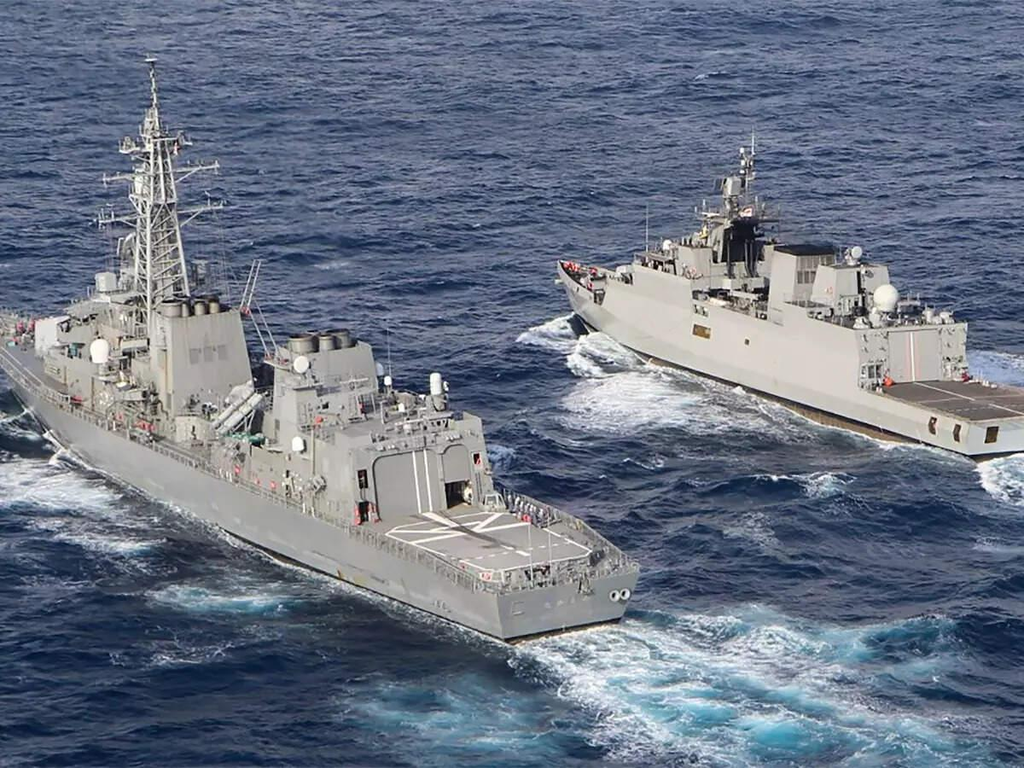
5. India–Japan Partnership and the Indo-Pacific
The Indo-Pacific and the three C’s: China, Challenges and Cooperation – Global Defense News – GSDN
The Indo-Pacific is a geographical and strategic concept connecting the Indian Ocean and Pacific Ocean regions.
It reflects the growing recognition that security and economic developments in these two maritime regions are closely interconnected.
For India, the Indo-Pacific extends from the eastern coast of Africa to the western Pacific. Japan’s strategic outlook similarly emphasises a free and open Indo-Pacific.
A. Free and Open Indo-Pacific (FOIP)
Japan has been a major proponent of the concept of a Free and Open Indo-Pacific.
The concept emphasises:
- Freedom of navigation and overflight.
- Respect for international law.
- Peaceful resolution of disputes.
- Connectivity and infrastructure development.
- Economic openness.
- Regional cooperation.
- Respect for sovereignty and territorial integrity.
India’s approach shares many of these principles, although it places particular emphasis on inclusivity, ASEAN centrality and strategic autonomy.
B. Indo-Pacific Oceans Initiative (IPOI)
India launched the Indo-Pacific Oceans Initiative in 2019 to promote practical cooperation in the maritime domain.
Its broad areas of cooperation include:
- Maritime security.
- Maritime ecology.
- Maritime resources.
- Capacity building and resource sharing.
- Disaster risk reduction and management.
- Science, technology and academic cooperation.
- Trade connectivity and maritime transport.
Japan has been an important partner in advancing the initiative.
C. MAHASAGAR
India’s MAHASAGAR – Mutual and Holistic Advancement for Security and Growth Across Regions – reflects an expanded vision of maritime cooperation and engagement with countries across the Global South.
The fourth 2+2 dialogue emphasised greater synergy between Japan’s FOIP vision, India’s IPOI and MAHASAGAR.
This convergence can strengthen regional cooperation without requiring countries to participate in an exclusive military grouping. Press Information Bureau
D. The Quad
India and Japan are also members of the Quadrilateral Security Dialogue (Quad), along with the United States and Australia.
The Quad is a diplomatic and strategic partnership that focuses on cooperation in areas such as:
- Maritime security.
- Critical and emerging technologies.
- Infrastructure and connectivity.
- Health security.
- Cyber security.
- Humanitarian assistance and disaster response.
- Economic security.
The Quad is not a formal collective defence alliance and does not have a mutual defence treaty.
India–Japan bilateral cooperation complements the wider Quad framework by enabling practical coordination on regional challenges. Press Information Bureau+1
6. Economic Cooperation: From Trade to Strategic Interdependence
Economic cooperation has traditionally been the foundation of India–Japan relations. It is now increasingly being viewed through the wider framework of economic security.
A. Comprehensive Economic Partnership Agreement (CEPA)
The India–Japan CEPA came into force on 1 August 2011.
It covers a broad range of areas:
- Trade in goods.
- Trade in services.
- Investment.
- Movement of natural persons.
- Intellectual property rights.
- Customs procedures.
- Cooperation in several economic sectors.
The agreement was designed to reduce trade barriers and improve economic integration between the two countries. Ministry of Foreign Affairs of Japan+1
B. Japanese investment in India
Japan has been an important source of investment and development assistance for India.
Japanese companies have invested in sectors such as:
- Automobiles and auto components.
- Electronics.
- Industrial machinery.
- Infrastructure.
- Financial services.
- Logistics.
- Renewable energy.
- Manufacturing.
Japanese investment has contributed to India’s industrial development, employment generation and technology acquisition.
C. Japanese Official Development Assistance
Japan has supported India’s infrastructure development through long-term, concessional ODA loans and technical cooperation.
Important areas include:
- Delhi Metro.
- Mumbai–Ahmedabad High-Speed Rail.
- Dedicated Freight Corridor.
- Urban infrastructure.
- Water supply and sanitation.
- Industrial corridors.
- North-Eastern connectivity projects.
The Mumbai–Ahmedabad High-Speed Rail Project, based on Japan’s Shinkansen technology, is one of the most visible examples of this cooperation.
Japanese ODA has also contributed to capacity building, technology transfer and infrastructure modernisation. Ministry of Foreign Affairs of Japan+2
D. The significance of economic security
Traditional economic cooperation focuses primarily on trade, investment and market access.
Economic security places greater emphasis on protecting critical supply chains, strategic industries and essential technologies from external disruptions.
This is becoming increasingly important because of:
- Geopolitical tensions.
- Export restrictions.
- Concentration of critical mineral processing.
- Semiconductor supply vulnerabilities.
- Dependence on imported energy.
- Disruptions in global logistics.
India and Japan have therefore identified economic security as a major pillar of their strategic partnership.
7. Cooperation in Critical and Emerging Technologies
Technological cooperation is becoming central to India–Japan relations.
The 2026 joint statement identified several areas where the two countries can develop complementary capabilities.
A. Semiconductor ecosystem
Semiconductors are essential for modern electronics, telecommunications, artificial intelligence, automobiles, defence systems and industrial automation.
India seeks to develop domestic semiconductor manufacturing and design capabilities, while Japan possesses considerable strengths in semiconductor materials, equipment and precision manufacturing.
Cooperation can include:
- Semiconductor manufacturing.
- Advanced materials.
- Research and development.
- Skilled workforce development.
- Supply-chain diversification.
- Technology partnerships.
B. Artificial intelligence
The two countries have identified artificial intelligence as an important area of strategic research and development cooperation.
The Japan–India AI Cooperation Initiative (JAI) seeks to strengthen cooperation in AI ecosystems and build capabilities to address economic and societal priorities.
Potential areas include:
- AI research and innovation.
- Industrial applications.
- Healthcare.
- Agriculture.
- Disaster management.
- Cyber security.
- Responsible AI governance.
C. Cyber security
Increasing dependence on digital infrastructure has created new vulnerabilities.
Cyberattacks targeting financial systems, telecommunications, power grids and government networks can have serious economic and national security consequences.
India and Japan have therefore agreed to deepen cooperation in:
- AI-enabled cyber security.
- Protection of critical infrastructure.
- Cyber threat information sharing.
- Security of AI systems.
- Institutional dialogue and capacity building.
D. Space cooperation
India and Japan have complementary capabilities in space technology.
Cooperation can be expanded in:
- Space Situational Awareness (SSA).
- Satellite-based maritime domain awareness.
- Earth observation.
- Space science.
- Space-related international rules and norms.
Space cooperation is particularly important because satellites increasingly support communication, navigation, disaster management, intelligence and military operations. Press Information Bureau+1
8. Critical Minerals and Resilient Supply Chains
Critical minerals are essential for clean energy technologies, electronics, defence systems and advanced manufacturing.
Minerals such as lithium, cobalt, nickel, graphite and rare earth elements are important for:
- Electric vehicle batteries.
- Solar panels and wind turbines.
- Semiconductors.
- Permanent magnets.
- Advanced electronic equipment.
- Defence technologies.
The concentration of mining, processing and refining capacities in a limited number of countries creates strategic vulnerabilities.
India and Japan have therefore identified critical minerals as an important area for economic security cooperation.
Potential areas of cooperation
- Joint exploration and development of mineral resources.
- Investment in mineral processing and refining.
- Research into alternative materials.
- Recycling and recovery of critical minerals.
- Diversification of international supply chains.
- Cooperation with resource-rich developing countries.
The partnership can help India reduce import vulnerabilities while providing Japanese industries with diversified supply options.
This is especially important in the context of the global energy transition and the growing demand for strategic materials. Press Information Bureau+1
9. Cooperation in Global Governance
India and Japan share an interest in reforming international institutions to reflect contemporary geopolitical and economic realities.
A. United Nations Security Council reform
Both countries support the expansion of the UN Security Council in its permanent and non-permanent categories.
They have expressed mutual support for each other’s candidature for permanent membership in a reformed Security Council.
They have also confirmed mutual support for their respective non-permanent candidatures for the years 2028–29 and 2033–34. Press Information Bureau+1
B. Counter-terrorism
India and Japan have condemned terrorism in all its forms, including cross-border terrorism.
The 2026 joint statement called for concerted action against UN-listed terrorist organisations, terrorist financing networks and safe havens.
This cooperation is significant in the context of transnational terrorism and the growing links between terrorist networks and organised crime. Press Information Bureau
C. Climate change and energy security
Both countries face the challenge of balancing economic growth with decarbonisation.
Potential areas of cooperation include:
- Clean energy technologies.
- Hydrogen and ammonia.
- Energy efficiency.
- Renewable energy.
- Battery technology.
- Green industrial development.
- Climate-resilient infrastructure.
D. Cooperation with the Global South
India and Japan can jointly contribute to infrastructure development, connectivity, capacity building and technological cooperation in developing countries.
Such cooperation can provide alternatives to unsustainable debt and poorly designed infrastructure projects.
10. Challenges in India–Japan Relations
Despite strong strategic convergence, the relationship faces several challenges that require sustained attention.
A. Trade imbalance and limited economic integration
Bilateral trade has not reached its full potential.
Indian exports to Japan remain relatively limited compared with the size of the two economies.
Differences in business practices, regulatory standards, language and market access can also constrain investment and trade.
B. Implementation delays in infrastructure projects
Large infrastructure projects often face delays because of:
- Land acquisition problems.
- Regulatory clearances.
- Cost escalation.
- Coordination difficulties.
- Technical and administrative constraints.
The Mumbai–Ahmedabad High-Speed Rail Project illustrates the complexity of implementing large technology-intensive infrastructure projects.
C. Defence technology transfer
Although defence cooperation is expanding, the actual transfer of sophisticated technologies and the development of joint production capabilities require sustained negotiations.
Differences in procurement systems, industrial standards and strategic requirements can complicate implementation.
D. Divergent strategic priorities
India and Japan share many regional concerns, but their security environments are not identical.
Japan’s security policy is shaped by its geographical proximity to East Asia’s major strategic tensions.
India’s security priorities also include continental threats, border security and developments in the Indian Ocean.
These differences may influence the extent and nature of strategic coordination.
E. Economic dependence on China
Both India and Japan maintain important economic relationships with China.
Rapid decoupling from Chinese supply chains could impose significant costs on their industries.
The challenge is therefore to pursue diversification and resilience without creating unnecessary economic disruption.
F. Differences in strategic outlook
Japan is a treaty ally of the United States, whereas India follows a policy of strategic autonomy and is not part of a formal military alliance system.
This does not prevent cooperation, but it influences the institutional structure and limits of bilateral strategic engagement.
G. Demographic and labour-market constraints
Japan faces an ageing population and a declining working-age population.
India has a relatively young population but faces challenges relating to skill development, employment and productivity.
Effective mobility arrangements and skill partnerships can help address complementary demographic needs, but require institutional coordination.
11. Way Forward: Towards a More Comprehensive Strategic Partnership
India and Japan should move from broad strategic declarations towards measurable outcomes in trade, technology, defence and regional cooperation.
1. Strengthen economic integration
India should improve its business environment, logistics infrastructure and regulatory predictability to attract greater Japanese investment.
Both countries should also address implementation bottlenecks under CEPA.
2. Promote joint defence manufacturing
Cooperation should move beyond the purchase and transfer of equipment towards joint research, design, production and maintenance.
The Design with Japan, Make in India framework can provide an institutional foundation for this process.
3. Expand maritime cooperation
The two countries should strengthen information sharing, maritime domain awareness, naval exercises, coast guard cooperation and capacity building for smaller Indian Ocean countries.
4. Build resilient supply chains
India and Japan should deepen cooperation in semiconductors, critical minerals, batteries, pharmaceuticals and other strategic sectors.
Diversification should be accompanied by investment in domestic capabilities.
5. Accelerate technology partnerships
Joint research, university partnerships, start-up exchanges and industrial collaboration can strengthen cooperation in AI, cyber security, robotics and space technology.
6. Strengthen North-Eastern connectivity
The India–Japan Act East Forum should be used to accelerate infrastructure, logistics and industrial development in India’s North-East.
This would strengthen India’s connectivity with Bangladesh, Myanmar and Southeast Asia.
7. Expand people-to-people exchanges
Student exchanges, skill mobility, tourism, language training and cultural programmes can strengthen the social foundations of the partnership.
The two countries have also agreed to celebrate the 75th anniversary of diplomatic relations in 2027 as the India–Japan Year of Shared Horizons. Press Information Bureau+1
8. Maintain strategic autonomy and inclusivity
India should deepen its partnership with Japan while maintaining constructive engagement with other regional powers.
The objective should be a stable, inclusive and rules-based Indo-Pacific rather than the creation of rigid geopolitical blocs.
12. Significance for India’s Foreign Policy
The India–Japan relationship reflects several important features of India’s contemporary foreign policy.
| Foreign policy objective | Contribution of Japan partnership |
|---|---|
| Strategic autonomy | Diversifies India’s strategic partnerships |
| Act East Policy | Strengthens India’s engagement with Southeast Asia |
| Indo-Pacific vision | Promotes maritime stability and freedom of navigation |
| Atmanirbhar Bharat | Supports manufacturing and technology partnerships |
| Make in India | Encourages investment and joint industrial production |
| Global South engagement | Facilitates development cooperation and infrastructure |
| Economic security | Diversifies critical supply chains |
| Defence modernisation | Supports defence technology and industrial cooperation |
| Multilateral reform | Strengthens India’s case for UNSC reform |
The relationship demonstrates that India’s foreign policy is increasingly based on issue-based partnerships, where cooperation is developed according to shared interests rather than rigid alliance commitments.
Conclusion
India–Japan relations have evolved into one of the most consequential strategic partnerships in the Indo-Pacific. Their cooperation is no longer confined to economic assistance, trade and infrastructure development. It now encompasses defence industrial collaboration, maritime security, advanced technologies, critical minerals, cyber security and regional governance.
The Fourth India–Japan 2+2 Ministerial Dialogue of November 2026 reflects this widening strategic agenda.
However, the long-term success of the partnership will depend on its ability to translate diplomatic convergence into concrete outcomes. Faster infrastructure implementation, greater economic integration, joint technology development and sustained defence cooperation are essential.
For India, Japan is not merely an important economic partner; it is a significant partner in building a stable, resilient, inclusive and rules-based Indo-Pacific order.
UPSC examination relevance
GS Paper II: Bilateral relations, regional groupings, international institutions, foreign policy and the Indo-Pacific.
GS Paper III: Defence technology, cyber security, critical technologies, supply-chain resilience and economic security.
Essay: Strategic partnerships in a multipolar world; the role of India in shaping the Indo-Pacific.
Prelims facts to remember
- India and Japan established diplomatic relations in 1952.
- Japan began providing ODA to India in 1958.
- The India–Japan CEPA entered into force on 1 August 2011.
- India–Japan relations were upgraded to a Special Strategic and Global Partnership in 2014.
- The India–Japan Act East Forum was established in 2017.
- The ACSA facilitates reciprocal provision of supplies and services between the armed forces of the two countries.
- Dharma Guardian is an army exercise; JIMEX is a naval exercise; Veer Guardian is an air force exercise.
- The Quad consists of India, Japan, the United States and Australia.
- IPOI was launched by India in 2019.
- The fourth India–Japan 2+2 dialogue was held in Tokyo on 19 November 2026.
- The two countries will celebrate 75 years of diplomatic relations in 2027.
Mains practice questions
1. GS Paper II – 10 Marks
Examine the significance of the India–Japan Special Strategic and Global Partnership in advancing India’s Indo-Pacific vision.
2. GS Paper II – 15 Marks
The India–Japan partnership has evolved from an economic relationship into a comprehensive strategic partnership. Discuss its major pillars and the challenges in realising its full potential.
3. GS Paper II – 15 Marks
“India and Japan can play a critical role in promoting a free, open, inclusive and rules-based Indo-Pacific.” Analyse the statement in the context of emerging geopolitical developments.
4. GS Paper III – 10 Marks
Discuss the importance of India–Japan cooperation in critical technologies and resilient supply chains for India’s strategic autonomy.
Official references and further reading
- PIB – Joint Statement: Fourth India–Japan 2+2 Foreign and Defence Ministerial Meeting, 19 November 2026.
- Japan Ministry of Foreign Affairs – Fourth Japan–India 2+2 Meeting.
- Japan Ministry of Defence – Japan–India Defence Ministers’ Joint Statement.
- Ministry of External Affairs – India–Japan Bilateral Brief.
- Japan Ministry of Foreign Affairs – India–Japan Economic Partnership Agreement.
- Japan Ministry of Foreign Affairs – India–Japan Relations: Basic Data.