
Introduction
Fertilisers are among the most important agricultural inputs influencing crop productivity, food security and farmers’ incomes. India’s agricultural transformation, particularly the Green Revolution, was supported by the expansion of irrigation, high-yielding varieties of seeds and the increased application of chemical fertilisers.
However, India’s fertiliser policy faces a complex challenge today. The country must ensure an uninterrupted supply of affordable fertilisers to millions of farmers while simultaneously reducing import dependence, managing the growing fiscal burden of subsidies and correcting the imbalance in nutrient application.
The issue has acquired renewed significance following the Union Cabinet’s approval of ₹62,370.02 crore in Nutrient-Based Subsidy (NBS) for phosphatic and potassic fertilisers for the Rabi 2026–27 season on 11 November 2026. The approved outlay is approximately 64.3% higher than the ₹37,952.29 crore provided for the corresponding previous Rabi season. Press Information Bureau+1
The decision reflects the impact of international fertiliser prices and the importance of government intervention in maintaining affordable agricultural inputs.
More importantly, it brings into focus a fundamental question:
Can India achieve fertiliser security without compromising fiscal sustainability, soil health and long-term agricultural productivity?
Fertiliser security must therefore be understood not merely as the availability of chemical inputs, but as the ability to provide farmers with the right nutrients, at the right price, in the right quantity and at the right time, while ensuring the sustainability of agricultural production.
1. Understanding Fertilisers and Their Role in Agriculture
Fertilisers are substances containing essential plant nutrients that are added to soil or applied to plants to improve growth, productivity and crop quality.
Plants require several nutrients for their growth and development. These are broadly classified into macronutrients and micronutrients.
A. Primary macronutrients
The three primary macronutrients are:
| Nutrient | Major functions | Deficiency symptoms |
|---|---|---|
| Nitrogen (N) | Promotes vegetative growth, chlorophyll formation and protein synthesis | Yellowing of older leaves and stunted growth |
| Phosphorus (P) | Supports root development, energy transfer, flowering and seed formation | Poor root development and delayed maturity |
| Potassium (K) | Regulates water balance, enzyme activity and disease resistance | Weak stems, leaf scorching and reduced crop quality |
These nutrients are commonly referred to as NPK.
B. Secondary nutrients
- Sulphur (S): Essential for protein synthesis and the formation of certain amino acids.
- Calcium (Ca): Important for cell-wall formation and root development.
- Magnesium (Mg): A central component of chlorophyll and essential for photosynthesis.
C. Micronutrients
Plants require micronutrients in smaller quantities, but their importance is considerable.
Examples include:
- Zinc
- Iron
- Boron
- Copper
- Manganese
- Molybdenum
- Chlorine
Deficiencies of micronutrients can reduce crop productivity even when the major nutrients are available in adequate quantities.
Important: Fertiliser application must be based on soil characteristics, crop requirements and nutrient availability rather than a uniform application across all agricultural land.
2. Major Types of Fertilisers Used in India
India uses different categories of chemical fertilisers depending on their nutrient composition and agricultural requirements.
| Fertiliser | Major nutrient composition | Importance |
|---|---|---|
| Urea | 46% Nitrogen | Major source of nitrogen |
| DAP | 18% Nitrogen and 46% Phosphorus pentoxide | Supplies nitrogen and phosphorus |
| MOP | Approximately 60% Potassium oxide | Major source of potassium |
| SSP | Phosphorus, calcium and sulphur | Supplies phosphorus and secondary nutrients |
| NPK complex fertilisers | Different combinations of N, P and K | Supports balanced nutrient application |
| Ammonium sulphate | Nitrogen and sulphur | Supplies nitrogen and sulphur |
Urea
Urea is the most widely used nitrogenous fertiliser in India.
Its nitrogen content is approximately 46%, making it a concentrated source of nitrogen.
The price of agricultural urea is regulated by the government and it is sold to farmers at a notified maximum retail price, with the government bearing the subsidy burden.
Di-Ammonium Phosphate (DAP)
DAP is an important phosphatic fertiliser containing 18% nitrogen and 46% phosphorus pentoxide.
It is widely used during the sowing stage of several crops because phosphorus supports early root development.
India depends significantly on imports of DAP and its raw materials.
Muriate of Potash (MOP)
MOP is an important source of potassium.
Potassium improves crop quality, water regulation, resistance to certain stresses and overall plant health.
India’s dependence on imported potash makes its availability particularly sensitive to international markets.
Single Superphosphate (SSP)
SSP is a phosphatic fertiliser that also supplies calcium and sulphur.
It can serve as an alternative source of phosphorus in suitable cropping and soil conditions.
The government continues to provide freight support to promote SSP as an affordable alternative to DAP during Rabi 2026–27. Press Information Bureau
3. Why is Fertiliser Security Important for India?
India has a large agricultural sector, and fertiliser availability has direct implications for food production, farm incomes and rural livelihoods.
A. Ensuring food security
Fertilisers contribute to higher agricultural productivity by replenishing nutrients removed from the soil through successive cropping cycles.
Their availability is particularly important for:
- Wheat and rice production.
- Maize and other cereals.
- Pulses and oilseeds.
- Sugarcane and cotton.
- Horticultural crops.
Any major disruption in fertiliser supplies during sowing seasons can affect agricultural output.
B. Supporting farmers’ incomes
Fertilisers constitute an important component of cultivation costs.
Government subsidies reduce the prices paid by farmers and help protect them from sudden increases in international prices.
C. Maintaining agricultural productivity
Continuous cultivation without adequate nutrient replenishment can deplete soil fertility.
Fertilisers help replenish essential nutrients and maintain crop productivity when used appropriately.
D. Reducing food-price volatility
Agricultural input costs influence production costs, which can ultimately affect food prices.
Disruptions in fertiliser supplies or sharp increases in prices may affect sowing decisions, crop yields and food availability.
E. Strategic and economic security
Fertiliser production depends on several raw materials and energy sources, including natural gas, ammonia, phosphate rock, sulphur and potash.
Dependence on international suppliers exposes India to:
- Geopolitical tensions.
- Trade restrictions.
- Shipping disruptions.
- Currency depreciation.
- Global commodity-price volatility.
Fertiliser security is therefore closely linked with national economic security and strategic autonomy.
4. Recent Development: Nutrient-Based Subsidy for Rabi 2026–27
The Union Cabinet approved revised Nutrient-Based Subsidy rates for phosphatic and potassic fertilisers for the Rabi 2026–27 season on 11 November 2026.
The decision was taken in response to changing international prices of fertilisers and important raw materials.
Key current-affairs development
Major financial details
| Particulars | Details |
|---|---|
| NBS outlay for Rabi 2026–27 | ₹62,370.02 crore |
| NBS outlay for Rabi 2025–26 | ₹37,952.29 crore |
| Increase in outlay | ₹24,417.73 crore |
| Approximate increase | 64.3% |
| Period of applicability | 1 October 2026 – 31 March 2027 |
| Number of P&K fertiliser grades covered | 28 |
The revised subsidy rates are linked to the nutrient content of fertilisers.
Nutrient-based subsidy rates for Rabi 2026–27
Subsidy rates per kilogram of nutrient
| Nutrient | Symbol | Subsidy rate |
|---|---|---|
| Nitrogen | N | ₹94.21 |
| Phosphorus | P | ₹66.11 |
| Potassium | K | ₹2.38 |
| Sulphur | S | ₹10.42 |
The subsidy is provided to fertiliser companies at notified rates to facilitate the availability of fertilisers to farmers at affordable prices. Press Information Bureau+1
Additional measures
The government has also continued several special provisions:
- DAP price support: Special provisions to maintain DAP availability at ₹1,350 per 50 kg bag, over and above the regular NBS subsidy.
- Extension to TSP and MAP: Special support has been extended to imported and domestic Triple Superphosphate and imported Monoammonium Phosphate.
- SSP freight subsidy: Freight support for Single Superphosphate has been continued.
- Ammonium sulphate subsidy: Support for imported and domestically produced ammonium sulphate has been continued.
- Sulphur package: Support has been provided to domestic manufacturers of sulphur and sulphuric acid.
These interventions seek to protect farmers from international price volatility while supporting domestic production. Press Information Bureau+1
What does the increase in subsidy indicate?
The increase in subsidy expenditure has two important implications.
First, it reflects the government’s attempt to protect farmers from rising international input costs.
Second, it highlights the fiscal vulnerability associated with a fertiliser system that depends significantly on imported raw materials and government price support.
The central challenge is to maintain affordability without allowing the subsidy system to become fiscally unsustainable.
5. Nutrient-Based Subsidy Scheme (NBS): Understanding the Policy
The Nutrient-Based Subsidy Scheme was introduced with effect from 1 April 2010.
Its primary objective is to promote balanced fertiliser application by linking subsidies to the nutrient content of fertilisers rather than treating all fertiliser products identically.
How does the NBS scheme work?
Under the scheme:
- The government determines subsidy rates for different nutrients.
- The rates are notified for the Kharif and Rabi seasons.
- Fertiliser manufacturers and importers receive subsidies based on the approved nutrient rates.
- The P&K fertiliser sector operates under a decontrolled pricing regime, subject to government oversight.
- Farmers purchase the fertilisers at the notified or company-determined retail prices, as applicable.
The scheme currently covers 28 grades of phosphatic and potassic fertilisers, including DAP and different NPKS grades. Press Information Bureau
Why was NBS introduced?
Before the introduction of NBS, fertiliser subsidies were largely based on product-specific pricing arrangements.
This created distortions in the relative prices of different fertilisers.
The NBS approach was intended to encourage:
- Balanced nutrient application.
- Greater competition among fertiliser manufacturers.
- Improved availability of different grades.
- More efficient subsidy allocation.
- Reduced excessive dependence on particular fertiliser products.
Limitations of the scheme
Despite its objectives, the NBS scheme has not completely corrected India’s nutrient imbalance.
One important reason is that urea remains outside the NBS framework and continues under a separate price-control and subsidy arrangement.
As a result, the relative affordability of nitrogenous fertiliser can encourage excessive urea consumption compared with phosphatic and potassic fertilisers.
This demonstrates that reforming the subsidy system requires a comprehensive approach rather than changes to P&K subsidies alone.
6. India’s Fertiliser Dependency: Domestic Production and Imports
India is among the world’s largest consumers and producers of fertilisers. However, domestic production does not fully satisfy the country’s requirements across all fertiliser categories.
The country continues to depend on imports of finished fertilisers as well as important raw materials and intermediate products.
Major sources of dependence
| Fertiliser/input | Nature of dependence |
|---|---|
| Urea | Domestic production is significant, but imported urea and feedstock dependence remain relevant |
| DAP | Significant import dependence |
| MOP | High dependence on imported potash |
| Phosphoric acid | Import dependence |
| Rock phosphate | Significant import dependence |
| Ammonia | Imports supplement domestic production |
| Sulphur | Important import dependence |
Why is import dependence a concern?
1. Geopolitical disruptions
Conflicts and political tensions in major producing or transit regions can interrupt supply.
2. Shipping and logistics costs
Fertiliser imports depend on maritime transportation. Disruptions to shipping routes can increase freight and insurance costs.
3. Exchange-rate fluctuations
A depreciation of the Indian rupee increases the domestic cost of imported fertilisers and raw materials.
4. Concentration of suppliers
Dependence on a limited number of suppliers creates vulnerability to export restrictions, production disruptions and changes in trade policies.
5. International price volatility
Fertiliser prices are influenced by energy costs, agricultural demand, supply disruptions and geopolitical developments.
The West Asian geopolitical dimension
India’s fertiliser supply chain was affected by disruptions arising from geopolitical tensions in West Asia during 2025–26.
According to the Ministry of Chemicals and Fertilisers, imports of ammonia, phosphoric acid and sulphur were particularly affected, while potash imports experienced higher landed costs because of logistical disruptions.
The government responded through diversification of sourcing, long-term supply arrangements and collective procurement of raw materials. Press Information Bureau
UPSC perspective: Fertiliser security is not merely an agricultural issue. It also involves international trade, maritime security, energy security and geopolitical risk management.
7. India’s Fertiliser Supply Position: Recent Stock Trends
The government has strengthened fertiliser supply monitoring and stock management to ensure availability during agricultural seasons.
According to the Ministry of Chemicals and Fertilisers, total stocks of major fertilisers increased from 173.46 lakh tonnes on 10 November 2025 to 235.21 lakh tonnes on 10 November 2026.
This represents an increase of approximately 35.6%. Press Information Bureau
Fertiliser stocks: November comparison
Major fertiliser stocks in India
Stocks on 10 November 2025 compared with 10 November 2026; lakh tonnes.
10 Nov 2025
10 Nov 2026
0 lakh tonnes30 lakh tonnes60 lakh tonnes90 lakh tonnes120 lakh tonnesUreaDAPNPKSMOPSSP
Source: Ministry of Chemicals and Fertilisers, PIB, 12 November 2026.
The increase in stock levels indicates improved supply preparedness. However, adequate national-level stocks do not automatically guarantee timely availability in every district.
The effectiveness of distribution, transport infrastructure, dealer networks and state-level monitoring remains important.
Fertiliser monitoring mechanisms
The Department of Fertilisers uses the Integrated Fertilizer Management System (iFMS) to monitor fertiliser movement and availability.
The system helps in:
- Tracking fertiliser stocks.
- Monitoring supply and distribution.
- Assessing state-wise requirements.
- Identifying regional shortages.
- Coordinating corrective measures.
The government also prepares state-wise and month-wise fertiliser requirements in consultation with state governments before each cropping season. Press Information Bureau
8. Nutrient Imbalance in Indian Agriculture
One of the most serious problems associated with India’s fertiliser policy is the imbalance in nutrient application.
The excessive application of nitrogenous fertilisers, particularly urea, compared with phosphorus and potassium has created distortions in soil nutrient management.
The ideal nutrient balance
The commonly cited general N:P:K application ratio for Indian agriculture is 4:2:1.
However, the actual ratio varies across regions, crops and seasons. National averages and ideal ratios should not be treated as universal recommendations for every soil or crop.
Why does nutrient imbalance occur?
1. Price distortions
Urea’s heavily subsidised price makes it relatively cheaper than many alternative fertilisers.
This encourages farmers to apply higher quantities of nitrogen.
2. Inadequate soil testing
Many farmers do not have timely access to reliable soil-testing facilities or do not receive adequate guidance on interpreting soil-health recommendations.
3. Lack of awareness
Farmers may associate higher fertiliser application with higher crop yields without understanding the importance of balanced nutrient management.
4. Cropping patterns
The intensive cultivation of water- and nutrient-demanding crops can increase the pressure on soil nutrients.
5. Procurement and distribution practices
The availability of certain fertiliser grades, local dealer incentives and seasonal supply conditions may influence farmers’ purchasing decisions.
Consequences of nutrient imbalance
- Declining soil fertility.
- Micronutrient deficiencies.
- Lower nutrient-use efficiency.
- Increased cultivation costs.
- Greater environmental pollution.
- Reduced long-term agricultural sustainability.
The challenge is not simply to reduce fertiliser consumption, but to ensure that every unit of nutrient applied produces the maximum possible agricultural benefit.
9. Environmental Consequences of Excessive Fertiliser Use
Excessive and poorly managed fertiliser application can create several environmental problems.
A. Soil degradation
Long-term imbalanced fertiliser application can alter soil chemical properties and contribute to nutrient depletion or accumulation.
It may also aggravate soil acidity or salinity under certain conditions.
B. Water pollution
Excess nitrogen and phosphorus can move into rivers, lakes and groundwater through runoff and leaching.
This may contribute to eutrophication, a process in which excessive nutrients stimulate algal growth and reduce dissolved oxygen in water bodies.
C. Groundwater contamination
Nitrate leaching from agricultural fields can contaminate groundwater.
High nitrate concentrations in drinking water pose public-health concerns.
D. Greenhouse gas emissions
Nitrogen fertilisers contribute to emissions of nitrous oxide (N₂O), a potent greenhouse gas.
Nitrous oxide is released through microbial processes in soil, particularly nitrification and denitrification.
Improving nitrogen-use efficiency can therefore provide both agricultural and climate benefits.
E. Biodiversity impacts
Nutrient runoff can alter aquatic ecosystems, while excessive fertiliser use can affect soil microbial communities and ecological balance.
Important: Chemical fertilisers are not inherently harmful. Their impact depends on the type, quantity, timing, method and environmental conditions of application.
The objective should be scientific nutrient management rather than the indiscriminate rejection of chemical fertilisers.
10. Government Initiatives for Improving Fertiliser Efficiency
India has introduced several measures to improve nutrient-use efficiency, promote balanced fertilisation and reduce excessive dependence on chemical inputs.
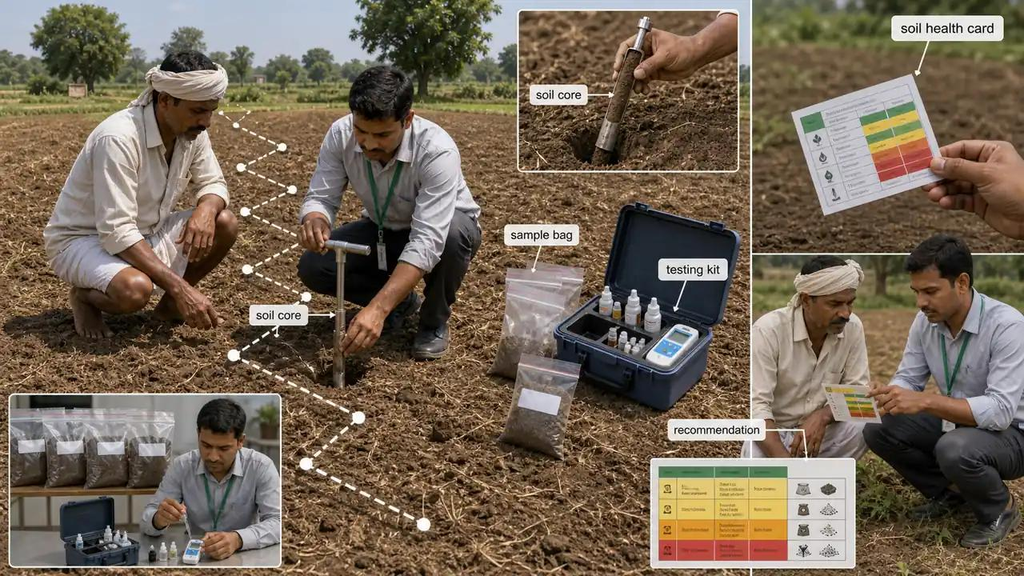
A. Soil Health Card Scheme
Telangana’s First Mobile Soil Lab Ignites a Movement for Environmental Wellness
The Soil Health Card Scheme was launched in 2015.
Its objective is to provide farmers with information about the nutrient status of their agricultural soil and recommend appropriate nutrient application.
The cards provide information on important soil parameters, including:
- Nitrogen.
- Phosphorus.
- Potassium.
- Sulphur.
- Zinc.
- Iron.
- Copper.
- Manganese.
- Boron.
- Soil pH and electrical conductivity.
- Organic carbon.
Significance: It promotes scientific fertiliser application based on soil requirements rather than conventional practices.
B. Neem-Coated Urea
Neem-coated urea was introduced to improve nitrogen-use efficiency and reduce the diversion of subsidised urea for non-agricultural purposes.
Neem coating slows the conversion of urea nitrogen into forms that can be rapidly lost from the soil.
Potential benefits include:
- Improved nitrogen-use efficiency.
- Reduced nitrogen losses.
- Better fertiliser management.
- Reduction in unauthorised diversion.
However, neem coating alone cannot eliminate excessive urea consumption. Balanced nutrient application and appropriate agronomic practices remain necessary.
C. PM-PRANAM
The Prime Minister Programme for Restoration, Awareness, Nourishment and Amelioration of Mother Earth (PM-PRANAM) seeks to encourage states and Union Territories to reduce the consumption of chemical fertilisers.
Its broad objective is to promote:
- Balanced fertiliser application.
- Alternative nutrient sources.
- Organic fertilisers.
- Biofertilisers.
- Sustainable agricultural practices.
The scheme provides incentives to states and Union Territories based on reductions in chemical fertiliser consumption, subject to the scheme’s prescribed framework.
D. Paramparagat Krishi Vikas Yojana (PKVY)
PKVY promotes organic farming through cluster-based approaches.
It encourages farmers to adopt organic agricultural practices and reduce dependence on synthetic chemical inputs.
E. National Mission on Natural Farming
The National Mission on Natural Farming promotes natural farming practices that seek to reduce dependence on purchased chemical inputs and improve ecological sustainability.
It emphasises the use of locally available resources, biological inputs and farm-based nutrient management.
F. Nano Fertilisers
Nano fertilisers are developed using nanotechnology to improve nutrient delivery and utilisation.
Examples include nano urea and nano DAP.
Their potential advantages include:
- Targeted nutrient delivery.
- Reduced bulk transportation.
- Improved application efficiency.
- Possibility of reducing conventional fertiliser requirements in suitable conditions.
However, their effectiveness must be assessed through independent field trials, crop-specific evidence, long-term soil studies and careful evaluation of environmental and economic impacts.
They should be viewed as complementary tools rather than automatic substitutes for all conventional fertilisers.
11. Alternatives to Conventional Chemical Fertilisers
A sustainable fertiliser policy requires diversification of nutrient sources.
Chemical fertilisers can be complemented with organic manures, biofertilisers, crop residues and other nutrient-recycling systems.
A. Organic manure
Organic manure includes decomposed plant and animal materials.
Examples include:
- Farmyard manure.
- Compost.
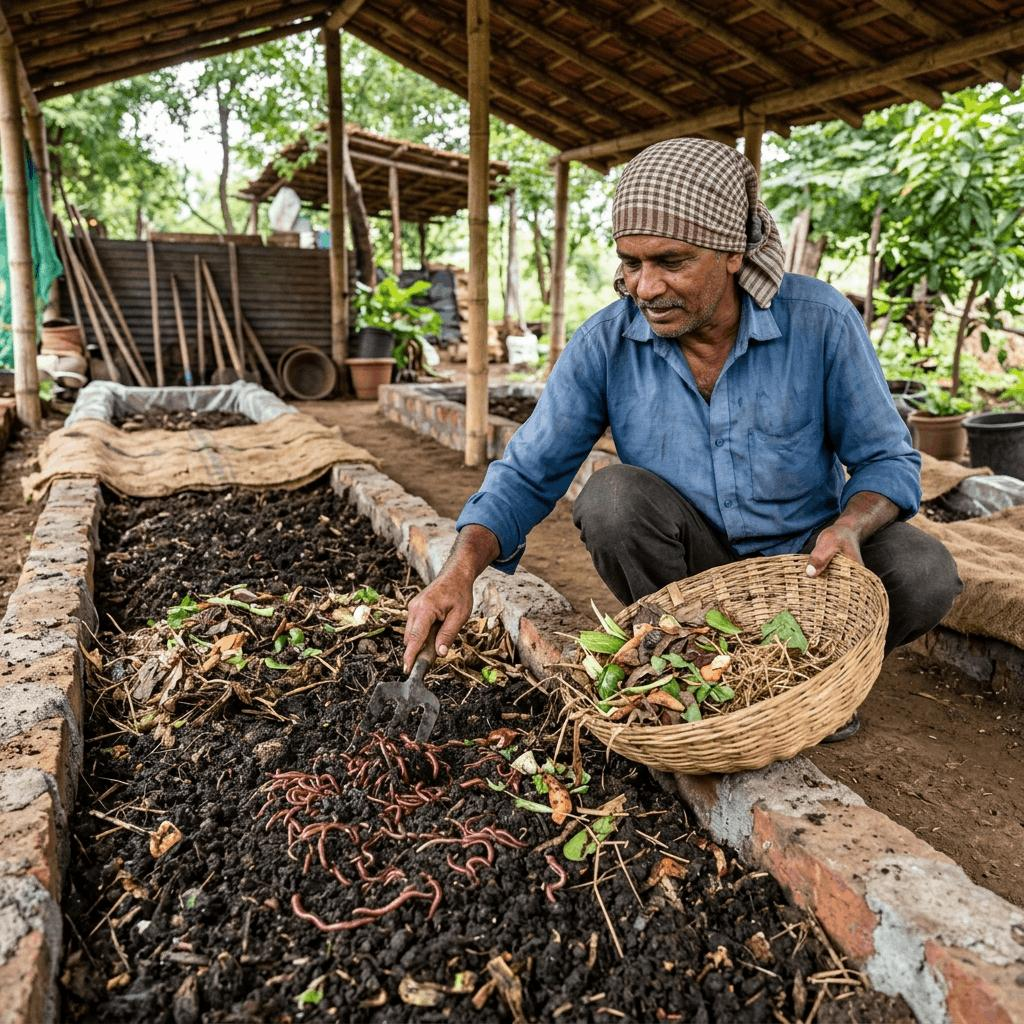
- Vermicompost.
- Green manure.
- Crop residues.
Organic manures improve soil organic matter and support soil structure, water retention and microbial activity.
B. Biofertilisers
Biofertilisers contain beneficial microorganisms that help make nutrients available to plants.
Examples include:
- Rhizobium.
- Azotobacter.
- Azospirillum.
- Phosphate-solubilising bacteria.
- Mycorrhizal fungi.
These microorganisms can support biological nitrogen fixation, phosphorus mobilisation and nutrient uptake.
C. Green manuring
Green manuring involves growing specific crops and incorporating their biomass into the soil to improve fertility.
Leguminous green-manure crops can contribute nitrogen through biological nitrogen fixation.
D. Crop residue management
Crop residues can be incorporated into soil or converted into compost and other organic inputs.
This helps recycle nutrients and improve soil organic matter.
E. Integrated Nutrient Management
Integrated Nutrient Management (INM) combines chemical fertilisers, organic manures, biofertilisers and other nutrient sources according to crop and soil requirements.
Its objective is to maintain soil fertility and improve nutrient-use efficiency over the long term.
INM does not necessarily require eliminating chemical fertilisers. It aims to optimise their use alongside other sources of nutrients.
12. Fertiliser Security and India’s Fiscal Management
Fertiliser subsidies are among the major components of India’s agricultural support system.
The subsidy is important because it protects farmers from high input prices. However, a substantial and volatile subsidy burden creates challenges for public finance.
Major fiscal concerns
1. Rising subsidy expenditure
Higher international fertiliser prices increase the amount of subsidy required to maintain affordable domestic prices.
2. Import dependence
Imported fertilisers and raw materials expose the government to international commodity prices and exchange-rate movements.
3. Price distortions
Differential pricing and subsidy structures can encourage excessive consumption of certain fertiliser products.
4. Opportunity cost
A large subsidy burden may constrain the fiscal space available for agricultural research, irrigation, extension services, storage infrastructure and rural development.
5. Uncertainty in subsidy estimates
Global price volatility makes it difficult to accurately forecast the final annual subsidy requirement.
Why subsidy reform must be gradual
An abrupt reduction in fertiliser subsidies could increase cultivation costs and adversely affect small and marginal farmers.
It may also influence crop choices and agricultural production.
Therefore, reforms must balance three objectives:
- Farmer affordability.
- Fiscal sustainability.
- Environmental sustainability.
The aim should be to improve the effectiveness of subsidies rather than simply reduce expenditure.
13. Way Forward: Towards Sustainable Fertiliser Security
India requires a comprehensive fertiliser strategy that addresses domestic production, international sourcing, nutrient management and environmental sustainability.
1. Diversify international sourcing
India should strengthen long-term supply arrangements with multiple countries and avoid excessive dependence on a limited number of suppliers.
2. Strengthen domestic production
Investment in domestic manufacturing, technology modernisation and raw-material processing can reduce external vulnerabilities.
3. Reform the subsidy structure
The government should gradually address distortions between nitrogenous, phosphatic and potassic fertilisers while protecting farmers from sudden price shocks.
4. Promote balanced nutrient application
Soil testing, crop-specific recommendations and extension services should be strengthened.
5. Improve nutrient-use efficiency
Precision agriculture, fertigation, suitable slow-release fertilisers and improved application methods can reduce nutrient losses.
6. Expand Integrated Nutrient Management
Chemical fertilisers should be used alongside organic manures, biofertilisers and crop-residue management.
7. Strengthen fertiliser research
Investment is needed in:
- Advanced fertiliser formulations.
- Biological nutrient management.
- Nano-enabled nutrient delivery.
- Soil microbiology.
- Crop-specific nutrient requirements.
- Sustainable fertiliser manufacturing.
8. Improve last-mile distribution
Digital monitoring, transparent allocation and better logistics can reduce regional shortages and delays.
9. Encourage crop diversification
Promoting pulses, oilseeds, millets and regionally suitable crops can reduce pressure arising from highly intensive monocropping systems.
10. Integrate fertiliser policy with water and soil conservation
Nutrient management should be integrated with irrigation efficiency, watershed development, soil organic carbon restoration and sustainable land management.
Conclusion
Fertiliser security is a critical component of India’s agricultural and food security framework. The country’s ability to maintain affordable fertiliser supplies has played an important role in supporting agricultural production and protecting farmers from fluctuations in international prices.
However, long-term fertiliser security cannot depend exclusively on rising subsidy expenditure and imported supplies.
India must move towards a more resilient system based on diversified sourcing, stronger domestic manufacturing, balanced nutrient application, efficient subsidy delivery and sustainable soil management.
The approval of ₹62,370.02 crore in Nutrient-Based Subsidy for Rabi 2026–27 demonstrates the government’s commitment to maintaining affordability. At the same time, it highlights the need for structural reforms that address the underlying weaknesses of the fertiliser system.
The objective of fertiliser policy should not simply be to maximise fertiliser consumption, but to maximise agricultural productivity per unit of nutrient applied while preserving the health of India’s soil and agricultural ecosystems.
UPSC Examination Relevance
GS Paper III: Major crops and cropping patterns; agricultural inputs; irrigation; agricultural subsidies; food security; environmental pollution and conservation.
GS Paper II: Government policies and interventions for development in various sectors.
Essay: Sustainable agriculture, food security, ecological limits to economic growth and the future of Indian farming.
Important Prelims facts
- The Nutrient-Based Subsidy Scheme came into effect on 1 April 2010.
- NBS covers phosphatic and potassic fertilisers, including DAP and different NPKS grades.
- The NBS subsidy is linked to the nutrient content of fertilisers.
- Urea is outside the NBS framework and is governed by a separate subsidy and price-control mechanism.
- The Soil Health Card Scheme was launched in 2015.
- Urea contains approximately 46% nitrogen.
- DAP contains 18% nitrogen and 46% phosphorus pentoxide.
- MOP is a major source of potassium.
- Rhizobium is associated with biological nitrogen fixation in leguminous plants.
- Eutrophication can result from excessive nutrient enrichment of water bodies.
- Nitrous oxide is a potent greenhouse gas associated with agricultural nitrogen management.
- PM-PRANAM encourages states and Union Territories to reduce chemical fertiliser consumption.
UPSC Mains Practice Questions
1. GS Paper III – 10 Marks
Examine the significance of the Nutrient-Based Subsidy Scheme in promoting balanced fertiliser application in India. What are its major limitations?
2. GS Paper III – 15 Marks
India’s fertiliser policy faces the twin challenges of import dependence and excessive chemical fertiliser consumption. Discuss the implications for agricultural productivity, fiscal sustainability and environmental security.
3. GS Paper III – 15 Marks
How can Integrated Nutrient Management contribute to sustainable agricultural development in India? Examine the role of government initiatives in promoting balanced nutrient application.
4. Essay
“Food security in the twenty-first century depends as much on soil health as on agricultural productivity.”
Official references and further reading
- PIB – Cabinet approves NBS rates for Rabi 2026–27, 11 November 2026.
- PIB – Nutrient-Based Subsidy Rates for Rabi 2026–27, 12 November 2026.
- PIB – Government measures to safeguard fertiliser supplies amid West Asian geopolitical tensions, 24 July 2026.
- PIB – Cabinet briefing on fertiliser subsidy package for Rabi 2026–27.
- Soil Health Card Portal.
- Department of Fertilisers, Government of India.