

Samata IAS Academy | Indian Polity and Constitution | UPSC Civil Services Examination – General Studies Paper II
1. Introduction
The territorial organisation of a country is one of the fundamental elements of its constitutional structure. It determines the geographical boundaries of the State, the relationship between the Union and its constituent units, and the constitutional authority responsible for altering territorial arrangements.
In India, the Constitution addresses these questions under Part I – The Union and Its Territory, comprising Articles 1 to 4.
These provisions establish the constitutional identity of India, define its territorial composition and empower Parliament to reorganise the country’s internal territorial boundaries.
The Constitution-makers adopted a flexible approach towards India’s territorial organisation. They recognised that the political and administrative structure inherited at independence might require changes to accommodate national integration, administrative convenience, regional aspirations and linguistic considerations.
Consequently, the Constitution provides Parliament with extensive powers to admit new States, establish new States and alter the boundaries, areas and names of existing States.
The provisions of Part I are particularly significant in understanding India’s federal structure, the nature of the Indian Union and the constitutional relationship between the Union and its constituent units.
Constitutional provisions covered in this article:
| Article | Subject |
|---|---|
| Article 1 | Name and territory of the Union |
| Article 2 | Admission or establishment of new States |
| Article 3 | Formation of new States and alteration of areas, boundaries or names of existing States |
| Article 4 | Laws made under Articles 2 and 3 and their relationship with Article 368 |
2. Article 1: Name and Territory of the Union
Article 1 of the Constitution deals with the name and territorial composition of India.
It contains three important clauses.
2.1 India, that is Bharat, shall be a Union of States
Article 1(1) states:
“India, that is Bharat, shall be a Union of States.”
This provision establishes the constitutional identity of the country.
The Constitution recognises both the names India and Bharat as referring to the same constitutional entity.
The expression “Union of States” is particularly significant because the Constitution-makers deliberately chose the term Union instead of Federation.
Dr. B. R. Ambedkar explained the reasons for this choice during the Constituent Assembly debates.
According to him, the expression Union of States was preferred for two principal reasons:
- The Indian federation was not the result of an agreement among independent States.
- The constituent units did not possess the right to secede from the Union.
Thus, the Indian Union is not a voluntary association of sovereign States that can independently withdraw from the constitutional arrangement.
The Union represents a permanent political and constitutional entity.
2.2 Why Did the Constitution Use the Expression ‘Union of States’?
The choice of this expression reflects two important characteristics of Indian federalism.
First: The Union is indestructible.
Unlike certain federations that originated through agreements among previously independent political units, the Indian Union was constitutionally established as a single political entity.
The States are constituent units of the Union, and they do not possess an independent constitutional right to secede.
Second: The States are not indestructible.
Parliament has the authority under Article 3 to alter the boundaries, areas and names of existing States and to create new States.
Therefore, while the Union is constitutionally permanent, its internal territorial organisation can be changed through parliamentary legislation.
This arrangement provides flexibility in accommodating regional, administrative and political requirements.
2.3 Federation versus Union of States
| Basis | Conventional federation | Indian Union |
|---|---|---|
| Origin | May arise through an agreement among constituent units. | Constitution establishes the Union. |
| Nature | Constituent units may have an independent historical identity. | States are constitutional units within India. |
| Right to secede | Depends on the constitutional arrangement; no universal rule. | No constitutional right of secession. |
| Territorial reorganisation | Often requires consent of constituent units. | Parliament can reorganise States under Article 3. |
| Constitutional identity | Federal system. | Union of States with federal characteristics. |
Important: The term Union does not mean that India is a unitary State. India has a federal constitutional structure, with powers distributed between the Union and States, but the Union enjoys certain distinctive constitutional powers.
2.4 Article 1(2): States and Territories
Article 1(2) provides that the States and the territories thereof shall be as specified in the First Schedule.
The First Schedule contains the names of States and Union Territories and specifies their respective territories.
It is important to distinguish between:
- The constitutional identity of India under Article 1.
- The territorial details of States and Union Territories under the First Schedule.
The First Schedule can be modified through legislation made under Articles 2 and 3, read with Article 4.
2.5 Article 1(3): Territory of India
Article 1(3) states that the territory of India shall comprise:
(a) The territories of the States.
(b) The Union Territories specified in the First Schedule.
(c) Such other territories as may be acquired.
This clause identifies three categories forming the territory of India.
A. Territories of States
These constitute the principal territorial units of the Indian Union.
States possess their own constitutional governments and exercise powers within the framework of the Constitution.
B. Union Territories
Union Territories are directly administered by the Union, subject to the special constitutional arrangements applicable to particular territories.
They are listed in the First Schedule.
Unlike States, they do not all possess the same degree of legislative and executive autonomy.
C. Acquired Territories
The Constitution also recognises the possibility of India acquiring additional territories.
Territories may become part of India through constitutionally valid means consistent with international law.
The expression is significant because it demonstrates that the territorial composition of India is not confined exclusively to the territories existing at the commencement of the Constitution.
Important distinction for UPSC:
The expression Union of India is not always synonymous with Territory of India.
- Union of India generally refers to the federal political entity consisting of the States.
- Territory of India is wider and includes States, Union Territories and territories that may be acquired.
This distinction is important when interpreting constitutional provisions concerning the territorial extent of governmental authority.
3. Article 2: Admission or Establishment of New States
Article 2 empowers Parliament to admit new States into the Union or establish new States on such terms and conditions as it considers appropriate.
It states:
“Parliament may by law admit into the Union, or establish, new States on such terms and conditions as it thinks fit.”
This provision gives Parliament considerable flexibility in determining the conditions under which new States may become part of the Indian Union.
3.1 Meaning of Admission and Establishment
Article 2 uses two distinct expressions: admission and establishment.
A. Admission of New States
Admission refers to bringing a territory or political entity into the Indian Union as a State.
It is relevant where a territory is to be incorporated into the Union and recognised as a constituent State.
B. Establishment of New States
Establishment refers to the creation of a new State within the constitutional framework under terms and conditions determined by Parliament.
Article 2 therefore provides a broad constitutional framework for the expansion of the Union and the establishment of new constituent units.
3.2 Scope of Parliamentary Power under Article 2
Article 2 gives Parliament the authority to determine:
- The terms and conditions of admission.
- The constitutional arrangements applicable to the new State.
- The representation of the new State in Parliament.
- Other necessary provisions relating to its incorporation into the Union.
The power is exercised through legislation.
However, Article 2 should not be confused with Article 3, which primarily deals with the internal reorganisation of the existing territorial units of India.
3.3 Article 2 versus Article 3
The distinction between these two provisions is important for UPSC Prelims and Mains.
| Basis | Article 2 | Article 3 |
|---|---|---|
| Subject | Admission or establishment of new States | Formation of new States and alteration of existing States |
| Territorial context | Admission or establishment under terms prescribed by Parliament | Reorganisation within the existing Union |
| Main purpose | Expansion or constitution of new State units | Internal territorial reorganisation |
| Procedure | Parliamentary law | Presidential recommendation and prescribed consultation with affected State Legislature |
| Role of State Legislature | No Article 3-style consultation requirement | Consultation is constitutionally required in the specified circumstances |
| Article 4 | Applicable | Applicable |
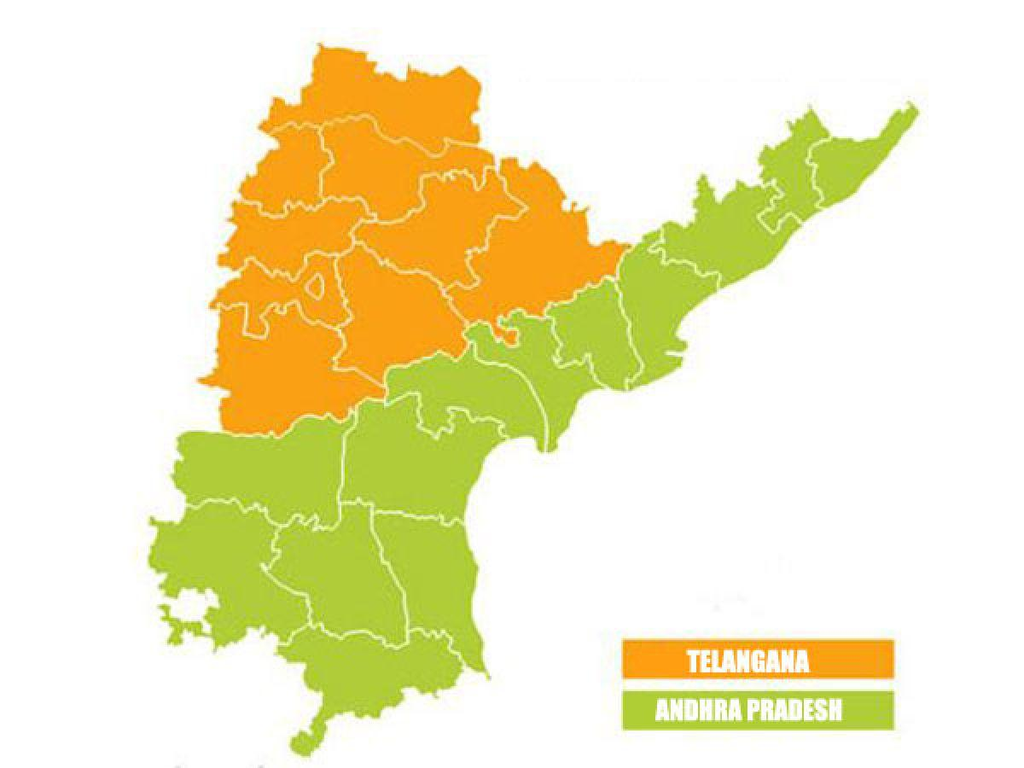
Illustration: Article 3 is the principal constitutional provision used for the reorganisation of existing States, such as the creation of Telangana from Andhra Pradesh in 2014.
Article 2 should be understood as a separate constitutional power concerning admission or establishment of States, rather than as a general alternative to Article 3 for every new State.
4. Article 3: Formation of New States and Alteration of Existing States
Article 3 is one of the most important provisions in Part I of the Constitution.
It empowers Parliament to reorganise the internal territorial structure of India.
The provision recognises that the boundaries and administrative arrangements of States may need to change in response to linguistic, cultural, administrative, economic and political considerations.
Article 3 authorises Parliament to undertake five types of territorial changes.
4.1 Powers of Parliament under Article 3
Article 3 empowers Parliament to:
(a) Form a new State
A new State may be formed through:
- Separation of territory from an existing State.
- Union of two or more States.
- Union of parts of different States.
- Union of a territory with a part of an existing State.
Examples include:
- Formation of Telangana in 2014 from Andhra Pradesh.
- Formation of Jharkhand in 2000 from Bihar.
- Formation of Chhattisgarh in 2000 from Madhya Pradesh.
- Formation of Uttarakhand in 2000 from Uttar Pradesh.
(b) Increase the area of a State
Parliament can increase the territorial area of an existing State by transferring territory from another State or through other constitutionally permissible arrangements.
(c) Diminish the area of a State
Parliament can reduce the territorial area of a State by transferring some of its territory to another State or by creating a new territorial unit.
(d) Alter the boundaries of a State
Parliament can modify the boundaries between existing States.
This may be necessary to resolve administrative difficulties, accommodate regional demands or facilitate territorial reorganisation.
(e) Alter the name of a State
Parliament can change the name of an existing State.
Examples include:
- Madras State renamed Tamil Nadu in 1969.
- Mysore State renamed Karnataka in 1973.
- Uttaranchal renamed Uttarakhand in 2007.
- Orissa renamed Odisha in 2011.
Thus, Article 3 provides Parliament with extensive powers to modify the internal territorial organisation of India.
4.2 Constitutional Procedure under Article 3
Although Parliament possesses extensive powers under Article 3, the Constitution prescribes a specific procedure that must be followed before a Bill concerning territorial reorganisation can be introduced.
The procedure involves the following stages.
Procedure for State Reorganisation under Article 3
- Proposal for territorial reorganisationA proposal is formulated for the creation of a new State or alteration of the area, boundary or name of an existing State.
- Recommendation of the PresidentThe Bill can be introduced in either House of Parliament only on the recommendation of the President.
- Reference to the concerned State LegislatureIf the proposal affects the area, boundaries or name of a State, the President refers the Bill to the Legislature of that State for expressing its views.
- Consideration by the State LegislatureThe State Legislature expresses its views within the period specified by the President or any further period allowed by the President.
- Introduction and consideration in ParliamentOnce the specified period expires, the Bill may be introduced and considered by Parliament.
- Passing of the BillThe Bill must be passed by both Houses of Parliament through the ordinary legislative process.
- Presidential assentAfter passage by both Houses, the Bill is presented to the President for assent.
4.3 Role of the President
The President performs an important constitutional role in the procedure prescribed under Article 3.
Two requirements are particularly important.
First: Recommendation for introduction
A Bill under Article 3 cannot be introduced in either House of Parliament without the recommendation of the President.
Second: Reference to the State Legislature
Where the proposal affects the area, boundaries or name of a State, the President must refer the Bill to the Legislature of that State for expressing its views.
The President specifies a period within which the State Legislature is expected to express its views.
The President may also extend the period.
Only after the specified or extended period has expired can the Bill proceed in Parliament.
Important: The Constitution requires the views of the State Legislature to be obtained through the prescribed procedure. It does not require the State Legislature’s consent.
4.4 Are the Views of the State Legislature Binding on Parliament?
No.
The views of the State Legislature are not binding on Parliament.
This is one of the most important features of Article 3.
The State Legislature has the constitutional opportunity to express its views, but Parliament retains the final legislative authority.
Therefore:
- The State Legislature may support the proposal.
- The State Legislature may oppose the proposal.
- The State Legislature may recommend modifications.
- Parliament is not constitutionally bound to accept those views.
Even if the State Legislature rejects the proposal, Parliament may proceed with the Bill after completing the prescribed constitutional procedure.
This provision demonstrates the predominance of Parliament in matters relating to the internal territorial organisation of the Union.
Illustration: Telangana State Formation
The creation of Telangana provides an important example.
The Andhra Pradesh Reorganisation Bill, 2014 was referred to the Andhra Pradesh Legislative Assembly for its views.
The Assembly expressed its opposition to the proposal.
However, its views were not binding on Parliament, and the Bill was subsequently passed by Parliament.
The Andhra Pradesh Reorganisation Act, 2014 resulted in the formation of Telangana as a separate State on 2 June 2014.
This example illustrates the distinction between consultation and consent under Article 3.
4.5 Can Parliament Make Changes to the Bill after Referring It to the State Legislature?
Yes.
Parliament is not confined to accepting or rejecting the proposal in the exact form in which it was referred to the State Legislature.
The parliamentary legislative process may involve amendments to the Bill.
For example, changes may be made concerning:
- The territorial extent of the proposed State.
- The boundaries of the affected States.
- Administrative arrangements.
- Representation in Parliament.
- Allocation of assets and liabilities.
- Other consequential matters.
The Constitution does not require every subsequent parliamentary amendment to be referred afresh to the State Legislature.
However, the legislative process must comply with the constitutional requirements applicable to the Bill.
4.6 Can an Article 3 Bill Be Introduced in Either House of Parliament?
Yes.
An Article 3 Bill can originate in either the Lok Sabha or the Rajya Sabha.
However, it must satisfy the requirement of prior presidential recommendation.
Unlike a Money Bill under Article 110, an Article 3 Bill is not restricted to introduction in the Lok Sabha.
It is passed through the ordinary legislative procedure.
UPSC fact: Article 3 Bills are ordinary legislative Bills, not Money Bills or Constitutional Amendment Bills under Article 368.
4.7 Does Article 3 Require a Special Majority?
No.
A Bill under Article 3 is passed by a simple majority of members present and voting in each House of Parliament, subject to the ordinary constitutional requirements.
It does not require:
- A special majority under Article 368.
- Ratification by half of the State Legislatures.
- Consent of the affected State Legislature.
This makes the procedure for internal territorial reorganisation relatively flexible.
5. Explanation to Article 3: Inclusion of Union Territories
Article 3 contains two important explanations inserted through the Constitution (Eighteenth Amendment) Act, 1966.
These explanations clarify the scope of Parliament’s territorial reorganisation powers.
5.1 Explanation I
For the purposes of clauses (a) to (e) of Article 3, the expression State includes a Union Territory.
However, in the proviso relating to reference to the State Legislature, the expression State does not include a Union Territory.
This distinction is important.
It means that Parliament can exercise the powers specified in Article 3 in relation to Union Territories as well.
However, the mandatory consultation procedure under the proviso applies to States, not Union Territories.
5.2 Explanation II
Explanation II clarifies that the power to form a new State under Article 3(a) includes the power to form a new State or Union Territory by uniting a part of any State or Union Territory with another State or Union Territory.
This gives Parliament flexibility in creating new territorial units through combinations of existing territorial areas.
UPSC significance: Do not assume that the term State in every clause of Article 3 necessarily excludes Union Territories. Explanation I specifically includes Union Territories in clauses (a) to (e), while excluding them from the proviso.legislative.gov.in+1
6. Article 4: Laws under Articles 2 and 3 and Their Constitutional Status
Article 4 deals with the legal and constitutional consequences of laws enacted under Articles 2 and 3.
It enables Parliament to make necessary amendments to the First and Fourth Schedules and incorporate supplementary, incidental and consequential provisions while reorganising the territory of India.
6.1 Amendment of the First Schedule
The First Schedule contains the names and territorial details of States and Union Territories.
Whenever a new State is created or the territorial boundaries of an existing State are altered, the First Schedule may require corresponding modifications.
For example, when Telangana was created in 2014, the First Schedule was modified to reflect the new territorial arrangement.
6.2 Amendment of the Fourth Schedule
The Fourth Schedule deals with the allocation of seats in the Rajya Sabha to States and Union Territories.
Territorial reorganisation may necessitate changes in the allocation of seats in the Council of States.
Article 4 therefore enables Parliament to make the corresponding modifications.
6.3 Supplementary, Incidental and Consequential Provisions
Article 4 also permits Parliament to include provisions necessary to implement the reorganisation.
These may relate to:
- Representation in Parliament.
- Representation in State Legislatures.
- Distribution of assets and liabilities.
- Transfer of government employees.
- Continuity of administrative institutions.
- High Courts and judicial administration.
- Public services.
- Transitional arrangements.
- Distribution of revenue and other financial matters.
Such provisions ensure that the creation of a new State or alteration of territorial boundaries does not disrupt the functioning of government.
6.4 Do Laws under Articles 2 and 3 Require a Constitutional Amendment under Article 368?
No.
Article 4(2) expressly provides that a law made under Article 2 or Article 3 shall not be deemed to be an amendment of the Constitution for the purposes of Article 368.
This is an important constitutional exception.
Although laws under Articles 2 and 3 may modify the First and Fourth Schedules, such modifications do not require the special amendment procedure prescribed under Article 368.
They can be enacted through the ordinary legislative procedure.
Why is this provision important?
The Constitution-makers wanted to ensure that India’s internal territorial organisation could be adjusted without requiring a cumbersome constitutional amendment procedure for every change.
This provides flexibility to Parliament while preserving the constitutional framework of the Union.
6.5 Article 4 and Article 368: A Comparison
| Basis | Article 4 | Article 368 |
|---|---|---|
| Nature | Consequential constitutional changes under laws made under Articles 2 and 3 | Formal constitutional amendment procedure |
| Majority | Simple majority | Special majority, and in specified cases State ratification |
| Subject | Territorial reorganisation and related provisions | Amendment of constitutional provisions |
| First and Fourth Schedules | Can be modified through relevant legislation | Can also be amended through Article 368 |
| State ratification | Not required merely for a law under Articles 2 and 3 | Required for specified federal provisions |
Important: Article 4 does not provide Parliament with a general power to amend the Constitution by ordinary legislation. Its operation is confined to laws made under Articles 2 and 3 and the supplementary, incidental and consequential matters contemplated by Article 4.legislative.gov.in+1
7. Historical Evolution of State Reorganisation in India
The present territorial organisation of India is the outcome of a long historical process involving national integration, linguistic aspirations, administrative considerations and regional demands.
At independence, India inherited a complicated territorial structure consisting of British provinces and numerous princely states.
The integration of these territories created the need for a rational administrative arrangement.
The process of State reorganisation can be understood through several important phases.
7.1 Territorial Organisation at Independence
At the time of independence in 1947, India consisted of:
- British Indian provinces.
- Princely states that acceded to India.
- Territories that were subsequently integrated into the Union.
The princely states differed considerably in geographical size, administrative capacity and political organisation.
Their integration was undertaken under the leadership of Sardar Vallabhbhai Patel, with the assistance of V. P. Menon.
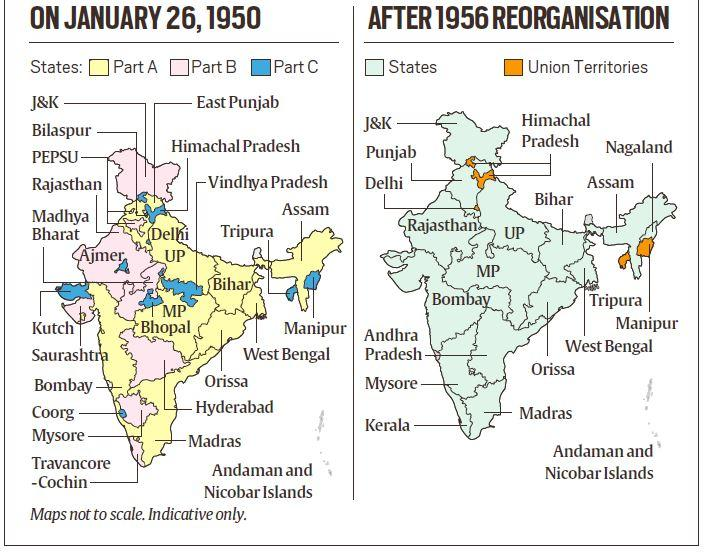
Following integration, the Constitution initially classified the constituent units into four categories:
| Category | Nature |
|---|---|
| Part A States | Former Governor’s Provinces of British India |
| Part B States | Former princely states or groups of princely states |
| Part C States | Former Chief Commissioners’ Provinces and certain princely states |
| Part D Territory | Andaman and Nicobar Islands |
This classification came into existence under the original Constitution of 1950.
It reflected the administrative and political realities of the immediate post-independence period.
7.2 Demand for Linguistic Reorganisation
The demand for the reorganisation of States on linguistic lines had emerged even before independence.
The Indian National Congress had supported linguistic reorganisation of provincial units during the freedom movement.
The underlying argument was that language provides an important basis for administrative convenience, democratic participation and cultural identity.
However, after independence, the national leadership initially adopted a cautious approach.
There were concerns that linguistic reorganisation might encourage regionalism and weaken national integration.
7.3 Dhar Commission, 1948
The Government of India appointed the Linguistic Provinces Commission, popularly known as the Dhar Commission, in June 1948.
It was chaired by S. K. Dhar.
The Commission was established to examine the feasibility of reorganising provinces on linguistic grounds.
It recommended that administrative convenience, economic viability and national unity should receive greater consideration than language alone.
The report did not favour immediate linguistic reorganisation.
7.4 JVP Committee, 1948–49
Following the Dhar Commission’s report, the Congress appointed a committee consisting of:
- Jawaharlal Nehru.
- Vallabhbhai Patel.
- Pattabhi Sitaramayya.
The committee is known as the JVP Committee.
It submitted its report in April 1949.
The committee also adopted a cautious position towards linguistic reorganisation.
It emphasised that national unity, administrative convenience and economic considerations should take precedence over linguistic demands.
However, it did not completely reject the possibility of future linguistic reorganisation.
7.5 Formation of Andhra State, 1953
The demand for a separate Telugu-speaking State became one of the most significant developments in the post-independence reorganisation of India.
The movement for a separate Andhra State intensified during the early 1950s.
Potti Sriramulu, a prominent Gandhian activist, undertook a fast demanding the creation of a separate State for Telugu-speaking people.
He died on 15 December 1952 after undertaking a prolonged fast.
His death triggered widespread protests and intensified the demand for a separate Andhra State.
Consequently, the Government of India agreed to the formation of Andhra State.
The Andhra State Act, 1953 provided for the creation of Andhra State on 1 October 1953, with Kurnool as its capital.
It was carved out of the then Madras State.
Inaugurating the State of Andhra (Kurnool, 01 Oct 1953) – The Nehru Archive
Constitutional significance:
- Andhra became the first State formed in independent India primarily on linguistic grounds.
- It strengthened demands for linguistic reorganisation in other parts of the country.
- It led to the appointment of the States Reorganisation Commission.
7.6 States Reorganisation Commission, 1953
Following the formation of Andhra State, the Government of India appointed the States Reorganisation Commission (SRC) on 22 December 1953.
The Commission consisted of three members:
| Member | Position |
|---|---|
| Fazl Ali | Chairman |
| H. N. Kunzru | Member |
| K. M. Panikkar | Member |
The Commission was entrusted with examining the principles and criteria for reorganising the States of India.
It submitted its report in September 1955.
Major considerations examined by the Commission included:
- National unity and security.
- Linguistic and cultural homogeneity.
- Administrative convenience.
- Economic viability.
- Regional development.
- Public welfare.
- Financial and administrative sustainability.
The Commission generally favoured linguistic reorganisation but did not recommend language as the sole criterion.
It emphasised the need to balance linguistic aspirations with national unity, administrative efficiency and economic considerations.
7.7 States Reorganisation Act, 1956
Reorganisation of Indian States and New Statehood Demands – Notes – Crash
On the basis of the SRC’s recommendations and subsequent political deliberations, Parliament enacted the States Reorganisation Act, 1956.
The Act came into force on 1 November 1956.
It represented the most extensive reorganisation of India’s internal territorial boundaries since independence.
The constitutional framework was also modified through the Constitution (Seventh Amendment) Act, 1956.
The major changes included:
- Abolition of the Part A, Part B and Part C classification of States.
- Introduction of the present constitutional distinction between States and Union Territories.
- Reorganisation of territorial boundaries on broadly linguistic and administrative considerations.
- Changes in the First and Fourth Schedules.
The reorganisation established the foundation of the present system of States and Union Territories. India Code+2
7.8 Subsequent State Reorganisation
The territorial organisation of India continued to evolve after 1956.
Several States were created or reorganised in response to linguistic, cultural, administrative and regional demands.
| Year | Major development |
|---|---|
| 1960 | Bombay State divided into Maharashtra and Gujarat |
| 1963 | Nagaland became a State |
| 1966 | Haryana formed; Punjab reorganised |
| 1971 | Himachal Pradesh became a full-fledged State |
| 1972 | Manipur, Tripura and Meghalaya became States |
| 1975 | Sikkim became the 22nd State of India |
| 1987 | Mizoram, Arunachal Pradesh and Goa became States |
| 2000 | Chhattisgarh, Uttarakhand and Jharkhand formed |
| 2014 | Telangana formed from Andhra Pradesh |
The creation of new States demonstrates the continuing relevance of Article 3 in accommodating India’s territorial and administrative requirements.
8. Formation of Telangana: An Important Illustration of Article 3
Telangana State to Be Born on June 2
The formation of Telangana provides an important contemporary example of the constitutional process under Article 3.
The demand for a separate Telangana State had a long historical background, involving regional disparities, political representation, employment opportunities, water resources and the implementation of safeguards.
The movement developed through different phases:
- The Telangana region was part of the erstwhile Hyderabad State.
- In 1956, Telangana was merged with Andhra State to form Andhra Pradesh.
- The merger was accompanied by political and administrative safeguards.
- The separate Telangana movement intensified in 1969 and witnessed further phases of mobilisation.
- The demand became a major political issue during the first decade of the twenty-first century.
8.1 Andhra Pradesh Reorganisation Act, 2014
The Andhra Pradesh Reorganisation Bill was introduced in Parliament following the prescribed constitutional process.
The Bill was referred to the Andhra Pradesh Legislative Assembly for its views.
The Assembly opposed the proposed bifurcation, but its views were not binding on Parliament under Article 3.
The Bill was passed by Parliament and received Presidential assent on 1 March 2014.
The Andhra Pradesh Reorganisation Act, 2014 provided for the formation of Telangana.
Telangana became the 29th State of India on 2 June 2014.
The Act also contained provisions concerning:
- Distribution of assets and liabilities.
- Allocation of government employees.
- Sharing of water resources.
- Electricity arrangements.
- Representation in Parliament.
- High Court arrangements.
- Administrative and financial matters.
8.2 Constitutional Significance
The formation of Telangana illustrates several aspects of India’s constitutional framework:
- Parliament possesses the authority to form new States under Article 3.
- Consultation with the affected State Legislature is constitutionally required.
- The views of the State Legislature are not binding on Parliament.
- Article 4 enables necessary consequential amendments and transitional arrangements.
- Regional aspirations can be accommodated within the constitutional framework.
It also demonstrates the importance of combining constitutional procedure with political negotiations and administrative planning.
9. Acquisition and Cession of Territory: The Berubari Union Case
One of the important constitutional questions concerning the territory of India is whether Parliament can transfer Indian territory to another country through an ordinary law under Article 3.
This issue was examined by the Supreme Court in the In Re: Berubari Union and Exchange of Enclaves (1960).
9.1 Background of the Case
The dispute arose from the implementation of the Indo-Pakistan Agreement of 1958 concerning the division of the Berubari Union in West Bengal and the exchange of certain enclaves between India and Pakistan.
The President referred the matter to the Supreme Court under Article 143 for its advisory opinion.
The principal constitutional issue was whether the transfer of Indian territory to Pakistan could be implemented through legislation under Article 3 or whether a constitutional amendment under Article 368 was necessary.
9.2 Supreme Court’s Opinion
The Supreme Court made an important distinction between acquisition and cession of territory.
A. Acquisition of Territory
The acquisition of foreign territory by India does not necessarily require a constitutional amendment under Article 368.
The Court recognised that the acquisition of territory is an attribute of sovereignty.
B. Cession of Territory
The transfer or cession of Indian territory to a foreign country is different.
The Court held that such a transfer could not be accomplished through an ordinary law under Article 3.
It required a constitutional amendment under Article 368.
This was because cession would involve a reduction in the territory of the Union and consequential changes to Article 1 and the First Schedule.
9.3 Constitutional Significance
The Berubari opinion established the following principles:
- Article 3 primarily concerns internal territorial reorganisation.
- Article 3 cannot be used to transfer Indian territory to a foreign country.
- Cession of national territory requires constitutional amendment under Article 368.
- Acquisition of territory is a distinct exercise of sovereign power.
The case is important for understanding the difference between the internal territorial reorganisation of India and the external transfer of national territory.
UPSC relevance: Remember that cession of Indian territory to a foreign State requires a constitutional amendment under Article 368, whereas internal reorganisation of States is governed by Articles 3 and 4. Calcutta High Court+2
10. Article 3 and the Jammu and Kashmir Reorganisation: Supreme Court Judgment, 2023
The In Re: Article 370 judgment, delivered on 11 December 2023, is important for understanding the scope of Parliament’s powers under Article 3.
The case involved constitutional challenges to the changes made to the status of Jammu and Kashmir in August 2019 and the enactment of the Jammu and Kashmir Reorganisation Act, 2019.
The Act bifurcated the erstwhile State of Jammu and Kashmir into:
- Union Territory of Jammu and Kashmir, with a Legislative Assembly.
- Union Territory of Ladakh, without a Legislative Assembly.
The Supreme Court examined several constitutional issues relating to the exercise of power under Article 3.
10.1 Important Constitutional Issues
The challenges raised questions concerning:
- The extent of Parliament’s power under Article 3.
- The mandatory reference to the State Legislature.
- The role of Parliament during President’s Rule.
- The conversion of a State into Union Territories.
- The relationship between federalism and territorial reorganisation.
10.2 Important Observations of the Supreme Court
The Court made several important observations concerning the constitutional framework.
First: Article 3 confers broad powers on Parliament to reorganise States.
Second: Parliament can exercise its powers under Article 3 even during the operation of a Proclamation under Article 356, subject to the constitutional requirements applicable to that situation.
Third: The Court upheld the creation of the Union Territory of Ladakh.
Fourth: On the question of converting an entire State into a Union Territory, the Court did not lay down a general ruling resolving the issue in all circumstances. It took note of the Union Government’s assurance that the Statehood of Jammu and Kashmir would be restored.
The Court directed that elections to the Legislative Assembly of Jammu and Kashmir be held by 30 September 2024 and that steps be taken for restoration of statehood as soon as possible.
10.3 Constitutional Significance
The judgment is important because it highlights the relationship between:
- Parliamentary authority.
- Federalism.
- Representative democracy.
- State autonomy.
- Constitutional procedures under Article 3.
It also demonstrates that the exercise of broad parliamentary powers must remain within the constitutional framework and is not automatically immune from judicial scrutiny.SciGov+3
11. Present Territorial Organisation of India
India’s territorial organisation has undergone considerable changes since the commencement of the Constitution.
Following successive reorganisations, India presently consists of 28 States and 8 Union Territories.
The States possess constitutional governments with their own legislative and executive institutions, whereas Union Territories are administered by the Union, subject to the special constitutional arrangements applicable to certain territories.
11.1 States and Union Territories: Constitutional Distinction
| Basis | States | Union Territories |
|---|---|---|
| Constitutional status | Constituent units of the Union | Territories administered under the Union framework |
| Executive authority | Governor and Council of Ministers | President through an Administrator or Lieutenant Governor |
| Legislative authority | State Legislature | Parliament; some UTs also have legislatures |
| Representation in Rajya Sabha | States are represented | Representation depends on constitutional and statutory provisions |
| Administrative autonomy | Generally greater | Generally more directly controlled by the Union |
| Constitutional provisions | Part VI | Part VIII |
Important: Not all Union Territories have identical constitutional arrangements. Delhi and Puducherry, for example, have legislatures, while other Union Territories do not.
The constitutional provisions concerning Union Territories will be examined separately in our subsequent study of Part VIII.
12. Constitutional and Political Significance of Articles 1–4
The provisions relating to the Union and its territory have far-reaching implications for India’s federal structure and national integration.
12.1 Preservation of National Unity
Article 1 establishes India as a Union of States and rules out the constitutional right of secession.
This provides a permanent constitutional framework for national unity.
12.2 Flexibility in Territorial Organisation
Article 3 allows Parliament to reorganise the internal territorial boundaries of States without following the elaborate procedure prescribed under Article 368.
This enables the Union to respond to changing administrative and political requirements.
12.3 Accommodation of Regional Aspirations
The creation of States such as Andhra Pradesh, Gujarat, Haryana, Jharkhand and Telangana demonstrates how constitutional mechanisms can accommodate regional aspirations.
Such reorganisation can provide opportunities for region-specific governance and administrative responsiveness.
12.4 Administrative Efficiency
Territorial reorganisation may help improve administrative accessibility, governance and the delivery of public services.
Smaller administrative units may, under appropriate conditions, facilitate better coordination between governments and citizens.
However, the effectiveness of a new State also depends on its financial resources, institutional capacity and administrative infrastructure.
12.5 Protection of Linguistic and Cultural Identities
Linguistic reorganisation helped accommodate the cultural and linguistic aspirations of different communities.
It demonstrated that national unity need not require cultural uniformity.
12.6 Strengthening Cooperative Federalism
The constitutional procedure under Article 3 provides an opportunity for affected State Legislatures to express their views.
Although these views are not binding, the consultation process provides an institutional channel for considering regional perspectives.
12.7 Constitutional Continuity
Article 4 ensures that territorial reorganisation is accompanied by necessary legal and administrative arrangements.
This enables institutional continuity despite changes in territorial boundaries.
13. Challenges Associated with State Reorganisation
Although the Constitution provides a flexible mechanism for territorial reorganisation, the process presents several administrative, economic and political challenges.
13.1 Financial Viability of New States
The creation of new States may involve substantial expenditure on administrative infrastructure, public institutions and government machinery.
New States must develop sustainable revenue sources and manage expenditure responsibly.
13.2 Distribution of Natural Resources
The division of States may create disputes concerning:
- River waters.
- Irrigation projects.
- Electricity generation and distribution.
- Mineral resources.
- Forest resources.
- Public assets.
The disputes arising after the formation of Telangana and Andhra Pradesh illustrate the complexity of sharing resources between successor States.
13.3 Distribution of Government Employees
Reorganisation requires the allocation of government employees between the newly constituted territorial units.
Questions concerning seniority, service conditions, cadre allocation and administrative control may create difficulties.
13.4 Capital and Institutional Infrastructure
The division of an existing State may require the establishment of:
- Legislative institutions.
- Secretariat buildings.
- High Court infrastructure.
- Police and administrative establishments.
- Public universities.
- Other government institutions.
The development of new administrative infrastructure may involve substantial financial and logistical challenges.
13.5 Inter-State Disputes
Changes in territorial boundaries may generate disagreements concerning:
- River-water sharing.
- Territorial claims.
- Common infrastructure.
- Administrative jurisdiction.
- Financial liabilities.
Appropriate institutional mechanisms are necessary to resolve these disputes.
13.6 Regionalism and National Integration
Regional aspirations can contribute to democratic participation and decentralised governance.
However, excessive regional mobilisation may also create tensions between different communities and territorial units.
The challenge is to accommodate legitimate regional demands while preserving national unity and constitutional values.
13.7 Consultation and Federal Principles
Article 3 gives Parliament the final authority over territorial reorganisation.
However, the absence of a requirement for State Legislature consent raises questions concerning the balance between parliamentary authority and federal autonomy.
A constitutionally sound approach requires meaningful consultation, transparent decision-making and adequate consideration of the interests of affected populations.
14. Critical Analysis: Is India an Indestructible Union with Destructible States?
The expression indestructible Union with destructible States is frequently used to explain the distinctive character of Indian federalism.
The underlying idea is that the Constitution establishes India as a permanent Union, while Parliament possesses the power to reorganise its constituent States.
This arrangement differs from federations in which constituent units may enjoy stronger constitutional protection against unilateral territorial alteration.
However, the flexibility provided by Article 3 should not be interpreted as making States administratively insignificant.
States are constitutionally recognised units with elected governments, legislative powers and an important role in India’s federal structure.
The Supreme Court’s observations in the 2023 Jammu and Kashmir judgment also underline the importance of States in maintaining federalism and representative democracy.
Therefore, India’s constitutional framework attempts to balance two objectives:
- National unity and territorial flexibility.
- Federalism and democratic representation.
The challenge is to ensure that the exercise of parliamentary powers does not undermine the democratic aspirations and legitimate interests of the people living in the affected territories.
15. Conclusion
Articles 1–4 establish the constitutional foundation of India’s territorial organisation.
Article 1 defines India as a Union of States and identifies the territory of India. Article 2 empowers Parliament to admit or establish new States. Article 3 provides extensive powers for internal territorial reorganisation, while Article 4 enables the necessary constitutional and administrative consequences of such changes.
Together, these provisions reflect the Constitution-makers’ intention to establish a permanent Union with a flexible internal territorial structure.
The experience of State reorganisation since independence demonstrates that India’s territorial organisation is not static. It has evolved in response to linguistic, cultural, administrative, economic and political considerations.
Ultimately, the constitutional objective is to accommodate regional aspirations without compromising national unity, federal principles and democratic governance.
UPSC Examination Preparation
16. Prelims Special: Important Facts to Remember
Quick Revision Sheet – Articles 1–4
Article 1
- India, that is Bharat, shall be a Union of States.
- First Schedule specifies States and Union Territories.
- Territory of India includes States, Union Territories and acquired territories.
Article 2
- Admission or establishment of new States.
- Parliament determines terms and conditions.
Article 3
- Formation of new States.
- Increase or diminution of State areas.
- Alteration of State boundaries.
- Alteration of State names.
- Presidential recommendation required.
- State Legislature’s views are not binding on Parliament.
Article 4
- Amendment of First and Fourth Schedules under Articles 2 and 3.
- Supplementary, incidental and consequential provisions.
- Such laws are not constitutional amendments for Article 368.
Important historical facts
- Andhra State – 1 October 1953.
- Dhar Commission – 1948.
- JVP Committee – 1948–49.
- States Reorganisation Commission – 1953.
- SRC Report – 1955.
- States Reorganisation Act – 1956.
- Seventh Constitutional Amendment – 1956.
- Telangana – 2 June 2014.
- Jammu and Kashmir Reorganisation – 31 October 2019.
17. Important Constitutional and Judicial References
| Case / Development | Significance |
|---|---|
| In Re: Berubari Union (1960) | Cession of Indian territory requires constitutional amendment under Article 368. |
| States Reorganisation Commission (1953–55) | Recommended principles for territorial reorganisation. |
| Andhra Pradesh Reorganisation (2014) | Illustration of Article 3 and formation of Telangana. |
| In Re: Article 370 (2023) | Examined the scope of Article 3 and Jammu and Kashmir reorganisation. |
18. UPSC Prelims Practice Questions
Q1. With reference to Article 1 of the Indian Constitution, consider the following statements:
- India is described as a Federation of States.
- The territory of India includes the territories of States and Union Territories.
- The territory of India also includes such other territories as may be acquired.
Which of the statements given above is/are correct?
(a) 1 only
(b) 2 and 3 only
(c) 1 and 3 only
(d) All three
Q2. Consider the following statements regarding Article 3:
- A Bill under Article 3 can be introduced in either House of Parliament.
- Prior recommendation of the President is necessary.
- The consent of the affected State Legislature is mandatory.
- The views of the State Legislature are not binding on Parliament.
Which of the statements given above are correct?
(a) 1 and 2 only
(b) 1, 2 and 4 only
(c) 2, 3 and 4 only
(d) All four
Q3. Which of the following statements correctly distinguishes Articles 2 and 3 of the Indian Constitution?
(a) Article 2 deals with the creation of new States from existing States, while Article 3 deals with the admission of foreign territories.
(b) Article 2 deals with the admission or establishment of new States, while Article 3 deals with the formation of new States and alteration of existing State boundaries.
(c) Both Articles deal exclusively with the alteration of State boundaries.
(d) Article 2 deals with Union Territories, while Article 3 deals exclusively with States.
Q4. With reference to Article 4 of the Constitution, consider the following statements:
- Laws made under Articles 2 and 3 may amend the First and Fourth Schedules.
- Such laws are deemed to be constitutional amendments under Article 368.
- Such laws may contain supplementary, incidental and consequential provisions.
Which of the statements given above is/are correct?
(a) 1 only
(b) 1 and 3 only
(c) 2 and 3 only
(d) All three
Q5. Which of the following committees recommended linguistic reorganisation of States after independence?
(a) Dhar Commission
(b) JVP Committee
(c) States Reorganisation Commission
(d) Sarkaria Commission
Q6. Consider the following pairs:
| Constitutional amendment / legislation | Purpose |
|---|---|
| 1. Seventh Amendment Act, 1956 | Reorganisation of States and Union Territories |
| 2. States Reorganisation Act, 1956 | Reorganisation of State boundaries |
| 3. Thirty-Sixth Amendment Act, 1975 | Sikkim became a full-fledged State |
How many of the above pairs are correctly matched?
(a) Only one
(b) Only two
(c) All three
(d) None
Q7. With reference to the Berubari Union case, consider the following statements:
- The Supreme Court held that cession of Indian territory to a foreign country could be carried out under Article 3.
- A constitutional amendment under Article 368 was required for the cession of territory.
- Acquisition of foreign territory is distinct from cession of Indian territory.
Which of the statements given above is/are correct?
(a) 1 only
(b) 2 only
(c) 2 and 3 only
(d) All three
Q8. The expression “Union of States” in Article 1 signifies that:
- Indian States have no constitutional right to secede from the Union.
- Parliament has the power to reorganise the internal territorial boundaries of States.
- India has no federal characteristics.
Select the correct answer:
(a) 1 and 2 only
(b) 2 and 3 only
(c) 1 and 3 only
(d) All three
Answer Key and Explanations
| Question | Answer | Explanation |
|---|---|---|
| 1 | (b) | Article 1 describes India as a Union of States, not a Federation of States. |
| 2 | (b) | Presidential recommendation and State Legislature consultation are required, but State consent is not. |
| 3 | (b) | Article 2 concerns admission or establishment; Article 3 concerns territorial reorganisation. |
| 4 | (b) | Article 4 expressly states that such laws are not amendments under Article 368. |
| 5 | (c) | The SRC generally supported linguistic reorganisation while considering other factors. |
| 6 | (c) | All three pairs are correctly matched. |
| 7 | (c) | Cession requires Article 368; acquisition is a distinct sovereign act. |
| 8 | (a) | India has federal characteristics, but States cannot secede. |
19. UPSC Mains Practice Questions
10 Marks
- Explain the constitutional significance of the expression “Union of States” under Article 1.
- Distinguish between Articles 2 and 3 of the Indian Constitution.
- Explain the procedure prescribed under Article 3 for the formation of new States.
- Discuss the constitutional significance of the States Reorganisation Act, 1956.
15 Marks
- “India is an indestructible Union with destructible States.” Examine this statement in the context of Articles 1–4 of the Constitution.
- Discuss the role of linguistic and administrative considerations in the reorganisation of States in India.
- Examine the constitutional relationship between parliamentary authority and State autonomy in matters of territorial reorganisation.
- Discuss how the constitutional provisions relating to territorial reorganisation have facilitated national integration while accommodating regional aspirations.