
Samata IAS Academy | Indian Polity and Constitution | UPSC Civil Services Examination – GS Paper II
1. Introduction
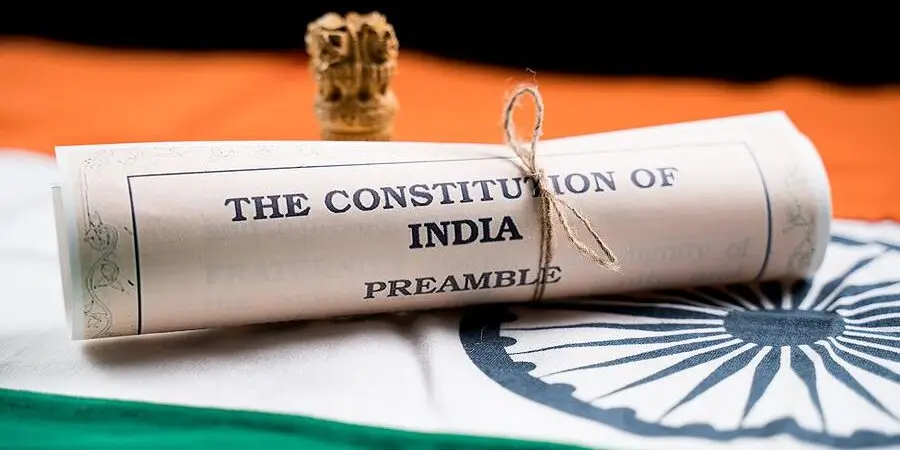
The Preamble is the introductory statement of the Indian Constitution. It expresses the fundamental philosophy, objectives, ideals and aspirations underlying the constitutional framework of India.
It provides an insight into the vision of the Constitution-makers regarding the nature of the Indian State, the source of constitutional authority, the relationship between the State and its citizens, and the ultimate objectives that the Constitution seeks to achieve.
While the substantive provisions of the Constitution establish the institutional framework of governance, the Preamble articulates the philosophical foundation upon which that framework rests.
The Preamble is particularly significant because it declares that the Constitution derives its authority from the people of India. It also identifies the nature of the Indian political system as a Sovereign, Socialist, Secular, Democratic Republic and lays down the objectives of Justice, Liberty, Equality and Fraternity.
The Preamble is therefore not merely a ceremonial introduction. It serves as an important interpretative guide to understanding the constitutional philosophy and the objectives of the Indian Republic.
2. Historical Background and Origin of the Preamble
The origin of the Preamble can be traced to the Objectives Resolution introduced by Jawaharlal Nehru in the Constituent Assembly.
The Constitution-makers wanted to establish a clear statement of the fundamental principles that would guide the framing of the Constitution.
2.1 Objectives Resolution: The Philosophical Foundation
Moving the objectives resolution in the constituent assembly (13 Dec 1946) – The Nehru Archive
On 13 December 1946, Jawaharlal Nehru moved the Objectives Resolution in the Constituent Assembly.
The Resolution articulated the fundamental objectives and guiding principles that the future Constitution of India was expected to embody.
The Objectives Resolution was debated in the Constituent Assembly and adopted on 22 January 1947.
It laid down the foundational principles of the proposed constitutional framework, including:
- India would be an independent and sovereign republic.
- The territories constituting India would form a Union.
- Sovereignty and authority would derive from the people.
- Justice, equality and freedom would be guaranteed to all people.
- Adequate safeguards would be provided for minorities, backward and tribal areas and other disadvantaged sections.
- India would contribute to the promotion of international peace and the welfare of humanity.
The Objectives Resolution subsequently became the philosophical basis for the Preamble.
Important distinction: The Objectives Resolution was not itself the Preamble. It was a foundational political and constitutional declaration from which the Preamble’s principal ideas were derived.
2.2 Adoption of the Preamble
The Preamble was finalised as part of the Constitution-making process and adopted along with the Constitution on 26 November 1949.
The Constitution came into force on 26 January 1950, when India became a Republic.
Thus, the Preamble reflects the constitutional vision that emerged from the deliberations of the Constituent Assembly.
3. Text of the Preamble
The Preamble reads as follows:
PREAMBLE
THE CONSTITUTION OF INDIA
WE, THE PEOPLE OF INDIA,
having solemnly resolved to constitute India into a SOVEREIGN SOCIALIST SECULAR DEMOCRATIC REPUBLIC and to secure to all its citizens:
JUSTICE, social, economic and political;
LIBERTY of thought, expression, belief, faith and worship;
EQUALITY of status and of opportunity;
and to promote among them all
FRATERNITY assuring the dignity of the individual and the unity and integrity of the Nation;
IN OUR CONSTITUENT ASSEMBLY this twenty-sixth day of November, 1949, do HEREBY ADOPT, ENACT AND GIVE TO OURSELVES THIS CONSTITUTION.
The text of the Preamble can be understood through four broad components:
- Source of authority: We, the People of India.
- Nature of the State: Sovereign, Socialist, Secular, Democratic Republic.
- Objectives of the Constitution: Justice, Liberty, Equality and Fraternity.
- Date and act of adoption: 26 November 1949.
These components collectively explain the constitutional philosophy of India.
4. Detailed Analysis of the Preamble
The Preamble can be divided into three major philosophical dimensions:
- Political philosophy: Sovereignty, democracy and republicanism.
- Socio-economic philosophy: Socialism, justice and equality.
- Humanistic philosophy: Liberty, fraternity and individual dignity.
Let us examine each expression in detail.
4.1 “We, the People of India”
The opening words of the Preamble establish the ultimate source of constitutional authority.
The expression signifies that the Constitution derives its legitimacy from the people of India and not from the British Crown, Parliament or any external authority.
It embodies the principle of popular sovereignty.
Its implications are:
- The people are the ultimate source of political authority.
- All constitutional institutions derive their powers from the Constitution.
- Governmental authority is subject to constitutional limitations.
- The Constitution is an expression of the collective political will of the Indian people.
An important constitutional distinction
The Constituent Assembly was not directly elected through universal adult franchise. Its members were largely indirectly elected by provincial legislative assemblies, while representatives of princely states were nominated.
Nevertheless, the Constitution declares its authority in the name of the people.
Thus, the expression “We, the People of India” represents the constitutional principle of popular sovereignty rather than a description of the electoral procedure through which the Constituent Assembly was constituted.
4.2 Sovereign
The term Sovereign signifies that India possesses independent political authority and is not subject to the control of any external power.
Sovereignty has two important dimensions.
A. External Sovereignty
External sovereignty means that India is independent in its relations with other countries.
- India is not legally subordinate to any foreign state.
- It can formulate its own foreign policy.
- It can enter into international treaties and agreements.
- It can maintain diplomatic relations with other countries.
- It can participate independently in international organisations.
India’s membership of international organisations such as the United Nations or its participation in international agreements does not compromise its sovereignty, because such participation is based on its independent consent.
B. Internal Sovereignty
Internal sovereignty refers to the supreme authority of the Indian State within its territorial boundaries.
- The Constitution establishes the framework of governmental authority.
- The Union and State governments exercise powers allocated to them by the Constitution.
- Individuals and institutions are subject to the laws of the country.
- No private individual or institution can claim authority superior to the Constitution.
India and Commonwealth Membership
India became a member of the Commonwealth in 1949 after becoming a Republic.
The British monarch is recognised as the symbolic Head of the Commonwealth, but this position does not confer any constitutional or political authority over India.
India’s Commonwealth membership is voluntary and does not affect its sovereign status.
UPSC relevance: Sovereignty should not be confused with the absence of international obligations. A sovereign country can voluntarily accept treaty obligations while retaining its independent constitutional and political authority.
4.3 Socialist
The word Socialist was inserted into the Preamble by the Constitution (Forty-Second Amendment) Act, 1976.
However, the underlying philosophy of social and economic justice was present in the original Constitution through provisions such as:
- Preamble’s commitment to social, economic and political justice.
- Article 14 – Equality before law and equal protection of laws.
- Article 15 – Prohibition of discrimination.
- Article 16 – Equality of opportunity in public employment.
- Article 38 – Promotion of social order based on justice.
- Article 39 – Certain principles of policy to be followed by the State.
- Article 39A – Equal justice and free legal aid.
- Article 43 – Living wage and decent conditions of work.
- Article 46 – Promotion of educational and economic interests of weaker sections.
Meaning of Indian Socialism
Indian socialism does not mean the complete abolition of private property or the exclusive ownership of all means of production by the State.
Instead, it envisages a system in which the State actively works towards reducing socio-economic inequalities and ensuring social and economic justice.
The Indian approach is generally described as democratic socialism.
Its important characteristics include:
- Reduction of economic inequalities.
- Prevention of concentration of wealth.
- Protection of weaker and disadvantaged sections.
- Promotion of social welfare.
- Equal opportunities for economic advancement.
- A balance between individual enterprise and public welfare.
India has followed a mixed-economy framework in which both public and private sectors operate.
Important Supreme Court interpretation
In D.S. Nakara v. Union of India (1983), the Supreme Court discussed the socialist character of the Indian constitutional framework and emphasised the commitment towards social and economic justice.
In the 2024 decision in Dr. Balram Singh v. Union of India, the Supreme Court clarified that the expression socialism in the Indian context signifies a welfare-state commitment and does not prescribe a particular economic model or prohibit private enterprise. API Sci+1
4.4 Secular
The word Secular was also inserted into the Preamble through the Forty-Second Constitutional Amendment Act, 1976.
However, the secular character of the Indian Constitution existed even before this amendment.
The original constitutional provisions relating to equality, freedom of religion and minority rights reflected the secular philosophy.
Important constitutional provisions include:
| Article | Constitutional provision |
|---|---|
| Article 14 | Equality before law |
| Article 15 | Prohibition of discrimination on specified grounds, including religion |
| Article 16 | Equality of opportunity in public employment |
| Article 25 | Freedom of conscience and free profession, practice and propagation of religion |
| Article 26 | Freedom to manage religious affairs |
| Article 27 | Freedom from taxation for promotion of a particular religion |
| Article 28 | Freedom regarding religious instruction in certain educational institutions |
| Articles 29–30 | Cultural and educational rights of minorities |
Meaning of Indian Secularism
Indian secularism implies that the State does not establish or maintain an official State religion and must respect the freedom of conscience and religious diversity of its people.
The Indian model is not based on an absolute separation between religion and State in the same manner as some Western models.
Instead, the Constitution permits the State to regulate secular activities associated with religious practices and to undertake reforms consistent with constitutional values.
Its principal dimensions include:
- Equal constitutional respect for all religions.
- Freedom of conscience and religious belief.
- Protection against religious discrimination.
- Freedom of religious practice, subject to constitutional limitations.
- Protection of religious and linguistic minorities.
- State intervention where necessary for social reform and public welfare.
Indian versus Western Secularism
| Indian approach | Classical Western model |
|---|---|
| Emphasises equal respect and religious freedom. | Often emphasises institutional separation between State and religion. |
| Permits limited State intervention in religious institutions and associated secular activities. | Generally emphasises a stronger institutional separation. |
| Protects religious diversity within a plural society. | Varies across countries and constitutional traditions. |
These are broad conceptual distinctions; Western countries themselves follow different constitutional models of secularism.
Judicial interpretation
In S.R. Bommai v. Union of India (1994), the Supreme Court recognised secularism as a basic feature of the Constitution.
The Court held that secularism is an essential constitutional principle governing the relationship between the State and religion.
The 2024 judgment in Dr. Balram Singh v. Union of India reiterated that India’s secular character is embedded in the constitutional scheme and is not dependent solely on the insertion of the word in the Preamble. Indian Kanoon+1
4.5 Democratic
The term Democratic signifies that the government derives its authority from the people and remains accountable to them.
India follows a representative parliamentary democracy.
The democratic character of the Indian Constitution is reflected in several institutional and constitutional arrangements:
Political democracy
- Universal adult franchise under Article 326.
- Periodic elections.
- Multi-party political system.
- Political equality.
- Freedom of expression and association.
- Responsible government.
Institutional democracy
- Parliamentary system of government.
- Accountability of the Council of Ministers to the Lok Sabha.
- Independent judiciary.
- Constitutional limitations on governmental authority.
- Federal distribution of powers.
- Independent Election Commission.
Social and economic democracy
Political democracy alone cannot ensure genuine equality if large sections of society remain deprived of basic opportunities.
The constitutional commitment to social and economic justice seeks to establish conditions in which citizens can participate meaningfully in democratic life.
Dr. B. R. Ambedkar emphasised this relationship in his concluding speech to the Constituent Assembly on 25 November 1949.
He cautioned that political democracy could not endure without a foundation of social democracy.
He described social democracy as a way of life recognising liberty, equality and fraternity as principles of life.
Important distinction: Democracy in India is not limited to periodic elections. It also requires constitutional government, accountability, civil liberties and equality before law.
4.6 Republic
The term Republic signifies that the head of the State is elected, directly or indirectly, and does not hold office by hereditary succession.
India is a Republic because its President is elected for a fixed term through an electoral process prescribed by the Constitution.
The constitutional provisions relating to the President are contained in Articles 52–62.
Important characteristics of a Republic include:
- Absence of hereditary monarchy.
- An elected head of State.
- Constitutional limitations on public authority.
- Public offices are not the exclusive privilege of a particular family or hereditary class.
India as a Republic
The President of India is elected indirectly by an electoral college consisting of elected members of both Houses of Parliament and elected members of the Legislative Assemblies of States and the relevant Union Territories, as prescribed under Article 54.
The President holds office for five years under Article 56.
Republic versus Democracy
These two terms are related but not identical.
| Democracy | Republic |
|---|---|
| Concerns the source and exercise of political authority. | Concerns the nature of the head of State and absence of hereditary monarchy. |
| Emphasises popular participation and accountability. | Emphasises an elected or constitutionally designated non-hereditary head of State. |
| Can exist in a constitutional monarchy. | Can exist in different forms of democratic or constitutional systems. |
For example, the United Kingdom is a parliamentary democracy but not a republic because it has a hereditary monarch as its head of State.
India combines both principles.
5. The Four Core Objectives of the Preamble
After defining the nature of the Indian State, the Preamble identifies four major objectives to be secured to all citizens:
- Justice
- Liberty
- Equality
- Fraternity
These objectives represent the socio-political and humanistic philosophy of the Indian Constitution.
5.1 Justice: Social, Economic and Political
Justice is placed first among the objectives of the Preamble.
It represents the commitment to establish a society in which individuals are protected against exploitation, discrimination and arbitrary exercise of power.
The Preamble identifies three dimensions of justice.
A. Social Justice
Social justice seeks to eliminate discrimination and social inequalities based on caste, religion, gender, race and other forms of social disadvantage.
Its objectives include:
- Elimination of untouchability.
- Protection of vulnerable communities.
- Promotion of equality.
- Removal of discriminatory social practices.
- Equal access to education and public opportunities.
- Advancement of Scheduled Castes, Scheduled Tribes and other disadvantaged sections.
Constitutional provisions supporting social justice include Articles 14–17, 23–24, 38, 39 and 46.
B. Economic Justice
Economic justice seeks to reduce inequalities in wealth, income and opportunities.
It aims to prevent the concentration of economic resources in a few hands and ensure conditions necessary for a dignified life.
Its important dimensions include:
- Equal pay for equal work.
- Adequate livelihood opportunities.
- Protection of workers.
- Prevention of exploitation.
- Reduction of wealth concentration.
- Promotion of welfare-oriented economic policies.
Relevant provisions include Articles 38, 39, 41, 42 and 43.
C. Political Justice
Political justice ensures that citizens enjoy equal political rights and opportunities to participate in the governance of the country.
Its important dimensions include:
- Universal adult franchise.
- Equal political rights.
- Right to participate in elections.
- Freedom of political expression.
- Equal opportunity to contest elections, subject to constitutional and statutory qualifications.
Article 326 provides for elections to the Lok Sabha and State Legislative Assemblies on the basis of adult suffrage.
Interrelationship between the three dimensions
Social, economic and political justice are interdependent.
Political equality may become ineffective where social discrimination and economic deprivation prevent individuals from exercising their democratic rights meaningfully.
Therefore, the Constitution envisages a comprehensive conception of justice.
5.2 Liberty: Thought, Expression, Belief, Faith and Worship
Liberty refers to the freedom of individuals to develop their personality, express their ideas, follow their conscience and practise their beliefs without unreasonable State interference.
The Preamble specifically identifies five dimensions of liberty.
| Dimension | Meaning |
|---|---|
| Liberty of thought | Freedom to develop ideas and opinions. |
| Liberty of expression | Freedom to communicate opinions and information. |
| Liberty of belief | Freedom to hold personal convictions. |
| Liberty of faith | Freedom to follow religious or spiritual beliefs. |
| Liberty of worship | Freedom to practise religious forms of worship. |
Constitutional safeguards
Article 19 guarantees important freedoms to citizens, including speech and expression, subject to reasonable restrictions.
Article 21 protects life and personal liberty.
Articles 25–28 protect freedom of conscience and religion, subject to constitutional limitations.
Liberty is not absolute.
The Constitution permits reasonable restrictions in the interests of public order, security, morality, health and other constitutionally recognised grounds.
The objective is to balance individual freedom with collective interests and the rights of others.
5.3 Equality: Status and Opportunity
Equality means that every individual must enjoy equal legal status and fair opportunities for development.
The Preamble identifies two dimensions.
A. Equality of Status
Equality of status implies that all individuals possess equal dignity and are entitled to equal treatment under the law.
It opposes:
- Caste-based discrimination.
- Religious discrimination.
- Gender discrimination.
- Untouchability.
- Arbitrary privileges based on birth or social position.
B. Equality of Opportunity
Equality of opportunity means that individuals should have fair access to education, employment and public institutions.
It does not necessarily require identical treatment in every circumstance.
The Constitution recognises that historical and social disadvantages may require special protective measures.
For example:
- Article 15(4) permits special provisions for socially and educationally backward classes and SCs and STs.
- Article 15(5) enables special provisions concerning admission to educational institutions, subject to its constitutional terms.
- Article 16(4) enables reservation in public employment for backward classes inadequately represented in State services.
- Articles 15(6) and 16(6) provide for economically weaker sections, subject to their provisions.
Thus, the Indian Constitution follows the principle of substantive equality, under which differential treatment may be constitutionally permissible to address structural disadvantages.
5.4 Fraternity: Dignity, Unity and Integrity
Fraternity means a sense of brotherhood and mutual respect among the people of India.
The Constitution-makers considered fraternity essential for maintaining national unity in a society characterised by considerable social, linguistic, religious and cultural diversity.
The Preamble identifies two important objectives of fraternity:
A. Dignity of the Individual
The dignity of the individual means that every human being possesses inherent worth and must be treated with respect.
It is reflected in:
- Protection of life and personal liberty under Article 21.
- Prohibition of untouchability under Article 17.
- Protection against exploitation under Articles 23 and 24.
- Equality before law under Article 14.
- Freedom of conscience and expression.
B. Unity and Integrity of the Nation
Fraternity also seeks to strengthen national cohesion and preserve the unity and territorial integrity of India.
This is particularly significant in the context of India’s diversity.
The objective is to create a common sense of constitutional belonging without eliminating cultural, linguistic or religious differences.
Article 51A(e) also requires citizens to promote harmony and the spirit of common brotherhood transcending religious, linguistic, regional or sectional diversities.
Relationship between Liberty, Equality and Fraternity
Dr. B. R. Ambedkar emphasised that these three principles must function together.
- Liberty without equality may result in domination by privileged sections.
- Equality without liberty may suppress individual freedom.
- Liberty and equality without fraternity may fail to establish social solidarity.
The Preamble therefore presents these ideals as mutually reinforcing foundations of constitutional democracy.
Interrelationship of the constitutional ideals
LIBERTY
Freedom of the individual
EQUALITY
Equal status and opportunity
FRATERNITY
Social solidarity and human dignity
Together, these principles sustain social democracy and constitutional government.
6. Unity and Integrity of the Nation
The original Preamble used the expression “unity of the Nation”.
The Forty-Second Amendment Act, 1976 inserted the word integrity, making the expression “unity and integrity of the Nation”.
The addition reflects the constitutional commitment to preserve both national unity and territorial integrity.
The distinction is useful:
- Unity refers to the political and social cohesion of the country.
- Integrity refers to the preservation of the country’s territorial wholeness and constitutional cohesion.
This objective is particularly relevant to India’s federal structure, regional diversity and challenges relating to national integration.
7. Constitutional Status of the Preamble
One of the most important questions in Indian constitutional law is whether the Preamble forms part of the Constitution.
This question was considered by the Supreme Court in several landmark judgments.
7.1 Berubari Union Case (1960)
In Re: Berubari Union and Exchange of Enclaves, 1960
The case arose in connection with the implementation of an agreement between India and Pakistan concerning the division of the Berubari Union and the exchange of enclaves.
The President of India sought the Supreme Court’s advisory opinion under Article 143.
One of the questions concerned the relevance of the Preamble in determining the constitutional power to transfer Indian territory.
The Supreme Court observed that:
- The Preamble could serve as a key to understanding the objectives of the Constitution-makers.
- It was not a source of substantive governmental power.
- It could not independently confer powers or impose limitations on constitutional authorities.
The Court also held that the Preamble was not a part of the Constitution.
Significance: The judgment established the early judicial position that the Preamble was an interpretative aid rather than an independent source of constitutional power.
7.2 Kesavananda Bharati Case (1973)
Kesavananda Bharati judgment: The Major Minority – Bar & Bench
Kesavananda Bharati v. State of Kerala (1973) is one of the most significant judgments in Indian constitutional history.
The case primarily concerned the extent of Parliament’s power to amend the Constitution under Article 368.
A thirteen-judge Constitution Bench examined the relationship between Parliament’s amending power and the fundamental structure of the Constitution.
The Supreme Court held that:
- The Preamble is a part of the Constitution.
- Parliament has the power to amend the Preamble under Article 368.
- Such amendment cannot destroy or damage the basic structure of the Constitution.
- The Preamble expresses the fundamental philosophy and objectives of the Constitution.
The judgment also recognised the importance of constitutional principles such as sovereignty, democracy and the republican character of the State.
Significance: The judgment reversed the earlier position in Berubari regarding whether the Preamble forms part of the Constitution and established the basic structure limitation on the amending power.
7.3 LIC of India v. Consumer Education and Research Centre (1995)
In this case, the Supreme Court reiterated the significance of the Preamble as an integral part of the Constitution.
The Court emphasised that the Preamble reflects the constitutional objectives of justice, equality and dignity.
It can guide the interpretation of constitutional provisions and the exercise of governmental authority.
7.4 S.R. Bommai v. Union of India (1994)
This judgment is particularly important for understanding the constitutional meaning of secularism.
The Supreme Court recognised secularism as a basic feature of the Constitution.
It emphasised that the secular character of the State is integral to the constitutional scheme.
The judgment is relevant to understanding the relationship between the Preamble, Fundamental Rights and the constitutional distribution of powers.
Evolution of judicial interpretation
- Berubari Union (1960)Preamble not considered part of the Constitution; useful as an interpretative aid.
- Kesavananda Bharati (1973)Preamble recognised as part of the Constitution; amendable subject to the basic structure doctrine.
- S.R. Bommai (1994)Secularism recognised as a basic feature of the Constitution.
- LIC of India (1995)Reaffirmed the Preamble’s constitutional significance.
- Dr. Balram Singh (2024)Reaffirmed Parliament’s power to amend the Preamble and upheld the insertion of socialist and secular.
8. Is the Preamble Justiciable?
The Preamble is an integral part of the Constitution, but it is not independently enforceable in a court of law.
This means that a person cannot claim a legal remedy solely on the ground that a governmental action violates a particular expression in the Preamble.
However, this does not make the Preamble legally irrelevant.
Its significance lies in constitutional interpretation.
The Supreme Court can refer to the Preamble when interpreting ambiguous constitutional provisions and assessing the constitutional validity of legislative and executive action.
For example:
- The commitment to equality informs the interpretation of Articles 14–16.
- The commitment to liberty informs the interpretation of Article 21.
- Secularism informs the interpretation of Articles 25–28.
- Social and economic justice informs the interpretation of Directive Principles.
Distinction to remember:
| Question | Position |
|---|---|
| Is the Preamble part of the Constitution? | Yes |
| Is it a source of independent legislative or executive power? | No |
| Is it independently enforceable in courts? | No |
| Can it guide constitutional interpretation? | Yes |
| Can it be amended? | Yes, subject to the basic structure doctrine |
9. Amendment of the Preamble
The Preamble has been amended only once since the commencement of the Constitution.
The amendment was made through the Constitution (Forty-Second Amendment) Act, 1976.
Three expressions were inserted or modified.
| Original expression | Amended expression |
|---|---|
| Sovereign Democratic Republic | Sovereign Socialist Secular Democratic Republic |
| Unity of the Nation | Unity and Integrity of the Nation |
The three additions were:
- Socialist
- Secular
- Integrity
The amendment came into force on 3 January 1977. Constitution of India+2
9.1 Why Was the Preamble Amended?
The Forty-Second Amendment was enacted during the National Emergency of 1975–1977.
The amendment sought to explicitly incorporate socialist and secular ideals into the Preamble and emphasise the integrity of the nation.
It is important to note that the underlying principles of social justice and religious freedom were already reflected in the original constitutional provisions.
9.2 Can the Preamble Be Amended?
Yes.
In Kesavananda Bharati v. State of Kerala (1973), the Supreme Court held that the Preamble can be amended under Article 368.
However, the power is subject to the Basic Structure Doctrine.
Therefore:
- Parliament can amend the Preamble.
- Parliament cannot destroy the basic structure of the Constitution.
- An amendment affecting essential constitutional principles can be subjected to judicial review.
9.3 Dr. Balram Singh v. Union of India (2024)
This case is important for contemporary UPSC preparation.
Petitions challenged the insertion of the words Socialist and Secular into the Preamble through the Forty-Second Amendment.
On 25 November 2024, the Supreme Court dismissed the petitions.
The Court observed that:
- Parliament’s amending power under Article 368 extends to the Preamble.
- The date of original adoption does not prevent subsequent constitutional amendments.
- Indian secularism does not mean hostility towards religion; it means the State neither supports nor penalises the profession and practice of any faith.
- Indian socialism signifies a commitment to welfare, social and economic justice and equality of opportunity.
- The expression Socialist does not prescribe a rigid economic structure or prohibit private enterprise.
The Court also observed that secularism is embedded in the original constitutional scheme through equality, liberty, fraternity and freedom of religion. API Sci+1
This judgment is useful for understanding the contemporary constitutional interpretation of socialism and secularism.
10. Significance of the Preamble in Indian Constitutional Governance
The Preamble has significance beyond its role as an introductory statement. It provides the philosophical direction for constitutional governance.
10.1 Interpretative Guide to the Constitution
The Preamble helps courts understand the objectives and philosophy behind constitutional provisions.
Where constitutional language is ambiguous, the Preamble may assist in identifying the interpretation consistent with the fundamental objectives of the Constitution.
However, it cannot override clear and unambiguous constitutional provisions.
10.2 Foundation of Constitutional Morality
The Preamble reflects values such as liberty, equality, justice, dignity and fraternity.
These values contribute to the development of constitutional morality, which requires public institutions and constitutional authorities to function in accordance with constitutional principles rather than arbitrary preferences.
10.3 Foundation of Social Transformation
The Preamble reflects the Constitution-makers’ intention to transform Indian society.
The commitment to social and economic justice provides the philosophical foundation for affirmative action, welfare legislation, labour protection and policies aimed at reducing inequalities.
10.4 Protection of Democratic Institutions
The principles of sovereignty, democracy and republicanism establish the foundation for representative government and constitutional accountability.
They also reinforce the idea that governmental power is not unlimited.
10.5 National Integration
The commitment to fraternity, unity and integrity is particularly important in a diverse country such as India.
The Preamble seeks to create a common constitutional identity among citizens while respecting their linguistic, religious, regional and cultural differences.
10.6 Balancing Individual Rights and Collective Welfare
The Preamble does not focus exclusively on individual liberty or collective welfare.
Instead, it seeks to balance individual freedom, social justice, equality and national solidarity.
This balance is reflected in the relationship between Fundamental Rights and Directive Principles of State Policy.
11. Critical Perspectives on the Preamble
Although the Preamble represents the constitutional philosophy of India, certain questions arise regarding its nature and practical implementation.
11.1 Ideals versus Reality
The Preamble promises social, economic and political justice, liberty and equality.
However, India continues to face challenges such as poverty, social discrimination, gender inequality, unequal access to education and economic concentration.
This raises the question of how effectively constitutional ideals are translated into actual social conditions.
11.2 Meaning of Socialism
The term socialism is broad and does not prescribe a single economic model.
Different governments may adopt different economic policies while remaining committed to the constitutional objectives of social and economic justice.
The challenge is to balance economic growth, private enterprise, redistribution and welfare.
11.3 Secularism and Religious Diversity
India’s religious diversity makes the practical implementation of secularism complex.
The constitutional challenge lies in protecting religious freedom while ensuring equality, public order and social reform.
11.4 Liberty versus Restrictions
The Constitution guarantees several freedoms but also permits reasonable restrictions.
Determining the appropriate balance between individual liberty and legitimate public interests remains an important constitutional issue.
11.5 Equality versus Historical Disadvantage
The principle of equality requires equal treatment, but historical and structural inequalities may require differential measures.
The challenge is to ensure that affirmative action promotes substantive equality while remaining consistent with constitutional requirements.
These issues demonstrate that the Preamble is not merely a historical declaration. It continues to provide a framework for examining contemporary constitutional questions.
12. Important Constitutional Distinctions for UPSC
| Concept | Meaning |
|---|---|
| Popular sovereignty | Ultimate authority originates from the people. |
| Sovereignty | Independent internal and external authority of the State. |
| Socialism | Commitment to social and economic justice and welfare. |
| Secularism | Constitutional protection of religious freedom and equal treatment of religions. |
| Democracy | Government based on popular participation and accountability. |
| Republic | Absence of hereditary headship of the State. |
| Social justice | Elimination of social inequalities and discrimination. |
| Economic justice | Reduction of economic inequalities and exploitation. |
| Political justice | Equal political rights and participation. |
| Liberty | Freedom of thought, expression, belief, faith and worship. |
| Equality | Equality of status and opportunity. |
| Fraternity | Brotherhood, individual dignity and national solidarity. |
13. Prelims Special: Important Facts
Quick Revision Sheet
- 13 December 1946: Objectives Resolution introduced by Jawaharlal Nehru.
- 22 January 1947: Objectives Resolution adopted.
- 26 November 1949: Constitution adopted.
- 26 January 1950: Constitution came into force.
- 42nd Amendment, 1976: Only amendment to the Preamble so far.
- 3 January 1977: Relevant Preamble amendment came into force.
- Berubari Union, 1960: Preamble not considered part of Constitution.
- Kesavananda Bharati, 1973: Preamble recognised as part of Constitution.
- S.R. Bommai, 1994: Secularism recognised as a basic feature.
- Dr. Balram Singh, 2024: Challenge to insertion of Socialist and Secular dismissed.Important constitutional provisions
- Article 14 – Equality before law.
- Article 19 – Important freedoms.
- Article 21 – Life and personal liberty.
- Articles 25–28 – Religious freedom.
- Article 38 – Social order based on justice.
- Article 39 – Principles of State policy.
- Article 368 – Amendment of the Constitution.
14. UPSC Prelims Practice Questions
Q1. With reference to the Preamble of the Indian Constitution, consider the following statements:
- The Preamble is a source of substantive powers for the government.
- The Preamble is a part of the Constitution.
- The Preamble can be amended under Article 368, subject to the basic structure doctrine.
Which of the statements given above is/are correct?
(a) 1 only
(b) 2 and 3 only
(c) 1 and 3 only
(d) 1, 2 and 3
Q2. Which of the following words were added to the Preamble by the Forty-Second Constitutional Amendment Act?
- Socialist
- Secular
- Integrity
- Democratic
Select the correct answer:
(a) 1 and 2 only
(b) 1, 2 and 3 only
(c) 2, 3 and 4 only
(d) All four
Q3. Consider the following statements regarding the Objectives Resolution:
- It was introduced by Jawaharlal Nehru.
- It was adopted on 22 January 1947.
- It formed the philosophical foundation of the Preamble.
Which of the statements given above are correct?
(a) 1 and 2 only
(b) 2 and 3 only
(c) 1 and 3 only
(d) 1, 2 and 3
Q4. Which of the following judgments held that the Preamble is a part of the Constitution?
(a) Berubari Union Case
(b) Golaknath Case
(c) Kesavananda Bharati Case
(d) Shankari Prasad Case
Q5. With reference to Indian secularism, consider the following statements:
- The Constitution establishes an official State religion.
- The State can regulate secular activities associated with religious practices.
- Freedom of religion is subject to public order, morality and health.
Which of the statements given above is/are correct?
(a) 1 only
(b) 2 and 3 only
(c) 1 and 3 only
(d) All three
Q6. Which of the following best describes the concept of a Republic?
(a) The head of State must be directly elected by all citizens.
(b) The head of State does not hold office through hereditary succession.
(c) The country must follow a presidential system.
(d) The country must have a federal system.
Q7. Which of the following constitutional objectives are explicitly mentioned in the Preamble?
- Social justice
- Economic justice
- Political justice
- Environmental justice
Select the correct answer:
(a) 1 and 2 only
(b) 1, 2 and 3 only
(c) 2, 3 and 4 only
(d) All four
Answer Key and Explanations
| Question | Answer | Explanation |
|---|---|---|
| 1 | (b) | The Preamble is part of the Constitution but does not confer independent substantive powers. |
| 2 | (b) | Socialist, Secular and Integrity were added or inserted by the 42nd Amendment. |
| 3 | (d) | All three statements are correct. |
| 4 | (c) | Kesavananda Bharati, 1973. |
| 5 | (b) | India has no official State religion, and religious freedom is subject to constitutional restrictions. |
| 6 | (b) | A Republic has a non-hereditary head of State. |
| 7 | (b) | Environmental justice is not expressly mentioned in the Preamble. |
15. UPSC Mains Practice Questions
10 Marks
- Explain the significance of the Preamble in understanding the philosophy and objectives of the Indian Constitution.
- Discuss the meaning and constitutional implications of the terms Socialist and Secular in the Indian Preamble.
- Why is the Preamble considered an important instrument of constitutional interpretation?
15 Marks
- The Preamble reflects the aspirations of the Constitution-makers to establish a society based on justice, liberty, equality and fraternity. Examine.
- Discuss the evolution of the judicial interpretation of the Preamble with reference to the Berubari Union and Kesavananda Bharati cases.
- “Political democracy cannot last unless there lies at the base of it social democracy.” Explain the relevance of this observation of Dr. B. R. Ambedkar in the context of the Preamble.
16. Conclusion
The Preamble represents the philosophical foundation of the Indian Constitution. It reflects the aspirations of the freedom struggle and the vision of the Constitution-makers for an independent, democratic and socially just society.
Its principles of sovereignty, socialism, secularism, democracy and republicanism define the character of the Indian State, while justice, liberty, equality and fraternity provide the objectives towards which constitutional governance must strive.
Although the Preamble does not independently confer governmental powers or create enforceable rights, its recognition as part of the Constitution and its role in constitutional interpretation make it an important element of Indian constitutional jurisprudence.
Ultimately, the Preamble reminds us that the Indian Constitution is not merely an instrument for establishing governmental institutions. It is also an instrument of social transformation, democratic governance and the protection of human dignity.