
Samata IAS Academy | Indian Polity and Constitution | UPSC Civil Services Examination – GS Paper II
1. Introduction
The Constituent Assembly of India was the representative body entrusted with the responsibility of framing the Constitution of independent India. It represented the culmination of India’s prolonged struggle for political independence and constitutional self-determination.
The demand for a Constituent Assembly emerged from the conviction that the Constitution of India should be framed by Indians themselves rather than imposed by the British Parliament.
The Assembly was established under the framework of the Cabinet Mission Plan, 1946. It first met on 9 December 1946 and, after nearly three years of deliberations, adopted the Constitution on 26 November 1949.
The Assembly was not merely a drafting body. It served as a national forum where representatives debated the fundamental questions concerning India’s political system, federal structure, citizenship, fundamental rights, minority safeguards, social justice and the institutional framework of governance.
Its deliberations laid the foundation for the world’s largest written national Constitution.
The study of the Constituent Assembly is important for UPSC because it helps aspirants understand not only how the Constitution was framed but also the historical, political and intellectual considerations underlying its provisions.
2. Establishment of the Constituent Assembly
2.1 Cabinet Mission Plan, 1946
British Cabinet Mission To India
The immediate institutional basis for the establishment of the Constituent Assembly was the Cabinet Mission Plan announced on 16 May 1946.
The British Government sent a three-member Cabinet Mission to India in March 1946 to facilitate the transfer of power and resolve the political deadlock between the Indian National Congress and the Muslim League.
The members of the mission were:
- Lord Pethick-Lawrence – Secretary of State for India.
- Sir Stafford Cripps – President of the Board of Trade.
- A. V. Alexander – First Lord of the Admiralty.
The mission proposed a constitutional framework under which a Constituent Assembly would be established to frame the Constitution of India.
The Assembly was to consist of representatives from British Indian provinces and princely states.
Important: The Constituent Assembly was established under the Cabinet Mission Plan, not through a separate British parliamentary enactment specifically creating an Indian constitution-making body.
2.2 Why Was the Cabinet Mission Plan Important?
The Cabinet Mission Plan was significant because it provided:
- A definite institutional mechanism for constitution-making.
- A method for selecting representatives.
- Representation for British Indian provinces and princely states.
- A framework for deliberation on the future constitutional structure.
- A process for transferring constitutional authority to an Indian body.
It converted the long-standing political demand for a Constituent Assembly into an operational constitutional arrangement.
3. Composition of the Constituent Assembly
Under the Cabinet Mission Plan, the original strength of the Constituent Assembly was fixed at 389 members.
Its composition was as follows:
| Category | Number of seats |
|---|---|
| British Indian provinces | 292 |
| Chief Commissioners’ provinces | 4 |
| Princely States | 93 |
| Total | 389 |
The 296 seats allocated to British Indian territories included 292 provincial seats and four seats for Chief Commissioners’ provinces.
The remaining 93 seats were allocated to princely states.
3.1 Allocation of Seats to Provinces
The allocation of seats to British Indian provinces was broadly based on population, with approximately one representative for every million people.
The seats were distributed among the three major communities recognised for the purpose of the election:
- General
- Muslims
- Sikhs
The allocation reflected the political and communal representation arrangements prevailing under the Cabinet Mission framework.
The representatives of these communities were to be elected by the members of the provincial legislative assemblies belonging to the respective categories.
3.2 Representation of Princely States
The princely states were allotted 93 seats.
Unlike the representatives from British Indian provinces, representatives from princely states were to be nominated by their respective rulers.
This arrangement reflected the political position of princely states, which had not been directly incorporated into the British provincial administrative system.
The participation of princely states was important because the proposed Indian Union was expected to include both British Indian territories and princely states.
4. Method of Election of the Constituent Assembly
The Constituent Assembly was indirectly elected, not directly elected by the people through universal adult franchise.
The election procedure was different for British Indian provinces and princely states.
4.1 Election from British Indian Provinces
The representatives from British Indian provinces were elected by the members of the provincial legislative assemblies.
The election was conducted through:
- Proportional representation.
- Single transferable vote.
- Separate voting by the members belonging to the respective community categories.
This system enabled the representation of different political and social communities within the Assembly.
4.2 Selection from Princely States
Representatives from princely states were nominated by their respective rulers.
Thus, the method of representation differed between British Indian provinces and princely states.
4.3 Was the Constituent Assembly Directly Elected?
No.
The Assembly was not directly elected by the entire adult population of India.
The provincial legislative assemblies themselves had been elected under the restricted colonial franchise system. Consequently, the electorate participating in the selection of Constituent Assembly members was limited.
This is an important point when evaluating the democratic character of the Assembly.
Nevertheless, the Assembly functioned as the principal Indian institution entrusted with framing the Constitution, and its members represented a wide range of political, regional, social and ideological perspectives.
5. Reconstitution of the Constituent Assembly after Partition
The Partition of India in 1947 fundamentally altered the composition and functioning of the Constituent Assembly.
The original Assembly of 389 members was constituted for an undivided India. Following the Partition, the representatives of areas that became part of Pakistan ceased to be members of the Indian Constituent Assembly.
Consequently, its total membership was reduced from 389 to 299.
The revised composition was:
| Category | Original strength | After Partition |
|---|---|---|
| British Indian provinces | 292 | 229 |
| Chief Commissioners’ provinces | 4 | 0* |
| Princely States | 93 | 70 |
| Total | 389 | 299 |
*The post-Partition provincial allocation included the relevant Chief Commissioners’ territories. The broad revised composition is generally presented as 229 provincial representatives and 70 princely-state representatives.
The reduction in membership was accompanied by a change in the political character of the Assembly.
Before Partition, the Assembly was expected to frame a constitutional arrangement for an undivided India. Following Partition, it became responsible for framing the Constitution of the independent Indian Union.
5.1 Impact of Partition on the Assembly
Partition had several consequences:
- The Assembly lost members representing territories that became part of Pakistan.
- The Muslim League members representing areas that joined Pakistan ceased to participate in the Indian Assembly.
- The political and constitutional framework had to be reconsidered in the context of Partition.
- Questions concerning citizenship, minority protection, refugee rehabilitation and national integration acquired greater urgency.
- The integration of princely states became an important constitutional and political priority.
Despite these challenges, the Assembly continued its constitution-making work.
6. First Meeting and Organisation of the Constituent Assembly
The Constituent Assembly held its first meeting on 9 December 1946 at Constitution Hall, New Delhi, which is now the Central Hall of Parliament House.
The first meeting was significant because it marked the formal beginning of the constitution-making process.
6.1 Temporary Chairman: Sachchidananda Sinha
Dr. Sachchidananda Sinha, the senior-most member of the Assembly, was appointed as its temporary Chairman.
He presided over the first meeting and performed the initial organisational functions.
6.2 Permanent President: Dr. Rajendra Prasad
On 11 December 1946, Dr. Rajendra Prasad was elected as the permanent President of the Constituent Assembly.
He presided over the Assembly’s proceedings and played a significant role in maintaining the orderly conduct of its deliberations.
He subsequently became the first President of the Republic of India in 1950.
6.3 Vice-Presidents of the Assembly
The Assembly had two Vice-Presidents:
- H. C. Mookherjee
- V. T. Krishnamachari
They assisted the President in conducting the proceedings.
6.4 Constitutional Adviser: B. N. Rau
Constitution Architects: How Benegal Narsing Rau Contributed To The Indian Constitution
Sir B. N. Rau was appointed as the Constitutional Adviser to the Constituent Assembly.
He played a significant technical and research-oriented role in the constitution-making process.
His contributions included:
- Studying the constitutional systems of various countries.
- Examining constitutional models suitable for India.
- Preparing an initial draft framework.
- Providing technical assistance to the committees.
- Assisting in the preparation of the constitutional draft that preceded the Drafting Committee’s work.
B. N. Rau’s initial draft provided an important foundation for the subsequent work of the Drafting Committee.
Important distinction: B. N. Rau was the Constitutional Adviser, whereas Dr. B. R. Ambedkar was the Chairman of the Drafting Committee.
7. Important Committees of the Constituent Assembly
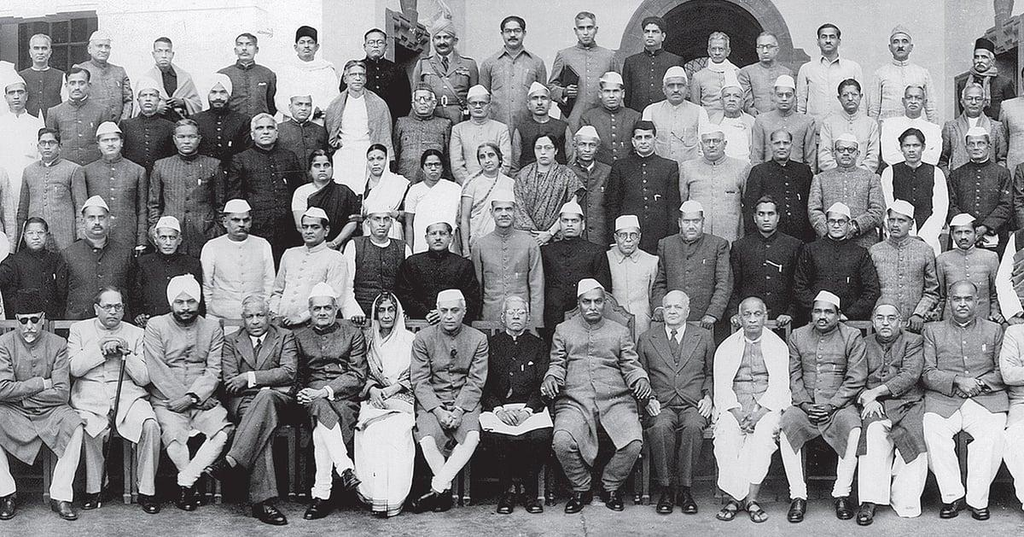
The Constituent Assembly appointed several committees to examine specific constitutional questions.
The Indian Constitution was a complex document involving a wide range of subjects, including federalism, fundamental rights, minority safeguards, parliamentary government, judiciary and administrative institutions.
It was not practical to examine every issue simultaneously in the full Assembly.
Therefore, committees were established to undertake detailed examination and submit recommendations to the Assembly.
The committee system enabled specialised deliberation, division of work and systematic consideration of constitutional issues.
The committees can broadly be classified into:
- Major committees dealing with substantive constitutional questions.
- Procedural and administrative committees.
- Specialised and ad hoc committees.
7.1 Major Committees and Their Chairpersons
These committees were particularly important in shaping the substantive provisions of the Constitution.
| Committee | Chairman |
|---|---|
| Union Powers Committee | Jawaharlal Nehru |
| Union Constitution Committee | Jawaharlal Nehru |
| Provincial Constitution Committee | Sardar Vallabhbhai Patel |
| Advisory Committee on Fundamental Rights, Minorities and Tribal and Excluded Areas | Sardar Vallabhbhai Patel |
| Drafting Committee | Dr. B. R. Ambedkar |
| States Committee | Jawaharlal Nehru |
| Steering Committee | Dr. Rajendra Prasad |
7.2 Union Powers Committee
Chairman: Jawaharlal Nehru
The Union Powers Committee examined the distribution of legislative powers between the proposed Union and the constituent units.
Its deliberations contributed to the development of India’s federal framework.
Important questions considered included:
- The powers of the Union government.
- The subjects to be placed under Union jurisdiction.
- The distribution of legislative responsibilities.
- The need for an effective central authority.
The recommendations of this committee contributed to the eventual distribution of legislative powers under the Seventh Schedule.
7.3 Union Constitution Committee
Chairman: Jawaharlal Nehru
This committee examined the constitutional structure and organisation of the Union government.
Its work related to:
- The nature of the Union constitutional system.
- The organisation of the Union executive.
- The structure and functioning of the Union legislature.
- The relationship between constitutional institutions.
Its deliberations contributed to the framework of parliamentary government at the Union level.
7.4 Provincial Constitution Committee
सरदार वल्लभ भाई पटेल की 71 वीं पुण्यतिथि,पीएम मोदी ने दी श्रद्धांजलि – Jai Bharat
Chairman: Sardar Vallabhbhai Patel
This committee examined the constitutional organisation of the provinces, which later became the States under the Indian constitutional framework.
Its important areas of consideration included:
- Provincial executive.
- Provincial legislatures.
- Constitutional position of provincial governments.
- Relationship between the provincial executive and legislature.
- Institutional arrangements for provincial administration.
The committee’s work contributed to the constitutional framework of State governments.
7.5 Advisory Committee on Fundamental Rights, Minorities and Tribal and Excluded Areas
Chairman: Sardar Vallabhbhai Patel
This was one of the most important committees of the Constituent Assembly.
It dealt with questions concerning individual rights, minority protection and the administration of tribal and excluded areas.
The committee’s mandate covered three broad areas:
- Fundamental Rights.
- Rights and safeguards of minorities.
- Administration of tribal and excluded areas.
The Advisory Committee appointed specialised sub-committees to examine these subjects.
Important sub-committees:
| Sub-committee | Chairman |
|---|---|
| Fundamental Rights Sub-Committee | J. B. Kripalani |
| Minorities Sub-Committee | H. C. Mookherjee |
| North-East Frontier (Assam) Tribal and Excluded Areas Sub-Committee | Gopinath Bordoloi |
| Excluded and Partially Excluded Areas (other than Assam) Sub-Committee | A. V. Thakkar |
The recommendations of these committees influenced several important constitutional provisions.
For example:
- Fundamental Rights in Part III.
- Minority protections under Articles 29 and 30.
- Special administrative arrangements for tribal areas under the Fifth and Sixth Schedules.
7.6 States Committee
Chairman: Jawaharlal Nehru
The States Committee, also known as the Negotiating Committee with States, dealt with the representation and constitutional relationship of princely states with the proposed Indian Union.
Its work was significant because the princely states were not directly administered as British provinces.
Their participation in the Indian Union required political negotiations and constitutional arrangements.
The integration of princely states was therefore closely connected with the broader process of constitution-making.
7.7 Drafting Committee
Dr. R Ambedkar – meherbabatravels jimdo page!
Chairman: Dr. B. R. Ambedkar
The Drafting Committee was established on 29 August 1947 by a resolution of the Constituent Assembly.
It was entrusted with the responsibility of preparing a draft Constitution based on the decisions and recommendations of the Assembly and its committees.
The Drafting Committee played a central role in converting the decisions of the Constituent Assembly into a coherent constitutional document.
Its responsibilities included:
- Examining the reports of the various committees.
- Translating the Assembly’s decisions into constitutional provisions.
- Ensuring consistency among different provisions.
- Preparing the Draft Constitution.
- Suggesting modifications and amendments.
- Presenting the draft for consideration by the Constituent Assembly.
The detailed composition, changes in membership and specific contribution of Dr. Ambedkar will also be relevant in our subsequent study of the making of the Constitution.
7.8 Other Important Committees
Apart from the substantive committees, several procedural and administrative committees ensured the smooth functioning of the Assembly.
| Committee | Chairman |
|---|---|
| Rules of Procedure Committee | Dr. Rajendra Prasad |
| Steering Committee | Dr. Rajendra Prasad |
| Finance and Staff Committee | Dr. Rajendra Prasad |
| Credential Committee | Alladi Krishnaswami Ayyar |
| House Committee | B. Pattabhi Sitaramayya |
| Order of Business Committee | K. M. Munshi |
| Ad hoc Committee on the National Flag | Dr. Rajendra Prasad |
| Committee on the Functions of the Constituent Assembly | G. V. Mavalankar |
UPSC preparation tip: Candidates should pay particular attention to the chairpersons of the major committees, especially Jawaharlal Nehru, Sardar Patel, Dr. Rajendra Prasad and Dr. B. R. Ambedkar.
The distinction between the Union Constitution Committee and Union Powers Committee, as well as the different sub-committees under Patel’s Advisory Committee, is also important.
The official Parliament resources and the digitised Constituent Assembly records provide useful material for verifying committee names and responsibilities. Digital Sansad+2
8. Working of the Constituent Assembly
The Constituent Assembly functioned through a combination of committee deliberations, detailed debates, examination of draft provisions and formal voting.
Its proceedings were conducted in a democratic and deliberative manner, with members having opportunities to express their views, propose amendments and question the constitutional provisions under consideration.
The Assembly’s work can be understood through the following dimensions.
8.1 Deliberative Nature of the Assembly
The Assembly did not simply approve a Constitution prepared by a few individuals.
Its members discussed a wide range of constitutional questions, including:
- Whether India should adopt a parliamentary or presidential system.
- Whether the Union should be strong or weak.
- The nature and scope of Fundamental Rights.
- The relationship between Fundamental Rights and Directive Principles.
- Minority safeguards.
- The powers of the President.
- The independence and jurisdiction of the judiciary.
- The relationship between the Union and States.
- The role of social and economic justice in constitutional governance.
The discussions reflected different political, ideological, regional and social perspectives.
The Assembly sought to reconcile these differences through debate, deliberation, compromise and voting.
8.2 Role of Constitutional Debates
The Constituent Assembly Debates are an important source for understanding the intentions of the Constitution-makers.
They help explain:
- Why particular constitutional provisions were adopted.
- Why certain alternatives were rejected.
- What concerns influenced the framing of specific provisions.
- How disagreements were resolved.
- What constitutional philosophy guided the decisions.
The debates continue to be referred to by constitutional scholars, lawyers and courts when interpreting difficult constitutional questions.
8.3 Participation of Women
The Constituent Assembly included 15 women members.
Their participation was important in the constitutional discussions concerning equality, education, social reform, women’s rights and representation.
Some prominent women members included:
- Hansa Mehta
- Durgabai Deshmukh
- Rajkumari Amrit Kaur
- Sucheta Kripalani
- Dakshayani Velayudhan
- Ammu Swaminathan
- Begum Aizaz Rasul
- Purnima Banerji
- Renuka Ray
- Malati Choudhury
- Leela Roy
- Kamla Chaudhri
- Annie Mascarene
- Vijayalakshmi Pandit
- G. Durgabai (Durgabai Deshmukh is listed only once in the standard membership list; the 15-member list should be checked against the original membership records when used for detailed biographical study).
Their contributions reflected the importance of women’s participation in the development of India’s constitutional democracy.
8.4 Consensus and Compromise
The Assembly frequently encountered disagreements on important constitutional questions.
However, it attempted to arrive at solutions through discussion and compromise rather than relying exclusively on majority voting.
For example, the debates concerning minority safeguards, language, federalism and the distribution of powers required extensive negotiations.
This deliberative approach contributed to the legitimacy and durability of the Constitution.
9. Dual Role of the Constituent Assembly after Independence
An important development occurred after the commencement of independence on 15 August 1947.
Under the Indian Independence Act, 1947, the Constituent Assembly became a fully sovereign body.
It no longer functioned merely under the framework of the Cabinet Mission Plan.
It acquired the authority to frame the Constitution without external British control.
It also assumed the legislative responsibilities of the newly independent Indian Dominion.
Thus, the Assembly performed two distinct functions:
- Constitution-making.
- Legislative functioning.
9.1 Constituent Assembly as a Constitution-making Body
In this capacity, the Assembly deliberated upon constitutional provisions, examined reports, considered amendments and ultimately adopted the Constitution.
Dr. Rajendra Prasad presided over its constitution-making proceedings.
9.2 Constituent Assembly as a Legislative Body
The Assembly also functioned as the Dominion Legislature until the first general elections under the new Constitution.
The legislative work was separated from its constitution-making work.
The Constituent Assembly (Legislative) commenced functioning on 17 November 1947.
G. V. Mavalankar served as its President.
The distinction between these two functions was important because constitution-making and ordinary legislation involved different responsibilities.
| Constitution-making role | Legislative role |
|---|---|
| Framed the Constitution. | Made ordinary laws. |
| Exercised constituent authority. | Exercised legislative authority. |
| Presided over by Dr. Rajendra Prasad. | Presided over by G. V. Mavalankar. |
| Continued until the Constitution-making task was completed. | Continued until the new Parliament was constituted under the Constitution. |
This dual role demonstrates that the Assembly was not simply a temporary drafting body; it also served as the legislature of independent India during the transitional period.
10. Duration and Sessions of the Constituent Assembly
The Constituent Assembly took approximately three years to complete its constitution-making task.
The commonly accepted duration is:
2 years, 11 months and 18 days.
During this period, the Assembly held:
- 11 sessions.
- 165 days of sittings.
- 114 days devoted specifically to the consideration of the Draft Constitution.
The following table provides an overview of its sessions.
| Session | Dates |
|---|---|
| First | 9–23 December 1946 |
| Second | 20–25 January 1947 |
| Third | 28 April–2 May 1947 |
| Fourth | 14–31 July 1947 |
| Fifth | 14–30 August 1947 |
| Sixth | 27 January 1948 |
| Seventh | 4 November 1948–8 January 1949 |
| Eighth | 16 May–16 June 1949 |
| Ninth | 30 July–18 September 1949 |
| Tenth | 6–17 October 1949 |
| Eleventh | 14–26 November 1949 |
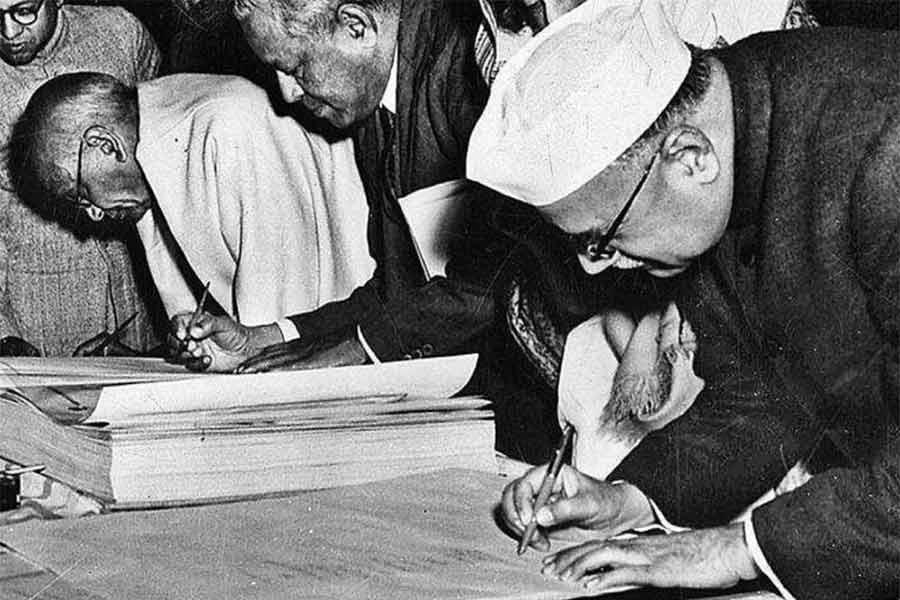
The Assembly met again on 24 January 1950 for the members to sign the Constitution.
These details are important for Prelims, particularly the number of sessions and the total number of days devoted to constitution-making. e-Parliament+2
11. Major Contributions of the Constituent Assembly
The Constituent Assembly’s contribution extended beyond drafting a legal document.
It established the institutional and philosophical foundations of independent India.
11.1 Establishment of Parliamentary Democracy
The Assembly adopted the parliamentary system of government, under which the executive is collectively responsible to the elected legislature.
This arrangement was considered suitable for ensuring political accountability and representative government.
11.2 Establishment of a Federal System with a Strong Union
The Constitution created a federal structure with a distribution of powers between the Union and States.
However, the Union was given substantial authority, particularly in areas relating to national security, economic coordination and national integration.
This reflected the historical circumstances surrounding Partition and the integration of princely states.
11.3 Guarantee of Fundamental Rights
The Assembly incorporated Fundamental Rights to protect individual liberty and establish constitutional limitations on governmental power.
These rights were intended to protect citizens against arbitrary State action and ensure equality and freedom.
11.4 Directive Principles of State Policy
The Assembly also incorporated Directive Principles of State Policy to guide the State towards social and economic transformation.
They reflected the commitment to building a welfare-oriented democratic society.
11.5 Independent Judiciary
The Assembly established an independent judicial system with the Supreme Court at its apex.
The judiciary was entrusted with protecting constitutional supremacy, interpreting constitutional provisions and safeguarding Fundamental Rights.
11.6 Universal Adult Franchise
One of the most significant decisions of the Assembly was the adoption of universal adult franchise.
It provided every adult citizen, subject to constitutional and statutory qualifications, an equal opportunity to participate in elections without discrimination based on caste, religion, sex, wealth or education.
This was particularly significant because India adopted universal adult suffrage at the very beginning of its constitutional democracy, despite widespread poverty and illiteracy.
11.7 Protection of Socially Disadvantaged Groups
The Constitution incorporated safeguards for Scheduled Castes, Scheduled Tribes and other disadvantaged sections.
It also established a framework for promoting social justice and equality of opportunity.
11.8 National Integration
The Assembly adopted a constitutional framework intended to maintain India’s unity while accommodating its linguistic, religious, regional and cultural diversity.
The provisions relating to federalism, citizenship, official language and tribal administration reflected this objective.
12. Criticism of the Constituent Assembly
Although the Constituent Assembly played a central role in framing the Constitution, its composition and functioning have been subject to academic and political criticism.
These criticisms are important for UPSC Mains because they provide a balanced understanding of the constitutional-making process.
12.1 Not Directly Elected by the People
The Assembly was indirectly elected by the provincial legislative assemblies.
Its members were not directly elected through universal adult franchise.
Consequently, critics questioned whether the Assembly could be considered fully representative of the Indian population.
Counterargument: The Assembly emerged from a national political struggle for independence and included representatives from diverse regions, communities and political viewpoints. Its constitutional legitimacy was subsequently strengthened by its deliberative process and adoption of the Constitution in the name of the people.
12.2 Congress Dominance
The Indian National Congress had a substantial majority in the Assembly.
Critics argued that this limited the influence of alternative political positions.
However, the Assembly also included members from different political backgrounds, including independent members, members of other parties and representatives of minority communities.
The existence of substantial internal differences within the Congress itself also meant that its members did not always hold identical views.
12.3 Limited Social Representation
Although the Assembly included representatives from different communities and backgrounds, its composition did not fully reflect the social and economic diversity of India’s population.
The representation of women, workers, peasants and some marginalised sections was limited.
This raised questions about the extent to which the Assembly reflected the composition of Indian society.
12.4 Influence of Foreign Constitutions
Some critics argued that the Indian Constitution borrowed extensively from foreign constitutional systems.
However, the Constitution-makers maintained that borrowing constitutional principles was not equivalent to blindly copying foreign institutions.
The provisions were examined and adapted to Indian historical, social and political conditions.
12.5 Lengthy Constitution-making Process
The Constitution took nearly three years to complete.
Critics questioned the time and expenditure involved in the exercise.
However, the complexity of India’s social structure, territorial integration, federal arrangements and rights framework required detailed deliberation.
The time spent on constitution-making should therefore be understood in the context of the extensive responsibilities entrusted to the Assembly.
12.6 Was the Constituent Assembly Sovereign from the Beginning?
The Assembly was originally established under the Cabinet Mission Plan of 1946.
Therefore, it did not initially possess unrestricted sovereign authority.
However, following the commencement of independence and the enactment of the Indian Independence Act, 1947, it became a sovereign constitution-making body.
This distinction is important in understanding the constitutional evolution of the Assembly.
13. Constitutional Significance of the Constituent Assembly
The Constituent Assembly occupies a central position in India’s constitutional history for several reasons.
First, it transformed the demand for independence into a constitutional project. The Assembly gave institutional form to the principle that Indians should determine their own constitutional future.
Second, it established constitutional democracy. It created a framework based on representative government, constitutional limitations and the rule of law.
Third, it provided a mechanism for reconciling diversity. The Assembly addressed the constitutional implications of India’s linguistic, religious, regional and social diversity.
Fourth, it established the foundations of social transformation. Fundamental Rights, Directive Principles and affirmative constitutional safeguards reflected the commitment to building a more egalitarian society.
Fifth, it established constitutional supremacy. The Constitution became the supreme law governing the relationship between the State, its institutions and citizens.
The Assembly’s deliberative approach also established an important tradition of constitutional debate and democratic decision-making.
14. Important Personalities and Their Contributions
The following personalities played important roles in the functioning of the Constituent Assembly.
| Personality | Contribution |
|---|---|
| Dr. Rajendra Prasad | President of the Constituent Assembly |
| Dr. B. R. Ambedkar | Chairman of the Drafting Committee |
| Jawaharlal Nehru | Chairman of Union Powers and Union Constitution Committees; introduced Objectives Resolution |
| Sardar Vallabhbhai Patel | Chairman of Advisory Committee and Provincial Constitution Committee |
| B. N. Rau | Constitutional Adviser |
| Dr. Sachchidananda Sinha | Temporary Chairman of the first meeting |
| H. C. Mookherjee | Vice-President and Chairman of Minorities Sub-Committee |
| G. V. Mavalankar | Chairman of Committee on Functions of Constituent Assembly; President of Constituent Assembly (Legislative) |
| J. B. Kripalani | Chairman of Fundamental Rights Sub-Committee |
| Gopinath Bordoloi | Chairman of North-East Frontier Tribal and Excluded Areas Sub-Committee |
| A. V. Thakkar | Chairman of Excluded and Partially Excluded Areas (other than Assam) Sub-Committee |
14.1 Important Members of the Drafting Committee
The Drafting Committee originally consisted of seven members:
- Dr. B. R. Ambedkar – Chairman.
- N. Gopalaswami Ayyangar.
- Alladi Krishnaswami Ayyar.
- K. M. Munshi.
- Syed Mohammad Saadulla.
- B. L. Mitter.
- D. P. Khaitan.
Subsequently:
- B. L. Mitter resigned due to ill health and was replaced by N. Madhava Rau.
- D. P. Khaitan passed away and was replaced by T. T. Krishnamachari.
UPSC fact: The original Drafting Committee had seven members, not eight or nine.
15. Important Chronology of the Constituent Assembly
The following timeline brings together the major developments in the Assembly’s history.
| Date | Event |
|---|---|
| 16 May 1946 | Cabinet Mission Plan announced |
| 9 December 1946 | First meeting of Constituent Assembly |
| 11 December 1946 | Dr. Rajendra Prasad elected permanent President |
| 13 December 1946 | Objectives Resolution introduced |
| 22 January 1947 | Objectives Resolution adopted |
| 22 July 1947 | National Flag adopted |
| 15 August 1947 | India attained independence |
| 29 August 1947 | Drafting Committee established |
| 21 February 1948 | Draft Constitution published for public comments |
| 4 November 1948 | Draft Constitution formally introduced for consideration |
| 26 November 1949 | Constitution adopted |
| 24 January 1950 | Members signed the Constitution |
| 26 January 1950 | Constitution came into force |
16. Conclusion
The Constituent Assembly was one of the most significant institutions in India’s transition from colonial rule to constitutional democracy.
Its importance lies not merely in the preparation of a written Constitution but in the deliberative process through which the fundamental principles of the Indian Republic were established.
The Assembly brought together representatives from different regions, communities and ideological backgrounds to address the complex questions confronting a newly independent and diverse country.
Through its committees, debates and negotiations, it developed a constitutional framework based on parliamentary democracy, federalism, Fundamental Rights, social justice, independent judiciary and universal adult franchise.
The Constituent Assembly thus transformed the political aspirations of the freedom struggle into a constitutional order.
Its work continues to influence Indian governance, constitutional interpretation and democratic institutions.
The Indian Constitution is therefore not simply a legal document; it is the product of a historic exercise in democratic deliberation and constitutional nation-building.
UPSC Examination Preparation
17. Prelims Special: Important Facts to Remember
Constituent Assembly – Quick Revision
- Established under the Cabinet Mission Plan, 1946.
- Original membership: 389.
- Membership after Partition: 299.
- First meeting: 9 December 1946.
- Temporary Chairman: Sachchidananda Sinha.
- Permanent President: Dr. Rajendra Prasad.
- Constitutional Adviser: B. N. Rau.
- Drafting Committee established: 29 August 1947.
- Drafting Committee Chairman: Dr. B. R. Ambedkar.
- Original Drafting Committee members: 7.
- Women members: 15.
- Total sessions: 11.
- Total sittings: 165 days.
- Draft Constitution consideration: 114 days.
- Duration: 2 years, 11 months and 18 days.
- Constitution adopted: 26 November 1949.
- Constitution signed: 24 January 1950.
- Constitution commenced: 26 January 1950.
18. UPSC Prelims Practice Questions
Q1. With reference to the Constituent Assembly of India, consider the following statements:
- It was established under the Cabinet Mission Plan.
- Its members were directly elected through universal adult franchise.
- Representatives of princely states were nominated by their rulers.
Which of the statements given above is/are correct?
(a) 1 only
(b) 1 and 3 only
(c) 2 and 3 only
(d) 1, 2 and 3
Q2. Who among the following was the Constitutional Adviser to the Constituent Assembly?
(a) Dr. B. R. Ambedkar
(b) K. M. Munshi
(c) B. N. Rau
(d) Alladi Krishnaswami Ayyar
Q3. Consider the following pairs:
| Committee | Chairman |
|---|---|
| 1. Union Powers Committee | Jawaharlal Nehru |
| 2. Provincial Constitution Committee | Sardar Vallabhbhai Patel |
| 3. Drafting Committee | Dr. Rajendra Prasad |
| 4. Advisory Committee | Sardar Vallabhbhai Patel |
How many of the above pairs are correctly matched?
(a) Only one
(b) Only two
(c) Only three
(d) All four
Q4. Which of the following statements regarding the Constituent Assembly is correct?
(a) It was directly elected by the people of India.
(b) Its original strength was 299 members.
(c) It became a sovereign body after the Indian Independence Act, 1947.
(d) It ceased functioning immediately after the adoption of the Constitution.
Q5. Consider the following statements:
- Dr. Sachchidananda Sinha was the temporary Chairman of the Constituent Assembly.
- Dr. Rajendra Prasad was elected its permanent President on 11 December 1946.
- B. N. Rau was the Chairman of the Drafting Committee.
Which of the statements given above is/are correct?
(a) 1 only
(b) 1 and 2 only
(c) 2 and 3 only
(d) All three
Q6. With reference to the functioning of the Constituent Assembly, consider the following statements:
- It held eleven sessions.
- It spent 114 days considering the Draft Constitution.
- It performed legislative functions after independence.
Which of the statements given above are correct?
(a) 1 and 2 only
(b) 2 and 3 only
(c) 1 and 3 only
(d) 1, 2 and 3
Q7. Which of the following committees was chaired by Jawaharlal Nehru?
- Union Powers Committee
- Union Constitution Committee
- States Committee
- Provincial Constitution Committee
Select the correct answer:
(a) 1, 2 and 3 only
(b) 1 and 4 only
(c) 2, 3 and 4 only
(d) All four
Answer Key and Explanations
| Question | Answer | Explanation |
|---|---|---|
| 1 | (b) | Provincial representatives were indirectly elected; princely-state representatives were nominated. |
| 2 | (c) | B. N. Rau served as Constitutional Adviser. |
| 3 | (c) | The Drafting Committee was chaired by Ambedkar, not Rajendra Prasad. |
| 4 | (c) | The Indian Independence Act, 1947 made the Assembly sovereign. |
| 5 | (b) | B. N. Rau was Constitutional Adviser, not Drafting Committee Chairman. |
| 6 | (d) | All three statements are correct. |
| 7 | (a) | Nehru chaired the first three committees listed. Patel chaired the Provincial Constitution Committee. |
19. UPSC Mains Practice Questions
10 Marks
- Explain the composition and method of election of the Constituent Assembly of India.
- Examine the contribution of the major committees of the Constituent Assembly in framing the Indian Constitution.
- Discuss the role of B. N. Rau and Dr. B. R. Ambedkar in the constitution-making process.
15 Marks
- The Constituent Assembly of India was not directly elected through universal adult franchise, yet it produced a Constitution that established a democratic republic. Examine.
- Discuss the role of the Constituent Assembly in establishing the institutional and philosophical foundations of Indian democracy.
- Critically examine the composition, representativeness and democratic legitimacy of the Constituent Assembly.