
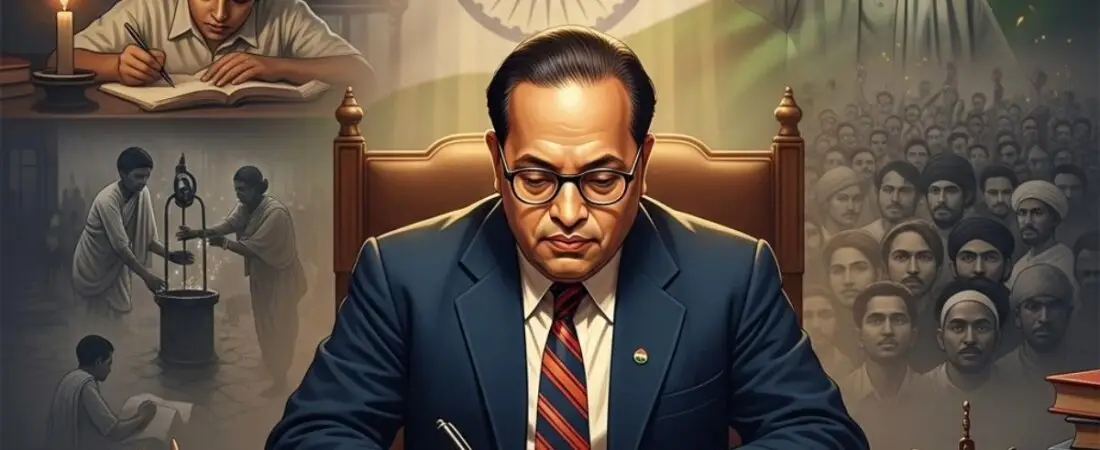
Samata IAS Academy | Indian Polity and Constitution | UPSC Civil Services Examination – General Studies Paper II
1. Introduction
The making of the Indian Constitution was one of the most significant exercises in constitutional institution-building in modern history. It involved an extensive process of research, consultation, committee deliberations, drafting, debate and political negotiation.
The Constitution was not prepared in a single exercise by one individual or committee. It emerged from the collective efforts of the Constituent Assembly, its various committees, constitutional experts and representatives belonging to different regions, communities and ideological backgrounds.
The process involved several distinct stages:
- Preliminary constitutional research and preparation of an initial draft.
- Examination of constitutional issues by various committees.
- Establishment of the Drafting Committee.
- Preparation and publication of the Draft Constitution.
- Detailed discussion and consideration of amendments.
- Adoption of the Constitution.
- Signing and commencement of the Constitution.
The process extended over 2 years, 11 months and 18 days, from the first meeting of the Constituent Assembly on 9 December 1946 to the adoption of the Constitution on 26 November 1949.
Understanding this process is important because it explains the historical circumstances, constitutional philosophy and deliberative foundations behind the Indian Constitution.
2. Preliminary Work before the Drafting Committee

The actual drafting of the Constitution began well before the establishment of the Drafting Committee on 29 August 1947.
The Constituent Assembly had already established several committees to examine specific constitutional questions.
These committees submitted reports dealing with the distribution of powers, fundamental rights, minority safeguards, provincial administration, tribal areas and the structure of the Union government.
The Assembly also relied on constitutional research and comparative studies of constitutional systems across the world.
2.1 Role of B. N. Rau: Constitutional Research and Initial Draft
Remembering B. N. Rau’s Contribution In The Making Of Indian Constitution
Sir Benegal Narsing Rau served as the Constitutional Adviser to the Constituent Assembly.
He played an important role in the preliminary technical and research work that preceded the Drafting Committee’s formal drafting exercise.
His major contributions included:
- Studying constitutional systems of different countries.
- Examining the reports submitted by the Constituent Assembly committees.
- Identifying constitutional provisions suitable for Indian conditions.
- Consulting constitutional experts and studying international constitutional practices.
- Preparing an initial draft framework of the Constitution.
In October 1947, B. N. Rau prepared an initial draft Constitution based on the decisions and recommendations available at that stage.
This draft served as an important working document for the Drafting Committee.
Important distinction: B. N. Rau prepared the preliminary draft as Constitutional Adviser. The Drafting Committee, under Dr. B. R. Ambedkar, subsequently examined, revised and developed the constitutional text.
2.2 Comparative Constitutional Research
The Constitution-makers examined the constitutional experiences of several countries to identify institutional arrangements that could be adapted to Indian conditions.
They did not merely reproduce foreign constitutional provisions. They studied their functioning, limitations and suitability for India’s political and social circumstances.
Important constitutional influences included:
| Country | Important constitutional influence |
|---|---|
| United Kingdom | Parliamentary government, cabinet system, rule of law |
| United States | Fundamental Rights, judicial review, impeachment of the President |
| Ireland | Directive Principles of State Policy |
| Canada | Federation with a strong Centre |
| Australia | Concurrent List and certain legislative arrangements |
| Germany (Weimar Constitution) | Emergency-related provisions |
| South Africa | Amendment procedure and election-related arrangements |
| France | Republican ideals of liberty, equality and fraternity |
| Japan | Procedure established by law |
The Constitution-makers also drew upon the Government of India Act, 1935, which provided an important administrative and institutional foundation for several provisions.
Its influence was particularly visible in the federal structure, provincial administration, public services and emergency-related arrangements.
The objective was to create a constitutional framework suited to India’s requirements rather than adopt any single foreign model.
3. Establishment and Composition of the Drafting Committee
The Constituent Assembly established the Drafting Committee on 29 August 1947 through a resolution moved by B. Pattabhi Sitaramayya.
The Committee was entrusted with the responsibility of examining the preliminary draft prepared by B. N. Rau and incorporating the decisions of the Constituent Assembly into a systematic constitutional document.
3.1 Original Composition of the Drafting Committee
The Drafting Committee originally consisted of seven members.
| Member | Role |
|---|---|
| Dr. B. R. Ambedkar | Chairman |
| N. Gopalaswami Ayyangar | Member |
| Alladi Krishnaswami Ayyar | Member |
| K. M. Munshi | Member |
| Syed Mohammad Saadulla | Member |
| B. L. Mitter | Member |
| D. P. Khaitan | Member |
Subsequent changes in membership took place:
- B. L. Mitter resigned due to ill health and was replaced by N. Madhava Rau.
- D. P. Khaitan passed away and was replaced by T. T. Krishnamachari.
3.2 First Meeting of the Drafting Committee
The Drafting Committee held its first meeting on 30 August 1947 and elected Dr. B. R. Ambedkar as its Chairman.
The Committee examined the preliminary draft prepared by B. N. Rau, the reports of various committees and the decisions already taken by the Constituent Assembly.
It then proceeded to develop a comprehensive constitutional document.
3.3 Functions of the Drafting Committee
The principal responsibilities of the Drafting Committee included:
- Examining the draft prepared by the Constitutional Adviser.
- Incorporating the decisions of the Constituent Assembly.
- Examining the recommendations of various committees.
- Ensuring consistency and coherence among constitutional provisions.
- Preparing a legally and technically sound constitutional document.
- Revising the draft in response to suggestions and amendments.
- Presenting the revised Constitution before the Constituent Assembly.
The Drafting Committee was not an independent constitution-making authority. The final authority to accept, reject or modify constitutional provisions rested with the Constituent Assembly.
This distinction is important in understanding the collective nature of India’s constitution-making process.
4. Preparation and Publication of the Draft Constitution
The preparation of the Draft Constitution involved multiple stages.
4.1 First Draft by the Drafting Committee
After examining B. N. Rau’s draft and the decisions of the Constituent Assembly, the Drafting Committee prepared its own draft.
On 21 February 1948, the Committee submitted the Draft Constitution to the President of the Constituent Assembly, Dr. Rajendra Prasad.
The draft was published in the Gazette of India on 26 February 1948 for general information and public discussion.
Making the Constitution a Public Affair (Chapter 2) – Assembling India’s Constitution
The first Draft Constitution prepared by the Drafting Committee contained:
- 315 Articles.
- 18 Parts.
- 8 Schedules.
This was the initial draft and should not be confused with the Constitution finally adopted in November 1949.
4.2 Public Consultation and Examination
The publication of the draft was an important step in ensuring wider scrutiny of the proposed constitutional framework.
The draft was circulated among:
- Members of the Constituent Assembly.
- Provincial governments.
- Provincial legislatures.
- Legal and constitutional experts.
- Interested members of the public.
Suggestions, criticisms and proposed amendments were invited.
The Drafting Committee examined the feedback and made appropriate modifications.
This process enabled the draft to undergo scrutiny beyond the immediate discussions of the Assembly.
4.3 Revised Draft Constitution
After considering the suggestions and proposed modifications, the Drafting Committee revised the draft.
The revised version was subsequently placed before the Constituent Assembly for detailed consideration.
On 4 November 1948, Dr. B. R. Ambedkar formally introduced the Draft Constitution in the Assembly.
This marked the beginning of the Assembly’s detailed examination of the constitutional document.
The first draft and the final Constitution differed considerably in their number of provisions because of the amendments, additions and modifications made during the Assembly’s deliberations. Ministry of External Affairs+2
5. Three Readings of the Draft Constitution
The Constituent Assembly followed a structured procedure for examining the Draft Constitution.
The examination broadly took place through three readings.
Each reading had a distinct purpose and enabled the Assembly to scrutinise the constitutional document at different levels.
Three stages of constitutional deliberation
First Reading
4–9 November 1948
General discussion on the principles and broad framework of the Draft Constitution.
Second Reading
15 November 1948 – 17 October 1949
Detailed, clause-by-clause examination and consideration of amendments.
Third Reading
14–26 November 1949
Final consideration and adoption of the Constitution.
5.1 First Reading: General Discussion
The first reading commenced on 4 November 1948, when Dr. B. R. Ambedkar formally introduced the Draft Constitution.
This stage involved a general discussion of the broad constitutional framework.
The members examined the overall structure, philosophy and major features of the proposed Constitution.
The discussions included:
- The nature of the Indian Union.
- The parliamentary system of government.
- The federal structure.
- Fundamental Rights.
- The Directive Principles of State Policy.
- The powers of the executive and legislature.
- The independence of the judiciary.
- The relationship between the Union and the States.
The objective was to examine the broad principles and suitability of the proposed constitutional framework before proceeding to detailed consideration.
The first reading concluded on 9 November 1948.
5.2 Second Reading: Clause-by-Clause Discussion
The second reading was the most extensive and substantive stage of the constitution-making process.
It commenced on 15 November 1948 and continued until 17 October 1949.
During this stage, the Assembly examined the Draft Constitution article by article.
Members were allowed to propose amendments, question provisions and suggest modifications.
The discussion covered almost every important aspect of constitutional governance.
Major areas of discussion included:
A. Fundamental Rights
The members debated the scope of individual freedoms, equality, religious liberty, minority rights and the limitations that could be imposed on Fundamental Rights.
B. Federal Structure
The Assembly examined the distribution of legislative powers between the Union and States, the nature of the Indian federation and the need for a strong Union government.
C. Parliamentary Government
The powers and responsibilities of the President, Prime Minister, Council of Ministers and Parliament were discussed.
D. Judiciary
The members examined the independence of the judiciary, the jurisdiction of the Supreme Court and High Courts, and the constitutional safeguards necessary for judicial independence.
E. Citizenship
The Assembly debated the principles governing citizenship, particularly in the context of Partition, migration and the rehabilitation of displaced persons.
F. Minority Safeguards
The debates addressed the protection of religious, cultural and educational rights of minorities.
G. Social and Economic Justice
The Assembly considered provisions relating to the welfare of disadvantaged communities, labour rights, social justice and the Directive Principles of State Policy.
5.3 Amendments during the Second Reading
The second reading witnessed extensive participation by members through proposed amendments.
The Draft Constitution attracted 7,635 amendment notices.
Of these, 2,473 amendments were actually moved in the Assembly.
These amendments were considered, debated and disposed of through the Assembly’s deliberative procedure.
The large number of proposed amendments demonstrates the extent of scrutiny to which the Draft Constitution was subjected.
The second reading concluded on 17 October 1949.
5.4 Third Reading: Final Consideration
The third reading commenced on 14 November 1949 and concluded on 26 November 1949.
At this stage, the Assembly considered the Constitution as a whole and examined whether the final document should be adopted.
The discussion focused on the overall character, objectives and implications of the proposed Constitution.
On 25 November 1949, Dr. B. R. Ambedkar delivered his concluding speech, reflecting upon the work of the Constituent Assembly and the constitutional challenges facing independent India.
On 26 November 1949, the Constitution was formally adopted.
Important: The third reading was not another detailed clause-by-clause examination. It was the final stage of considering and adopting the constitutional document.
The official records of the Constituent Assembly and the Parliamentary research on its proceedings provide the basis for these three stages and their dates. PRS Legislative Research+2
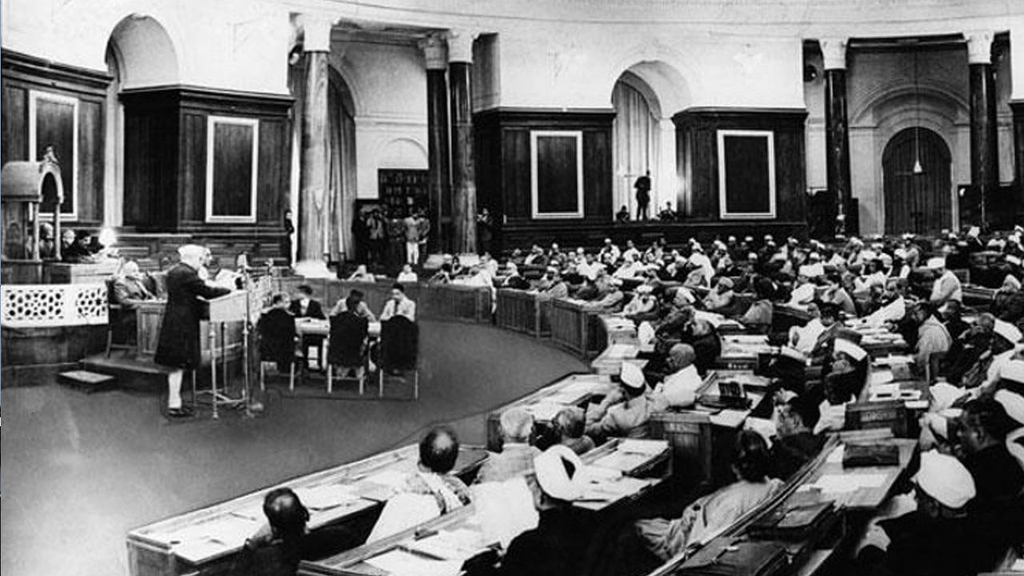
6. Important Constitutional Debates
The Constituent Assembly debates were not limited to technical questions of legal drafting. They involved fundamental disagreements about the nature of the Indian State and the direction of the newly independent country.
Several debates were particularly significant.
6.1 Nature of the Indian Federation
One of the major debates concerned the distribution of powers between the Union and States.
Some members favoured greater provincial autonomy, while others emphasised the need for a strong Union.
The historical circumstances of Partition, communal tensions, princely-state integration and national security influenced the decision to establish a strong Centre.
Ultimately, the Constitution provided for a federal structure with a comparatively strong Union.
This is reflected in:
- The Union List.
- The State List.
- The Concurrent List.
- Residuary legislative powers vested in Parliament.
- Emergency provisions.
- The constitutional position of Governors.
6.2 Parliamentary versus Presidential System
The Assembly considered whether India should adopt the parliamentary system followed in Britain or a presidential system similar to that of the United States.
The parliamentary system was ultimately adopted.
The major considerations included:
- Familiarity with parliamentary institutions developed during British rule.
- Collective responsibility of the executive to the legislature.
- Greater accountability of the executive.
- Compatibility with India’s diverse political conditions.
The Constitution therefore established a parliamentary system at both Union and State levels.
6.3 Fundamental Rights and Restrictions
Another major debate concerned the scope of Fundamental Rights.
The Constitution-makers wanted to guarantee individual liberty while recognising the need to protect public order, national security and social welfare.
The final Constitution therefore guaranteed Fundamental Rights but permitted reasonable restrictions under specified constitutional conditions.
This balance became an important feature of Indian constitutional democracy.
6.4 Uniform Civil Code
Article 44, which provides for the State to endeavour to secure a Uniform Civil Code for citizens, was included in the Directive Principles of State Policy.
The debate reflected differing perspectives concerning personal laws, religious freedom, gender equality and national integration.
The decision to include the provision among the Directive Principles rather than Fundamental Rights reflected the constitutional compromise adopted by the Assembly.
6.5 Official Language
The question of India’s official language generated extensive debate.
Members expressed different views regarding Hindi, English and the protection of linguistic diversity.
The Assembly ultimately adopted a constitutional compromise.
Article 343 provided for Hindi in Devanagari script as the official language of the Union, while allowing the continued use of English for official purposes for a period of fifteen years, subject to Parliament’s power to provide otherwise.
The Constitution also included provisions for the protection and development of linguistic interests.
6.6 Reservation and Minority Representation
The Assembly examined the question of political representation and safeguards for disadvantaged communities.
It adopted constitutional provisions providing for reservation of seats for Scheduled Castes and Scheduled Tribes in the Lok Sabha and State Legislative Assemblies.
At the same time, it rejected separate electorates for religious minorities.
This represented an important constitutional decision in favour of common electoral arrangements while providing specified safeguards for historically disadvantaged communities.
6.7 Universal Adult Franchise
One of the most significant decisions was the adoption of universal adult franchise.
India chose to grant voting rights to adult citizens without making wealth, property ownership, education or gender a general qualification.
This decision was particularly significant in the context of widespread poverty and illiteracy at the time of independence.
It reflected the Assembly’s confidence in democratic participation and political equality.
7. Adoption of the Indian Constitution
How the Bengali chotalok shaped India’s destiny – Forward Press
After completing the three readings and resolving the proposed amendments, the Constituent Assembly adopted the Constitution on 26 November 1949.
This marked the culmination of the constitution-making process.
The adoption of the Constitution was a historic event because it formally established the constitutional framework of independent India.
7.1 Why Was the Constitution Adopted on 26 November 1949?
The date of 26 November 1949 marks the formal adoption and enactment of the Constitution by the Constituent Assembly.
The concluding words of the Preamble record this event:
“In our Constituent Assembly this twenty-sixth day of November, 1949, do hereby adopt, enact and give to ourselves this Constitution.”
This declaration is important because it establishes that the Constitution was adopted in the name of the people of India.
7.2 Why Did the Constitution Not Come into Force Immediately?
Although the Constitution was adopted on 26 November 1949, it did not become fully operational on that date.
The Constitution-makers decided that the Constitution would generally come into force on 26 January 1950.
However, certain provisions were brought into force immediately on 26 November 1949 under Article 394.
These included provisions relating to citizenship, the President’s oath, the Election Commission and certain transitional and commencement arrangements.
The decision to have a later general commencement date was connected with the historical significance of 26 January.
7.3 Why Was 26 January Chosen as the Commencement Date?
The choice of 26 January was intended to commemorate an important event in India’s freedom struggle.
On 26 January 1930, the Indian National Congress observed Purna Swaraj Day, following the declaration of complete independence at its Lahore Session in December 1929.
The national movement had declared complete independence as its political objective and called upon Indians to observe 26 January as Independence Day.
By choosing the same date in 1950 for the commencement of the Constitution, the Constitution-makers sought to maintain continuity between the freedom struggle and the establishment of the Indian Republic.
Thus, 26 January 1950 became the day on which India formally became a Republic.
8. Signing of the Constitution
After its adoption, the Constitution was signed by the members of the Constituent Assembly on 24 January 1950.
A total of 284 members signed the Constitution.
The original Constitution was prepared in two handwritten versions:
- One in English.
- One in Hindi.
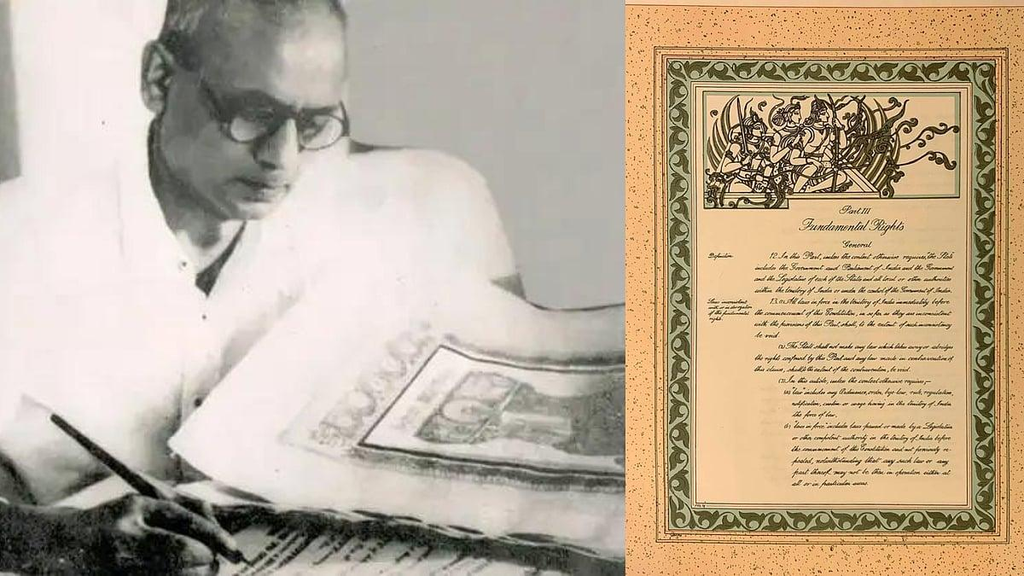
The English version was handwritten by Prem Behari Narain Raizada, while the Hindi version was calligraphed by Vasant Krishan Vaidya.
The original manuscript was decorated with illustrations representing different periods and themes of Indian history.
These illustrations were prepared under the artistic direction of Nandalal Bose, with contributions from other artists associated with Kala Bhavana, Santiniketan.
The original handwritten Constitution is preserved in special conditions in the Parliament Library.
8.1 Election of the First President of India
On 24 January 1950, Dr. Rajendra Prasad was elected as the first President of India by the Constituent Assembly.
He subsequently assumed office on 26 January 1950, when India became a Republic.
This was the final institutional step in the transition from the Dominion of India to the Republic of India.
9. Commencement of the Constitution
The Constitution came into force on 26 January 1950.
With its commencement:
- India became a sovereign democratic republic.
- The office of the Governor-General ceased to exist.
- The President of India became the constitutional head of the State.
- The Constituent Assembly’s constitution-making task came to an end.
- The constitutional framework of the Union and States became operational.
- The Constitution became the supreme law of the country.
The commencement of the Constitution also marked the transition from the constitutional framework of the Indian Independence Act, 1947, to the constitutional order established by the Constitution of India.
9.1 What Happened to the Constituent Assembly?
Following the commencement of the Constitution, the Constituent Assembly ceased to function as the constitution-making body.
However, it continued temporarily as the Provisional Parliament of India until the first general elections were held under the new Constitution.
The first general elections to the Lok Sabha were conducted during 1951–52, and the first elected Parliament was constituted thereafter.
This transitional arrangement ensured continuity in legislative governance.
10. Original Constitution: Structure and Characteristics
At the time of its adoption in 1949, the Indian Constitution contained:
395
ArticlesOriginal constitutional text
22
PartsOriginal constitutional structure
8
SchedulesOriginal schedules
~145,000
WordsApproximate length of the original text
The Constitution was one of the most detailed written national constitutions at the time of its adoption.
Its comprehensive character reflected the need to address India’s complex political, social, economic and administrative conditions.
It provided a detailed framework concerning:
- Union and State governments.
- Distribution of legislative powers.
- Fundamental Rights.
- Directive Principles of State Policy.
- Judiciary.
- Emergency provisions.
- Public services.
- Elections.
- Special provisions for disadvantaged communities.
- Constitutional amendment procedures.
Important: The figures of 395 Articles, 22 Parts and 8 Schedules refer to the original Constitution of 1950. The present constitutional text has undergone numerous amendments and structural changes.
11. Time Taken and Expenditure on Constitution-making
The Constituent Assembly took approximately three years to complete its constitution-making task.
The period is conventionally stated as:
2 years, 11 months and 17 days
The period is calculated from the first meeting of the Assembly on 9 December 1946 to the adoption of the Constitution on 26 November 1949.
The Assembly held:
- 11 sessions.
- 165 days of sittings.
- 114 days devoted to consideration of the Draft Constitution.
The Drafting Committee itself held numerous meetings and undertook extensive examination of the constitutional text.
The total expenditure on constitution-making is commonly reported as approximately ₹63.96 lakh.
These figures provide an indication of the scale and complexity of the constitution-making exercise. Constitution of India+2
12. Role of Dr. B. R. Ambedkar in the Making of the Constitution
How Ambedkar’s Vision Ensured The Independence of The Election Commission
Dr. B. R. Ambedkar played a central role in the drafting and presentation of the Constitution.
As Chairman of the Drafting Committee, he coordinated the examination of constitutional provisions and presented the draft before the Constituent Assembly.
His contributions included:
- Leading the work of the Drafting Committee.
- Examining the constitutional provisions prepared by the Constitutional Adviser.
- Presenting the Draft Constitution for consideration.
- Explaining the rationale behind various constitutional provisions.
- Responding to criticisms and proposed amendments.
- Defending the constitutional framework during the Assembly debates.
- Presenting the final constitutional document for adoption.
Ambedkar’s contribution was particularly important in explaining the relationship between political democracy, social democracy, constitutional morality and individual liberty.
12.1 Ambedkar’s Concluding Speech: 25 November 1949
In his concluding speech, Dr. Ambedkar reflected on the achievements and challenges associated with the new Constitution.
Some of his important observations concerned:
A. Political Democracy and Social Democracy
He warned that political democracy could not endure without a foundation of social democracy.
He emphasised that liberty, equality and fraternity must operate together as principles of social life.
B. Constitutional Methods
He emphasised the importance of constitutional methods for achieving political and social objectives.
C. Hero Worship in Politics
He cautioned against excessive devotion to political leaders, which could undermine democratic institutions and individual independence.
D. Constitutional Morality
He highlighted the importance of developing constitutional morality, noting that constitutional institutions could function effectively only when democratic values and constitutional practices were respected.
E. Social and Economic Inequality
He warned that political equality would coexist with substantial social and economic inequalities unless appropriate efforts were made to address them.
His concluding observations remain important for understanding the philosophical foundations of the Indian Constitution.
13. Critical Assessment of the Constitution-making Process
The making of the Indian Constitution was a complex exercise involving political negotiation, institutional design and social transformation.
Although the process produced a comprehensive constitutional framework, it also attracted criticism from scholars and political thinkers.
13.1 Extensive Borrowing from Foreign Constitutions
The Indian Constitution incorporated several institutional arrangements and constitutional principles from other countries.
Critics argued that excessive borrowing reduced its originality.
However, the Constitution-makers maintained that constitutional provisions should be evaluated according to their suitability and effectiveness rather than their country of origin.
The borrowed provisions were adapted to Indian conditions and integrated into a distinct constitutional framework.
13.2 Length and Complexity
The Constitution was considerably detailed compared with many other national constitutions.
Critics questioned whether such a lengthy document was necessary.
However, the Constitution-makers considered detailed constitutional provisions necessary because of:
- India’s social and cultural diversity.
- The need to accommodate princely states.
- Historical inequalities.
- Administrative complexity.
- The need for safeguards for disadvantaged communities.
- The necessity of establishing detailed institutional arrangements.
13.3 Strong Central Government
Some members criticised the concentration of substantial powers in the Union government.
They argued that the constitutional framework provided insufficient autonomy to States.
However, the Constitution-makers considered a strong Centre necessary in the context of Partition, communal tensions, national integration and economic reconstruction.
13.4 Limited Direct Popular Participation
The Constituent Assembly was not directly elected through universal adult franchise.
Therefore, the constitution-making process did not involve direct participation of the entire adult population.
Nevertheless, the Assembly conducted extensive deliberations and incorporated provisions for universal adult franchise in the Constitution itself.
13.5 Debate between Continuity and Transformation
The Constitution retained several administrative arrangements inherited from British rule, particularly those associated with the Government of India Act, 1935.
At the same time, it introduced fundamental changes through parliamentary democracy, Fundamental Rights, universal adult franchise and constitutional safeguards.
The constitution-making process therefore involved balancing administrative continuity with democratic and social transformation.
14. Significance of the Constitution-making Process
The process of framing the Indian Constitution is significant for several reasons.
1. Democratic legitimacy: The Constitution emerged from deliberations by an Indian representative body rather than being imposed by an external authority.
2. Constitutional deliberation: The three readings and extensive amendment process enabled detailed scrutiny of constitutional provisions.
3. Accommodation of diversity: The Assembly attempted to reconcile competing regional, religious, linguistic and ideological interests.
4. Social transformation: The Constitution established a framework for addressing historical inequalities and promoting social justice.
5. Institutional stability: It established the institutional framework of parliamentary government, federalism and an independent judiciary.
6. Constitutional supremacy: It established the Constitution as the supreme law governing the exercise of public authority.
The Constitution-making process also demonstrated that a democratic Constitution requires more than legal drafting. It requires deliberation, negotiation, compromise and a shared commitment to constitutional principles.
15. Important Chronology: From Drafting to Commencement
| Date | Constitutional development |
|---|---|
| 29 August 1947 | Drafting Committee established |
| 30 August 1947 | First meeting of Drafting Committee |
| October 1947 | B. N. Rau’s initial draft prepared |
| 21 February 1948 | Drafting Committee submitted its draft |
| 26 February 1948 | Draft published in Gazette |
| 4 November 1948 | Draft Constitution introduced in Assembly |
| 4–9 November 1948 | First reading |
| 15 November 1948–17 October 1949 | Second reading |
| 14–26 November 1949 | Third reading |
| 26 November 1949 | Constitution adopted |
| 24 January 1950 | Constitution signed by 284 members |
| 24 January 1950 | Dr. Rajendra Prasad elected first President |
| 26 January 1950 | Constitution came into force |
The Illustrated Constitution of India
16. Conclusion
The making of the Indian Constitution was a carefully organised and deliberative exercise that transformed the political aspirations of the freedom struggle into a comprehensive constitutional framework.
The contribution of B. N. Rau, the Drafting Committee, Dr. B. R. Ambedkar and the wider Constituent Assembly was essential to this process.
The three readings, extensive amendments, public consultation and constitutional debates ensured that the proposed framework received detailed consideration before adoption.
The Constitution-makers did not merely establish institutions of government. They sought to create a democratic political order based on justice, liberty, equality and fraternity.
The adoption of the Constitution on 26 November 1949 and its commencement on 26 January 1950 marked the completion of India’s transition from colonial rule to a constitutional republic.
The constitution-making process therefore represents a defining moment in India’s political and constitutional history.
UPSC Examination Preparation
17. Prelims Special: Important Facts to Remember
Quick Revision Sheet
- Constitutional Adviser: B. N. Rau.
- Initial draft by B. N. Rau: October 1947.
- Drafting Committee established: 29 August 1947.
- First meeting of Drafting Committee: 30 August 1947.
- Chairman of Drafting Committee: Dr. B. R. Ambedkar.
- Draft submitted: 21 February 1948.
- Draft published: 26 February 1948.
- Draft introduced in Assembly: 4 November 1948.
- First reading: 4–9 November 1948.
- Second reading: 15 November 1948–17 October 1949.
- Third reading: 14–26 November 1949.
- Amendment notices: 7,635.
- Amendments actually moved: 2,473.
- Constitution adopted: 26 November 1949.
- Members who signed: 284.
- Constitution commenced: 26 January 1950.
- Original Constitution: 395 Articles, 22 Parts and 8 Schedules.
- Total duration: 2 years, 11 months and 17 days.Important distinction
| Event | Date |
|---|---|
| Adoption | 26 November 1949 |
| Signing | 24 January 1950 |
| Commencement | 26 January 1950 |
18. UPSC Prelims Practice Questions
Q1. With reference to the making of the Indian Constitution, consider the following statements:
- B. N. Rau was the Chairman of the Drafting Committee.
- The Drafting Committee was established on 29 August 1947.
- The Draft Constitution was introduced in the Constituent Assembly on 4 November 1948.
Which of the statements given above is/are correct?
(a) 1 only
(b) 2 and 3 only
(c) 1 and 3 only
(d) 1, 2 and 3
Q2. Consider the following statements regarding the three readings of the Draft Constitution:
- The first reading involved general discussion.
- The second reading involved clause-by-clause examination.
- The third reading involved final consideration and adoption.
Which of the statements given above are correct?
(a) 1 and 2 only
(b) 2 and 3 only
(c) 1 and 3 only
(d) 1, 2 and 3
Q3. The Constitution of India was adopted on 26 November 1949 but came into force on 26 January 1950 primarily because:
(a) The British Government required an additional two months for approval.
(b) The Constituent Assembly wanted to commemorate the Purna Swaraj declaration of 1930.
(c) The first general elections had to be completed before commencement.
(d) The Constitution required approval by all princely states.
Q4. Which of the following statements is correct regarding the original Constitution of India?
(a) It contained 395 Articles, 22 Parts and 8 Schedules.
(b) It contained 395 Articles, 20 Parts and 12 Schedules.
(c) It contained 448 Articles, 22 Parts and 8 Schedules.
(d) It contained 395 Articles, 25 Parts and 8 Schedules.
Q5. Consider the following statements:
- The Constitution was signed by 284 members of the Constituent Assembly.
- The English version of the original Constitution was handwritten by Prem Behari Narain Raizada.
- The original Constitution was illustrated under the artistic direction of Nandalal Bose.
Which of the statements given above are correct?
(a) 1 and 2 only
(b) 2 and 3 only
(c) 1 and 3 only
(d) 1, 2 and 3
Q6. Which of the following provisions came into force immediately on 26 November 1949?
- Citizenship provisions.
- Provisions relating to the Election Commission.
- All provisions relating to Fundamental Rights.
- Certain transitional provisions.
Select the correct answer:
(a) 1 and 2 only
(b) 1, 2 and 4 only
(c) 2, 3 and 4 only
(d) All four
Q7. Consider the following statements regarding the constitution-making process:
- The Drafting Committee prepared the Constitution entirely independently of the Constituent Assembly.
- The Drafting Committee considered public suggestions and criticisms.
- The final authority to adopt the Constitution rested with the Constituent Assembly.
Which of the statements given above is/are correct?
(a) 1 and 2 only
(b) 2 and 3 only
(c) 1 and 3 only
(d) All three
Answer Key and Explanations
| Question | Answer | Explanation |
|---|---|---|
| 1 | (b) | B. N. Rau was Constitutional Adviser; Ambedkar chaired the Drafting Committee. |
| 2 | (d) | All three statements correctly describe the readings. |
| 3 | (b) | 26 January commemorated the Purna Swaraj declaration of 1930. |
| 4 | (a) | These were the original constitutional figures. |
| 5 | (d) | All three statements are correct. |
| 6 | (b) | Specified provisions commenced under Article 394; the entire Constitution did not. |
| 7 | (b) | The Drafting Committee worked under the authority and decisions of the Constituent Assembly. |
19. UPSC Mains Practice Questions
10 Marks
- Explain the role of B. N. Rau and the Drafting Committee in the making of the Indian Constitution.
- Describe the three readings of the Draft Constitution and their significance.
- Why was the Constitution adopted on 26 November 1949 but brought into force on 26 January 1950?
15 Marks
- The Indian Constitution was the product of extensive deliberation, negotiation and compromise. Discuss the various stages involved in its making.
- Examine the contribution of Dr. B. R. Ambedkar to the drafting and adoption of the Indian Constitution.
- Critically analyse the constitution-making process with reference to public participation, democratic legitimacy and constitutional deliberation.