
Introduction
Parliament is the central legislative institution of India’s parliamentary democracy. It makes laws, authorises public expenditure, debates national issues and holds the Union executive accountable. However, the growing complexity of governance, the volume of legislation and the technical nature of public policy make it difficult for Parliament to examine every issue in sufficient detail during floor debates alone.
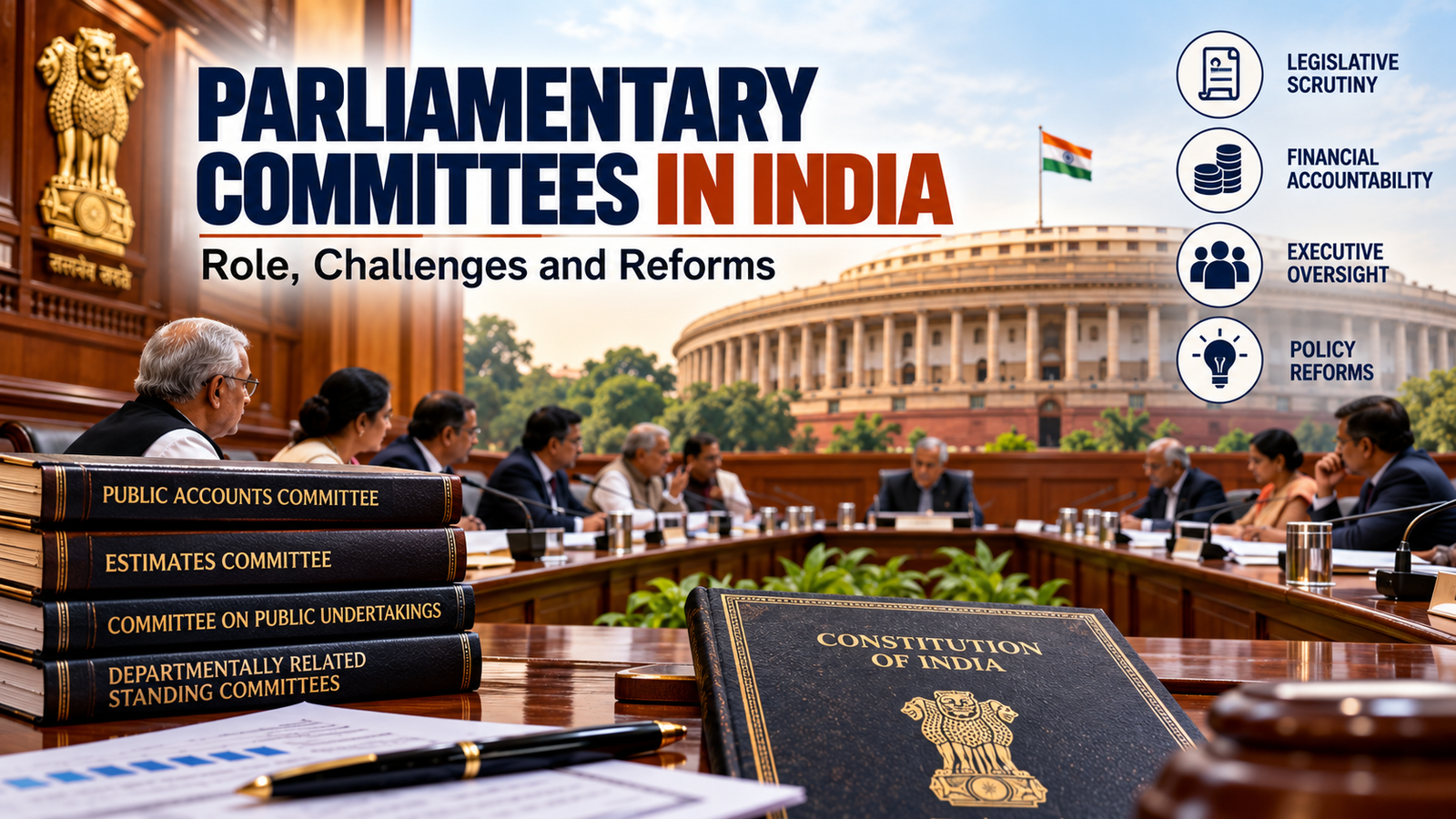
Parliamentary committees help bridge this gap by enabling detailed examination of legislation, public expenditure, government programmes and administrative performance. They provide a forum in which Members of Parliament can scrutinise issues more closely than is generally possible during ordinary proceedings of the two Houses.
Committees are particularly important in a system where the executive exercises substantial influence over the legislative agenda. Through committee examination, parliamentarians can seek explanations from ministries, consult experts and stakeholders, identify implementation problems and recommend improvements.
Yet, the effectiveness of this system depends on whether committees receive adequate time, whether important Bills are referred for detailed scrutiny, how seriously their recommendations are considered, and whether the government provides meaningful responses.
For UPSC aspirants, parliamentary committees are relevant to GS Paper II, especially Parliament, executive accountability, legislative procedures and institutional reforms. They also connect with public finance, governance and evidence-based policymaking.
1. What are parliamentary committees?
A parliamentary committee is a body of Members of Parliament constituted through election, nomination or appointment under the rules and procedures of Parliament to examine particular subjects, government activities or legislative proposals.
Parliament’s official explanation notes that modern government business is too extensive and complex for every matter to receive detailed consideration in the full House. A substantial amount of parliamentary work is therefore conducted through committees.
Digital Sansad
Committees enable MPs to examine matters in greater detail, question officials, analyse documents and reports, and make recommendations to the House.
They are not substitutes for Parliament. Rather, they are specialised extensions of Parliament’s scrutiny and deliberative functions.
Why are committees necessary?
Parliament has limited time for debates, while government activities span the economy, defence, health, education, infrastructure, technology and numerous other areas. Bills may also contain complex legal, financial and administrative provisions.
Committee examination can help MPs:
- Understand the practical consequences of proposed legislation.
- Identify gaps, ambiguities and unintended effects.
- Scrutinise government expenditure and programme implementation.
- Seek information from ministries and subject experts.
- Build consensus across party lines on technical issues.
- Improve the quality of parliamentary debate and public accountability.
The committee system is therefore important for both the quality of legislation and the accountability of the executive.
2. Constitutional and procedural basis
The Constitution does not provide a single, exhaustive list of all parliamentary committees. The committee system operates primarily through the rules of procedure of the two Houses, parliamentary directions and established conventions, alongside relevant constitutional provisions.
Important constitutional connections include:
| Constitutional provision | Relevance to parliamentary scrutiny |
|---|---|
| Article 105 | Privileges and powers of Parliament and its members, including protections relevant to parliamentary proceedings. |
| Article 118 | Empowers each House to make rules regulating its procedure and conduct of business. |
| Article 112 | Provides for the Annual Financial Statement, which is central to parliamentary financial scrutiny. |
| Article 113 | Deals with parliamentary procedure concerning demands for grants. |
| Article 148 | Establishes the office of the Comptroller and Auditor General of India, whose audit reports are important inputs for financial oversight. |
The detailed organisation and functioning of committees are governed by parliamentary rules and directions. The official Lok Sabha committee portal explains the committee system, membership and tenure.
Digital Sansad
A crucial distinction for UPSC Prelims is that not every parliamentary committee is explicitly mentioned in the Constitution. Many are established under parliamentary rules and practices.
3. Classification of parliamentary committees
Parliamentary committees can be broadly divided into two categories:
Standing committees
These are continuing committees constituted periodically or on a regular basis. They include financial committees, departmentally related standing committees and other standing committees.
Ad hoc committees
These are constituted for a specific purpose or inquiry and normally cease to exist after submitting their report or completing the assigned task.
The distinction is based primarily on their continuing or task-specific nature, rather than on whether their work is important or politically sensitive.
A. Financial committees
The three major financial committees are:
- Public Accounts Committee (PAC)
- Estimates Committee
- Committee on Public Undertakings (COPU)
They examine different dimensions of public finance, government expenditure and accountability.
B. Departmentally Related Standing Committees
These committees examine the work of Union ministries and departments. They may scrutinise demands for grants, Bills referred to them, annual reports and relevant policy documents.
The Rajya Sabha’s official committee FAQ records that 24 Departmentally Related Standing Committees have been constituted, with membership drawn from both Houses.
Digital Sansad
C. Other standing committees
These include committees dealing with matters such as:
- Petitions
- Privileges
- Ethics
- Government assurances
- Subordinate legislation
- Business advisory matters
- Rules and general purposes
Their responsibilities differ according to the rules governing each committee.
D. Ad hoc committees
Ad hoc committees include select committees of a House, joint committees of both Houses and other committees established for a specific task. Joint Parliamentary Committees (JPCs) are often constituted to examine a particular issue, policy controversy or Bill.
Their powers and scope depend on the terms of reference and the parliamentary resolution or decision under which they are constituted.
4. The three financial committees: functions and differences
Financial oversight is one of the most important contributions of the parliamentary committee system.
Public Accounts Committee
The Public Accounts Committee examines public expenditure and the accounts of the Union government, including audit findings of the Comptroller and Auditor General (CAG).
Its work helps Parliament determine whether public money was spent for authorised purposes and whether irregularities, waste or weaknesses in financial administration require corrective action.
Key points:
- It has 22 members: 15 from the Lok Sabha and 7 from the Rajya Sabha.
- Members are elected annually according to parliamentary procedure.
- A minister cannot be a member of the committee.
- By convention, its chairperson is generally from the Opposition, though this is not a constitutional requirement.
The PAC is primarily concerned with accountability for expenditure already incurred, rather than deciding the government’s policy priorities in advance.
Digital Sansad
+1
Estimates Committee
The Estimates Committee examines estimates of public expenditure and suggests ways to improve economy, efficiency and administrative organisation.
Its work is forward-looking in emphasis: it considers how public spending can be organised more effectively.
Key points:
- It has 30 members, all from the Lok Sabha.
- Members are elected annually.
- A minister cannot be a member.
The committee can recommend improvements in administrative structure, efficiency and the use of public resources.
Committee on Public Undertakings
The Committee on Public Undertakings examines the functioning and performance of selected public-sector enterprises within its remit, including matters relating to accounts, audit and operational accountability.
Key points:
- It has 22 members: 15 from the Lok Sabha and 7 from the Rajya Sabha.
- Members are elected annually.
- A minister cannot be a member.
Its role helps Parliament scrutinise whether public enterprises are operating in accordance with their objectives and the standards of financial and administrative accountability.
Comparison for UPSC
| Feature | Public Accounts Committee | Estimates Committee | Committee on Public Undertakings |
|---|---|---|---|
| Main focus | Expenditure and audit accountability | Economy and efficiency of expenditure | Public-sector enterprises |
| Membership | 22 | 30 | 22 |
| House composition | Both Houses | Lok Sabha only | Both Houses |
| CAG reports | Central to its work | May be relevant to its scrutiny | Relevant to its remit |
| Core question | Was public money spent properly? | Could expenditure be organised more efficiently? | Are public enterprises accountable and performing effectively? |
The official Parliament portal provides details of committee membership, functions and tenure.
Digital Sansad
+1
5. Departmentally Related Standing Committees (DRSCs)
Departmentally Related Standing Committees were introduced in 1993 to strengthen parliamentary scrutiny of ministries and departments. Their work is particularly important because it allows MPs to examine policy and expenditure within specific sectors.
The 24 DRSCs cover areas such as defence, finance, external affairs, agriculture, education, health, energy, railways, rural development and social justice.
Their main functions include:
- Examination of demands for grants: Committees scrutinise the budgetary demands of the ministries assigned to them.
- Examination of Bills: They examine Bills referred to them by the Speaker of the Lok Sabha or the Chairperson of the Rajya Sabha.
- Review of annual reports: They assess the work and performance of ministries.
- Examination of policy documents: They consider national policy documents referred to them.
- Recommendations: They submit reports to Parliament, identifying concerns and suggesting improvements.
Their examination can bring technical depth to legislative discussions. For example, a committee examining a health-related Bill may assess administrative feasibility, financial requirements, institutional capacity and stakeholder concerns that cannot always be explored adequately during a short debate in the House.
Membership and tenure
DRSCs have up to 31 members, with 21 nominated by the Speaker of the Lok Sabha and 10 by the Chairperson of the Rajya Sabha. Their tenure does not exceed one year under the established arrangement.
Ministers are not members of these committees. This helps maintain a distinction between executive responsibility and legislative scrutiny.
For additional details, consult the Rajya Sabha’s official FAQ on standing committees and the Lok Sabha committee portal.
Digital Sansad
+1
6. How parliamentary committees examine Bills
A committee’s examination of a Bill can be one of the most consequential stages of legislative scrutiny.
When a Bill is referred to a committee, members can examine its provisions in detail, consider whether the proposed legal framework is workable, and identify unintended consequences. Depending on the terms of reference and procedures, committees may obtain evidence from government representatives, experts and other stakeholders.
A simplified process is shown below.
Bill introduced in Parliament
Referral to a committee, where decided
Detailed examination and evidence
Committee report and recommendations
Parliament considers the Bill under its procedures
This is a simplified illustration. Not every Bill is referred to a committee, and referral does not automatically determine the Bill’s final outcome.
Are committee recommendations binding?
Generally, committee recommendations are recommendatory rather than legally binding. The government may accept them fully, accept them partly or reject them, subject to parliamentary accountability and applicable procedures.
The value of a committee report therefore depends not only on the quality of its analysis but also on whether the government responds to its findings and whether MPs use the report to improve legislative deliberation.
Why is pre-legislative scrutiny important?
Committee scrutiny before a Bill is enacted can help:
- Identify drafting errors and conflicting provisions.
- Examine whether proposed powers are sufficiently defined.
- Assess financial and administrative implications.
- Identify implementation challenges.
- Consider the impact on citizens, businesses and public institutions.
- Improve transparency and public confidence.
This is particularly important for legislation involving technology, data protection, financial regulation, criminal law, environmental governance and major institutional reforms.
7. Parliamentary committees and executive accountability
The parliamentary system is based on the principle that the executive is accountable to the legislature. In practice, however, the government usually has substantial control over legislative business when it commands a stable majority in the Lok Sabha.
Committee scrutiny creates additional opportunities to examine the executive’s decisions in detail.
Accountability through financial scrutiny
The PAC examines audit findings and expenditure accountability. The Estimates Committee focuses on efficiency and economy, while COPU examines public undertakings within its mandate.
Together, these committees help Parliament assess how public resources are used and whether government programmes are being implemented effectively.
Accountability through policy review
DRSCs provide a forum to examine ministry performance, budgetary requirements and selected policy questions. Their reports can expose implementation gaps and encourage ministries to explain their decisions.
Accountability through follow-up
The committee system can also support accountability after a report is submitted. Ministries may be asked to provide action-taken responses, and committees may examine the adequacy of those responses through established procedures.
This follow-up is important because scrutiny has limited practical value if findings are ignored without explanation.
8. Evidence from the 18th Lok Sabha: the referral challenge
A key indicator of legislative scrutiny is the proportion of Bills referred to parliamentary committees.
According to PRS Legislative Research’s analysis of the Winter Session of 2025, 11 of the 42 Bills introduced in the 18th Lok Sabha had been referred to committees by that point. Only one of those Bills had been referred to a Departmentally Related Standing Committee; the others had been referred to Joint or Select Committees.
PRS Legislative Research
+1
This is a dated snapshot, not a final figure for the entire 18th Lok Sabha. Referral patterns change as Parliament proceeds through successive sessions, and individual Bills may be referred to different kinds of committees.
The same concern had appeared earlier in the 18th Lok Sabha. PRS reported that, up to the Monsoon Session of 2025, approximately 27% of Bills introduced had been referred to committees, while none had been referred to DRSCs at that stage.
PRS Legislative Research
These figures highlight an important distinction: a Bill may be referred to a Joint or Select Committee, but this is not the same as routine examination by a subject-specific standing committee.
Why does the referral rate matter?
A lower referral rate can reduce opportunities for systematic examination, particularly when legislation is technically complex or has far-reaching social and economic consequences.
However, the referral percentage alone does not establish the quality of every legislative process. Some Bills may be narrow, urgent or primarily financial in nature, while others may require extensive scrutiny. A meaningful assessment should also consider:
- The complexity and significance of the Bill.
- The time available for debate.
- The quality of committee reports.
- The extent of expert and stakeholder consultation.
- The government’s response to committee recommendations.
- Whether Parliament considered the recommendations before passing legislation.
The objective should not be to refer every Bill automatically, but to ensure that important legislation receives adequate and proportionate scrutiny.
9. Major challenges facing parliamentary committees
9.1 Declining or selective referral of Bills
If major Bills are passed without detailed committee examination, Parliament may lose an important opportunity to assess their legal, administrative and financial implications.
The concern is especially significant for legislation that creates new institutions, grants extensive executive powers or substantially changes existing rights and obligations.
9.2 Limited time for examination
Committees must examine complex subjects within their allotted time. They may face competing demands from budget scrutiny, policy reviews and legislative referrals.
Insufficient time can limit the depth of analysis, stakeholder consultation and follow-up.
9.3 Limited research and technical support
Many policy questions require specialised knowledge in economics, law, technology, defence, climate science, public health and finance.
Parliamentary committees need dependable research assistance, access to experts and adequate institutional support to examine these issues effectively.
9.4 Partisanship and political polarisation
Committees can provide a setting for cross-party deliberation, but political disagreement may still affect the conduct of meetings, the content of reports and the willingness of members to reach consensus.
The effectiveness of the committee system depends partly on members’ willingness to treat scrutiny as an institutional responsibility rather than merely an extension of party competition.
9.5 Non-binding recommendations
Since committee recommendations are generally not binding, ministries may accept only some of the proposed changes.
This is not necessarily a defect: Parliament and the government retain their respective constitutional roles. However, recommendations should receive reasoned consideration, and action-taken responses should be sufficiently detailed to enable meaningful follow-up.
9.6 Transparency and confidentiality
Committee proceedings often need a degree of confidentiality to encourage candid discussion and protect sensitive information. At the same time, public access to reports and clear explanations of findings are essential for accountability.
The challenge is to balance the need for frank deliberation with transparency about the committee’s conclusions and the government’s response.
9.7 Short tenure and continuity
A limited tenure can make it difficult for members to build deep expertise in a subject. Frequent changes in membership may also reduce institutional memory.
Continuity, orientation and access to research support can help mitigate these limitations.
10. Parliamentary committees in comparative perspective
Many parliamentary democracies rely on committees to scrutinise legislation and government policy. Their exact powers, composition and relationship with the executive vary according to the constitutional system.
The United Kingdom, for example, has a long-established system of select committees that examine government departments and public policy. Other parliamentary systems also use committees to examine legislation, public expenditure and administration.
The useful lesson for India is not to copy another country’s model mechanically. Instead, India can strengthen its own committee system by improving research support, ensuring sufficient time for scrutiny, enhancing follow-up and making the government’s response to committee findings more transparent.
The effectiveness of committees depends on their institutional design, the resources available to them and the political willingness to respect legislative scrutiny.
11. Reforms needed to strengthen parliamentary committees
A. Establish clearer referral criteria for important Bills
Parliament should consider transparent criteria for identifying Bills that would benefit from detailed committee scrutiny. Relevant factors could include the legal complexity of the proposal, the extent of delegated powers, its financial implications, its effect on fundamental rights and the scale of institutional change.
This would not require every Bill to follow the same procedure. It would help ensure that consequential legislation is not deprived of detailed scrutiny without adequate consideration.
B. Provide adequate time for committee examination
Committees should receive sufficient time to study complex Bills and policy issues. Timelines should account for the need to examine documents, consult relevant stakeholders and consider the practical consequences of proposed provisions.
A report prepared under excessive time pressure may be less useful than one based on careful evidence and analysis.
C. Strengthen research and expert support
Parliament should continue to strengthen professional research assistance, access to independent subject experts and the analytical capacity of committee secretariats.
This is especially important for emerging areas such as artificial intelligence, cybersecurity, digital markets, climate policy, biotechnology and financial regulation.
D. Improve follow-up on recommendations
Ministries should provide clear action-taken responses explaining which recommendations have been accepted, which have been rejected and why.
Parliamentary committees can then assess whether the response is adequate and whether further action is needed. This would improve accountability without making every recommendation automatically binding.
E. Encourage continuity and specialisation
Where appropriate, committee membership and research support should promote institutional continuity and subject expertise. Members should have access to briefings on technical and legislative issues relevant to their committee’s responsibilities.
Training in budget analysis, legislative drafting, public administration and emerging technologies could also improve the quality of scrutiny.
F. Improve access to evidence
Committees should have effective procedures for obtaining relevant information from ministries, independent experts and other stakeholders, subject to parliamentary rules and legitimate confidentiality requirements.
Consultation should be balanced and evidence-based. It should help committees understand competing perspectives rather than merely reproduce the positions of organised interests.
G. Protect the non-partisan character of financial oversight
Financial committees are most effective when they concentrate on public accountability, efficiency and the proper use of resources. Their work should be guided by evidence and established procedures rather than partisan advantage.
The convention of appointing an Opposition member as chairperson of the Public Accounts Committee is one example of how parliamentary practice can support institutional scrutiny.
H. Strengthen transparency without undermining deliberation
Committee reports, findings and action-taken responses should be made readily accessible. At the same time, confidential evidence and sensitive information should be handled under the applicable parliamentary rules.
Digital access to committee reports can help citizens, researchers, journalists and UPSC aspirants understand how Parliament examines public policy.
I. Improve coordination between committees and Parliament’s wider work
Committee reports should feed more effectively into debates, legislative deliberations and budget scrutiny. Members should have adequate opportunities to use committee findings when discussing Bills, demands for grants and ministry performance.
The objective is to ensure that committee work informs Parliament’s decisions rather than remaining a separate administrative exercise.
12. Parliamentary committees and democratic governance
The committee system strengthens democratic governance in several interconnected ways.
- Legislative quality: Detailed scrutiny can identify ambiguities, inconsistencies and implementation problems before laws are enacted.
- Executive accountability: Committees provide structured opportunities to examine ministries, expenditure and government performance.
- Financial responsibility: Financial committees help Parliament assess whether public money is used lawfully and efficiently.
- Evidence-based policy: Expert input and documentary examination can improve the quality of legislative and policy decisions.
- Cross-party deliberation: Committees can create opportunities for discussion beyond the constraints of short floor debates.
- Public trust: Transparent reports and reasoned government responses help citizens understand how public decisions are scrutinised.
These benefits are not automatic. They depend on meaningful examination, adequate institutional support and serious consideration of committee findings.
For students studying the wider constitutional framework, parliamentary committees should be connected with the principles of constitutionalism, separation of powers and executive accountability. Samata IAS Academy’s Indian Polity and Constitution study material provides a broader framework for understanding Parliament and other constitutional institutions.
Samata IAS Academy
13. Linkages with other areas of the UPSC syllabus
Parliamentary committees are best understood as part of a broader institutional framework.
- Constitutionalism and Fundamental Rights: Committee scrutiny can help examine the implications of legislation for liberty, equality and legal safeguards. See Samata’s article on Fundamental Rights in the Indian Constitution.
- Directive Principles of State Policy: Committees examining welfare, education, health and economic policy can assess how government programmes relate to constitutional objectives. See Directive Principles of State Policy.
- Fundamental Duties: Parliamentary deliberations and public policy can also connect with responsible citizenship and constitutional values. See Fundamental Duties under Article 51A.
- Fiscal federalism and public finance: Financial scrutiny connects Parliament’s budgetary role with public expenditure, tax policy and accountability. This can be studied alongside the article on fiscal federalism in India.
These connections help aspirants move beyond memorising committee names and develop analytical answers linking institutions, accountability and public policy.
Conclusion
Parliamentary committees are indispensable to the effective functioning of India’s parliamentary democracy. They allow MPs to examine legislation, government expenditure and administrative performance in greater depth than is generally possible during ordinary proceedings of the House.
Their significance extends beyond technical scrutiny. Committees help Parliament hold the executive accountable, improve the quality of legislation, strengthen financial responsibility and create opportunities for evidence-based policymaking.
However, their effectiveness depends on adequate time, strong research support, meaningful referral of important Bills, institutional continuity and serious consideration of their recommendations.
The reform objective should be to ensure that committee scrutiny becomes a meaningful part of legislative decision-making, while preserving Parliament’s authority to determine its own procedures and legislative outcomes.
A strong committee system does not weaken Parliament or delay democracy unnecessarily. It helps Parliament make better-informed decisions and exercise more effective oversight over the executive.
14. UPSC Prelims: Key facts to remember
| Topic | Fact |
|---|---|
| Constitutional basis | The committee system operates mainly under parliamentary rules and procedures; not every committee is explicitly mentioned in the Constitution. |
| Article 118 | Each House of Parliament may make rules for regulating its procedure and conduct of business. |
| Public Accounts Committee | 22 members: 15 from Lok Sabha and 7 from Rajya Sabha. |
| Estimates Committee | 30 members, all from Lok Sabha. |
| Committee on Public Undertakings | 22 members: 15 from Lok Sabha and 7 from Rajya Sabha. |
| DRSCs | 24 departmentally related standing committees. |
| DRSC membership | Up to 31 members: 21 from Lok Sabha and 10 from Rajya Sabha. |
| Ministers | Ministers are not members of the three major financial committees or DRSCs. |
| Recommendations | Committee recommendations are generally recommendatory, not legally binding. |
| Joint Parliamentary Committee | An ad hoc committee constituted for a specified purpose, depending on its terms of reference. |
15. UPSC Mains practice questions
- “Parliamentary committees are essential to ensuring effective legislative scrutiny and executive accountability.” Discuss.
- Examine the role of Departmentally Related Standing Committees in improving the quality of legislation in India.
- Compare the functions of the Public Accounts Committee, Estimates Committee and Committee on Public Undertakings.
- Declining referral of Bills to parliamentary committees can weaken deliberative democracy. Critically examine.
- Suggest reforms to strengthen the effectiveness, independence and transparency of India’s parliamentary committee system.
16. Further reading: authoritative sources
These sources provide primary or institutional material for deeper study.
- Parliament of India: Introduction to parliamentary committees — committee functions, membership and tenure.
- Rajya Sabha Secretariat: Frequently asked questions on parliamentary committees — standing committees and DRSCs.
- Parliament Digital Library: Parliamentary committee reports — reports of financial, standing, joint and ad hoc committees.
- PRS Legislative Research: Parliament functioning in the Winter Session of 2025 — data on Bills introduced and referred to committees during that reporting period.
The PRS figures cited above refer to a particular point in the 18th Lok Sabha and should not be interpreted as final statistics for the full Lok Sabha term.