
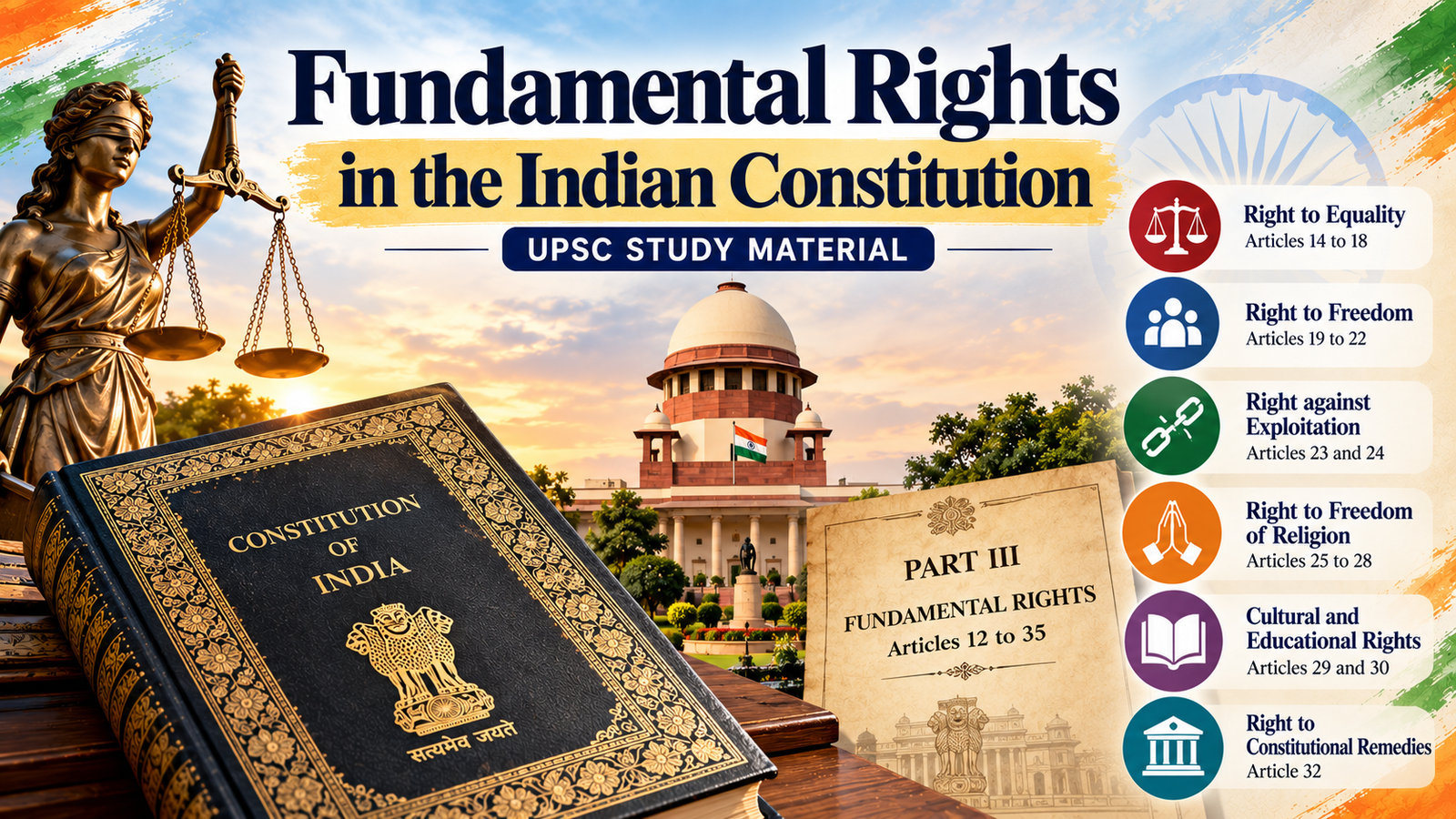
Fundamental Rights in the Indian Constitution
Fundamental Rights constitute one of the most important pillars of the Indian constitutional order. They protect individual liberty, equality and dignity while placing constitutional limits on the exercise of State power.
Contained primarily in Part III of the Constitution, Articles 12 to 35, Fundamental Rights transform certain basic human freedoms into constitutionally protected rights enforceable through courts.
They are not merely declarations of individual liberty. They also perform a broader constitutional function: they establish the relationship between the individual and the State, protect minorities and vulnerable groups, preserve democratic participation and provide judicial safeguards against arbitrary governmental action.
The Supreme Court has progressively interpreted these rights in light of changing social, technological and economic conditions. Consequently, the meaning of Fundamental Rights today extends well beyond the literal text of individual provisions.
For UPSC preparation, Fundamental Rights should therefore be studied through three interconnected dimensions:
Constitutional text → Judicial interpretation → Contemporary application
1. What Are Fundamental Rights?
Fundamental Rights are constitutionally guaranteed rights contained in Part III of the Constitution.
They are described as fundamental because they are considered essential for:
- individual liberty;
- human dignity;
- equality;
- democratic participation;
- rule of law;
- protection against arbitrary State action; and
- the development of constitutional democracy.
The Constitution does not treat all rights in the same manner. Some rights are available to all persons, while some are available only to citizens.
For example:
- Article 14 applies to any person.
- Article 21 applies to any person.
- Article 19 is available only to citizens.
- Articles 15 and 16 principally protect citizens.
This distinction is important for UPSC Prelims.
2. Fundamental Rights and Part III of the Constitution
Fundamental Rights are contained in Articles 12 to 35.
The six broad categories presently recognised are:
| Category | Articles | Core subject |
|---|---|---|
| Right to Equality | 14–18 | Equality before law and abolition of discrimination |
| Right to Freedom | 19–22 | Civil liberties, life and personal liberty |
| Right against Exploitation | 23–24 | Human trafficking, forced labour and child labour |
| Right to Freedom of Religion | 25–28 | Religious belief and practice |
| Cultural and Educational Rights | 29–30 | Protection of language, script, culture and minorities |
| Right to Constitutional Remedies | 32 | Enforcement of Fundamental Rights |
Article 31, which originally protected the right to property as a Fundamental Right, was repealed by the 44th Constitutional Amendment Act, 1978.
The right to property is now protected under Article 300A as a constitutional/legal right, rather than a Fundamental Right.
The official constitutional text provides the complete provisions relating to Part III. Legislative.gov.in
3. Article 12 — Meaning of “State”
Article 12 is extremely important because Fundamental Rights are principally enforceable against the State.
For Part III, the term State includes:
- Government and Parliament of India;
- Government and Legislature of each State;
- local authorities; and
- other authorities within the territory of India or under the control of the Government of India.
The importance of Article 12 lies in determining against whom a Fundamental Right can be enforced.
The Supreme Court has developed various tests to determine whether an entity can be considered an instrumentality or agency of the State.
This becomes particularly important where public functions are performed through statutory corporations, government-controlled bodies or other institutions.
4. Article 13 — Laws Inconsistent with Fundamental Rights
Article 13 establishes the constitutional relationship between Fundamental Rights and ordinary law.
It provides that laws inconsistent with Fundamental Rights are void to the extent of their inconsistency.
The expression law is interpreted broadly and includes instruments such as:
- ordinances;
- orders;
- bye-laws;
- rules;
- regulations;
- notifications;
- customs; and
- usages having the force of law.
Article 13 is therefore an important constitutional basis for judicial review.
It prevents the legislature and executive from making laws or regulations that violate constitutionally guaranteed Fundamental Rights.
Article 13 and Constitutional Amendments
An important constitutional development concerns whether a constitutional amendment can be tested against Fundamental Rights.
The Supreme Court’s jurisprudence evolved through cases such as:
- Shankari Prasad v. Union of India
- Sajjan Singh v. State of Rajasthan
- Golaknath v. State of Punjab
- Kesavananda Bharati v. State of Kerala
The eventual position is that Parliament’s power to amend the Constitution is broad but not unlimited. Constitutional amendments cannot destroy the Basic Structure of the Constitution.
This connects Fundamental Rights directly with the doctrine of constitutional supremacy and the Basic Structure Doctrine.
5. Right to Equality — Articles 14 to 18
The Right to Equality seeks to establish formal equality, substantive equality and equal constitutional citizenship.
It includes:
- Article 14 — Equality before law and equal protection of laws
- Article 15 — Prohibition of discrimination
- Article 16 — Equality of opportunity in public employment
- Article 17 — Abolition of untouchability
- Article 18 — Abolition of titles
5.1 Article 14 — Equality Before Law
Article 14 provides:
Equality before law and equal protection of laws.
These two expressions have slightly different origins and meanings.
Equality before law
It reflects the idea of formal equality before the law and is associated with the British concept of the Rule of Law.
It means that no individual is above the law.
Equal protection of laws
This reflects a more substantive approach.
Persons who are similarly situated should ordinarily be treated alike, while reasonable classification may be permissible where genuine differences exist.
Therefore, Article 14 does not mean that every person must be treated identically in every circumstance.
Reasonable Classification
A classification must generally satisfy two requirements:
- Intelligible differentia — there must be a clear basis distinguishing those grouped together from those excluded.
- Rational nexus — the classification must have a reasonable relationship with the objective sought to be achieved.
Over time, Article 14 jurisprudence has also developed beyond the traditional classification test to address arbitrariness in State action.
6. Article 15 — Prohibition of Discrimination
Article 15 prohibits discrimination by the State against citizens on specified grounds.
The Constitution identifies:
- religion;
- race;
- caste;
- sex; and
- place of birth.
However, the Constitution simultaneously permits affirmative action to address historical and structural disadvantage.
Thus, Indian constitutional equality is not merely formal equality. It also seeks substantive equality.
Important exceptions and enabling provisions
The Constitution permits special provisions for:
- women and children;
- socially and educationally backward classes;
- Scheduled Castes;
- Scheduled Tribes;
- economically weaker sections.
The development of Article 15 illustrates an important constitutional principle:
Equality may require differential treatment of unequals in order to achieve substantive equality.
7. Article 16 — Equality of Opportunity in Public Employment
Article 16 guarantees equality of opportunity for citizens in matters of public employment.
It establishes the general principle of equality while permitting constitutionally recognised forms of reservation and affirmative action.
Important provisions include:
- Article 16(4) — reservation for backward classes inadequately represented in State services;
- Article 16(4A) — reservation in promotion for SCs and STs subject to constitutional conditions;
- Article 16(4B) — treatment of certain unfilled reserved vacancies;
- Article 16(5) — religious requirements for certain offices associated with religious institutions;
- Article 16(6) — provisions concerning economically weaker sections.
The constitutional scheme demonstrates that the Indian model of equality seeks to balance:
Equal opportunity + social justice + adequate representation
8. Article 17 — Abolition of Untouchability
Article 17 abolishes untouchability and forbids its practice in any form.
It is significant because it is one of the strongest examples of the Constitution being used as an instrument of social transformation.
Article 17 is not simply a prohibition on government discrimination. It seeks to eliminate a deeply entrenched social practice.
Parliament has enacted legislation to give effect to this constitutional guarantee, including the Protection of Civil Rights Act, 1955.
9. Article 18 — Abolition of Titles
Article 18 seeks to prevent the creation of artificial distinctions based on State-conferred titles.
However, the Constitution permits distinctions associated with:
- military service; and
- academic achievement.
National awards such as the Bharat Ratna and Padma Awards are not considered titles when they are used in accordance with constitutional principles and are not employed as prefixes or suffixes to names.
10. Right to Freedom — Articles 19 to 22
The Right to Freedom is central to democratic constitutionalism.
It includes:
- freedom of speech and expression;
- peaceful assembly;
- association;
- movement;
- residence;
- profession or occupation;
- protection of life and personal liberty;
- safeguards against arbitrary arrest and detention.
11. Article 19 — Six Freedoms
Article 19 presently guarantees six freedoms to citizens.
| Freedom | Article |
|---|---|
| Speech and expression | 19(1)(a) |
| Peaceful assembly without arms | 19(1)(b) |
| Form associations/unions/co-operative societies | 19(1)(c) |
| Move freely throughout India | 19(1)(d) |
| Reside and settle anywhere in India | 19(1)(e) |
| Practise any profession or carry on occupation, trade or business | 19(1)(g) |
These freedoms are not absolute.
The Constitution itself permits reasonable restrictions on specified grounds.
Article 19(1)(a) — Freedom of Speech and Expression
This is one of the most significant democratic freedoms.
It encompasses communication of ideas through different forms, subject to constitutionally permissible restrictions.
The grounds for restriction under Article 19(2) include matters such as:
- sovereignty and integrity of India;
- security of the State;
- friendly relations with foreign States;
- public order;
- decency or morality;
- contempt of court;
- defamation; and
- incitement to an offence.
This illustrates an important constitutional principle:
Fundamental freedom does not mean unrestricted freedom.
The constitutional question is whether a restriction is authorised by law and satisfies the applicable constitutional standards.
12. Article 20 — Protection in Respect of Conviction for Offences
Article 20 provides three important safeguards.
12.1 No ex-post-facto criminal law
A person cannot be convicted for an act that was not an offence when it was committed.
Nor can a heavier penalty be imposed retrospectively.
12.2 Protection against double jeopardy
A person cannot be prosecuted and punished more than once for the same offence, subject to the constitutional and legal framework.
12.3 Protection against self-incrimination
No person accused of an offence shall be compelled to be a witness against himself or herself.
These protections are particularly significant in criminal justice.
13. Article 21 — Protection of Life and Personal Liberty
Article 21 states:
No person shall be deprived of his life or personal liberty except according to procedure established by law.
Although the text is brief, Article 21 has become one of the most expansive provisions in Indian constitutional law.
The Supreme Court’s interpretation has transformed Article 21 from a relatively narrow protection into a broad guarantee of life, liberty, dignity and autonomy.
13.1 From Procedure to Fair, Just and Reasonable Procedure
In Maneka Gandhi v. Union of India (1978), the Supreme Court significantly expanded the understanding of Article 21.
The Court linked Articles 14, 19 and 21, producing what is often described as the Golden Triangle of Fundamental Rights.
State action affecting personal liberty must therefore satisfy constitutional standards of fairness and reasonableness.
14. Expanding Scope of Article 21
Judicial interpretation has brought several rights within the broader protection of Article 21.
These include dimensions of:
- dignity;
- privacy;
- personal autonomy;
- livelihood;
- legal aid;
- speedy trial;
- humane treatment;
- clean environment;
- shelter;
- education in the constitutional context;
- reproductive autonomy; and
- protection against arbitrary State action.
These rights have not simply been mechanically added to the Constitution. They have emerged through constitutional interpretation of life and personal liberty.
15. Right to Privacy
The K.S. Puttaswamy v. Union of India judgment is a landmark development in Article 21 jurisprudence.
A nine-judge Constitution Bench recognised privacy as a constitutionally protected right, connected with liberty, dignity and individual autonomy. Sci.gov.in
The implications extend to areas such as:
- informational privacy;
- bodily autonomy;
- decisional autonomy;
- personal choices;
- dignity;
- digital data and technology.
The Court has also emphasised that privacy is not absolute. State restrictions affecting privacy must satisfy constitutional requirements including legality, legitimate State aim and proportionality. Sci API
This makes privacy particularly important for contemporary UPSC questions involving:
Artificial Intelligence → surveillance → data protection → digital governance → individual autonomy
16. Article 21A — Right to Education
Article 21A provides for the right to education for children in the constitutionally specified age group of six to fourteen years.
It was inserted by the 86th Constitutional Amendment Act, 2002.
The constitutional provision is supported by the Right of Children to Free and Compulsory Education Act, 2009.
Article 21A demonstrates how constitutional rights can be strengthened through subsequent amendments in response to evolving social priorities.
17. Article 22 — Protection Against Arrest and Detention
Article 22 provides safeguards for persons arrested or detained.
These include:
- being informed of the grounds of arrest;
- right to consult and be defended by a legal practitioner;
- production before the nearest magistrate within 24 hours, excluding necessary travel time;
- protection against detention beyond the prescribed period without magistrate’s authority.
However, Article 22 also contains a separate constitutional framework concerning preventive detention.
This creates an important tension:
Individual liberty ↔ State security and preventive action
UPSC questions frequently examine this balance.
18. Right Against Exploitation — Articles 23 and 24
The Right against Exploitation protects individuals from serious forms of economic and social exploitation.
18.1 Article 23 — Trafficking and Forced Labour
Article 23 prohibits:
- trafficking in human beings;
- begar; and
- other similar forms of forced labour.
The provision applies not merely to State action but has relevance to exploitation by private individuals as well.
This is important because several Fundamental Rights primarily operate vertically against State action, whereas certain rights also have significant horizontal application.
18.2 Article 24 — Child Labour
Article 24 prohibits employment of children below the constitutionally specified age in:
- factories;
- mines; and
- other hazardous employment.
It represents the constitutional commitment to protect childhood from exploitative labour.
The constitutional framework is supplemented by legislation dealing with child and adolescent labour.
19. Right to Freedom of Religion — Articles 25 to 28
India does not establish a theocratic State.
The Constitution protects freedom of conscience and religious freedom, while simultaneously permitting regulation of secular activities associated with religion and social reform.
The four principal provisions are:
| Article | Subject |
|---|---|
| 25 | Freedom of conscience and free profession, practice and propagation of religion |
| 26 | Freedom to manage religious affairs |
| 27 | Freedom from taxation for promotion of a particular religion |
| 28 | Freedom regarding religious instruction in educational institutions |
20. Article 25 — Freedom of Conscience and Religion
Article 25 protects freedom of conscience and the right to freely profess, practise and propagate religion.
However, the right is subject to:
- public order;
- morality;
- health; and
- other provisions of Part III.
The State may also regulate secular activities associated with religious practice and enact laws for social welfare and reform.
Therefore, religious freedom under the Indian Constitution is neither completely individualistic nor completely immune from regulation.
21. Articles 26 to 28
Article 26
Religious denominations have rights relating to:
- establishing and maintaining religious institutions;
- managing affairs in matters of religion;
- owning and acquiring property; and
- administering such property according to law.
Article 27
No person can be compelled to pay a tax specifically appropriated for the promotion or maintenance of a particular religion.
Article 28
The Constitution regulates religious instruction in educational institutions, with distinctions depending on the institutional character and source of establishment.
22. Cultural and Educational Rights — Articles 29 and 30
These provisions are particularly important in understanding India’s plural and multicultural constitutional structure.
Article 29
It protects the interests of sections of citizens having a distinct:
- language;
- script; or
- culture.
Article 30
Religious and linguistic minorities have the right to establish and administer educational institutions of their choice.
These provisions seek to combine:
National unity + cultural diversity + minority protection
23. Right to Constitutional Remedies — Article 32
Article 32 is among the most important provisions in Part III.
It guarantees the right to move the Supreme Court for enforcement of Fundamental Rights.
Dr B.R. Ambedkar famously regarded Article 32 as one of the Constitution’s most important safeguards because a right without an effective remedy can become merely theoretical.
Article 32 therefore converts Fundamental Rights from constitutional promises into judicially enforceable guarantees.
24. Constitutional Writs
The Supreme Court can issue constitutional writs for enforcement of Fundamental Rights.
The five traditional writs are:
| Writ | Purpose |
|---|---|
| Habeas Corpus | Protection against unlawful detention |
| Mandamus | Commands a public authority to perform a legal duty |
| Prohibition | Prevents a lower court/tribunal from exceeding jurisdiction |
| Certiorari | Quashes an order of a lower court/tribunal in appropriate cases |
| Quo Warranto | Questions the legal authority of a person occupying a public office |
The High Courts under Article 226 also possess writ jurisdiction.
There is, however, an important distinction:
Article 32 → enforcement of Fundamental Rights
Article 226 → Fundamental Rights + other legal rights
Therefore, the jurisdiction of High Courts under Article 226 is wider in scope.
25. Fundamental Rights and Directive Principles
Fundamental Rights and Directive Principles of State Policy are sometimes presented as competing constitutional philosophies.
A better understanding is that they represent complementary dimensions of constitutional governance.
| Fundamental Rights | Directive Principles |
|---|---|
| Primarily protect individual freedoms | Promote social and economic welfare |
| Generally enforceable through courts | Generally non-justiciable |
| Limit arbitrary State action | Guide State policy |
| Strongly associated with political and civil liberty | Strongly associated with social and economic justice |
The constitutional objective is not to choose one over the other but to establish a harmonious constitutional order.
This relationship has evolved considerably through Supreme Court jurisprudence.
26. Fundamental Rights and Fundamental Duties
Fundamental Rights protect individual constitutional freedom.
Fundamental Duties under Article 51A articulate certain responsibilities expected of citizens.
The two should not be understood as exact legal opposites.
For example:
Freedom of speech → responsible democratic participation
Freedom of religion → respect for pluralism
Right to equality → rejection of discriminatory social practices
The constitutional system therefore seeks to combine rights with civic responsibility.
27. Are Fundamental Rights Absolute?
No.
Fundamental Rights are not absolute.
The Constitution itself permits restrictions in specific circumstances.
The underlying principle is not:
Freedom without limits.
Rather, it is:
Freedom subject to constitutionally authorised and justified limitations.
For example, Article 19 permits reasonable restrictions on specified grounds.
Similarly, religious freedom under Articles 25 and 26 is subject to public order, morality and health, along with the other constitutional provisions mentioned therein.
The constitutional validity of restrictions can therefore become a matter of judicial review.
28. Fundamental Rights During Emergency
The Emergency provisions create a special relationship with Fundamental Rights.
The 44th Constitutional Amendment Act, 1978 significantly altered the earlier constitutional framework.
A particularly important protection is that Articles 20 and 21 cannot be suspended through an order under Article 359.
This reflects constitutional learning from the experience of the 1975–77 Emergency.
For UPSC, the Emergency–Fundamental Rights relationship should therefore be studied together with:
- Article 352;
- Article 358;
- Article 359;
- 44th Amendment;
- Article 20;
- Article 21.
29. Fundamental Rights and Judicial Review
Judicial review is essential to the protection of Fundamental Rights.
The courts can examine:
- legislative action;
- executive action;
- delegated legislation;
- administrative decisions;
- constitutional amendments within the Basic Structure framework.
The Supreme Court has repeatedly emphasised the central role of constitutional rights in maintaining the rule of law.
This makes Fundamental Rights closely connected with:
Judicial review → Rule of Law → Constitutional Supremacy → Basic Structure
30. Horizontal and Vertical Application
A useful conceptual distinction is between vertical and horizontal application of rights.
Vertical application
The individual is protected against the State.
For example:
Government cannot arbitrarily deprive an individual of constitutionally protected liberty.
Horizontal application
A right may also have consequences in relationships involving private individuals or entities.
Articles such as 17 and 23 are particularly significant in this regard.
This distinction is useful for advanced UPSC Mains analysis because Fundamental Rights are not uniformly confined to a simple State-versus-individual relationship.
31. Fundamental Rights and Social Transformation
The Indian Constitution does not merely preserve an existing social order.
Fundamental Rights are also instruments of social transformation.
Consider:
- Article 14 → constitutional equality
- Article 15 → anti-discrimination and affirmative action
- Article 16 → equality of opportunity
- Article 17 → abolition of untouchability
- Article 23 → protection from exploitation
- Article 24 → protection of children
- Article 25 → religious freedom
- Article 29 → cultural protection
- Article 30 → minority educational rights
Thus, Part III combines liberal constitutionalism with social reform.
32. Important Supreme Court Cases
For UPSC, memorising isolated case names is less useful than understanding the constitutional principles established through them.
| Case | Major constitutional significance |
|---|---|
| A.K. Gopalan v. State of Madras (1950) | Early narrow interpretation of Article 21 |
| State of Madras v. Champakam Dorairajan (1951) | Fundamental Rights and affirmative action; led to First Amendment response |
| Shankari Prasad v. Union of India (1951) | Early position on Parliament’s amending power |
| Golaknath v. State of Punjab (1967) | Parliament’s power to amend Fundamental Rights questioned |
| Kesavananda Bharati v. State of Kerala (1973) | Basic Structure Doctrine |
| Maneka Gandhi v. Union of India (1978) | Expanded Article 21; relationship between Articles 14, 19 and 21 |
| Minerva Mills v. Union of India (1980) | Balance between Fundamental Rights and DPSP; limited amending power |
| Indra Sawhney v. Union of India (1992) | Reservation and equality jurisprudence |
| Vishaka v. State of Rajasthan (1997) | Constitutional protection against workplace sexual harassment |
| Shreya Singhal v. Union of India (2015) | Freedom of speech and online expression |
| K.S. Puttaswamy v. Union of India (2017) | Privacy as a constitutionally protected right |
| Navtej Singh Johar v. Union of India (2018) | Constitutional morality, dignity and individual autonomy |
| Joseph Shine v. Union of India (2018) | Equality, dignity and autonomy |
| Janhit Abhiyan v. Union of India (2022) | Constitutional validity of EWS reservation |
33. Fundamental Rights and Constitutional Morality
Modern Fundamental Rights jurisprudence increasingly involves the idea of constitutional morality.
Constitutional morality requires public institutions and individuals exercising public power to respect:
- equality;
- dignity;
- liberty;
- fraternity;
- pluralism;
- individual autonomy;
- constitutional limitations on power.
This is particularly relevant in cases involving:
- discrimination;
- privacy;
- gender equality;
- religious freedom;
- sexual orientation;
- personal autonomy;
- freedom of expression.
34. Fundamental Rights in the Digital Age
Technological development has created new constitutional questions.
Fundamental Rights increasingly intersect with:
Digital privacy
Article 21 and the right to privacy raise questions concerning:
- personal data;
- surveillance;
- facial recognition;
- biometric information;
- digital identity.
Freedom of expression
Article 19(1)(a) applies to contemporary communication environments, including online platforms.
Questions arise regarding:
- content regulation;
- misinformation;
- intermediary liability;
- online censorship;
- platform governance.
Equality
Algorithmic decision-making can raise questions concerning:
- discrimination;
- access;
- transparency;
- automated profiling.
Thus, Fundamental Rights remain relevant even as the technologies through which individuals interact with the State and society change.
35. Fundamental Rights and Human Rights
Fundamental Rights and human rights are closely related but not identical concepts.
Human rights are generally understood as rights inherent to human beings.
Fundamental Rights are rights given specific constitutional protection within the Indian legal system.
The Universal Declaration of Human Rights (UDHR), adopted by the United Nations General Assembly in 1948, provides an important international framework for understanding human dignity, equality, liberty and related rights. United Nations
There are significant conceptual overlaps between the UDHR and the Indian constitutional framework, particularly concerning:
- equality;
- liberty;
- dignity;
- freedom of religion;
- expression;
- protection against arbitrary detention.
However, the legal sources and enforceability mechanisms are different.
36. Fundamental Rights — A Conceptual Map
                  FUNDAMENTAL RIGHTS
                         │
        ┌────────────────┼────────────────┐
        │                │                │
     Equality         Freedom        Social Protection
     Arts. 14–18      Arts. 19–22      Arts. 23–24
        │                │                │
        │                │                ├── Anti-trafficking
        │                │                └── Child protection
        │                │
        │                ├── Speech
        │                ├── Life & liberty
        │                └── Arrest safeguards
        │
        ├── Equality
        ├── Anti-discrimination
        └── Social transformation

        ┌────────────────┼────────────────┐
        │                                 │
 Religious Freedom             Cultural & Educational Rights
 Arts. 25–28                         Arts. 29–30
        │                                 │
        ├── Conscience                   ├── Language
        ├── Practice                     ├── Script
        └── Religious affairs            └── Minority institutions

                         │
                         ▼
              Constitutional Remedies
                    Article 32
                         │
                         ▼
              Judicial Review
                         │
                         ▼
                Constitutionalism
37. Why Fundamental Rights Matter
Fundamental Rights perform several constitutional functions simultaneously.
1. Protection of liberty
They prevent arbitrary State interference with individual freedom.
2. Promotion of equality
They challenge discriminatory and unequal treatment.
3. Protection of dignity
Rights jurisprudence increasingly places human dignity at the centre of constitutional interpretation.
4. Democratic participation
Freedom of speech, assembly and association support democratic politics.
5. Minority protection
Cultural, religious and educational rights protect India’s plural social structure.
6. Social transformation
Provisions such as Articles 15, 17, 23 and 24 seek to change unjust social conditions.
7. Constitutional limitation of power
Fundamental Rights place substantive limits on governmental authority.
38. Fundamental Rights and UPSC Prelims
For UPSC Prelims, candidates should have absolute clarity about:
- Part III;
- Articles 12–35;
- six categories of Fundamental Rights;
- citizens versus persons;
- Article 14;
- Article 15;
- Article 16;
- Article 17;
- Article 19;
- Article 20;
- Article 21;
- Article 21A;
- Article 22;
- Articles 23–24;
- Articles 25–28;
- Articles 29–30;
- Article 32;
- Article 33;
- Article 34;
- Article 35;
- Article 31 and its present status;
- Article 300A;
- writ jurisdiction;
- emergency provisions;
- major Supreme Court judgments.
Prelims traps
Trap 1: Fundamental Rights are available only to citizens.
Incorrect. Several Fundamental Rights are available to all persons.
Trap 2: Article 21 applies only to citizens.
Incorrect. It applies to persons.
Trap 3: Right to property remains a Fundamental Right.
Incorrect. It is now a constitutional right under Article 300A.
Trap 4: Fundamental Rights are absolute.
Incorrect. Several rights are subject to constitutionally permitted restrictions.
Trap 5: Only the Supreme Court can issue writs.
Incorrect. High Courts also have writ jurisdiction under Article 226.
39. Fundamental Rights and UPSC Mains
For UPSC Mains, merely listing Articles is insufficient.
Answers should connect Fundamental Rights with:
- constitutionalism;
- rule of law;
- judicial review;
- social justice;
- dignity;
- individual autonomy;
- minority protection;
- affirmative action;
- constitutional morality;
- democracy;
- technology;
- national security;
- public order.
A strong Mains answer should demonstrate the evolution:
Text → Interpretation → Application → Constitutional balance
40. Possible UPSC Mains Questions
Question 1
“Fundamental Rights in the Indian Constitution are not merely safeguards against State power but also instruments of social transformation.” Discuss.
Question 2
“The evolution of Article 21 demonstrates the dynamic nature of the Indian Constitution.” Examine.
Question 3
Discuss the relationship between Fundamental Rights and Directive Principles of State Policy in achieving the constitutional vision of social justice.
Question 4
“Reasonable restrictions are essential for reconciling individual liberty with collective interests.” Examine with reference to Article 19.
Question 5
The expansion of the right to privacy has transformed the constitutional understanding of individual autonomy in India. Discuss.
41. Fundamental Rights — Key Takeaways
- Part III contains the Fundamental Rights framework.
- Fundamental Rights are primarily contained in Articles 12–35.
- Article 12 defines State.
- Article 13 provides an important basis for judicial review of laws inconsistent with Fundamental Rights.
- Articles 14–18 deal with equality.
- Articles 19–22 deal primarily with freedom and personal liberty.
- Articles 23–24 protect against exploitation.
- Articles 25–28 protect religious freedom.
- Articles 29–30 protect cultural and educational interests.
- Article 32 provides the constitutional remedy for enforcement of Fundamental Rights before the Supreme Court.
- Fundamental Rights are not absolute.
- Article 21 has developed significantly through judicial interpretation.
- Privacy is constitutionally protected as part of liberty, dignity and autonomy.
- Article 31 no longer provides a Fundamental Right to property.
- Right to property is protected under Article 300A.
- Fundamental Rights and DPSP should be understood as complementary constitutional objectives.
- The judiciary plays a central role in interpreting and protecting Fundamental Rights.
- Fundamental Rights remain relevant to contemporary issues involving technology, privacy, expression, equality, religion and individual autonomy.
42. Conclusion
Fundamental Rights form the constitutional core of individual liberty and dignity in India.
Their importance lies not simply in the rights enumerated in Part III, but in the constitutional philosophy they embody: limited government, equality before law, individual dignity, democratic freedom and protection against arbitrary power.
At the same time, Indian constitutionalism does not treat liberty as existing in isolation. Fundamental Rights operate alongside Directive Principles, Fundamental Duties, social justice commitments, public order and national security considerations.
The Supreme Court’s interpretation has ensured that the constitutional meaning of liberty and dignity can respond to changing social and technological realities.
For UPSC aspirants, the most productive way to study Fundamental Rights is therefore not through article-by-article memorisation alone, but through the relationship between:
Constitutional text → Rights → Restrictions → Judicial review → Social transformation → Contemporary challenges
Further Study
Related Study Material
- Indian Constitution: Historical Background, Making and Evolution
- Salient Features of the Indian Constitution
- Preamble of the Indian Constitution
- UPSC Polity Study Material
- Indian Polity and Constitution
- UPSC Syllabus
- UPSC Previous Year Questions
For the official constitutional text, refer to the Legislative Department’s Constitution of India documents. The official Part III text covers Articles 12 onward and the Fundamental Rights provisions. Legislative.gov.in
For international comparison, the United Nations’ Universal Declaration of Human Rights provides the principal international reference framework for human rights and dignity. United Nations