
1. Introduction
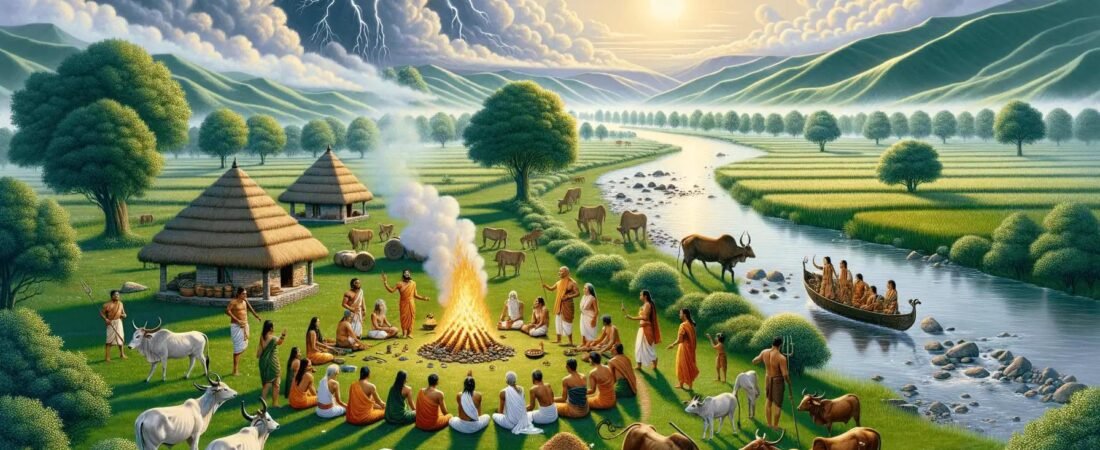
The Vedic Age represents a formative phase in the development of ancient Indian civilisation. It witnessed the emergence and evolution of Vedic religious traditions, Sanskrit literature, political institutions, social organisation, economic activities and philosophical ideas.
The period is named after the Vedas, a collection of ancient sacred compositions that constitute the foundation of the Vedic religious tradition.
The Vedic Age is particularly significant because it witnessed major transformations in the social, economic and political organisation of communities in northern India.
During the Early Vedic period, society was predominantly pastoral, with cattle forming an important component of economic life. Political organisation was largely tribal, and institutions such as Sabha and Samiti played an important role.
During the Later Vedic period, agriculture became increasingly important, settlements expanded towards the Gangetic plains, territorial political formations emerged, and kingship became more powerful. Social stratification also became more pronounced, while religious practices increasingly emphasised elaborate sacrifices and priestly authority.
The Vedic Age also witnessed the emergence of important philosophical ideas concerning the nature of existence, the relationship between the individual and the universe, karma, rebirth and liberation.
Understanding these developments is essential for studying the subsequent emergence of the Mahajanapadas, the rise of Buddhism and Jainism, and the development of ancient Indian political and philosophical traditions.
2. Chronology and Division of the Vedic Age
The Vedic Age is conventionally divided into two broad phases:
- Early Vedic Period or Rigvedic Period.
- Later Vedic Period.
| Period | Approximate chronology | Principal literary source |
|---|---|---|
| Early Vedic Period | c. 1500–1000 BCE | Rigveda |
| Later Vedic Period | c. 1000–600 BCE | Later Vedic literature |
These dates are approximate scholarly conventions. The composition, compilation and transmission of Vedic literature occurred over extended periods, and the chronology of individual texts remains a subject of historical and philological research.
2.1 Early Vedic Period
The Early Vedic period is primarily reconstructed through the oldest portions of the Rigveda.
It provides information about the social, political, economic and religious life of the early Vedic communities.
Its major characteristics included:
- Predominantly pastoral economy.
- Importance of cattle wealth.
- Tribal political organisation.
- Relatively limited importance of agriculture compared with pastoral activities.
- Importance of Sabha and Samiti.
- Worship of natural forces.
- Composition of hymns dedicated to different deities.
2.2 Later Vedic Period
The Later Vedic period witnessed important transformations in northern India.
The major characteristics included:
- Expansion of agricultural settlements.
- Increasing use of iron.
- Movement towards the western and middle Gangetic plains.
- Emergence of territorial political units.
- Strengthening of monarchical institutions.
- Increasing social stratification.
- Greater importance of elaborate sacrificial rituals.
- Development of philosophical discussions in the Upanishads.
2.3 Historical Significance of the Division
The distinction between Early and Later Vedic periods helps us understand the transformation of ancient Indian society.
The transition was not simply religious or literary. It involved changes in:
- Production systems.
- Settlement patterns.
- Political authority.
- Social hierarchy.
- Religious institutions.
- Cultural practices.
The Vedic Age therefore represents an important stage in the transition from predominantly pastoral and tribal communities towards more settled agricultural societies and territorial states.
3. Sources for the Study of the Vedic Age
The reconstruction of Vedic history depends primarily on literary sources, particularly the Vedas and their associated texts.
Archaeological evidence, linguistic studies and comparative historical research provide additional information.
3.1 The Four Vedas
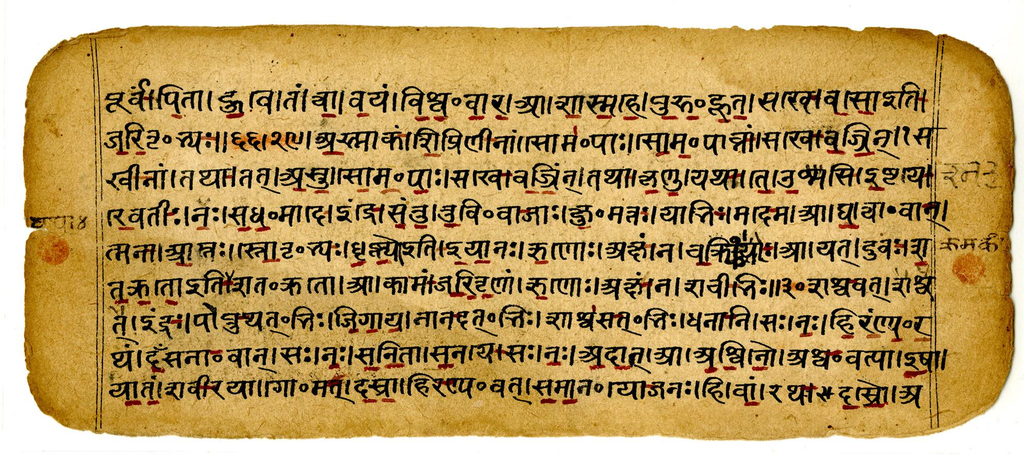
The Vedas are the oldest surviving body of sacred literature associated with the Vedic tradition.
The term Veda is derived from the Sanskrit root Vid, meaning knowledge.
There are four Vedas:
- Rigveda.
- Samaveda.
- Yajurveda.
- Atharvaveda.
A. Rigveda
The Rigveda is the oldest of the four Vedas and the principal literary source for reconstructing the Early Vedic period.
It consists of 10 Mandalas and 1,028 hymns, traditionally known as Suktas.
The hymns are dedicated to various deities and contain references to religious beliefs, political institutions, social relationships and economic activities.
Major features
- Contains hymns dedicated to deities such as Indra, Agni, Varuna and Soma.
- Provides information about pastoral activities.
- Mentions cattle, horses, chariots and agricultural practices.
- Refers to tribal groups and political leaders.
- Contains references to Sabha and Samiti.
- Provides information about conflicts and alliances among different groups.
- Reflects the religious and social life of early Vedic communities.
The Rigveda is particularly important because it provides the earliest substantial textual evidence for Vedic society.
B. Samaveda
The Samaveda is primarily associated with musical chants and melodies used in sacrificial rituals.
Most of its verses are derived from the Rigveda, although their arrangement and musical use are different.
Major features
- Associated with the chanting of hymns during sacrifices.
- Important for the development of Vedic musical traditions.
- Closely connected with the role of the Udgatri priest.
C. Yajurveda
The Yajurveda contains ritual formulas and instructions associated with the performance of Vedic sacrifices.
It is particularly important for understanding the increasing complexity of sacrificial rituals during the Later Vedic period.
It has two major recensional traditions:
- Shukla Yajurveda or White Yajurveda.
- Krishna Yajurveda or Black Yajurveda.
The Yajurveda provides information about the ritual practices, sacrificial institutions and the growing importance of priestly functions.
D. Atharvaveda
The Atharvaveda contains hymns, prayers, spells and incantations associated with everyday life.
It reflects concerns relating to health, prosperity, protection, disease, family life and social relationships.
Historical significance
The Atharvaveda is important for understanding:
- Popular religious beliefs.
- Domestic rituals.
- Healing practices.
- Everyday social concerns.
- Beliefs regarding spirits and supernatural forces.
- The development of religious traditions beyond formal sacrificial rituals.
3.2 Comparison of the Four Vedas
| Veda | Main subject | Associated priest |
|---|---|---|
| Rigveda | Hymns and prayers | Hotri |
| Samaveda | Musical chants | Udgatri |
| Yajurveda | Sacrificial formulas | Adhvaryu |
| Atharvaveda | Spells, prayers and everyday rituals | Associated with Atharvan traditions; not one of the principal three ritual functions in the same manner |
The four Vedas are collectively known as the Chaturveda.
3.3 Brahmanas
The Brahmanas are prose texts associated with the different Vedas.
They explain the meaning, procedure and significance of Vedic sacrifices.
Important examples include:
- Aitareya Brahmana – associated with the Rigveda.
- Kaushitaki Brahmana – associated with the Rigveda.
- Shatapatha Brahmana – associated with the Shukla Yajurveda.
- Taittiriya Brahmana – associated with the Krishna Yajurveda.
- Panchavimsha Brahmana – associated with the Samaveda.
Historical significance
The Brahmanas provide information about:
- Development of sacrificial rituals.
- Increasing complexity of religious practices.
- Importance of priestly groups.
- Political and social institutions.
- Ritual legitimation of kingship.
- Changes in religious ideas.
The Shatapatha Brahmana is particularly important for understanding Later Vedic ritual traditions and contains narratives relating to the expansion of Vedic culture.
3.4 Aranyakas
The term Aranyaka is derived from Aranya, meaning forest.
The Aranyakas represent a transitional phase between ritualistic Brahmana literature and the philosophical discussions of the Upanishads.
They contain discussions about the symbolic and philosophical dimensions of sacrifices.
They are important for understanding the gradual movement from external ritual practices towards philosophical reflection.
3.5 Upanishads
The Upanishads represent an important stage in the development of Indian philosophical thought.
They explore fundamental questions concerning:
- Nature of ultimate reality.
- Relationship between the individual and the universe.
- Concept of Brahman.
- Concept of Atman.
- Karma and rebirth.
- Liberation or Moksha.
- Nature of knowledge.
- Meaning of existence.
The Upanishads gradually shifted attention from the performance of external rituals towards knowledge, self-realisation and philosophical inquiry.
Important early Upanishads include:
- Brihadaranyaka Upanishad.
- Chandogya Upanishad.
- Taittiriya Upanishad.
- Aitareya Upanishad.
- Kausitaki Upanishad.
- Kena Upanishad.
- Katha Upanishad.
The Brihadaranyaka and Chandogya Upanishads are particularly important for understanding early Upanishadic philosophy.
3.6 Vedangas
The Vedangas are six auxiliary disciplines developed to facilitate the correct understanding, preservation and transmission of Vedic knowledge.
| Vedanga | Subject |
|---|---|
| Shiksha | Phonetics and pronunciation |
| Kalpa | Ritual practices and procedures |
| Vyakarana | Grammar |
| Nirukta | Etymology and explanation of words |
| Chandas | Prosody and metres |
| Jyotisha | Astronomy and calendrical calculations |
These disciplines demonstrate the development of specialised intellectual traditions in ancient India.
3.7 Upavedas
The term Upaveda refers to traditional auxiliary knowledge systems associated with the Vedas.
Commonly recognised associations include:
- Ayurveda – Medicine.
- Dhanurveda – Warfare and archery.
- Gandharvaveda – Music and performing arts.
- Sthapatyaveda – Architecture and construction.
The classifications and associations differ among traditional sources.
3.8 Archaeological Sources
Archaeological evidence provides additional information about the material culture of the Vedic period.
Important archaeological traditions include:
A. Painted Grey Ware (PGW)
Painted Grey Ware is a distinctive pottery tradition found in parts of the upper Gangetic plains and north-western India.
It is characterised by:
- Fine grey-coloured pottery.
- Black painted geometric designs.
- Relatively well-finished ceramic surfaces.
Important sites include:
- Hastinapura.
- Ahichchhatra.
- Atranjikhera.
- Bhagwanpura.
PGW is frequently discussed in connection with the later Vedic and early Iron Age cultural context.
However, it should not be treated as definitive proof of the identity of a particular Vedic community.
B. Black and Red Ware
Black and Red Ware is another important pottery tradition found in several archaeological contexts.
It occurs across different regions and periods, including parts of the later prehistoric and early historic sequence.
C. Iron Objects
The increasing use of iron in the Gangetic plains is an important feature of the later Vedic and subsequent periods.
Iron tools contributed to changes in agriculture, settlement expansion and productive activities.
However, the expansion of agriculture cannot be explained by iron technology alone. Ecological conditions, social organisation and other technologies were also important.
3.9 Importance and Limitations of Vedic Sources
The Vedic texts are indispensable for understanding ancient Indian civilisation. However, they have certain limitations.
- They are primarily religious compositions rather than systematic historical chronicles.
- Their composition and transmission extended over long periods.
- They frequently reflect the perspectives of particular social and ritual groups.
- Their references are often symbolic or poetic.
- Geographical and chronological references require careful interpretation.
- Archaeological evidence does not always correspond directly with literary descriptions.
Therefore, Vedic literature must be studied alongside archaeological and linguistic evidence.
PART I: EARLY VEDIC PERIOD
4. Early Vedic Period: Geographical Background
The Early Vedic period is conventionally dated to approximately 1500–1000 BCE.
The geographical focus of the Rigvedic communities was primarily the north-western part of the Indian subcontinent.
The Rigveda frequently refers to rivers, geographical features and tribal territories in this region.
4.1 Sapta Sindhu Region
The term Sapta Sindhu is generally understood as the land of seven rivers.
It represents an important geographical setting of the Early Vedic period.
The region included parts of:
- Punjab.
- Haryana.
- North-western India.
- Present-day Pakistan.
- Adjoining areas of Afghanistan.
The river systems played an important role in settlement, agriculture, pastoral activities and movement.
4.2 Important Rivers Mentioned in the Rigveda
The Rigveda contains references to several rivers.
| Vedic name | Modern identification |
|---|---|
| Sindhu | Indus |
| Vitasta | Jhelum |
| Asikni | Chenab |
| Parushni | Ravi |
| Vipasha | Beas |
| Shutudri | Sutlej |
| Saraswati | Traditionally identified with a major ancient river system; its precise historical course and relationship with present-day channels remain debated |
| Yamuna | Yamuna |
| Ganga | Ganga |
The river system was important not only for agriculture but also for pastoral movement, settlement and political interaction.
4.3 Importance of the Saraswati
The Saraswati occupies an important position in the Rigveda.
It is praised as a significant river and is associated with the religious and geographical traditions of the Vedic communities.
Its precise identification has been the subject of extensive scholarly debate.
Some scholars associate it with ancient river channels in north-western India, including parts of the Ghaggar-Hakra system.
However, the relationship between the Rigvedic Saraswati, ancient river systems and present-day geographical features is complex.
Historical interpretation requires the combined examination of textual, geological, hydrological and archaeological evidence.
4.4 Geographical Expansion during the Later Vedic Period
During the Later Vedic period, the geographical focus of Vedic culture gradually expanded towards the western and middle Gangetic plains.
Important regions included:
- Kuru.
- Panchala.
- Kosala.
- Videha.
The expansion was associated with the development of agricultural settlements, changes in political organisation and the emergence of larger territorial communities.
5. Political Organisation during the Early Vedic Period
Political organisation during the Early Vedic period was primarily tribal in character.
The basic political unit was the Jana, representing a tribal or people-based community.
The political system was less territorially centralised than the kingdoms that emerged during the Later Vedic and subsequent periods.
5.1 Jana and Vish
The early Vedic political and social organisation contained several levels of collective organisation.
Important terms included:
- Jana – Tribal community or people.
- Vish – A subdivision or group within the Jana.
- Grama – A smaller settlement or organised group, depending on context.
- Kula – Family or household.
The precise administrative relationship between these terms should not be assumed to have been identical to later territorial administrative units.
5.2 Position of the King (Rajan)
The ruler was known as the Rajan.
The Rajan was primarily a tribal chief whose authority depended on leadership, military ability, distribution of resources and support from the community.
Major functions
- Protection of the tribe.
- Leadership during warfare.
- Maintenance of order.
- Protection of cattle and other resources.
- Leadership in religious and ceremonial activities.
- Distribution of booty obtained during conflicts.
The early Vedic king did not exercise the same extensive territorial authority associated with later monarchies.
5.3 Nature of Kingship
Kingship was generally not based on an elaborate system of hereditary bureaucracy.
The position of the Rajan was closely connected with tribal support and military leadership.
The ruler was expected to protect the community and provide leadership.
The institution of kingship gradually became more powerful during the Later Vedic period.
5.4 Sabha
The Sabha was an important assembly mentioned in the Rigveda.
It is generally understood as an assembly of influential members or elders of the community.
Its functions may have included:
- Discussion of important matters.
- Deliberation on political affairs.
- Social and judicial activities.
- Advice to the ruler.
The precise composition and functions of the Sabha are not fully established.
5.5 Samiti
The Samiti was another important assembly of the Early Vedic period.
It is often interpreted as a broader popular or tribal assembly.
Its functions may have included:
- Discussion of community affairs.
- Participation in political deliberations.
- Selection or recognition of the ruler in certain contexts.
- Collective decision-making.
The Sabha and Samiti demonstrate that early Vedic political organisation involved important collective institutions.
5.6 Vidatha
Vidatha is another important institution mentioned in the Rigveda.
It appears to have been an assembly or gathering associated with different social, economic, military and religious activities.
It is particularly important for understanding the collective character of early Vedic society.
5.7 Gana
The term Gana is also found in early Vedic literature.
It generally refers to a group or collective body.
Its precise political significance varied according to context.
5.8 Important Political Officials
Some important officials associated with the early Vedic political system included:
| Official | Function |
|---|---|
| Purohita | Religious adviser and priest |
| Senani | Military leader or commander |
| Gramani | Leader of a Grama or smaller group |
| Vrajapati | Associated with the management or leadership of pasture-related groups in some interpretations |
The Purohita and Senani were particularly important figures in the king’s circle.
5.9 Taxation and Revenue
The early Vedic economy did not possess a fully developed system of regular taxation comparable to later states.
The ruler received voluntary offerings and contributions.
Bali was an important term associated with offerings or tribute.
The exact nature of Bali changed over time and became increasingly associated with royal revenue during the development of later political institutions.
5.10 Warfare and Political Conflicts
Conflicts between different tribal communities were an important feature of the Early Vedic period.
These conflicts frequently involved:
- Cattle.
- Pasturelands.
- Water resources.
- Territory.
- Political prestige.
Cattle raiding was an important feature of the pastoral economy.
The Rigveda contains references to conflicts between different tribal groups.
The Battle of Ten Kings (Dasharajna)
The Battle of Ten Kings is one of the most important political events mentioned in the Rigveda.
It is described in the seventh Mandala.
The conflict involved King Sudas of the Bharata tribe and a coalition of opposing groups.
The battle is associated with the Parushni River, generally identified with the modern Ravi.
Important features
- Sudas was the ruler of the Bharata tribe.
- The opposing coalition consisted of several groups.
- The conflict is described in the Rigveda.
- It is associated with the Parushni River.
- The Bharatas emerged victorious.
Historical significance
The Battle of Ten Kings provides important information about:
- Tribal political organisation.
- Inter-tribal conflicts.
- The importance of river systems.
- Political alliances.
- The emergence of powerful tribal groups.
It also illustrates the political and military character of early Vedic society.
6. Economic Life during the Early Vedic Period
The Early Vedic economy was predominantly pastoral, although agriculture was also known and practised.
Cattle formed the most important component of economic wealth.
6.1 Pastoral Economy
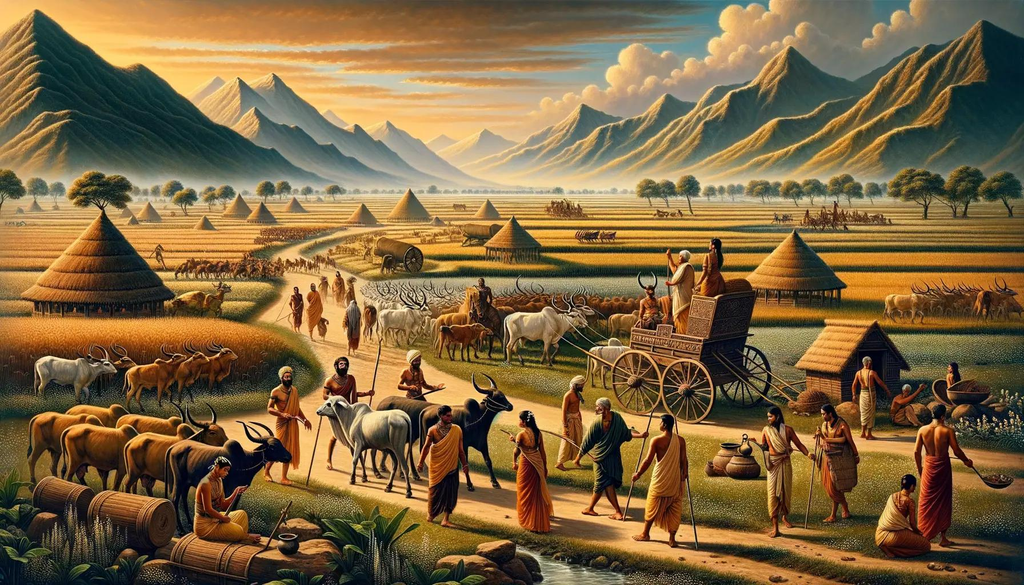
The Rigveda contains numerous references to cattle.
Cattle were important for:
- Food.
- Dairy products.
- Exchange and wealth.
- Agricultural activities.
- Social prestige.
- Ritual offerings.
The possession of cattle was an important indicator of prosperity.
Several terms in the Rigveda are associated with cattle and pastoral life.
The word Gavishti, frequently interpreted as a search or quest for cows, is also associated with warfare or conflict in the Rigvedic context.
6.2 Cattle as a Measure of Wealth
Cattle constituted an important component of wealth.
The king and other influential members of society were expected to protect cattle and other productive resources.
Cattle raiding was one of the causes of conflicts between tribes.
The importance of cattle is reflected in the frequency of references to cows, bulls and other animals in the Rigveda.
6.3 Agriculture
Agriculture was known during the Early Vedic period, although pastoralism occupied a more prominent position in the Rigvedic economy.
The Rigveda contains references to:
- Ploughing.
- Agricultural fields.
- Barley.
- Rainfall.
- Agricultural production.
The term Yava is generally associated with barley.
The increasing importance of agriculture became more evident during the Later Vedic period.
6.4 Crafts and Occupations
The Early Vedic society possessed several specialised occupations.
These included:
- Weaving.
- Carpentry.
- Chariot-making.
- Metalworking.
- Pottery.
- Leatherworking.
- Animal husbandry.
The importance of the chariot-maker and carpenter reflects the technological and military requirements of the period.
6.5 Trade and Exchange
Trade was relatively less developed than in the later urban and early historic periods.
Exchange occurred through barter and other forms of transactions.
Cattle and other commodities were important measures of value.
The term Nishka occurs in the Rigveda and is associated with valuable ornaments, generally made of gold. It should not automatically be interpreted as a fully developed coinage system.
6.6 Technology
Important technological features included:
- Use of copper and bronze.
- Horse-drawn chariots.
- Wooden agricultural implements.
- Weaving.
- Carpentry.
- Metalworking.
Iron was not a characteristic metal of the Early Vedic period.
7. Social Organisation during the Early Vedic Period
Early Vedic society was primarily organised around kinship and tribal relationships.
Social organisation was relatively less stratified than during the Later Vedic period.
However, social distinctions based on occupation, wealth and status were already developing.
7.1 Family Organisation
The family was an important unit of social organisation.
The household was generally patriarchal, with the father exercising considerable authority.
The extended family and kinship relationships played an important role in social life.
The term Kula was associated with the family or household.
7.2 Position of Women
The position of women during the Early Vedic period was relatively favourable in certain respects compared with later periods.
Women participated in religious and intellectual activities, and some women are associated with the composition of Vedic hymns.
Important women associated with Vedic literature include:
- Ghosha.
- Apala.
- Lopamudra.
- Vishvavara.
- Romasha.
Major characteristics
- Women could participate in certain religious rituals.
- Some women composed Vedic hymns.
- Marriage was an important social institution.
- Women were associated with household and ritual activities.
- There is evidence of women participating in intellectual discussions.
The available evidence suggests that certain women enjoyed significant religious and intellectual roles.
However, early Vedic society was not completely egalitarian, and patriarchal structures were present.
7.3 Marriage
Marriage was an important social institution.
The Rigveda contains references to marriage ceremonies and domestic relationships.
Marriage was generally associated with family and community traditions.
The available evidence does not support a simplistic claim that every form of later social restriction was absent during this period.
7.4 Social Stratification
Early Vedic society did not possess the fully developed and rigid social hierarchy associated with later periods.
The Rigveda refers to different social functions and groups.
The famous Purusha Sukta, found in the tenth Mandala, describes the four Varna categories:
- Brahmana.
- Rajanya or Kshatriya.
- Vaishya.
- Shudra.
However, the Purusha Sukta is generally considered a relatively late addition to the Rigvedic collection.
Its presence indicates the emergence of a more explicit fourfold social classification, but it should not be treated as proof that a fully developed and rigid Varna system existed throughout the Early Vedic period.
7.5 Food and Lifestyle
The Early Vedic people consumed a variety of food products.
These included:
- Milk.
- Ghee.
- Barley.
- Fruits.
- Meat.
- Other agricultural and pastoral products.
The Rigveda contains references to Soma, a ritual drink of considerable religious significance.
The lifestyle was closely associated with cattle rearing, movement and the natural environment.
7.6 Education
Knowledge was transmitted primarily through oral traditions.
The memorisation and recitation of hymns played an important role.
The development of specialised priestly knowledge contributed to the emergence of increasingly organised systems of education and religious instruction.
8. Religious Beliefs during the Early Vedic Period
Early Vedic religion was characterised by the worship of natural forces and the performance of sacrifices.
The deities were associated with natural phenomena such as fire, rain, storms, the sky and cosmic order.
The religious system was primarily based on hymns, prayers and offerings.
8.1 Nature Worship
The Early Vedic people worshipped several natural forces.
Important deities included:
- Indra.
- Agni.
- Varuna.
- Surya.
- Ushas.
- Vayu.
- Soma.
- Prithvi.
These deities were associated with natural and cosmic phenomena.
8.2 Indra
Indra was one of the most prominent deities of the Rigveda.
He was associated with:
- Thunder and storms.
- Rain.
- Warfare.
- Strength and victory.
- Protection of the community.
He is celebrated in numerous Rigvedic hymns.
Indra is also associated with the defeat of Vritra, a figure representing the obstruction of waters.
8.3 Agni
Agni was the deity of fire.
He occupied an important position in Vedic religious practices because fire served as the medium through which offerings were conveyed to the gods.
Agni was associated with:
- Sacrificial rituals.
- Communication between humans and gods.
- Domestic and ritual fires.
- Purification.
8.4 Varuna
Varuna was associated with the maintenance of Rita, the cosmic and moral order.
He was believed to uphold the principles governing the universe.
Varuna’s role reflects the importance of moral and cosmic order in early Vedic religious thought.
8.5 Surya
Surya was associated with the Sun.
He represented light, life and the movement of the celestial world.
8.6 Ushas
Ushas represented the dawn.
She was celebrated in the Rigveda for bringing light and marking the beginning of a new day.
8.7 Soma
Soma was associated with a sacred ritual drink and also personified as a deity.
The Soma ritual occupied an important position in Vedic sacrificial practices.
8.8 Concept of Rita
The concept of Rita was central to early Vedic religious thought.
Rita represented the cosmic order governing the universe.
It was associated with:
- Natural regularity.
- Moral order.
- Truth.
- Proper conduct.
- Harmony between different aspects of existence.
Varuna was particularly associated with the protection and maintenance of Rita.
The concept represents an important stage in the development of Indian philosophical and ethical thought.
8.9 Sacrificial Practices
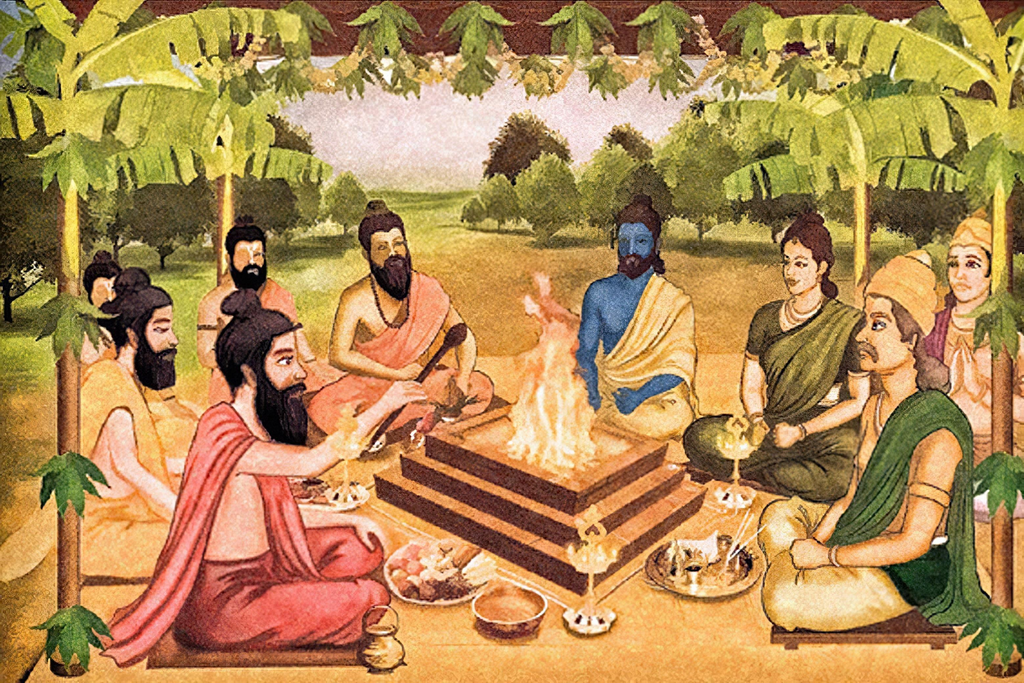
Yajna or sacrifice was an important component of early Vedic religion.
Offerings were made to different deities through fire rituals.
These offerings included:
- Ghee.
- Milk.
- Grains.
- Soma.
- Other ritual substances.
The purpose of sacrifices was generally associated with prosperity, rainfall, protection, victory and well-being.
8.10 Nature of Early Vedic Religion
Early Vedic religion was predominantly characterised by:
- Worship of natural forces.
- Hymns and prayers.
- Sacrificial offerings.
- Importance of Agni and Indra.
- Concept of Rita.
- Limited evidence of temple-centred worship.
- Absence of the elaborate later Puranic religious system in its developed form.
The emphasis was primarily on maintaining a relationship with the gods through hymns, prayers and sacrifices.
PART II: LATER VEDIC PERIOD
9. Later Vedic Period: Geographical Expansion
The Later Vedic period is conventionally dated to approximately 1000–600 BCE.
During this period, Vedic cultural traditions expanded from the north-western region towards the western and middle Gangetic plains.
The expansion was associated with changes in agricultural practices, settlement patterns and political organisation.
9.1 Expansion towards the Gangetic Plains
The later Vedic texts refer to important regions and political communities in northern India.
These included:
- Kuru.
- Panchala.
- Kosala.
- Videha.
The Kuru-Panchala region emerged as an important centre of Later Vedic culture.
The expansion towards the Gangetic plains was associated with the growing importance of agriculture and settled communities.
9.2 Role of Forest Clearance
The expansion of agriculture required the development of cultivable land.
The use of tools, including iron implements during the later part of this broad period, contributed to changes in land clearance and agricultural production.
However, the role of iron should not be exaggerated.
The expansion of agriculture was also influenced by:
- Population growth.
- Availability of fertile land.
- Water resources.
- Knowledge of cultivation.
- Settlement expansion.
- Social and political organisation.
9.3 Important Regions
Kuru
The Kuru region became an important political and cultural centre during the Later Vedic period.
Panchala
Panchala was another major political formation associated with the western Gangetic region.
Kosala
Kosala emerged as an important territorial polity in the eastern Gangetic region.
Videha
Videha, associated with the region of present-day northern Bihar and adjoining Nepal, became an important centre of Later Vedic intellectual and philosophical traditions.
The region is particularly associated with King Janaka and philosophical discussions recorded in the Upanishads.
10. Political Organisation during the Later Vedic Period
The Later Vedic period witnessed a major transformation in political organisation.
The earlier tribal system gradually gave way to territorial political formations.
The authority of the king increased, and political institutions became increasingly associated with the control of land and agricultural resources.
10.1 Emergence of Territorial Kingdoms
The concept of Jana gradually developed into more territorially organised political communities.
The growing importance of agricultural settlements and control over productive land contributed to the strengthening of kingship.
The Kuru and Panchala political formations are important examples of this transformation.
10.2 Strengthening of Kingship
The position of the king became increasingly powerful.
The ruler was no longer merely a tribal chief responsible for leading the community in warfare.
He increasingly became the centre of territorial political authority.
Major features
- Increasing hereditary character of kingship.
- Expansion of royal authority.
- Greater control over agricultural resources.
- Increasing military organisation.
- Collection of regular contributions and revenues.
- Use of elaborate royal rituals to legitimise political authority.
10.3 Decline in the Importance of Sabha and Samiti
The Sabha and Samiti continued to be mentioned in Later Vedic literature.
However, their relative political importance appears to have declined as monarchical authority became stronger.
Political power became increasingly concentrated in the hands of the ruler and his officials.
This was an important departure from the relatively tribal and collective political organisation of the Early Vedic period.
10.4 Administrative Officials
The Later Vedic political system contained several officials and functionaries.
Some important officials included:
| Official | Function or association |
|---|---|
| Purohita | Chief priest and religious adviser |
| Senani | Military commander |
| Gramani | Village or group leader |
| Sangrahitri | Treasurer or collector of resources |
| Bhagadugha | Associated with the collection or distribution of shares |
| Suta | Charioteer and royal functionary |
| Akshavapa | Associated with dice or gaming functions |
| Kshattri | Associated with palace or royal household functions |
The precise responsibilities of some officials varied according to textual context.
The increasing number of specialised functionaries reflects the growing complexity of political administration.
10.5 Royal Rituals and Political Legitimacy
The Later Vedic period witnessed the increasing importance of elaborate royal sacrifices.
These rituals helped establish and legitimise the authority of the king.
Important royal sacrifices included:
A. Rajasuya
The Rajasuya was a royal consecration ceremony associated with the legitimisation of kingship.
It symbolised the ruler’s authority and political status.
B. Ashvamedha
The Ashvamedha was the horse sacrifice.
It was associated with the assertion of royal supremacy and territorial authority.
A horse was allowed to move through different territories, and challenges to its movement could lead to political or military confrontation.
C. Vajapeya
The Vajapeya was an important ritual associated with royal power and prestige.
It involved ceremonial activities, including a chariot race.
10.6 Increasing Importance of the Purohita
The Purohita became increasingly important because of the growing complexity of royal rituals.
The king depended on priests for the performance of sacrifices and the legitimisation of political authority.
This contributed to the increasing influence of the Brahmana class.
10.7 Bali and Other Contributions
The collection of resources became more systematic during the Later Vedic period.
Important terms included:
- Bali.
- Bhaga.
- Shulka in later textual contexts.
These terms reflect the increasing importance of royal revenue and contributions.
The development of regular taxation was closely associated with the emergence of more territorially organised political systems.
11. Economic Life during the Later Vedic Period
The Later Vedic economy underwent significant transformation.
Agriculture became increasingly important, and pastoral activities were gradually integrated into a more diversified economic system.
11.1 Expansion of Agriculture
Agriculture became the principal economic activity in several regions.
The expansion towards the fertile Gangetic plains created opportunities for agricultural production.
Important crops included:
- Rice.
- Barley.
- Wheat.
- Pulses.
- Other cultivated crops.
Rice became increasingly important in the eastern Gangetic region.
The term Vrihi is associated with rice in Vedic literature.
11.2 Agricultural Technology
The Later Vedic period witnessed the increasing use of agricultural implements and techniques.
Important developments included:
- Greater use of the plough.
- Use of animal power.
- Cultivation of different crops.
- Expansion of agricultural settlements.
- Development of food storage.
- Use of iron implements during the later part of the period.
The increased use of iron contributed to changes in productive activities.
11.3 Iron Technology
Iron became increasingly important during the later Vedic period.
The metal was referred to in Vedic literature as Shyama Ayas or Krishna Ayas in certain textual contexts.
Iron objects included:
- Agricultural implements.
- Tools.
- Weapons.
- Other utilitarian objects.
Archaeological evidence of iron objects has been discovered at several sites associated with the later Vedic and early Iron Age cultural contexts.
The increasing availability of iron technology facilitated agricultural expansion and the development of settlements, although its impact differed across regions.
11.4 Pastoral Activities
Although agriculture became increasingly important, pastoralism continued to play a significant role.
Cattle remained valuable for:
- Agricultural labour.
- Dairy products.
- Transportation.
- Wealth and exchange.
- Social prestige.
The economy therefore became increasingly mixed, combining agriculture, animal husbandry and craft production.
11.5 Craft Production
The Later Vedic period witnessed increasing occupational specialisation.
Important crafts included:
- Carpentry.
- Metalworking.
- Pottery.
- Weaving.
- Leatherworking.
- Chariot-making.
- Jewellery production.
The growing importance of specialised crafts was associated with the expansion of settled communities and exchange networks.
11.6 Trade and Exchange
Trade and exchange became increasingly important.
The development of agricultural surplus and specialised crafts created opportunities for commercial activities.
However, the Later Vedic economy should not be confused with the fully developed urban commercial economy of the subsequent Mahajanapada period.
Exchange continued through barter and other forms of transactions.
Terms such as Nishka and Satamana appear in Vedic literature, but they should not automatically be interpreted as evidence of a fully developed coinage system.
12. Social Organisation during the Later Vedic Period
One of the most important developments of the Later Vedic period was the increasing stratification of society.
The fourfold Varna system became more clearly articulated, and distinctions based on occupation, ritual status and social position became increasingly pronounced.
12.1 Development of the Varna System
The four major Varna categories were:
- Brahmana.
- Kshatriya.
- Vaishya.
- Shudra.
Brahmanas
The Brahmanas were associated with:
- Religious rituals.
- Sacrificial ceremonies.
- Preservation of sacred knowledge.
- Teaching and intellectual activities.
Their influence increased because of the growing complexity of Vedic rituals.
Kshatriyas
The Kshatriyas were associated with:
- Political authority.
- Warfare.
- Protection of the community.
- Kingship and administration.
The increasing power of territorial rulers strengthened the position of the Kshatriya class.
Vaishyas
The Vaishyas were primarily associated with:
- Agriculture.
- Animal husbandry.
- Trade.
- Other productive activities.
They formed an important component of the economic organisation of society.
Shudras
The Shudras occupied the lowest position in the fourfold Varna hierarchy.
They were associated with service and other occupational functions.
The increasing social differentiation contributed to the development of a more hierarchical social structure.
12.2 Varna and Social Stratification
The Varna system became increasingly associated with ritual status and social hierarchy.
The social position of individuals was increasingly defined through inherited status and prescribed duties in later Brahmanical traditions.
However, it is important to recognise that the fourfold Varna model was an ideological and normative classification.
Actual social relations were considerably more complex and varied across regions and communities.
12.3 Position of Women
The position of women underwent important changes during the Later Vedic period.
The available textual evidence suggests increasing restrictions on women’s participation in certain religious, intellectual and public activities.
Major developments
- Increasing emphasis on patriarchal family structures.
- Greater restrictions on certain forms of religious participation.
- Increasing importance of male lineage and inheritance.
- Greater emphasis on marriage and domestic roles.
- Growing ritual authority of male priests.
However, women continued to participate in philosophical discussions and intellectual activities in certain contexts.
Important women associated with the Later Vedic and Upanishadic traditions included:
A. Gargi Vachaknavi
Gargi was a philosopher who participated in philosophical discussions recorded in the Brihadaranyaka Upanishad.
She is particularly associated with debates concerning the nature of ultimate reality.
B. Maitreyi
Maitreyi is associated with philosophical discussions concerning the nature of immortality, Atman and spiritual knowledge.
Her dialogue with Yajnavalkya is recorded in the Brihadaranyaka Upanishad.
These examples demonstrate that women were not entirely excluded from intellectual and philosophical traditions.
12.4 Marriage and Family
Marriage continued to be an important social institution.
The family became increasingly associated with patriarchal authority and lineage-based inheritance.
The institution of marriage was closely connected with religious and social duties.
The position of women within the family was increasingly shaped by emerging social norms and ritual practices.
12.5 Gotra System
The Gotra system became increasingly important in later Vedic social organisation.
It was associated with lineage and descent, traditionally tracing ancestry to particular sages.
Gotra distinctions became relevant in marriage regulations and social relationships.
12.6 Ashrama System
The Ashrama system represents a later development in Brahmanical social thought.
The four stages of life are:
- Brahmacharya – Student life.
- Grihastha – Householder life.
- Vanaprastha – Retirement or gradual withdrawal from household responsibilities.
- Sannyasa – Renunciation.
The system is associated with the normative organisation of an individual’s life according to religious and social duties.
Its fully developed formulation belongs to later Brahmanical traditions and should not be assumed to have existed in a uniform institutional form throughout the Later Vedic period.
13. Religious Developments during the Later Vedic Period
The Later Vedic period witnessed important changes in religious practices.
The simple hymns and offerings characteristic of much of the Early Vedic tradition gradually gave way to increasingly elaborate sacrificial rituals.
The importance of priestly groups increased, and religious authority became more closely associated with ritual knowledge.
13.1 Increasing Importance of Sacrifices
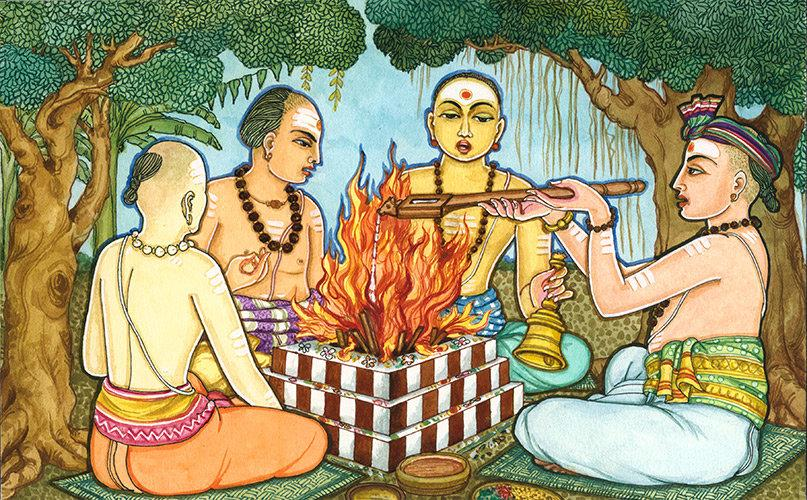
Yajnas became more elaborate and complex.
The performance of sacrifices required the participation of specialised priests.
Important sacrifices included:
- Ashvamedha.
- Rajasuya.
- Vajapeya.
- Agnihotra.
- Somayaga.
Sacrifices were performed for:
- Prosperity.
- Agricultural productivity.
- Political legitimacy.
- Victory in warfare.
- Protection.
- Continuity of the cosmic order.
13.2 Changing Importance of Deities
The relative importance of different deities changed.
During the Early Vedic period, Indra, Agni and Varuna occupied prominent positions.
During the Later Vedic period, other deities gained greater importance.
Important deities included:
Prajapati
Prajapati became increasingly important as a creator figure.
He was associated with creation and the origin of living beings.
Vishnu
Vishnu gained increasing importance in Vedic religious literature.
He was associated with cosmic order and the preservation of the universe.
Rudra
Rudra was associated with powerful and sometimes destructive forces of nature.
His later religious significance contributed to the development of traditions associated with Shiva, although the historical development of these traditions was gradual.
13.3 Declining Relative Importance of Indra and Agni
Indra and Agni continued to be important deities.
However, their relative prominence changed as Vedic religious thought developed.
Prajapati, Vishnu and Rudra gained increasing importance in later textual traditions.
13.4 Increasing Authority of Priests
The complexity of sacrificial rituals strengthened the position of specialised priests.
The Brahmana class acquired greater ritual authority because of its knowledge of sacrificial procedures and sacred texts.
This development contributed to the growing importance of Brahmanical institutions.
13.5 Transition towards Philosophical Inquiry
The Later Vedic period also witnessed the development of philosophical discussions that questioned the limitations of ritualism.
The Aranyakas and Upanishads increasingly explored:
- The nature of ultimate reality.
- The meaning of human existence.
- The relationship between Atman and Brahman.
- The cycle of birth and death.
- The concept of karma.
- The possibility of liberation.
This transition laid important foundations for subsequent Indian philosophical traditions.
14. Development of Upanishadic Philosophy
The Upanishads represent one of the most significant intellectual achievements of ancient India.
They shifted the emphasis from external sacrificial practices towards knowledge, self-realisation and philosophical inquiry.
14.1 Concept of Brahman
Brahman represents the ultimate reality or fundamental principle underlying the universe.
It is understood as the ultimate source and basis of existence in important Upanishadic traditions.
14.2 Concept of Atman
Atman refers to the inner self or essential principle of the individual.
The Upanishads explore the nature of the self and its relationship with ultimate reality.
14.3 Relationship between Atman and Brahman
One of the most important philosophical discussions in the Upanishads concerns the relationship between Atman and Brahman.
Certain Upanishadic teachings emphasise the fundamental unity of the individual self and ultimate reality.
The statement Tat Tvam Asi, meaning “That Thou Art”, occurs in the Chandogya Upanishad.
It is associated with the teaching of Uddalaka Aruni to his son Shvetaketu.
14.4 Concept of Karma
The doctrine of Karma concerns the relationship between actions and their consequences.
Actions were increasingly understood as having implications beyond immediate worldly life.
14.5 Concept of Rebirth
The Upanishads contain important discussions concerning the continuation of existence through successive births.
The concept of rebirth became closely associated with the doctrine of Karma.
14.6 Concept of Moksha
Moksha refers to liberation from the cycle of birth and death.
The Upanishads emphasised knowledge and self-realisation as important means of attaining liberation.
14.7 Historical Significance
The Upanishads contributed to:
- The development of Indian metaphysics.
- Philosophical discussions on the nature of reality.
- The development of concepts of Atman and Brahman.
- The evolution of Karma and rebirth doctrines.
- The intellectual background of later Indian philosophical schools.
- The growth of traditions emphasising knowledge and liberation.
15. Important Philosophical Thinkers and Dialogues
The Upanishadic period witnessed important philosophical debates.
15.1 Yajnavalkya
Yajnavalkya is one of the most important philosophical figures associated with the Brihadaranyaka Upanishad.
He participated in philosophical discussions concerning:
- Atman.
- Brahman.
- Immortality.
- Knowledge.
- The nature of ultimate reality.
His dialogues with Gargi and Maitreyi are particularly significant.
15.2 Gargi
Gargi participated in philosophical debates concerning the nature of reality and the ultimate basis of existence.
Her questions to Yajnavalkya demonstrate the intellectual role of women in certain Upanishadic traditions.
15.3 Maitreyi
Maitreyi is associated with discussions concerning the limitations of material wealth and the significance of spiritual knowledge.
Her dialogue with Yajnavalkya is important for understanding early Indian philosophical thought.
15.4 Uddalaka Aruni
Uddalaka Aruni is associated with important teachings in the Chandogya Upanishad.
His discussions with Shvetaketu explore the nature of ultimate reality and the relationship between the individual and the universe.
15.5 King Janaka
Janaka of Videha is frequently associated with philosophical discussions in the Upanishadic tradition.
His court is portrayed as a centre of intellectual debate.
The association of kings with philosophical discussions demonstrates the interaction between political authority and intellectual traditions.
16. Comparison between Early Vedic and Later Vedic Periods
The comparison between the two periods is one of the most important areas for UPSC Prelims and Mains.
| Dimension | Early Vedic Period | Later Vedic Period |
|---|---|---|
| Chronology | c. 1500–1000 BCE | c. 1000–600 BCE |
| Main source | Rigveda | Samaveda, Yajurveda, Atharvaveda, Brahmanas and Upanishads |
| Geographical focus | Sapta Sindhu region | Western and middle Gangetic plains |
| Economy | Predominantly pastoral | Increasingly agricultural |
| Important wealth | Cattle | Land, agricultural produce and cattle |
| Political organisation | Tribal | Territorial political formations |
| King | Tribal chief | Increasingly powerful territorial ruler |
| Assemblies | Sabha, Samiti and Vidatha important | Relative importance of assemblies declined |
| Revenue | Voluntary contributions and Bali | Increasingly organised royal contributions |
| Social structure | Comparatively less stratified | More pronounced Varna hierarchy |
| Position of women | Relatively greater participation in certain religious and intellectual activities | Increasing social and ritual restrictions, though important exceptions existed |
| Religion | Nature worship and relatively simple sacrifices | Elaborate sacrifices and growing priestly authority |
| Important deities | Indra, Agni, Varuna | Prajapati, Vishnu and Rudra gained prominence |
| Philosophy | Concept of Rita | Brahman, Atman, Karma, rebirth and Moksha |
| Technology | Copper and bronze | Increasing use of iron |
| Settlements | Predominantly pastoral and smaller communities | Expansion of agricultural settlements |
Overall transformation: The Early Vedic period was characterised by a predominantly pastoral and tribal society, whereas the Later Vedic period witnessed the increasing importance of agriculture, territorial political organisation, social stratification and philosophical inquiry.
17. Historical Significance of the Vedic Age
The Vedic Age represents an important stage in the evolution of ancient Indian civilisation.
Its contributions can be examined through political, economic, social, religious and intellectual dimensions.
17.1 Political Development
The period witnessed the transformation of tribal political organisation into increasingly territorial forms of kingship.
Institutions such as Sabha and Samiti provide important evidence of early collective political traditions.
17.2 Economic Transformation
The growing importance of agriculture, animal husbandry and specialised crafts contributed to the expansion of settled communities.
The increasing use of iron during the later part of the period facilitated changes in production and settlement patterns.
17.3 Social Transformation
The Vedic period witnessed the development of increasingly differentiated social structures.
The fourfold Varna classification became more clearly articulated, laying important foundations for subsequent Brahmanical social ideology.
17.4 Religious Development
The period witnessed the evolution of Vedic religious practices, sacrificial traditions and philosophical ideas.
The transition from nature worship and ritual practices towards philosophical inquiry was particularly significant.
17.5 Intellectual Contributions
The Vedic and Upanishadic traditions contributed to the development of:
- Sanskrit literature.
- Grammar and linguistics.
- Philosophy.
- Astronomy and calendrical knowledge.
- Ritual studies.
- Metaphysical thought.
17.6 Background to the Rise of New Religious Movements
The growing complexity of sacrificial practices, social differentiation and intellectual debates formed part of the broader historical background to the emergence of Buddhism and Jainism in the sixth century BCE.
However, these religious movements emerged through multiple social, economic and intellectual processes and cannot be explained by a single cause.
18. The Vedic Age and the Emergence of the Mahajanapadas
The Later Vedic period contributed to the transformation of political and economic organisation in northern India.
The expansion of agriculture, settled communities, social differentiation and territorial kingship created important preconditions for the emergence of larger states.
By approximately the sixth century BCE, northern India witnessed the rise of the Mahajanapadas.
Important political formations included:
- Magadha.
- Kosala.
- Vatsa.
- Avanti.
- Kuru.
- Panchala.
- Gandhara.
- Kamboja.
The emergence of the Mahajanapadas represented a major stage in the development of territorial states and urban centres.
The transition was not immediate. It involved several centuries of political, economic and social transformation.
19. Conclusion
The Vedic Age represents a formative period in the political, economic, social, religious and intellectual evolution of ancient India.
The Early Vedic period was characterised by predominantly pastoral economic activities, tribal political organisation, the importance of cattle wealth and the worship of natural forces.
The Later Vedic period witnessed the expansion of agriculture, increasing use of iron, the emergence of territorial political formations, strengthening of kingship and greater social stratification.
The period also witnessed the development of elaborate sacrificial traditions and the emergence of important philosophical ideas through the Upanishads.
The transformation from Early Vedic to Later Vedic society was not merely a change in religious practices. It represented a fundamental reorganisation of economic activities, political authority, social relationships and intellectual traditions.
For understanding ancient Indian history, the Vedic Age is particularly important because it provides the historical background for the emergence of the Mahajanapadas, the rise of new religious movements and the subsequent development of classical Indian civilisation.
20. UPSC Prelims: Important Facts to Remember
- The Rigveda consists of 10 Mandalas and 1,028 hymns.
- The Rigveda is the principal source for the Early Vedic period.
- The Samaveda is associated with musical chants.
- The Yajurveda contains sacrificial formulas.
- The Atharvaveda contains spells, prayers and everyday religious practices.
- The Brahmanas explain Vedic rituals and sacrifices.
- The Aranyakas form a transitional category between ritualistic and philosophical literature.
- The Upanishads deal with philosophical questions concerning Atman, Brahman, Karma and Moksha.
- The six Vedangas are Shiksha, Kalpa, Vyakarana, Nirukta, Chandas and Jyotisha.
- Sabha and Samiti were important political assemblies in the Early Vedic period.
- Vidatha was another important collective institution mentioned in the Rigveda.
- The Battle of Ten Kings is described in the seventh Mandala of the Rigveda.
- King Sudas was associated with the Bharata tribe.
- The Battle of Ten Kings is associated with the Parushni River.
- Cattle constituted an important measure of wealth in the Early Vedic period.
- The term Yava is generally associated with barley.
- The Purusha Sukta is found in the tenth Mandala of the Rigveda.
- Gargi and Maitreyi are important women associated with Upanishadic philosophy.
- The Shatapatha Brahmana is associated with the Shukla Yajurveda.
- The Chandogya Upanishad contains the teaching Tat Tvam Asi.
- The Ashvamedha was a royal horse sacrifice.
- The Rajasuya was a royal consecration ritual.
- The Vajapeya was an important ritual associated with royal status.
- Painted Grey Ware is associated with archaeological contexts of the upper Gangetic plains and adjoining regions.
- The increasing use of iron was an important feature of the later Vedic and subsequent periods.
21. UPSC Mains Practice Questions
10-mark questions
- Examine the major features of the Early Vedic economy.
- Discuss the significance of Sabha and Samiti in the political organisation of the Early Vedic period.
- Explain the transformation of religious practices during the Later Vedic period.
- Discuss the contribution of the Upanishads to Indian philosophical thought.
15-mark questions
- Compare and contrast the political, economic and social conditions of the Early Vedic and Later Vedic periods.
- Examine the transformation of Vedic society from a predominantly pastoral economy to an agricultural society.
- Discuss the evolution of the Varna system during the Vedic period.
- Analyse the changing position of women during the Early and Later Vedic periods.
- Examine the role of Vedic literature as a source for reconstructing ancient Indian history.
- The Later Vedic period witnessed significant changes in political organisation and the emergence of territorial states. Discuss.
Important analytical question
The transition from Early Vedic to Later Vedic society represents a fundamental transformation in the economic and political organisation of ancient India. Critically examine.
Students should discuss the transition from pastoralism to agriculture, tribal organisation to territorial kingship, collective assemblies to stronger monarchical authority, and relatively flexible social relations to increasingly stratified structures.