
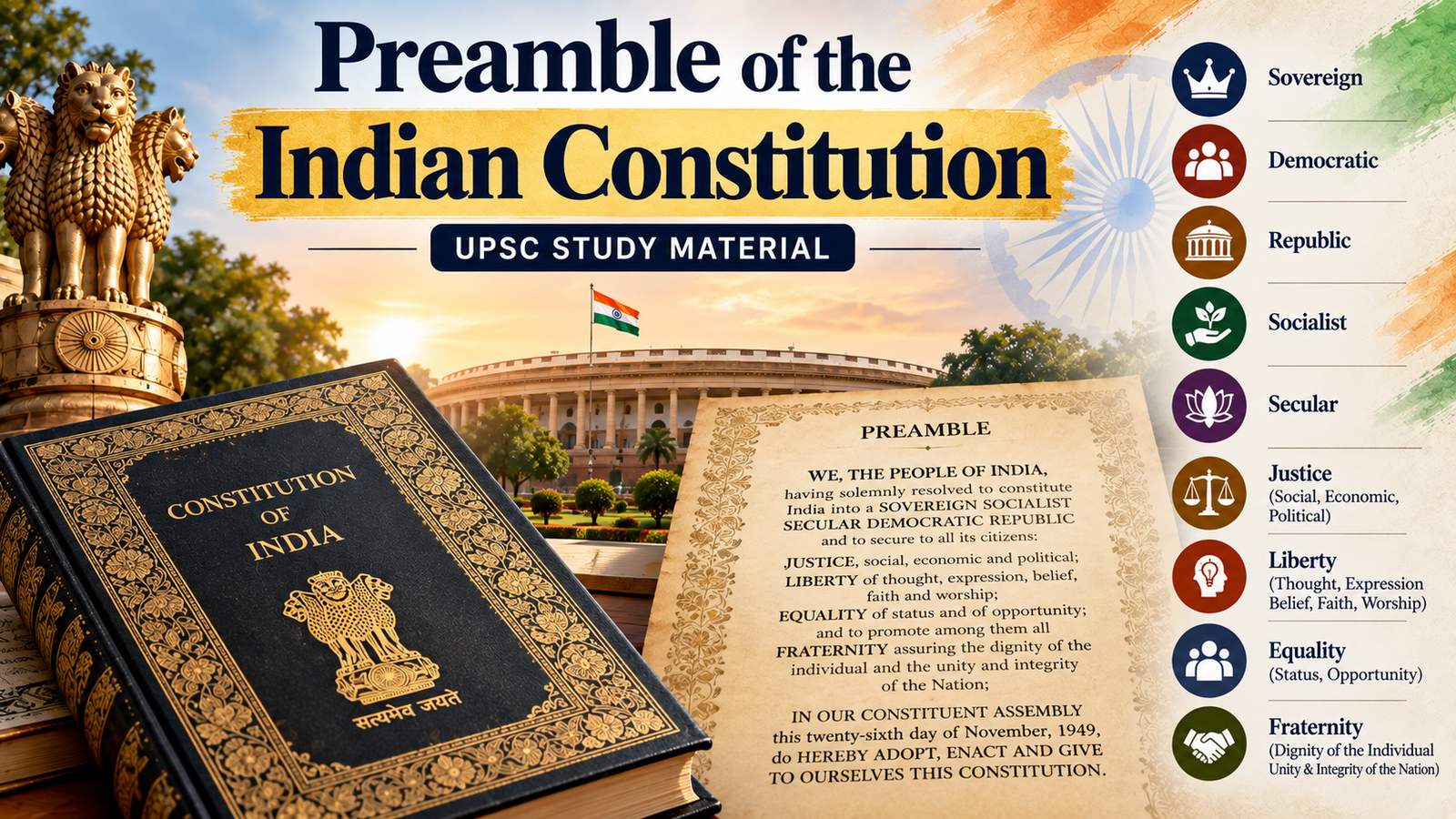
Preamble of the Indian Constitution
The Preamble of the Indian Constitution expresses the fundamental philosophy, objectives and political character of the Indian constitutional system. It identifies the ultimate source of constitutional authority, declares the nature of the Indian State and sets out the major objectives that the Constitution seeks to secure for its citizens.
Beginning with “We, the People of India”, the Preamble establishes the principle of popular sovereignty. It declares India to be a Sovereign Socialist Secular Democratic Republic and promises to secure Justice, Liberty, Equality and Fraternity to all citizens. The official constitutional text also connects fraternity with the dignity of the individual and the unity and integrity of the Nation. Legislative.gov.in
For UPSC Civil Services Examination preparation, the Preamble of the Indian Constitution is much more than a passage to be memorised. It provides a conceptual framework for understanding Fundamental Rights, Directive Principles, democracy, secularism, social justice, constitutional interpretation and the Basic Structure Doctrine.
This article forms part of Samata IAS Academy’s Study Material → Polity & Constitution series. Students should study it after Indian Constitution: Historical Background, Making and Evolution and Salient Features of the Indian Constitution.
1. What is the Preamble?
A preamble is an introductory statement that explains the purpose, objectives and underlying philosophy of a constitutional document.
The Preamble to the Indian Constitution performs several important functions. It:
- identifies the source of constitutional authority;
- declares the nature of the Indian State;
- identifies the principal objectives of the Constitution;
- expresses the constitutional vision of justice, liberty, equality and fraternity;
- provides context for understanding constitutional provisions; and
- serves as an important aid to constitutional interpretation.
The Preamble therefore acts as a constitutional statement of purpose.
It does not itself establish the detailed powers of Parliament, the President, the Supreme Court or State governments. Those powers arise from the substantive provisions of the Constitution.
Its importance lies primarily in expressing the values and objectives underlying those provisions.
The original Constitution and the Constituent Assembly provide important visual context for understanding the historical and constitutional origins of the Preamble.
2. The Text of the Preamble
The Preamble begins with:
“We, the People of India…”
It declares India’s constitutional identity as:
Sovereign
Socialist
Secular
Democratic
Republic
It then promises:
Justice
- Social
- Economic
- Political
Liberty
- Thought
- Expression
- Belief
- Faith
- Worship
Equality
- Status
- Opportunity
and seeks to promote:
Fraternity
- Dignity of the individual
- Unity and integrity of the Nation
The Preamble concludes by declaring that the people, through the Constituent Assembly, adopted, enacted and gave to themselves the Constitution on 26 November 1949. Legislative.gov.in
The complete official constitutional text is available through the Legislative Department, Government of India. Legislative.gov.in
A useful UPSC distinction
The Preamble is an expression of constitutional philosophy, while the Articles of the Constitution provide the detailed legal framework through which that philosophy is implemented.
3. Historical Origin of the Preamble
The Preamble did not originate independently during the final drafting of the Constitution.
Its philosophical foundation can be traced to the Objectives Resolution moved by Jawaharlal Nehru in the Constituent Assembly.
Nehru introduced the Objectives Resolution on:
13 December 1946
The Constituent Assembly subsequently debated the Resolution. The official Constituent Assembly record preserves Nehru’s speech and the text of the Resolution. Constitution of India
The Objectives Resolution articulated broad constitutional objectives relating to:
- sovereignty;
- independence;
- democracy;
- justice;
- equality;
- freedom;
- minority safeguards; and
- national integrity.
It therefore provided the philosophical foundation for the Preamble.
The relationship between the Objectives Resolution and the eventual Preamble is important because it demonstrates that the Preamble was rooted in the constitutional vision articulated during the earliest stages of constitution-making.
Objectives Resolution → Preamble
The relationship can be represented as:
Objectives Resolution
↓
Constitutional ideals
↓
Constituent Assembly deliberations
↓
Preamble
↓
Substantive constitutional provisions
The original Constituent Assembly proceedings are available through the Constitution of India Constituent Assembly Debates archive. Constitution of India
4. “We, the People of India”
The opening words of the Preamble are:
“We, the People of India”
These words express the principle of popular sovereignty.
The ultimate source of constitutional authority is therefore the people of India.
This has several implications.
First
The Constitution is not presented as a grant from a monarch or foreign power.
Second
The Constitution derives its legitimacy from the people.
Third
The people are regarded as the ultimate constitutional sovereign.
The principle is closely connected with:
- universal adult franchise;
- representative democracy;
- elections;
- parliamentary government; and
- constitutional accountability.
The Objectives Resolution itself stated that the authority of sovereign India and its constituent parts and organs of government would be derived from the people. Constitution of India
Thus, the opening words of the Preamble are not merely ceremonial. They express a foundational principle of Indian constitutionalism.
5. “Sovereign”
The word Sovereign signifies that India possesses supreme authority over its internal and external affairs.
Internal sovereignty
The Indian constitutional system possesses supreme authority within the territory of India.
External sovereignty
India is not legally subordinate to another country in determining its constitutional order or external relations.
Sovereignty is therefore connected with:
- independence;
- territorial integrity;
- foreign-policy autonomy;
- constitutional authority; and
- national self-determination.
For UPSC, it is useful to distinguish sovereignty from the government of the day.
Governments change through elections.
The sovereignty of the constitutional State continues.
6. “Socialist”
The term Socialist was inserted into the Preamble by the 42nd Constitutional Amendment Act, 1976.
However, the Constitution already contained provisions reflecting social and economic justice before the word was formally inserted.
These include:
- equality;
- abolition of untouchability;
- affirmative action;
- Directive Principles;
- protection of weaker sections; and
- welfare-oriented objectives.
Indian constitutional socialism should therefore not be equated mechanically with a particular economic model.
It is better understood as a constitutional commitment to:
- social justice;
- economic justice;
- reduction of inequality;
- welfare;
- equitable opportunities; and
- inclusive development.
This creates a direct conceptual connection between the Preamble and Directive Principles of State Policy.
7. “Secular”
The word Secular was also inserted into the Preamble through the 42nd Constitutional Amendment Act, 1976.
However, secular principles were already embedded in the original constitutional framework.
The Constitution guarantees freedom of conscience and religious freedom while simultaneously establishing equality before law.
The Indian constitutional model therefore seeks to balance:
Religious freedom
Equality
Social reform
Indian secularism should consequently not be understood simply as complete institutional separation between the State and religion.
The Constitution protects religious freedom while permitting the State to regulate secular activities associated with religion and undertake constitutionally legitimate social reform.
The constitutional text places freedom of conscience and religion within the framework of Articles 25–28. Legislative.gov.in
8. “Democratic”
The term Democratic indicates that political authority ultimately derives from the people.
Indian democracy operates through:
- universal adult franchise;
- periodic elections;
- representative institutions;
- parliamentary government;
- political participation;
- constitutional rights; and
- accountability mechanisms.
Democracy in the Indian Constitution therefore extends beyond elections.
It involves:
Political participation + representative institutions + constitutional rights + accountability
The Objectives Resolution itself envisaged an independent sovereign republic in which governmental authority would be derived from the people. Constitution of India
9. “Republic”
The word Republic means that India has an elected head of State.
The President does not hold office by hereditary succession.
This distinguishes India from a constitutional monarchy in which the head of State occupies office through hereditary succession.
The republican principle also reinforces the idea that public authority is based on constitutional office rather than hereditary privilege.
Prelims distinction
Democratic
→ concerns the source and exercise of political authority.
Republic
→ concerns the nature of the headship of the State and the absence of hereditary monarchy.
10. Justice: Social, Economic and Political
The Preamble promises Justice in three dimensions.
Social Justice
Social justice seeks to address discrimination, exclusion and entrenched social inequalities.
It is reflected in provisions concerning:
- equality;
- abolition of untouchability;
- affirmative action;
- protection of weaker sections; and
- social welfare.
Economic Justice
Economic justice seeks to reduce extreme inequalities and promote equitable opportunities.
The Directive Principles are particularly significant here.
Political Justice
Political justice means equal political participation and access to political institutions.
Universal adult franchise is one of its clearest manifestations.
Thus:
Social Justice
Economic Justice
Political Justice
form an integrated constitutional objective.
11. Liberty
The Preamble promises Liberty of thought, expression, belief, faith and worship.
Liberty is closely connected with the Fundamental Rights contained in Part III.
It finds constitutional expression through protections concerning:
- speech and expression;
- personal liberty;
- freedom of conscience;
- freedom of religion; and
- other individual freedoms.
However, constitutional liberty is not absolute.
The Constitution permits restrictions on certain freedoms under specified constitutional conditions.
Therefore, the Indian conception of liberty can be understood as:
Individual freedom protected within a constitutional framework of rights, duties and legitimate restrictions.
This creates an important balance between individual autonomy and collective interests.
12. Equality
The Preamble promises:
“Equality of status and of opportunity.”
Equality is one of the central principles of Indian constitutionalism.
It is reflected through provisions concerning:
- equality before law;
- equal protection of laws;
- prohibition of discrimination;
- equality of opportunity in public employment;
- abolition of untouchability; and
- abolition of titles.
At the same time, the Constitution recognises that formal equality alone may not address historical disadvantages.
This explains the constitutional accommodation of affirmative action and protective discrimination.
Thus, Indian constitutional equality combines:
Formal equality
with
Substantive equality.
13. Fraternity
The Preamble seeks to promote Fraternity.
It specifically associates fraternity with:
“the dignity of the individual”
and
“the unity and integrity of the Nation.” Legislative.gov.in
Fraternity therefore has two dimensions.
Individual dimension
Protection of human dignity.
National dimension
Promotion of national unity and integrity.
This becomes particularly important in a country characterised by:
- linguistic diversity;
- religious diversity;
- cultural diversity;
- regional diversity; and
- social diversity.
Fraternity therefore provides an important ethical foundation for constitutional citizenship.
14. Dignity of the Individual
The Preamble links fraternity with the dignity of the individual.
Dignity has acquired considerable importance in Indian constitutional jurisprudence, particularly in the interpretation of Article 21.
The constitutional idea of dignity has been relevant to questions concerning:
- privacy;
- personal autonomy;
- equality;
- liberty;
- identity; and
- humane treatment.
The Preamble therefore provides an important normative connection between individual dignity and constitutional rights.
15. Unity and Integrity of the Nation
The words “unity and integrity of the Nation” were introduced into the Preamble through the 42nd Constitutional Amendment Act, 1976.
Before the amendment, the Preamble referred to:
“unity of the Nation.”
The amendment changed this to:
“unity and integrity of the Nation.” Legislative.gov.in
The addition emphasised both:
- national unity; and
- the integrity of the constitutional and territorial order.
The principle has relevance to:
- federalism;
- national integration;
- territorial integrity;
- citizenship;
- secessionist challenges; and
- constitutional patriotism.
16. “Adopt, Enact and Give to Ourselves”
The concluding portion of the Preamble states that the people:
“adopt, enact and give to ourselves this Constitution.”
This language reinforces the principle that the Constitution derives its legitimacy from the people rather than from a colonial or external authority.
The Preamble records:
26 November 1949
as the date on which the Constituent Assembly adopted the Constitution. Legislative.gov.in
The Constitution subsequently came into force on:
26 January 1950
The distinction is important for UPSC:
26 November 1949 → Adoption
26 January 1950 → Commencement
17. Was the Preamble Part of the Constitution?
This is one of the most important areas of the Preamble and UPSC discussion.
The Supreme Court’s position evolved over time.
Berubari Union case, 1960
In the Berubari Union case, the Supreme Court treated the Preamble as not being a part of the Constitution and held that it could not be regarded as a source of substantive power.
However, the Preamble remained relevant as an aid to understanding constitutional objectives.
Kesavananda Bharati case, 1973
The constitutional position changed significantly in Kesavananda Bharati v. State of Kerala.
The Supreme Court recognised the Preamble as part of the Constitution and treated its principles as important in understanding the constitutional structure.
The judgment became foundational to the development of the Basic Structure Doctrine. Subsequent Supreme Court decisions have continued to recognise constitutional principles such as constitutional supremacy, republican and democratic government, judicial review, federalism and sovereignty/integrity as part of the basic constitutional structure. Sci API
Present understanding
The Preamble is regarded as part of the Constitution.
However, it does not independently confer substantive governmental power.
It primarily functions as:
- a statement of constitutional philosophy;
- an interpretive guide;
- an expression of constitutional objectives; and
- an indicator of constitutional identity.
18. Can the Preamble Be Amended?
Yes.
The decision in Kesavananda Bharati established that the Preamble can be amended under Article 368.
However, the amendment power is subject to the Basic Structure Doctrine.
Therefore:
Preamble
↓
Can be amended
↓
But
↓
Cannot be amended so as to destroy the basic structure of the Constitution.
This creates an important constitutional relationship between:
Preamble
→ Article 368
→ Basic Structure Doctrine
→ Judicial Review
The Preamble is therefore neither completely immutable nor subject to unrestricted alteration.
19. The 42nd Constitutional Amendment and the Preamble
The 42nd Constitutional Amendment Act, 1976 made three important changes.
1. “Socialist”
Inserted after Sovereign.
2. “Secular”
Inserted before Democratic.
3. “Integrity”
The phrase:
“unity of the Nation”
was changed to:
“unity and integrity of the Nation.”
The official constitutional text records these changes in its footnotes. Legislative.gov.in
UPSC Prelims point
The 42nd Amendment did not rewrite the entire Preamble.
It made these specific textual changes.
20. Preamble and Fundamental Rights
There is a close conceptual relationship between the Preamble and Fundamental Rights.
Preamble
Justice + Liberty + Equality + Dignity
↓
Fundamental Rights
Constitutional protection of liberty and equality
For example:
Liberty in the Preamble
→ freedoms protected under Part III.
Equality in the Preamble
→ Articles 14–18.
The Preamble therefore provides the broader constitutional philosophy behind several Fundamental Rights.
This relationship will become particularly important when studying the next major block of Polity & Constitution Study Material: Fundamental Rights.
21. Preamble and Directive Principles
The Preamble also connects closely with the Directive Principles of State Policy.
The Preamble promises:
Social Justice
and
Economic Justice.
The Directive Principles establish policy-oriented constitutional objectives concerning:
- social welfare;
- economic justice;
- equitable distribution;
- public health;
- education;
- protection of weaker sections; and
- social transformation.
Thus:
Preamble
→ Constitutional goals
↓
DPSP
→ Governance-oriented principles
↓
Public policy
→ Social and economic transformation
This relationship is central to understanding the transformative character of the Indian Constitution.
22. Preamble and Basic Structure Doctrine
The Preamble became especially important in the development of the Basic Structure Doctrine.
In Kesavananda Bharati, constitutional principles reflected in the Preamble were considered while examining the limits of Parliament’s amending power.
Subsequent Supreme Court decisions have continued to recognise principles such as:
- constitutional supremacy;
- republican and democratic government;
- secularism;
- federalism;
- judicial review;
- separation of powers;
- sovereignty and integrity;
as part of India’s basic constitutional structure. Sci API
The Supreme Court of India is central to constitutional interpretation and the evolution of the Basic Structure Doctrine.
The Supreme Court of India should therefore be studied not simply as another constitutional institution but as a major actor in the development of Indian constitutional doctrine.
23. Preamble as a Constitutional Compass
The Preamble can be understood as a constitutional compass.
It does not replace the Articles of the Constitution.
Instead, it helps establish the larger direction in which those provisions operate.
For example:
| Preamble principle | Constitutional expression |
|---|---|
| Sovereignty | Independent constitutional authority |
| Democracy | Elections and representative institutions |
| Republic | Elected President |
| Justice | Fundamental Rights, DPSP and social justice provisions |
| Liberty | Fundamental Rights |
| Equality | Articles 14–18 and related provisions |
| Fraternity | Dignity, unity and constitutional citizenship |
| Secularism | Freedom of conscience and religion |
| Socialism | Welfare and socio-economic justice |
| Integrity | National and constitutional unity |
This approach is more useful for UPSC than simply memorising the words of the Preamble.
24. Preamble and Constitutional Interpretation
The Preamble can assist constitutional courts when interpreting constitutional provisions.
It is particularly useful when the constitutional text requires interpretation in light of broader constitutional objectives.
However, there is an important limitation:
The Preamble cannot be used to override clear substantive constitutional provisions.
It is an interpretive aid, not an independent source of legislative or executive power.
This distinction is essential for avoiding a common conceptual error in UPSC preparation.
25. Preamble and Contemporary Constitutional Questions
The values contained in the Preamble remain relevant to contemporary constitutional debates.
Justice
Relevant to:
- affirmative action;
- welfare;
- socio-economic inequality;
- access to justice.
Liberty
Relevant to:
- free speech;
- privacy;
- personal autonomy;
- individual rights.
Equality
Relevant to:
- discrimination;
- reservations;
- gender equality;
- social justice.
Fraternity
Relevant to:
- communal harmony;
- national integration;
- constitutional citizenship.
Democracy
Relevant to:
- elections;
- representation;
- parliamentary accountability;
- institutional independence.
Secularism
Relevant to:
- freedom of religion;
- equality;
- state-religion relations.
This makes the Preamble an excellent bridge between static Study Material and contemporary Current Affairs.
26. Why the Preamble Matters for UPSC
The Preamble connects several parts of the UPSC Polity syllabus.
Constitution
↓
Preamble
↓
Fundamental Rights
↓
DPSP
↓
Parliament
↓
Judiciary
↓
Federalism
↓
Social Justice
↓
Basic Structure
Therefore, the Preamble should be treated as a foundation chapter, not merely as a one-page factual topic.
For examination preparation, it is especially useful to connect constitutional philosophy with actual institutional functioning.
The UPSC Polity Study Material section at Samata IAS Academy can serve as the broader knowledge base for this sequence.
27. UPSC Prelims Perspective
For Preliminary Examination, remember the following.
Objectives Resolution
Introduced: 13 December 1946
Adopted: 22 January 1947
The original Constituent Assembly record provides the text and proceedings relating to the Resolution. Constitution of India
Preamble
Adopted: 26 November 1949
Constitution came into force: 26 January 1950
42nd Constitutional Amendment, 1976
Inserted:
- Socialist
- Secular
Changed:
- Unity of the Nation
- to Unity and integrity of the Nation
Important judicial developments
Berubari Union, 1960
→ Earlier view concerning the constitutional status of the Preamble.
Kesavananda Bharati, 1973
→ Preamble recognised as part of the Constitution and important to understanding constitutional structure.
Prelims trap
Do not confuse:
Preamble = source of constitutional philosophy
with:
Preamble = independent source of governmental power
These are not the same.
28. UPSC Mains Perspective
The Preamble can be used in answers concerning:
- constitutionalism;
- democracy;
- secularism;
- social justice;
- equality;
- liberty;
- federalism;
- constitutional morality;
- Fundamental Rights;
- DPSP;
- Basic Structure Doctrine;
- judicial review; and
- national integration.
A strong Mains answer should not merely list the words in the Preamble.
Instead, establish the connection between constitutional values and constitutional institutions.
For example:
Equality is not merely a Preamble ideal; it is operationalised through Articles 14–18 and related constitutional provisions.
Similarly:
Justice is reflected through Fundamental Rights, Directive Principles and affirmative constitutional measures.
This transforms a factual answer into constitutional analysis.
29. Possible UPSC Mains Question
“The Preamble is more than an introduction to the Constitution; it represents the constitutional philosophy of the Republic.” Discuss.
Answer approach
Introduction
Define the Preamble as a statement of constitutional objectives and political philosophy.
Body
Discuss:
- Popular sovereignty
- Nature of the Indian State
- Justice
- Liberty
- Equality
- Fraternity
- Constitutional interpretation
- Relationship with Fundamental Rights
- Relationship with DPSP
- Basic Structure Doctrine
Conclusion
The Preamble does not itself create governmental powers, but it provides an important constitutional framework for understanding the purposes, values and identity of the Indian constitutional order.
30. Conceptual Map of the Preamble
WE, THE PEOPLE OF INDIA
↓
Nature of the State
Sovereign
Socialist
Secular
Democratic
Republic
↓
Constitutional Objectives
Justice
Social + Economic + Political
Liberty
Thought + Expression + Belief + Faith + Worship
Equality
Status + Opportunity
Fraternity
Dignity + Unity + Integrity
↓
Constitutional Institutions
Fundamental Rights
DPSP
Parliament
Executive
Judiciary
Federalism
Elections
↓
Constitutional Goal
A democratic, just, equal, free and fraternal Republic
31. Key Takeaways
The Preamble of the Indian Constitution:
- identifies the people as the source of constitutional authority;
- declares India to be a Sovereign Socialist Secular Democratic Republic;
- promises Justice, Liberty and Equality;
- promotes Fraternity;
- emphasises dignity of the individual;
- protects the idea of unity and integrity of the Nation;
- has its philosophical roots in the Objectives Resolution;
- forms an important aid to constitutional interpretation;
- is regarded as part of the Constitution;
- can be amended subject to the Basic Structure Doctrine; and
- does not independently confer substantive governmental power.
The most useful conceptual chain is:
Objectives Resolution → Preamble → Constitutional Values → Fundamental Rights + DPSP → Constitutional Institutions → Basic Structure
Conclusion
The Preamble of the Indian Constitution is the constitutional expression of the vision that guided India’s transition from colonial rule to a democratic republic.
Its significance lies not simply in the words it contains but in the constitutional values those words represent.
Sovereignty establishes India’s independent constitutional authority.
Democracy establishes popular political participation.
Republicanism rejects hereditary political authority.
Justice, liberty and equality establish the normative foundations of citizenship.
Fraternity, dignity, unity and integrity provide the social and national foundations of constitutional democracy.
The Preamble therefore serves as an important bridge between constitutional philosophy and constitutional institutions.
For UPSC aspirants, it should be studied not as an isolated introductory paragraph, but as a framework through which the wider Constitution can be understood.
Further Study
Samata IAS Academy
- UPSC Polity Study Material — the broader Polity & Constitution Study Material sequence.
- Indian Polity and Constitution — broader conceptual resources.
- UPSC Previous Year Questions — use PYQs to connect constitutional concepts with actual UPSC examination patterns.
- UPSC Syllabus — map the topic to the GS-II constitutional and polity syllabus.
Authoritative Sources
- Constitution of India — Legislative Department — official constitutional documents. Legislative.gov.in
- Official Constitution of India — Preamble and Constitutional Text — official text. Legislative.gov.in
- Constituent Assembly Debates — Objectives Resolution — primary-source material. Constitution of India
- Supreme Court of India — Constitutional Jurisprudence — official judicial source.