
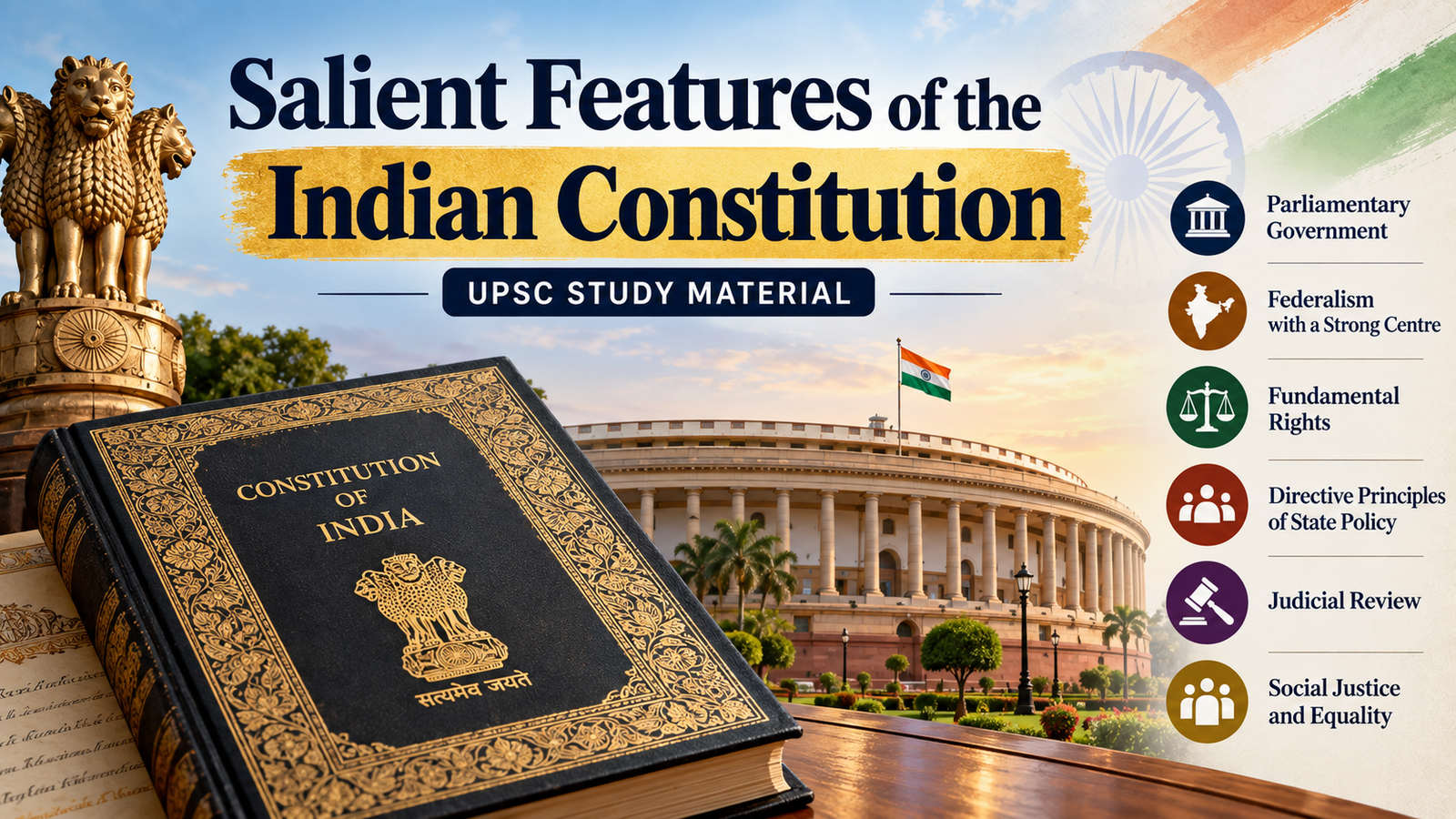
Salient Features of the Indian Constitution
The Indian Constitution is the foundation of India’s political and administrative system. It establishes the structure of government, distributes powers among institutions, guarantees fundamental rights, establishes constitutional limitations on state power and sets out broader objectives of social and economic transformation.
The Constitution is distinctive because it combines parliamentary government, federalism, Fundamental Rights, Directive Principles, judicial review, universal adult franchise and social justice within a single constitutional framework.
For UPSC Civil Services Examination aspirants, understanding the salient features of the Indian Constitution is essential because these features provide the conceptual foundation for studying the Preamble, Fundamental Rights, Directive Principles of State Policy, Parliament, Judiciary, Federalism, Constitutional Amendments and the Basic Structure Doctrine.
This article forms part of Samata IAS Academy’s Study Material → Polity & Constitution series. For the broader sequence of topics, see the UPSC Polity Study Material section. Samata IAS Academy
1. A Written and Detailed Constitution
India has a written Constitution that provides a comprehensive framework for the functioning of the state.
When it came into force on 26 January 1950, the Constitution contained 395 Articles, 22 Parts and 8 Schedules. Its structure has subsequently evolved through constitutional amendments.
The Constitution is detailed because the constitution-makers were dealing with an exceptionally complex political and social environment. They had to address:
- India’s enormous geographical and social diversity;
- linguistic and cultural differences;
- the legacy of colonial rule;
- Partition;
- integration of princely states;
- widespread poverty and inequality;
- the establishment of democratic institutions; and
- the transformation from colonial rule to a constitutional republic.
The official text of the Constitution is maintained by the Legislative Department, Ministry of Law and Justice, Government of India. Aspirants should use the official constitutional text whenever precise Articles or provisions need to be verified. Legislative Assembly of India
Suggested caption: The Constitution of India is a detailed written constitutional document containing the fundamental framework of the Indian state.
2. Popular Sovereignty
The Preamble begins with the words:
“We, the People of India”
This expresses the principle of popular sovereignty.
The ultimate source of constitutional authority is therefore the people of India.
The Constitution transformed India from a colonial political system into a democratic constitutional order in which governmental authority derives its legitimacy from the people.
Popular sovereignty is expressed through:
- elections;
- representative institutions;
- universal adult franchise;
- parliamentary accountability;
- constitutional rights; and
- democratic participation.
The Preamble officially records the decision of the people, through the Constituent Assembly, to adopt and give themselves the Constitution. Legislative Dashboard
This idea is closely connected with the constitutional concept of representative democracy.
3. Sovereign, Socialist, Secular, Democratic Republic
The Preamble describes India as a:
Sovereign Socialist Secular Democratic Republic.
The words Socialist and Secular were inserted through the 42nd Constitutional Amendment Act, 1976.
Sovereign
India is internally and externally sovereign. Its constitutional authority is not subordinate to another state.
Socialist
The Indian constitutional conception of socialism is associated with social and economic justice, reduction of inequality and a welfare-oriented state.
Secular
The Constitution guarantees freedom of conscience and religious freedom while also establishing equality before law.
Democratic
Political authority ultimately derives from the people through representative institutions and elections.
Republic
India has an elected head of state rather than a hereditary monarch.
The constitutional text of the Preamble can be consulted in the official Constitution published by the Legislative Department. Legislative Dashboard
Internal connection: The Preamble will be examined separately in the next article of this Study Material series.
4. Parliamentary Form of Government
India follows the parliamentary form of government.
At the Union level:
President
↓
Constitutional Head
↓
Prime Minister
↓
Head of the Council of Ministers
↓
Council of Ministers
↓
Collectively responsible to the Lok Sabha
The central principle is collective responsibility.
The parliamentary system therefore establishes a close relationship between the executive and legislature.
This was not an accidental choice. During the constitution-making process, the constitution-makers specifically considered whether India should adopt a unitary or federal structure and whether the parliamentary system would suit Indian conditions. The Constituent Assembly debates record the decision to adopt a parliamentary type of Cabinet system. Constitution of India
This feature also connects the Constitution with the subsequent study of the President, Prime Minister, Council of Ministers and Parliament.
For a systematic study of these institutions, aspirants can use the UPSC Polity Study Material hub. Samata IAS Academy
5. Federal System with a Strong Centre
The Constitution establishes a federal distribution of powers between the Union and the States.
The Seventh Schedule divides legislative subjects into:
- Union List;
- State List; and
- Concurrent List.
However, Indian federalism has several distinctive features that give the Union considerable strength.
These include:
- residuary legislative powers with the Union;
- integrated constitutional institutions;
- emergency provisions;
- financial dependence and intergovernmental transfers;
- Union intervention in specified constitutional circumstances; and
- a strong national framework for administration.
Therefore, India is often described as a federation with a strong Centre or a federal system containing significant unitary features.
Interestingly, the Constituent Assembly itself resisted simplistic classification. During the final stages of constitution-making, the Assembly discussed whether the Constitution should be labelled simply federal or unitary and emphasised that India’s own historical circumstances had to guide constitutional design. Constitution of India
UPSC connection
This feature should later be studied alongside:
- Centre-State relations;
- Governor;
- Inter-State Council;
- Finance Commission;
- fiscal federalism;
- cooperative federalism; and
- competitive federalism.
6. Constitutional Supremacy
The Constitution is the supreme law of India.
All organs of government derive their powers from the Constitution and must operate within constitutional limits.
This includes:
- Parliament;
- State Legislatures;
- Executive;
- Judiciary;
- Constitutional bodies; and
- other public authorities.
Constitutional supremacy is reinforced through Fundamental Rights, judicial review, federal distribution of powers and constitutional limitations on governmental authority.
The official Constitution contains the provisions concerning Fundamental Rights in Part III and other major constitutional principles throughout the document. Legislative Assembly of India
External reference: Aspirants should consult the official Constitution of India when studying constitutional provisions. Legislative Assembly of India
7. Fundamental Rights
One of the most important features of the Indian Constitution is the guarantee of Fundamental Rights.
They are contained in Part III.
The six broad categories currently recognised are:
- Right to Equality
- Right to Freedom
- Right against Exploitation
- Right to Freedom of Religion
- Cultural and Educational Rights
- Right to Constitutional Remedies
Fundamental Rights place constitutional limitations on state action and provide important protections for individual liberty and equality.
For example, Article 14 guarantees equality before law and equal protection of laws, while Article 13 addresses laws inconsistent with Fundamental Rights. Legislative Assembly of India
The right to constitutional remedies allows individuals to approach constitutional courts for enforcement of Fundamental Rights.
Internal link
This article should lead naturally to our forthcoming Fundamental Rights Study Material article. Once that article is published, we will add the permanent internal link here.
8. Directive Principles of State Policy
The Directive Principles of State Policy, contained in Part IV, represent the social and economic objectives of governance.
They include principles concerning:
- social justice;
- economic welfare;
- equitable distribution of resources;
- public health;
- education;
- protection of weaker sections;
- environmental protection;
- village panchayats; and
- international peace.
Unlike Fundamental Rights, the Directive Principles are generally non-justiciable.
However, Article 37 makes clear that although these provisions are not enforceable by courts, the principles are fundamental in the governance of the country and it is the duty of the State to apply them in making laws. Legislative Assembly of India
This demonstrates that the Indian Constitution is not merely concerned with restricting government power. It also seeks to promote social and economic transformation.
9. Fundamental Duties
Fundamental Duties are contained in Part IVA, Article 51A.
They were introduced through the 42nd Constitutional Amendment Act, 1976.
The Constitution currently contains 11 Fundamental Duties.
They concern responsibilities such as:
- respecting the Constitution;
- protecting national unity;
- promoting harmony;
- preserving cultural heritage;
- protecting the environment;
- developing scientific temper;
- safeguarding public property; and
- providing educational opportunities to children in the specified age group.
Fundamental Duties are generally not directly enforceable in the same manner as Fundamental Rights.
They nevertheless contribute to the constitutional conception of responsible citizenship.
10. Independent Judiciary
The Constitution establishes an independent and integrated judicial system.
The structure consists of:
Supreme Court
↓
High Courts
↓
Subordinate Courts
The judiciary performs several constitutional functions:
- interpretation of the Constitution;
- protection of Fundamental Rights;
- judicial review;
- resolution of constitutional disputes;
- enforcement of constitutional limitations.
The independence of the judiciary is closely related to the principles of constitutional supremacy and rule of law.
Suggested caption: The Supreme Court of India plays a central role in constitutional interpretation and judicial review.
11. Judicial Review
Judicial review allows constitutional courts to examine whether laws and governmental actions conform to the Constitution.
It supports:
Constitutional supremacy
↓
Protection of rights
↓
Limitation of governmental power
↓
Rule of law
Judicial review has also played a central role in the development of the Basic Structure Doctrine.
This is an important example of how the Constitution operates through interaction between constitutional text and judicial interpretation.
12. Rule of Law
The principle of rule of law requires government to act according to law and within constitutional limits.
It is associated with:
- equality before law;
- non-arbitrariness;
- legal accountability;
- constitutional limitations on power; and
- judicial protection of rights.
Article 14 is particularly important in understanding the constitutional commitment to equality before law. Legislative Assembly of India
For UPSC Mains, rule of law should therefore be understood not merely as a definition but as a principle connecting equality, constitutionalism and limited government.
13. Universal Adult Franchise
India adopted universal adult franchise from the commencement of the Republic.
This was historically significant.
The Constitution did not introduce voting rights gradually over several decades. Instead, democratic political participation was extended on a broad basis from the beginning of the Republic, subject to constitutional and statutory qualifications.
This reflected the constitution-makers’ commitment to:
- political equality;
- democratic citizenship;
- representative government; and
- popular sovereignty.
Universal adult franchise also helped transform democracy from an elite political system into a system based on mass political participation.
14. Single Citizenship
India follows the principle of single citizenship.
A citizen is a citizen of India rather than possessing a separate constitutional citizenship of an individual State.
Single citizenship promotes:
- national unity;
- common civic identity; and
- political integration.
It is one of the features that distinguishes Indian federalism from some other federal constitutional systems.
15. Constitutional and Independent Bodies
The Constitution establishes several institutions with specific constitutional responsibilities.
Important examples include:
- Election Commission of India;
- Union Public Service Commission;
- Finance Commission;
- Comptroller and Auditor General;
- Attorney General; and
- constitutional commissions.
These institutions support:
- accountability;
- electoral integrity;
- financial oversight;
- recruitment to public services; and
- constitutional administration.
The Samata IAS Academy Polity Study Material hub provides the broader topic structure for studying these institutions. Samata IAS Academy
16. Emergency Provisions
The Constitution contains provisions for exceptional circumstances.
These include:
- National Emergency;
- President’s Rule; and
- Financial Emergency.
The provisions seek to protect:
- national security;
- constitutional government;
- territorial integrity; and
- financial stability.
However, the experience of the 1975–77 Emergency also demonstrates why constitutional safeguards and institutional accountability are important.
This makes Emergency provisions an excellent example of the relationship between constitutional text and constitutional practice.
17. Social Justice and Transformative Constitutionalism
The Indian Constitution does not restrict itself to formal political equality.
It also seeks to address historical and structural inequalities.
The constitutional framework includes provisions concerning:
- abolition of untouchability;
- affirmative action;
- protection of Scheduled Castes and Scheduled Tribes;
- protection of weaker sections;
- social and economic justice;
- equal opportunity; and
- welfare-oriented governance.
This is often described through the idea of transformative constitutionalism.
The objective is not simply to establish equality before law, but to create conditions that enable substantive equality and social justice.
18. Local Self-Government
The 73rd and 74th Constitutional Amendments strengthened democratic decentralisation.
The 73rd Amendment gave constitutional recognition to:
Panchayati Raj Institutions
while the 74th Amendment gave constitutional recognition to:
Urban Local Bodies.
These amendments introduced:
- Part IX;
- Part IXA;
- Eleventh Schedule; and
- Twelfth Schedule.
Local government therefore became an important constitutional dimension of Indian democracy.
For UPSC, this topic should be connected with:
- Gram Sabha;
- State Election Commissions;
- State Finance Commissions;
- decentralisation;
- local governance; and
- participatory democracy.
19. Blend of Rigidity and Flexibility
The Indian Constitution is neither completely rigid nor completely flexible.
Different provisions require different amendment procedures.
Some provisions can be amended through a simple majority.
Many require a special majority of Parliament.
Certain federal provisions require:
Special majority of Parliament
Ratification by at least half of the State Legislatures
This creates a balance between:
Constitutional stability and constitutional adaptability.
The amendment procedure is therefore itself an important feature of Indian constitutionalism.
20. Basic Structure Doctrine
Parliament has the power to amend the Constitution under Article 368.
However, this power is not unlimited.
In Kesavananda Bharati v. State of Kerala (1973), the Supreme Court established the Basic Structure Doctrine.
The doctrine holds that Parliament cannot use its constitutional amendment power to destroy the basic structure of the Constitution.
The doctrine has subsequently become one of the most important features of Indian constitutional law.
It illustrates the interaction between:
Parliamentary power
Constitutional supremacy
Judicial review
The Basic Structure Doctrine should therefore be studied separately as a major topic within Polity & Constitution Study Material.
21. Parliamentary Democracy, Federalism and Judicial Review: A Constitutional Synthesis
One of the most distinctive features of the Indian Constitution is that it combines institutions that are sometimes studied separately.
India has:
Parliamentary government
but also
Judicial review
and
Constitutional supremacy
It has:
Federalism
but also
A strong Union
It protects:
Individual liberty
while also pursuing
Social transformation
This synthesis is more important than memorising individual features in isolation.
The Constituent Assembly debates themselves demonstrate that the constitution-makers consciously considered how these institutions would operate within India’s specific historical circumstances. Constitution of India
22. Why These Features Matter for UPSC
The importance of this topic goes beyond a factual Prelims question.
The features of the Constitution provide the conceptual framework for almost the entire Indian Polity portion of the UPSC syllabus.
For example:
Parliamentary Government
→ President
→ Prime Minister
→ Council of Ministers
→ Parliament
Federalism
→ Centre-State Relations
→ Governor
→ Finance Commission
→ Inter-State Relations
Constitutional Supremacy
→ Fundamental Rights
→ Judicial Review
→ Basic Structure
Social Justice
→ DPSP
→ Reservation
→ Welfare State
→ Equality
Democratic Decentralisation
→ Panchayats
→ Municipalities
→ Local Governance
This is why the topic should be treated as a foundation chapter, rather than a simple list of constitutional characteristics.
23. UPSC Prelims Perspective
For Preliminary Examination, focus on distinctions and constitutional relationships.
Important areas
- Written versus unwritten constitutions
- Parliamentary versus presidential government
- Federal versus unitary features
- Fundamental Rights versus DPSP
- Fundamental Duties
- Constitutional bodies
- Judicial review
- Constitutional amendment procedures
- Emergency provisions
- 73rd and 74th Amendments
- Basic Structure Doctrine
- Universal adult franchise
- Single citizenship
Prelims principle
Do not merely memorise:
“India is federal.”
Understand:
Why is India described as federal, and what features make Indian federalism distinctive?
Similarly, do not merely memorise:
“India has a parliamentary system.”
Understand:
What makes the Indian executive politically responsible to the legislature?
That conceptual approach is more useful for statement-based UPSC questions.
24. UPSC Mains Perspective
The topic can be connected to questions on:
- nature of the Indian Constitution;
- constitutionalism;
- federalism;
- parliamentary democracy;
- Fundamental Rights;
- social justice;
- judicial review;
- Basic Structure Doctrine;
- decentralisation;
- constitutional morality;
- separation of powers.
A strong Mains answer should establish relationships between constitutional principles.
For example:
Fundamental Rights + DPSP + affirmative action
can be used to explain India’s commitment to liberty as well as social transformation.
Similarly:
Federalism + strong Centre + integrated administration
helps explain India’s approach to national integration.
And:
Parliamentary government + judicial review + constitutional supremacy
demonstrates the constitutional system of checks and balances.
25. Possible UPSC Mains Question
“The Indian Constitution represents a careful balance between individual liberty, social transformation and institutional stability.” Discuss.
Answer approach
Introduction
Introduce the Constitution as a framework that combines democratic government with social and economic transformation.
Body
Discuss:
- Fundamental Rights and individual liberty
- DPSP and welfare objectives
- Parliamentary accountability
- Federalism
- Independent judiciary
- Judicial review
- Social justice
- Constitutional amendment
- Basic Structure Doctrine
- Democratic decentralisation
Conclusion
The Constitution’s durability lies in its ability to reconcile competing constitutional objectives while preserving its core democratic and constitutional values.
26. Salient Features at a Glance
| Feature | Constitutional significance |
|---|---|
| Written Constitution | Provides a comprehensive constitutional framework |
| Detailed Constitution | Addresses India’s complex social and institutional conditions |
| Popular Sovereignty | Authority ultimately derives from the people |
| Parliamentary Government | Executive accountability to legislature |
| Federalism with Strong Centre | Balances regional autonomy and national unity |
| Constitutional Supremacy | Government operates within constitutional limits |
| Fundamental Rights | Protect liberty and equality |
| DPSP | Establish social and economic objectives |
| Fundamental Duties | Promote responsible citizenship |
| Independent Judiciary | Protects constitutional governance |
| Judicial Review | Checks unconstitutional state action |
| Universal Adult Franchise | Establishes political equality |
| Single Citizenship | Promotes national integration |
| Constitutional Bodies | Strengthen institutional accountability |
| Emergency Provisions | Address exceptional circumstances |
| Local Self-Government | Deepens democratic decentralisation |
| Flexible and Rigid Elements | Balances stability and adaptability |
| Basic Structure Doctrine | Limits the amending power |
27. Connecting This Article with the Samata IAS Academy Resource Structure
This article should not exist in isolation.
The recommended preparation pathway is:
Historical Background & Making
↓
Salient Features
↓
Preamble
↓
Fundamental Rights
↓
DPSP
↓
Fundamental Duties
↓
Union Executive
↓
Parliament
↓
Judiciary
↓
Federalism
↓
Constitutional Amendments
↓
Basic Structure Doctrine
The preceding article, Indian Constitution: Historical Background, Making and Evolution, should therefore be internally linked from this article once its final URL is confirmed.
Students can also return to the UPSC Polity Study Material hub for the complete sequence of constitutional and institutional topics. Samata IAS Academy
For examination application, the article should connect to the UPSC Previous Year Questions section, where Constitution, Parliament, Judiciary, Federalism and Constitutional Bodies are already organised as major PYQ areas. Samata IAS Academy
The broader Samata IAS Academy Resources section can be used to connect Study Material with Current Affairs, Government Reports, Supreme Court judgments and other examination resources. Samata IAS Academy
28. Key Takeaways
The Indian Constitution is characterised by a combination of:
- Written and detailed constitutionalism
- Popular sovereignty
- Parliamentary democracy
- Federalism with a strong Centre
- Constitutional supremacy
- Fundamental Rights
- Directive Principles
- Fundamental Duties
- Independent judiciary
- Judicial review
- Universal adult franchise
- Single citizenship
- Constitutional bodies
- Social justice
- Democratic decentralisation
- Blend of rigidity and flexibility
- Basic Structure Doctrine
The deeper constitutional principle is the attempt to balance:
Liberty + Equality + Justice + Democracy + Federalism + Social Transformation
Conclusion
The salient features of the Indian Constitution reveal the distinctive character of India’s constitutional democracy.
The Constitution combines parliamentary government with constitutional supremacy, federalism with a strong Union, individual rights with social obligations, judicial review with legislative authority, and political democracy with an aspiration for social and economic transformation.
Its uniqueness therefore lies not merely in the individual provisions it contains, but in the relationship among those provisions.
For UPSC aspirants, the most useful approach is to study every feature through three questions:
What does the Constitution provide?
Why was it provided?
How does it operate in contemporary India?
That approach transforms constitutional study from memorisation of Articles and features into a deeper understanding of Indian constitutionalism.
Further Reading
Internal Samata IAS Academy Resources
- UPSC Polity Study Material — complete Polity & Constitution study sequence. Samata IAS Academy
- UPSC Previous Year Questions — Constitution, Parliament, Judiciary, Federalism and other PYQs. Samata IAS Academy
- Samata IAS Academy Resources — Study Material, Current Affairs, Government Reports and other UPSC resources. Samata IAS Academy
Authoritative External Resources
- Constitution of India — Legislative Department, Government of India — official constitutional documents. Legislative Assembly of India
- Official Constitution of India — Legislative Department — constitutional text. Legislative Assembly of India
- Constituent Assembly Debates — Constitution of India — primary-source material from the constitution-making process. Constitution of India