
Introduction
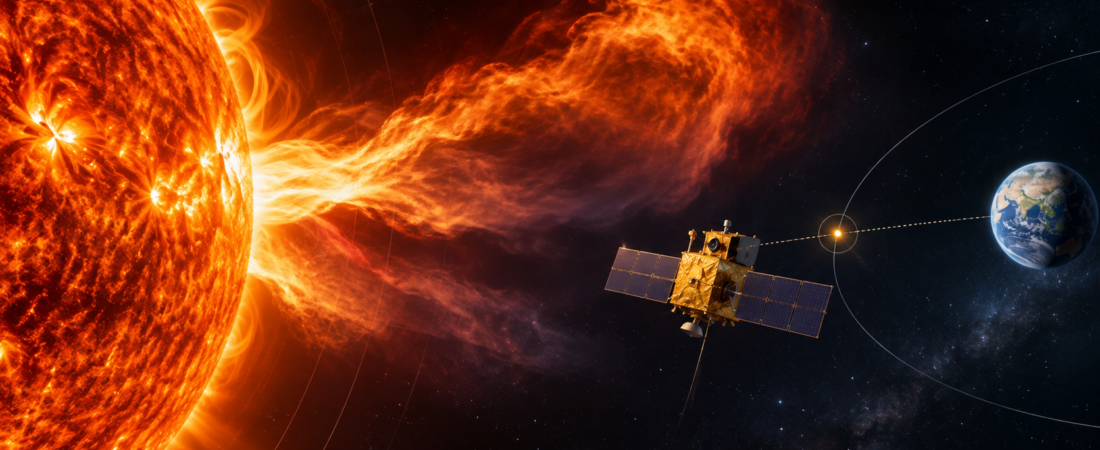
India’s first space-based solar observatory, Aditya-L1, has provided new insights into the behaviour of solar eruptions. Observations from its Visible Emission Line Coronagraph (VELC), combined with data from NASA’s Solar Dynamics Observatory (SDO) and three-dimensional modelling, have revealed that a coronal mass ejection (CME) did not expand uniformly like a symmetrical bubble. Instead, it developed an asymmetric shape during its early evolution near the Sun.
The research was conducted by scientists from the Indian Institute of Astrophysics (IIA), Bengaluru, an autonomous institute under the Department of Science and Technology. The findings were published in The Astrophysical Journal Letters and announced on 3 November 2026.
The study examined a solar eruption that occurred on 5 August 2024. By combining spectroscopic observations from VELC with imaging observations from NASA’s SDO, researchers were able to reconstruct important aspects of the eruption’s three-dimensional geometry and motion.
The finding is significant because the shape and expansion of a CME influence how it interacts with the solar wind, how its speed evolves and when it may reach Earth. Better understanding of these processes can contribute to more reliable space-weather assessment, which is increasingly important for satellite operations, communication systems, navigation and other technology-dependent infrastructure.
The discovery also demonstrates the growing scientific value of India’s Aditya-L1 mission and its contribution to international solar research.
1. What is the Recent Discovery?
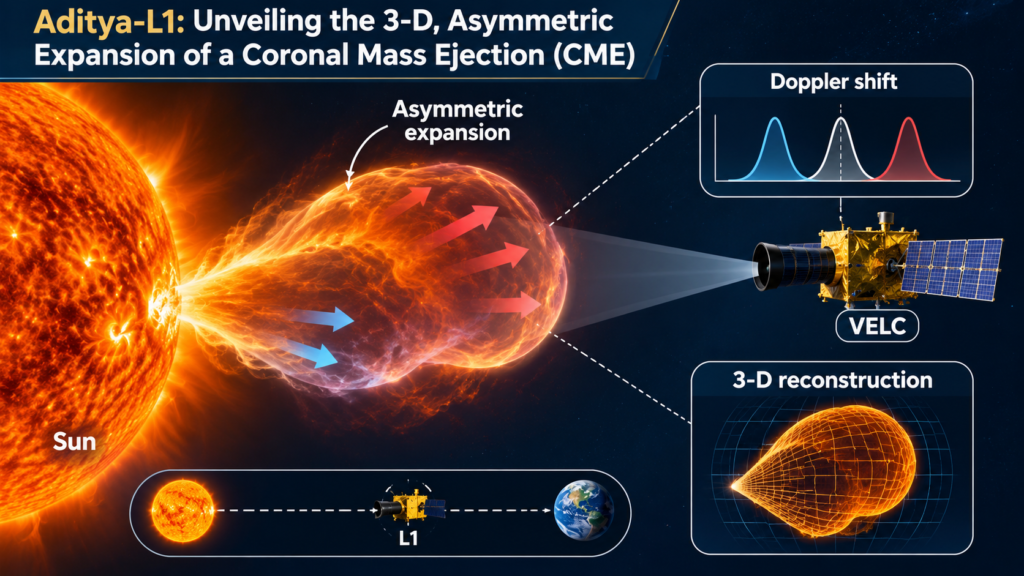
The study found that a coronal mass ejection observed on 5 August 2024 did not expand uniformly in all directions. Instead, it exhibited non-uniform lateral expansion and an inclined orientation, resulting in an asymmetric three-dimensional structure.
Earlier observations and simplified models often represented CMEs as expanding bubble-like structures. Although this approximation can be useful, the new observations demonstrate that the actual geometry can be more complex.
The researchers combined three important sources of information:
- Spectroscopic observations from VELC aboard Aditya-L1.
- Imaging observations from the Atmospheric Imaging Assembly (AIA) aboard NASA’s Solar Dynamics Observatory.
- Three-dimensional geometric and kinematic modelling.
The imaging observations captured the movement of the eruption across the plane of the sky. VELC provided additional information about the movement of plasma towards and away from the observer through Doppler shifts.
A model assuming symmetrical expansion could not reproduce the observed spectral pattern. A model incorporating an inclined CME axis and asymmetric lateral expansion produced a much closer match with the observations.
The central scientific contribution is the ability to constrain the three-dimensional structure and motion of a solar eruption by combining spectroscopy, imaging and modelling.
2. Understanding Solar Eruptions
The Sun is a dynamic star. Its surface and outer atmosphere are characterised by magnetic activity, plasma movements, solar flares and large-scale eruptions.
Two important phenomena associated with solar activity are solar flares and coronal mass ejections.
2.1 Solar Flares
A solar flare is a sudden and intense release of energy from the Sun’s atmosphere, generally associated with the rearrangement of magnetic fields.
Solar flares emit electromagnetic radiation across a broad range of wavelengths, including:
- X-rays.
- Ultraviolet radiation.
- Visible light.
- Radio waves.
When intense flare radiation reaches Earth, it can disturb the ionosphere and affect high-frequency radio communication, particularly on the sunlit side of the planet.
Solar flares release energy and radiation, but they are different from the large-scale ejection of plasma represented by a CME.
2.2 Coronal Mass Ejection (CME)
A coronal mass ejection is a large-scale eruption in which enormous quantities of magnetised plasma are expelled from the Sun’s outer atmosphere, known as the corona, into interplanetary space.
A CME contains:
- Electrically charged particles.
- Hot plasma.
- Embedded magnetic fields.
- Large amounts of kinetic and magnetic energy.
CMEs can travel through the heliosphere at widely varying speeds. Their effects on Earth depend on factors such as their direction, velocity, magnetic-field configuration and interaction with the solar wind.
Not every CME affects Earth. Only eruptions whose trajectories and magnetic characteristics bring them into interaction with Earth’s magnetosphere can produce significant geomagnetic disturbances.
2.3 Difference between Solar Flare and CME
| Feature | Solar flare | Coronal mass ejection |
|---|---|---|
| Nature | Sudden release of electromagnetic energy | Large-scale ejection of magnetised plasma |
| Main output | Radiation across different wavelengths | Plasma and magnetic field |
| Propagation | Radiation travels at the speed of light | Plasma travels at a variable speed |
| Time to affect Earth | Radiation reaches Earth in about 8 minutes | Travel time varies, commonly from roughly one to several days |
| Major effects | Ionospheric disturbances and radio blackouts | Geomagnetic storms and disturbances to space-based and ground infrastructure |
Solar flares and CMEs may occur together, but one does not necessarily imply the occurrence of the other.
3. What is Space Weather?
Space weather refers to the changing environmental conditions in space, particularly those driven by solar activity and their interaction with Earth’s magnetosphere, ionosphere and upper atmosphere.
The Sun continuously emits a stream of charged particles known as the solar wind. It also produces episodic disturbances such as solar flares and CMEs.
When these disturbances reach Earth, they can interact with the planet’s magnetic field and upper atmosphere.
Important components of space weather include:
- Solar flares.
- Coronal mass ejections.
- Solar energetic particles.
- Solar wind variations.
- Geomagnetic storms.
- Ionospheric disturbances.
3.1 Geomagnetic Storms
A geomagnetic storm is a significant disturbance of Earth’s magnetosphere caused by enhanced solar-wind conditions and the interaction of interplanetary magnetic fields with Earth’s magnetic field.
A particularly important factor is the orientation of the magnetic field carried by a CME. A strong southward component can facilitate energy transfer into Earth’s magnetosphere.
Geomagnetic storms can produce:
- Disturbances in satellite operations.
- Increased atmospheric drag on satellites in low Earth orbit.
- Errors in satellite-based navigation and positioning.
- Disruption of high-frequency radio communication.
- Induced currents in long-distance power transmission networks.
- Increased radiation exposure for astronauts and high-altitude aviation.
The severity of the impact depends on the intensity and duration of the disturbance, the magnetic configuration of the CME and the vulnerability of the affected systems.
3.2 Why Space Weather is Becoming More Important
Modern societies increasingly depend on interconnected technological systems.
Satellite-based communication, navigation, weather forecasting, financial networks, aviation and electricity transmission are all dependent on infrastructure that can be affected by severe space-weather events.
The growing dependence on these systems makes space-weather forecasting an important component of technological resilience and disaster preparedness.
4. Why is the Three-Dimensional Structure of a CME Important?
A CME does not travel through space as a rigid object. Its shape, internal magnetic structure and interaction with the solar wind evolve continuously.
Understanding its three-dimensional geometry is important for estimating:
- Direction of propagation.
- Speed of expansion.
- Orientation of the eruption.
- Interaction with the surrounding solar wind.
- Potential arrival time at Earth.
4.1 Limitations of Two-Dimensional Observations
A conventional coronagraph or solar imaging instrument records the apparent movement of a CME across the plane of the sky.
However, a two-dimensional image cannot independently reveal the full movement of plasma along the line of sight—that is, towards or away from the observer.
This creates an observational limitation.
For example, two CMEs may appear to have similar shapes in an image, even though their actual three-dimensional orientations and expansion patterns differ.
Such differences can affect the estimation of their velocity and trajectory.
4.2 How the Aditya-L1 Observations Address This Limitation
VELC provides spectroscopic information that complements conventional imaging.
By measuring changes in the wavelength of emitted light, scientists can estimate the velocity of plasma along the line of sight.
When this information is combined with images from other instruments and three-dimensional modelling, researchers can obtain a more complete understanding of the eruption.
The August 2024 event demonstrated how this combination can reveal an asymmetric structure that could not be adequately explained by a symmetrical model.
4.3 Implications for CME Arrival-Time Prediction
The shape of a CME can influence the aerodynamic-like drag it experiences from the solar wind as it moves through the heliosphere.
A CME with an asymmetric structure may interact differently with the surrounding solar wind compared with a uniformly expanding eruption.
This can influence its speed and therefore the time it takes to reach Earth.
Consequently, accurate reconstruction of the CME’s early geometry can improve the physical understanding needed for space-weather prediction.
However, this particular study does not itself establish a new operational warning system or guarantee more accurate arrival-time forecasts. Further observations and modelling of multiple CMEs are required.
5. Aditya-L1: India’s First Space-Based Solar Observatory
Aditya-L1 is India’s first dedicated space-based solar observatory, developed by the Indian Space Research Organisation (ISRO).
It was launched on 2 September 2023 aboard the PSLV-C57 launch vehicle from the Satish Dhawan Space Centre, Sriharikota.
The spacecraft was placed in a halo orbit around the Sun-Earth Lagrange Point 1 (L1) in January 2024.
Its primary objective is to study the Sun’s photosphere, chromosphere and corona, along with solar activity and its effects on the space environment.
5.1 Why was L1 selected?
The Sun-Earth L1 point is located approximately 1.5 million kilometres from Earth towards the Sun.
It is one of the five Lagrange points in the Sun-Earth system.
At these locations, the gravitational effects of the two massive bodies and the orbital motion of a spacecraft can combine to create useful dynamical conditions for space missions.
Aditya-L1 operates in a halo orbit around L1 rather than remaining fixed at the mathematical point.
The location offers several scientific advantages:
- Continuous observation of the Sun without the regular interruptions associated with Earth’s rotation.
- An uninterrupted view of solar activity.
- Early observation of solar eruptions before they travel towards Earth.
- A useful vantage point for studying solar wind and space-weather conditions.
5.2 The Seven Scientific Payloads of Aditya-L1
Aditya-L1 carries seven scientific payloads designed to study different aspects of the Sun and the surrounding space environment.
| Payload | Major function |
|---|---|
| VELC – Visible Emission Line Coronagraph | Studies the solar corona and CMEs using imaging and spectroscopy. |
| SUIT – Solar Ultraviolet Imaging Telescope | Observes the photosphere and chromosphere in ultraviolet wavelengths. |
| SoLEXS – Solar Low Energy X-ray Spectrometer | Measures soft X-ray emissions from the Sun. |
| HEL1OS – High Energy L1 Orbiting X-ray Spectrometer | Studies high-energy X-ray emissions associated with solar activity. |
| ASPEX – Aditya Solar wind Particle Experiment | Studies solar-wind particles and energetic particles. |
| PAPA – Plasma Analyser Package for Aditya | Analyses the composition and characteristics of solar-wind plasma. |
| Magnetometer | Measures the magnetic field in the space environment around the spacecraft. |
The payloads collectively provide observations across different wavelengths, particles and magnetic-field parameters.
This multi-instrument approach is important because solar activity involves interconnected physical processes that cannot be understood through a single type of observation.
6. VELC: The Instrument Behind the Discovery
The Visible Emission Line Coronagraph (VELC) is the primary payload of Aditya-L1.
It was designed and developed by the Indian Institute of Astrophysics, Bengaluru, at its M.G.K. Menon Laboratory for Space Sciences on the CREST campus in Hosakote, with substantial support from ISRO.
VELC is designed to observe the solar corona, the outermost atmosphere of the Sun.
The corona is extremely hot but much fainter than the bright solar disc. Observing it requires instruments that can suppress the intense light from the solar disc.
6.1 What is a Coronagraph?
A coronagraph is an instrument that blocks the direct light from a bright source, such as the Sun’s disc, to enable the observation of its faint surrounding atmosphere.
In solar astronomy, coronagraphs are used to study:
- The solar corona.
- Coronal structures.
- Solar eruptions.
- Coronal mass ejections.
- Changes in the outer solar atmosphere.
VELC uses an internally occulted design to suppress the bright solar disc and observe the corona.
6.2 The 530.3 Nanometre Green Emission Line
VELC studies the corona using spectroscopy, including observations of the green emission line at 530.3 nanometres.
This emission is associated with highly ionised iron atoms in the hot solar corona.
The line provides information about coronal plasma at temperatures of approximately 1.8 million kelvin.
By studying changes in this emission, scientists can obtain information about the movement and physical conditions of the coronal plasma.
6.3 Doppler Spectroscopy: Measuring Plasma Motion
One of the most important scientific capabilities used in this study is Doppler spectroscopy.
The Doppler effect refers to the apparent change in the frequency or wavelength of a wave due to the relative motion between the source and the observer.
In astronomy, the movement of emitting material can be studied through changes in the wavelength of light.
- Blueshift: When emitting material moves towards the observer, the observed wavelength shifts towards shorter wavelengths.
- Redshift: When emitting material moves away from the observer, the observed wavelength shifts towards longer wavelengths.
In the August 2024 CME, VELC detected distinct blueward and redward shifted emission features.
These indicated plasma motion both towards and away from the observer.
This information, combined with imaging observations, helped scientists reconstruct the eruption’s three-dimensional expansion.
The significance of VELC lies not merely in taking images of the corona but also in providing spectroscopic information about plasma motion.
7. How Was the August 2024 Solar Eruption Studied?
The research examined a CME that occurred on 5 August 2024, originating from an active region near the western limb of the Sun.
The scientists combined observations from two space-based instruments.
7.1 Aditya-L1’s VELC
VELC recorded the spectral evolution of the coronal emission during the eruption.
The observations showed two distinct Doppler-shifted emission branches on opposite sides of the normal coronal emission line.
These features indicated plasma moving in opposite directions along the line of sight.
7.2 NASA’s Solar Dynamics Observatory
NASA’s Solar Dynamics Observatory carries the Atmospheric Imaging Assembly (AIA), which provides high-resolution images of the Sun across multiple ultraviolet wavelengths.
The AIA observations captured the CME’s apparent propagation across the plane of the sky.
7.3 Three-Dimensional Geometric and Kinematic Modelling
The research team developed a three-dimensional model of the expanding CME structure.
The model was used to examine whether different orientations and expansion patterns could reproduce the observed spectral signatures.
A model assuming symmetrical expansion failed to reproduce the observed pattern.
A model incorporating an inclined axis and asymmetric lateral expansion produced a much closer match.
The combination of these observations and modelling provided evidence that the eruption expanded non-uniformly in the low corona.
The Research Process
Solar eruption → VELC spectroscopy + SDO imaging → Doppler analysis → 3-D geometric modelling → Reconstruction of asymmetric CME expansion
This approach demonstrates the value of combining different observational techniques to understand complex astrophysical phenomena.
8. Implications for India’s Space-Weather Preparedness
The findings have significance beyond solar physics.
India’s economy and critical infrastructure are increasingly dependent on satellite-based technologies.
8.1 Satellite Operations
Geomagnetic storms can increase the density of the upper atmosphere, particularly during periods of strong solar activity.
This can increase atmospheric drag on satellites in low Earth orbit, altering their trajectories and increasing the need for orbital corrections.
Space-weather disturbances can also affect satellite electronics and communication systems.
8.2 Navigation Systems
Satellite navigation systems depend on signals travelling through the ionosphere.
Solar disturbances can alter the electron density of the ionosphere, producing errors in satellite positioning and navigation.
This is relevant to aviation, maritime navigation, precision agriculture, surveying and location-based services.
8.3 Communication Networks
High-frequency radio communication can be disrupted by solar flares and ionospheric disturbances.
Satellite communication systems may also face operational challenges during severe space-weather events.
8.4 Power Transmission Networks
Strong geomagnetic disturbances can induce geomagnetically induced currents in long conducting systems, including electricity transmission networks.
Such currents can affect transformers and other components of power infrastructure.
The risk depends on the intensity of the storm, local geological conditions, grid design and operational safeguards.
8.5 Aviation and Human Spaceflight
Solar energetic particles can increase radiation exposure for astronauts and, in some circumstances, for aviation operating at high latitudes.
Space-weather monitoring is therefore important for crew safety and mission planning.
8.6 Strategic and Economic Infrastructure
India’s growing dependence on satellites for communication, defence, navigation, weather forecasting and disaster management makes space-weather resilience a strategic requirement.
Better understanding of solar eruptions can contribute to the scientific basis for improved monitoring, forecasting and protective measures.
9. India’s Growing Role in Solar and Space Science
Aditya-L1 represents an important step in India’s transition from being primarily a user of space-based scientific information to becoming a contributor to global solar research.
The mission offers several advantages.
1. Indigenous scientific capability: The development of VELC demonstrates the capacity of Indian scientific institutions to design and build advanced space-based observational instruments.
2. Global research collaboration: The study combined Indian observations with data from NASA’s Solar Dynamics Observatory, demonstrating the importance of international scientific cooperation.
3. Continuous solar monitoring: The L1 vantage point enables sustained observations of solar activity.
4. Contribution to space-weather science: Understanding the early evolution of CMEs can improve the scientific basis for modelling their propagation.
5. Human resource development: The mission provides opportunities for Indian researchers, engineers and students to participate in advanced astrophysical research.
The mission also complements India’s wider space programme, which includes Earth observation, communication, navigation, planetary exploration and human spaceflight.
10. Challenges in Space-Weather Forecasting
Despite advances in solar observation, accurate space-weather forecasting remains difficult.
10.1 Complex CME Geometry
CMEs can have irregular structures, varying orientations and non-uniform expansion patterns.
Simplified geometric assumptions may lead to errors in estimating their trajectory and speed.
10.2 Magnetic-Field Prediction
The magnetic orientation of a CME is a major determinant of its potential interaction with Earth’s magnetosphere.
Predicting the internal magnetic-field configuration of a CME remains challenging.
10.3 Solar-Wind Interaction
A CME interacts with the surrounding solar wind as it travels through interplanetary space.
Its speed and structure can change during propagation.
10.4 Limited Observation Points
Although multi-spacecraft observations improve scientific understanding, comprehensive observations from multiple directions are not always available.
VELC’s ability to provide line-of-sight information from the L1 vantage point is valuable, but further observations are needed to establish the reliability of the method across different events.
10.5 From Scientific Observation to Operational Forecasting
A scientific discovery does not automatically translate into an operational forecasting capability.
It must be integrated into validated models, tested against multiple events and incorporated into forecasting systems.
India therefore needs sustained investment in solar observation, computational modelling, data assimilation, scientific research and coordination among relevant institutions.
11. Way Forward
India should strengthen its space-weather research and preparedness through an integrated approach.
- Expand solar observation: Continue developing advanced instruments and observational capabilities to study the Sun’s corona, solar wind and magnetic activity.
- Improve predictive models: Incorporate three-dimensional CME geometry, magnetic-field measurements and solar-wind interactions into forecasting models.
- Strengthen institutional cooperation: Encourage collaboration among ISRO, the Indian Institute of Astrophysics, research universities and international scientific organisations.
- Develop operational space-weather services: Improve the use of scientific observations for early warning and risk assessment.
- Protect critical infrastructure: Develop protocols for satellite operators, power utilities, communication networks and aviation authorities.
- Invest in computational science: Use high-performance computing, artificial intelligence and data assimilation techniques to analyse large volumes of solar observations.
- Promote international data sharing: Space weather is a global phenomenon, and collaborative observation improves scientific understanding and preparedness.
12. Conclusion
The recent Aditya-L1 discovery demonstrates how advanced solar observations can reveal the complex three-dimensional behaviour of coronal mass ejections.
By combining VELC’s spectroscopic measurements with NASA’s imaging observations and three-dimensional modelling, Indian scientists have shown that a solar eruption can expand asymmetrically rather than as a uniformly expanding bubble.
The finding is important because the geometry and evolution of CMEs influence their interaction with the solar wind and may affect their speed and arrival time at Earth.
The study does not by itself constitute a new operational warning system. However, it provides valuable observational evidence that can contribute to the development of better space-weather models.
As India becomes increasingly dependent on satellite-based infrastructure, understanding the Sun is no longer only a question of astronomy. It is also a question of technological resilience, economic security and national preparedness.
UPSC Examination Relevance
GS Paper III – Science and Technology
- India’s space programme.
- Aditya-L1 mission and its scientific payloads.
- Solar physics and space-weather research.
- Coronal mass ejections and geomagnetic storms.
- Applications of spectroscopy and Doppler effect.
- Space-based observation and international scientific cooperation.
- Protection of critical technological infrastructure.
Prelims – Important Facts
- Aditya-L1 is India’s first dedicated space-based solar observatory.
- It was launched on 2 September 2023 by PSLV-C57.
- It operates in a halo orbit around the Sun-Earth L1 point.
- L1 is approximately 1.5 million kilometres from Earth towards the Sun.
- Aditya-L1 carries seven scientific payloads.
- VELC stands for Visible Emission Line Coronagraph.
- VELC was developed by the Indian Institute of Astrophysics with substantial support from ISRO.
- VELC studies the solar corona and CMEs through imaging and spectroscopy.
- The 530.3 nm green emission line is associated with highly ionised iron in the solar corona.
- A CME is an ejection of magnetised plasma from the Sun’s corona.
Prelims Practice Questions
Q1. With reference to Aditya-L1, consider the following statements:
- It is India’s first dedicated space-based solar observatory.
- It operates in a halo orbit around the Sun-Earth L1 point.
- It carries the Visible Emission Line Coronagraph (VELC) as one of its scientific payloads.
- It is designed exclusively to study the photosphere of the Sun.
Which of the statements given above are correct?
(a) 1 and 2 only
(b) 1, 2 and 3 only
(c) 2, 3 and 4 only
(d) 1, 2, 3 and 4
Answer: (b) 1, 2 and 3 only
Explanation: Aditya-L1 studies different layers of the Sun and the space environment, including the photosphere, chromosphere and corona. It is not restricted exclusively to the photosphere.
Q2. Consider the following statements about Coronal Mass Ejections:
- They involve the ejection of magnetised plasma from the Sun’s corona.
- Every CME necessarily produces a geomagnetic storm on Earth.
- Their interaction with Earth’s magnetosphere can disturb satellite operations and power transmission networks.
Which of the statements given above are correct?
(a) 1 only
(b) 1 and 3 only
(c) 2 and 3 only
(d) 1, 2 and 3
Answer: (b) 1 and 3 only
Explanation: Not every CME is directed towards Earth or produces a geomagnetic storm. Their effects depend on their trajectory, speed, magnetic-field configuration and interaction with Earth’s magnetosphere.
Q3. The Doppler effect in solar spectroscopy is useful for determining:
(a) The chemical composition of the Sun alone
(b) The distance between the Sun and Earth
(c) The line-of-sight velocity of emitting plasma
(d) The total mass of the Sun
Answer: (c) The line-of-sight velocity of emitting plasma
Explanation: Changes in the wavelength of emitted light provide information about the movement of plasma towards or away from the observer.
Mains Practice Question
“The Aditya-L1 mission represents an important step in strengthening India’s capacity in solar physics and space-weather research.” Discuss its scientific significance and examine the implications of space-weather disturbances for India’s critical infrastructure. (15 marks)
Key dimensions for the answer: Aditya-L1 objectives, L1 vantage point, VELC, Doppler spectroscopy, CME geometry, geomagnetic storms, satellite infrastructure, navigation, communication, power grids, forecasting challenges and international scientific cooperation.
Keywords for Mains: Solar corona, coronal mass ejection, heliosphere, Doppler spectroscopy, Lagrange point, geomagnetic storm, space-weather forecasting, critical infrastructure resilience and indigenous scientific capability.</WritingBlock}
3. Featured image and in-article infographic
The two generated images are displayed above and can be used as follows:
<row align=start gap={3}> <box flex=”1″> <AsyncImage query=”Aditya L1 spacecraft Sun Earth L1 coronal mass ejection solar eruption space illustration” aspectRatio=”16:9″ width=”100%”/> **Image 1 — Featured image** <caption color=”secondary”>Aditya-L1 observing an asymmetric solar eruption.</caption> </box> <box flex=”1″> <AsyncImage query=”Aditya L1 VELC asymmetric coronal mass ejection Doppler shift three dimensional reconstruction infographic” aspectRatio=”16:9″ width=”100%”/> **Image 2 — In-article infographic** <caption color=”secondary”>VELC, Doppler spectroscopy and three-dimensional CME reconstruction.</caption> </box> </row>
4. WordPress image attributes
Image 1 — Featured image
| Field | Value |
|---|---|
| Filename | aditya-l1-asymmetric-solar-eruption.webp |
| Title | Aditya-L1 Observes an Asymmetric Solar Eruption |
| Alt text | Aditya-L1 spacecraft observing a coronal mass ejection expanding from the Sun towards interplanetary space. |
| Caption | Aditya-L1’s observations are providing new insights into the three-dimensional evolution of solar eruptions. |
| Description | An illustration of India’s Aditya-L1 solar observatory monitoring a coronal mass ejection from its vantage point around the Sun-Earth L1 region. |
Image 2 — In-article infographic
| Field | Value |
|---|---|
| Filename | aditya-l1-velc-cme-three-dimensional-expansion.webp |
| Title | VELC Reveals Three-Dimensional CME Expansion |
| Alt text | Scientific illustration showing Aditya-L1’s VELC instrument, Doppler shifts and asymmetric three-dimensional expansion of a coronal mass ejection. |
| Caption | Combining Doppler spectroscopy with solar imaging helped scientists reconstruct the asymmetric expansion of a CME. |
| Description | An educational infographic explaining how VELC observations and three-dimensional modelling reveal the geometry and motion of a solar eruption. |
Placement: Insert Image 2 after Section 7, How Was the August 2024 Solar Eruption Studied?
5. External links and references
Use these links contextually within the article.
| Anchor text | Official source |
|---|---|
| Aditya-L1 reveals the hidden third dimension of a solar eruption | <Link url=”https://www.isro.gov.in/ISRO_EN/Aditya_L1_Reveals_the_Hidden_Third_Dimension_of_Solar_Eruption.html” title=”ISRO research announcement”/> |
| PIB announcement of the VELC discovery | <Link url=”https://www.pib.gov.in/PressReleseDetailm.aspx?PRID=2331935&lang=1®=3” title=”Press Information Bureau”/> |
| Original research paper in The Astrophysical Journal Letters | <Link url=”https://doi.org/10.3847/2041-8213/aea295” title=”Research publication”/> |
| Aditya-L1 mission | <Link url=”https://www.isro.gov.in/Aditya_L1.html” title=”ISRO mission page”/> |
| Solar Dynamics Observatory | <Link url=”https://science.nasa.gov/mission/sdo/” title=”NASA SDO”/> |
| Space weather information | <Link url=”https://www.swpc.noaa.gov/” title=”NOAA Space Weather Prediction Center”/> |
The ISRO research announcement and original journal reference are the most important sources for the article’s central scientific findings. <Cite refs={[“turn169952search0″,”turn169952search1”]}/>
6. Internal linking recommendation
This article can be linked to your existing Science and Technology study material on India’s space programme or satellite technology, if that article is already published. It will help connect current affairs with static UPSC concepts.
7. Final publishing checklist
- Category: Current Affairs
- Add the SEO title, focus keyphrase and meta description.
- Add the comma-separated tags.
- Upload the featured image.
- Insert the infographic after Section 7.
- Add the ISRO, PIB, NASA and research-paper links.
- Add a relevant internal link.
- Check heading hierarchy and mobile readability.
- Preview and publish.
Editorial point: Retain the distinction between a scientific finding and an operational forecasting capability. The study improves understanding of CME geometry; it does not mean that Aditya-L1 can yet predict every geomagnetic storm or its precise impact on Earth.