
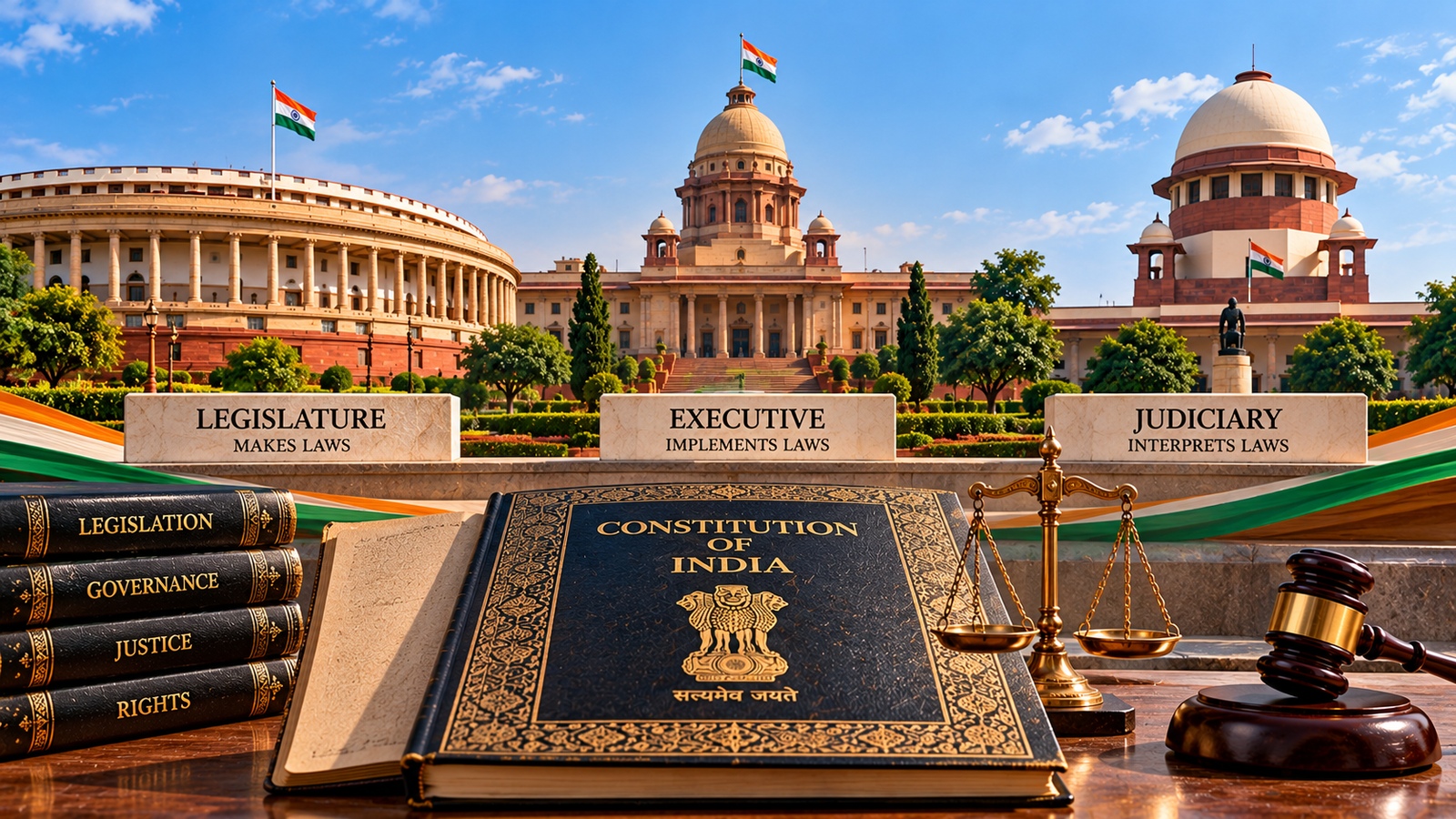
The separation of powers in India is a fundamental constitutional principle that distributes governmental functions among the legislature, executive and judiciary. It seeks to prevent the concentration of excessive power in any single institution and promotes accountability, constitutional governance and the rule of law.
The Indian Constitution does not establish a completely rigid separation of powers. Instead, it follows a system of functional separation, institutional overlap and checks and balances. Each organ of government has its own constitutional responsibilities, but each is also subject to limitations designed to prevent the arbitrary exercise of power.
The Supreme Court of India has repeatedly emphasised the importance of this principle. In Indira Nehru Gandhi v. Raj Narain (1975) and subsequent judgments, the Court recognised separation of powers as an essential feature of the constitutional framework.
For UPSC Civil Services Examination aspirants, this topic is important for General Studies Paper II, particularly the Constitution, functioning of Parliament, executive accountability, judicial independence and constitutional institutions.
1. What Is the Separation of Powers?
The doctrine of separation of powers refers to the distribution of governmental authority among three principal organs:
- Legislature: Makes laws and holds the executive accountable through constitutional and parliamentary procedures.
- Executive: Implements laws, administers government policies and manages public administration.
- Judiciary: Interprets laws, resolves disputes and protects constitutional rights through judicial remedies.
The doctrine is intended to prevent the concentration of legislative, executive and judicial authority in the same hands.
For example, Parliament may enact a law, but the executive must implement it in accordance with the Constitution. If the law violates constitutional provisions, a competent court may review its validity. Similarly, the judiciary must exercise its powers within the jurisdiction and procedures established by the Constitution.
The doctrine therefore promotes a system in which governmental power is divided, limited and accountable.
2. Origin and Evolution of the Doctrine
The modern doctrine of separation of powers is commonly associated with the French political philosopher Montesquieu, particularly his work The Spirit of the Laws published in 1748.
Montesquieu argued that liberty is endangered when legislative, executive and judicial powers are concentrated in the same person or institution.
His ideas influenced constitutional developments in several countries, including the United States, where the Constitution establishes a comparatively strict institutional separation accompanied by checks and balances.
India adopted a different approach. The Indian Constitution distributes functions among different institutions but also permits certain overlaps because of the parliamentary system of government and the practical requirements of administration.
For instance, the Council of Ministers exercises executive authority while remaining collectively responsible to the Lok Sabha. Ministers are generally members of Parliament, although a person who is not a member may serve as a minister for up to six consecutive months, subject to the constitutional requirement of membership thereafter.
Similarly, courts can review legislation, while the executive participates in judicial appointments through the constitutionally evolved appointments process.
Thus, the Indian model is best understood as functional separation combined with checks and balances, rather than complete institutional isolation.
3. Constitutional Provisions Relating to Separation of Powers
The Constitution does not contain a single article explicitly declaring a rigid separation of powers. Instead, several provisions collectively establish the framework.
3.1 Article 50: Separation of Judiciary from the Executive
Article 50 is a Directive Principle of State Policy. It directs the state to take steps to separate the judiciary from the executive in the public services of the state.
Its primary objective is to promote judicial independence, particularly at the subordinate level, by preventing executive interference in judicial functions.
Article 50 is not directly enforceable in the same manner as a Fundamental Right, but it expresses an important constitutional objective.
3.2 Articles 53 and 154: Executive Power
Article 53 vests the executive power of the Union in the President, while Article 154 vests the executive power of a state in the Governor.
These provisions must be read alongside the parliamentary system established by the Constitution. In ordinary constitutional practice, the President and Governors exercise their functions in accordance with the constitutional framework governing ministerial advice and their limited discretionary powers.
The provisions establish the formal constitutional location of executive authority without creating an executive institution entirely independent of the legislature.
3.3 Articles 74 and 163: Council of Ministers
Article 74 provides for a Council of Ministers headed by the Prime Minister to aid and advise the President. Article 163 establishes a corresponding Council of Ministers headed by the Chief Minister to aid and advise the Governor, subject to the constitutional provisions concerning discretion.
These provisions illustrate the parliamentary model, in which the executive is constitutionally connected to the legislature and remains accountable to the elected House.
3.4 Articles 121 and 211: Restrictions on Discussion of Judicial Conduct
Article 121 restricts discussion in Parliament concerning the conduct of a Supreme Court or High Court judge in the discharge of judicial duties, except upon a motion for presenting an address to the President seeking the judge’s removal.
Article 211 imposes a corresponding restriction on state legislatures concerning the conduct of Supreme Court and High Court judges in the discharge of their duties.
These provisions help protect judicial independence from inappropriate political interference.
3.5 Articles 122 and 212: Legislative Proceedings
Article 122 restricts judicial scrutiny of parliamentary proceedings on the ground of an alleged irregularity of procedure, subject to the constitutional limits on this protection.
Article 212 provides a corresponding safeguard for proceedings in state legislatures.
These provisions do not create an unrestricted immunity for legislative action. Courts may still examine constitutional violations and issues that fall within their lawful jurisdiction.
3.6 Articles 32 and 226: Judicial Remedies
Article 32 empowers the Supreme Court to enforce Fundamental Rights. Article 226 empowers High Courts to issue writs for enforcing Fundamental Rights and for other legal purposes.
These provisions enable the judiciary to review governmental action and provide remedies where constitutional or legal requirements have been violated.
For a deeper explanation, read our article on Judicial Review in India. Confirm the published URL before inserting this internal link.
3.7 Article 361: Constitutional Immunities
Article 361 provides certain constitutional immunities to the President and Governors while in office. These include protection from being answerable to courts for the exercise and performance of their official powers and duties, subject to the constitutional framework.
The article does not mean that every action taken by the Union or state executive is beyond judicial review. The constitutionality of governmental action may be examined in proceedings brought against the appropriate government or authority, subject to applicable law.
4. How Separation of Powers Operates in India
The Indian Constitution establishes a parliamentary system in which the three organs are functionally distinct but interconnected.
| Organ | Principal functions | Constitutional checks |
|---|---|---|
| Legislature | Enacts laws, approves taxation and expenditure, and scrutinises the executive | Judicial review of unconstitutional laws; constitutional limits on legislative powers |
| Executive | Implements laws, administers public policy and manages government departments | Parliamentary questions, debates, motions, committees and judicial review of unlawful action |
| Judiciary | Interprets the Constitution, resolves disputes and protects legal and constitutional rights | Constitutional jurisdiction, judicial precedent, prescribed procedures and the limits of judicial power |
These relationships demonstrate that no organ is completely isolated from the others.
The legislature controls public finance through constitutional procedures. The executive is accountable to the elected House under the parliamentary system. The judiciary can examine whether legislative and executive action complies with the Constitution.
At the same time, courts are not intended to replace the legislature in making ordinary policy choices or to assume routine administrative responsibilities.
5. Checks and Balances in the Indian Constitution
Checks and balances are mechanisms through which one institution can limit, scrutinise or hold another institution accountable.
They complement the separation of powers by ensuring that constitutional authority is not exercised without oversight.
5.1 Parliamentary Control over the Executive
The Council of Ministers is collectively responsible to the Lok Sabha under Article 75(3).
This means that the government must retain the confidence of the Lok Sabha. Parliamentary questions, debates, motions and committee scrutiny provide additional mechanisms for holding ministers accountable.
A government that loses the confidence of the Lok Sabha cannot ordinarily continue in office as though it retained majority support.
5.2 Judicial Review of Legislative and Executive Action
Courts may examine whether laws and executive decisions comply with the Constitution.
A law that violates constitutional provisions may be declared invalid to the extent of the inconsistency. Executive action may also be set aside if it exceeds legal authority or violates applicable constitutional requirements.
For a broader discussion of constitutional limits on Parliament’s amending power, see our article on the Basic Structure Doctrine. Confirm the published URL before inserting the link.
5.3 Legislative Oversight of Public Finance
The executive cannot spend public money without constitutional and legal authority. Parliamentary approval is required for the relevant grants and appropriations under the constitutional framework.
Financial committees, including the Public Accounts Committee, examine public expenditure and help strengthen accountability.
5.4 Constitutional Limits on Judicial Authority
The judiciary must act within its constitutional jurisdiction and follow applicable legal procedures. Courts interpret and apply the law, but their authority is not a general mandate to formulate every aspect of public policy.
The Constitution also prescribes procedures for judicial appointments and removal. These arrangements seek to protect judicial independence while maintaining institutional accountability.
5.5 Federal Distribution of Powers
The distribution of legislative powers between Parliament and state legislatures also acts as a constitutional check.
Articles 245 and 246, read with the Seventh Schedule, define important aspects of legislative competence. Courts can adjudicate disputes concerning the constitutional distribution of powers.
This mechanism prevents legislative authority from being exercised without regard to constitutional boundaries.
6. Separation of Powers in the Parliamentary System
India follows the parliamentary form of government at the Union and state levels.
Unlike a presidential system in which the executive is institutionally separated from the legislature to a greater degree, India’s parliamentary system establishes a close relationship between the executive and the legislature.
The Prime Minister and other ministers are generally drawn from Parliament. The Council of Ministers remains collectively responsible to the Lok Sabha.
This relationship creates both advantages and challenges.
Advantages include:
- Better coordination between law-making and policy implementation when the government commands a legislative majority.
- Direct parliamentary accountability of ministers.
- The possibility of removing a government that loses the confidence of the elected House.
Challenges include:
- A strong majority may reduce effective legislative scrutiny of government proposals.
- Party discipline may limit independent legislative deliberation.
- The executive may dominate the legislative agenda.
- Insufficient time for parliamentary committees and detailed examination may weaken oversight.
The Indian model therefore relies not on complete separation between the executive and legislature, but on accountability mechanisms, constitutional limitations and institutional conventions.
7. Landmark Judgments on Separation of Powers
The Supreme Court has clarified the relationship between the three organs through several important judgments.
7.1 Kesavananda Bharati v. State of Kerala (1973)
In Kesavananda Bharati v. State of Kerala, the Supreme Court held that Parliament could amend the Constitution but could not damage or destroy its basic structure.
The judgment established the Basic Structure Doctrine, which limits Parliament’s constitutional amending power.
The doctrine is relevant to separation of powers because it prevents constitutional amendments from being used to destroy essential institutional arrangements or remove fundamental constitutional limitations.
7.2 Indira Nehru Gandhi v. Raj Narain (1975)
This case concerned a constitutional amendment that sought to place certain election disputes, including the election of the Prime Minister, beyond ordinary judicial scrutiny.
The Supreme Court invalidated the relevant provision concerning the election dispute.
The judgment reinforced the importance of democracy, the rule of law, judicial review and the constitutional division of institutional functions.
It demonstrated that Parliament cannot simply assume judicial functions by using a constitutional amendment to exclude adjudication of a particular dispute from the courts.
7.3 Minerva Mills v. Union of India (1980)
In Minerva Mills v. Union of India, the Supreme Court invalidated provisions of the Forty-second Constitutional Amendment that attempted to expand Parliament’s amending power without substantive limits and exclude constitutional amendments from judicial review.
The judgment reaffirmed that limited amending power and judicial review are essential features of the constitutional framework.
It also emphasised that every organ of the state derives its authority from the Constitution and must function within its constitutional limits.
7.4 S.R. Bommai v. Union of India (1994)
In S.R. Bommai v. Union of India, the Supreme Court examined the constitutional use of Article 356, under which President’s Rule may be imposed in a state.
The judgment strengthened judicial review of proclamations under Article 356 and clarified important constitutional limitations on the use of this power.
It is significant for understanding federalism, executive authority and judicial oversight of constitutional action.
7.5 L. Chandra Kumar v. Union of India (1997)
In L. Chandra Kumar v. Union of India, the Supreme Court held that judicial review by the High Courts under Articles 226 and 227 and by the Supreme Court under Article 32 forms part of the Constitution’s basic structure.
The Court clarified that tribunals may exercise important adjudicatory functions, but their decisions remain subject to the constitutionally established scrutiny of the higher judiciary.
The judgment reinforces the principle that institutional arrangements cannot completely exclude the constitutional role of the judiciary.
8. Separation of Powers and Judicial Activism
Judicial activism refers to an approach in which courts adopt an active role in interpreting constitutional and statutory provisions, enforcing rights or addressing legal failures.
Judicial activism can help protect constitutional values where other institutions fail to fulfil their legal obligations. However, it can also raise concerns when judicial directions move beyond enforcing the law and enter areas primarily entrusted to elected governments.
The central issue is not whether courts should be active or passive in every case. It is whether the exercise of judicial authority is supported by the Constitution, the law and the facts before the court.
For example, a court may direct a public authority to comply with a statutory duty. However, the court should be cautious about assuming responsibility for every operational decision involved in implementing a public programme.
The principle of separation of powers requires the judiciary to enforce constitutional limits while respecting the legitimate functions of the legislature and executive.
9. Separation of Powers and Judicial Independence
Judicial independence is essential for the effective functioning of separation of powers.
If judges are subject to improper political or executive pressure, they may be unable to review governmental action impartially. This would weaken constitutional safeguards and reduce public confidence in the justice system.
Judicial independence is supported by several constitutional arrangements, including security of tenure, prescribed procedures for removal, protections relating to judicial service and the constitutional powers of the courts.
However, judicial independence does not mean that judges are above the law or beyond legitimate accountability.
The objective is to ensure that judges can decide cases according to the Constitution and law, without improper influence, while maintaining professional standards and public confidence.
10. Challenges to Separation of Powers in India
Despite the constitutional framework, several challenges affect the practical operation of separation of powers.
10.1 Executive Dominance over the Legislature
When the government has a strong majority, legislative scrutiny may weaken if bills are passed without sufficient deliberation or committee examination.
Effective parliamentary debate and meaningful oversight are necessary to prevent excessive concentration of practical power in the executive.
10.2 Ordinance-Making Power
Articles 123 and 213 empower the President and Governors, respectively, to promulgate ordinances when the relevant constitutional conditions are satisfied.
Ordinances have the force of law but are subject to constitutional requirements and legislative control.
Repeated use of ordinances to bypass ordinary legislative deliberation can raise concerns about executive dominance and the proper functioning of the legislature.
10.3 Judicial Overreach
Judicial intervention may generate institutional tensions when courts appear to take over policy decisions or administrative functions without a sufficient constitutional or legal basis.
Courts must protect rights and enforce legal duties while respecting the legitimate policy-making authority of elected institutions.
10.4 Delays in Judicial Appointments and Vacancies
Vacancies and delays can reduce the capacity of courts to decide cases promptly. An under-resourced judiciary may struggle to provide timely remedies and exercise effective constitutional oversight.
10.5 Limited Parliamentary Scrutiny
Insufficient time for legislative debate, limited committee examination and disruptions can weaken Parliament’s ability to scrutinise government action.
Strengthening parliamentary procedures is therefore as important as maintaining judicial independence.
10.6 Institutional Conflicts
Disagreements over appointments, legislative privileges, tribunal structures and the limits of judicial intervention can create tensions between institutions.
Such conflicts should be resolved through constitutional interpretation, institutional dialogue and respect for established legal procedures.
11. Way Forward
Strengthening separation of powers requires each institution to fulfil its constitutional responsibilities effectively.
First, Parliament should ensure adequate deliberation on legislation, meaningful committee scrutiny and effective oversight of public expenditure.
Second, the executive should respect legislative accountability and exercise ordinance-making and other exceptional powers only within the constitutional framework.
Third, the judiciary should remain independent, accessible and efficient while ensuring that its interventions are grounded in constitutional and legal principles.
Fourth, constitutional institutions should strengthen dialogue and cooperation to resolve disputes without undermining their independent functions.
Finally, citizens and civil society should promote constitutional awareness and demand accountability from all public institutions.
The objective is not to create complete isolation among the three organs, which is neither the Indian constitutional design nor practically feasible. It is to maintain a workable balance in which each institution can perform its duties without improperly usurping the functions of another.
Conclusion
The separation of powers in India is a principle of constitutional balance rather than rigid institutional isolation. The Constitution distributes authority among the legislature, executive and judiciary while allowing necessary overlap, particularly under the parliamentary system.
Through checks and balances, judicial review, parliamentary accountability and constitutional limitations, the system seeks to prevent the concentration and arbitrary exercise of power.
Landmark judgments such as Kesavananda Bharati, Indira Nehru Gandhi v. Raj Narain and Minerva Mills have reinforced the principle that no organ of government can claim unlimited authority.
For Indian democracy to function effectively, each institution must respect the constitutional responsibilities of the others. The ultimate objective is to preserve constitutional supremacy, accountability, liberty and the rule of law.
UPSC Examination Relevance
Important Prelims facts
- Article 50: Separation of the judiciary from the executive in the public services of the state.
- Articles 74 and 75: Union Council of Ministers and collective responsibility to the Lok Sabha.
- Articles 121 and 211: Restrictions on discussion of the conduct of Supreme Court and High Court judges in legislatures.
- Articles 122 and 212: Protection of legislative proceedings against judicial scrutiny based solely on irregularity of procedure, subject to constitutional limits.
- Articles 123 and 213: Ordinance-making powers of the President and Governors.
- Kesavananda Bharati (1973): Established the Basic Structure Doctrine.
- Indira Nehru Gandhi v. Raj Narain (1975): Reinforced constitutional limits on the exclusion of judicial adjudication.
- Minerva Mills (1980): Reaffirmed limited amending power and judicial review as basic-structure principles.
UPSC Mains practice question — GS Paper II
“The Indian Constitution does not establish a rigid separation of powers, but relies on a system of checks and balances to prevent the concentration of authority.” Discuss with reference to constitutional provisions and landmark Supreme Court judgments. (15 marks, 250 words)