
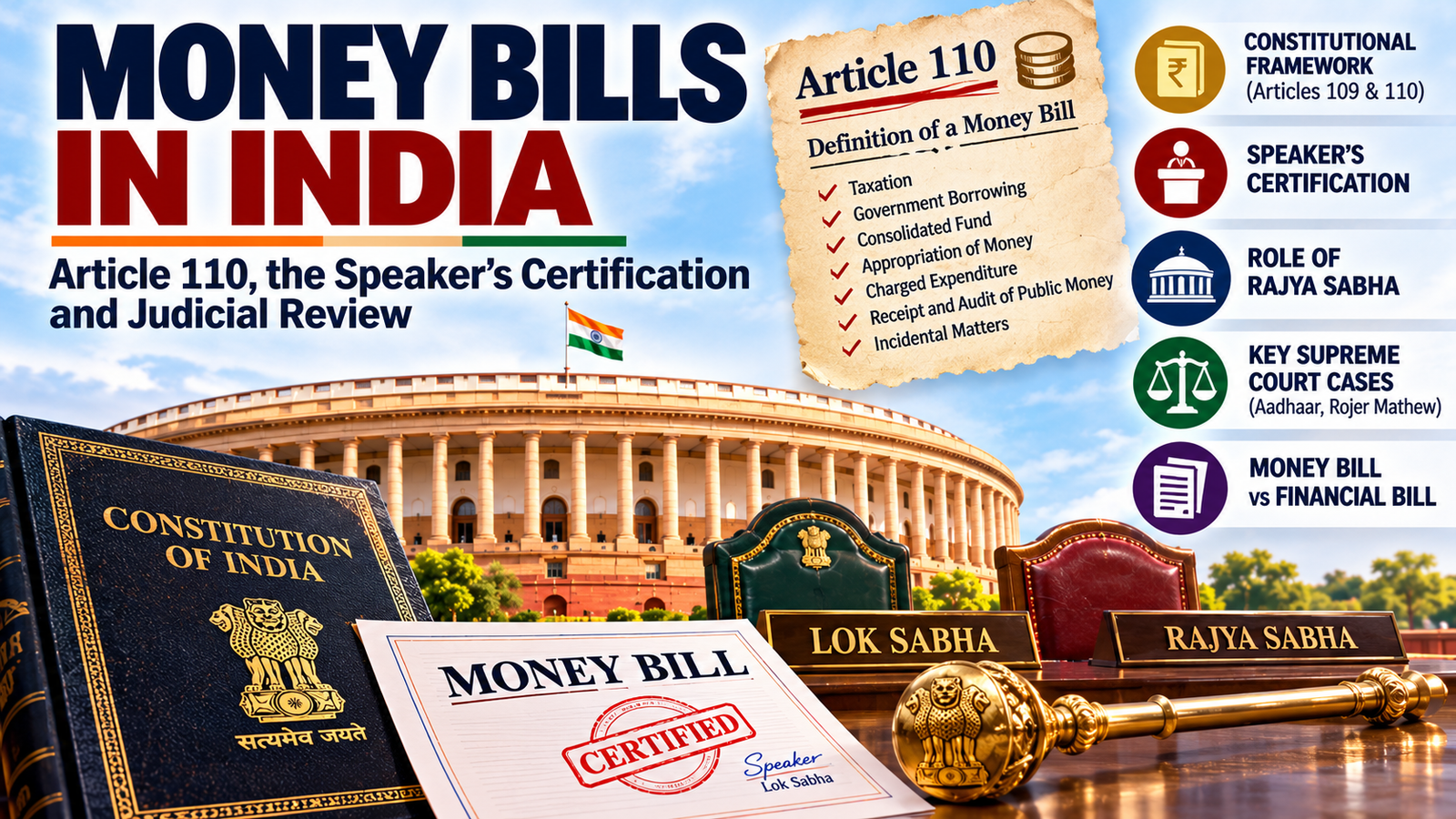
Money Bills in India: Article 110, the Speaker’s Certification and Judicial Review
Samata IAS Academy | Issues & Analysis | UPSC GS Paper II
Introduction
The classification of a Bill as a Money Bill is one of the most consequential decisions in India’s parliamentary system. It determines whether the Rajya Sabha can participate in the legislative process on equal terms or is restricted to making recommendations that the Lok Sabha may accept or reject.
Article 110 of the Constitution defines Money Bills and establishes the constitutional basis for this special procedure. Article 109 governs their passage through Parliament, while Article 110(3) assigns the Speaker of the Lok Sabha the authority to decide whether a Bill qualifies as a Money Bill.
The issue has generated significant constitutional debate because certification as a Money Bill limits the role of the Rajya Sabha, the Council of States. Critics argue that an overly broad interpretation can weaken bicameral scrutiny by allowing legislation with substantial non-financial provisions to bypass the normal legislative process.
The debate resurfaced in 2026 when the Supreme Court (Number of Judges) Amendment Bill, 2026 was passed as a Money Bill, prompting renewed questions about the scope of Article 110 and the use of this legislative route.
For UPSC aspirants, this issue connects constitutional provisions, parliamentary procedure, federalism, judicial review and the balance of power among constitutional institutions.
1. What is a Money Bill?
A Money Bill is a Bill that contains only provisions dealing with the matters specified in Article 110(1) of the Constitution, including certain matters incidental to those subjects.
These matters relate primarily to taxation, government borrowing, public funds, appropriation of money, expenditure charged on the Consolidated Fund of India, government receipts and audit.
The word only is central to the constitutional definition. A Bill does not automatically become a Money Bill merely because it has financial implications or involves government expenditure.
For example, a Bill that authorises the withdrawal of money from the Consolidated Fund for a specified purpose may fall within the Money Bill framework. By contrast, a Bill that establishes a new regulatory institution does not become a Money Bill simply because the institution will require public funding.
The classification must be determined by reference to Article 110, not merely by the presence of a financial clause.
2. Article 110: Constitutional definition of a Money Bill
Article 110(1) identifies the categories of provisions that may be included in a Money Bill.
| Article 110 category | What it covers |
|---|---|
| Article 110(1)(a) | Imposition, abolition, remission, alteration or regulation of a tax |
| Article 110(1)(b) | Regulation of government borrowing or guarantees and related financial obligations |
| Article 110(1)(c) | Custody of the Consolidated Fund or Contingency Fund, and payments into or withdrawals from these funds |
| Article 110(1)(d) | Appropriation of money out of the Consolidated Fund of India |
| Article 110(1)(e) | Declaring expenditure to be charged on the Consolidated Fund or increasing such expenditure |
| Article 110(1)(f) | Receipt, custody, issue or audit of public money, including the relevant accounts |
| Article 110(1)(g) | Any matter incidental to the matters specified in clauses (a) to (f) |
Article 110(2) also clarifies that a Bill is not to be treated as a Money Bill merely because it provides for the imposition of fines or other pecuniary penalties, the demand or payment of fees for licences or services, or the imposition, abolition, remission, alteration or regulation of a tax by a local authority or body for local purposes.
The distinction prevents the Money Bill procedure from being used simply because legislation has some monetary consequences.
The official Lok Sabha FAQ on Money Bills provides the parliamentary explanation of Article 110.
Digital Sansad
3. How does a Money Bill pass through Parliament?
The Constitution creates a special legislative procedure for Money Bills, reflecting the Lok Sabha’s direct electoral mandate and its primary responsibility for financial legislation.
1. Introduction in the Lok Sabha
A Money Bill can be introduced only in the Lok Sabha and requires the President’s recommendation.
2. Passage by the Lok Sabha
The elected House considers and passes the Bill.
3. Transmission to the Rajya Sabha
The Upper House may make recommendations but cannot amend or reject the Bill.
4. Fourteen-day period
The Rajya Sabha must return the Bill within 14 days. The Lok Sabha may accept or reject its recommendations.
5. Deemed passage and presidential assent
If the Rajya Sabha does not return the Bill within 14 days, it is deemed passed by both Houses in the form passed by the Lok Sabha.
This procedure follows Articles 109 and 110. There is no provision for a joint sitting to resolve a disagreement over a Money Bill because the Rajya Sabha does not possess the same amending and rejecting powers that it exercises over ordinary Bills.
4. Money Bill versus Financial Bill
A frequent source of confusion in the UPSC examination is the difference between a Money Bill and a Financial Bill.
All Money Bills are financial in nature, but not all Financial Bills are Money Bills.
| Feature | Money Bill | Financial Bill under Article 117 |
|---|---|---|
| Constitutional basis | Article 110 | Article 117 |
| Scope | Contains only matters specified in Article 110(1), including incidental matters | May contain financial provisions along with other provisions, depending on the category |
| Introduction | Only in the Lok Sabha | Article 117(1) Bills are introduced only in the Lok Sabha; Article 117(3) Bills may be introduced in either House |
| President’s recommendation | Required for introduction | Required in the circumstances specified in Article 117 |
| Rajya Sabha’s powers | May recommend changes but cannot amend or reject the Bill | Has ordinary legislative powers over Article 117(1) Bills; Article 117(3) Bills follow the ordinary legislative procedure, subject to the recommendation requirement for consideration |
| Joint sitting | Not available for a Money Bill | May be available for an Article 117(1) Bill if the constitutional conditions for a joint sitting are met |
Article 117(1) concerns a Bill containing provisions on matters specified in Article 110(1) as well as other matters. Article 117(3) concerns a Bill that, if enacted and brought into operation, would involve expenditure from the Consolidated Fund of India.
The distinction is constitutionally significant. A Bill involving expenditure is not necessarily a Money Bill. The classification depends on its contents and the relevant constitutional provision.
5. Why does the Speaker’s certification matter?
Article 110(3) provides that if a question arises as to whether a Bill is a Money Bill, the decision of the Speaker of the Lok Sabha is final. Article 110(4) requires the Speaker’s certificate to be endorsed on the Bill when it is transmitted to the Rajya Sabha and when it is presented to the President for assent.
The Speaker’s role is important because the certification determines the procedure through which legislation will be considered. If a Bill is certified as a Money Bill, the Rajya Sabha loses the power to amend or reject it.
The constitutional concern is therefore not merely about parliamentary terminology. Certification affects bicameralism, legislative scrutiny and the institutional balance between the two Houses.
Why has certification become controversial?
The controversy arises when a Bill contains significant non-financial provisions but is nevertheless certified as a Money Bill. Critics contend that this can reduce the Rajya Sabha’s role on matters that extend well beyond taxation or appropriation.
Supporters of a broad approach may rely on the incidental-matters clause in Article 110(1)(g), arguing that provisions closely connected to specified financial subjects can be included.
The central interpretive question is how closely additional provisions must relate to the listed financial matters before a Bill can qualify as a Money Bill.
This is why the meaning of Article 110, and the extent of judicial review over the Speaker’s certificate, have become important constitutional questions.
6. Major Supreme Court cases on Money Bills
The constitutional debate has developed through several important judgments.
A. K.S. Puttaswamy (Aadhaar) v. Union of India (2018)
The Aadhaar Act, 2016 was passed as a Money Bill. In the Supreme Court’s Aadhaar judgment, the majority upheld the Act’s certification, while Justice D.Y. Chandrachud dissented on the Money Bill question.
The disagreement exposed a fundamental issue: can legislation containing a wide range of regulatory and institutional provisions be passed through the Money Bill route when the Rajya Sabha’s ordinary legislative powers would otherwise apply?
The case brought Article 110 into the wider debate over parliamentary accountability and constitutional limits.
B. Rojer Mathew v. South Indian Bank Ltd. (2019)
In Rojer Mathew, a five-judge Constitution Bench considered the use of the Money Bill route for provisions concerning tribunal-related matters introduced through the Finance Act, 2017.
The Court referred the interpretation of Article 110 and the issue of Money Bill certification to a larger Bench. The judgment is significant because it recognised that the Speaker’s certification is not necessarily beyond judicial scrutiny simply because Article 110(3) describes the decision as final.
The distinction is between respecting the Speaker’s constitutional role and treating that role as completely immune from constitutional review.
C. The seven-judge Constitution Bench reference
The larger-Bench reference concerns the scope of Article 110 and the standards that should govern the classification of a Bill as a Money Bill. The question has implications for legislation involving public finance, regulatory institutions and the balance between the two Houses.
As of October 2026, the interpretation referred in Rojer Mathew remains an important unresolved constitutional issue, according to available legal reporting. The latest Supreme Court cause lists and judgments should be checked before publication or subsequent updates.
7. The 2026 controversy: the Supreme Court (Number of Judges) Amendment Bill
The Supreme Court (Number of Judges) Amendment Bill, 2026 was passed as a Money Bill, bringing the constitutional classification question back into public debate. The measure concerned an increase in the sanctioned strength of Supreme Court judges.
The issue is not simply whether additional judges are needed. It is whether the provisions of a Bill satisfy the constitutional definition in Article 110 and whether the Money Bill procedure is appropriate for the legislation in question.
The controversy illustrates three broader principles:
- Substance matters: A Bill’s classification must be assessed against its actual provisions, not merely its title or the fact that it has financial consequences.
- Bicameral scrutiny matters: The Rajya Sabha’s reduced role under Articles 109 and 110 makes correct classification especially important.
- Constitutional interpretation matters: The final scope of Article 110 and the permissible limits of judicial review must be understood in light of Supreme Court decisions.
The passage of a Bill as a Money Bill does not, by itself, establish that its certification is constitutionally correct or incorrect. That assessment depends on the constitutional provisions, the contents of the legislation and the applicable judicial framework.
8. Why is the Money Bill procedure important for federalism?
The Rajya Sabha is designed to represent the States at the Union level. Although its members are elected by elected members of State Legislative Assemblies under the constitutional framework, the House is a permanent chamber that provides continuity and a second stage of legislative scrutiny.
The Money Bill procedure limits the Rajya Sabha’s role in matters classified under Article 110. If the category is interpreted too broadly, legislation with significant implications for States, public institutions or governance may receive less scrutiny from the chamber that represents the States.
This is particularly important when legislation affects the distribution of public resources or the institutional framework of the Union. The debate therefore connects with the wider constitutional issues discussed in Samata IAS Academy’s article on fiscal federalism in India.
A sound interpretation must preserve the special role of the Lok Sabha in financial matters without undermining the constitutional purpose of bicameral Parliament.
9. Arguments for and against a broad interpretation of Article 110
| Arguments supporting flexibility | Arguments favouring a narrow interpretation |
|---|---|
| Financial legislation may require related administrative provisions to operate effectively. | Article 110 uses a restrictive list and the word “only.” |
| The Lok Sabha has a direct electoral mandate and primary responsibility for financial matters. | The Rajya Sabha is a constitutionally important chamber, not merely an advisory body. |
| A workable incidental-matters clause can avoid fragmenting closely connected legislation. | A broad interpretation could allow non-financial provisions to bypass ordinary bicameral scrutiny. |
| Speaker certification provides a defined parliamentary mechanism for classification. | The constitutional significance of certification warrants meaningful safeguards and judicial scrutiny. |
The objective should not be to prevent all flexibility in drafting financial legislation. It should be to ensure that flexibility does not become a means of avoiding the ordinary legislative process.
10. Reforms and the way forward
A balanced approach should preserve the Lok Sabha’s special position on financial legislation while protecting the constitutional role of the Rajya Sabha.
First, clarify the legal standard. The interpretation of Article 110 should clearly explain how the listed subjects and the incidental-matters clause relate to the requirement that a Money Bill contain only qualifying provisions.
Second, strengthen the reasoning behind certification. A concise explanation of why a Bill satisfies Article 110 could improve transparency and public understanding, while respecting the Speaker’s constitutional office.
Third, preserve bicameral scrutiny. The Money Bill route should be used for legislation that genuinely meets the constitutional definition, not merely because a Bill has financial implications or requires public expenditure.
Fourth, respect constitutional review. Courts should apply the governing legal standard and respect the separation of powers. At the same time, the constitutional allocation of legislative authority cannot be treated as irrelevant when certification is challenged.
Fifth, improve parliamentary scrutiny. Parliamentary committees, legislative research and reasoned debate can help identify whether a Bill contains provisions that belong in a Money Bill or should be considered through the ordinary legislative procedure.
Sixth, distinguish financial urgency from legislative classification. The need to enact a measure quickly does not automatically make it a Money Bill. The appropriate constitutional route should be determined by the Bill’s contents and the applicable rules.
The goal is to ensure that financial legislation can be enacted effectively without weakening the broader principles of representative government and bicameralism.
Conclusion
The Money Bill procedure reflects a deliberate constitutional balance: the Lok Sabha has primacy in specified financial matters, while the Rajya Sabha retains a significant role in ordinary legislation and in representing the States.
Article 110 is therefore not merely a technical definition. It determines the legislative route available to a Bill and influences the balance of power between the two Houses.
The controversy surrounding Money Bill certification highlights the importance of constitutional restraint, transparent reasoning and meaningful parliamentary scrutiny. A narrow and principled application of Article 110 can preserve the efficiency of financial legislation while preventing the exceptional procedure from weakening the constitutional role of the Rajya Sabha.
The guiding principle should be clear: the Money Bill procedure must serve its specific constitutional purpose, not become a substitute for the ordinary legislative process.
Prelims quick revision
| Question area | Key fact |
|---|---|
| Article 109 | Special procedure for Money Bills |
| Article 110 | Definition of a Money Bill |
| Article 110(3) | Speaker’s decision on classification is stated to be final |
| Article 110(4) | Speaker’s certificate accompanies the Bill when transmitted to the Rajya Sabha and presented to the President |
| Article 117 | Special provisions concerning Financial Bills |
| Rajya Sabha | Can recommend changes to a Money Bill but cannot amend or reject it |
| Time limit | 14 days for the Rajya Sabha to return a Money Bill |
| Joint sitting | Not available for Money Bills |
| K.S. Puttaswamy (Aadhaar) (2018) | Major case involving Money Bill certification |
| Rojer Mathew (2019) | Referred the interpretation of Article 110 to a larger Bench |
UPSC Mains practice questions
- GS Paper II: Explain the constitutional distinction between a Money Bill and a Financial Bill. Why is this distinction important for bicameralism?
- Critically examine the Speaker’s role in certifying Money Bills under Article 110.
- “The classification of a Bill as a Money Bill affects the federal character of Parliament.” Discuss.
- Examine the significance of Rojer Mathew v. South Indian Bank Ltd. for the relationship between parliamentary privilege and judicial review.
- How can India preserve the Lok Sabha’s primacy in financial matters without weakening the legislative role of the Rajya Sabha?
Authoritative sources
- Lok Sabha Secretariat — FAQ on Money Bills
- Constitution of India — Legislative Department
- Supreme Court of India — Rojer Mathew judgment
- Supreme Court of India — Aadhaar judgment
- PRS Legislative Research