
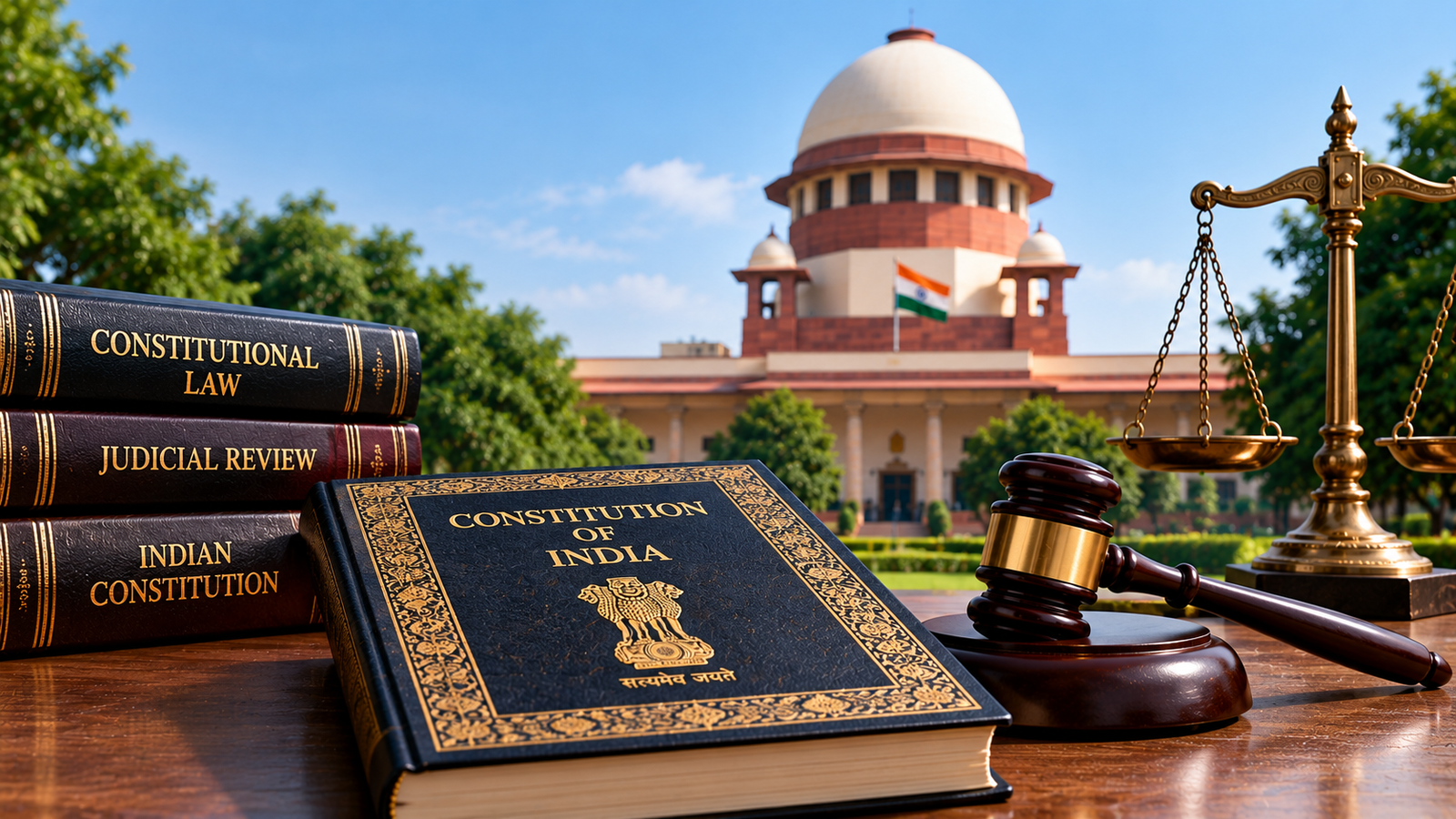
Judicial review is one of the most important features of the Indian constitutional system. It empowers the judiciary to examine whether legislative enactments, executive actions and, within established constitutional limits, constitutional amendments comply with the Constitution. By enforcing constitutional limitations on public power, judicial review helps protect Fundamental Rights, maintain the rule of law and preserve the supremacy of the Constitution.
The power of judicial review is exercised primarily by the Supreme Court of India and the High Courts. Articles 13, 32, 226 and other constitutional provisions provide important foundations for this power. Over the years, landmark judgments such as Kesavananda Bharati v. State of Kerala, Minerva Mills v. Union of India and L. Chandra Kumar v. Union of India have clarified its scope and constitutional significance.
For UPSC Civil Services Examination aspirants, judicial review is an important topic under Indian Polity and Governance, particularly General Studies Paper II. It is closely connected with Fundamental Rights, the Basic Structure Doctrine, separation of powers, judicial activism and the relationship between the legislature, executive and judiciary.
1. What Is Judicial Review?
Judicial review is the power of constitutional courts to examine the legality and constitutionality of governmental action.
Through judicial review, courts can determine whether a law or executive action violates constitutional provisions, exceeds the authority of the institution that adopted it or infringes legally protected rights.
For example, if a law enacted by a legislature violates a Fundamental Right or exceeds its legislative competence, an affected person may challenge it before a competent court. If the court finds the law unconstitutional, it may declare the relevant provision invalid, subject to the applicable legal principles.
Judicial review may concern:
- Legislative action: Whether a law enacted by Parliament or a state legislature complies with the Constitution.
- Executive action: Whether administrative decisions, government orders and executive measures are legally and constitutionally valid.
- Constitutional amendments: Whether an amendment violates the Constitution’s basic structure.
- Administrative and quasi-judicial decisions: Whether public authorities have acted within their legal powers and followed the applicable principles of law.
Judicial review does not mean that courts can replace every policy decision of the government with their own preferences. Its central purpose is to ensure that public authorities exercise power within constitutional and legal limits.
2. Constitutional Basis of Judicial Review in India
The Indian Constitution does not place the entire power of judicial review in a single article. Instead, several provisions collectively establish the constitutional framework for reviewing governmental action.
2.1 Article 13: Laws Inconsistent with Fundamental Rights
Article 13 provides an important foundation for judicial review by addressing laws inconsistent with Fundamental Rights.
Article 13(1) concerns laws in force before the commencement of the Constitution, to the extent that they are inconsistent with the provisions of Part III.
Article 13(2) prohibits the state from making laws that take away or abridge the Fundamental Rights conferred by Part III. Laws made in contravention of this prohibition are void to the extent of the contravention.
The provision enables constitutional courts to examine whether legislation violates Fundamental Rights.
However, Article 13 should not be understood as the only source of judicial review. Constitutional courts also examine questions of legislative competence, constitutional procedure and other constitutional limitations under relevant provisions and judicial doctrines.
2.2 Article 32: Constitutional Remedies
Article 32 guarantees the right to move the Supreme Court for the enforcement of Fundamental Rights.
The Supreme Court may issue directions, orders or writs, including habeas corpus, mandamus, prohibition, quo warranto and certiorari, as appropriate for enforcing these rights.
Dr. B.R. Ambedkar famously described Article 32 as the Constitution’s “heart and soul” during the Constituent Assembly debates.
Article 32 is particularly significant because it makes the Supreme Court directly accessible for the enforcement of Fundamental Rights, subject to the constitutional requirements governing the remedy.
2.3 Article 226: Powers of High Courts
Article 226 empowers High Courts to issue directions, orders and writs for the enforcement of Fundamental Rights and for any other purpose.
This broader wording means that the writ jurisdiction of High Courts extends beyond Fundamental Rights to other legally enforceable rights, subject to the applicable principles governing the exercise of writ jurisdiction.
The Supreme Court’s jurisdiction under Article 32 is specifically directed towards the enforcement of Fundamental Rights, whereas High Courts can exercise writ jurisdiction for a wider range of legal purposes.
Article 226 is therefore a major instrument for controlling unlawful administrative action and protecting constitutional and legal rights at the state level.
2.4 Article 227: Superintendence over Subordinate Courts and Tribunals
Article 227 gives High Courts the power of superintendence over courts and tribunals within their territorial jurisdiction, subject to constitutional exceptions.
This provision supports judicial supervision of subordinate judicial institutions. Its scope and application differ from the writ jurisdiction under Article 226, although both contribute to the constitutional oversight exercised by High Courts.
2.5 Articles 245 and 246: Legislative Competence
Articles 245 and 246 define important aspects of the territorial and subject-matter distribution of legislative powers between Parliament and state legislatures. The Seventh Schedule specifies the Union List, State List and Concurrent List.
If a legislature enacts a law outside its constitutionally assigned legislative competence, the law may be challenged before the courts.
Judicial review therefore protects not only Fundamental Rights but also the constitutional distribution of legislative authority.
2.6 Article 368 and the Basic Structure Doctrine
Article 368 provides the constitutional procedure for amending the Constitution. The Supreme Court has held that Parliament cannot use this power to destroy or damage the Constitution’s basic structure.
This limitation emerged from the landmark Kesavananda Bharati judgment of 1973.
For a detailed explanation of this doctrine, read our article on the Basic Structure Doctrine.
Note: Confirm the internal link against the published article URL before publishing.
3. Why Is Judicial Review Necessary?
Judicial review serves several important constitutional purposes.
3.1 Protection of Fundamental Rights
It provides a mechanism through which individuals can challenge laws and government actions that violate constitutionally guaranteed rights.
Without effective judicial remedies, constitutional rights could become difficult to enforce against the state.
3.2 Maintenance of Constitutional Supremacy
In India, all organs of government derive their authority from the Constitution. Judicial review ensures that the legislature and executive operate within the powers granted to them.
3.3 Prevention of Arbitrary Exercise of Power
Judicial review can restrain arbitrary, unlawful or unconstitutional governmental action. It reinforces the principle that public power must be exercised according to law.
3.4 Protection of Federalism
The Constitution distributes legislative and executive responsibilities between the Union and the states. Judicial review helps resolve disputes involving constitutional powers and prevents one level of government from exceeding its authority.
3.5 Preservation of the Rule of Law
The rule of law requires government institutions to act under established legal rules rather than arbitrary discretion. Judicial review provides an important means of enforcing this principle.
3.6 Accountability of Public Institutions
Judicial review creates a mechanism through which public authorities may be required to justify their actions under the Constitution and applicable law. It strengthens institutional accountability without transferring the ordinary functions of the legislature or executive to the judiciary.
4. Landmark Judgments on Judicial Review in India
The scope of judicial review has developed through constitutional interpretation and landmark Supreme Court decisions.
4.1 Shankari Prasad v. Union of India (1951)
In Shankari Prasad v. Union of India, the Supreme Court upheld the First Constitutional Amendment and held that a constitutional amendment under Article 368 was not “law” within the meaning of Article 13.
The decision supported a broad interpretation of Parliament’s power to amend Fundamental Rights.
The case formed an early stage in the constitutional debate over the extent of Parliament’s amending power and the role of judicial review.
4.2 I.C. Golaknath v. State of Punjab (1967)
In I.C. Golaknath v. State of Punjab, the Supreme Court held by a narrow majority that Parliament could not amend Fundamental Rights.
The judgment adopted a restrictive interpretation of Parliament’s amending power. Parliament subsequently enacted the Twenty-fourth Constitutional Amendment to reaffirm its authority to amend constitutional provisions, including Fundamental Rights.
The dispute ultimately led to the landmark Kesavananda Bharati case, which established the Basic Structure Doctrine.
4.3 Kesavananda Bharati v. State of Kerala (1973)
In Kesavananda Bharati v. State of Kerala, a thirteen-judge bench of the Supreme Court held by a 7:6 majority that Parliament could amend any part of the Constitution but could not damage or destroy its basic structure.
The judgment established a substantive constitutional limitation on Parliament’s amending power.
Judicial review of constitutional amendments became central to enforcing this limitation. The Court’s decision remains a defining moment in the development of Indian constitutional law.
4.4 Indira Nehru Gandhi v. Raj Narain (1975)
This case arose from a dispute concerning the election of Prime Minister Indira Gandhi.
The Supreme Court invalidated a constitutional provision that sought to place the Prime Minister’s election beyond ordinary judicial scrutiny. The judgment reinforced the importance of democracy, free and fair elections, the rule of law and judicial review.
It demonstrated that Parliament could not use constitutional amendments to undermine essential democratic principles.
4.5 Minerva Mills v. Union of India (1980)
In Minerva Mills v. Union of India, the Supreme Court examined provisions introduced by the Forty-second Constitutional Amendment.
The Court invalidated provisions that attempted to make Parliament’s amending power unlimited and to exclude constitutional amendments from judicial review.
The judgment affirmed that limited amending power and judicial review form part of the Constitution’s basic structure.
It also emphasised the need to maintain harmony between Fundamental Rights and Directive Principles of State Policy.
4.6 L. Chandra Kumar v. Union of India (1997)
The L. Chandra Kumar judgment is a landmark decision concerning judicial review and administrative tribunals.
The Supreme Court held that the power of judicial review vested in High Courts under Articles 226 and 227, and in the Supreme Court under Article 32, forms part of the Constitution’s basic structure.
The Court also held that decisions of tribunals established under relevant constitutional provisions remain subject to scrutiny by the appropriate High Courts.
The judgment clarified that tribunals can perform important adjudicatory functions but cannot completely replace the constitutional role of the higher judiciary.
4.7 I.R. Coelho v. State of Tamil Nadu (2007)
In I.R. Coelho v. State of Tamil Nadu, the Supreme Court examined the constitutional protection available to laws placed in the Ninth Schedule.
The Court held that laws inserted into the Ninth Schedule after 24 April 1973 could be subjected to judicial review if their provisions or impact damaged the Constitution’s basic structure.
The judgment confirmed that constitutional devices cannot automatically immunise legislation from scrutiny when fundamental constitutional principles are threatened.
5. Judicial Review of Constitutional Amendments
Judicial review in India extends to constitutional amendments, but the applicable test differs from the ordinary review of legislation.
In the case of an ordinary law, courts may examine issues such as legislative competence, violation of Fundamental Rights and inconsistency with other constitutional requirements.
In the case of a constitutional amendment, the Supreme Court examines whether the amendment complies with the requirements of Article 368 and whether it damages or destroys the Constitution’s basic structure.
The distinction is important because Parliament has a specific constitutional authority to amend the Constitution. The judiciary does not invalidate an amendment merely because it disagrees with the policy underlying it.
The Basic Structure Doctrine places a substantive limitation on the exercise of the amending power.
For example, an amendment that seeks to eliminate the essential independence of the judiciary or abolish judicial review may raise serious basic-structure concerns.
The doctrine therefore protects the constitutional framework while permitting Parliament to make legitimate constitutional changes.
6. Judicial Review and Separation of Powers
The doctrine of separation of powers refers to the distribution of governmental functions among the legislature, executive and judiciary.
India does not follow a completely rigid separation of powers. Instead, the Constitution establishes a system of functional separation, checks and balances, and institutional accountability.
The legislature makes laws, the executive implements them, and the judiciary interprets the law and adjudicates disputes.
Judicial review operates as a constitutional check on legislative and executive power. However, it does not give courts a general mandate to assume the policy-making responsibilities of elected governments.
A constitutional balance requires each institution to respect the legitimate functions of the others.
The judiciary must enforce constitutional limits, while Parliament and the executive must exercise their powers within those limits.
7. Judicial Review, Judicial Activism and Judicial Restraint
These three concepts are related but distinct. Understanding their differences is important for UPSC examinations.
| Concept | Meaning | Main purpose |
|---|---|---|
| Judicial review | Examination of the constitutionality or legality of governmental action | Enforce constitutional and legal limits |
| Judicial activism | An approach involving proactive judicial interpretation or intervention, often to protect rights or address legal failures | Provide effective remedies where legally justified |
| Judicial restraint | A cautious approach that respects institutional boundaries and avoids unnecessary interference with decisions entrusted to other branches | Preserve institutional balance and democratic accountability |
Judicial review is a constitutional power and function. Judicial activism and judicial restraint describe approaches to the exercise of judicial authority.
A court can exercise judicial review while adopting either a restrained or a more interventionist approach, depending on the case.
For instance, a court may invalidate an unconstitutional law through judicial review without prescribing a detailed alternative public policy. In another case, it may issue directions to ensure compliance with constitutional or statutory obligations.
The key question is whether judicial intervention is supported by the Constitution, the law and the facts of the case.
8. Limitations and Criticisms of Judicial Review
Although judicial review is essential to constitutional governance, it also raises important institutional concerns.
8.1 Concerns About Judicial Overreach
Critics argue that courts may sometimes enter areas of policy-making that are primarily entrusted to elected institutions.
The concern is particularly significant when judicial orders require detailed administrative or policy choices without sufficient regard for implementation constraints.
8.2 Democratic Accountability
Judges are not elected through the same process as legislators. Some critics therefore question the democratic legitimacy of courts invalidating legislation enacted by elected representatives.
The constitutional response is that elected institutions must also operate within the limits established by the Constitution.
8.3 Delays in Judicial Proceedings
Lengthy litigation and delays in the disposal of cases can weaken the practical effectiveness of judicial review. A legal remedy may lose some of its value if it arrives too late to prevent serious harm.
8.4 Institutional Capacity
Courts may not always possess the technical expertise or administrative resources necessary to design and implement complex public policies.
This makes it important for courts to distinguish between enforcing constitutional requirements and taking over routine executive functions.
8.5 Need for Consistency and Clear Reasoning
Constitutional review requires careful reasoning, transparent interpretation and consistent application of legal principles. Clear judgments help public institutions understand their obligations and improve predictability in constitutional governance.
These concerns do not negate the importance of judicial review. They highlight the need for principled adjudication and respect for constitutional boundaries.
9. Strengthening Judicial Review in India
The effectiveness of judicial review depends on more than the formal existence of constitutional powers. It also requires an accessible, independent and efficient judicial system.
Several measures can strengthen this framework:
- Improve access to justice: Reduce procedural barriers and improve access to legal assistance for disadvantaged groups.
- Address judicial delays: Strengthen judicial capacity and improve case management to ensure timely constitutional remedies.
- Maintain judicial independence: Protect the judiciary’s ability to decide cases without improper external influence.
- Improve the quality of constitutional reasoning: Ensure that judgments clearly identify the relevant constitutional provisions, legal tests and reasons for the final decision.
- Respect institutional boundaries: Courts should enforce constitutional limits while recognising the legitimate roles of the legislature and executive.
- Promote constitutional awareness: Greater public understanding of Fundamental Rights and constitutional remedies can help citizens use legal institutions effectively.
The objective should be to make judicial review both effective and consistent with the constitutional distribution of powers.
Conclusion
Judicial review is a fundamental mechanism through which India’s constitutional system protects the supremacy of the Constitution, enforces Fundamental Rights and maintains accountability in public institutions.
Its constitutional foundations are spread across several provisions, including Articles 13, 32 and 226. Landmark judgments such as Kesavananda Bharati, Minerva Mills and L. Chandra Kumar have clarified its role in protecting the basic structure and maintaining constitutional limits on public power.
At the same time, judicial review must operate within a framework of institutional balance. Courts must be capable of invalidating unconstitutional action while respecting the legitimate responsibilities of Parliament and the executive.
For India, the central challenge is not to choose between judicial authority and democratic governance, but to ensure that both function within the Constitution. Judicial review is most effective when it protects constitutional principles, provides meaningful remedies and reinforces the rule of law.
UPSC Examination Relevance
Important Prelims facts
- Article 13: Laws inconsistent with or in derogation of Fundamental Rights.
- Article 32: Supreme Court remedies for enforcement of Fundamental Rights.
- Article 226: High Court writ jurisdiction for Fundamental Rights and other legal purposes.
- Article 227: High Court superintendence over subordinate courts and tribunals, subject to constitutional exceptions.
- Kesavananda Bharati (1973): Established the Basic Structure Doctrine.
- Minerva Mills (1980): Reaffirmed limited amending power and judicial review as basic-structure principles.
- L. Chandra Kumar (1997): Affirmed the constitutional importance of judicial review by the higher judiciary.
UPSC Mains practice question — GS Paper II
“Judicial review is essential for protecting constitutional supremacy, but its exercise must respect the separation of powers and institutional boundaries.” Discuss with reference to landmark Supreme Court judgments. (15 marks, 250 words)