
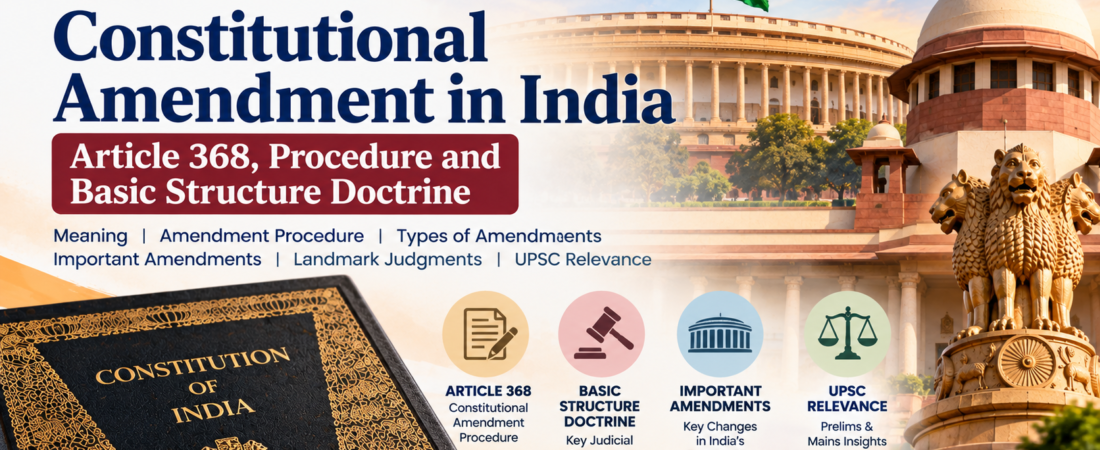
Introduction
A Constitution must provide both stability and adaptability. Stability protects the fundamental principles of the political system, while adaptability allows constitutional institutions to respond to changing social, economic, political and technological conditions.
The Constitution of India seeks to achieve this balance through a combination of constitutional supremacy, parliamentary democracy, judicial review and a carefully designed amendment procedure.
The power to amend the Constitution is principally governed by Article 368, contained in Part XX. However, not every constitutional change follows the same procedure. Some provisions can be amended by a simple majority of Parliament, others require a special majority, and certain federal provisions additionally require ratification by at least half of the State Legislatures.
The Supreme Court has also established that Parliament’s power to amend the Constitution is not unlimited. Under the Basic Structure Doctrine, Parliament cannot use its amending power to destroy or damage the Constitution’s basic structure.
This doctrine, established in Kesavananda Bharati v. State of Kerala (1973), represents one of the most important developments in Indian constitutional law. It seeks to preserve the Constitution’s fundamental identity while permitting necessary constitutional change.
India
+1
For UPSC aspirants, this topic is important for Prelims questions concerning amendment procedures and constitutional provisions, as well as Mains GS Paper II questions on Parliament, judicial review, federalism, constitutional supremacy and the separation of powers.
1. Meaning and need for constitutional amendments
A constitutional amendment is a formal change to the text or legal operation of a Constitution through the procedure prescribed by that Constitution.
Amendments may add new provisions, modify existing Articles, delete provisions or alter constitutional arrangements.
The Indian Constitution is neither entirely rigid nor entirely flexible. Its amendment procedures vary according to the nature and significance of the provision being changed.
Why does a Constitution require amendments?
1. Changing social conditions
Constitutional provisions may require adaptation to changing social relations, demographic patterns and expectations concerning equality, justice and welfare.
2. Economic transformation
Changes in economic organisation, taxation, public finance and welfare policy may require constitutional adjustments.
3. Institutional reform
Amendments may be necessary to reorganise constitutional institutions, improve governance or modify the distribution of powers.
4. Strengthening democracy
Constitutional amendments can introduce electoral reforms, improve political representation and establish additional safeguards for democratic participation.
5. Responding to judicial interpretation
Judicial decisions may clarify the meaning of constitutional provisions and lead Parliament to consider amendments, provided the proposed changes comply with constitutional limitations.
6. Adapting federal arrangements
Changes in the distribution of legislative powers, representation of States or other federal arrangements may require constitutional amendments.
The need to balance flexibility and rigidity
An excessively rigid Constitution may become difficult to adapt to changing circumstances. Conversely, an excessively flexible Constitution may permit a temporary parliamentary majority to alter fundamental constitutional safeguards too easily.
India’s amendment framework seeks to avoid both extremes.
2. Constitutional basis: Article 368
Article 368 is located in Part XX of the Constitution, titled Amendment of the Constitution.
It establishes Parliament’s constituent power to amend the Constitution and prescribes the principal procedure for exercising that power.
Article 368 must be read alongside other constitutional provisions because some changes to constitutional arrangements are expressly excluded from the procedure under Article 368(2) and are made through ordinary legislative processes, sometimes by a simple majority.
Article 368(1): Power to amend
Article 368(1) provides that Parliament may, in exercise of its constituent power, amend the Constitution by way of addition, variation or repeal of any provision, in accordance with the procedure laid down in the Article.
However, this power is subject to the Basic Structure Doctrine developed by the Supreme Court.
Article 368(2): Procedure
A constitutional amendment Bill may be introduced in either House of Parliament.
It must be passed in each House separately by:
- A majority of the total membership of that House; and
- A majority of not less than two-thirds of the members of that House present and voting.
Where the amendment seeks to make changes to specified federal provisions, it must also be ratified by the Legislatures of not less than one-half of the States before being presented to the President.
After the Bill is duly passed and, where necessary, ratified, it is presented to the President, who is required to give assent. The Constitution then stands amended in accordance with the terms of the amendment.
Important constitutional distinction
The Constitution does not require every constitutional amendment to follow the same procedure. For example, changes to certain matters listed in Article 368(2) require State ratification, whereas other amendments under Article 368 require only the prescribed special majority in Parliament.
Some changes are made outside Article 368 altogether.
This distinction is central to understanding the amendment process.
3. Three methods of amending the Indian Constitution
For UPSC preparation, constitutional changes are conventionally classified into three categories.
Method 1: Simple majority of Parliament
Ordinary legislative procedure for specified constitutional matters.
Examples include the formation of new States and alteration of State boundaries under Articles 2, 3 and 4, and certain matters concerning State Legislative Councils under Article 169.
Method 2: Special majority of Parliament
Article 368 procedure without State ratification.
Most amendments under Article 368 fall into this category.
Method 3: Special majority plus State ratification
For specified provisions affecting federal arrangements.
These amendments require the prescribed parliamentary majority and ratification by at least half of the State Legislatures.
This is a useful examination classification, but students should remember that the first category consists of specified constitutional changes that do not follow Article 368’s special-majority procedure.
3.1 Constitutional changes by simple majority
A simple majority generally means more members voting in favour than against, among those present and voting, subject to the applicable procedural rules.
Certain constitutional changes are expressly excluded from the Article 368 procedure.
Examples include:
- Admission or establishment of new States under Article 2.
- Formation of new States and alteration of areas, boundaries or names of existing States under Article 3.
- Matters specified in Article 4 in connection with laws under Articles 2 and 3.
- Creation or abolition of State Legislative Councils under Article 169, subject to its prescribed legislative requirements.
- Certain matters concerning citizenship, parliamentary privileges and other constitutional arrangements where the Constitution provides for ordinary legislation rather than amendment under Article 368.
These examples should not be treated as an exhaustive list of every constitutional change made through ordinary legislation.
UPSC point: A law made under Articles 2 and 3 may make supplemental, incidental and consequential changes to the First and Fourth Schedules. Article 4 expressly states that such a law is not to be deemed an amendment of the Constitution for the purposes of Article 368.
3.2 Amendments by special majority of Parliament
Most constitutional amendments require a special majority in each House of Parliament under Article 368(2).
The Bill must obtain both:
- A majority of the total membership of the House; and
- A majority of at least two-thirds of members present and voting.
These are cumulative requirements. Satisfying only one is insufficient.
Illustration: Suppose a House has a total membership of 500. If 300 members are present and voting, at least 251 votes are required to satisfy the majority of the total membership, while at least 200 affirmative votes are required to satisfy the two-thirds requirement among members present and voting. The Bill must meet both requirements.
If 400 members are present and voting, at least 267 affirmative votes would be required to meet the two-thirds condition, assuming the stated numbers and rounding to a whole member.
3.3 Amendments requiring State ratification
Certain constitutional amendments affect the federal relationship between the Union and the States. Article 368(2) therefore requires ratification by the Legislatures of not less than one-half of the States.
The amendment must first satisfy the prescribed parliamentary majority. State ratification is an additional constitutional requirement, not a substitute for parliamentary approval.
Ratification is required for amendments seeking to make changes to specified provisions concerning:
- The election of the President under Articles 54 and 55.
- The extent of the executive power of the Union and the States under Articles 73 and 162.
- The Supreme Court and High Courts under Chapter IV of Part V and Chapter V of Part VI.
- The distribution of legislative powers between the Union and the States under Chapter I of Part XI.
- The representation of States in Parliament.
- The amendment provisions of Article 368 itself.
The requirement applies to the specific provisions identified in Article 368(2), not to every constitutional amendment that may have an indirect effect on federalism.
For example, an amendment changing the constitutional distribution of legislative powers would ordinarily require State ratification, while an amendment concerning another subject would not require ratification merely because it has implications for State policy.
4. Step-by-step procedure for a constitutional amendment
The amendment procedure is designed to ensure that constitutional changes receive a higher level of parliamentary agreement than ordinary legislation.
1
Introduction
An amendment Bill may be introduced in either House of Parliament.
2
Parliamentary approval
Each House separately passes the Bill by the required special majority.
3
State ratification, if required
At least half of the State Legislatures ratify amendments concerning the specified federal provisions.
4
Presidential assent
The Bill is presented to the President, who must give assent once the constitutional requirements are fulfilled.
5
Constitution amended
The amendment becomes part of the Constitution according to its terms.
Important procedural features
No joint sitting: If the two Houses disagree on an amendment Bill, there is no provision for a joint sitting to resolve the deadlock. The Bill must satisfy the required majority independently in both Houses.
Introduction in either House: An amendment Bill may originate in either the Lok Sabha or the Rajya Sabha.
No prior presidential recommendation: Article 368 does not require the President’s prior recommendation for introducing a constitutional amendment Bill.
State ratification: Where Article 368(2) requires State ratification, the amendment cannot be completed without the required number of State Legislatures approving it.
Presidential assent: Article 368 requires the President to give assent to a duly passed amendment Bill.
No referendum requirement: The Constitution does not prescribe a nationwide referendum as part of the Article 368 amendment procedure.
5. Can Parliament amend any part of the Constitution?
This question lies at the heart of the development of Indian constitutional law.
The Supreme Court’s interpretation of Parliament’s amending power has evolved through several landmark judgments.
5.1 Shankari Prasad v. Union of India (1951)
The Supreme Court upheld the First Constitutional Amendment and held that the constitutional amendment power could be exercised to amend Fundamental Rights.
The Court distinguished a constitutional amendment made through the constituent power from an ordinary law within the meaning of Article 13.
This judgment supported a broad interpretation of Parliament’s amending power.
5.2 Sajjan Singh v. State of Rajasthan (1965)
The Supreme Court reaffirmed the position that Parliament could amend Fundamental Rights through the constitutional amendment procedure.
However, the case also exposed judicial concerns about whether the power to amend the Constitution should be treated as unlimited.
These concerns became more prominent in subsequent litigation.
5.3 I.C. Golak Nath v. State of Punjab (1967)
In this case, the Supreme Court held that Parliament could not amend Fundamental Rights in a manner that abridged or took away those rights, treating constitutional amendments as falling within Article 13 for this purpose.
The judgment restricted Parliament’s amending power as understood at that time.
Parliament responded with constitutional amendments, including the 24th Amendment Act, 1971, which expressly addressed Parliament’s power to amend constitutional provisions.
The position was reconsidered by the Supreme Court in Kesavananda Bharati.
5.4 Kesavananda Bharati v. State of Kerala (1973)

Image placement: Insert after the introduction to the Basic Structure Doctrine.
The Supreme Court delivered its judgment on 24 April 1973 through a 13-judge Bench, by a 7–6 majority. It held that Parliament could amend any part of the Constitution, including Fundamental Rights, but could not alter or destroy its basic structure.
Home
+1
The judgment is significant for three reasons:
- It recognised Parliament’s broad power to amend the Constitution.
- It rejected the idea that this power was unlimited.
- It established the Basic Structure Doctrine as a constitutional limitation on the amending power.
The doctrine does not provide a closed, exhaustive list of basic features. Their identification depends on constitutional principles and judicial interpretation in the case before the Court.
5.5 Indira Nehru Gandhi v. Raj Narain (1975)
The Supreme Court examined a constitutional amendment that attempted to place the election of the Prime Minister beyond ordinary judicial scrutiny in the circumstances specified by the amendment.
The Court invalidated the challenged provision and reaffirmed the importance of basic constitutional features, including democratic principles and free and fair elections.
The case demonstrated that the Basic Structure Doctrine was not confined to disputes involving property rights or land reform.
5.6 Minerva Mills v. Union of India (1980)
In Minerva Mills, the Supreme Court examined provisions inserted by the 42nd Constitutional Amendment Act, 1976.
The Court struck down clauses (4) and (5) of Article 368, which sought to exclude judicial review of constitutional amendments and declare Parliament’s amending power unlimited.
The judgment reaffirmed that limited amending power and judicial review are essential features of the Constitution. It also emphasised the importance of harmony between Fundamental Rights and Directive Principles.
Indian Kanoon
+1
5.7 I.R. Coelho v. State of Tamil Nadu (2007)
The Supreme Court examined the relationship between the Ninth Schedule and the Basic Structure Doctrine.
It held that laws inserted into the Ninth Schedule after 24 April 1973 could be subject to judicial review where the constitutional amendment protecting them damaged or destroyed basic features of the Constitution.
The judgment demonstrated that Parliament could not avoid constitutional limitations simply by placing legislation within the Ninth Schedule.
Summary of landmark judgments
| Case | Year | Major significance |
|---|---|---|
| Shankari Prasad v. Union of India | 1951 | Upheld Parliament’s power to amend Fundamental Rights. |
| Sajjan Singh v. State of Rajasthan | 1965 | Reaffirmed the broad amendment power while constitutional concerns emerged. |
| I.C. Golak Nath v. State of Punjab | 1967 | Restricted Parliament’s power to amend Fundamental Rights; later overruled on this point. |
| Kesavananda Bharati v. State of Kerala | 1973 | Established the Basic Structure Doctrine. |
| Indira Nehru Gandhi v. Raj Narain | 1975 | Applied basic-structure limitations in the context of elections and democracy. |
| Minerva Mills v. Union of India | 1980 | Reaffirmed limited amending power, judicial review and harmony between Parts III and IV. |
| I.R. Coelho v. State of Tamil Nadu | 2007 | Clarified judicial review of Ninth Schedule laws inserted after the Kesavananda judgment. |
For the original Kesavananda Bharati judgment, consult the Supreme Court of India judgment repository.
6. The Basic Structure Doctrine
The Basic Structure Doctrine holds that Parliament may amend the Constitution, but it cannot alter or destroy the essential features that constitute its basic structure.
The doctrine is not expressly enumerated in a separate Article. It emerged through judicial interpretation of the Constitution, particularly Article 368, and the constitutional scheme as a whole.
Its central purpose is to ensure that constitutional amendment does not become a mechanism for abolishing the fundamental identity of the Constitution.
Why was the doctrine necessary?
A constitutional amendment may be passed through the prescribed parliamentary procedure and still raise questions about whether it destroys an essential constitutional feature.
Without substantive limitations, a parliamentary majority could theoretically attempt to remove democratic elections, eliminate judicial review or abolish constitutional limits on public power.
The Basic Structure Doctrine provides a constitutional safeguard against such outcomes.
Features recognised as part of the basic structure
The Supreme Court has recognised several features as part of the Constitution’s basic structure in different cases. These include:
- Supremacy of the Constitution.
- Republican and democratic form of government.
- Secular character of the Constitution.
- Federal character of the Constitution.
- Separation of powers.
- Judicial review.
- Independence of the judiciary.
- Rule of law.
- Free and fair elections.
- Parliamentary democracy.
- Limited amending power.
- Harmony and balance between Fundamental Rights and Directive Principles.
This list is illustrative, not exhaustive. Whether a particular principle forms part of the basic structure depends on constitutional interpretation and the relevant judicial precedent.
Basic Structure Doctrine: How it operates
Parliament passes a constitutional amendment
The amendment is examined against constitutional limitations
Does it damage or destroy the basic structure?
No
The amendment may remain valid, subject to other constitutional requirements.
Yes
The amendment may be invalidated by the judiciary.
The doctrine does not mean that every constitutional amendment is subject to invalidation merely because it changes an important provision. The constitutional question is whether the amendment damages or destroys an essential feature of the Constitution.
7. Important constitutional amendments for UPSC
India’s constitutional history includes amendments that have substantially changed political institutions, social policy, federal arrangements and constitutional rights.
The following amendments are especially relevant to understanding the evolution of the amendment process.
| Amendment | Year | Major significance |
|---|---|---|
| 1st Amendment | 1951 | Introduced changes relating to restrictions on certain Fundamental Rights and added the Ninth Schedule. |
| 7th Amendment | 1956 | Implemented major changes associated with the reorganisation of States. |
| 24th Amendment | 1971 | Expressly addressed Parliament’s constituent power to amend the Constitution and presidential assent. |
| 25th Amendment | 1971 | Introduced Article 31C in relation to specified Directive Principles. |
| 42nd Amendment | 1976 | Made wide-ranging constitutional changes, including changes concerning the Preamble, Directive Principles and Article 368. |
| 44th Amendment | 1978 | Reversed or modified several Emergency-era changes and introduced additional safeguards. |
| 52nd Amendment | 1985 | Introduced the anti-defection framework through the Tenth Schedule. |
| 61st Amendment | 1988 | Reduced the voting age for elections to the Lok Sabha and State Legislative Assemblies from 21 to 18 years. |
| 73rd Amendment | 1992 | Established a constitutional framework for Panchayati Raj institutions. |
| 74th Amendment | 1992 | Established a constitutional framework for urban local bodies. |
| 86th Amendment | 2002 | Introduced Article 21A, revised Article 45 and added Article 51A(k). |
| 101st Amendment | 2016 | Introduced the constitutional framework for the Goods and Services Tax (GST). |
| 103rd Amendment | 2019 | Introduced provisions for reservation for Economically Weaker Sections under Articles 15(6) and 16(6). |
| 106th Amendment | 2023 | Provided for reservation of seats for women in the Lok Sabha, State Legislative Assemblies and the Legislative Assembly of the National Capital Territory of Delhi, subject to its constitutional implementation provisions. |
The table is selective, not a complete list of amendments. For UPSC, students should connect each amendment with the constitutional provision it changed and the institutional or policy objective it pursued.
The official Legislative Department is an appropriate source for checking constitutional amendment Acts and the text of amended provisions.
8. Parliament’s amending power and judicial review
The relationship between Parliament and the judiciary is central to constitutional governance.
Parliament exercises legislative power and the constituent power to amend the Constitution. The Supreme Court and High Courts exercise judicial review within the constitutional framework.
The Basic Structure Doctrine does not remove Parliament’s power to amend the Constitution. Instead, it places a substantive limitation on the exercise of that power.
Why judicial review matters
Constitutional supremacy: Parliament derives its powers from the Constitution and must act within constitutional limits.
Protection of democratic institutions: Judicial review can prevent amendments that would eliminate the essential features of constitutional democracy.
Protection of federalism: The Constitution prescribes State ratification for specified amendments affecting federal arrangements.
Preservation of rights: Constitutional amendments cannot be used to destroy the basic structure, including those fundamental principles that the Supreme Court has recognised as essential to the constitutional order.
Institutional balance: Parliament can respond to changing conditions through amendments, while the judiciary ensures that the amendment process remains within constitutional limits.
Is judicial review itself part of the basic structure?
Yes. The Supreme Court has recognised judicial review as a basic feature of the Constitution.
This does not mean that courts can invalidate every constitutional amendment simply because they disagree with Parliament’s policy choices. Judicial review must be exercised on constitutional grounds.
9. Significance of constitutional amendments in Indian democracy
Constitutional amendments have played an important role in India’s political and institutional development.
9.1 Institutional adaptability
Amendments have enabled changes to electoral arrangements, local governance, taxation, representation and constitutional institutions.
9.2 Social justice
Constitutional amendments have supported changes in education, representation and welfare-related arrangements, subject to constitutional scrutiny.
9.3 Federal cooperation
The requirement of State ratification for specified amendments ensures that certain changes cannot be made solely through a parliamentary majority.
9.4 Democratic safeguards
Amendments have both expanded constitutional protections and, at times, raised concerns about excessive concentration of power. Judicial review has been important in maintaining constitutional limits.
9.5 Constitutional continuity
The Basic Structure Doctrine seeks to preserve the essential identity of the Constitution while allowing Parliament to respond to changing circumstances.
10. Criticisms and challenges
Although constitutional amendments are essential, the process raises several concerns.
1. Political majorities: A government with sufficient parliamentary strength may seek amendments that advance immediate political objectives rather than long-term constitutional interests.
2. Federal concerns: Changes affecting the distribution of powers between the Union and States may generate disagreements over representation and autonomy.
3. Judicial interpretation: The Basic Structure Doctrine has no single exhaustive list of features, and its application requires judicial assessment.
4. Constitutional rigidity: Requirements such as special majorities and State ratification can make certain reforms difficult to enact, even when substantial change is considered desirable.
5. Institutional conflict: Disagreements between Parliament and the judiciary over constitutional interpretation may create political and legal uncertainty.
6. Public participation: Constitutional amendments may have wide-ranging consequences, making public debate, transparency and informed parliamentary deliberation important.
These challenges illustrate why constitutional amendment requires both procedural legitimacy and substantive constitutional restraint.
11. Way forward: Improving the amendment process
The quality of constitutional amendments depends not only on the voting procedure but also on the manner in which constitutional changes are proposed, debated and implemented.
1. Strengthen parliamentary deliberation. Major constitutional amendments should receive careful scrutiny, including consideration of their legal, institutional and federal implications.
2. Encourage wider consultation. Consultation with States, experts, civil society and affected groups can improve the quality and legitimacy of constitutional reform.
3. Respect federal arrangements. The constitutional requirements for State ratification should be followed wherever applicable.
4. Maintain constitutional accountability. The amendment process should remain consistent with the Constitution’s fundamental principles and the limits established by judicial interpretation.
5. Improve public constitutional literacy. Citizens should understand the significance of amendments, the procedure under Article 368 and the relationship between parliamentary authority and constitutional supremacy.
6. Promote clarity in drafting. Amendment Bills should clearly identify the provisions being changed and explain the intended constitutional consequences.
12. UPSC Prelims: Important facts to remember
- Article 368 is located in Part XX of the Constitution.
- A constitutional amendment Bill may be introduced in either House of Parliament.
- Article 368 requires a special majority in each House for amendments under its procedure.
- The special majority combines a majority of the total membership of the House with a two-thirds majority of members present and voting.
- Certain amendments also require ratification by at least half of the State Legislatures.
- There is no provision for a joint sitting to resolve a disagreement between the Houses on a constitutional amendment Bill.
- The President is required to give assent to a duly passed constitutional amendment Bill.
- Certain constitutional changes, including those under Articles 2, 3 and 4, are outside the special amendment procedure of Article 368.
- The Basic Structure Doctrine was established in Kesavananda Bharati v. State of Kerala (1973).
- Minerva Mills v. Union of India (1980) reaffirmed the limitation on Parliament’s amending power.
- The Basic Structure Doctrine does not prohibit all amendments affecting important constitutional provisions; it prohibits amendments that damage or destroy the Constitution’s basic structure.
- State ratification applies to specified federal provisions listed in Article 368(2), not to every amendment that has an impact on States.
13. UPSC Mains: Analytical framework
Constitutional amendment is relevant to questions on Parliament, judicial review, federalism, constitutionalism, separation of powers and democratic accountability.
Illustrative Mains question
“The power of Parliament to amend the Constitution is extensive, but it is not unlimited.” Explain the constitutional amendment procedure and examine the significance of the Basic Structure Doctrine.
Suggested answer structure
Introduction: Introduce Article 368 and explain the need to balance constitutional stability with adaptability.
Constitutional procedure: Explain simple-majority changes outside Article 368, special-majority amendments and amendments requiring State ratification.
Judicial evolution: Discuss Shankari Prasad, Golak Nath, Kesavananda Bharati and Minerva Mills.
Significance: Examine constitutional supremacy, judicial review, federalism, democratic institutions and protection of essential constitutional principles.
Criticism: Briefly consider concerns about judicial interpretation, institutional conflict and constitutional rigidity.
Conclusion: Emphasise that a legitimate amendment process must allow constitutional evolution while preserving the essential features of India’s democratic constitutional order.
Conclusion
The constitutional amendment procedure enables India to adapt its constitutional framework to changing social, economic and political conditions. Article 368 establishes the principal procedure for amendments, while other provisions permit specified constitutional changes through ordinary legislative processes.
The Basic Structure Doctrine provides a substantive limitation on Parliament’s constituent power. Established in Kesavananda Bharati and reaffirmed in subsequent judgments, it protects the Constitution’s essential identity against amendments that would damage or destroy its basic structure.
For UPSC aspirants, the central lesson is that constitutional amendment involves more than the numerical strength required to pass a Bill. It requires an understanding of constitutional supremacy, parliamentary authority, federal participation, judicial review and the continuing balance between stability and change.