
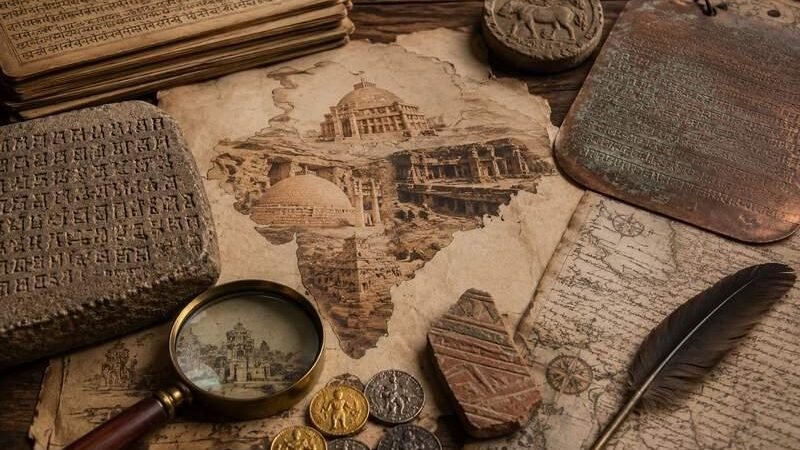
1. Understanding Ancient Indian History
History is the systematic study of the human past through the examination, interpretation and evaluation of available evidence. It enables us to understand how human societies evolved, how political institutions emerged, how economies developed, and how religious, philosophical and cultural traditions took shape.
The study of ancient Indian history is particularly significant because the Indian subcontinent witnessed some of the earliest developments in human civilisation, including prehistoric settlements, agricultural communities, urbanisation, organised political institutions, religious movements and philosophical traditions.
Ancient Indian history is not merely a chronological account of kings, dynasties and battles. It is also the study of the evolution of human society, economic relations, technological developments, religious beliefs, social institutions, art, architecture and intellectual traditions.
1.1 Geographical Context of Ancient Indian History
The geographical boundaries of ancient India were not identical to the political boundaries of modern India. Historical developments in the Indian subcontinent extended across territories that today constitute India, Pakistan, Bangladesh, Nepal and parts of Afghanistan.
The geographical diversity of the subcontinent played an important role in shaping its historical development.
- The Himalayan region: Provided natural geographical boundaries while facilitating cultural and commercial interactions through mountain passes.
- The Indo-Gangetic plains: Supported agricultural expansion, population growth and the emergence of major political formations.
- The north-western region: Served as an important corridor for migration, trade and cultural interactions with Central Asia and West Asia.
- The Deccan Plateau: Developed distinct political, economic and cultural traditions.
- The coastal regions: Facilitated maritime trade and interactions with West Asia, Southeast Asia and other parts of the Indian Ocean world.
- The river valleys: Supported early agricultural settlements and the emergence of urban centres.
Thus, the geographical diversity of the subcontinent contributed to the development of multiple regional cultures and political traditions rather than a single uniform civilisation.
1.2 Chronological Framework of Ancient Indian History
For the purpose of historical study, ancient Indian history can broadly be divided into the following phases:
| Historical period | Broad chronological framework |
|---|---|
| Prehistoric period | Before the emergence of written records |
| Protohistoric period | Societies with archaeological evidence but undeciphered or limited written records |
| Indus Valley Civilisation | c. 2600–1900 BCE (Mature Harappan phase) |
| Vedic Age | c. 1500–600 BCE (conventional broad framework) |
| Mahajanapada period | c. 600–300 BCE |
| Mauryan period | c. 322–185 BCE |
| Post-Mauryan period | c. 200 BCE–300 CE |
| Gupta period | c. 4th–6th centuries CE |
| Post-Gupta period | c. 6th–12th centuries CE |
Note: These dates are approximate and represent broad historical frameworks. Chronological boundaries differ according to regions, archaeological evidence and scholarly interpretations. Historical developments in different parts of the subcontinent frequently overlapped.
2. Nature and Importance of Historical Sources
Unlike the study of contemporary events, the reconstruction of ancient history depends largely on surviving evidence. Historians examine different categories of sources to understand past societies.
A historical source is any material, written record or other form of evidence that provides information about the past.
The sources of ancient Indian history can broadly be classified into:
- Archaeological sources.
- Literary sources.
- Foreign accounts.
These categories are not mutually exclusive. A comprehensive understanding of the past requires the examination and comparison of evidence from multiple sources.
3. Archaeological Sources
Archaeology is the scientific study of past human societies through the examination of material remains. It is one of the most important sources for reconstructing ancient Indian history, particularly for periods for which written records are absent or limited.
Archaeological evidence provides information about settlement patterns, food production, technology, trade, religious practices, social organisation and cultural developments.
3.1 Excavations and Material Remains
Excavation involves the systematic removal and recording of soil deposits to uncover the remains of earlier human settlements.
Archaeologists study:
- Remains of houses and settlements.
- Fortifications and public structures.
- Pottery and ceramic objects.
- Tools and implements.
- Weapons and ornaments.
- Terracotta figurines.
- Seals and sealings.
- Beads and other craft products.
- Burial sites and human remains.
- Remains of plants and animals.
These materials help reconstruct the economic and social conditions of ancient communities.
Important archaeological sites include:
| Site | Present location | Historical significance |
|---|---|---|
| Bhimbetka | Madhya Pradesh | Prehistoric rock shelters and paintings |
| Mehrgarh | Balochistan, Pakistan | Early agricultural and pastoral settlement |
| Harappa | Punjab, Pakistan | Major Indus Valley urban centre |
| Mohenjo-daro | Sindh, Pakistan | Mature Harappan urban civilisation |
| Dholavira | Gujarat | Urban planning and water management |
| Lothal | Gujarat | Harappan settlement associated with maritime trade |
| Kalibangan | Rajasthan | Harappan settlement and evidence of a ploughed field |
| Inamgaon | Maharashtra | Chalcolithic settlement |
| Brahmagiri | Karnataka | Megalithic and early historic archaeological remains |
| Arikamedu | Puducherry | Indo-Roman trade connections |
The archaeological record is particularly valuable because it provides evidence independent of literary descriptions.
3.2 Stratigraphy
Stratigraphy refers to the study of successive layers of soil and deposits at an archaeological site.
In undisturbed archaeological contexts, lower layers are generally older than the layers above them. By examining the objects found in different layers, archaeologists can establish a relative chronology of human occupation.
For example, an excavation may reveal:
- Lower layers containing stone tools.
- Intermediate layers containing pottery and evidence of agriculture.
- Upper layers containing iron objects and more developed settlement remains.
Such evidence helps reconstruct technological and cultural changes over time.
However, disturbances caused by later construction, burrowing animals, flooding or human activity can alter the original sequence. Therefore, stratigraphic evidence must be interpreted carefully.
3.3 Dating Techniques
Archaeologists employ scientific methods to establish the approximate age of archaeological remains.
A. Relative Dating
Relative dating establishes whether one archaeological object or layer is older or younger than another without necessarily assigning an exact numerical date.
Important methods include:
- Stratigraphic analysis.
- Typological comparison of pottery and tools.
- Cross-dating with objects of known chronology.
B. Absolute or Chronometric Dating
These techniques help estimate the actual age of archaeological materials.
| Method | Principle | Application |
|---|---|---|
| Radiocarbon dating (C-14) | Measures the remaining radioactive carbon in once-living organic material | Wood, charcoal, seeds and bones |
| Dendrochronology | Studies annual growth rings of trees | Dating preserved timber |
| Thermoluminescence | Measures light released from previously heated materials | Pottery and burnt archaeological objects |
| Optically Stimulated Luminescence (OSL) | Measures the time since mineral grains were last exposed to sunlight | Sediments and buried deposits |
| Potassium-Argon dating | Uses radioactive decay of potassium-40 | Dating suitable volcanic rocks and associated geological contexts |
Radiocarbon dating is particularly important in prehistoric and protohistoric archaeology. However, it is not directly applicable to materials such as ordinary stone tools or metal objects unless suitable associated organic samples are available.
3.4 Pottery
Pottery is one of the most important archaeological sources for reconstructing ancient Indian history.
Changes in pottery styles, manufacturing techniques, surface treatment and decoration help archaeologists identify cultural phases and establish relative chronologies.
Some important pottery traditions include:
A. Painted Grey Ware (PGW)
- Characterised by fine grey-coloured pottery with painted geometric designs, generally in black.
- Commonly associated with settlements in parts of the upper Gangetic plains and north-western India.
- Often discussed in connection with the later Vedic and early Iron Age cultural context.
- Important sites include Hastinapura, Atranjikhera and Ahichchhatra.
B. Northern Black Polished Ware (NBPW)
- Characterised by a distinctive glossy surface, usually black or dark grey, though other colours also occur.
- Associated with the period of expanding urbanisation in the middle Gangetic plains.
- Frequently linked with the rise of cities, trade, craft production and early states.
- Important sites include Rajgir, Pataliputra, Kaushambi and Varanasi.
C. Black and Red Ware (BRW)
- Characterised by a black interior and rim with a red exterior in many examples.
- Found across several regions and archaeological contexts.
- Associated with different cultural phases, including some Chalcolithic and Iron Age settlements.
Pottery evidence should not be treated as proof of a single homogeneous ethnic or political community. Similar pottery traditions may occur across different societies.
3.5 Inscriptions (Epigraphy)
Epigraphy is the scientific study of inscriptions engraved on durable materials such as stone, metal plates, pillars, caves and temple walls.
Inscriptions constitute one of the most valuable sources for ancient Indian history because they often provide information about rulers, political events, administration, religious donations, land grants and social relations.
Important examples include:
1. Ashokan Inscriptions
- Issued by Emperor Ashoka during the Mauryan period.
- Found across different parts of the subcontinent.
- Provide information about Ashoka’s Dhamma, administrative concerns, religious policy and territorial extent.
- Written predominantly in Prakrit using Brahmi and Kharosthi scripts, with Greek and Aramaic also used in certain north-western inscriptions.
2. Hathigumpha Inscription
- Located in Odisha.
- Associated with Kharavela, the ruler of Kalinga.
- Provides information about his military campaigns, public works and achievements.
- Written in Prakrit using Brahmi script.
3. Allahabad Pillar Inscription (Prayaga Prashasti)
- Composed by Harisena, the court poet of Samudragupta.
- Provides information about Samudragupta’s military campaigns, political achievements and relations with other rulers.
- An important source for the political history of the Gupta period.
4. Junagadh Inscription of Rudradaman I
- Associated with the Western Kshatrapa ruler Rudradaman I.
- Provides information about the repair of the Sudarshana Lake.
- Considered an important early example of an elaborate Sanskrit inscription.
5. Aihole Inscription
- Composed by Ravikirti, the court poet of Pulakeshin II.
- Provides information about the Chalukya ruler and his military achievements.
- An important source for the political history of early medieval Deccan.
Limitations of Inscriptions
Although inscriptions are valuable historical records, they must be critically examined.
- Royal inscriptions frequently exaggerate the achievements of rulers.
- Prashastis were often composed to glorify kings and legitimise their authority.
- Some inscriptions provide information only about specific regions or events.
- Damaged inscriptions may contain incomplete information.
- The language and terminology used may reflect the interests of the ruling elite.
Therefore, inscriptions should be corroborated with archaeological and literary evidence.
3.6 Numismatics (Study of Coins)
Numismatics is the systematic study of coins and currency.
Coins provide important information about the political, economic, commercial and cultural history of ancient India.
They help historians understand:
- Political authority and dynastic succession.
- Trade and commercial relations.
- Monetary systems and economic activity.
- Religious beliefs and royal patronage.
- Art, iconography and technological developments.
Important coin traditions:
A. Punch-Marked Coins
- Among the earliest widely circulating coin forms in the Indian subcontinent.
- Usually made of silver, with some examples in copper and other metals.
- Contain symbols punched onto the surface.
- Associated with the development of early monetary exchange and urban economic activity.
B. Indo-Greek Coins
- Often contain portraits of rulers.
- Carry inscriptions in Greek and, in some cases, Kharosthi.
- Provide evidence of political authority and cultural interaction.
C. Kushana Coins
- Issued by Kushana rulers such as Vima Kadphises and Kanishka.
- Frequently depict rulers and a variety of deities.
- Provide evidence of religious diversity and long-distance commercial connections.
D. Gupta Gold Coins
- Known for their artistic quality and variety of designs.
- Depict rulers in different activities, including military, religious and cultural representations.
- Provide information about Gupta kingship, royal ideology and monetary circulation.
Coins are particularly useful because they provide evidence of the names, titles, symbols and ideological claims of rulers. However, the presence of gold coins alone cannot be treated as conclusive evidence of widespread prosperity throughout society.
3.7 Monuments, Sculpture and Architecture
Ancient monuments and artistic remains provide evidence about religious practices, technological capabilities, political patronage and cultural developments.
Important examples include:
- Buddhist stupas at Sanchi and Bharhut.
- Rock-cut caves at Ajanta, Karle, Bhaja and Barabar.
- Ancient temple remains at Deogarh and Bhitargaon.
- Sculptural traditions of Gandhara, Mathura and Amaravati.
- Early structural and rock-cut temples in different regions.
These remains provide insights into religious movements, artistic traditions, architectural techniques and the relationship between political power and religious institutions.
3.8 Environmental and Bioarchaeological Evidence
Modern archaeology increasingly uses scientific evidence to understand ancient societies.
Important sources include:
- Archaeobotany: Study of ancient plant remains, seeds and grains.
- Zooarchaeology: Study of animal remains to understand domestication, food habits and pastoral activities.
- Palaeoanthropology: Study of human evolution and ancient human remains.
- Palaeoenvironmental studies: Reconstruction of past climatic and environmental conditions.
- Ancient DNA studies: Analysis of genetic material recovered from ancient human and other biological remains.
Such evidence helps examine questions relating to migration, agricultural practices, domestication, population history and environmental change.
4. Literary Sources
Literary sources constitute another major category of evidence for reconstructing ancient Indian history.
They provide information about religious beliefs, philosophical traditions, political institutions, social structures, economic practices, education, literature and cultural developments.
Literary sources can broadly be classified into:
- Religious literature.
- Secular literature.
4.1 Religious Literature
Religious literature is particularly important for understanding the development of religious and philosophical traditions in ancient India.
A. Vedic Literature
The Vedas are among the oldest surviving literary compositions of ancient India and form the foundation of the Vedic religious tradition.
There are four Vedas:
| Veda | Main content |
|---|---|
| Rigveda | Hymns dedicated to various deities |
| Samaveda | Melodies and chants, largely based on Rigvedic verses |
| Yajurveda | Ritual formulas and instructions associated with sacrifices |
| Atharvaveda | Hymns, spells, prayers and traditions relating to everyday life |
The Vedic corpus also includes several associated literary categories.
1. Brahmanas
- Prose texts explaining Vedic rituals and sacrificial practices.
- Provide information about the growing complexity of ritual traditions.
2. Aranyakas
- Literally associated with the forest.
- Represent a transitional phase between ritualistic and philosophical discussions.
3. Upanishads
- Philosophical texts dealing with concepts such as Brahman, Atman, karma, rebirth and moksha.
- Provide important insights into the development of Indian philosophical thought.
4. Vedangas
The six Vedangas were developed to facilitate the understanding and proper transmission of the Vedas.
They are:
- Shiksha – Phonetics.
- Kalpa – Ritual practices.
- Vyakarana – Grammar.
- Nirukta – Etymology.
- Chandas – Prosody.
- Jyotisha – Astronomy and calendrical calculations.
Historical significance of Vedic literature
Vedic literature provides information about:
- Early Indo-Aryan religious traditions.
- Social organisation and kinship relations.
- Political institutions such as Sabha and Samiti.
- Pastoral and agricultural activities.
- Ritual practices and religious beliefs.
- Changes in the relationship between social groups.
- The development of philosophical thought.
However, Vedic literature is primarily religious and ritualistic in nature. It does not provide a complete or uniform account of the political and social conditions of the entire subcontinent.
B. Buddhist Literature
Buddhist literature is an important source for understanding the religious, social, political and economic developments of ancient India, particularly from the middle of the first millennium BCE onwards.
The most important collection is the Tripitaka (Three Baskets).
| Collection | Subject matter |
|---|---|
| Vinaya Pitaka | Rules and regulations governing the Buddhist monastic community |
| Sutta Pitaka | Discourses and teachings attributed to the Buddha |
| Abhidhamma Pitaka | Philosophical and analytical discussions of Buddhist teachings |
The Tripitaka was preserved primarily in Pali in the Theravada tradition. Buddhist literature also developed in Sanskrit, Buddhist Hybrid Sanskrit and other languages.
Other important Buddhist texts include:
- Jataka stories: Narratives concerning the previous births of the Buddha.
- Mahavastu: A text associated with the Lokottaravada tradition.
- Buddhacharita: A biography of the Buddha composed by Ashvaghosha.
- Milindapanho: A philosophical dialogue between King Menander and the Buddhist monk Nagasena.
- Dipavamsa and Mahavamsa: Important Sri Lankan chronicles containing information about Buddhism and the Mauryan period.
Historical significance
Buddhist literature provides information about:
- The emergence of new religious movements.
- Urbanisation and the growth of trade.
- The rise of merchant communities.
- The political landscape of the Mahajanapada period.
- Social conditions and occupational groups.
- Monastic institutions and educational centres.
- Interactions between rulers and religious communities.
Jataka stories are particularly useful for understanding contemporary social and economic life, although they should be interpreted with due attention to their religious and literary character.
C. Jain Literature
Jain literature provides important information about the development of Jain philosophy, religious institutions and the social conditions of ancient India.
The principal canonical texts of the Shvetambara Jain tradition are known as the Agamas.
Important texts and literary traditions include:
- Acharanga Sutra: Deals with the conduct and discipline of Jain monks.
- Sutrakritanga: Discusses philosophical doctrines and religious debates.
- Bhagavati Sutra: Contains discussions about Jain philosophy and historical traditions.
- Kalpa Sutra: Associated with the lives of Jain Tirthankaras, particularly Mahavira.
- Uttaradhyayana Sutra: Contains teachings and ethical discussions.
Jain literary traditions also developed in Prakrit, Sanskrit, Tamil and Kannada.
Historical significance
Jain literature provides insights into:
- The life and teachings of Mahavira.
- Religious developments during the sixth century BCE.
- The growth of urban centres and merchant communities.
- Social and economic conditions.
- Religious patronage by rulers and trading groups.
- The spread of Jainism into different regions of India.
It is important to recognise that the preservation and classification of Jain canonical literature differed between the Shvetambara and Digambara traditions.
D. Puranic Literature
The Puranas form an important category of Sanskrit religious literature.
Traditionally, eighteen texts are classified as Mahapuranas.
They contain information relating to:
- Cosmology and creation.
- Mythological narratives.
- Genealogies of gods, sages and rulers.
- Religious traditions and rituals.
- Dynastic accounts.
- Pilgrimage centres and sacred geography.
The Puranic genealogies are particularly important for reconstructing aspects of ancient dynastic history.
However, Puranic accounts often combine mythology, religious beliefs and historical traditions. Their chronological and genealogical information must therefore be compared with inscriptions, coins and other evidence.
4.2 Secular Literary Sources
Secular literary works provide information about political administration, economic conditions, social organisation, literature, science and intellectual developments.
A. Kautilya’s Arthashastra
The Arthashastra is an important Sanskrit treatise on statecraft, administration, political economy and military strategy.
It discusses:
- The duties and powers of the king.
- Administrative organisation.
- Taxation and revenue collection.
- Agriculture and trade.
- Spies and intelligence.
- Law and justice.
- Military organisation.
- Foreign policy and inter-state relations.
The text is traditionally attributed to Kautilya, also known as Chanakya or Vishnugupta.
It is an important source for understanding ancient Indian political and administrative thought. However, the text is a prescriptive treatise, not a direct administrative report of the Mauryan Empire. Its composition and compilation are also understood to have involved different chronological layers.
B. Panini’s Ashtadhyayi
- A major Sanskrit grammatical treatise.
- Composed by Panini.
- Provides information about the structure of Sanskrit and the linguistic environment of ancient India.
- Contains references that help historians understand contemporary political, social and geographical terminology.
C. Patanjali’s Mahabhashya
- An important Sanskrit commentary on Panini’s grammar.
- Provides information about linguistic traditions and certain aspects of contemporary society and political developments.
D. Kalidasa’s Literary Works
Kalidasa was one of the most celebrated Sanskrit literary figures.
Important works include:
- Abhijnanashakuntalam.
- Meghaduta.
- Raghuvamsha.
- Kumarasambhava.
- Malavikagnimitram.
His works provide insights into courtly culture, social values, literary traditions and aspects of political life.
E. Sangam Literature
Sangam literature is one of the most important sources for understanding early historic South India, particularly the Tamil region.
It consists of a large body of early Tamil poetry traditionally associated with the Sangam literary tradition.
Important collections include:
- Ettuthokai (Eight Anthologies).
- Pattuppattu (Ten Idylls).
- Tolkappiyam, an important early Tamil grammatical and literary work.
Sangam poetry provides information about:
- Chera, Chola and Pandya rulers.
- Warfare and political relations.
- Agriculture and pastoral activities.
- Maritime trade.
- Social organisation.
- Religious practices.
- Heroic traditions and ethical values.
The concept of Tinai is particularly important. It classifies landscapes and associates them with distinct forms of human activity, emotions and social life.
The five major landscapes are:
| Tinai | Landscape | Associated economic activity |
|---|---|---|
| Kurinji | Mountainous region | Hunting and gathering |
| Mullai | Forest and pastoral region | Cattle rearing |
| Marutham | Agricultural plains | Agriculture |
| Neithal | Coastal region | Fishing and maritime activities |
| Palai | Arid region | Movement, hardship and raiding |
Sangam literature is especially significant because it provides an indigenous literary perspective on early historic South Indian society.
F. Other Literary Sources
Other important works include:
- Mudrarakshasa by Vishakhadatta: Provides literary accounts of political developments associated with the rise of the Mauryas.
- Harshacharita by Banabhatta: A biographical account of Harshavardhana.
- Rajatarangini by Kalhana: A historical chronicle of Kashmir.
- Vikramankadevacharita by Bilhana: Provides information about the Western Chalukya ruler Vikramaditya VI.
- Dasakumaracharita by Dandin: Offers insights into aspects of social and cultural life.
Literary works must be examined critically because authors often wrote to entertain, praise rulers, communicate religious beliefs or advance particular philosophical positions.
5. Foreign Accounts
Foreign accounts are an important supplementary source for reconstructing ancient Indian history.
Travellers, ambassadors, merchants and religious scholars from other regions visited the Indian subcontinent and recorded their observations.
These accounts provide external perspectives on Indian political institutions, society, economy, religion, education and commercial relations.
5.1 Greek and Roman Accounts
A. Megasthenes
Megasthenes was a Greek ambassador sent by Seleucus I Nicator to the court of Chandragupta Maurya.
He authored a work known as Indica.
Although the original work has not survived in its entirety, several portions are preserved through quotations and references in later Greek and Roman writers.
It provides information about:
- The Mauryan capital, Pataliputra.
- Administration and governance.
- Social organisation.
- Agriculture and economic activities.
- The army and political institutions.
Megasthenes’ descriptions must be treated cautiously because some of his observations appear exaggerated or reflect misunderstandings of Indian social institutions.
B. Arrian
Arrian was a Greek historian who wrote about Alexander’s campaigns and drew upon earlier accounts, including those relating to India.
His work is useful for reconstructing the north-western political landscape during Alexander’s invasion.
C. Strabo
Strabo was a Greek geographer who referred to India in his geographical writings and preserved information from earlier Greek accounts.
D. Pliny the Elder
His work Natural History contains references to Indian products, trade and commercial relations with the Roman world.
E. Periplus of the Erythraean Sea
This anonymous Greek-language navigational and commercial text is a major source for understanding maritime trade in the Indian Ocean during the first century CE.
It provides information about:
- Indian ports.
- Maritime trade routes.
- Export and import commodities.
- Commercial interactions with the Roman world.
- Coastal settlements and trading centres.
5.2 Chinese Travellers
Chinese Buddhist pilgrims visited India to study Buddhist teachings, collect religious manuscripts and visit important Buddhist sites.
Their travel accounts provide valuable information about Indian religious institutions, educational centres, political conditions and social practices.
A. Fa-Hien (Faxian)
- Visited India during the reign of Chandragupta II, in the early fifth century CE.
- Travelled primarily to study Buddhist teachings and collect Buddhist texts.
- His account provides information about Buddhism, society, administration and religious institutions.
B. Hiuen Tsang (Xuanzang)
- Visited India during the reign of Harshavardhana in the seventh century CE.
- Studied at Nalanda and travelled to several regions of India.
- His account provides detailed information about political conditions, Buddhist institutions, education, society and religious practices.
His work is particularly useful for reconstructing the political and cultural conditions of Harsha’s period.
C. I-Tsing (Yijing)
- Visited India during the seventh century CE.
- Studied Buddhist traditions and monastic practices.
- Provided information about Buddhist education, monastic life and religious connections between India and Southeast Asia.
5.3 Other Foreign Accounts
Other travellers and writers also contributed to the reconstruction of ancient Indian history.
A. Al-Biruni
Al-Biruni visited the Indian subcontinent in the early eleventh century CE.
His work Kitab-ul-Hind provides detailed observations about Indian philosophy, religion, sciences, social customs and intellectual traditions.
He studied Sanskrit and attempted to understand Indian society through its texts and knowledge systems.
B. Tibetan Buddhist Traditions
Tibetan Buddhist accounts provide information about Indian Buddhist scholars, monasteries, philosophical traditions and the transmission of Buddhist knowledge.
These accounts are particularly useful for understanding India’s intellectual and religious connections with the Himalayan region and Central Asia.
5.4 Comparative Table of Important Foreign Visitors
| Visitor / Author | Period | Associated ruler or context | Major contribution |
|---|---|---|---|
| Megasthenes | 4th–3rd century BCE | Chandragupta Maurya | Mauryan administration and society |
| Fa-Hien | 5th century CE | Chandragupta II | Buddhism and Gupta-period society |
| Hiuen Tsang | 7th century CE | Harshavardhana | Political conditions and education |
| I-Tsing | 7th century CE | Later ancient period | Buddhist monastic institutions |
| Al-Biruni | 11th century CE | Early medieval context | Indian sciences, philosophy and society |
6. Limitations of Historical Sources
Although ancient Indian history is reconstructed through a wide variety of sources, each category has certain limitations.
6.1 Limitations of Archaeological Sources
- Archaeological remains are often fragmentary and incomplete.
- Many materials are perishable and may not survive over long periods.
- Archaeological discoveries may be geographically concentrated.
- Material remains do not always reveal the beliefs or intentions of the people who created them.
- Similar material cultures do not necessarily indicate common political or ethnic identities.
6.2 Limitations of Literary Sources
- Religious texts often focus on spiritual and ritual concerns rather than everyday political developments.
- Many texts were composed or compiled over long periods.
- Literary works may contain mythology, legends and exaggerated narratives.
- Surviving texts frequently represent the perspectives of particular social groups.
- Manuscript transmission may have introduced variations and interpolations.
6.3 Limitations of Foreign Accounts
- Foreign visitors did not always understand local languages, customs and institutions.
- Their accounts were often based on limited geographical and social exposure.
- Some writers depended on second-hand information.
- Cultural differences could lead to misinterpretation.
- Their accounts may reflect the political or religious interests of their own societies.
6.4 The Need for Corroboration
No single historical source can provide a complete and unbiased account of the past.
For example, the political achievements of a ruler described in a royal inscription may be compared with:
- Coins issued during the same period.
- Archaeological evidence from the ruler’s territory.
- Literary accounts.
- References in foreign travel records.
Such comparison enables historians to distinguish historical evidence from exaggeration, mythology and ideological representation.
7. How Historians Reconstruct Ancient Indian History
The reconstruction of ancient Indian history involves the systematic collection, classification, dating and interpretation of different kinds of evidence.
The process can be represented as follows:
Historical reconstruction
- Identification of archaeological and literary evidence.
- Collection and documentation of sources.
- Dating and chronological classification.
- Interpretation of the evidence.
- Comparison and corroboration of different sources.
- Development of historical explanations.
Historical knowledge is not static. New archaeological discoveries, scientific dating techniques, decipherment of inscriptions and fresh interpretations of existing evidence can change our understanding of the past.
7.1 Historical Interpretation and Objectivity
Historical writing requires a critical distinction between evidence and interpretation.
For instance, the discovery of large urban structures may establish the existence of organised settlements. However, determining the precise political structure, social hierarchy or administrative system of those settlements requires further evidence and interpretation.
Similarly, the presence of religious symbols at an archaeological site does not automatically establish the precise religious beliefs of its inhabitants.
Historians must therefore avoid imposing contemporary assumptions on ancient societies.
7.2 The Role of Modern Archaeological Research
Modern historical research increasingly combines traditional archaeological methods with scientific techniques.
Important developments include:
- Scientific dating of archaeological remains.
- Remote sensing and satellite imagery.
- Geographic Information Systems (GIS).
- Archaeobotanical and zooarchaeological analysis.
- Ancient DNA research.
- Digital documentation of inscriptions and manuscripts.
- Material science and chemical analysis of archaeological objects.
These methods have expanded the possibilities of reconstructing ancient societies, although their findings must also be evaluated within the limitations of the available evidence.
8. Significance of Studying Ancient Indian History
The study of ancient Indian history is important for understanding the foundations of India’s civilisation and the evolution of its institutions.
8.1 Understanding the Evolution of Political Institutions
Ancient Indian history reveals the emergence of tribal assemblies, territorial states, monarchies, republican political formations and large empires.
It helps explain the development of kingship, administration, taxation, diplomacy and military organisation.
8.2 Understanding Economic Transformation
The transition from hunting and gathering to agriculture, the growth of pastoralism, the emergence of urban centres, the development of trade networks and the expansion of monetary exchange represent important stages in India’s economic history.
8.3 Understanding Social Change
The study of ancient India provides insights into the evolution of family structures, occupational groups, social hierarchies, gender relations and religious communities.
8.4 Understanding Religious and Philosophical Traditions
Ancient India witnessed the development of Vedic traditions, Buddhism, Jainism and several philosophical schools.
These traditions made important contributions to ethics, metaphysics, logic, epistemology and debates concerning the nature of existence.
8.5 Understanding Art and Cultural Heritage
Ancient Indian architecture, sculpture, painting, literature and religious traditions form an important part of India’s cultural heritage.
Their study also helps understand cultural exchanges between India and other regions of Asia.
9. Conclusion
Ancient Indian history is reconstructed through a combination of archaeological, literary and foreign sources. Each source provides a different perspective on the past, but none is sufficient by itself.
Archaeology reveals the material foundations of human life, literary sources provide insights into religious, social and intellectual traditions, while foreign accounts offer external observations of Indian society and institutions.
The scientific and critical examination of these sources enables historians to reconstruct the evolution of ancient Indian civilisation.
For UPSC aspirants, understanding historical sources is essential because it provides the methodological foundation for studying subsequent developments, including the prehistoric period, Indus Valley Civilisation, Vedic Age, emergence of states, religious movements and the rise of empires.
Key Takeaways for UPSC Aspirants
- Archaeology reconstructs the past through material remains, including settlements, pottery, tools, inscriptions and coins.
- Epigraphy is the study of inscriptions, while Numismatics is the study of coins.
- The four Vedas are Rigveda, Samaveda, Yajurveda and Atharvaveda.
- The Tripitaka consists of Vinaya Pitaka, Sutta Pitaka and Abhidhamma Pitaka.
- Megasthenes was an ambassador at the court of Chandragupta Maurya and authored Indica.
- Fa-Hien visited India during the reign of Chandragupta II.
- Hiuen Tsang visited India during the reign of Harshavardhana.
- The Allahabad Pillar Inscription provides important information about Samudragupta.
- The Hathigumpha inscription is associated with Kharavela.
- Sangam literature is an important source for reconstructing early historic South Indian history.
- The Arthashastra is an important treatise on statecraft, administration and political economy.
- Historical reconstruction requires the critical comparison and corroboration of multiple sources.
The central principle of historical research is that the past must be reconstructed through evidence, not merely accepted through tradition or literary descriptions.