

1. Introduction
Human life involves continuous interaction with other individuals, communities, institutions and the natural environment. In these interactions, people frequently encounter questions concerning fairness, honesty, responsibility, dignity and justice. While some decisions are governed by established rules and legal obligations, many require individuals to exercise moral judgement and distinguish between what is merely possible and what is ethically appropriate.
For instance, a public official may possess the authority to make a particular administrative decision. However, the possession of authority does not automatically establish that every decision made within its formal limits is morally justified. The official must also consider fairness, the rights of affected individuals, the public interest and the principles that should guide the exercise of authority.
Ethics provides a framework for examining such questions and evaluating human conduct in the light of moral principles.
Ethics is therefore central to understanding human behaviour, interpersonal relationships, professional responsibilities and public administration. It is also the conceptual starting point for the UPSC Civil Services Examination’s General Studies Paper IV, which examines the moral and ethical dimensions of public life.
The study of ethics begins with understanding its meaning, nature, scope and foundations. These concepts provide the basis for subsequently examining ethical judgement, human values, attitude, integrity, emotional intelligence and probity in governance.
2. Meaning and Definition of Ethics
The word ethics is derived from the Greek term ethos, associated with character, custom and habitual conduct. Ethics is a branch of philosophy concerned with the systematic examination of moral principles, standards of conduct and judgements about right and wrong.
In simple terms, ethics examines what people ought to do, why they ought to do it, and the principles by which their actions can be evaluated.
Ethics is not limited to identifying whether an action produces a desirable result. It also examines whether the action respects moral obligations, whether the methods employed are justified, and whether the decision can be defended through sound reasoning.
For example, an administrator may wish to improve the delivery of a welfare programme. The objective is desirable, but the administrator must also consider whether the proposed procedure treats eligible beneficiaries fairly, protects their dignity and complies with applicable rules.
Ethics helps establish the principles by which such decisions can be evaluated.
2.1 Ethics as a branch of philosophy
Ethics is traditionally regarded as a major branch of philosophy alongside metaphysics, epistemology and logic.
- Metaphysics examines the fundamental nature of reality and existence.
- Epistemology examines knowledge, its sources and its justification.
- Logic examines valid reasoning and the principles of sound argument.
- Ethics examines moral questions concerning right and wrong, good and bad, duty and responsibility, and justice and injustice.
Ethics is distinctive because it evaluates conduct and examines the standards that should guide human choices.
However, ethical questions are not always answered through simple rules. People may disagree about what constitutes justice, how competing duties should be balanced or whether a particular action is justified by its consequences. Ethics provides methods of reasoning through these disagreements.
2.2 Ethics as the study of moral principles
Ethics examines the principles through which human conduct can be evaluated.
Consider the following situations:
- A person discovers a wallet containing money and must decide whether to return it.
- An employee discovers serious wrongdoing within an organisation and must consider how to respond.
- A public official must decide how to allocate scarce resources among competing legitimate needs.
- A company must determine whether it should disclose a product defect that could affect consumers.
Each situation raises questions about honesty, responsibility, fairness, harm and the obligations owed to others.
Ethical analysis seeks to identify the relevant moral principles, examine the available alternatives and justify a course of action.
Thus, ethics is both a field of philosophical inquiry and a practical discipline concerned with responsible human conduct.
3. Nature and Characteristics of Ethics
Ethics possesses several characteristics that distinguish it from the mere description of human behaviour or the enforcement of formal rules.
3.1 Normative in nature
Ethics is primarily concerned with how individuals ought to behave rather than merely describing how they actually behave.
For example, the observation that corruption occurs in a particular institution is a descriptive statement. The argument that public officials ought not to misuse their authority for private gain is a normative judgement.
Ethics therefore establishes and evaluates standards of conduct.
3.2 Concerned with moral evaluation
Ethics examines whether actions, decisions, intentions and institutional practices are morally defensible.
An action may be technically efficient but ethically questionable if it involves discrimination, deception or an unjustified violation of rights.
Similarly, a decision that produces immediate benefits may still require scrutiny if the methods used to achieve those benefits are unfair.
Ethical evaluation goes beyond asking whether an action is successful. It asks whether the action is morally justified.
3.3 Rational and reflective
Ethical judgements should be supported by reasons that can be examined and discussed.
A person cannot adequately justify a decision merely by stating that it reflects personal preference or established practice. The decision should be supported by relevant principles, facts and defensible arguments.
For example, an administrator who recommends prioritising a particular group during an emergency should be able to explain the relevant criteria, the urgency of the group’s needs and the reasons for the proposed allocation.
Rational reflection helps distinguish ethical judgement from arbitrary preference, prejudice and impulsive reactions.
3.4 Concerned with human dignity
Ethics recognises that individuals should not be treated merely as instruments for achieving someone else’s objectives.
Respect for human dignity requires consideration of individual rights, autonomy, welfare and fair treatment.
In public administration, this principle is reflected in the expectation that citizens should be treated respectfully regardless of their economic position, social background or personal connections.
An efficient administrative procedure that unnecessarily humiliates citizens or disregards their legitimate rights raises ethical concerns even if it achieves its immediate objective.
3.5 Both individual and social in scope
Ethics concerns individual character and conduct, but it also examines the effects of actions on other people and society.
Personal honesty is an individual virtue. Fairness in public institutions is a broader social concern. Both are relevant to ethical life.
An individual may act in a manner that provides personal benefits but imposes significant costs on others. Ethical reasoning requires consideration of these wider effects rather than focusing exclusively on private advantage.
3.6 Concerned with principles and judgement
Ethics provides general principles, but their application frequently requires judgement.
For example, honesty is an important ethical principle. However, questions may arise concerning confidential information, privacy or the disclosure of sensitive personal details.
An ethical decision must consider honesty alongside other relevant obligations rather than applying a single principle mechanically.
This does not mean that ethical principles can be ignored whenever they become inconvenient. It means that complex situations require careful examination of competing obligations and the circumstances in which they arise.
3.7 Relevant across different spheres of life
Ethics is relevant to personal relationships, professional conduct, business decisions, scientific research, technological development, environmental protection and public administration.
The specific obligations may differ between these settings, but questions of honesty, fairness, responsibility and harm remain important.
For civil servants, ethical considerations become particularly significant because official decisions can affect public resources, individual rights and the distribution of opportunities.
3.8 Dynamic in application, but not arbitrary
Ethical reasoning develops as societies encounter new circumstances, technologies and forms of social interaction.
For example, artificial intelligence has raised questions concerning privacy, accountability, algorithmic discrimination and the responsible use of automated decision-making.
Such developments require the application of established moral concerns to new situations.
However, changing circumstances do not make ethical judgement arbitrary. Decisions must still be supported by defensible reasoning and appropriate consideration of human welfare, justice and rights.
4. Scope of Ethics
The scope of ethics extends beyond individual decisions to the principles governing relationships, institutions and collective life.
4.1 Individual conduct
Ethics examines personal choices involving honesty, self-restraint, responsibility, fairness and respect for others.
It encourages individuals to reflect on their conduct and examine whether their decisions are consistent with defensible moral principles.
4.2 Interpersonal relationships
Ethics is relevant to relationships involving family members, friends, colleagues and other individuals.
Honesty, trust, mutual respect and responsibility help sustain relationships. Deception, exploitation and deliberate unfairness can undermine them.
4.3 Professional conduct
Professional ethics examines the standards appropriate to particular occupations and responsibilities.
For example, medical professionals have obligations concerning patient welfare and confidentiality, while lawyers have professional duties towards clients and the administration of justice.
Public officials have additional obligations concerning impartiality, accountability and the responsible use of public authority.
4.4 Institutional conduct
Organisations make decisions concerning recruitment, promotion, procurement, resource allocation, workplace treatment and the handling of complaints.
These decisions have ethical implications because institutional practices can promote fairness and accountability or create opportunities for discrimination, favouritism and abuse.
Ethics therefore examines not only the conduct of individuals within organisations but also the principles reflected in institutional rules and practices.
4.5 Social and environmental concerns
Ethical questions arise in relation to inequality, social exclusion, environmental degradation, intergenerational justice and the treatment of vulnerable groups.
For example, decisions concerning industrial development may involve competing considerations such as employment, economic growth, public health and environmental protection.
Ethical analysis helps identify the interests involved and evaluate how the resulting benefits and burdens should be distributed.
4.6 Public administration and governance
Ethics is central to the exercise of public authority because administrative decisions must be justified in terms of legitimate public purposes.
Issues involving corruption, conflicts of interest, discrimination, misuse of public funds and arbitrary decision-making have both legal and ethical dimensions.
Ethical governance seeks to ensure that authority is exercised responsibly and that institutions remain responsive to the rights and legitimate interests of citizens.
These areas demonstrate the breadth of ethics. The detailed examination of the essence, determinants, consequences and dimensions of ethical conduct, however, requires separate treatment.
5. Foundations of Ethical Thought
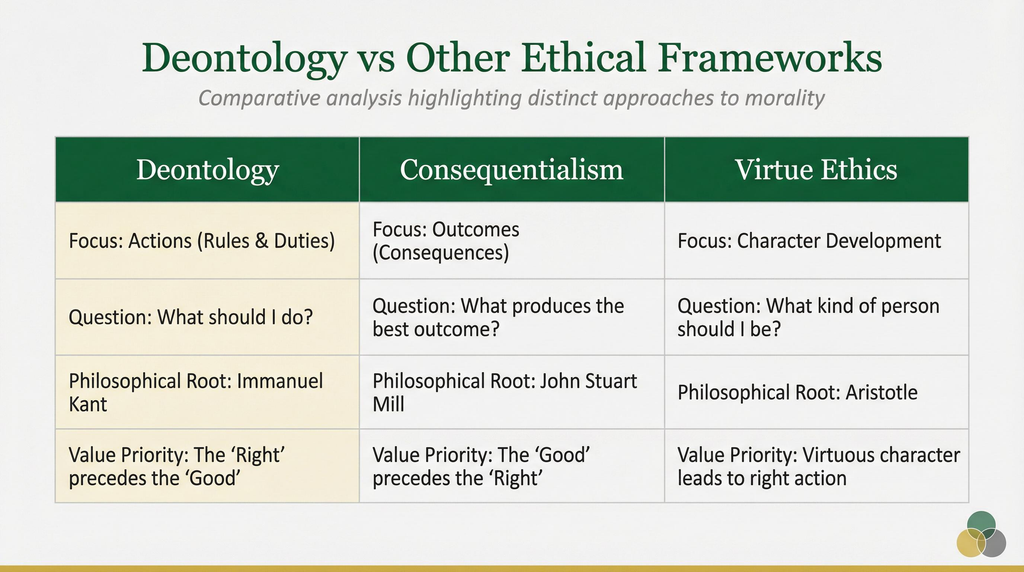
Ethics has developed through different philosophical traditions that attempt to explain what makes an action right, what constitutes a good life and how individuals should resolve moral disagreements.
For introductory UPSC study, three major approaches provide a useful foundation: consequentialism, deontology and virtue ethics.
5.1 Consequentialism
Consequentialism evaluates actions primarily by examining their consequences.
According to this broad approach, the moral assessment of an action depends significantly on the outcomes it produces.
A prominent form of consequentialism is utilitarianism, associated particularly with Jeremy Bentham and John Stuart Mill.
Utilitarianism seeks to promote overall happiness or welfare and to reduce suffering. It encourages decision-makers to consider the effects of their actions on all those affected rather than focusing exclusively on personal interests.
For example, when allocating limited emergency resources, a consequentialist approach may examine which allocation is likely to prevent the greatest amount of harm.
Contribution: Consequentialist reasoning encourages attention to outcomes, public welfare and the wider effects of decisions.
Limitation: An exclusive focus on aggregate welfare may overlook individual rights or justify unfair treatment of a minority if the overall benefits appear sufficiently large.
5.2 Deontology
Deontology is an ethical approach that emphasises duties, moral rules and principles rather than evaluating actions exclusively through their consequences.
The German philosopher Immanuel Kant is a central figure in deontological ethics.
Kant argued that moral principles should be capable of universal application and that human beings should be treated as ends in themselves rather than merely as means to another person’s objectives.
For example, a public official should not deliberately falsify records simply because doing so might produce a desirable immediate outcome. The act of deception itself raises moral concerns concerning honesty, duty and respect for others.
Contribution: Deontological reasoning emphasises duties, consistency, moral obligations and respect for persons.
Limitation: Duties may sometimes conflict. A decision-maker may need to reconcile obligations concerning honesty, confidentiality, protection of life and professional responsibility.
5.3 Virtue ethics
Virtue ethics focuses on moral character and the cultivation of good dispositions rather than treating ethical conduct solely as the application of rules or the calculation of consequences.
Aristotle is a major figure in this tradition.
Virtues such as courage, honesty, justice, temperance and practical wisdom help individuals develop the capacity to act well across different circumstances.
For example, an administrator who possesses integrity may resist improper pressure even when misconduct is unlikely to be detected. A compassionate officer may recognise the difficulties faced by vulnerable citizens while remaining committed to fair procedures.
Virtue ethics therefore emphasises the development of character through practice, reflection and habituation.
Contribution: It highlights the importance of character, moral development and consistent ethical conduct.
Limitation: A virtue-based approach may not, by itself, provide a sufficiently precise answer when several virtues or obligations appear to conflict.
5.4 Comparative understanding
| Dimension | Consequentialism | Deontology | Virtue ethics |
|---|---|---|---|
| Central concern | Outcomes of actions | Duties and moral principles | Character and virtues |
| Main question | What consequences will this action produce? | What is my moral duty? | What would a person of good character do? |
| Important association | Jeremy Bentham and John Stuart Mill | Immanuel Kant | Aristotle |
| Administrative relevance | Evaluating public welfare and policy outcomes | Respecting rights, rules and duties | Cultivating integrity, courage and practical wisdom |
These approaches should not be treated as mutually exclusive tools in every situation. Responsible ethical judgement may require attention to consequences, duties and character together.
6. Ethics, Morality, Law and Values: Conceptual Distinctions
Ethics is closely related to morality, law and values. However, these concepts address different aspects of human conduct.
6.1 Ethics and morality
Morality generally refers to beliefs, standards and practices concerning right and wrong. Ethics critically examines, evaluates and seeks to justify moral standards.
For example, an individual may believe that helping a relative is morally desirable. Ethical reflection becomes necessary when that individual must decide whether such assistance is appropriate in a professional setting where other people have equal claims.
The distinction is not absolute: everyday language frequently uses ethics and morality interchangeably. Nevertheless, distinguishing moral beliefs from their systematic evaluation is useful for academic study.
6.2 Ethics and law
Law consists of rules recognised and enforced through the legal system. Ethics examines whether conduct is morally justified.
The two overlap substantially, particularly in areas involving corruption, discrimination, violence and the protection of rights. However, they are not identical.
An action may comply with a legal rule while raising questions of fairness or compassion. Conversely, a person may believe that a particular action is morally justified while still being legally prohibited from undertaking it.
For a civil servant, personal moral conviction does not automatically authorise the violation of law. Ethical judgement must take legal obligations seriously and seek lawful ways to address injustice or hardship.
6.3 Ethics and values
Values are principles, ideals or standards that individuals or communities regard as important.
Examples include honesty, achievement, loyalty, equality, freedom and compassion.
Values influence choices and priorities, but not every value is necessarily ethical in every application. Loyalty, for instance, can strengthen trust, but it may become problematic when used to justify favouritism or conceal serious wrongdoing.
Ethical reflection helps individuals assess how values should be prioritised when they conflict.
6.4 Ethics and customs
Customs are established social practices transmitted across generations or maintained within communities.
Some customs support cooperation, hospitality and mutual responsibility. Others may perpetuate exclusion or unequal treatment.
The fact that a practice is traditional does not automatically establish its moral legitimacy. Ethical examination requires consideration of dignity, fairness, rights and the effects of the practice on those affected.
6.5 Summary of distinctions
| Concept | Central question | Primary function |
|---|---|---|
| Ethics | What is morally right, and why? | Evaluates and justifies moral principles |
| Morality | What is regarded as right or wrong? | Provides moral beliefs and standards |
| Law | What is legally permitted or prohibited? | Establishes enforceable rules and obligations |
| Values | What is considered important or desirable? | Influences priorities and choices |
| Customs | What practices are socially established? | Transmits shared patterns of conduct |
These distinctions are important for civil servants because legal compliance, social acceptance, personal conviction and ethical justification may not always point towards the same course of action.
7. Why Is the Study of Ethics Important?
The study of ethics is valuable because individuals and institutions frequently encounter situations in which interests conflict, information is incomplete or formal rules do not fully resolve the problem.
7.1 Development of moral reasoning
Ethics encourages individuals to move beyond impulsive reactions and examine the reasons supporting a decision.
It helps identify assumptions, distinguish facts from opinions and evaluate competing arguments.
7.2 Recognition of competing interests
Ethical reasoning encourages consideration of individuals and groups whose interests might otherwise be overlooked.
This is particularly important when decisions affect vulnerable populations or distribute scarce resources.
7.3 Responsible exercise of authority
Authority creates the possibility of both public benefit and abuse. Ethical principles help establish standards for the responsible exercise of discretion.
7.4 Prevention of arbitrary judgement
Personal preferences and prejudices can influence decisions unconsciously. Ethical reflection encourages consistency, fairness and reasoned justification.
7.5 Strengthening public trust
Citizens are more likely to trust institutions when decisions are fair, transparent and supported by defensible reasons.
Ethical conduct is therefore important for both the legitimacy and effectiveness of governance.
7.6 Addressing emerging challenges
Technological change, environmental pressures, global interdependence and new forms of social interaction create ethical questions that may not have straightforward answers.
Ethical reasoning helps individuals and institutions assess these challenges systematically.
8. Relevance of Ethics to the Civil Services
For a civil servant, ethics is not merely an abstract philosophical subject. It is relevant to the everyday exercise of administrative responsibilities.
Public officials make decisions concerning welfare benefits, public expenditure, regulation, law enforcement, public procurement and the delivery of essential services. These decisions may have substantial consequences for citizens, particularly those who lack the resources to challenge administrative decisions.
Ethical understanding helps civil servants recognise that public authority is held in trust and should be exercised for legitimate public purposes.
It also encourages reflection on the distinction between personal interests and official responsibilities, the importance of treating citizens fairly and the need to justify decisions through evidence and defensible principles.
A technically competent administrator may still make poor decisions if ethical considerations are ignored. Conversely, good intentions without legal knowledge, administrative competence and sound judgement may also produce harmful outcomes.
The objective is therefore to integrate ethical awareness, professional competence, legal responsibility and reasoned decision-making.
9. Conclusion
Ethics is the systematic examination of moral principles and the standards that should guide human conduct. Its nature is normative, reflective and evaluative, while its scope extends from individual choices and interpersonal relationships to professional responsibilities, institutional practices and public governance.
Its philosophical foundations include different approaches that emphasise consequences, duties and moral character. Understanding these approaches enables individuals to examine ethical questions from multiple perspectives rather than relying exclusively on personal preference or established practice.
For civil servants, ethics provides a conceptual foundation for responsible public authority, fair treatment and reasoned decision-making. It helps explain why administrative competence must be accompanied by moral judgement and why legality, efficiency and ethical justification, although closely related, are not interchangeable.
The study of ethics begins with understanding what makes conduct morally defensible. The next step is to examine the essence of ethics in human actions: how intention, duty, means and consequences enter into the evaluation of a particular decision.
UPSC Mains Practice Questions
Question 1 — 10 marks
Define ethics and explain its principal characteristics. How does ethics differ from the mere description of human behaviour?
Question 2 — 10 marks
Distinguish between ethics, morality, law and values. Why are these distinctions important in public administration?
Question 3 — 15 marks
Explain the fundamental differences between consequentialism, deontology and virtue ethics. How can these approaches contribute to the evaluation of administrative decisions?
Question 4 — 10 marks
“An action may be legally permissible without being ethically desirable.” Discuss with suitable examples.
Question 5 — 15 marks
Examine the scope and significance of ethics in individual life, professional conduct and public administration.
Suggested approach to answer writing
For definition-based questions, begin with a precise definition, explain the relevant concepts and provide a suitable example. For comparative questions, establish the conceptual distinctions before discussing their implications. For questions on public administration, connect the philosophical discussion to accountability, impartiality, fairness and the responsible use of authority.