
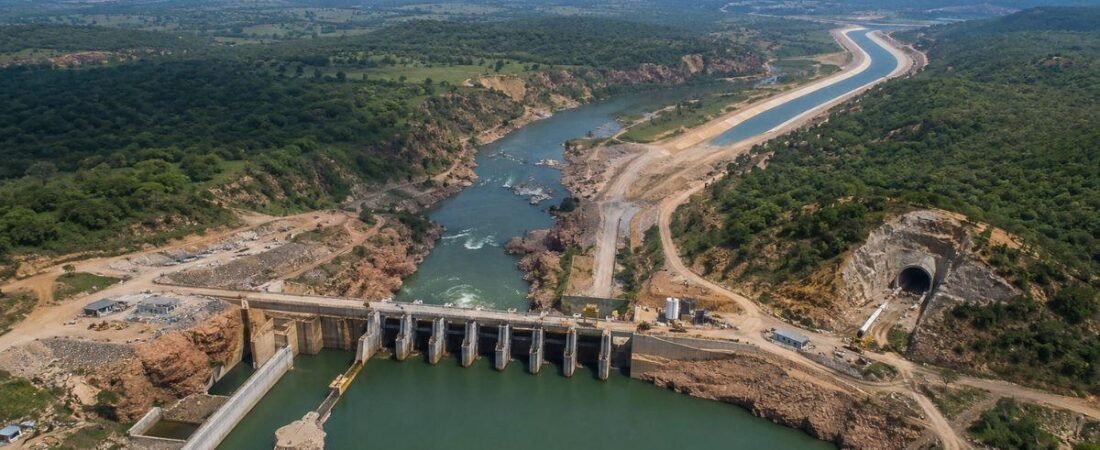
Introduction
India faces a persistent paradox in water management. Some regions experience severe water scarcity, declining groundwater levels and recurring droughts, while others face seasonal floods and the rapid discharge of monsoon water into the sea. The uneven distribution of rainfall, variations in river flows, rising demand for irrigation and urbanisation have made water security a major development challenge.
Against this background, river interlinking has emerged as an ambitious proposal to transfer water from river basins considered to have surplus water to regions facing shortages. Supporters argue that inter-basin transfers can expand irrigation, improve drinking-water availability, moderate some flood risks and strengthen agricultural productivity. Critics, however, raise questions about ecological disruption, displacement, interstate disputes, financial costs and the assumption that a river basin’s surplus water will remain available under changing climatic conditions.
The central question is not whether India needs better water management. It clearly does. The question is whether river interlinking, by itself, can provide a sustainable solution to India’s water crisis, or whether it must form part of a broader strategy involving conservation, groundwater recharge, efficient irrigation and basin-level governance.
1. What Is River Interlinking?
River interlinking involves transferring water from one river basin to another through infrastructure such as dams, reservoirs, canals, tunnels and associated pumping systems.
A river basin is the geographical area from which rainfall and surface runoff drain into a common river system. Water availability within a basin depends on rainfall, groundwater interactions, soil characteristics, vegetation, storage capacity, river flows and human consumption.
The basic principle of river interlinking is that water available in one basin during particular periods could be transferred to another basin where demand exceeds locally available supplies.
The National Perspective Plan (NPP) for inter-basin water transfer was formulated in 1980. The National Water Development Agency (NWDA), under the Ministry of Jal Shakti, is responsible for work relating to the identified interlinking projects.
The plan comprises two components:
- Himalayan Rivers Development Component: Includes proposed links involving Himalayan and adjoining river systems.
- Peninsular Rivers Development Component: Includes proposed links among rivers of peninsular India.
The government has identified 30 interlinking projects under the NPP: 14 under the Himalayan component and 16 under the peninsular component.
It is important to distinguish between identifying a project, completing a feasibility report, preparing a Detailed Project Report (DPR), obtaining clearances and actually implementing the project. These are separate stages, and inclusion in the plan does not mean that a link is ready for construction.
Official reference: Ministry of Jal Shakti — Status of National Rivers Interlinking Programme, 10 August 2026
2. Why Does India Consider River Interlinking Necessary?
2.1 Uneven spatial distribution of water
Rainfall and river flows vary considerably across India. The Western Ghats, parts of northeastern India and several Himalayan catchments receive substantial rainfall, while many regions of Rajasthan, Gujarat, central India and the Deccan Plateau experience varying degrees of seasonal water stress.
These broad geographical patterns do not mean that every river in a high-rainfall region has transferable surplus water or that every water-stressed region can be supplied through a canal. Local conditions, seasonal variation, existing uses and ecological requirements determine actual availability.
River interlinking seeks to address part of this geographical imbalance by moving water across basin boundaries.
2.2 Dependence on the monsoon
A significant share of India’s rainfall occurs during the southwest monsoon. Concentrated rainfall can produce high river flows over a relatively short period, while agricultural, domestic and industrial demand continues through much of the year.
Storage infrastructure can help regulate this seasonal variation. Inter-basin transfer projects seek to extend that function by moving water between regions.
However, the effectiveness of such transfers depends on the timing and reliability of flows in the source basin, the capacity of storage infrastructure and the requirements of the receiving basin.
2.3 Irrigation and agricultural productivity
Agriculture remains a major user of freshwater in India. Rain-fed farmers are vulnerable to variations in rainfall, delayed monsoons and dry spells during critical stages of crop growth.
Reliable irrigation can reduce some of this vulnerability, support crop diversification and improve agricultural productivity.
River interlinking projects are often presented as one way to expand irrigation in water-stressed regions. Their actual contribution, however, depends on whether transferred water reaches farms reliably and whether the distribution system is affordable, efficient and equitable.
2.4 Drinking-water security
Population growth, urban expansion and economic development increase demand for reliable drinking water.
Inter-basin transfers can potentially supplement water supplies in selected towns, villages and districts. But drinking-water security also requires protected local sources, functioning distribution networks, reduced leakage, safe water treatment and responsible groundwater management.
A large transfer project cannot compensate indefinitely for inefficient local water systems.
2.5 Flood and drought management
Some river-linking proposals are associated with the idea of transferring water away from flood-prone basins and delivering it to water-deficient regions.
This proposition requires careful evaluation. Floods are caused by several factors, including extreme rainfall, catchment conditions, reservoir operations, river-channel capacity, floodplain encroachment and drainage constraints.
A transfer canal designed for water supply cannot automatically be assumed to prevent floods. Its contribution depends on its design, operating rules, available storage and whether the timing and magnitude of flood flows can actually be managed through the proposed system.
Similarly, drought risk cannot be eliminated merely by connecting rivers. Prolonged rainfall deficits can reduce water availability across multiple basins at the same time.
3. Major Benefits of River Interlinking
3.1 Expansion of irrigation potential
The principal anticipated benefit of many interlinking projects is improved irrigation in water-deficient areas.
Where a reliable and ecologically sustainable supply is available, transferred water can support additional irrigation, reduce dependence on rainfall and improve the reliability of agricultural production.
The benefits could be particularly relevant in regions with recurrent agricultural distress and limited access to dependable water sources.
Nevertheless, additional irrigation infrastructure must be accompanied by efficient water application, appropriate cropping patterns and adequate last-mile distribution. Otherwise, the expansion of supply may encourage water-intensive agriculture without improving long-term sustainability.
3.2 Support for regional development
Water scarcity can constrain agricultural activity, small industries, urban growth and the provision of basic services.
A carefully designed project may help reduce these constraints in selected areas. Improved water availability can support livelihoods, increase the reliability of rural economic activity and strengthen drinking-water systems.
But the developmental benefits are not automatic. They depend on project costs, distribution arrangements, local employment opportunities, environmental impacts and whether intended beneficiaries actually receive the water.
3.3 Drinking-water supply
River-linking projects can supplement drinking-water supplies where local sources are insufficient and a viable transfer arrangement exists.
This may be useful for settlements experiencing seasonal shortages. However, the long-term reliability of such supplies must be assessed against projected demand, climate variability, source-basin needs and the cost of pumping, treatment and distribution.
3.4 Hydropower generation
Some interlinking projects include dams and associated infrastructure that may provide opportunities for hydropower generation.
Hydropower can contribute to electricity supply and, depending on project design, provide operational flexibility to the power system.
The net benefits must nevertheless be evaluated against ecological impacts, displacement, reservoir-related emissions where relevant, construction costs and the effects of altered river flows.
3.5 Potential contribution to drought resilience
Inter-basin transfers may diversify water supplies for certain regions and reduce dependence on a single source.
This can improve resilience where source-basin flows remain reliable during periods of stress in the receiving basin. However, climate change may alter rainfall patterns and river flows, potentially reducing the reliability of historical assumptions about water availability.
Projects must therefore be evaluated using climate-informed hydrological assessments rather than relying exclusively on past averages.
4. Ken–Betwa Link Project: India’s First Priority Link Under Implementation
The Ken–Betwa Link Project (KBLP) is a major example of India’s river-interlinking programme.
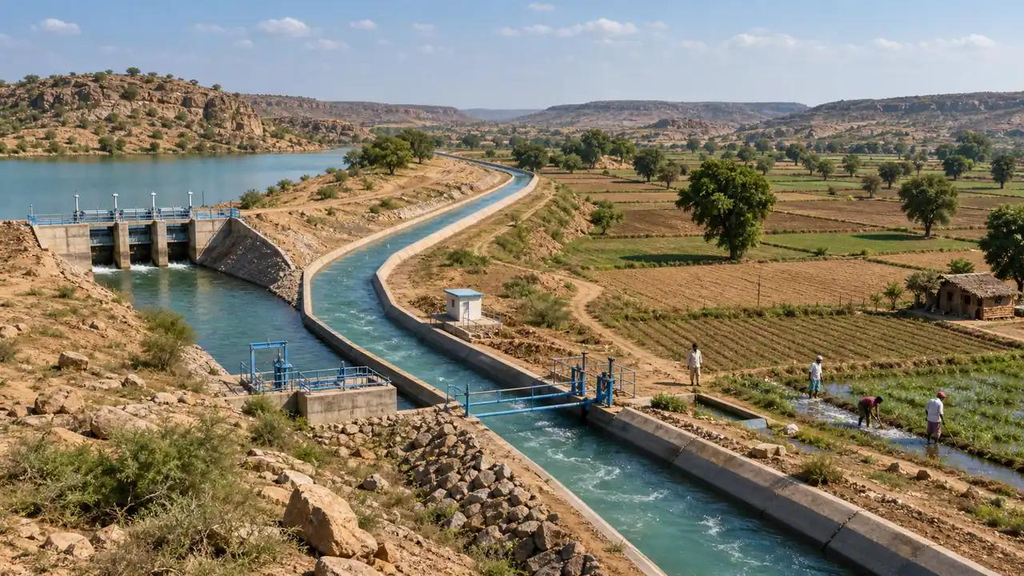
It is intended to transfer water from the Ken River basin to the Betwa River basin, addressing water-supply and irrigation challenges in the Bundelkhand region of Madhya Pradesh and Uttar Pradesh.
The project involves the Daudhan Dam on the Ken River, a link canal and associated infrastructure.
According to the Ministry of Jal Shakti’s August 2026 update, the project has an estimated cost of ₹44,605 crore and is envisaged to provide irrigation to approximately 11.88 lakh hectares, drinking water to about 62 lakh people, and 103 MW of hydropower along with 27 MW of solar power.
These are projected benefits, not a guarantee that every intended outcome will be achieved. Actual results will depend on implementation, water availability, distribution systems, rehabilitation and environmental management.
The project has also attracted attention because of concerns relating to forest land, biodiversity, the Panna landscape, submergence and the rehabilitation of affected communities.
The broader lesson is that river interlinking involves much more than constructing a canal between two rivers. It requires coordination across engineering, ecology, water allocation, land acquisition and social safeguards.
Official references:
- PIB — Status of National Rivers Interlinking Programme
- Ken–Betwa Link Project Authority — Project Documents and Environmental Assessments
5. Major Concerns and Challenges
5.1 The difficulty of identifying a genuine water surplus
The concept of a surplus river basin requires careful scrutiny.
A basin may experience high flows during the monsoon but face shortages during other seasons. Water that appears to be available for transfer may already support agriculture, drinking water, industries, fisheries, wetlands, river ecosystems and downstream communities.
Determining a transferable surplus therefore requires consideration of existing use, future demand, environmental flows and seasonal variation.
Climate change makes this assessment more complex. A basin’s historical water availability cannot automatically be treated as a reliable forecast of future supply.
Interlinking decisions should consequently be based on transparent, periodically updated basin-level water budgets.
5.2 Ecological impacts and river health
Rivers are dynamic ecosystems, not simply channels that transport water.
Their flows support fish migration, sediment transport, wetlands, floodplains, groundwater recharge and downstream habitats. Dams and diversion structures can change the timing and volume of flows, alter sediment movement and fragment habitats.
Large infrastructure projects can also affect forests and wildlife, particularly where reservoirs and associated construction occupy ecologically sensitive areas.
Environmental assessment should therefore consider the entire river basin and its ecological connections, not just the immediate construction site.
Environmental safeguards must be implemented throughout the project lifecycle, supported by independent monitoring and enforceable corrective measures.
5.3 Displacement and rehabilitation
Dams, reservoirs and canals may require the acquisition of land and the relocation of households.
Displacement can affect agricultural livelihoods, access to forests, community networks, cultural sites and traditional resource rights. Monetary compensation alone may not fully restore these losses.
Fair rehabilitation requires accurate identification of affected households, transparent compensation, timely resettlement, restoration of livelihoods and meaningful participation by affected communities.
Where forest rights and tribal rights apply, the relevant legal safeguards must be respected.
A project cannot be considered socially successful merely because construction targets are met. The welfare of affected populations is an essential measure of its performance.
5.4 Interstate disputes and cooperative federalism
Rivers often cross state boundaries. Water allocation can therefore involve competing demands from upstream and downstream states.
Even where two states agree to a project, disagreements may arise over the quantity of water available, seasonal releases, the sharing of costs, operating rules and future changes in demand.
Water is primarily a State subject under the Constitution, although the Union has important responsibilities relating to inter-state rivers and water disputes.
River interlinking requires sustained cooperation between the Union government, participating states and relevant institutions. Agreements must specify allocation principles, monitoring arrangements, dispute-resolution mechanisms and responses to drought conditions.
Without such arrangements, infrastructure may create new political and legal conflicts rather than resolving existing water stress.
5.5 High financial and energy costs
Large dams, canals, tunnels and transfer systems require substantial capital investment. Costs can increase because of land acquisition, geological conditions, rehabilitation, construction delays and changes in project design.
Operating costs also matter. Where water must be pumped across considerable distances or elevations, electricity consumption can be substantial.
A proper cost-benefit assessment should consider the full project lifecycle, including construction, operation, maintenance, rehabilitation and environmental management.
The benefits should be compared with alternative investments such as watershed restoration, local storage, irrigation efficiency and wastewater reuse.
5.6 Flood control is not guaranteed
River interlinking is sometimes presented as a comprehensive solution to India’s flood problem. This claim should be treated cautiously.
Floods can result from extreme rainfall within a basin, inadequate drainage, saturated soils, reservoir operations, riverbank encroachment and floodplain development.
Transferring water between basins may help manage some flows under suitable conditions, but it cannot eliminate the causes of flooding.
Flood management requires basin-level forecasting, floodplain zoning, wetland protection, improved drainage, reservoir coordination and preparedness at the local level.
5.7 The danger of supply-side thinking
A major limitation of large water-transfer projects is that they can encourage policymakers to focus primarily on increasing supply.
Yet water scarcity also reflects demand-side problems: inefficient irrigation, water-intensive cropping in unsuitable regions, leakage in distribution systems, groundwater over-extraction, inadequate wastewater reuse and weak regulation.
If these issues remain unresolved, additional water may create only temporary relief while consumption continues to rise.
Sustainable water security requires a balance between augmenting supply and managing demand.
6. River Interlinking and Climate Change
Climate change complicates the assumptions underlying large water-transfer projects.
Changes in monsoon behaviour, extreme rainfall, glacier dynamics and seasonal runoff may affect the timing and reliability of river flows. Some basins may experience greater variability, while others may face longer dry periods or changes in the availability of water during critical seasons.
This has three major implications.
First, the identification of surplus and deficit basins must be based on forward-looking climate scenarios, not merely historical hydrological records.
Second, projects must be designed to remain functional under a range of possible conditions, including prolonged droughts and extreme rainfall.
Third, water-sharing agreements must provide for situations in which the source basin itself experiences scarcity.
A climate-resilient project should include periodic reassessment, transparent monitoring and the capacity to modify operating rules when conditions change.
7. Alternatives and Complementary Measures
River interlinking should be assessed alongside other approaches to water security. In many locations, a combination of local and basin-level measures may be more cost-effective, environmentally appropriate and socially acceptable than a large transfer project.
7.1 Watershed development
Watershed management seeks to improve the conservation and use of rainfall within a defined drainage area.
Measures can include contour bunding, check dams where appropriate, vegetative barriers, soil-moisture conservation and the restoration of degraded catchments.
These interventions can reduce runoff, support groundwater recharge and improve agricultural resilience. Their effectiveness depends on local geology, rainfall, maintenance and the scale of intervention.
7.2 Groundwater recharge and sustainable extraction
Groundwater is a crucial source of water for households, agriculture and industry. Recharge structures, protection of recharge zones, restoration of local water bodies and regulation of excessive extraction can improve groundwater sustainability where hydrogeological conditions permit.
However, recharge measures alone cannot compensate for unlimited pumping. Groundwater governance must connect recharge with extraction limits, crop choices and local water budgeting.
7.3 Efficient irrigation
Micro-irrigation systems, improved irrigation scheduling, soil-moisture monitoring and better canal management can reduce water losses and improve the productivity of water use.
These measures must be selected according to crop type, soil, climate and local conditions. Efficiency gains should also be accompanied by suitable incentives so that saved water is not simply used to expand water-intensive cultivation.
7.4 Crop diversification
Agricultural policy can support a shift towards crops suited to local agro-climatic conditions and water availability.
This may involve improving market access, procurement arrangements, processing infrastructure, extension services and risk management for farmers.
Crop diversification is not merely a technical question. Farmers need viable economic alternatives before they can move away from established cropping patterns.
7.5 Wastewater treatment and reuse
Treated wastewater can supplement water supplies for certain industrial uses, landscaping, construction and other applications where quality standards are met.
Reusing wastewater can reduce pressure on freshwater sources, particularly in urban and industrial areas.
Successful implementation requires reliable treatment infrastructure, monitoring, public-health safeguards and clear standards for different uses.
7.6 Restoration of tanks, lakes and traditional water systems
Traditional water-harvesting systems and local storage structures can provide valuable supplementary sources, particularly in regions with established community water-management practices.
Restoring these systems can improve local resilience while preserving cultural and ecological assets.
Such interventions should be based on hydrological suitability and accompanied by maintenance arrangements and community participation.
8. The Way Forward: A Sustainable Framework for Water Security
India needs a water-management framework that combines appropriate infrastructure with ecological safeguards, demand management and cooperative governance.
First, adopt basin-level planning. Decisions about water transfer should consider the entire source and receiving basins, including existing uses, environmental flows, groundwater interactions and future demand.
Second, strengthen independent assessment. Hydrological assumptions, economic projections, environmental impacts and rehabilitation plans should be publicly accessible and open to scrutiny. Independent evaluation should continue after project approval.
Third, make climate resilience central to project design. Feasibility assessments should include different rainfall and runoff scenarios, prolonged drought conditions and the possibility that projected surpluses may not materialise.
Fourth, prioritise ecological safeguards. Environmental flows, biodiversity protection, forest conservation and the functioning of wetlands must be incorporated into operating rules and monitored over time.
Fifth, ensure fair rehabilitation. Affected communities should participate meaningfully in project planning, receive lawful compensation and have access to livelihood restoration and effective grievance redressal.
Sixth, improve interstate cooperation. Participating states should agree on transparent allocation principles, data sharing, monitoring, operating procedures and dispute resolution before conflicts emerge.
Seventh, strengthen demand management. Irrigation efficiency, sustainable groundwater use, crop diversification, wastewater reuse and local water conservation should be pursued alongside major infrastructure projects.
Finally, evaluate alternatives transparently. Every major link should be compared with feasible alternatives on the basis of economic costs, social consequences, ecological impacts, water reliability and long-term resilience.
The objective should not be to maximise the volume of water transferred. It should be to maximise sustainable and equitable access to water.
Conclusion
River interlinking represents an ambitious attempt to address India’s uneven distribution of water and growing demand for irrigation and drinking water. Under suitable conditions, carefully designed inter-basin transfers may provide meaningful benefits to selected regions.
However, rivers cannot be treated as independent reservoirs of surplus water waiting to be redistributed. They form interconnected ecological systems that support livelihoods, biodiversity and downstream communities. Their flows are also shaped by climatic variability and competing demands.
India’s water crisis cannot be solved by engineering infrastructure alone. It requires better water governance, ecological conservation, efficient irrigation, sustainable groundwater management, responsible urban water use and cooperation among states.
The most effective approach is therefore neither to accept every river-linking proposal uncritically nor to reject inter-basin transfers categorically. Each project should be assessed on its own merits, with transparent evidence, realistic hydrological assumptions and enforceable environmental and social safeguards.
India’s long-term water security will depend on managing water as a shared ecological and economic resource—not merely on moving it from one river to another.
UPSC Relevance
GS Paper I: Indian geography, river systems, monsoon, regional variations in water availability and human-environment interactions.
GS Paper II: Federalism, inter-state relations, constitutional provisions relating to water, governance and institutional coordination.
GS Paper III: Irrigation, agriculture, environmental conservation, disaster management, infrastructure and sustainable development.
Essay: Water security, development versus environment, cooperative federalism and sustainable resource management.
Practice Questions
Mains question
River interlinking has the potential to improve water availability in selected regions, but it also raises serious ecological, economic and federal challenges. Critically examine the role of river interlinking in India’s long-term water security strategy.
Prelims practice question
Consider the following statements about India’s river-interlinking programme:
- The National Perspective Plan includes both Himalayan and peninsular components.
- The National Water Development Agency is entrusted with work relating to interlinking projects under the plan.
- Every identified interlinking project has already entered the implementation stage.
- Inter-basin water transfer can eliminate the need for groundwater management and demand-side conservation.
Which of the statements given above are correct?
(a) 1 and 2 only
(b) 1, 2 and 3 only
(c) 2 and 4 only
(d) 1, 2, 3 and 4
Answer: (a)
Explanation: The National Perspective Plan contains Himalayan and peninsular components, and the NWDA is responsible for work relating to the programme. Identification of a project does not mean it has entered implementation. River interlinking also cannot replace sustainable groundwater management or water-demand reduction.