
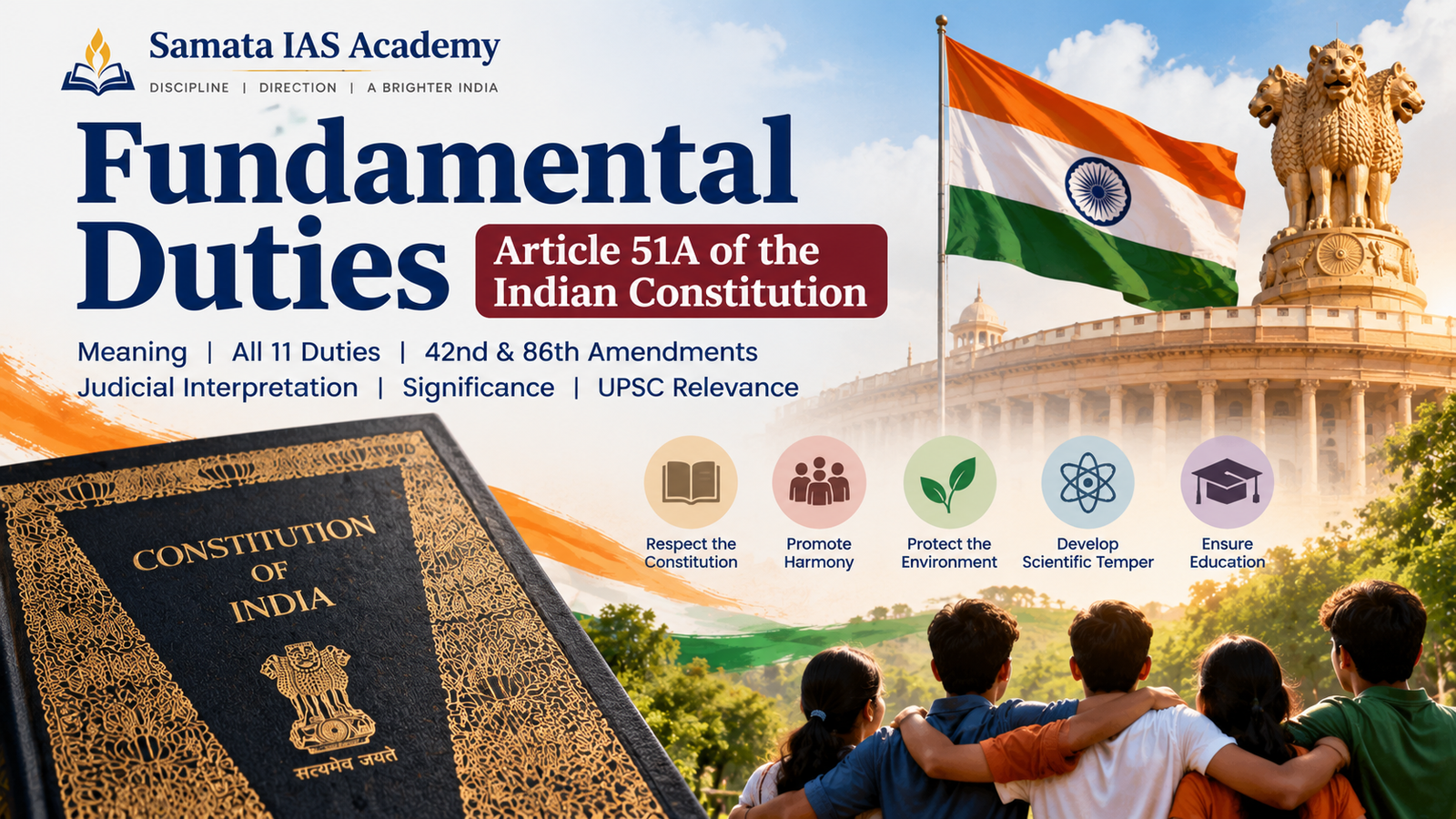
Fundamental Duties in the Indian Constitution: Article 51A, 42nd Amendment and UPSC Relevance
Introduction
The Constitution of India establishes a democratic political system based on justice, liberty, equality and fraternity. While Fundamental Rights protect the freedoms and entitlements of individuals, and the Directive Principles of State Policy guide the State towards social and economic justice, Fundamental Duties emphasise the responsibilities of citizens towards the Constitution, society and the nation.
Fundamental Duties are contained in Part IVA, Article 51A, of the Indian Constitution. They identify responsibilities such as respecting the Constitution and national symbols, protecting the sovereignty and integrity of India, promoting harmony, preserving cultural heritage, protecting the environment, developing scientific temper and safeguarding public property.
The Constitution originally contained a detailed chapter on Fundamental Rights and a separate chapter on Directive Principles, but it did not include an explicit list of Fundamental Duties. These duties were incorporated through the 42nd Constitutional Amendment Act, 1976, on the recommendation of the Swaran Singh Committee. An additional duty concerning educational opportunities for children was introduced by the 86th Constitutional Amendment Act, 2002.
Fundamental Duties are important for the UPSC Civil Services Examination because they connect constitutional morality, responsible citizenship, environmental protection, national integration and the relationship between individual liberty and collective welfare.
For conceptual continuity, aspirants should also study Fundamental Rights and the Directive Principles of State Policy.
1. Meaning and constitutional position of Fundamental Duties
Fundamental Duties are constitutional responsibilities expected of citizens in their relationship with the nation, the constitutional order and society.
They express the idea that citizenship involves not only enjoying rights but also contributing to the preservation and effective functioning of democratic institutions.
For example:
- Citizens are expected to respect the Constitution, its ideals and institutions.
- They should promote harmony and common brotherhood across religious, linguistic, regional and sectional differences.
- They should protect the natural environment and show compassion towards living creatures.
- They should develop scientific temper, humanism and a spirit of inquiry and reform.
- Parents and guardians should provide opportunities for education to children or wards between six and fourteen years of age.
Fundamental Duties are not all directly enforceable through courts merely because they appear in Article 51A. Nevertheless, they have constitutional significance and may inform legislation, judicial interpretation and public policy.
A law may prescribe enforceable consequences for conduct connected with a Fundamental Duty. In such cases, the legal obligation arises from the relevant law, subject to constitutional scrutiny, rather than automatically from Article 51A alone.
Constitutional location
| Constitutional provision | Subject |
|---|---|
| Part III, Articles 12–35 | Fundamental Rights |
| Part IV, Articles 36–51 | Directive Principles of State Policy |
| Part IVA, Article 51A | Fundamental Duties |
This structure reflects three complementary dimensions of the constitutional framework: rights, principles of governance and civic responsibilities.
2. Historical background: Why were Fundamental Duties introduced?
2.1 Absence of Fundamental Duties in the original Constitution
When the Constitution came into force on 26 January 1950, it contained Fundamental Rights and Directive Principles but did not contain a separate list of Fundamental Duties.
The Constitution-makers placed considerable emphasis on safeguarding individual freedom, preventing arbitrary State action and creating institutions for democratic governance. They also expected citizens to participate responsibly in public life.
However, there was no explicit constitutional list corresponding to the Fundamental Duties subsequently introduced in Part IVA.
2.2 The Swaran Singh Committee
During the 1970s, the question of explicitly identifying citizens’ duties received renewed attention.
The Swaran Singh Committee, constituted in 1976, recommended the inclusion of Fundamental Duties in the Constitution.
The recommendations were considered in the context of the wider constitutional changes undertaken during the Emergency period. The government subsequently incorporated Fundamental Duties through the 42nd Constitutional Amendment Act, 1976.
2.3 The 42nd Constitutional Amendment Act, 1976
The 42nd Amendment inserted Part IVA and Article 51A, initially containing ten Fundamental Duties.
The amendment sought to emphasise that citizens should contribute to national unity, respect constitutional institutions, preserve cultural heritage and support the broader public interest.
The introduction of Fundamental Duties did not make them equivalent to Fundamental Rights. Their constitutional status and enforceability remain distinct.
2.4 The 86th Constitutional Amendment Act, 2002
The 86th Constitutional Amendment Act, 2002, added Article 51A(k), introducing an educational responsibility for parents and guardians.
It provides that a parent or guardian should provide opportunities for education to their child or ward between six and fourteen years of age.
The amendment also introduced Article 21A, which establishes the Fundamental Right to free and compulsory education for children aged six to fourteen, and revised Article 45 concerning early childhood care and education.
These changes demonstrate how constitutional rights, duties and policy principles can work together to advance a common objective.
3. The 11 Fundamental Duties under Article 51A
Article 51A contains 11 Fundamental Duties. The first ten were introduced by the 42nd Amendment in 1976, while the eleventh was added by the 86th Amendment in 2002.
The following table presents all eleven duties in a student-friendly format. For legal precision, consult the official Constitution of India and constitutional amendments.
| Clause | Fundamental Duty | Explanation |
|---|---|---|
| Article 51A(a) | Respect for the Constitution, its ideals and institutions, the National Flag and the National Anthem | Citizens should uphold constitutional values and respect national symbols and institutions. |
| Article 51A(b) | Cherish and follow the noble ideals that inspired the national struggle for freedom | Citizens should uphold ideals such as liberty, equality, justice, non-violence and sacrifice associated with the freedom movement. |
| Article 51A(c) | Uphold and protect the sovereignty, unity and integrity of India | Citizens should support India’s independence, territorial integrity and national unity. |
| Article 51A(d) | Defend the country and render national service when called upon to do so | Citizens have a constitutional responsibility to defend the country and provide national service when required. |
| Article 51A(e) | Promote harmony and the spirit of common brotherhood; renounce practices derogatory to the dignity of women | Citizens should foster social harmony and reject practices that undermine women’s dignity. |
| Article 51A(f) | Value and preserve the rich heritage of India’s composite culture | Citizens should respect and help preserve India’s diverse cultural traditions and heritage. |
| Article 51A(g) | Protect and improve the natural environment, including forests, lakes, rivers and wildlife, and show compassion for living creatures | Citizens should support environmental conservation, biodiversity protection and compassion towards living beings. |
| Article 51A(h) | Develop scientific temper, humanism and the spirit of inquiry and reform | Citizens should cultivate rational thinking, evidence-based reasoning, humanism and openness to reform. |
| Article 51A(i) | Safeguard public property and abjure violence | Citizens should protect public assets and reject violence as a means of resolving disputes. |
| Article 51A(j) | Strive towards excellence in all spheres of individual and collective activity | Citizens should work towards higher standards of achievement so that the nation continually advances. |
| Article 51A(k) | Provide opportunities for education to one’s child or ward between six and fourteen years of age, as a parent or guardian | Parents and guardians should support children’s access to education. |
3.1 Respect for the Constitution and national symbols — Article 51A(a)
This duty requires citizens to respect the Constitution, its ideals and institutions, the National Flag and the National Anthem.
Respect for the Constitution extends beyond ceremonial observance. It involves recognising constitutional democracy, the rule of law, equality, liberty, institutional accountability and the legitimacy of constitutional processes.
The duty does not eliminate citizens’ freedom to criticise government policies or public institutions. Democratic criticism, peaceful protest and lawful dissent can themselves contribute to constitutional governance.
3.2 Cherishing the ideals of the freedom struggle — Article 51A(b)
India’s freedom movement involved diverse political, social and intellectual traditions. Its ideals included the pursuit of independence, popular participation, social reform, equality and opposition to colonial domination.
This duty encourages citizens to preserve the values that inspired the national movement rather than treating independence merely as a historical event.
Its relevance extends to civic participation, respect for democratic institutions and resistance to discrimination and injustice.
3.3 Protecting sovereignty, unity and integrity — Article 51A(c)
Sovereignty refers to India’s independent authority as a state. Unity and integrity concern the preservation of the country’s political unity and territorial integrity.
The duty is relevant to national integration, constitutional patriotism and the peaceful management of India’s social and regional diversity.
It should be interpreted consistently with the Constitution’s democratic framework and the rights of citizens.
3.4 Defending the country and rendering national service — Article 51A(d)
Article 51A(d) requires citizens to defend the country and render national service when called upon to do so.
The duty recognises that national security and public safety are not solely matters for government institutions. Citizens may also have responsibilities under applicable laws.
The provision does not independently establish a universal requirement for compulsory military service. Its operation must be understood in the context of lawful requirements and the constitutional framework.
3.5 Promoting harmony and respecting women’s dignity — Article 51A(e)
This clause combines two closely related responsibilities.
First, citizens should promote harmony and the spirit of common brotherhood across religious, linguistic, regional and sectional diversities.
Second, they should renounce practices derogatory to the dignity of women.
The provision is relevant to communal harmony, gender equality, social inclusion and the rejection of discriminatory customs.
India’s diversity is a constitutional and social reality. Promoting harmony does not require eliminating cultural differences; it requires respecting diversity while sustaining common citizenship and constitutional values.
3.6 Preserving India’s composite cultural heritage — Article 51A(f)
India’s cultural heritage has developed through centuries of interaction among different linguistic, religious, artistic, philosophical and regional traditions.
The term composite culture recognises this shared and diverse inheritance.
This duty is relevant to the preservation of monuments, traditional knowledge, literature, performing arts, handicrafts, languages and historical sites.
It also encourages citizens to understand cultural heritage as a shared responsibility rather than the exclusive property of one community.
3.7 Protecting the environment — Article 51A(g)
Article 51A(g) directs citizens to protect and improve the natural environment, including forests, lakes, rivers and wildlife, and to show compassion for living creatures.
Environmental protection is one of the clearest examples of a Fundamental Duty with contemporary policy relevance.
Citizens can contribute through responsible resource use, pollution prevention, biodiversity conservation and sustainable consumption.
The provision should be read alongside Article 48A, which directs the State to protect and improve the environment and safeguard forests and wildlife.

Image placement: Environmental conservation. The image illustrates the relationship between the State’s responsibility under Article 48A and citizens’ duty under Article 51A(g).
The connection between these provisions is important: environmental protection requires both public policy and responsible civic behaviour.
3.8 Developing scientific temper — Article 51A(h)
Article 51A(h) asks citizens to develop scientific temper, humanism and the spirit of inquiry and reform.
Scientific temper involves examining claims critically, relying on evidence, questioning unsupported assertions and remaining willing to revise conclusions when new evidence emerges.
Humanism emphasises human dignity and concern for the well-being of others. The spirit of inquiry and reform encourages society to identify harmful practices and pursue improvements through reasoned debate.
This duty is relevant to scientific literacy, public health communication, innovation, education and the responsible use of technology.
For UPSC aspirants, it also illustrates the relationship between constitutional values and the development of a rational, evidence-oriented society.
3.9 Safeguarding public property and rejecting violence — Article 51A(i)
Public property includes assets such as public buildings, roads, railway infrastructure and other facilities maintained for collective use.
Damage to public property imposes costs on society, disrupts public services and may disproportionately affect disadvantaged citizens.
Article 51A(i) therefore encourages citizens to protect public assets and reject violence.
The duty does not prohibit peaceful demonstrations or lawful political protest. It emphasises the protection of public property and the rejection of violence.
3.10 Striving towards excellence — Article 51A(j)
Article 51A(j) encourages citizens to strive towards excellence in all spheres of individual and collective activity so that the nation continually rises to higher levels of endeavour and achievement.
Excellence may involve professional competence, scientific research, ethical public service, educational achievement, innovation, sports, art and institutional performance.
The duty emphasises that national development depends not only on government programmes but also on the quality of individual and collective effort.
3.11 Providing educational opportunities to children — Article 51A(k)
Article 51A(k) requires every parent or guardian to provide opportunities for education to their child or ward between six and fourteen years of age.
It was added by the 86th Constitutional Amendment Act, 2002.
This duty complements Article 21A, which establishes the right to free and compulsory education for children aged six to fourteen years.
The relationship is significant because the State has constitutional responsibilities concerning educational access, while parents and guardians also have a duty to facilitate children’s education.
The provision should not be interpreted as transferring the State’s responsibility for providing free and compulsory education entirely to parents.
4. Legal nature and enforceability of Fundamental Duties
Fundamental Duties are constitutional provisions, but their legal operation differs from that of Fundamental Rights.
Article 51A does not generally provide a direct judicial remedy for every alleged failure to perform a duty. Nevertheless, Parliament and State Legislatures may enact laws that promote or enforce conduct related to particular duties, subject to their constitutional powers and limitations.
For example, laws relating to environmental protection, prevention of damage to public property and protection of national symbols may give legal effect to conduct associated with Fundamental Duties.
The distinction can be summarised as follows:
| Aspect | Fundamental Duties |
|---|---|
| Constitutional location | Part IVA |
| Principal Article | Article 51A |
| Number of duties | 11 |
| Applicability | Expressly framed as duties of citizens, with Article 51A(k) addressing parents or guardians |
| Direct enforceability | Not generally independently enforceable merely through Article 51A |
| Legislative implementation | Particular duties may be supported by enforceable laws |
| Judicial relevance | May inform interpretation of laws and constitutional provisions |
| Principal purpose | Promote responsible citizenship and constitutional values |
A key point for UPSC is that non-justiciability does not mean constitutional irrelevance. Fundamental Duties can influence public policy, legislation and judicial reasoning even though they are not equivalent to enforceable Fundamental Rights.
5. Fundamental Duties and the Directive Principles of State Policy
Fundamental Duties and Directive Principles are complementary elements of the Constitution. However, they differ in their primary subjects and purposes.
The Directive Principles principally guide the State in making laws and formulating public policies. Fundamental Duties identify responsibilities expected of citizens.
The relationship becomes particularly clear in areas such as environmental protection, education, cultural preservation and national integration.
| Issue | Directive Principle | Fundamental Duty |
|---|---|---|
| Environmental protection | Article 48A: duty of the State to protect and improve the environment | Article 51A(g): duty of citizens to protect and improve the environment |
| Education | Article 45: early childhood care and education for children below six | Article 51A(k): parental or guardian responsibility for education of children aged six to fourteen |
| Social justice | Articles 38 and 46: welfare and protection of weaker sections | Article 51A(e): harmony and practices consistent with women’s dignity |
| Cultural heritage | Article 49: protection of monuments and objects of national importance | Article 51A(f): preservation of India’s composite cultural heritage |
| Governance | Part IV guides State policy | Part IVA encourages responsible citizenship |
The provisions should be understood as mutually reinforcing rather than interchangeable.
For example, environmental protection cannot be achieved solely through government regulation. It also requires responsible behaviour by individuals, communities and businesses. Similarly, educational development requires public provision, effective institutions and parental participation.
6. Fundamental Rights and Fundamental Duties: The constitutional relationship
Fundamental Rights and Fundamental Duties represent complementary dimensions of citizenship.
Fundamental Rights protect liberty, equality and dignity. Fundamental Duties emphasise the responsibilities associated with living in a constitutional democracy.
However, Fundamental Duties cannot be used as a blanket justification for restricting Fundamental Rights. Any restriction on a right must have an appropriate constitutional and legal basis.
| Basis | Fundamental Rights | Fundamental Duties |
|---|---|---|
| Constitutional location | Part III | Part IVA |
| Articles | 12–35 | 51A |
| Number | Multiple rights and protections | 11 enumerated duties |
| Principal orientation | Protect individual rights and freedoms | Promote responsible citizenship |
| Enforceability | Many rights are directly enforceable through courts | Not generally independently enforceable solely under Article 51A |
| Relationship with State | Impose constitutional obligations and limitations on State action | Guide civic conduct and may inform legislation |
| Example | Article 21: protection of life and personal liberty | Article 51A(g): environmental protection |
Constitutional balance
A democratic constitutional order requires both rights and responsibilities.
Citizens must be able to express disagreement, participate in political processes and seek legal remedies. At the same time, democratic participation should be accompanied by respect for the Constitution, public property, human dignity and the rights of others.
Therefore, the relationship between rights and duties should be understood through constitutional balance, rather than by treating duties as superior to rights.
7. Important judicial decisions relating to Fundamental Duties
Although Fundamental Duties are generally non-justiciable on their own, the Supreme Court has referred to them in several constitutional and statutory contexts.
7.1 AIIMS Students’ Union v. AIIMS (2001)
The Supreme Court discussed the constitutional significance of Fundamental Duties and recognised their relevance to interpreting constitutional and legal questions.
The decision is useful for understanding that duties can contribute to constitutional reasoning even without creating independent, directly enforceable claims in every instance.
7.2 M.C. Mehta v. Union of India — environmental jurisprudence
The Supreme Court’s environmental decisions in the M.C. Mehta line of cases have contributed to the development of environmental protection in Indian law.
Article 51A(g), together with Article 48A and the environmental dimensions of Article 21, provides a constitutional framework for understanding environmental responsibilities.
The environmental cases should be studied as a broader body of jurisprudence rather than as a single judgment dealing exclusively with Fundamental Duties.
7.3 Ramlila Maidan Incident v. Home Secretary, Union of India (2012)
The Supreme Court examined issues concerning civil liberties, public order and State action in the context of a public assembly.
The decision is relevant to the broader constitutional balance between individual freedoms, public order and responsible civic conduct. It should not be treated as establishing that Fundamental Duties automatically override Fundamental Rights.
7.4 General judicial approach
Courts may use Fundamental Duties to:
- Interpret ambiguous statutory provisions where legally appropriate.
- Understand the constitutional purpose of environmental and educational legislation.
- Assess the significance of public responsibilities in a democratic society.
- Support the constitutional objectives underlying valid legislation.
Nevertheless, the precise legal effect depends on the provision, statute and constitutional question involved.
8. Significance of Fundamental Duties in contemporary India
8.1 Strengthening constitutional culture
Fundamental Duties encourage citizens to respect constitutional institutions and democratic values.
Their significance lies in building a political culture in which citizens understand that democratic institutions require participation, accountability and respect for lawful processes.
8.2 Promoting national integration
Article 51A(c) concerns sovereignty, unity and integrity, while Article 51A(e) promotes harmony and common brotherhood.
Together, these duties are relevant to the management of India’s linguistic, religious, regional and cultural diversity.
National integration is most sustainable when it is based on constitutional citizenship, equality and mutual respect.
8.3 Environmental sustainability
Article 51A(g) establishes environmental protection as a citizen’s responsibility.
The provision is increasingly relevant to pollution prevention, conservation, waste management, biodiversity protection and sustainable resource use.
It also illustrates how environmental governance requires cooperation among government institutions, citizens, communities and businesses.
8.4 Scientific temper and innovation
Article 51A(h) promotes scientific temper, humanism and the spirit of inquiry and reform.
In a society experiencing rapid technological change, these values are important for scientific literacy, public understanding of evidence, innovation and the responsible use of emerging technologies.
Scientific temper also helps citizens distinguish between evidence-based conclusions and unsupported claims.
8.5 Gender dignity and social reform
Article 51A(e) explicitly calls for renouncing practices derogatory to the dignity of women.
The provision reinforces the constitutional commitment to gender equality and is relevant to debates on discrimination, violence against women, unequal opportunities and harmful social practices.
8.6 Protecting public assets
Article 51A(i) promotes the safeguarding of public property and the rejection of violence.
Public infrastructure is financed and maintained for collective use. Protecting these assets supports service delivery, public safety and the efficient use of public resources.
8.7 Improving education
Article 51A(k) connects parental responsibility with children’s access to education.
The provision is particularly relevant to school attendance, educational inclusion and the need to prevent children from being excluded from learning opportunities.
It complements the State’s responsibility under Article 21A and the policy objectives of Article 45.
9. Challenges in implementing Fundamental Duties
Despite their constitutional importance, several challenges affect the effective promotion of Fundamental Duties.
1. Limited public awareness: Many citizens are familiar with Fundamental Rights but less familiar with the specific duties listed in Article 51A.
2. Non-justiciability: Since the duties are not generally independently enforceable, their promotion depends substantially on education, civic participation, legislation and public institutions.
3. Selective interpretation: Particular duties may be emphasised without adequate attention to the constitutional values and rights that accompany them.
4. Weak civic education: Awareness of constitutional responsibilities is not always adequately integrated into everyday educational and civic practices.
5. Collective-action problems: Environmental protection and public-property conservation require coordination among individuals, communities, businesses and government institutions.
6. Confusion between duty and compulsion: A constitutional duty does not automatically create a criminal offence or an unrestricted power for the State to compel conduct. Enforceable obligations require an appropriate legal basis.
10. Measures to strengthen the observance of Fundamental Duties
The effective promotion of Fundamental Duties requires education, public participation and constitutional governance rather than an exclusive reliance on coercive measures.
Constitutional literacy
Schools, colleges and public institutions should promote an understanding of constitutional values, civic responsibilities and the relationship between rights and duties.
Integration into education
Constitutional education can connect Article 51A with environmental conservation, gender equality, scientific temper, cultural heritage and responsible citizenship.
Environmental participation
Citizen participation in waste reduction, water conservation, biodiversity protection and pollution prevention can translate Article 51A(g) into practical action.
Promotion of scientific temper
Educational institutions, research organisations and public agencies can encourage critical thinking, evidence-based debate and a spirit of inquiry.
Protection of public property
Public awareness, responsible protest practices and effective enforcement of applicable laws can help reduce damage to public assets.
Responsible use of legal mechanisms
Where Parliament or State Legislatures have enacted valid laws relating to particular duties, those laws should be implemented consistently with Fundamental Rights, due process and other constitutional requirements.
Democratic accountability
Governments, institutions and citizens should promote constitutional values through transparent governance, equal treatment, civic engagement and respect for lawful dissent.
11. Fundamental Duties: Important facts for UPSC Prelims
The following facts deserve particular attention:
- Fundamental Duties are contained in Part IVA of the Constitution.
- They are enumerated under Article 51A.
- The 42nd Constitutional Amendment Act, 1976, introduced the original 10 Fundamental Duties.
- The Swaran Singh Committee recommended the introduction of Fundamental Duties.
- The 86th Constitutional Amendment Act, 2002, added Article 51A(k).
- There are 11 Fundamental Duties at present.
- Fundamental Duties are expressly framed as duties of citizens, with Article 51A(k) specifically concerning parents or guardians.
- Article 51A(g) concerns environmental protection and compassion for living creatures.
- Article 51A(h) concerns scientific temper, humanism and the spirit of inquiry and reform.
- Article 51A(i) concerns public property and the rejection of violence.
- Article 51A(j) concerns striving towards excellence.
- Article 51A(k) concerns educational opportunities for children between six and fourteen years.
- Fundamental Duties are generally non-justiciable on their own, but legislation can create enforceable obligations related to particular duties.
- Fundamental Duties should not be treated as automatically overriding Fundamental Rights.
12. UPSC Mains: Analytical framework
Fundamental Duties can be used in answers concerning constitutionalism, national integration, environmental governance, gender justice, education, scientific temper and civic responsibility.
Illustrative question
“Fundamental Duties are essential for promoting responsible citizenship, but their effectiveness depends on more than constitutional recognition.” Discuss.
Suggested answer framework
Introduction: Explain Article 51A and the constitutional purpose of Fundamental Duties.
Body — Significance: Discuss constitutional culture, national integration, environmental protection, gender dignity, scientific temper and educational responsibility.
Body — Limitations: Examine limited public awareness, non-justiciability, selective interpretation and weak civic education.
Way forward: Suggest constitutional literacy, education, public participation, responsible institutions and enforcement of valid legislation.
Conclusion: Emphasise that democratic citizenship requires both protection of rights and responsible participation in constitutional life.
How to add value to Mains answers
Where relevant, connect Fundamental Duties with:
- Article 48A for environmental governance.
- Article 21A for education.
- Article 14 for equality.
- Article 19 for freedoms and the limits of restrictions.
- Article 37 for the constitutional position of Directive Principles.
- The Preamble for justice, liberty, equality and fraternity.
Use these connections only where they directly support the question. Listing constitutional Articles without explaining their relevance does not strengthen an answer.
Conclusion
Fundamental Duties represent the Constitution’s emphasis on responsible citizenship and the preservation of democratic values. Article 51A asks citizens to respect the Constitution, protect national unity, promote harmony, preserve cultural heritage, safeguard the environment, develop scientific temper and support the education of children.
Although these duties are generally not independently enforceable through courts, they remain constitutionally significant. Their implementation can be strengthened through education, public participation, appropriate legislation and respect for constitutional freedoms.
Ultimately, Fundamental Rights, Directive Principles and Fundamental Duties should be understood as complementary elements of India’s constitutional framework. Together, they connect individual liberty, social transformation and civic responsibility in the pursuit of a democratic and just society.
Internal links incorporated
- Fundamental Rights in the Indian Constitution
- Directive Principles of State Policy
- Indian Polity and Constitution
- UPSC Polity Study Material