
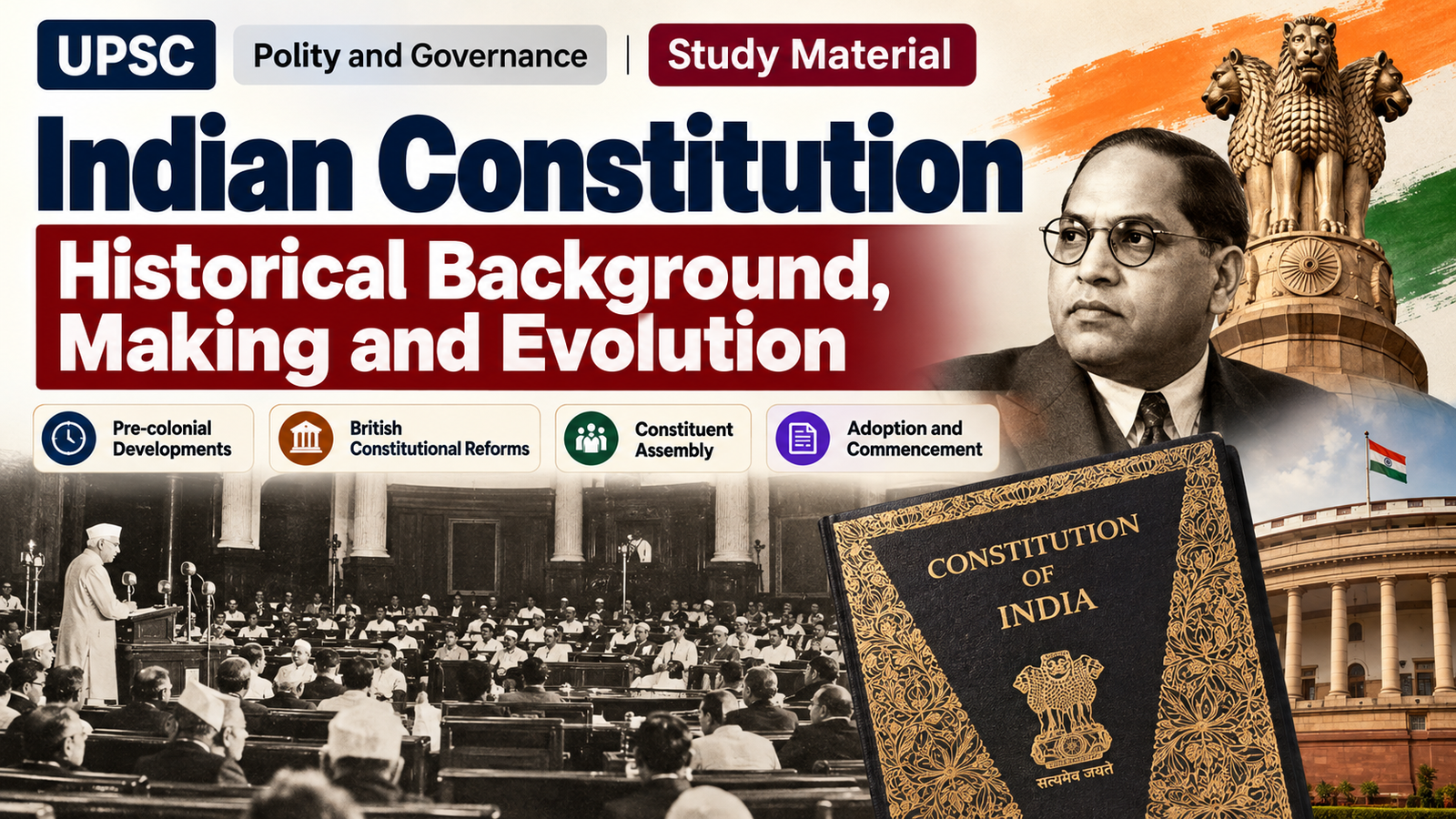
Indian Constitution: Historical Background, Making and Evolution
The Indian Constitution is the product of a long process of constitutional development, political struggle, institutional experimentation and constitution-making. It did not emerge suddenly in 1949. Its foundations can be traced through the constitutional reforms introduced during British rule, the growth of representative institutions, the demand for self-government and, ultimately, the work of the Constituent Assembly of India.
For UPSC Civil Services Examination preparation, understanding the historical background of the Indian Constitution is important because many provisions of the present constitutional system have institutional roots in the colonial period, while the Constitution simultaneously represents a decisive break from colonial rule.
This study material examines the constitutional development in India, the major British Acts, the evolution and functioning of the Constituent Assembly, the drafting process, the sources of the Constitution, its adoption and commencement, and the significance of the Constitution as a living document.
For a broader understanding of Indian Polity, students can also refer to Samata IAS Academy’s [Indian Polity & Constitution study resource] Indian Polity & Constitution — Samata IAS Academy.
Suggested image caption: The Constitution of India emerged from a long process of constitutional development and constitution-making.
1. Why Did India Need a Constitution?
A constitution establishes the fundamental framework within which the political system of a country operates.
It determines:
- the structure of government;
- distribution of powers;
- relationship between different organs of the state;
- relationship between the Union and the States;
- rights of citizens;
- institutional mechanisms for accountability;
- procedures for exercising political power; and
- broad objectives of governance.
In India’s case, the need for a Constitution was particularly significant because independent India inherited a society characterised by enormous social, economic, linguistic, religious and regional diversity.
The Constitution therefore had to perform two seemingly different tasks:
Create a common political framework while accommodating India’s extraordinary diversity.
It also had to transform India from a colonial system of government into a sovereign democratic republic based on popular sovereignty.
The Constitution therefore represents both:
Continuity with the past
and
A fundamental transformation of the political order.
2. Constitutional Development Before 1858
The British initially came to India primarily for commercial purposes. However, the expansion of the East India Company’s political power created the need for parliamentary supervision.
The British Parliament gradually introduced laws regulating the administration of British territories in India.
The major milestones of this constitutional development in India were:
| Year | Act | Major Significance |
|---|---|---|
| 1773 | Regulating Act | First major parliamentary intervention in Company’s administration |
| 1784 | Pitt’s India Act | Established system of dual control |
| 1793 | Charter Act | Continued Company’s privileges |
| 1813 | Charter Act | Ended Company’s trade monopoly except specified areas |
| 1833 | Charter Act | Centralised legislative authority and created Governor-General of India |
| 1853 | Charter Act | Separated legislative and executive functions to some extent |
These measures gradually transformed the East India Company from a commercial organisation into an administrative authority operating under increasing parliamentary supervision.
3. Regulating Act, 1773
The Regulating Act of 1773 was the first major step by the British Parliament to regulate the affairs of the East India Company in India.
Major provisions
The Act:
- recognised the political significance of the Company’s territories;
- made the Governor of Bengal the Governor-General of Bengal;
- established an Executive Council of four members;
- subordinated the Presidencies of Bombay and Madras to Bengal in specified matters;
- established the Supreme Court at Calcutta in 1774; and
- introduced parliamentary supervision over Company affairs.
Constitutional significance
The importance of the Act lies not merely in its administrative provisions.
It marked the beginning of a process through which:
The administration of India gradually became a matter of constitutional and parliamentary concern in Britain.
4. Pitt’s India Act, 1784
The Pitt’s India Act of 1784 introduced a system commonly described as dual control.
The Company continued to possess commercial functions, while political affairs came under greater supervision by the British Government.
A Board of Control was established to supervise the Company’s political and administrative affairs.
Thus, two authorities operated simultaneously:
Court of Directors
→ Company administration
Board of Control
→ British Government’s political supervision
This arrangement strengthened the authority of the British Government over Indian administration.
UPSC significance
The Act is important for understanding the gradual movement from:
Company rule → Parliamentary control → Crown rule
5. Charter Acts and Increasing Centralisation
The Charter Acts further transformed the institutional structure of British India.
Charter Act, 1813
The Act:
- ended the Company’s trade monopoly in India, except for trade in tea and trade with China;
- permitted Christian missionaries to operate in India; and
- increased British governmental involvement in education and administration.
Charter Act, 1833
The Charter Act of 1833 was particularly significant.
It:
- made the Governor-General of Bengal the Governor-General of India;
- centralised legislative authority;
- ended the Company’s remaining commercial functions;
- strengthened legislative centralisation; and
- provided for the establishment of a Law Commission.
Lord William Bentinck became the first Governor-General of India.
The Act therefore represented a major step towards administrative centralisation.
Charter Act, 1853
The Charter Act of 1853:
- separated the legislative and executive functions of the Governor-General’s Council to a greater extent;
- expanded the legislative council;
- introduced an element of open competition for recruitment to the civil services.
Although representative government was still far away, these reforms contributed to the gradual evolution of modern administrative institutions.
6. Government of India Act, 1858
The Revolt of 1857 fundamentally changed the constitutional structure of British India.
The Government of India Act, 1858 abolished the rule of the East India Company and transferred the administration of India directly to the British Crown.
Major provisions
The Act:
- abolished the East India Company’s political authority;
- transferred governance to the British Crown;
- created the office of the Secretary of State for India;
- established a Council to assist the Secretary of State;
- transferred the powers of the Company’s Court of Directors to the Crown; and
- replaced the Governor-General’s Company-era position with the office of Viceroy as the Crown’s representative in India.
Lord Canning became the first Viceroy of India.
Constitutional significance
The year 1858 marks a major constitutional transition:
Company Rule → Crown Rule
However, the transfer of power did not mean representative government. Political power remained concentrated in British hands.
Suggested image caption: Colonial constitutional legislation provided several institutional precedents that later influenced India’s constitutional development.
7. Indian Councils Act, 1861
The Indian Councils Act of 1861 introduced several important changes.
It:
- restored legislative powers to the Bombay and Madras Presidencies;
- expanded the Governor-General’s legislative council;
- introduced the principle of associating Indians with legislative councils; and
- recognised the portfolio system.
Although the participation of Indians remained extremely limited, the Act represented an early movement towards legislative consultation.
8. Indian Councils Act, 1892
The Indian Councils Act, 1892 expanded legislative councils and increased the participation of Indians.
The Act:
- increased the number of members in legislative councils;
- allowed discussion of the budget;
- permitted members to ask questions, subject to limitations; and
- introduced an indirect electoral principle for selecting some members.
The system remained far from democratic representation, but it created an institutional foundation for later representative politics.
9. Indian Councils Act, 1909 — Morley-Minto Reforms
The Indian Councils Act, 1909, commonly known as the Morley-Minto Reforms, introduced important changes in legislative representation.
Major features
- Legislative councils were enlarged.
- Indians were given greater representation.
- The principle of election was expanded.
- Separate electorates for Muslims were introduced.
The introduction of separate electorates had long-term political consequences and contributed to the development of communal representation.
UPSC perspective
The 1909 reforms are important because they illustrate how constitutional arrangements can influence political identity and representation.
10. Government of India Act, 1919
The Government of India Act, 1919, also known as the Montagu-Chelmsford Reforms, represented another important stage in constitutional development.
Major features
The Act introduced:
- dyarchy in the provinces;
- bicameralism at the Centre;
- direct elections on a wider basis;
- expansion of legislative councils; and
- greater participation of Indians in administration.
Under provincial dyarchy, subjects were divided into:
Reserved subjects
and
Transferred subjects
The system attempted to introduce limited responsible government while retaining substantial British control.
11. Government of India Act, 1935
The Government of India Act, 1935 was the most comprehensive constitutional legislation enacted by the British Parliament for India.
Its significance for the making of the Indian Constitution is particularly important because several institutional features of the present Constitution have antecedents in this Act.
Major provisions
The Act provided for:
- an All-India Federation;
- provincial autonomy;
- abolition of provincial dyarchy;
- a federal court;
- expanded legislative structures;
- division of legislative subjects;
- extension of the franchise; and
- institutional mechanisms for federal administration.
The proposed federation, however, never came into operation in the intended form.
Constitutional significance
The Government of India Act, 1935 influenced the institutional architecture inherited by independent India.
Its influence can be seen in areas such as:
- federal arrangements;
- public services;
- emergency administration;
- administrative structures;
- legislative distribution of powers; and
- provincial governance.
However, the Indian Constitution transformed these inherited structures within a democratic and republican framework.
12. Indian Independence Act, 1947
The Indian Independence Act, 1947 provided the legal framework for the transfer of power.
The Act:
- created the two Dominions of India and Pakistan;
- ended British sovereignty over India;
- ended the authority of the British Parliament over Indian constitutional affairs;
- provided for the partition of British India; and
- enabled the Constituent Assemblies of the two Dominions to function as sovereign legislative bodies.
Thus:
1773
↓
1858
↓
1909
↓
1919
↓
1935
↓
1947
marked successive stages in the transformation of India’s constitutional structure.
13. Evolution of the Idea of a Constituent Assembly
The idea that Indians should frame their own Constitution developed gradually during the nationalist movement.
The demand was based on the principle that:
The people of India should determine the constitutional framework of independent India.
The idea gained increasing political importance during the twentieth century.
The Constituent Assembly ultimately became the institutional mechanism through which representatives framed the Constitution of independent India.
The official records of the Constituent Assembly provide valuable primary material for understanding this process. The record of its first sitting on 9 December 1946 is available through the [Constitution of India Constituent Assembly Debates archive] Constituent Assembly Debates — 9 December 1946.
14. Formation of the Constituent Assembly
The Constituent Assembly was formed under the framework proposed by the Cabinet Mission Plan of 1946.
Its members were not elected through universal adult franchise.
Instead, members representing the provinces were elected indirectly by the provincial legislatures, while representatives of princely states were nominated by their respective rulers.
Original strength
The Constituent Assembly originally consisted of 389 members:
- 292 from British Indian provinces;
- 93 from princely states; and
- 4 from Chief Commissioners’ Provinces.
Following Partition, the strength was reduced to 299 members.
The Assembly therefore represented a broad spectrum of political and social interests, although its composition reflected the political circumstances of late colonial India.
Suggested image caption: Composition of the Constituent Assembly in 1946.
15. First Meeting of the Constituent Assembly
The Constituent Assembly held its first meeting on:
9 December 1946
at Constitution Hall in New Delhi.
Dr. Sachchidananda Sinha served as the temporary Chairman.
The official record of the first sitting records that the Assembly met at 11 a.m. on 9 December 1946. Constitution of India
Later:
- Dr. Rajendra Prasad became President of the Constituent Assembly.
- H.C. Mookherjee became Vice-President.
- B.N. Rau served as Constitutional Adviser.
The Assembly subsequently established several committees to undertake different aspects of constitution-making.
16. Objectives Resolution
One of the most important stages in the making of the Indian Constitution was the introduction of the Objectives Resolution by Jawaharlal Nehru.
It was introduced on:
13 December 1946
and adopted on:
22 January 1947.
The Objectives Resolution articulated the broad constitutional vision that was later reflected in the Preamble to the Constitution.
It emphasised ideas such as:
- sovereignty;
- democracy;
- justice;
- equality;
- freedom; and
- protection of the rights of the people.
It therefore provided an important philosophical foundation for the constitution-making process.
17. Major Committees of the Constituent Assembly
The Constituent Assembly created numerous committees to deal with different aspects of constitution-making.
Some of the most important included:
| Committee | Chairman |
|---|---|
| Union Powers Committee | Jawaharlal Nehru |
| Union Constitution Committee | Jawaharlal Nehru |
| Provincial Constitution Committee | Sardar Vallabhbhai Patel |
| Advisory Committee on Fundamental Rights, Minorities and Tribal Areas | Sardar Vallabhbhai Patel |
| Rules of Procedure Committee | Rajendra Prasad |
| Steering Committee | Rajendra Prasad |
| Drafting Committee | B.R. Ambedkar |
The committees divided the enormous task of constitution-making into manageable areas.
This committee system also demonstrates that the Constitution was not drafted by one individual.
It was the outcome of a collective deliberative process.
18. Drafting Committee
The Drafting Committee was established on:
29 August 1947
with Dr. B.R. Ambedkar as its Chairman.
The Committee played a central role in converting the decisions and reports of the Constituent Assembly’s various committees into a coherent constitutional document.
However, it is important for UPSC aspirants to understand that the Constitution was not simply “written by Ambedkar”.
The final document emerged from:
Committee reports
↓
Constituent Assembly debates
↓
Drafting process
↓
Amendments and deliberations
↓
Final Constitution
Dr. Ambedkar’s role as Chairman of the Drafting Committee was extraordinarily important, but constitution-making was fundamentally a collective exercise.
19. Role of B.N. Rau
B.N. Rau, the Constitutional Adviser to the Constituent Assembly, played an important role in the preparatory stages of constitution-making.
He examined constitutional systems from different countries and prepared constitutional material for consideration by the Assembly.
His work helped provide comparative constitutional perspectives to the constitution-makers.
This is one reason why the Indian Constitution reflects ideas derived from several constitutional traditions while adapting them to Indian conditions.
20. Sources of the Indian Constitution
The Indian Constitution drew upon several constitutional traditions.
However, the Constitution did not mechanically copy foreign provisions.
The constitution-makers examined existing constitutional institutions and adapted them according to India’s political, social and administrative circumstances.
| Source | Major Features Influencing the Constitution |
|---|---|
| Government of India Act, 1935 | Federal structure, administration, public services and several institutional provisions |
| United Kingdom | Parliamentary government, rule of law, legislative procedures |
| United States | Fundamental Rights, judicial review, impeachment and constitutional supremacy |
| Ireland | Directive Principles of State Policy |
| Canada | Federal system with a strong Centre |
| Australia | Concurrent List, trade and commerce provisions, joint sitting |
| Germany/Weimar | Emergency-related constitutional ideas |
| USSR | Fundamental Duties and broader ideological influence |
| France | Liberty, equality and fraternity |
| South Africa | Constitutional amendment procedure and election-related provisions |
The significance of these sources should therefore be understood through the principle of adaptation rather than imitation.
21. Adoption of the Constitution
After extensive deliberations, the Constituent Assembly adopted the Constitution on:
26 November 1949
The Preamble itself records that the Constitution was adopted, enacted and given to the people of India on this date. The current official text is available from the [Legislative Department, Government of India] Official Constitution of India — Legislative Department. Legislative Assembly of India
The adoption of the Constitution was therefore a decisive constitutional milestone.
However, the Constitution did not come into force immediately.
22. Commencement of the Constitution
The Constitution came into force on:
26 January 1950
The date was deliberately chosen because 26 January had acquired historical significance during the national movement following the declaration of Purna Swaraj in 1930.
Thus:
26 November 1949
Constitution adopted
26 January 1950
Constitution came into force
This distinction is extremely important for UPSC Prelims.
23. Original Constitution
At the time of commencement, the Constitution contained:
- 395 Articles
- 22 Parts
- 8 Schedules
The constitutional document has subsequently undergone extensive amendment.
The current Constitution therefore differs considerably in size and structure from the original document.
The official Constitution of India can be consulted through the [Legislative Department’s Constitution documents] Constitution of India — Legislative Department Documents.
For historical study, the original 1949 constitutional text is also preserved in the [Wikimedia Commons archive of the 1949 Constitution] Original Constitution of India — 1949 Archive.
24. Historical Timeline of Constitutional Development
Constitutional Development in India — UPSC Timeline
1773
Regulating Act
↓
1784
Pitt’s India Act
↓
1833
Charter Act — Governor-General of India
↓
1858
Government of India Act — Crown Rule
↓
1909
Morley-Minto Reforms — Separate Electorates
↓
1919
Montagu-Chelmsford Reforms — Dyarchy
↓
1935
Government of India Act — Provincial Autonomy and Federal Scheme
↓
1947
Indian Independence Act
↓
9 December 1946
First meeting of Constituent Assembly
↓
22 January 1947
Objectives Resolution adopted
↓
29 August 1947
Drafting Committee established
↓
26 November 1949
Constitution adopted
↓
26 January 1950
Constitution came into force
This timeline is particularly useful for UPSC Prelims revision.
25. Continuity and Change in the Indian Constitution
An important way of understanding the Constitution is through the relationship between continuity and transformation.
Several administrative institutions inherited from the colonial period continued after independence.
However, their constitutional purpose changed fundamentally.
Colonial system
Imperial authority
↓
Limited representation
↓
Administrative control
↓
Colonial objectives
Constitutional Republic
Popular sovereignty
↓
Universal adult franchise
↓
Fundamental Rights
↓
Parliamentary democracy
↓
Federalism
↓
Independent judiciary
↓
Constitutional government
Therefore, the Constitution represents both institutional continuity and political transformation.
This distinction is highly relevant for UPSC Mains.
26. Constitution as a Living Document
The Constitution is not a static document.
Indian constitutional development has continued through:
- constitutional amendments;
- judicial interpretation;
- parliamentary legislation;
- conventions;
- institutional practices;
- federal developments; and
- changing social and political circumstances.
A major example is the development of the Basic Structure Doctrine through Kesavananda Bharati v. State of Kerala in 1973.
The doctrine established that Parliament’s power to amend the Constitution is not unlimited.
Thus, the Constitution combines:
Stability
with
Adaptability
This balance is one of the central characteristics of India’s constitutional system.
27. Why the Historical Background Matters for UPSC
The historical background of the Indian Constitution is not merely a list of Acts and dates.
It helps explain why particular constitutional institutions developed in the way they did.
For example:
Government of India Act, 1935
helps explain aspects of:
- federal arrangements;
- administrative structures;
- public services; and
- legislative distribution.
British Constitutional Tradition
helps explain:
- parliamentary government;
- cabinet responsibility;
- rule of law;
- legislative procedures.
American Constitutional Tradition
helps explain:
- Fundamental Rights;
- judicial review;
- constitutional supremacy.
Irish Constitution
helps explain:
- Directive Principles of State Policy.
Therefore, constitutional history should be studied as a chain of institutional evolution, not as isolated facts.
28. UPSC Prelims Perspective
The following facts are particularly important for Preliminary Examination revision.
Regulating Act, 1773
- First major parliamentary intervention in Company administration.
- Governor-General of Bengal created.
- Supreme Court established at Calcutta.
Pitt’s India Act, 1784
- Introduced dual control.
- Board of Control established.
Charter Act, 1833
- Governor-General of Bengal became Governor-General of India.
- Legislative centralisation increased.
Government of India Act, 1858
- Company rule ended.
- Crown assumed direct control.
- Secretary of State for India created.
Indian Councils Act, 1909
- Separate electorates for Muslims introduced.
Government of India Act, 1919
- Dyarchy introduced in provinces.
- Bicameralism introduced at the Centre.
Government of India Act, 1935
- Provincial autonomy.
- Proposed federation.
- Federal Court.
- Expanded legislative arrangements.
Constituent Assembly
- First meeting: 9 December 1946
- Original strength: 389
- Post-Partition strength: 299
- Drafting Committee: 29 August 1947
Constitution
- Adopted: 26 November 1949
- Came into force: 26 January 1950
- Original Constitution: 395 Articles, 22 Parts and 8 Schedules
29. UPSC Mains Perspective
The historical background can be used in questions concerning:
- constitutional development;
- colonial legacy;
- Constituent Assembly;
- federalism;
- parliamentary government;
- Fundamental Rights;
- Directive Principles;
- constitutional morality;
- constitutional amendments;
- judicial review;
- Basic Structure Doctrine;
- democratic consolidation.
A strong Mains answer should not simply list constitutional Acts.
Instead, establish the relationship between:
Historical development
→ Institutional evolution
→ Constitution-making
→ Present constitutional system
30. Possible UPSC Mains Question
“The Constitution of India represents both continuity with the colonial administrative framework and a fundamental break from the colonial political system.” Discuss.
Approach
Introduction
Briefly explain that independent India inherited several administrative institutions but fundamentally transformed their political purpose.
Body
Discuss:
- Colonial institutional legacy
- Government of India Act, 1935
- Parliamentary system
- Federal arrangements
- Administrative continuity
- Fundamental Rights
- Universal adult franchise
- Popular sovereignty
- Republicanism
- Independent judiciary
- Social transformation through constitutional provisions
Conclusion
India’s Constitution transformed inherited administrative structures into institutions operating under democratic sovereignty, constitutional supremacy and fundamental rights.
31. Connecting Study Material with Current Affairs and PYQs
Historical study becomes more useful when connected with contemporary constitutional developments.
The recommended preparation chain is:
Study Material
↓
Current Affairs
↓
Constitutional Developments
↓
Supreme Court Judgments
↓
PYQs
↓
Mains Answer Writing
Students should therefore not study constitutional history in isolation.
For example, after studying the historical development of the Constitution, the next logical areas are:
- Preamble
- Salient Features
- Fundamental Rights
- Directive Principles
- Fundamental Duties
- Constitutional Amendments
- Basic Structure Doctrine
- Parliament
- Judiciary
- Federalism
Samata IAS Academy’s [PYQ resource] UPSC Previous Year Questions — Samata IAS Academy can then be used to identify how UPSC has tested these themes.
The broader [UPSC resources section] UPSC Resources — Samata IAS Academy can be used to connect the topic with Prelims, Mains, Current Affairs and other preparation resources.
32. Key Takeaways
The historical background of the Indian Constitution can be understood through the following sequence:
Company Rule
→ Parliamentary Regulation
→ Crown Rule
→ Limited Representation
→ Constitutional Reforms
→ Provincial Autonomy
→ Independence
→ Constituent Assembly
→ Constitution-making
→ Adoption
→ Republican Constitution
The most important dates to remember are:
| Date/Year | Event |
|---|---|
| 1773 | Regulating Act |
| 1784 | Pitt’s India Act |
| 1858 | Crown Rule |
| 1909 | Morley-Minto Reforms |
| 1919 | Montagu-Chelmsford Reforms |
| 1935 | Government of India Act |
| 9 Dec 1946 | First Constituent Assembly meeting |
| 22 Jan 1947 | Objectives Resolution adopted |
| 29 Aug 1947 | Drafting Committee established |
| 26 Nov 1949 | Constitution adopted |
| 26 Jan 1950 | Constitution came into force |
Conclusion
The Indian Constitution was the outcome of a long historical process rather than a single constitutional event.
British constitutional legislation created several administrative and institutional structures, but the Indian national movement transformed the demand from limited participation to self-government and popular sovereignty.
The Constituent Assembly then converted these political aspirations into a comprehensive constitutional framework.
The Constitution therefore combines:
Historical experience + democratic aspirations + institutional continuity + constitutional transformation.
Understanding this evolution is essential for developing a deeper understanding of Indian Polity.
For UPSC aspirants, the objective should not be merely to memorise constitutional Acts and dates. The larger objective is to understand why India’s constitutional institutions look the way they do and how their historical evolution continues to influence contemporary constitutional governance.
Further Study
Continue your preparation with:
- [Indian Polity & Constitution — Samata IAS Academy] Indian Polity & Constitution
- [UPSC Previous Year Questions] UPSC PYQs
- [UPSC Resources] UPSC Resources
- [Samata IAS Academy Resources] Resources
- [Official Constitution of India — Legislative Department] Constitution of India
- [Constituent Assembly Debates — 9 December 1946] Constituent Assembly Debates