

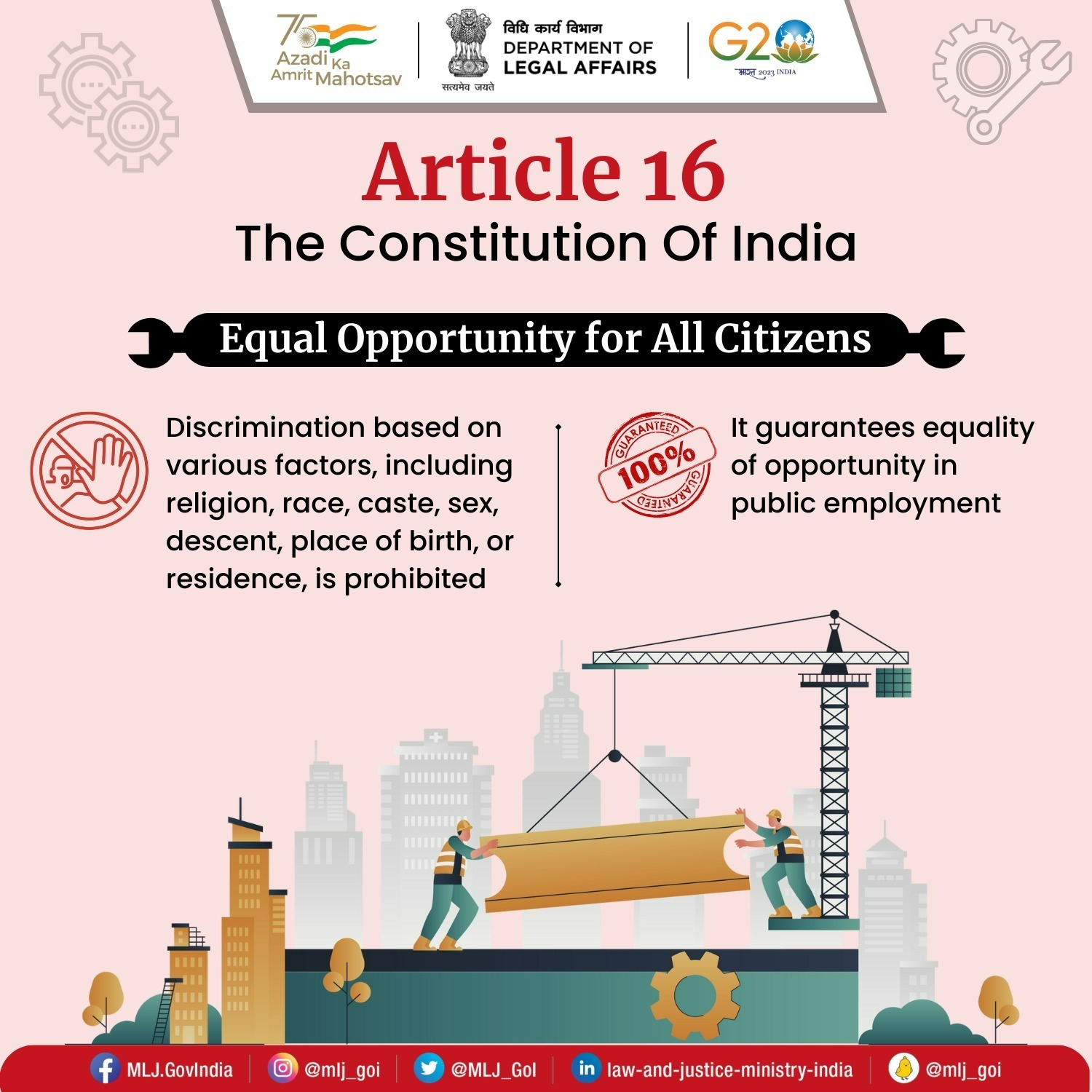
Article 16 of the Indian Constitution is a fundamental right enshrined under Part III. It guarantees equality of opportunity in matters of public employment, ensuring a fair and non-discriminatory system for government jobs. This article plays a crucial role in upholding social justice and promoting inclusive governance.
Text of Article 16
“There shall be equality of opportunity for all citizens in matters relating to employment or appointment to any office under the State.”
Key Provisions
- Equality of Opportunity (Clause 1)
- Every citizen shall have equal opportunity in public employment or appointments under the State.
- Prohibition of Discrimination (Clause 2)
- The State cannot discriminate against any citizen based on:
- Religion
- Race
- Caste
- Sex
- Place of Birth
- Descent
- Residence
- The State cannot discriminate against any citizen based on:
- Permissible Exceptions (Clause 3-5)
- Residence-based reservations (Clause 3): Parliament can legislate requirements of residence for certain jobs, particularly at the local or state level.
- Special provisions for backward classes (Clause 4): The State can provide reservations for Scheduled Castes (SCs), Scheduled Tribes (STs), and Other Backward Classes (OBCs) if they are not adequately represented in public services.
- Religious or denominational institutions (Clause 5): Reservations can be made for appointments to religious or denominational institutions to fulfill their specific objectives.
- Special Measures (Clause 4A and 4B)
- Clause 4A: Allows reservations in matters of promotion for SCs and STs.
- Clause 4B: Excludes reservation seats for backward classes from the 50% cap, enabling fulfillment of quotas without affecting the total.
Judicial Interpretations
- Indra Sawhney v. Union of India (1992)
- Upheld reservations for OBCs under Clause 4.
- Introduced the 50% cap on reservations, barring exceptional circumstances.
- Excluded the “creamy layer” (economically advanced sections) of OBCs from reservation benefits.
- M. Nagaraj v. Union of India (2006)
- Upheld reservations in promotions (Clause 4A) but required the State to provide quantifiable data showing inadequate representation of SCs/STs.
- Jarnail Singh v. Lachhmi Narain Gupta (2018)
- Eliminated the need for proving backwardness for SCs/STs in promotions.
Exceptions to Article 16
- Armed Forces and Public Employment: Exclusion of women from certain combat roles is permitted for operational efficiency.
- Local Preferences: Residence-based reservations are allowed in certain public employment, especially in tribal and remote areas.
- Religious Denominations: Article 16(5) permits reservation in appointments in institutions meant for specific religious or denominational purposes.
Scope and Applicability
- Applies only to public employment or offices under the State.
- Does not apply to private sector jobs or offices outside the purview of State control.
Significance of Article 16
- Promotes Inclusivity: Provides a framework for the inclusion of socially and economically disadvantaged groups in public services.
- Strengthens Social Justice: Addresses historical injustices through affirmative actions like reservations.
- Ensures Equality: Balances meritocracy with the need to reduce socio-economic inequalities.
Examples of Implementation
- Reservation Policies: 15% for SCs, 7.5% for STs, and 27% for OBCs in central government jobs.
- Promotions: Reservation in promotions for SCs/STs under specific conditions.
- State-specific Initiatives: Domicile-based preferences in certain states for lower-level public services.
Article 16, by ensuring equal opportunities in public employment while allowing reasonable exceptions for affirmative action, fosters balanced socio-economic development and enhances representation in governance. It is a cornerstone for building an egalitarian society in India.