

Article 15 of the Indian Constitution, part of Fundamental Rights under Part III, prohibits discrimination on specific grounds, fostering social equality in a diverse society like India. It ensures that every individual is treated equitably irrespective of inherent differences.
Text of Article 15
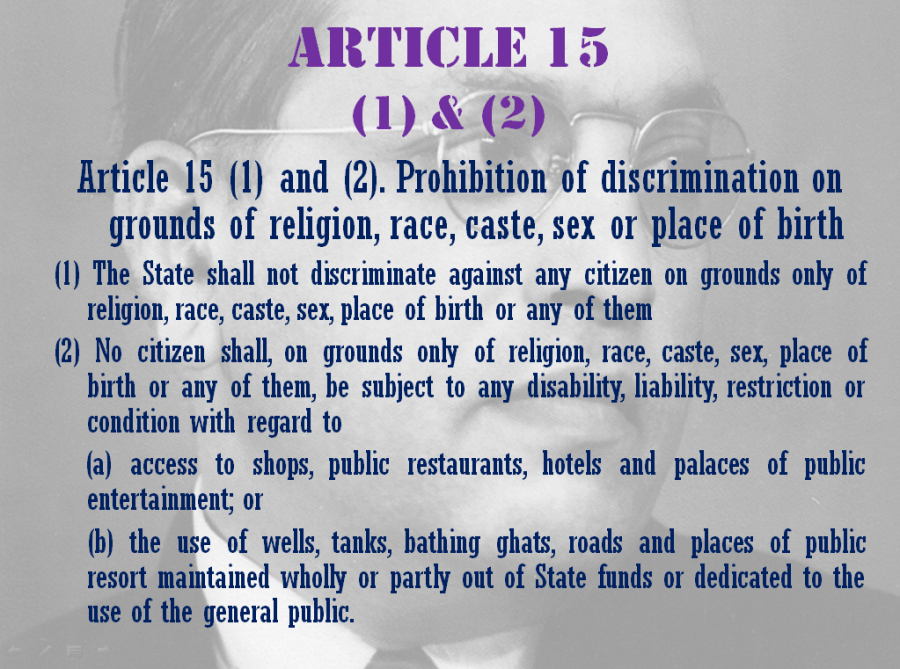
“The State shall not discriminate against any citizen on grounds only of religion, race, caste, sex, place of birth, or any of them.”
Key Features
- Prohibition of Discrimination
- The article restricts the State from discriminating against any citizen solely on the grounds of:
- Religion
- Race
- Caste
- Sex
- Place of Birth
- The article restricts the State from discriminating against any citizen solely on the grounds of:
- Exceptions for Positive Discrimination
- The article allows for affirmative action to uplift marginalized groups.
- Clause (3) permits special provisions for women and children.
- Clause (4) empowers the State to make special provisions for the advancement of Scheduled Castes (SCs), Scheduled Tribes (STs), and Other Backward Classes (OBCs).
- Clause (5) added by the 93rd Constitutional Amendment (2005) allows for reservations in educational institutions, including private institutions (except minority-run institutions).
- Applicability
- Article 15 applies specifically to citizens of India, unlike Article 14, which applies to both citizens and non-citizens.
Judicial Interpretations
- State of Madras v. Champakam Dorairajan (1951)
- The Supreme Court ruled that State-sponsored reservations based solely on caste were unconstitutional.
- This led to the First Constitutional Amendment (1951), introducing Clause (4) to Article 15.
- Indra Sawhney v. Union of India (1992)
- Affirmed that reservation policies for OBCs were valid under Article 15(4).
- Introduced the 50% cap on reservations, barring exceptional cases.
- Ashoka Kumar Thakur v. Union of India (2008)
- Upheld the constitutional validity of reservations in private educational institutions under Clause (5).
Exceptions and Provisions for Equity
Article 15 balances the principle of equality with the need for social justice through reasonable exceptions:
- Special provisions for women and children: e.g., maternity benefits, separate educational institutions, etc.
- Reservations: Affirmative actions like quotas in education and employment for backward classes.
- Exclusion of minority institutions: Clause (5) exempts them from reservation policies to safeguard their autonomy.
Significance of Article 15
- Promotes inclusivity: Ensures no citizen is excluded from opportunities based on religion, caste, or sex.
- Addresses historical injustices: Empowers the State to adopt protective discrimination for marginalized communities.
- Foundation of reservation policies: Provides the constitutional framework for affirmative action to reduce socio-economic disparities.
Examples in Practice
- Women’s Safety Measures: Separate seats in buses or reserved quotas in local governance.
- Educational Reservations: Provisions for SC/ST/OBC students in public and private institutions.
- Schemes for Children: Policies aimed at child welfare, such as free midday meals or scholarships.
In essence, Article 15 underscores India’s commitment to social justice and equality, enabling the State to address systemic inequalities while maintaining the constitutional ethos of fairness and non-discrimination.