
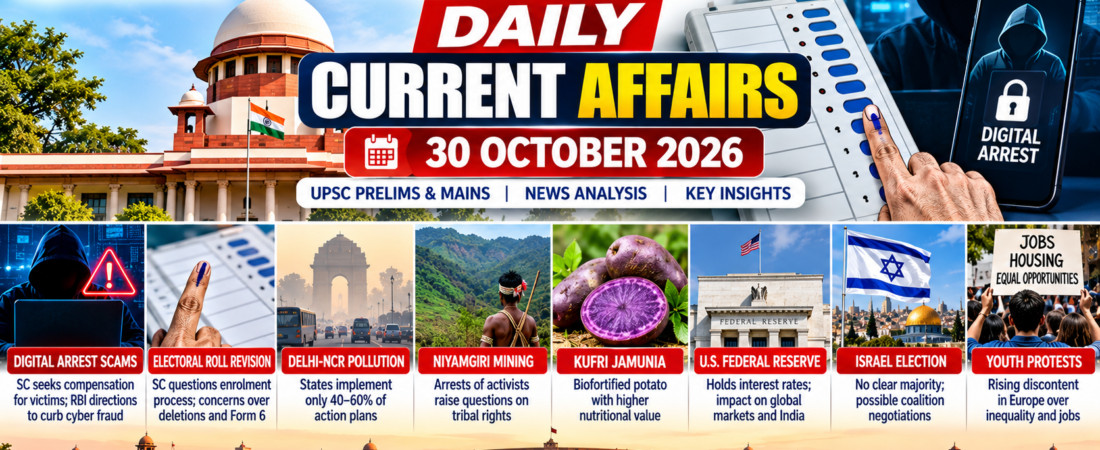
UPSC Civil Services Examination: Daily Current Affairs Analysis
Source: The Hindu, Delhi Edition, Friday, 30 October 2026
Coverage: Polity and Governance | Social Justice | Internal Security | Environment | Economy | Science and Technology | International Relations
1. Digital Arrest Scams: Supreme Court Seeks Greater Accountability from Banks
What happened?
The Supreme Court called upon the Reserve Bank of India (RBI) to consider requiring financial institutions to fully indemnify victims of digital arrest scams where the fraud occurs because of a lack of institutional diligence.
The Court noted that more than ₹800 crore had reportedly been siphoned off in a year by cybercriminals impersonating law-enforcement officials. It expressed concern that people continued to fall victim to scams in which fraudsters threaten them with arrest through phone or video calls.
The Court also sought information from States on:
- FIRs registered in digital arrest cases.
- The progress of investigations.
- The status of prosecutions.
What is a digital arrest scam?
A digital arrest scam is a form of cyber fraud in which criminals impersonate officials of agencies such as the police, the Central Bureau of Investigation, customs or other law-enforcement bodies.
The victim is falsely told that:
- Their identity documents or bank accounts are linked to criminal activity.
- An arrest warrant or investigation has been initiated.
- They must remain under continuous surveillance through video calls.
- Money must be transferred to specified accounts for verification or to avoid arrest.
The fraud exploits fear, authority and social pressure. The term “digital arrest” does not describe a lawful form of arrest.
Proposed institutional safeguards
The Court sought to examine the proposed RBI (Know Your Customer) Amendment Directions, 2026. It suggested that financial institutions should develop systems to:
- Identify transactions that deviate significantly from an account’s normal transaction history.
- Suspend or flag suspicious transactions for verification.
- Generate automated alerts.
- Relay such alerts to police authorities.
- Undertake physical verification to establish the genuineness of suspicious transactions.
The Union government and RBI informed the Court that the proposed directions would be notified by November 30, 2026, and operationalised by December 31, 2026.
Why is this important?
A. Cybersecurity and financial regulation
Cyber fraud is no longer only a matter of individual awareness. It also raises questions about the responsibility of banks and payment intermediaries to identify unusual transactions and prevent financial losses.
B. Customer protection
The Court’s suggestion on indemnification raises an important policy question: should victims bear the entire financial loss when institutional negligence contributes to the fraud?
C. Coordination between institutions
Effective prevention requires coordination among:
- RBI and regulated financial institutions.
- State police and cybercrime units.
- National cybercrime reporting mechanisms.
- Telecommunications and digital-payment service providers.
D. Challenges in implementation
Automated detection systems must distinguish fraudulent transactions from legitimate but unusual activity. Excessively broad transaction suspensions could inconvenience genuine customers, while weak detection systems may fail to prevent fraud.
UPSC relevance
- GS Paper II: Regulatory institutions, governance and accountability.
- GS Paper III: Cybersecurity, cybercrime and financial-sector security.
- GS Paper IV: Institutional responsibility and protection of vulnerable citizens.
Mains perspective: Cyber fraud prevention must move beyond public-awareness campaigns towards institutional accountability, rapid response mechanisms and effective recovery of victims’ funds.
2. Special Intensive Revision of Electoral Rolls: Supreme Court Questions the Enrolment Process
What happened?
The Supreme Court raised concerns about the Election Commission of India’s approach to the ongoing Special Intensive Revision (SIR) of electoral rolls.
During a hearing concerning the Delhi SIR, the Court questioned whether an existing voter who failed to return an enumeration form could be required to apply again through Form 6 as though they were a new voter.
The Bench questioned whether a failure to respond to an enumeration exercise should result in the loss of an existing voter’s right to vote.
The Court also discussed the treatment of voters who had shifted residence and the use of algorithmic checks to identify so-called logical discrepancies.
Key concerns raised
1. Requiring existing voters to apply afresh
The Court questioned why voters whose names were deleted for not returning enumeration forms should be required to submit Form 6, which is ordinarily used for new enrolment.
It asked whether such voters could instead be permitted to submit the required details belatedly.
2. Treatment of shifted voters
A change of residence does not necessarily mean that a person is no longer eligible to vote. The Court questioned why shifted voters could not simply disclose their new addresses.
3. Algorithmic logical-discrepancy checks
The Court discussed checks based on family size and the age gap between voters and their parents. It questioned the legal basis for using such criteria to assess voter eligibility.
The Court also observed that the legality of these checks had not been finally adjudicated.
Figures reported in the newspaper
- In Karnataka, approximately 84 lakh electors were deleted or marked as shifted or absent during enumeration.
- During the claims phase, only a net 8.2 lakh electors, including new electors, were added.
- The final electoral roll was reported to be 64.5 lakh below the projected adult population.
These figures were discussed in the newspaper’s editorial analysis and should not be treated as a final judicial finding that every deletion was wrongful.
Related development: Form 7 applications in Mustafabad, Delhi
A separate report highlighted concerns about applications seeking deletion of voters from electoral rolls.
In north-east Delhi’s Mustafabad:
- Form 7 applications were filed against 28 voters, citing reasons such as absence, permanent shifting or death.
- The newspaper reported that all 28 were found living at their addresses during its visit.
- The applications were filed by a BJP-appointed booth-level agent-2, according to Election Commission records.
- Of 597 third-party Form 7 applications in the area, 96% reportedly named BJP booth-level agents as objectors.
- The report stated that 572 applications filed by these agents were against Muslim electors.
These are reported findings from the newspaper’s investigation. They should not be interpreted as a final legal determination of electoral malpractice.
Why is this important?
A. Universal adult franchise
Article 326 of the Constitution provides for elections to the Lok Sabha and State Legislative Assemblies on the basis of adult suffrage, subject to constitutional and statutory conditions.
Electoral-roll revision must improve the accuracy of voter lists without unnecessarily excluding eligible citizens.
B. Burden of proof and administrative fairness
The issue raises a fundamental question: how should the burden of establishing eligibility be distributed between the citizen and the election administration?
C. Technology and electoral integrity
Algorithmic checks may help identify inconsistencies, but opaque criteria can create the risk of arbitrary exclusion. Decisions affecting voting rights must be transparent, legally grounded and open to effective review.
D. Political neutrality
The electoral process depends not only on accurate rolls but also on public confidence in the neutrality of the institutions responsible for preparing them.
Constitutional and legal framework
- Article 324: Superintendence, direction and control of elections vested in the Election Commission.
- Article 325: No person to be ineligible for inclusion in an electoral roll on grounds only of religion, race, caste or sex.
- Article 326: Elections based on adult suffrage.
- Representation of the People Act, 1950: Preparation and revision of electoral rolls.
- Registration of Electors Rules, 1960: Procedures relating to electoral registration and revision.
UPSC relevance
- GS Paper II: Election Commission, electoral reforms and constitutional institutions.
- GS Paper II: Fundamental rights and democratic participation.
- Essay: Technology, democracy and institutional accountability.
Mains perspective: Electoral-roll accuracy and universal franchise are complementary objectives. Revision mechanisms must eliminate ineligible entries while ensuring that procedural requirements do not become barriers to the participation of eligible voters.
3. Delhi-NCR Air Pollution: States Have Implemented Only 40–60% of Action Plans
What happened?
Delhi and adjoining States have implemented only around 40–60% of the measures contained in their annual air-pollution action plans, according to official sources cited in the newspaper.
The action plans were submitted to the Commission for Air Quality Management (CAQM) in January and finalised in February 2026.
States were expected to complete a major portion of the measures by October 31, before the seasonal increase in pollution.
Delhi recorded an Air Quality Index (AQI) of 229, placing it in the ‘poor’ category on Thursday, October 29.
States and implementation
The report identified:
- Rajasthan as the worst-performing State.
- Uttar Pradesh as the best-performing State, based on weighted action taken up to September 30.
The report also noted that most States had not completed even 50% of their targets for redevelopment of poor-quality roads.
Major sources of pollution
The annual action plans cover:
- Vehicular emissions.
- Road and construction dust.
- Crop-residue burning.
- Industrial emissions.
- Waste burning and other local sources.
Institutional framework
Commission for Air Quality Management (CAQM)
The CAQM is a statutory body established under the Commission for Air Quality Management in National Capital Region and Adjoining Areas Act, 2021.
Its functions include:
- Coordinating action among States and agencies.
- Issuing directions to address air pollution.
- Monitoring implementation of pollution-control measures.
- Promoting coordinated regional strategies.
Why does the problem persist?
1. Fragmented governance
Air pollution does not respect administrative boundaries. Delhi’s air quality is affected by activities across neighbouring States.
2. Weak implementation
Action plans may contain targets and deadlines, but their effectiveness depends on execution, monitoring and accountability.
3. Seasonal approach
Emergency measures during winter cannot substitute for year-round control of emissions and dust.
4. Transport and urban planning
Vehicular emissions, road dust and poorly planned urban development require long-term structural interventions.
Way forward
- Strengthen public transport and last-mile connectivity.
- Improve road maintenance and dust control.
- Enforce construction and demolition waste regulations.
- Promote cleaner industrial technologies.
- Improve coordination among NCR States.
- Establish transparent, publicly accessible progress dashboards.
- Move towards airshed-based planning rather than isolated city-level interventions.
UPSC relevance
- GS Paper III: Environmental pollution and degradation.
- GS Paper II: Centre-State coordination and statutory regulatory bodies.
- Essay: Urbanisation, public health and environmental governance.
Mains perspective: The air-pollution crisis is increasingly a problem of implementation and coordination, not merely a shortage of policy announcements.
4. Niyamgiri Hills: Arrests of Anti-Mining Activists Raise Questions about Tribal Rights
What happened?
A report from Odisha’s Niyamgiri region examined the arrests of activists opposing mining projects in the mineral-rich Eastern Ghats.
The report described the arrests of Dr. Randall Sequeira and Dalit activist Laxman Naik, who were linked by the police to a violent clash that had occurred 192 days earlier.
Activists alleged that criminal cases were being used to intimidate villagers and those opposing mining projects.
The Rayagada Superintendent of Police rejected the allegations of misuse, stating that people could be identified at a later stage through CCTV footage or eyewitness statements.
The report therefore presents competing accounts: allegations of intimidation by activists and the police’s explanation of its investigative procedure.
Economic significance of the region
According to the Indian Minerals Yearbook 2023, the districts of Kalahandi, Rayagada and Koraput together account for:
- 51% of India’s bauxite reserves.
- 74.64% of the country’s bauxite production.
Bauxite is the principal raw material used in the production of aluminium.
Why is Niyamgiri important?
The Niyamgiri hills are ecologically and culturally significant. The region is associated with the Dongria Kondh and other tribal communities whose livelihoods and cultural practices are closely linked to the surrounding forests and hills.
Mining in such areas raises questions involving:
- Forest conservation.
- Tribal land and community rights.
- Livelihood protection.
- Environmental impact.
- Consent and democratic participation.
- The balance between mineral development and ecological sustainability.
Legal and constitutional framework
1. Forest Rights Act, 2006
The Scheduled Tribes and Other Traditional Forest Dwellers (Recognition of Forest Rights) Act, 2006 recognises individual and community forest rights.
It also provides an important role for Gram Sabhas in the recognition and protection of forest rights.
2. PESA Act, 1996
The Panchayats (Extension to Scheduled Areas) Act, 1996 seeks to strengthen self-governance in Fifth Schedule areas.
It recognises the importance of Gram Sabhas in local decision-making and the protection of community resources.
3. Fifth Schedule
The Fifth Schedule provides a special administrative framework for Scheduled Areas and Scheduled Tribes in specified States.
4. Environmental governance
Mining projects are subject to applicable environmental clearances, forest-related requirements and other statutory procedures.
Development versus rights
The debate should not be reduced to a simple choice between mining and opposition to development.
A sustainable approach requires:
- Meaningful participation of affected communities.
- Transparent environmental assessments.
- Protection of customary and statutory rights.
- Fair rehabilitation and livelihood arrangements.
- Independent investigation of allegations of human-rights violations.
- Accountability for violence, irrespective of the identity of those involved.
UPSC relevance
- GS Paper II: Tribal rights, Fifth Schedule and local self-government.
- GS Paper III: Mineral resources and environmental conservation.
- GS Paper IV: Ethics in administration and protection of vulnerable communities.
Mains perspective: Resource extraction in tribal regions must be guided by constitutional protections, ecological sustainability and meaningful participation of local communities.
5. Kufri Jamunia: Biofortified Potato and the Challenge of Hidden Hunger
What happened?
Scientists at the ICAR-Central Potato Research Institute (CPRI) developed a new potato variety called Kufri Jamunia.
The variety contains higher levels of anthocyanins, vitamin C and certain micronutrients than regular potatoes.
The Central government has been promoting it as one possible contribution to addressing hidden hunger.
What is hidden hunger?
Hidden hunger refers to a condition in which individuals may consume sufficient calories but do not receive adequate quantities of essential vitamins and minerals.
It can occur even when a person does not appear to be undernourished in terms of calorie intake.
Micronutrient deficiencies can affect:
- Physical growth.
- Cognitive development.
- Immune function.
- Maternal and child health.
- Overall productivity and well-being.
Development of Kufri Jamunia
According to the newspaper:
- The CPRI team crossed two potato lines, MS/8-1148 and CP4242, in 2015.
- One line was high in vitamin C, while the other had purple skin and flesh.
- The resulting variety was formally identified as MSP/16-307.
- Multi-location trials were conducted during 2021–2023.
- The variety was approved in mid-2024.
- It was notified by the government in November 2024.
The plants produce around 10–12 medium-to-large tubers and mature in approximately 90 days.
Its purple colour is due to anthocyanins, organic compounds also found in foods such as jamun and blueberries.
Why is it significant?
1. Biofortification
Biofortification seeks to improve the nutritional quality of food crops through plant breeding and related agricultural techniques.
2. Food security beyond calories
Food security must include nutritional quality, not merely the availability of sufficient calories.
3. Agricultural research
The variety demonstrates the role of public agricultural research institutions in developing crops with improved nutritional characteristics.
Limitations and questions
The newspaper also highlighted important limitations:
- Potatoes are not consumed as consistently as rice or salt by all sections of the population.
- Nutrient retention may vary with cooking methods.
- Disease resistance and performance under different conditions remain relevant considerations.
- Purple colour and appearance may affect consumer acceptance.
- A consumer assessment involving 64 people found encouraging acceptability, but the sample is too small to generalise to the entire population.
Way forward
- Conduct wider consumer-acceptance studies.
- Assess nutrient retention after common cooking methods.
- Evaluate disease resistance and yield stability.
- Improve awareness among farmers and consumers.
- Develop market linkages and suitable processing applications.
- Integrate biofortified crops into broader nutrition strategies where appropriate.
UPSC relevance
- GS Paper III: Biotechnology, agricultural research and food security.
- GS Paper II: Nutrition and public health.
- Essay: From food security to nutritional security.
Mains perspective: Biofortification can complement food-distribution and nutrition programmes, but its impact depends on consumer acceptance, affordability, agronomic performance and actual nutrient intake.
6. Supreme Court on Disclosure of Beneficial Ownership in AIFs and FPIs
What happened?
The Supreme Court declined to direct the Securities and Exchange Board of India (SEBI) to mandate full public disclosure of the ultimate beneficial owners of Alternative Investment Funds (AIFs) and Foreign Portfolio Investors (FPIs).
The Court held that a judicial direction requiring complete public disclosure would need an appropriate legal and regulatory framework.
It asked the Union government and SEBI to consider whether suitable transparency regulations were necessary.
What is beneficial ownership?
Beneficial ownership refers to the individual or entity that ultimately owns, controls or derives economic benefit from an asset or investment, even if the asset is held through intermediaries or legal entities.
Identifying beneficial owners can help reveal the persons exercising actual control over investment structures.
What are AIFs?
Alternative Investment Funds are privately pooled investment vehicles that collect funds from investors and invest according to a defined investment strategy.
They may invest in:
- Private equity.
- Venture capital.
- Hedge-fund strategies.
- Infrastructure.
- Other permitted alternative assets.
What are FPIs?
Foreign Portfolio Investors are overseas investors registered under the applicable Indian securities-market framework to invest in Indian financial instruments.
Why is transparency important?
1. Preventing misuse of financial structures
Complex ownership chains can make it difficult to identify the actual persons behind investments.
2. Market integrity
Transparency can strengthen confidence in the securities market and improve regulatory supervision.
3. Financial crime prevention
Beneficial-ownership information can support efforts to detect money laundering, illicit financial flows and other forms of financial misconduct.
4. Balancing transparency and privacy
Public disclosure, regulatory disclosure and disclosure to law-enforcement authorities are not necessarily identical. A regulatory framework must determine what information should be publicly available and what should remain accessible only to competent authorities.
Key distinction
The Supreme Court did not itself order full public disclosure. It indicated that the Union government and SEBI should consider the need for an appropriate regulatory framework.
UPSC relevance
- GS Paper III: Capital markets and financial regulation.
- GS Paper II: Regulatory institutions and accountability.
- Governance: Transparency and financial integrity.
Mains perspective: Financial-market transparency requires a carefully designed framework that balances investor privacy, regulatory oversight and the need to identify the persons who ultimately control investment vehicles.
7. U.S. Federal Reserve Holds Interest Rates Amid Sticky Inflation
What happened?
The U.S. Federal Reserve kept its benchmark interest-rate range unchanged at 3.75%–4.00% at its October policy meeting.
The 12-member committee voted 10:2 in favour of maintaining the existing rate. Two members favoured a 25-basis-point increase.
The decision came amid persistent inflation concerns.
Why do U.S. interest rates matter to India?
The monetary-policy decisions of the U.S. Federal Reserve influence global financial conditions.
When U.S. interest rates remain relatively high:
- Dollar-denominated assets may become more attractive.
- Capital may move away from emerging markets.
- The dollar may strengthen against other currencies.
- Countries with external financing requirements may face greater pressure.
Implications for India
The newspaper reported that Indian equity markets rebounded on Thursday:
| Indicator | Closing level / movement |
|---|---|
| Nifty | 22,936.77, up 1.05% |
| Sensex | 74,151.04, up 1.2% |
| Rupee | Closed at ₹95.26 per U.S. dollar |
| Rupee’s intraday low | ₹95.38 per U.S. dollar |
The newspaper attributed part of the market recovery to the Fed’s decision to hold rates, while noting continuing foreign-fund outflows and pressure on the rupee.
Important concepts
Basis point: One basis point equals 0.01 percentage point. A 25-basis-point increase is a rise of 0.25 percentage point.
Capital outflow: Withdrawal of investment from a country by domestic or foreign investors.
Exchange-rate pressure: When demand for foreign currency rises relative to domestic currency, the domestic currency may depreciate.
UPSC relevance
- GS Paper III: Indian economy, monetary policy and external sector.
- International economy: Global monetary-policy transmission.
- Prelims: Federal Reserve, basis points and exchange-rate concepts.
Mains perspective: India’s monetary and exchange-rate management is influenced not only by domestic macroeconomic conditions but also by global interest rates, capital flows and dollar movements.
8. Israel’s Election: No Bloc Secures a Majority in the Provisional Count
What happened?
Israel held an election on October 27, 2026. With nearly 90% of votes counted at the time of the newspaper report, no political bloc had secured the 61 seats required for a majority in the 120-member Knesset.
The reported provisional position was:
| Political grouping | Seats |
|---|---|
| Benjamin Netanyahu’s right-religious bloc | 53 |
| Opposition bloc led by Gadi Eisenkot | 48 |
| Arab parties | 19 |
| Total | 120 |
Likud emerged as the largest party with 27 seats, according to the provisional count.
What happens next?
The report discussed possible coalition arrangements.
As no bloc had an outright majority, government formation would depend on political negotiations and the ability to secure support from other parties.
The report described the result as a political setback for Netanyahu, but did not establish that he had lost the opportunity to form a government.
Why is it important?
- Israel’s coalition-based parliamentary system makes post-election negotiations crucial.
- Political stability in Israel has wider implications for West Asia.
- The country’s domestic political developments affect its approach to the Gaza conflict, regional security and relations with neighbouring countries.
- India’s interests include energy security, defence cooperation, trade and the safety of Indian nationals in the region.
UPSC relevance
- GS Paper II: International relations and West Asia.
- Prelims: Parliamentary systems and coalition governments.
- Mains: India’s relations with Israel and the wider West Asian region.
Note: The figures above were provisional as reported in the newspaper, with approximately 90% of votes counted.
9. Arunachal Pradesh: Proposed Siang Mega Dam Faces Local Opposition
What happened?
A rally was held in Itanagar demanding the release of people detained after protests against the proposed 11,200-MW Siang Upper Multipurpose Project (SUMP).
More than 30 people had reportedly been detained after violent protests in the Siang region on October 23 and 24.
The project is being presented by the government as a countermeasure to China’s major hydropower project on the Yarlung Tsangpo river.
Geographical significance
The Yarlung Tsangpo flows from Tibet into Arunachal Pradesh, where it is known as the Siang. It later meets the Dibang and Lohit rivers to form the Brahmaputra in Assam.
The proposed project therefore has significance for:
- Hydropower generation.
- Water-resource management.
- Regional infrastructure.
- India-China strategic concerns.
- The livelihoods of communities in the Siang region.
Why are local communities opposing the project?
The protesters raised concerns about:
- Land and displacement.
- River ecology.
- Indigenous identity and culture.
- Local rights and participation.
- The impact of large infrastructure projects on the region.
The report also described violence, damage to public property and injuries during protests. The protests should therefore be understood alongside the competing concerns of public order, local rights and infrastructure development.
Strategic dimension
The government argues that the project is necessary to minimise the impact of China’s hydropower project across the border.
The issue highlights the strategic importance of transboundary rivers and the need for India to assess upstream developments in the Tibetan region.
Way forward
- Conduct transparent environmental and social-impact assessments.
- Consult affected communities meaningfully.
- Ensure fair rehabilitation and compensation.
- Assess cumulative impacts of multiple projects in the river basin.
- Strengthen India-China dialogue on transboundary river information and cooperation.
- Maintain public order while protecting lawful democratic participation.
UPSC relevance
- GS Paper II: India-China relations and border-region governance.
- GS Paper III: Hydropower, river management and environmental impact.
- GS Paper III: Disaster management and ecological vulnerability.
Mains perspective: Strategic infrastructure in border regions must be planned through a framework that combines national security, ecological sustainability and the rights of local communities.
10. Supreme Court on Firecracker Restrictions: Public Health and Religious Freedom
What happened?
The Supreme Court criticised the repeated violation of its directions concerning firecrackers during Deepavali.
The Bench observed that religious freedom must be balanced with public health and the protection of fundamental rights.
However, the Court indicated that it was not necessarily in favour of a complete ban and emphasised the need for effective enforcement against spurious and banned firecrackers.
Constitutional dimension
Article 25 guarantees freedom of conscience and the right freely to profess, practise and propagate religion, subject to public order, morality, health and other provisions of Part III.
The issue illustrates that religious freedom is not absolute and must be balanced with the rights and health of others.
Environmental and public-health dimension
Firecrackers can contribute to:
- Particulate pollution.
- Respiratory problems.
- Noise pollution.
- Health risks for children, older persons and vulnerable groups.
Governance challenge
Repeated judicial directions have limited value if enforcement remains weak.
Effective implementation requires:
- Monitoring of manufacture and sale.
- Action against counterfeit green-cracker labels.
- Enforcement of time restrictions.
- Public awareness.
- Coordination among pollution-control authorities, police and local administrations.
UPSC relevance
- GS Paper II: Fundamental rights and judicial intervention.
- GS Paper III: Air and noise pollution.
- GS Paper IV: Balancing competing rights and public interest.
Mains perspective: Environmental regulation requires both constitutional sensitivity and credible enforcement. Public-health protection cannot depend exclusively on court orders issued during festival seasons.
11. Telangana: 37% of Pre-SIR Form 6 Applications Rejected
What happened?
A report from Telangana highlighted the rejection of a substantial number of applications for new voter enrolment submitted before the Special Intensive Revision process.
According to data obtained from the office of the Telangana Chief Electoral Officer:
| Particulars | Number |
|---|---|
| Pre-SIR Form 6 applications received | 5,20,331 |
| Applications accepted | 3,22,785 |
| Applications rejected | 1,92,574 |
The rejected applications represented approximately 37% of the total.
Why were applications rejected?
The report stated that many applications submitted before the SIR process did not include a declaration form that became mandatory during the SIR process.
The declaration sought information relating to the applicant or their parents/relatives from the 2002 SIR. Where such details were unavailable, applicants were required to submit one of the listed citizenship documents.
The report raised concerns about applying a requirement introduced for the SIR process to applications submitted earlier.
Why is this significant?
- It raises questions about procedural fairness in electoral registration.
- It highlights the importance of clear communication of eligibility and documentation requirements.
- It reinforces the need for timely disposal of enrolment applications.
- It has implications for the principle of universal adult franchise.
UPSC relevance
- GS Paper II: Electoral reforms and Election Commission.
- Governance: Transparency, due process and citizen-centric administration.
- Telangana-specific current affairs.
Mains perspective: Administrative procedures must be predictable and fair. Retrospective application of new documentation requirements can create barriers to the exercise of democratic rights.
12. Public Distribution System: Karnataka Seizes 17.78 Lakh kg of Foodgrains
What happened?
Karnataka’s Food, Civil Supplies and Consumer Affairs Department seized 17.78 lakh kg of rice and other foodgrains meant for public distribution over a three-month period.
The newspaper reported the following enforcement figures:
- 238 FIRs registered.
- 215 persons arrested.
- 156 vehicles confiscated.
Belagavi accounted for more than five lakh kg of seized foodgrains, followed by Kolar with 3.5 lakh kg.
Why does diversion occur?
Diversion of subsidised foodgrains can occur through:
- Illegal sale of ration supplies in open markets.
- Manipulation of transport and storage records.
- Collusion among intermediaries.
- Weak monitoring of distribution channels.
- Diversion before commodities reach eligible beneficiaries.
Why is this important?
The Public Distribution System is a major instrument of food security. Diversion reduces the availability of subsidised foodgrains for eligible households and undermines public expenditure.
Way forward
- Strengthen end-to-end tracking of foodgrains.
- Improve stock and transport audits.
- Use technology without excluding genuine beneficiaries.
- Strengthen grievance-redressal systems.
- Improve accountability at storage and distribution points.
UPSC relevance
- GS Paper II: Welfare schemes and implementation.
- GS Paper III: Food security and agricultural supply chains.
- Governance: Leakages and accountability.
13. Delhi Food Safety: Government Announces Stronger Checks Against Adulteration
The Delhi government announced plans to strengthen the Food Safety Department through modern equipment and additional staff.
The announcement followed inspections during which 948.9 litres of ghee were seized from markets in Bhogal, Najafgarh and Shiv Vihar.
The Chief Minister also announced measures such as blacklisting offending brands, imposing penalties, cancelling licences, registering FIRs and publicly disclosing violators.
Significance
Food adulteration is a public-health concern and requires:
- Regular inspections.
- Laboratory testing.
- Traceability of food products.
- Swift prosecution where violations are established.
- Consumer awareness and accessible complaint mechanisms.
Legal framework
The Food Safety and Standards Act, 2006 provides the statutory framework for regulating food safety in India. The Food Safety and Standards Authority of India (FSSAI) is the national food-safety regulator.
UPSC relevance: GS Paper II – health governance; GS Paper III – food processing and food safety.
14. Jamia Millia Islamia: Administration Agrees to a Timeline for Student Union Elections
An 18-day student agitation at Jamia Millia Islamia ended after the administration agreed to a timeline for drafting the student-union constitution and holding elections.
According to the Registrar’s order:
- The constitution is to be drafted and approved by May 15, 2027.
- Elections are to be held within six weeks of July 16, 2027, the beginning of the next academic year.
- Student representatives will be included in the drafting committee along with faculty members and legal experts.
- Disciplinary notices connected with participation in the agitation were to be revoked.
- Physical classes were scheduled to resume on November 2.
The administration also stated that elections would follow the Lyngdoh Committee recommendations.
Why is it important?
The issue highlights:
- Student representation in higher education.
- Institutional autonomy and university governance.
- Democratic participation on campuses.
- The balance between protest, discipline and academic functioning.
UPSC relevance: GS Paper II – education, institutional governance and democratic participation.
15. Delhi High Court on Race Course Mosque: Court Seeks Status Report
The Delhi High Court declined to direct immediate restoration of worshippers’ access to the Race Course mosque in Lutyens’ Delhi.
The Centre assured the Court that no coercive action would be taken against the structure for the time being. It also stated that the authorities would decide on a representation made by the Delhi Waqf Board within four weeks.
The Court raised concerns about the safety of worshippers in view of demolition work around the structure and directed the authorities to file a status report.
The matter was listed for further hearing on December 16.
Significance
The case involves:
- Protection of places of worship.
- Public safety during demolition activity.
- Administrative accountability.
- Judicial oversight of government action.
Important: The Court did not finally decide the dispute over the structure in the reported hearing.
16. Other Important Developments
A. West Bengal restricts political activity by newly appointed teachers
The West Bengal Cabinet decided that newly appointed teachers in State-run and government-aided schools would not be permitted to engage in direct political activity or contest elections. Existing teachers involved in politics were stated to be unaffected.
The decision attracted criticism from teachers’ associations and opposition leaders, who questioned its legal basis and implications.
UPSC relevance: Service rules, political neutrality, freedom of association and education governance.
B. Delhi Police prepares for INDIA bloc protest on November 1
Delhi Police planned to deploy more than 3,000 personnel and over 200 CCTV cameras, including AI-enabled surveillance systems, for the INDIA bloc’s proposed ‘Chalo Dilli’ event at Ramlila Maidan.
The venue was divided into 14 zones for security and crowd management.
UPSC relevance: Policing, public order, surveillance and the right to peaceful assembly.
C. Fake health camps allegedly used to steal Aadhaar biometric details
Delhi Police arrested two men from Mathura for allegedly operating fake health camps to collect Aadhaar details on the promise of subsidised medicines.
Police alleged that the biometric details were used to obtain SIM cards that were subsequently sold to cybercriminals. The SIM cards were reportedly linked to more than 20 cybercrime cases involving around ₹2.64 crore.
UPSC relevance: Aadhaar security, identity theft, cybercrime and data protection.
D. Delhi High Court seeks ED response in Lalu Prasad case
The Delhi High Court issued notice to the Enforcement Directorate on a petition by RJD leader Lalu Prasad challenging a trial court order framing money-laundering charges in the alleged IRCTC hotel scam.
The High Court has sought the agency’s response. The reported development is procedural and does not constitute a decision on the merits of the case.
UPSC relevance: Prevention of Money Laundering Act, investigative agencies and judicial process.
E. Gujarat political parties report income of ₹510.41 crore
Twenty-nine Registered Unrecognised Political Parties (RUPPs) from Gujarat reportedly recorded the highest aggregate income of ₹510.41 crore during financial year 2024–25.
UPSC relevance: Political-party finance, electoral transparency and accountability.
F. West Bengal tightens firecracker restrictions
West Bengal announced enforcement measures against violations of firecracker norms during Deepavali and Chhath Puja. The State said only green crackers would be permitted under the announced restrictions and specified time windows for bursting crackers.
UPSC relevance: Environmental regulation and implementation of pollution-control rules.
G. Yamuna pollution becomes a political issue ahead of Chhath Puja
A Delhi BJP MP took a dip in the Yamuna and claimed that pollution levels had reduced due to government measures. The AAP disputed the claim and referred to the condition of different stretches of the river.
The statements are competing political claims, not an independent assessment of river-water quality.
UPSC relevance: River pollution, urban governance and evidence-based environmental monitoring.
Editorial and Analytical Perspectives
17. Electoral Roll Revision: Accuracy Must Not Come at the Cost of Universal Franchise
The newspaper’s editorial questioned the design of the ongoing SIR process and argued that the burden of enrolment should not be shifted excessively from the administration to existing voters.
The central concern is that a voter who has previously been enrolled should not be treated as a new applicant merely because an enumeration form was not returned.
The editorial also questioned the use of algorithmic logical-discrepancy checks based on family size and age differences, arguing that such criteria require a clear statutory basis.
Analytical assessment
Electoral-roll revision has two legitimate objectives:
- Removing deceased, duplicate and otherwise ineligible entries.
- Ensuring that every eligible citizen is included.
The challenge is to pursue both objectives simultaneously.
A process that removes ineligible entries but creates unnecessary barriers for genuine voters risks undermining the legitimacy of the electoral process.
Way forward:
- Clear and uniform procedures.
- Adequate notice and opportunity to respond.
- Transparent deletion criteria.
- Effective appeal and correction mechanisms.
- Public disclosure of revision data.
- Independent scrutiny of algorithmic decision-making.
18. Youth Protests in Europe: Economic Insecurity and Political Discontent
The newspaper’s discussion of youth protests in Europe highlighted concerns involving:
- Housing affordability.
- Unemployment and stagnant real wages.
- Education costs.
- Corruption.
- Cost of living.
- Reductions in public services.
The broader argument linked these protests to dissatisfaction with economic and political institutions.
Analytical perspective
Youth discontent cannot be explained by unemployment alone. It may reflect a combination of economic insecurity, limited social mobility, high living costs and declining confidence in public institutions.
For policymakers, the challenge is to ensure that economic growth translates into accessible housing, quality education, stable employment and effective public services.
UPSC relevance: GS Paper II – social justice and governance; GS Paper III – employment and inclusive growth; Essay – inequality and social mobility.
Prelims Practice Questions
1. With reference to digital arrest scams, consider the following statements:
- Digital arrest is a legally recognised form of arrest under Indian criminal law.
- The Supreme Court has asked the RBI to examine safeguards against suspicious transactions.
- The Court has sought information from States regarding FIRs and the progress of investigations in digital arrest cases.
Which of the statements given above is/are correct?
A. 1 only
B. 2 and 3 only
C. 1 and 3 only
D. 1, 2 and 3
2. Consider the following constitutional provisions:
- Article 324 deals with the superintendence, direction and control of elections.
- Article 325 prohibits exclusion from electoral rolls solely on grounds of religion, race, caste or sex.
- Article 326 provides for elections on the basis of adult suffrage.
Which of the statements given above is/are correct?
A. 1 only
B. 1 and 2 only
C. 2 and 3 only
D. 1, 2 and 3
3. The Commission for Air Quality Management (CAQM) is associated with:
A. Regulation of coastal pollution
B. Air-quality management in the NCR and adjoining areas
C. Regulation of industrial wastewater across India
D. Management of river interlinking projects
4. With reference to the Forest Rights Act, 2006, consider the following statements:
- It recognises individual and community forest rights.
- It recognises a role for Gram Sabhas in the process of recognising forest rights.
- It applies only to urban forest areas.
Which of the statements given above is/are correct?
A. 1 only
B. 1 and 2 only
C. 2 and 3 only
D. 1, 2 and 3
5. Anthocyanins are:
A. Organic pigments responsible for colours in several plants and fruits
B. A class of synthetic fertilisers
C. Enzymes used in nitrogen fixation
D. A type of plant virus
6. Biofortification primarily seeks to:
A. Increase the shelf life of agricultural commodities
B. Improve the nutritional quality of crops
C. Replace organic farming with chemical farming
D. Increase the water requirement of crops
7. Consider the following statements about AIFs and FPIs:
- AIFs are privately pooled investment vehicles.
- FPIs are foreign investors participating in Indian securities markets under the applicable regulatory framework.
- Beneficial ownership refers only to the registered legal holder of an asset.
Which of the statements given above is/are correct?
A. 1 and 2 only
B. 2 and 3 only
C. 1 and 3 only
D. 1, 2 and 3
8. One basis point is equal to:
A. 1 percentage point
B. 0.1 percentage point
C. 0.01 percentage point
D. 0.001 percentage point
9. The Siang river is part of the river system that eventually forms the:
A. Ganga
B. Brahmaputra
C. Barak
D. Mahanadi
10. The PESA Act, 1996 primarily seeks to:
A. Extend Panchayati Raj provisions to Scheduled Areas with appropriate modifications
B. Establish autonomous courts in all districts
C. Regulate the mining of major minerals
D. Create a national tribal development authority
11. The Food Safety and Standards Authority of India is associated with which legislation?
A. Essential Commodities Act, 1955
B. Food Safety and Standards Act, 2006
C. Consumer Protection Act, 2019
D. Legal Metrology Act, 2009
12. Consider the following statements about Article 25 of the Constitution:
- It guarantees freedom of conscience.
- The freedom to practise religion is subject to public order, morality and health.
- It is an absolute right without constitutional limitations.
Which of the statements given above is/are correct?
A. 1 only
B. 1 and 2 only
C. 2 and 3 only
D. 1, 2 and 3
Answer Key and Explanations
1. B — 2 and 3 only. Digital arrest is a fraudulent impersonation technique, not a legally recognised form of arrest. The Supreme Court sought RBI safeguards and State-level investigation data.
2. D — 1, 2 and 3. Articles 324, 325 and 326 respectively concern the Election Commission’s authority, non-discrimination in electoral rolls and adult suffrage.
3. B — Air-quality management in the NCR and adjoining areas. CAQM is a statutory body established under the 2021 Act.
4. B — 1 and 2 only. The Forest Rights Act recognises individual and community forest rights and gives Gram Sabhas an important role. It is not restricted to urban forest areas.
5. A — Organic pigments responsible for colours in several plants and fruits. Anthocyanins are responsible for purple, red and blue pigmentation in many plant foods.
6. B — Improve the nutritional quality of crops. Biofortification seeks to increase the concentration or availability of essential nutrients in food crops.
7. A — 1 and 2 only. Beneficial ownership concerns the ultimate individual or entity exercising ownership, control or economic benefit, not merely the registered holder.
8. C — 0.01 percentage point. One basis point is one-hundredth of a percentage point.
9. B — Brahmaputra. The Yarlung Tsangpo enters Arunachal Pradesh as the Siang and joins the Dibang and Lohit to form the Brahmaputra in Assam.
10. A — Extend Panchayati Raj provisions to Scheduled Areas with appropriate modifications. PESA seeks to strengthen self-governance in Fifth Schedule areas.
11. B — Food Safety and Standards Act, 2006. This Act provides the statutory framework for food-safety regulation in India.
12. B — 1 and 2 only. Article 25 protects freedom of conscience and religious practice, subject to constitutional limitations including public order, morality and health.
Mains Practice Questions
GS Paper II – Polity and Governance
- Electoral-roll revision is essential for ensuring the integrity of elections. Examine how procedural requirements during intensive revision can affect the principle of universal adult franchise.
- Discuss the role of the Election Commission of India in maintaining the accuracy and inclusiveness of electoral rolls. What safeguards are necessary to ensure transparency in the use of technology during electoral revision?
- Examine the importance of institutional accountability in preventing cyber fraud. Discuss the role of the RBI and financial institutions in protecting victims of digital arrest scams.
GS Paper II – Social Justice and Governance
- Discuss the constitutional and institutional safeguards available to tribal communities affected by development projects in Scheduled Areas.
- Food adulteration is not merely a consumer-protection issue but also a public-health and governance challenge. Examine.
GS Paper III – Economy, Environment and Science
- Examine the impact of U.S. Federal Reserve monetary policy on capital flows, exchange-rate stability and financial markets in emerging economies such as India.
- Biofortification can complement existing food-security interventions in India. Discuss its potential and limitations in addressing micronutrient deficiencies.
- Large hydropower projects in India’s border regions involve strategic, economic and environmental considerations. Critically examine with reference to the proposed Siang Upper Multipurpose Project.
- Despite several institutional mechanisms and annual action plans, air pollution continues to be a major challenge in the National Capital Region. Examine the reasons and suggest a coordinated regional approach.
- Discuss the importance of beneficial-ownership transparency in strengthening the integrity of financial markets. How can India balance regulatory transparency with legitimate investor privacy?
Key Takeaways for UPSC
- Digital arrest scams: Cybercrime prevention requires institutional accountability, suspicious-transaction detection and coordination between banks and police.
- Electoral-roll revision: Accuracy of electoral rolls must be balanced with the constitutional commitment to universal adult franchise.
- Air pollution: Regional coordination and implementation are as important as policy formulation.
- Niyamgiri: Mining in tribal regions requires protection of forest rights, community participation and environmental safeguards.
- Kufri Jamunia: Biofortification can contribute to nutritional security, but adoption and nutrient retention matter.
- Beneficial ownership: Financial transparency is essential to market integrity and prevention of illicit financial activity.
- Federal Reserve: Global monetary-policy decisions influence India’s exchange rate, capital flows and financial markets.
- Siang project: Border-region infrastructure requires a balance between strategic interests, ecology and community rights.
Suggested Revision Keywords
Digital arrest | RBI KYC Directions | Special Intensive Revision | Article 324 | Article 325 | Article 326 | Form 6 | Form 7 | CAQM | Air Quality Index | Niyamgiri | Forest Rights Act | PESA | Bauxite | Biofortification | Anthocyanins | Kufri Jamunia | AIFs | FPIs | Beneficial ownership | Federal Reserve | Siang Upper Multipurpose Project | Brahmaputra | PDS diversion | Food Safety and Standards Act