
GS Paper I & III | CURRENT AFFAIRS ANALYSIS | 5 NOVEMBER 2026 | 12–15 MIN READ
1. Introduction
India is undergoing one of the largest urban transformations in the world. Cities and towns are increasingly becoming centres of economic activity, employment, innovation, services and technological development. However, the country’s institutional arrangements for managing urbanisation have not evolved at the same pace as its demographic and economic transformation.
A significant proportion of India’s emerging urban population lives not only in large metropolitan cities but also in smaller towns, Census Towns and peri-urban areas. These settlements are increasingly urban in their economic characteristics but continue to be governed through rural administrative structures.
This mismatch between the actual pattern of urbanisation and the institutional framework governing settlements has created serious challenges relating to infrastructure, housing, sanitation, mobility, environmental sustainability and local governance.
The discussion around a proposed National Urbanisation Policy (NUP) has therefore gained importance. India needs to move beyond a fragmented, city-centric approach towards an integrated framework that recognises urbanisation as a national development process.
The central question is no longer whether India will urbanise, but whether it can manage urbanisation in a planned, inclusive, productive and environmentally sustainable manner.
2. Why in News?
The need for a comprehensive National Urbanisation Policy came into focus in November 2026 amid discussions on India’s urban classification framework and the preparations for the upcoming Census.
The Census 2027 exercise is expected to retain the existing criteria for identifying Census Towns, which were used in the 2011 Census. This has renewed the debate over whether India’s conventional definition of urban settlements adequately captures the changing realities of urbanisation.
The proposed policy seeks to address the disconnect between:
- Administrative boundaries and actual urban expansion.
- Rural governance structures and changing economic activities.
- Municipal responsibilities and the geographical spread of urban infrastructure.
- Urban population growth and the capacity of local governments to provide essential services.
The discussion also draws upon the recommendations of the World Resources Institute (WRI) India report on developing an equitable, productive, low-carbon and resilient system of cities. Next IAS+2
Important clarification: The National Urbanisation Policy is being discussed as a policy framework; it should not be confused with an already enacted law or a fully operational national policy.
3. Understanding Urbanisation in India
3.1 What is urbanisation?
Urbanisation refers to the increasing concentration of population, economic activities and infrastructure in urban settlements.
It involves more than the migration of people from villages to cities. It also includes:
- Transformation of agricultural settlements into non-agricultural economic centres.
- Expansion of existing cities into surrounding rural areas.
- Development of new industrial, commercial and service-sector centres.
- Increasing economic and social interdependence between cities and surrounding settlements.
- Expansion of urban lifestyles, consumption patterns and infrastructure networks.
Urbanisation is therefore a demographic, economic, spatial and institutional transformation.
3.2 India’s urbanisation: Key facts
| Indicator | Important information |
|---|---|
| Urban population (Census 2011) | Approximately 377 million |
| Share of urban population (2011) | 31.1% |
| Expected urban population by 2036 | Around 600 million |
| Projected urban population share by 2036 | Around 40% |
| Urban contribution to GDP | Estimated at around 70% |
| Urban infrastructure requirement | $840 billion over 15 years (World Bank, 2022) |
The World Bank estimates that India’s urban population could reach approximately 600 million by 2036. Urban areas are also expected to contribute nearly 70% of the country’s GDP. World Bank+2
An important dimension of India’s urbanisation is that conventional population-based estimates may not fully capture the economic and functional characteristics of settlements.
The Economic Survey 2025–26 highlighted that satellite-based estimates placed India’s urbanisation level at approximately 63% in 2015, substantially higher than the proportion reported by the 2011 Census. These figures use different methodologies and should not be treated as directly interchangeable. Press Information Bureau+1
4. How Does India Classify Urban Settlements?
The Census of India recognises two broad categories of urban settlements.
A. Statutory Towns
These are settlements declared urban by the respective State Governments under applicable laws.
They include:
- Municipal Corporations.
- Municipal Councils.
- Municipalities.
- Nagar Panchayats and other notified urban local bodies.
Their classification is primarily based on administrative notification rather than the application of the Census Town population criteria.
B. Census Towns
A settlement is classified as a Census Town when it satisfies all three following conditions:
| Criterion | Requirement |
|---|---|
| Population | At least 5,000 |
| Population density | At least 400 persons per square kilometre |
| Occupational structure | At least 75% of male main workers engaged in non-agricultural activities |
These criteria were applied in the 2011 Census and are relevant to the ongoing debate on urban classification.
The fundamental problem: A settlement may satisfy the economic and demographic characteristics of an urban area but continue to be governed as a village because it has not been formally notified as an urban local body.
Consequently, its population may experience urban problems without receiving corresponding urban governance arrangements.
5. The Emerging Challenge: India’s Rural–Urban Continuum
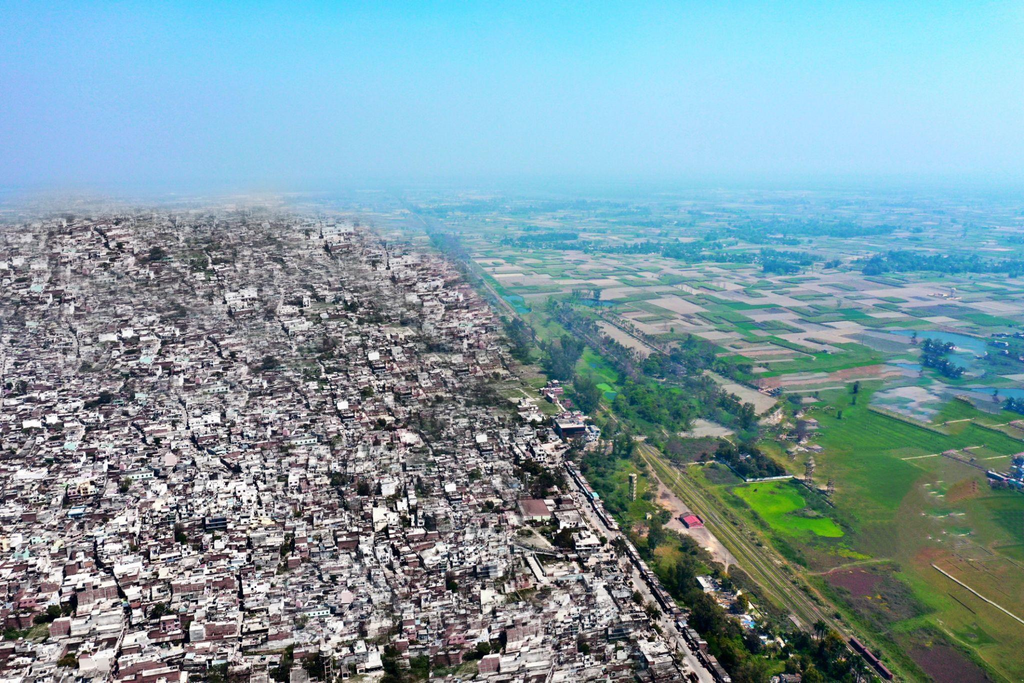
One of the most important features of contemporary Indian urbanisation is the emergence of the rural–urban continuum.
Traditional urban planning treated villages and cities as distinct geographical and administrative entities. However, economic and spatial developments have blurred this distinction.
Maharashtra entrusts PMC to decide development of merged villages | Pune News – The Indian Express
12
Consider a village located on the outskirts of a rapidly expanding city.
Over time:
- Agricultural land is converted into residential layouts.
- Commercial establishments and industries emerge.
- Rural residents increasingly work in nearby cities.
- Population density rises.
- Transport and water demand increases.
- Land prices and real-estate activity expand.
Despite these changes, the settlement may continue to be administered by a Gram Panchayat.
This creates a governance mismatch.
Problems associated with peri-urban settlements
1. Inadequate infrastructure: Water supply, sewerage, drainage and solid waste management systems are often insufficient.
2. Unplanned land conversion: Agricultural land is converted into residential and commercial uses without comprehensive spatial planning.
3. Institutional fragmentation: Multiple agencies may exercise overlapping or unclear responsibilities.
4. Environmental degradation: Wetlands, lakes, agricultural land and natural drainage channels face encroachment.
5. Financial constraints: Gram Panchayats may lack the financial resources and technical expertise required to address increasingly urban demands.
6. Social vulnerabilities: Migrant workers, informal settlements and economically weaker households often face inadequate access to essential services.
Thus, peri-urbanisation has emerged as an important governance challenge in India.
6. Why Does India Need a National Urbanisation Policy?
A comprehensive policy is necessary for the following reasons.
6.1 Correcting the mismatch in urban classification
Existing classification mechanisms do not adequately capture the dynamic nature of urbanisation.
A National Urbanisation Policy can establish a more comprehensive framework for identifying and managing emerging urban settlements.
It should consider:
- Population and population density.
- Occupational diversification.
- Economic integration with neighbouring cities.
- Infrastructure connectivity.
- Commuting patterns.
- Land-use transformation.
Such an approach would help identify urban growth areas before they develop serious infrastructure deficiencies.
6.2 Integrated spatial and regional planning
Urbanisation frequently extends beyond municipal boundaries.
For example, the economic and functional region of a metropolitan city may include neighbouring municipalities, industrial clusters, satellite towns and peri-urban villages.
Planning each administrative unit independently can lead to:
- Traffic congestion.
- Uncoordinated infrastructure development.
- Inefficient land use.
- Unequal distribution of public services.
- Environmental degradation.
The policy should promote functional urban region-based planning, integrating land use, housing, transport, water resources and economic development.
6.3 Strengthening urban local bodies
The 74th Constitutional Amendment Act, 1992, gave constitutional recognition to urban local bodies.
However, decentralisation remains incomplete in many States.
Municipalities frequently lack adequate:
- Financial autonomy.
- Administrative personnel.
- Technical capacity.
- Planning authority.
- Independent revenue sources.
A National Urbanisation Policy should promote genuine decentralisation through the transfer of Functions, Funds and Functionaries (3Fs).
6.4 Improving municipal finances
Indian urban local bodies depend substantially on transfers from State and Union Governments.
Their own-source revenue remains constrained by:
- Weak property-tax administration.
- Inadequate user charges.
- Limited tax bases.
- Poor revenue collection.
- Political resistance to revising municipal charges.
The World Bank estimated that India would need approximately $840 billion in urban infrastructure investment over 15 years from 2022 to meet the needs of its growing urban population. World Bank
This highlights the need for stronger municipal finances and diversified infrastructure financing.
6.5 Addressing climate change and environmental sustainability
Indian cities are increasingly vulnerable to:
- Urban flooding.
- Heatwaves.
- Urban heat island effects.
- Water scarcity.
- Air pollution.
- Loss of wetlands and green spaces.
A national framework can promote climate-sensitive land-use planning, nature-based solutions, sustainable mobility and resilient infrastructure.
6.6 Balanced regional development
India’s urbanisation has been disproportionately concentrated in major metropolitan regions.
A comprehensive policy should strengthen:
- Tier-2 and Tier-3 cities.
- Regional growth centres.
- Small towns.
- Industrial and logistics clusters.
- Emerging service-sector centres.
This can reduce excessive pressure on metropolitan cities while creating employment opportunities closer to smaller settlements.
7. Constitutional and Institutional Framework for Urban Governance
Urbanisation in India is governed through a combination of constitutional provisions, State legislation and centrally sponsored programmes.
The National Urbanisation Policy must build upon this existing framework rather than create an entirely parallel institutional structure.
7.1 The 74th Constitutional Amendment Act, 1992
The 74th Constitutional Amendment Act introduced Part IX-A into the Constitution, providing constitutional recognition to urban local governments.
Important provisions include:
| Article | Constitutional provision |
|---|---|
| Article 243P | Definitions relating to municipalities |
| Article 243Q | Constitution of Municipalities |
| Article 243R | Composition of Municipalities |
| Article 243S | Ward Committees |
| Article 243T | Reservation of seats |
| Article 243W | Powers, authority and responsibilities of Municipalities |
| Article 243X | Power to impose taxes and funds of Municipalities |
| Article 243Y | Finance Commission |
| Article 243ZD | District Planning Committee |
| Article 243ZE | Metropolitan Planning Committee |
| Article 243ZG | Bar to interference by courts in electoral matters |
7.2 Twelfth Schedule
The Twelfth Schedule contains 18 functions that may be entrusted to municipalities by State legislatures under Article 243W.
These include:
- Urban planning, including town planning.
- Regulation of land use and construction of buildings.
- Planning for economic and social development.
- Roads and bridges.
- Water supply.
- Public health, sanitation and solid waste management.
- Fire services.
- Urban forestry and protection of the environment.
- Safeguarding the interests of weaker sections.
- Slum improvement and upgradation.
- Urban poverty alleviation.
- Provision of urban amenities and facilities.
- Promotion of cultural, educational and aesthetic aspects.
- Burials and burial grounds.
- Cattle pounds and prevention of cruelty to animals.
- Vital statistics, including registration of births and deaths.
- Public amenities, including street lighting, parking lots and bus stops.
- Regulation of slaughterhouses and tanneries.
Critical observation: Constitutional recognition does not automatically translate into effective decentralisation. The actual transfer of responsibilities and resources depends substantially on State legislation and administrative decisions.
7.3 District Planning Committees
Under Article 243ZD, every State is required to constitute District Planning Committees.
Their principal responsibility is to consolidate plans prepared by Panchayats and Municipalities and prepare a draft development plan for the district as a whole.
This is particularly important for integrating rural and urban development.
7.4 Metropolitan Planning Committees
Article 243ZE provides for Metropolitan Planning Committees in metropolitan areas.
Their purpose is to prepare draft development plans for metropolitan regions, taking into account:
- Plans prepared by municipalities and Panchayats.
- Spatial planning.
- Sharing of water and other natural resources.
- Integrated infrastructure development.
- Environmental conservation.
- Investments in infrastructure and services.
However, the effectiveness of these institutions remains constrained by weak coordination, inadequate resources and limited authority in several States.
8. What Should a National Urbanisation Policy Contain?
The WRI India report, Equitable, Productive, Low-Carbon and Resilient System of Cities in India, provides an important framework for thinking about the proposed policy.
The following reforms should form its central pillars. WRI India+1
8.1 A uniform and dynamic urban classification framework
India needs a classification system that captures the actual economic and spatial characteristics of settlements.
The policy should:
- Establish transparent criteria for identifying urban settlements.
- Introduce periodic reviews of settlement classifications.
- Recognise functional urban regions.
- Identify peri-urban growth areas.
- Improve coordination between Census classification and State-level urban notifications.
However, urban reclassification must not merely change administrative labels. It must be accompanied by adequate financial and institutional capacity.
8.2 Integrated regional planning
Planning must extend beyond the boundaries of individual municipalities.
A metropolitan region should be treated as an integrated economic and geographical unit.
For example, transport planning should consider the movement of people across the entire metropolitan region rather than merely within municipal limits.
Similarly, water supply, sewage treatment, waste management and environmental conservation require regional approaches.
8.3 A National Urbanisation Council
A high-level institutional mechanism could facilitate coordination between the Union Government, State Governments and urban local bodies.
Such a council could:
- Develop common national urbanisation priorities.
- Facilitate inter-State and inter-agency coordination.
- Promote integrated infrastructure investment.
- Encourage policy learning and sharing of best practices.
- Monitor implementation of urban reforms.
It should complement constitutional institutions and existing intergovernmental mechanisms rather than undermine State autonomy.
8.4 Reforming urban finance
The policy should strengthen the financial autonomy of urban local bodies through:
Property-tax reforms: GIS-based property mapping, regular valuation and improved collection efficiency.
Municipal bonds: Encourage creditworthy municipalities to access capital markets.
Land-value capture: Enable municipalities to recover a portion of the increase in land value generated by public infrastructure investments.
Predictable fiscal transfers: Strengthen formula-based transfers instead of excessive dependence on fragmented project-based grants.
User charges: Introduce rational and socially sensitive charges for municipal services while protecting vulnerable households.
8.5 Strengthening institutional capacity
Urban governance requires trained personnel in:
- Urban and regional planning.
- Municipal finance.
- Environmental management.
- Infrastructure engineering.
- Public transport.
- Data management.
- Disaster risk reduction.
Smaller towns particularly need shared technical-service platforms and project preparation facilities to develop viable infrastructure projects.
8.6 Climate-resilient and sustainable urbanisation
Urban planning should integrate climate adaptation and mitigation from the initial stage of development.
Important interventions include:
- Protection of urban wetlands and lakes.
- Restoration of natural drainage channels.
- Urban forests and green spaces.
- Energy-efficient buildings.
- Sustainable public transport.
- Rainwater harvesting.
- Decentralised wastewater treatment.
- Climate-resilient infrastructure.
8.7 Strengthening smaller cities and towns
India should not concentrate urban development expenditure exclusively on metropolitan cities.
Smaller cities can become important centres of manufacturing, logistics, education, healthcare and services.
Their development requires:
- Reliable connectivity.
- Affordable housing.
- Quality educational institutions.
- Healthcare facilities.
- Industrial infrastructure.
- Efficient municipal administration.
9. Existing Government Initiatives Supporting Urban Development
A National Urbanisation Policy should integrate and strengthen existing programmes.
| Initiative | Major objective |
|---|---|
| Smart Cities Mission | Technology-enabled urban infrastructure and governance |
| AMRUT 2.0 | Universal water supply and improved sewerage management |
| Swachh Bharat Mission–Urban 2.0 | Sanitation and scientific solid waste management |
| PMAY–Urban 2.0 | Affordable housing for eligible urban households |
| PM-eBus Sewa | Expansion of organised urban bus services |
| Metro Rail Policy, 2017 | Framework for urban mass rapid transit |
| DAY-NULM | Urban livelihoods and poverty alleviation |
| PM SVANidhi | Working capital support to street vendors |
| National Clean Air Programme | Reduction of air pollution in cities |
The Economic Survey 2025–26 also emphasised that urban policy should focus on the performance of entire urban systems rather than treating individual infrastructure projects as isolated interventions. Press Information Bureau
10. Challenges in Implementing a National Urbanisation Policy
Despite its potential, the implementation of a comprehensive national framework will face several structural challenges.
10.1 Federalism and State autonomy
Urban development is primarily a State responsibility under the constitutional distribution of powers.
The Union Government can provide policy guidance, financial support and institutional coordination, but implementation requires the cooperation of State Governments.
A uniform national framework must therefore accommodate regional differences.
10.2 Weak municipal governance
Many municipalities lack adequate human resources, technical expertise and financial independence.
Without strengthening urban local bodies, even a well-designed policy may remain largely on paper.
10.3 Fragmented institutional structures
Urban development responsibilities are often distributed among several agencies, including:
- Municipal corporations.
- Development authorities.
- Water supply boards.
- Housing boards.
- Transport agencies.
- State pollution control boards.
This fragmentation creates coordination problems and diffuses accountability.
10.4 Political and administrative resistance
Urban reclassification may require changes in administrative boundaries, institutional responsibilities and revenue arrangements.
States may be reluctant to merge peri-urban settlements into municipalities because of the associated administrative and political implications.
10.5 Land acquisition and planning conflicts
Urban expansion involves competing demands for:
- Agricultural land.
- Residential development.
- Industrial activities.
- Transport infrastructure.
- Ecological conservation.
Poorly planned land conversion can create displacement, livelihood insecurity and environmental degradation.
10.6 Inequality and exclusion
Urban development may disproportionately benefit formal property owners and organised businesses while excluding:
- Migrant workers.
- Street vendors.
- Slum dwellers.
- Informal-sector workers.
- Economically weaker households.
Urbanisation must therefore be accompanied by inclusive housing, livelihood protection and access to essential services.
10.7 Climate and ecological constraints
Cities face increasing climate risks, but many continue to expand without adequate consideration of ecological carrying capacity.
Urban expansion into floodplains, wetlands and water bodies can increase long-term disaster vulnerability.
11. The Way Forward: Towards an Inclusive and Sustainable Urban Transition
India should adopt a long-term urbanisation strategy that recognises cities as critical economic and social infrastructure.
The following measures can strengthen its implementation.
1. Adopt a National Urbanisation Policy through cooperative federalism
The Union Government should work with States to develop a common framework while allowing flexibility in implementation according to regional requirements.
2. Strengthen the 3Fs of decentralisation
States should progressively transfer adequate Functions, Funds and Functionaries to urban local bodies in accordance with the constitutional framework.
3. Make metropolitan and district planning institutions effective
District Planning Committees and Metropolitan Planning Committees must become functional institutions with technical expertise, financial support and clearly defined responsibilities.
4. Adopt functional urban-region planning
Urban development should be planned around actual economic and geographical relationships rather than rigid municipal boundaries.
5. Improve municipal revenue mobilisation
Property-tax reforms, municipal bonds, land-value capture and rational user charges should form part of a sustainable municipal financing strategy.
6. Give priority to smaller cities and towns
Tier-2 and Tier-3 cities should receive appropriate infrastructure investments to promote balanced regional development.
7. Integrate climate resilience into urban planning
Urban master plans must incorporate flood-risk mapping, heat-action plans, water conservation and ecological protection.
8. Ensure inclusive urbanisation
Affordable housing, public transport, basic services and social security should be made accessible to vulnerable urban populations.
9. Build an urban data and monitoring framework
Reliable and regularly updated data on population, land use, infrastructure, municipal finance and environmental indicators are essential for evidence-based urban policymaking.
10. Link urbanisation with employment generation
Cities should be developed as productive economic regions through industrial clusters, logistics networks, innovation ecosystems and service-sector development.
12. Conclusion
Urbanisation is not merely a demographic trend; it is one of the most important determinants of India’s future economic and social development.
India’s challenge is not simply to accommodate a growing urban population but to develop institutions capable of managing the economic, spatial, social and environmental consequences of urban transformation.
The proposed National Urbanisation Policy offers an opportunity to move from fragmented, project-oriented urban development towards an integrated national vision.
However, the success of such a framework will depend on genuine decentralisation, stronger municipal finances, effective regional planning, institutional coordination and environmental sustainability.
India’s journey towards Viksit Bharat 2047 will depend significantly on its ability to transform its cities and towns into productive, inclusive, liveable and climate-resilient spaces.
13. UPSC Examination Perspective
GS Paper I – Indian Society and Geography
- Urbanisation, its problems and remedies.
- Migration and its consequences.
- Urban growth and regional inequalities.
- Changing rural–urban relationships.
GS Paper II – Polity and Governance
- 74th Constitutional Amendment.
- Urban local self-government.
- Decentralisation and local governance.
- Centre–State relations.
- Constitutional institutions of local planning.
GS Paper III – Economy and Environment
- Urban infrastructure financing.
- Sustainable urban development.
- Smart cities and urban transport.
- Climate-resilient infrastructure.
- Urban employment and economic growth.
Relevant Sustainable Development Goals
| SDG | Relevance |
|---|---|
| SDG 6 | Clean Water and Sanitation |
| SDG 7 | Affordable and Clean Energy |
| SDG 9 | Industry, Innovation and Infrastructure |
| SDG 10 | Reduced Inequalities |
| SDG 11 | Sustainable Cities and Communities |
| SDG 13 | Climate Action |
Prelims Facts to Remember
- The 74th Constitutional Amendment Act, 1992, introduced Part IX-A.
- Article 243Q deals with the constitution of municipalities.
- Article 243W deals with the powers and responsibilities of municipalities.
- The Twelfth Schedule contains 18 functions.
- Article 243ZD provides for District Planning Committees.
- Article 243ZE provides for Metropolitan Planning Committees.
- Census Town criteria include population of 5,000, density of 400 persons per sq. km and 75% of male main workers in non-agricultural activities.
- Census Towns are not automatically statutory municipalities.
Possible UPSC Mains Questions
Question 1 – GS Paper I (15 marks)
“India’s urbanisation is increasingly characterised by the expansion of peri-urban settlements and the blurring of rural–urban boundaries.” Examine the challenges arising from this transformation and suggest appropriate policy interventions.
Question 2 – GS Paper II (15 marks)
The constitutional recognition of urban local bodies has not translated into effective decentralisation of urban governance in India. Critically examine.
Question 3 – GS Paper III (15 marks)
Discuss the need for a comprehensive National Urbanisation Policy in India. How can it promote inclusive, productive and climate-resilient urban development?