
Samata IAS Academy | UPSC Civil Services Examination
Date: 5 November 2026
Newspaper: The Hindu – Delhi Edition
Coverage: GS Papers I, II, III and IV
Introduction
The 5 November 2026 edition of The Hindu brings together important developments in constitutional governance, demographic change, defence reforms, electoral administration, economic transformation, public health and international relations.
One of the most significant developments is the Supreme Court’s observation that laws penalising individuals for having more than two children have lost their relevance in the context of India’s declining fertility rate. The development raises important questions about reproductive autonomy, demographic transition and the constitutional validity of population-control measures.
The Union Cabinet’s decision to revise the Agnipath scheme, the Supreme Court’s intervention concerning excluded voters during the Special Intensive Revision (SIR), and the challenge to the legal immunity granted to Election Commissioners are also important developments in constitutional and institutional governance.
On the economic front, the government has approved three major initiatives: domestic processing facilities for lithium and nickel, grid-scale energy storage and the modernisation of India’s statistical system. These initiatives have implications for energy security, industrial development and evidence-based policymaking.
The newspaper also carries an important analysis of India’s poverty reduction experience. While extreme poverty has declined significantly, the persistence of low-quality employment, stagnant real wages and limited upward economic mobility highlights the difference between poverty alleviation and genuine prosperity.
Environmental and public-health issues are equally important. The editorial discussion on Cyclones Arnab and Murasu highlights the need for climate-resilient infrastructure and cooperative federalism, while the analysis of double-fortified salt questions the effectiveness of single-nutrient interventions in addressing India’s anaemia burden.
PART I – POLITY, CONSTITUTION AND GOVERNANCE
1. Two-Child Norm: Supreme Court Questions the Relevance of Population-Control Laws
GS Paper II – Constitution, Fundamental Rights and Governance
GS Paper I – Population and Demographic Transition
Why is this in the news?
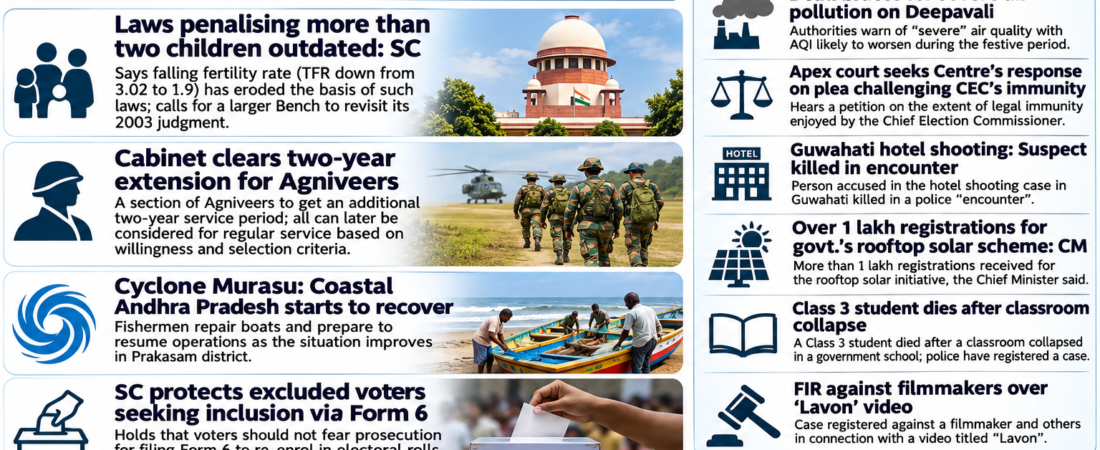
The Supreme Court observed that laws penalising individuals for having more than two children have lost their relevance in view of India’s declining fertility rate and changing demographic profile.
The Court indicated that its 2003 judgment in Javed v. State of Haryana, which upheld disqualification provisions based on the two-child norm, requires reconsideration by a larger Bench.
The matter arose from an appeal by Mangala Bhimrao Ingle, whose election as a sarpanch of the Kakoda Gram Panchayat in Maharashtra had been set aside because she had more than two children.
The Court permitted her to continue in her elected position while staying the proceedings against her.
What are two-child norm laws?
Several States have historically introduced provisions restricting individuals with more than two children from contesting elections to local self-government institutions.
These provisions were introduced with the objective of encouraging small-family norms and controlling population growth.
Under such laws, individuals having more than two children could be disqualified from contesting elections to Panchayati Raj institutions or urban local bodies.
The Supreme Court had upheld the constitutional validity of such a provision in Javed v. State of Haryana (2003).
Why has the Supreme Court questioned these laws?
The Court highlighted the transformation in India’s demographic situation.
The newspaper reports the following figures:
| Indicator | Earlier/Current position |
|---|---|
| India’s Total Fertility Rate in the earlier period | 3.02 |
| Reported current Total Fertility Rate | 1.9 |
| Replacement-level fertility | 2.1 |
| Population aged 60 years and above in 2014 | 8.3% |
| Population aged 60 years and above in 2024 | 9.7% |
| Projected share of elderly population by 2036 | Nearly 15% |
The Total Fertility Rate has fallen below the replacement level.
This indicates a major transformation in India’s population dynamics.
The Court observed that the earlier concern about excessive population growth must be reconsidered in light of the emerging challenges of population ageing and a declining proportion of working-age people.
Understanding Total Fertility Rate
The Total Fertility Rate (TFR) represents the average number of children a woman would give birth to during her reproductive years if prevailing age-specific fertility rates continued throughout her reproductive life.
A TFR of approximately 2.1 is generally considered the replacement-level fertility rate in a low-mortality population.
Replacement fertility does not mean that population immediately stops growing.
Population momentum, age structure, mortality and migration also influence population change.
Constitutional dimensions
Article 21 – Right to life and personal liberty
The Court emphasised that reproductive autonomy is an important dimension of Article 21.
The decision to have children is closely connected with individual dignity, personal liberty and reproductive choices.
Article 14 – Equality before law
Disqualification based on family size may impose unequal restrictions on individuals seeking political representation.
Article 243F and Article 243V
These provisions deal with disqualifications for membership of Panchayats and Municipalities respectively.
State legislation operates within the constitutional framework governing local self-government.
The reproductive autonomy argument
The Court observed that such laws could compel an individual to make an unreasonable choice between motherhood and political participation.
Disqualification based on the number of children may therefore affect the ability of women to participate in democratic institutions.
The issue becomes particularly significant because reproductive decisions involve multiple social, economic and personal considerations.
Why are two-child norms increasingly problematic?
- Demographic transition: India’s fertility rate has declined considerably.
- Population ageing: The proportion of elderly persons is increasing.
- Gender inequality: Women may disproportionately bear the consequences of restrictive reproductive policies.
- Political exclusion: Disqualification may prevent otherwise eligible individuals from participating in local democracy.
- Changing developmental priorities: India increasingly needs to address ageing, healthcare, pension requirements and labour-force participation.
Way forward
- Reconsider population-control legislation in light of current demographic evidence.
- Promote voluntary family planning.
- Strengthen reproductive healthcare.
- Improve women’s education and economic empowerment.
- Develop policies for healthy ageing.
- Expand geriatric healthcare and social security.
- Avoid coercive demographic interventions.
UPSC Mains perspective: India’s demographic challenge is shifting from controlling population growth towards managing demographic transition. Population policy must respect reproductive autonomy while preparing for the economic and social consequences of population ageing.
2. Agnipath Scheme: Union Cabinet Approves Two-Year Extension for Agniveers
GS Paper III – Internal Security and Defence Management
Why is this in the news?
The Union Cabinet has approved an additional two-year engagement period for a section of Agniveers recruited under the Agnipath scheme.
The revised framework creates an additional opportunity for Agniveers to serve in the armed forces and subsequently be considered for regular enrolment, subject to willingness and fulfilment of selection criteria.
The decision follows a review of the scheme after four years of implementation.
What is the revised arrangement?
Under the original Agnipath framework:
- Agniveers were recruited for four years.
- Up to 25% of each batch could be retained in the regular cadre.
- The remaining 75% were released after completion of four years, with the applicable Seva Nidhi package and other benefits.
Under the revised arrangement reported by the newspaper:
- 25% of Agniveers will continue to be offered regular employment under the existing retention framework.
- The remaining 75% will have an opportunity to serve for an additional two years.
- Following this additional period, they may be considered for enrolment as regular soldiers, subject to selection requirements.
- The second engagement period will carry higher remuneration, an enhanced Seva Nidhi package and seniority-related benefits.
The revised framework is intended to align the aspirations of Agniveers with the organisational requirements of the armed forces.
Background of the Agnipath scheme
The Agnipath scheme was introduced in 2022 to reform recruitment into the armed forces below officer rank.
It aimed to create a younger military force, reduce long-term pension expenditure and improve the operational efficiency of the armed forces.
Objectives of the scheme
- Reduce the average age of armed forces personnel.
- Introduce a more flexible recruitment system.
- Improve the technological capabilities of the armed forces.
- Reduce long-term salary and pension liabilities.
- Develop a disciplined and trained youth population.
- Improve military preparedness.
Why was the scheme controversial?
The original four-year engagement period generated concerns among aspiring military candidates.
1. Employment uncertainty
Only a limited proportion of recruits could enter the regular armed forces.
2. Short service duration
Four years was considered insufficient by some aspirants to build a long-term military career.
3. Pension concerns
Agniveers released after four years would not receive the same pension benefits as regular long-term service personnel.
4. Post-service rehabilitation
Questions were raised regarding the availability of suitable civilian employment opportunities after release.
5. Regional concerns
States with a long tradition of military recruitment witnessed significant opposition to the scheme.
Significance of the revised framework
- Provides a longer engagement opportunity.
- May improve retention of trained personnel.
- Provides additional time to assess military aptitude.
- Could address concerns relating to employment uncertainty.
- May improve the continuity of operational experience.
Issues requiring attention
The revised framework should be evaluated in terms of:
- Transparency in selection.
- Equal opportunities for all Agniveers.
- Adequacy of remuneration.
- Post-service employment opportunities.
- Long-term military human-resource requirements.
- Fiscal implications.
Way forward
The government should periodically review the scheme through consultations with the three services, serving personnel, veterans and prospective recruits.
The objective must be to balance a youthful military force with institutional experience, continuity and career security.
UPSC Mains perspective: Defence reforms must balance operational efficiency, fiscal sustainability and the welfare of military personnel. Recruitment policy should strengthen both national security and the dignity of military service.
3. Supreme Court Seeks Response on Lifelong Legal Immunity for Election Commissioners
GS Paper II – Constitutional Bodies and Institutional Independence
Why is this in the news?
The Supreme Court has sought a response from the Union government and the Election Commission of India on petitions challenging Section 16 of the Chief Election Commissioner and Other Election Commissioners (Appointment, Conditions of Service and Term of Office) Act, 2023.
The provision grants immunity from civil and criminal proceedings for acts, words or decisions undertaken in the discharge or purported discharge of official duties.
The petitions argue that the protection extends even beyond retirement and is inconsistent with constitutional principles.
The matter has been listed for December 18.
What does Section 16 provide?
Section 16 provides legal protection to a person who is or was a Chief Election Commissioner or Election Commissioner against civil or criminal proceedings for acts performed in the discharge or purported discharge of official functions.
The petitioners have argued that the provision creates an excessively broad immunity.
Why is the issue important?
The Election Commission is responsible for conducting free and fair elections.
Its credibility depends on:
- Institutional independence.
- Impartial decision-making.
- Transparency.
- Accountability.
- Public confidence.
The question is whether legal protection necessary for independent functioning can be extended so broadly that it restricts judicial scrutiny.
Constitutional provisions
Article 324
Vests the superintendence, direction and control of elections in the Election Commission.
Article 14
Guarantees equality before law and equal protection of laws.
Article 32
Provides the right to approach the Supreme Court for enforcement of fundamental rights.
Article 226
Empowers High Courts to issue writs for enforcement of fundamental rights and for other purposes.
Basic Structure Doctrine
Judicial review and the independence of constitutional institutions are important constitutional principles.
The central constitutional dilemma
Constitutional functionaries require protection against frivolous litigation and politically motivated harassment.
However, immunity should not become a mechanism for eliminating accountability.
A balance is required between:
- Independence in official functioning.
- Protection against vexatious litigation.
- Judicial review.
- Accountability for unlawful conduct.
Way forward
- Clearly define the scope of official-duty immunity.
- Preserve judicial review.
- Establish safeguards against frivolous litigation.
- Ensure accountability for mala fide or unlawful actions.
- Strengthen the transparency of Election Commission decisions.
UPSC Mains perspective: Institutional independence and institutional accountability are complementary rather than contradictory principles.
4. Electoral Roll Revision: Supreme Court Assures Excluded Voters Against Prosecution
GS Paper II – Election Commission and Electoral Reforms
Why is this in the news?
The Supreme Court assured petitioners that voters excluded from electoral rolls during the Special Intensive Revision (SIR) exercise would not face criminal prosecution merely because they submitted Form 6 to seek inclusion again.
The development follows concerns about the use of Form 6 by previously registered voters whose names were removed during the SIR exercise.
What is the controversy?
Form 6 is prescribed for the inclusion of a new elector in the electoral roll.
However, voters whose names were deleted during SIR were reportedly being asked to submit Form 6 as new applicants.
The petitioners argued that this could compel previously registered voters to make declarations that were inappropriate to their actual status.
They also raised concerns about possible prosecution under Section 31 of the Representation of the People Act, 1950.
Supreme Court’s intervention
On October 28, the Supreme Court had orally indicated that voters removed from the electoral rolls should be permitted to use Form 8 or the relevant enumeration form rather than being forced to apply as new voters.
Form 8 is generally used for correction of entries and related electoral-roll modifications, including shifting of residence.
On November 5, the Court reiterated that voters should not fear prosecution merely because they had previously been enrolled and subsequently submitted Form 6.
The Election Commission had clarified that previous enrolment by itself would not make the declaration false.
The Supreme Court asked the petitioners to file an application concerning the continuing use of Form 6. The matter is scheduled for November 19.
Why is this significant?
Electoral-roll revision is necessary to ensure that electoral databases are accurate.
However, it must not create barriers for eligible citizens seeking to exercise their right to vote.
The issue raises three important concerns:
- Whether the identification process is legally appropriate.
- Whether excluded voters have accessible remedies.
- Whether procedural requirements create a risk of wrongful disenfranchisement.
Constitutional provisions
| Article | Relevance |
|---|---|
| Article 324 | Election Commission |
| Article 325 | One general electoral roll |
| Article 326 | Adult suffrage |
| Article 14 | Equality before law |
| Article 21 | Fair procedure and dignity |
Way forward
- Establish clear procedures for re-inclusion.
- Ensure accessible grievance-redressal mechanisms.
- Provide adequate notice before deletion.
- Improve transparency in the SIR process.
- Ensure that technical or procedural errors do not exclude eligible electors.
UPSC takeaway: Electoral-roll accuracy and universal adult franchise must be protected simultaneously.
5. Delhi SIR: Allegations of Irregularities in Form 7 Applications
GS Paper II – Electoral Governance
Why is this in the news?
An investigation by The Hindu reported that several BJP-appointed Booth-Level Agents (BLAs) named as objectors in Form 7 applications in Delhi’s Mustafabad constituency denied having filed or authorised the applications.
Form 7 is used to object to the inclusion of an elector’s name or seek deletion from the electoral roll.
Major findings reported
- A total of 1,021 deletion applications had reportedly been filed.
- BJP-appointed BLAs were listed as objectors in 787 applications, approximately 77% of the total.
- Sixteen of the 20 individuals contacted by the newspaper denied having filed or signed the applications.
- The applications reportedly sought deletion of Muslim electors.
- Some applicants stated that the electors concerned were living at their registered addresses.
The newspaper also reported that the applications were filed despite an ECI-imposed limit on individual Form 7 applications.
These are reported allegations requiring investigation and verification by the electoral authorities.
Why is this important?
The issue raises concerns regarding:
- Accuracy of electoral rolls.
- Misuse of deletion procedures.
- Verification of objections.
- Protection against discriminatory exclusion.
- Accountability of Booth-Level Agents.
- Transparency of electoral administration.
Way forward
- Verify the identity of every applicant.
- Establish a digital audit trail.
- Investigate allegations of forged signatures.
- Ensure that deletion is supported by evidence.
- Provide affected electors an opportunity to respond.
- Take action against knowingly false applications.
UPSC Mains perspective: The credibility of electoral institutions depends not only on the accuracy of voter lists but also on transparent and non-discriminatory procedures for adding and deleting names.
6. Public Protests and Section 163 of BNSS: Balancing Public Order and Democratic Rights
GS Paper II – Fundamental Rights and Criminal Justice
Why is this in the news?
An investigation reported that Delhi Police issued seven separate prohibitory orders under Section 163 of the Bharatiya Nagarik Suraksha Sanhita (BNSS), 2023, restricting public gatherings and movement in parts of the national capital.
The orders were issued before the protests demanding the resignation of the Chief Election Commissioner.
Some of these restrictions followed protests over alleged NEET examination-paper leaks.
What is Section 163 of BNSS?
Section 163 empowers an Executive Magistrate to issue urgent orders in cases of nuisance or apprehended danger.
It enables the authority to direct individuals to abstain from certain acts or take specified actions where immediate prevention or speedy remedy is necessary.
The provision broadly corresponds to the earlier Section 144 of the Code of Criminal Procedure, 1973.
Constitutional relationship
Article 19(1)(a): Freedom of speech and expression.
Article 19(1)(b): Right to assemble peacefully and without arms.
These rights are subject to reasonable restrictions under Articles 19(2) and 19(3), respectively.
The dilemma
The State has a legitimate responsibility to maintain public order and prevent violence.
However, prohibitory orders should not become routine instruments for suppressing peaceful dissent.
Way forward
- Ensure that orders are based on specific and credible grounds.
- Apply restrictions proportionately.
- Limit their duration to what is necessary.
- Provide judicial and administrative review.
- Distinguish peaceful protest from violent conduct.
- Protect public access to democratic spaces.
UPSC takeaway: Public order is a legitimate constitutional objective, but restrictions on fundamental rights must satisfy the test of legality, necessity and proportionality.
7. Supreme Court on State Taxation: Cess Levied on Sales Tax
GS Paper II – Federalism and Constitutional Division of Powers
GS Paper III – Taxation and Public Finance
Why is this in the news?
A seven-judge Bench of the Supreme Court reaffirmed the validity of the principle laid down in the 1975 judgment S. Kodar v. State of Kerala.
The Court held that an additional tax or surcharge calculated as a percentage of sales tax payable is an enhancement of the rate of sales tax and falls within the relevant legislative competence of the State legislature.
Constitutional background
The case concerned the legislative competence of State legislatures to impose an additional levy linked to sales tax.
The dispute involved Entry 54 of the State List in the Seventh Schedule, as it existed before the constitutional changes associated with GST.
The taxpayers argued that such a levy amounted to a tax on an existing tax.
The States argued that it was merely an enhancement of the sales-tax rate.
Significance
The judgment clarifies the constitutional treatment of an additional levy calculated with reference to an existing tax.
It also illustrates the importance of interpreting legislative entries according to the essential nature of the tax rather than merely its method of calculation.
UPSC relevance
- Seventh Schedule.
- Distribution of legislative powers.
- State taxation.
- Constitutional interpretation.
- Federal fiscal relations.
- Judicial precedents.
Important distinction: Entry 54 has undergone significant changes following the 101st Constitutional Amendment and introduction of GST. The judgment’s historical constitutional context must be kept in mind while discussing present-day State taxation powers.
8. Public Accounts Committees Call for Stronger Financial Accountability
GS Paper II – Parliament and State Legislatures
Why is this in the news?
A conference of Public Accounts Committee (PAC) chairpersons from Parliament and 25 State legislatures adopted an eight-point resolution calling for closer scrutiny of public expenditure and quicker action on audit findings.
The conference was held in Thiruvananthapuram.
Major concerns
The conference highlighted:
- Delays in placing CAG reports before legislatures.
- Delayed replies by ministries and departments.
- Incomplete responses to PAC observations.
- Weak follow-up on audit recommendations.
- Difficulty in tracking responsibility for financial irregularities.
Eight-point resolution: Key directions
The resolution emphasised:
- Ensuring that public funds are spent only for sanctioned purposes.
- Strengthening legislative oversight.
- Introducing standardised timelines for Action Taken Notes.
- Creating a digital platform for sharing best practices.
- Adopting digital oversight systems in State legislatures.
- Strengthening cooperation with the CAG.
- Using forensic tools to identify high-risk areas.
- Improving accountability for audit observations.
Role of the PAC
The PAC examines:
- Appropriation accounts.
- Finance accounts.
- Reports of the Comptroller and Auditor General.
- Instances of excess expenditure.
- Financial irregularities and administrative lapses.
Relationship between CAG and PAC
CAG audit → PAC scrutiny → Departmental response → Action Taken Notes → Legislative accountability.
Way forward
- Ensure timely submission of audit reports.
- Strengthen legislative research support.
- Introduce digital tracking of audit observations.
- Make departmental accountability time-bound.
- Conduct regular reviews of compliance.
UPSC takeaway: Public financial management requires not merely expenditure authorisation but also continuous legislative scrutiny and effective corrective action.
PART II – ECONOMY AND INCLUSIVE DEVELOPMENT
9. From Poverty Alleviation to Prosperity: Understanding India’s Prosperity Gap
GS Paper III – Inclusive Growth, Poverty and Employment
Why is this in the news?
An analytical article in The Hindu examines India’s progress in reducing extreme poverty while highlighting the continuing gap between poverty alleviation and genuine economic prosperity.
The central argument is that escaping poverty does not automatically ensure a stable, secure and comfortable standard of living.
India’s progress in poverty reduction
According to the World Bank Poverty and Equity Brief discussed in the article:
| Indicator | Earlier position | Later position |
|---|---|---|
| Population below $3 per day | — | 2.6% in 2023 |
| Population below $4.20 per day | 57.7% in 2011 | 16.1% in 2023 |
| People estimated to have moved out of poverty | — | 496 million |
| Multidimensional poverty | 53.8% in 2005–06 | 16.4% in 2019–21 |
The article notes that India has achieved substantial reductions in extreme income poverty.
However, the results depend on the poverty threshold used.
Understanding different poverty thresholds
The World Bank’s poverty thresholds are expressed in international dollars based on purchasing power parity.
The article discusses three thresholds:
| Poverty threshold | Classification |
|---|---|
| $3 per person per day | Extreme poverty benchmark |
| $4.20 per person per day | Lower-middle-income poverty benchmark |
| $8.30 per person per day | Upper-middle-income poverty benchmark |
The article estimates that approximately 80% of India’s population remains below the $8.30 threshold.
This indicates that a substantial section of the population continues to live far below the income levels associated with upper-middle-income economies.
What is the prosperity gap?
The prosperity gap is a World Bank indicator that measures how far people’s income or consumption levels are from a defined prosperity benchmark.
The article refers to a global benchmark of $28 per person per day in 2021 PPP terms.
India’s prosperity-gap measure is reported at 4.9.
This indicates that average consumption would need to increase substantially to approach the benchmark.
The prosperity gap shifts attention from merely escaping extreme poverty towards the broader objective of improving living standards.
Why does the poverty-to-prosperity transition remain difficult?
1. Informal employment
The ILO India Employment Report 2024 found that approximately 90% of India’s workers were informally employed.
Informal workers often face:
- Low wages.
- Employment insecurity.
- Lack of social security.
- Limited access to institutional credit.
- Weak bargaining power.
2. Stagnant real wages
The article highlights the persistence of stagnant or declining real wages in several employment categories.
Even when nominal incomes increase, inflation may reduce the purchasing power of households.
3. Low-productivity employment
Employment growth concentrated in low-productivity activities does not necessarily generate substantial improvements in living standards.
4. Educated unemployment
The India Employment Report 2024 estimated that educated young people accounted for approximately 65.7% of unemployed youth in 2022.
This reflects a mismatch between educational qualifications and employment opportunities.
5. Poor-quality human capital services
Households may spend heavily on private education and healthcare without receiving services of adequate quality.
The returns on investment in human capital may therefore remain limited.
Understanding human capital markets
Human capital markets include the institutions and service providers through which individuals acquire education, healthcare and skills.
These markets influence people’s ability to improve their productivity and economic position.
However, information asymmetry and uneven quality can reduce the returns on household investments in education and healthcare.
Poverty alleviation versus prosperity
| Poverty alleviation | Prosperity |
|---|---|
| Ensures minimum consumption | Ensures sustained improvement in living standards |
| Focuses on deprivation | Focuses on economic security and opportunity |
| Can be supported by transfers | Requires productive employment and human capital |
| Addresses immediate vulnerability | Addresses long-term upward mobility |
| Focuses on minimum thresholds | Focuses on broader quality of life |
Policy implications
India must shift from a narrow poverty-reduction approach towards prosperity-enhancing growth.
Important priorities include:
- Creation of productive non-farm employment.
- Improvement in labour productivity.
- Expansion of formal employment.
- Strengthening of social security.
- Better-quality public education.
- Affordable healthcare.
- Skill development.
- Women’s labour-force participation.
- Growth of labour-intensive manufacturing.
Way forward
Economic development should be measured not only by GDP growth or reductions in extreme poverty but also by improvements in real wages, employment security, access to quality services and household economic resilience.
UPSC Mains perspective: Poverty reduction is an essential but insufficient condition for inclusive development. The ultimate objective of economic policy must be to transform poverty alleviation into sustained prosperity through productive employment and human-capital formation.
10. Critical Minerals: Cabinet Approves ₹2,814-Crore Scheme for Lithium and Nickel Processing
GS Paper III – Mineral Resources, Industrial Policy and Energy Security
Why is this in the news?
The Union Cabinet approved a ₹2,814-crore capital expenditure support scheme to establish domestic processing facilities for lithium and nickel.
The scheme will operate for five years and aims to strengthen India’s critical-mineral processing ecosystem.
What are critical minerals?
Critical minerals are minerals that are economically and strategically important but face significant risks relating to supply disruption.
Their importance arises from their role in:
- Clean-energy technologies.
- Electronics.
- Electric vehicles.
- Defence manufacturing.
- Telecommunications.
- Advanced industrial applications.
Importance of lithium
Lithium is a major component of lithium-ion batteries.
It is used in:
- Electric vehicles.
- Mobile phones.
- Laptops.
- Grid-scale battery storage.
- Renewable-energy storage systems.
Importance of nickel
Nickel is used in:
- Stainless steel production.
- Battery cathodes.
- Special alloys.
- Aerospace applications.
- Defence equipment.
- Industrial machinery.
Why is domestic processing important?
Mineral security is not determined merely by access to mineral deposits.
The ability to process and refine minerals is equally important.
India’s dependence on imported processing capacity creates vulnerabilities in critical supply chains.
Major objectives
- Establish domestic mineral-processing capacity.
- Reduce dependence on imports.
- Strengthen manufacturing.
- Develop technical expertise.
- Encourage private investment.
- Improve supply-chain resilience.
Challenges
- Limited domestic processing technology.
- High capital requirements.
- Environmental impacts of mining and refining.
- Dependence on imported intermediate materials.
- Competition from established global processors.
- Recycling and waste-management requirements.
Way forward
- Strengthen domestic mineral exploration.
- Develop mineral-processing technologies.
- Promote public-private partnerships.
- Improve recycling of batteries and electronic waste.
- Diversify international supply sources.
- Develop strategic mineral reserves.
- Maintain high environmental and social safeguards.
UPSC Mains perspective: Critical-mineral security is an essential component of India’s industrial competitiveness, energy transition and strategic autonomy.
11. Grid-Scale Energy Storage: Cabinet Approves ₹14,500-Crore VGF Scheme
GS Paper III – Infrastructure and Renewable Energy
Why is this in the news?
The Union Cabinet approved a ₹14,500-crore Viability Gap Funding scheme to promote the development of grid-scale energy storage systems between 2026–27 and 2030–31.
The scheme is intended to support the creation of 92 GWh of new energy storage capacity.
The total estimated investment associated with the proposed capacity is ₹97,600 crore.
What is grid-scale energy storage?
Grid-scale energy storage refers to technologies that store electricity and release it into the electricity network when required.
It is essential for managing the variability of renewable energy sources such as solar and wind.
Proposed capacity allocation
| Technology | Proposed capacity |
|---|---|
| Pumped Storage Plants | 60 GWh |
| Battery Energy Storage Systems | 30 GWh |
| Alternative storage technologies | 2 GWh |
| Total | 92 GWh |
The government has indicated that the scheme will help meet the estimated grid-scale energy storage requirement of 411 GWh by 2031–32.
Major energy-storage technologies
A. Pumped Storage Hydropower
Pumped storage systems use surplus electricity to pump water from a lower reservoir to an upper reservoir.
When electricity demand rises, water is released through turbines to generate electricity.
Working principle:
Surplus electricity → Pump water uphill → Store potential energy → Release water → Generate electricity.
B. Battery Energy Storage Systems
These systems store electrical energy through electrochemical processes.
Lithium-ion batteries are widely used because of their energy density and efficiency.
Other battery technologies include sodium-ion, flow batteries and advanced chemistries.
C. Alternative storage technologies
These may include compressed-air energy storage, thermal energy storage and other emerging technologies.
Why is storage essential?
Renewable energy generation is variable.
Solar generation is high during daylight hours, while electricity demand may peak during evening hours.
Similarly, wind generation fluctuates according to weather conditions.
Energy storage helps bridge the gap between electricity generation and demand.
Significance
- Improves grid stability.
- Facilitates renewable-energy integration.
- Reduces curtailment of renewable electricity.
- Supports peak-load management.
- Improves energy security.
- Encourages domestic battery manufacturing.
What is Viability Gap Funding?
Viability Gap Funding is financial assistance provided by the government to make economically important infrastructure projects financially viable.
It is particularly useful where the social and economic benefits of a project exceed the returns that private investors can independently capture.
Challenges
- High initial capital expenditure.
- Battery replacement costs.
- Limited domestic supply chains.
- Land and environmental constraints for pumped storage.
- Recycling and disposal of batteries.
- Regulatory and market-design issues.
Way forward
India must develop a diversified energy-storage ecosystem combining pumped storage, batteries and emerging technologies.
UPSC Mains perspective: Renewable-energy expansion must be accompanied by adequate storage capacity, grid modernisation and flexible electricity markets.
12. VISTAR: Cabinet Approves ₹4,371-Crore Statistical Transformation Scheme
GS Paper III – Indian Economy and Governance
Why is this in the news?
The Union Cabinet approved the Viksit Bharat Initiative for Statistical Transformation, Analytics and Research (VISTAR), with an outlay of approximately ₹4,371 crore.
The scheme will operate from 2026–27 to 2030–31.
It aims to modernise India’s statistical architecture at the Central and State levels.
Major components
The scheme has three broad components:
- Comprehensive statistical operations and strengthening of the statistical ecosystem.
- Support for statistical strengthening.
- Economic Census.
Why does India need statistical transformation?
Reliable statistical information is essential for evidence-based policymaking.
Government decisions concerning employment, poverty, agriculture, industry, inflation and public expenditure depend on the availability of accurate data.
Major challenges in India’s statistical system
- Delays in publication of statistical information.
- Inadequate State-level statistical capacity.
- Inconsistent methodologies.
- Limited integration of administrative datasets.
- Gaps in economic and employment information.
- Difficulty in measuring the informal sector.
Importance of the Economic Census
The Economic Census provides information about establishments and economic activities across the country.
It helps in understanding:
- Distribution of enterprises.
- Employment patterns.
- Sectoral composition.
- Geographic concentration of economic activity.
- Growth of non-agricultural establishments.
Significance of VISTAR
- Improves statistical infrastructure.
- Strengthens evidence-based governance.
- Supports national and State-level planning.
- Improves the quality of economic statistics.
- Strengthens the information base for public policy.
Way forward
- Improve statistical independence.
- Adopt common data standards.
- Strengthen State statistical institutions.
- Promote digital data collection.
- Improve transparency and data accessibility.
- Ensure adequate safeguards for privacy.
UPSC Mains perspective: A developed economy requires not only financial and physical infrastructure but also reliable statistical infrastructure.
13. India’s Stock Market Volatility: Understanding the VIX
GS Paper III – Indian Economy and Financial Markets
Why is this in the news?
Indian equity markets extended their gains for five consecutive sessions.
However, the India VIX remained elevated, indicating continued investor uncertainty.
The newspaper reported a 65.4% year-to-date increase in the volatility index.
What is India VIX?
India VIX is a measure of the market’s expectation of near-term volatility in the Nifty 50 index.
It is derived from the prices of Nifty options and reflects expected volatility over approximately the next 30 days.
It is commonly known as the market’s fear gauge.
What does a high VIX indicate?
A higher VIX indicates that investors expect greater market fluctuations.
It does not necessarily mean that markets will fall.
It indicates greater uncertainty and the possibility of larger price movements.
Factors affecting investor sentiment
The newspaper identifies:
- Continuing conflict in West Asia.
- Crude-oil price uncertainty.
- U.S. midterm election results.
- Global trade tensions.
- Uncertainty concerning the U.S.-Iran conflict.
- International capital flows.
- Valuation concerns in technology stocks.
Significance for India
India is integrated into global financial markets.
International geopolitical developments can influence:
- Foreign portfolio investment.
- Exchange rates.
- Crude-oil prices.
- Inflation expectations.
- Corporate earnings.
- Domestic equity valuations.
UPSC takeaway: Financial-market volatility reflects not only domestic economic conditions but also global geopolitical and financial uncertainties.
14. Renewable Energy: India Secures Preliminary $400-Billion Investment Commitments
GS Paper III – Renewable Energy and Investment
Why is this in the news?
Union Minister for New and Renewable Energy Pralhad Joshi stated that India had received preliminary investment commitments worth approximately $400 billion across the renewable-energy sector.
The commitments emerged from discussions with global investors and fund managers during the Bharat Renewable Energy Summit and Expo.
Areas covered
- Renewable electricity generation.
- Green hydrogen.
- Energy storage.
- Electricity transmission.
- Related clean-energy infrastructure.
Significance
The investment commitments indicate growing interest in India’s energy-transition opportunities.
They could support:
- Renewable-energy expansion.
- Domestic manufacturing.
- Green hydrogen production.
- Grid infrastructure.
- Battery manufacturing.
- Employment generation.
Important qualification
These are preliminary commitments, not necessarily realised investments.
Their actual economic impact will depend on project implementation, financing, regulatory approvals and commercial viability.
Way forward
- Improve policy certainty.
- Strengthen electricity transmission.
- Promote domestic manufacturing.
- Improve access to finance.
- Develop energy-storage capacity.
- Ensure timely implementation of projects.
PART III – ENVIRONMENT, CLIMATE CHANGE AND PUBLIC HEALTH
15. Cyclones Arnab and Murasu: Strengthening Disaster Preparedness and Cooperative Federalism
GS Paper III – Disaster Management and Climate Resilience
Why is this in the news?
Back-to-back cyclones Arnab and Murasu affected the eastern coast, particularly Andhra Pradesh and southern Odisha.
An editorial in The Hindu examines the importance of preparedness, technological intervention and cooperation between governments in reducing disaster-related casualties and damage.
Impact of the cyclones
According to the editorial:
- Cyclone Arnab made landfall on October 28.
- Preliminary damage estimates from Cyclone Arnab in Andhra Pradesh were approximately ₹4,526 crore.
- Cyclone Murasu crossed the Andhra Pradesh coast on November 3.
- Approximately 52,500 hectares of standing crops were affected by Cyclone Murasu.
- Seven deaths were reported from the two cyclones in Andhra Pradesh.
- Cyclone Arnab damaged nearly 90,000 hectares of standing crops in southern Odisha.
Personnel from Karnataka, Telangana and Tamil Nadu also assisted Andhra Pradesh in rescue and relief operations.
Lessons from Cyclone Hudhud
Cyclone Hudhud struck Andhra Pradesh in October 2014.
The State reported:
- 63 deaths.
- Damage estimated at nearly ₹22,000 crore.
The editorial notes that improved preparedness and technological interventions have helped reduce casualties and property damage during subsequent cyclones.
Role of Real Time Governance Society
The Real Time Governance Society (RTGS) has played an important role in strengthening disaster response in Andhra Pradesh.
Technology can improve:
- Weather monitoring.
- Early-warning dissemination.
- Interdepartmental coordination.
- Evacuation.
- Rescue operations.
- Damage assessment.
Why do cyclones cause significant economic losses?
Cyclones affect multiple sectors simultaneously.
Agriculture: Crop destruction, soil salinity and damage to irrigation systems.
Infrastructure: Damage to roads, bridges, electricity networks and communication systems.
Fisheries: Damage to boats, nets and coastal landing infrastructure.
Housing: Destruction of houses and displacement of communities.
Livelihoods: Loss of income for agricultural labourers, fishers and small businesses.
Institutional framework
National Disaster Management Authority
Established under the Disaster Management Act, 2005, it provides policy guidance and coordination for disaster management.
State Disaster Management Authorities
Responsible for State-level disaster planning and implementation.
National Disaster Response Force
Provides specialised response during disasters.
State Disaster Response Forces
Support disaster-response operations at the State level.
Crop insurance and agricultural resilience
The editorial raises concerns about the adequacy of the Pradhan Mantri Fasal Bima Yojana in protecting farmers against crop losses.
It argues that insurance coverage should be expanded and compensation systems strengthened.
Disaster financing
The National and State Disaster Response Funds provide financial support for response and relief.
The editorial notes that recovery and reconstruction were added as components of the funds following the recommendations of the 15th Finance Commission.
However, extensive damage to public infrastructure may require additional financial assistance from the Union government.
Way forward
- Strengthen early-warning systems.
- Improve coastal evacuation infrastructure.
- Promote disaster-resistant housing.
- Expand crop insurance coverage.
- Improve compensation for crop losses.
- Strengthen permanent restoration of public infrastructure.
- Improve cooperation among neighbouring States.
- Promote scientific research and disaster-risk assessment.
- Develop climate-resilient agriculture.
- Strengthen local-level disaster preparedness.
UPSC Mains perspective: Disaster management must move beyond relief and rehabilitation towards a comprehensive framework of risk reduction, preparedness, resilient infrastructure and sustainable recovery.
16. Double-Fortified Salt: Is Iron Fortification an Appropriate Solution to India’s Anaemia Burden?
GS Paper II – Health and Nutrition
GS Paper III – Science, Technology and Public Health
Why is this in the news?
A critical health-policy article examines the proposal to use double-fortified salt (DFS), containing iodine and iron, as a major intervention to address India’s anaemia burden.
The article argues that iron fortification through salt may not be sufficient to address the multiple causes of anaemia and could create additional public-health concerns.
What is double-fortified salt?
Double-fortified salt is salt fortified with:
- Iodine.
- Iron.
It is intended to address deficiencies of both micronutrients through a commonly consumed food item.
Why was it proposed?
Salt is widely consumed across households.
Fortifying salt provides a convenient method of delivering micronutrients to a large population.
The strategy is intended to improve iron intake, particularly among vulnerable population groups.
India’s anaemia burden
The National Family Health Survey-5 found that:
- More than half of women were anaemic.
- Approximately two-thirds of young children were anaemic.
Anaemia is therefore a major public-health and nutritional challenge.
Why does the article question double-fortified salt?
1. Conflict with salt-reduction policy
The WHO recommends that adults consume less than five grams of salt per day.
India has a significant burden of hypertension and cardiovascular disease.
The article argues that a fortification strategy dependent on salt consumption must be carefully assessed against the public-health objective of reducing sodium intake.
2. Unequal iron requirements
Different population groups consume different quantities of salt.
Adult men generally consume more salt than women and young children.
Therefore, the quantity of iron delivered through salt may not correspond to the nutritional requirements of the most vulnerable groups.
3. Risk of excessive iron intake
Iron is an essential micronutrient, but excessive accumulation can be harmful.
Iron overload is a particular concern among certain individuals with haemoglobin disorders, including those requiring repeated blood transfusions.
4. Interaction with dietary components
Iron absorption is influenced by the composition of meals.
Phytates present in cereals, millets and pulses can reduce the absorption of non-haem iron.
Polyphenols in tea and coffee and calcium in milk can also affect absorption.
5. Multiple causes of anaemia
Anaemia is not synonymous with iron deficiency.
It can result from:
- Iron deficiency.
- Vitamin B12 deficiency.
- Folate deficiency.
- Chronic inflammation.
- Recurrent infections.
- Hookworm.
- Malaria.
- Haemoglobinopathies.
- Poor sanitation.
- General undernutrition.
6. Overlapping supplementation
Iron may already be delivered through multiple public programmes.
These include:
- Fortified rice distribution.
- Public Distribution System.
- PM POSHAN.
- Integrated Child Development Services.
- Iron-folic acid supplementation programmes.
The article highlights the need to examine cumulative iron exposure before expanding additional fortification interventions.
Understanding the 7x7x7 strategy
India’s Anaemia Mukt Bharat strategy adopts a multi-pronged approach.
The 7x7x7 framework broadly focuses on:
- Seven beneficiary groups.
- Seven interventions.
- Seven institutional mechanisms.
The strategy recognises that anaemia requires coordinated action involving nutrition, supplementation, testing, deworming and public-health interventions.
Alternative policy approach
The article recommends:
- District-level pilot studies.
- Regular assessment of haemoglobin and ferritin.
- Monitoring cumulative iron exposure.
- Targeted rather than indiscriminate fortification.
- Better diagnostics.
- Improved dietary diversity.
- Strengthening deworming programmes.
- Improving sanitation.
- Addressing malaria and other infections.
- Monitoring health outcomes rather than merely counting tests and tablets.
UPSC Mains perspective
Anaemia is a multidimensional public-health problem. Nutritional fortification may be useful, but interventions must be based on scientific evidence, population-specific nutritional requirements and the broader determinants of health.
17. BRICS Carbon Markets Partnership: Need for Common Carbon Accounting Standards
GS Paper II – International Environmental Cooperation
GS Paper III – Climate Change and Carbon Markets
Why is this in the news?
An analytical article examines the need to operationalise the BRICS Carbon Markets Partnership.
The New Delhi Declaration adopted at the 18th BRICS Summit expressed support for implementing the Memorandum of Understanding on the partnership.
The article argues that BRICS countries need a common framework for carbon accounting, measurement and verification rather than immediately creating a common carbon-trading platform.
What are carbon markets?
Carbon markets are mechanisms through which carbon credits or emissions allowances are traded.
They are intended to create economic incentives for reducing greenhouse-gas emissions.
One carbon credit generally represents one tonne of carbon dioxide equivalent reduced, avoided or removed, subject to the applicable rules.
Types of carbon markets
A. Compliance markets
These are established through government regulations.
Entities covered by the system must comply with legally prescribed emissions limits or obligations.
B. Voluntary carbon markets
These allow companies and other organisations to purchase carbon credits voluntarily to support their climate commitments.
Carbon-market developments in BRICS countries
The article identifies the following developments:
- China has expanded its emissions-trading system to additional industrial sectors.
- India has notified emission-intensity targets for 490 entities across nine sectors under its Carbon Credit Trading Scheme.
- Brazil has established a legal framework for its greenhouse-gas emissions-trading system.
- Indonesia and other BRICS members have also developed carbon-market mechanisms.
Why is a common framework needed?
Different countries follow different systems for:
- Emissions measurement.
- Carbon-credit certification.
- Verification.
- Trading.
- Legal ownership.
- Offset mechanisms.
Without common standards, the same quantity of emissions reduction may be measured or recognised differently across countries.
Measurement, Reporting and Verification
The first requirement for an effective carbon-market partnership is a common MRV framework.
Measurement: Quantification of emissions and reductions.
Reporting: Disclosure of emissions data.
Verification: Independent assessment of reported information.
Reliable MRV systems help prevent:
- Double counting.
- Overstatement of emissions reductions.
- Fraudulent carbon credits.
- Weak environmental claims.
European Union’s Carbon Border Adjustment Mechanism
The article discusses the growing importance of the EU’s Carbon Border Adjustment Mechanism (CBAM).
CBAM places a carbon-related cost on certain imported goods based on embedded emissions, subject to the applicable rules.
It affects sectors such as:
- Iron and steel.
- Aluminium.
- Cement.
- Fertilisers.
- Hydrogen.
The UK is also moving towards its own carbon-border mechanism.
These developments make credible carbon accounting increasingly important for Indian exporters.
Role of Article 6 of the Paris Agreement
Article 6 provides a framework for international cooperation in achieving climate goals.
Article 6.2 provides for cooperative approaches involving internationally transferred mitigation outcomes.
Corresponding adjustments are important to prevent the same emissions reduction from being counted towards the climate targets of multiple countries.
Way forward for BRICS
- Develop common MRV standards.
- Improve mutual recognition of verification agencies.
- Harmonise carbon-credit registries.
- Prevent double counting.
- Promote pilot cross-border carbon-credit projects.
- Strengthen cooperation on low-carbon technologies.
- Improve coordination in international climate negotiations.
UPSC Mains perspective: Carbon-market cooperation requires institutional trust, transparent measurement and common accounting standards. A common rulebook is more important than merely creating a common trading platform.
18. Delhi Air Pollution: Deepavali and the Need for Year-Round Air-Quality Management
GS Paper III – Environmental Pollution
Why is this in the news?
Delhi’s air quality remained in the very poor category for the third consecutive day.
Authorities warned that pollution levels could deteriorate further around Deepavali.
The newspaper also reported that schools had been directed to organise awareness assemblies on the harmful effects of firecrackers.
Why is Delhi vulnerable to severe air pollution?
Delhi experiences a combination of:
- Vehicular emissions.
- Industrial pollution.
- Construction dust.
- Road dust.
- Waste burning.
- Agricultural residue burning.
- Firecracker emissions.
- Unfavourable meteorological conditions.
Role of meteorology
During winter, temperature inversion and low wind speeds can prevent pollutants from dispersing.
This leads to the accumulation of particulate matter near the surface.
Why is firecracker regulation insufficient?
Firecrackers contribute to pollution, but they are not the only source.
Long-term improvement requires coordinated action throughout the year.
Way forward
- Improve public transport.
- Reduce vehicular emissions.
- Strengthen industrial pollution control.
- Improve construction-dust management.
- Prevent waste burning.
- Strengthen inter-State air-quality coordination.
- Promote clean household energy.
- Improve real-time air-quality monitoring.
UPSC takeaway: Air pollution requires airshed-level governance rather than isolated city-level or festival-specific interventions.
PART IV – INTERNATIONAL RELATIONS
19. U.S. Midterm Elections: Implications for India and Global Geopolitics
GS Paper II – India and the World
Why is this in the news?
The Democratic Party secured major victories in the U.S. midterm elections, gaining control of both the House of Representatives and the Senate.
The results represent a significant political setback for President Donald Trump.
The outcome may influence the remaining two years of his presidency and affect the international political environment.
What are midterm elections?
Midterm elections are elections held halfway through a U.S. President’s four-year term.
They determine the composition of:
- The entire House of Representatives.
- A portion of the Senate.
- Several State governorships.
- Other State and local offices.
Unlike presidential elections, midterm elections do not directly elect the President.
Why are the results significant?
The Opposition’s control of Congress can strengthen legislative oversight and constrain aspects of the President’s domestic and foreign-policy agenda.
The Democratic victories also reflect dissatisfaction among voters with economic conditions, the Iran conflict and the administration’s policies.
How could the results affect India?
1. India-U.S. trade negotiations
The results may influence negotiations on the proposed bilateral trade agreement.
The newspaper reports that analysts expect both pressure for an agreement and possible opportunities for India to seek more favourable terms.
2. Tariff uncertainty
The President retains certain statutory powers to impose tariffs even when Congress is controlled by the Opposition.
Therefore, a change in congressional control does not automatically eliminate trade-related risks for India.
3. Russia-related sanctions
The Lindsey Graham Sanctioning Russia and Iran Act of 2026, discussed in the newspaper, could expose countries importing Russian oil and gas to substantial tariff risks if implemented.
The Act has received bipartisan support.
India will therefore need to maintain engagement with both political parties in Washington.
4. Iran conflict
The U.S.-Iran conflict has affected India’s energy imports, shipping and trade.
The newspaper notes that at least 24 Indians had been killed since the conflict began, including seafarers.
A reduction in hostilities would benefit India’s energy and maritime security.
5. Immigration policy
The election of several Indian-American lawmakers may improve the representation of the Indian diaspora.
However, immigration restrictions may continue because they have support across sections of the U.S. political system.
Implications for India’s strategic autonomy
India must avoid excessive dependence on any single global power.
Its foreign policy should preserve:
- Strategic autonomy.
- Energy security.
- Trade diversification.
- Defence partnerships.
- Diaspora interests.
- Multilateral engagement.
Way forward
- Strengthen bipartisan engagement in the U.S.
- Accelerate mutually beneficial trade negotiations.
- Diversify energy sources.
- Strengthen relations with Europe and other Asian economies.
- Maintain independent decision-making on foreign policy.
- Protect Indian nationals and commercial shipping.
UPSC Mains perspective: Domestic political developments in major powers can have significant consequences for international relations. India must maintain stable bilateral engagement while preserving strategic autonomy.
20. Strait of Hormuz: Escalating Conflict and India’s Energy Security
GS Paper II – International Relations
GS Paper III – Energy Security and Maritime Security
Why is this in the news?
Iran reported that four oil tankers attempting to cross the Strait of Hormuz had been destroyed after striking naval mines.
The incident occurred amid renewed military confrontation involving the United States, Israel and Iran.
Iran also stated that it had halted other vessels and shot down a drone over the strait.
The newspaper separately reported that the United States had imposed additional sanctions on Indian and Turkish entities accused of supporting Iran.
Strategic importance of the Strait of Hormuz
The Strait of Hormuz is a narrow maritime passage connecting the Persian Gulf with the Gulf of Oman and the Arabian Sea.
It is one of the world’s most important energy transportation routes.
Why is it important?
A substantial share of internationally traded crude oil and petroleum products passes through this maritime corridor.
The route is also important for LNG transportation.
Implications for India
1. Energy security
India imports a substantial share of its crude-oil requirements.
Disruption of the Strait can affect supply availability and prices.
2. Fertiliser security
West Asian countries are important suppliers of energy and fertiliser-related inputs.
Disruption may increase costs for India’s agricultural sector.
3. Maritime security
Indian seafarers and commercial vessels may be exposed to military attacks, mines and shipping restrictions.
4. Trade and inflation
Higher oil prices can increase:
- Import expenditure.
- Current account pressures.
- Transport costs.
- Fertiliser subsidies.
- Inflationary pressures.
5. Diaspora safety
India has a large expatriate population in the Gulf region.
Escalation can create risks for their security and livelihoods.
Iran’s transit restrictions
The newspaper’s data box reported that Iran had exempted commercial vessels from four countries, including India and China, from certain transit restrictions.
However, such exemptions do not remove the broader risks arising from the conflict.
Way forward
- Maintain diplomatic engagement with all regional actors.
- Protect Indian commercial shipping.
- Strengthen maritime surveillance.
- Diversify energy suppliers.
- Expand strategic petroleum reserves.
- Improve coordination with regional maritime partners.
- Prepare evacuation and emergency-response mechanisms for Indian nationals.
UPSC Mains perspective: The security of the Strait of Hormuz is directly connected with India’s energy security, trade competitiveness and strategic interests in West Asia.
21. Israel-Palestine Conflict: International Commission Raises Concerns over Alleged War Crimes
GS Paper II – International Institutions and Global Governance
Why is this in the news?
An editorial examines the latest report of the International Commission of Inquiry concerning Israel and the Palestinian territories.
The commission, chaired by retired Indian judge Justice Srinivasan Muralidhar, presented findings to the United Nations General Assembly.
The report alleged continuing violations of international humanitarian and human-rights law by Israeli security forces.
It also raised concerns about the use of Artificial Intelligence in military targeting.
These are the commission’s findings and allegations, not a final judicial determination by an international court.
Major concerns raised
- Alleged attacks on civilians.
- Alleged war crimes and crimes against humanity.
- Civilian casualties, including children and women.
- Use of AI-based systems in identifying targets.
- Lack of effective accountability.
- Weak international enforcement mechanisms.
International legal framework
International Humanitarian Law
Regulates the conduct of armed conflict and seeks to protect civilians and other persons not participating in hostilities.
Geneva Conventions
Provide the principal international legal framework for the protection of victims of armed conflict.
International Criminal Court
The ICC prosecutes individuals for genocide, crimes against humanity, war crimes and the crime of aggression, subject to its jurisdiction.
United Nations Security Council
Has primary responsibility for maintaining international peace and security under the UN Charter.
AI and warfare
The report raises important questions about the use of Artificial Intelligence in military operations.
Potential risks include:
- Errors in target identification.
- Civilian casualties.
- Lack of meaningful human control.
- Accountability gaps.
- Difficulty in assigning responsibility.
- Rapid escalation of military operations.
India’s diplomatic dilemma
India maintains relations with Israel while also supporting Palestinian rights and providing humanitarian assistance.
Its policy involves balancing:
- Strategic cooperation with Israel.
- Historical support for Palestinian statehood.
- Energy and diaspora interests in West Asia.
- International humanitarian obligations.
- Relations with Arab countries.
Way forward
- Support international humanitarian law.
- Strengthen civilian protection.
- Promote humanitarian assistance.
- Encourage independent investigations.
- Develop international standards for military AI.
- Maintain balanced diplomatic engagement.
UPSC Mains perspective: India’s foreign policy must balance strategic interests with the principles of international law, humanitarian protection and peaceful conflict resolution.
22. Bhutan’s Gelephu Mindfulness City: 108 Buddhist Stupas and Cultural Diplomacy
GS Paper II – India and Neighbourhood Relations
GS Paper I – Art and Culture
Why is this in the news?
Bhutan set a Guinness World Record by constructing 108 Buddhist stupas in nine hours at Gelephu.
Approximately 40,000 trained volunteers participated in the initiative.
The project is associated with Gelephu Mindfulness City, an initiative intended to develop a future-oriented economic and cultural hub rooted in Bhutanese values.
Significance
The initiative reflects Bhutan’s attempt to integrate:
- Cultural identity.
- Spiritual values.
- Economic development.
- Community participation.
- Sustainable urban planning.
The project also highlights Bhutan’s emphasis on development rooted in its cultural traditions.
Relevance for India
Bhutan is an important strategic partner for India.
Its development initiatives have implications for:
- Cross-border connectivity.
- Economic cooperation.
- Cultural exchanges.
- Regional stability.
- India’s neighbourhood policy.
UPSC takeaway: Cultural identity and economic development need not be competing objectives. They can be integrated through sustainable and locally rooted development models.
PART V – SCIENCE, TECHNOLOGY AND RESEARCH
23. Scientific Research: Why India Must Move Beyond the ‘Top 2% Scientists’ Ranking
GS Paper III – Science and Technology and Research Ecosystem
Why is this in the news?
An opinion article by Mamidala Jagadesh Kumar argues that India should move beyond excessive dependence on the so-called ‘top 2% scientists’ database while evaluating scientific contributions.
The article emphasises the need to recognise scientific work based on its actual contribution to knowledge, technology and society rather than relying excessively on citation-based indicators.
What is the top 2% scientists database?
The database is associated with research-ranking exercises that identify scientists based on bibliometric indicators.
These may include:
- Citation counts.
- Research publications.
- H-index.
- Co-authorship.
- Composite citation indicators.
Such indicators attempt to measure the influence of scientific publications.
Why are citation-based rankings insufficient?
1. Differences between disciplines
Citation patterns vary across scientific fields.
A publication in one discipline may receive far more citations than an equally important publication in another.
2. Research quality versus quantity
A high publication count does not necessarily indicate groundbreaking scientific work.
3. Applied research
Scientific innovations that solve practical problems may not receive the same number of academic citations as theoretical research.
4. Team-based innovation
Many major scientific achievements result from large collaborative teams.
Individual citation rankings may not adequately recognise these contributions.
5. Incentive distortions
Excessive emphasis on citations may encourage researchers to prioritise highly citable subjects over socially relevant research.
Examples of Indian scientific achievements
The article identifies several important contributions:
| Achievement | Institution/Organisation |
|---|---|
| Chandrayaan-3 lunar landing | ISRO |
| SHAKTI microprocessors | IIT Madras |
| NexCAR19 cancer therapy | IIT Bombay, Tata Memorial Centre and ImmunoACT |
| Indigenous 4G technology stack | Indian technology ecosystem |
| CERVAVAC vaccine | Serum Institute of India |
These examples illustrate that scientific achievement can involve fundamental research, engineering, innovation, product development and social applications.
What should be the basis of scientific evaluation?
India needs a multidimensional research-assessment framework.
It should consider:
- Originality of research.
- Scientific quality.
- Technological innovation.
- Societal impact.
- Contribution to national priorities.
- Collaborative research.
- Development of indigenous technology.
- Training and mentoring of young researchers.
Way forward
- Strengthen fundamental research.
- Encourage applied research.
- Improve university-industry collaboration.
- Support interdisciplinary research.
- Develop transparent evaluation systems.
- Reduce excessive dependence on citation metrics.
- Recognise team-based scientific contributions.
UPSC Mains perspective: Scientific excellence cannot be measured through publications and citations alone. Research evaluation must recognise knowledge creation, technological innovation and contributions to society.
24. Historiography and the Political Use of History
GS Paper I – Indian History and Historiography
Why is this in the news?
The newspaper carried edited excerpts from a lecture delivered by historian Romila Thapar on Historiography and Early Indian History.
The lecture examined the importance of understanding how historical narratives are constructed, interpreted and used in contemporary society.
What is historiography?
Historiography refers to the study of how history is written, interpreted and understood.
It examines:
- Historical sources.
- Methods of historical investigation.
- Interpretations of the past.
- Historians and their perspectives.
- The social and political context of historical writing.
Major arguments
1. History is not a fixed narrative
Historical interpretations change as new evidence, methods and perspectives emerge.
2. Sources require critical examination
Historians must ask:
- Who created a source?
- When was it created?
- For what purpose?
- Whose interests does it represent?
- How reliable is the information?
3. Diversity of Indian society
Indian history cannot be adequately explained through a single political, religious or social narrative.
4. Importance of regional histories
Regional economies, social structures, religious movements and cultural interactions shaped India’s historical development.
5. Political use of history
Historical narratives may be selectively used to legitimise contemporary political claims.
Important examples discussed
- Gana-sanghas and the evolution of political institutions.
- Changes in land relations after the Gupta period.
- Mauryan administration.
- Long-distance trade.
- Evolution of Bhakti traditions.
- Shramana traditions.
- Interactions among religious communities.
- The transition from kingdoms and colonies to democratic nation-states.
Why is this important for UPSC?
Historiography helps aspirants understand that historical knowledge is based on evidence, interpretation and critical examination.
It is especially important for understanding ancient Indian society, religious movements, political institutions and the evolution of social structures.
UPSC takeaway: History must be studied as a critical investigation of the past rather than as a collection of politically predetermined narratives.
PART VI – IMPORTANT NATIONAL DEVELOPMENTS
25. Tamil Nadu Seeks a Supreme Court Bench in Chennai
GS Paper II – Judiciary and Access to Justice
Tamil Nadu Chief Minister C. Joseph Vijay wrote to the Prime Minister requesting the establishment of a Supreme Court Bench in Chennai.
The proposal is intended to reduce the difficulties faced by litigants from southern States who have to travel to New Delhi to seek remedies before the Supreme Court.
Constitutional provision
Article 130
The Supreme Court shall sit in Delhi or at such other place or places as the Chief Justice of India may, with the approval of the President, appoint from time to time.
Significance
- Improves geographical access to justice.
- Reduces litigation-related travel costs.
- Improves convenience for litigants.
- Strengthens access to constitutional remedies.
- May reduce certain regional disparities in judicial access.
Challenges
- Constitutional and administrative requirements.
- Allocation of judges.
- Case-management arrangements.
- Infrastructure and staffing.
- Coordination with the existing Supreme Court registry.
UPSC takeaway: Access to justice is not merely about the existence of legal remedies but also about the practical ability of citizens to approach courts.
26. NEET and Examination Reforms: Tamil Nadu Reiterates Its Opposition
GS Paper II – Education and Federalism
Tamil Nadu Chief Minister C. Joseph Vijay reiterated the State government’s opposition to NEET and similar common entrance examinations for higher-education admissions.
The State favoured the use of Class 12 public examination marks as the basis for admission.
The issue was raised before the Nandan Nilekani-led high-powered task force on examination reforms.
Major issues
- Uniformity in entrance examinations.
- Federal autonomy in education.
- Equality of opportunity.
- Rural-urban disparities.
- Access to coaching.
- Language barriers.
- Examination integrity.
- Paper-leak prevention.
Constitutional context
Education is in the Concurrent List under Entry 25 of List III of the Seventh Schedule, subject to the relevant constitutional provisions.
This allows both Parliament and State legislatures to legislate on several aspects of education.
Way forward
Examination reforms must ensure:
- Transparency.
- Reliability.
- Equal opportunity.
- Reduced coaching dependence.
- Secure digital systems.
- Timely grievance redressal.
PART VII – IMPORTANT PRELIMS FACTS
| Topic | Important fact |
|---|---|
| Total Fertility Rate | Average number of children a woman would bear under prevailing age-specific fertility rates |
| Replacement-level fertility | Approximately 2.1 in a low-mortality population |
| Article 21 | Right to life and personal liberty |
| Article 243F | Disqualifications for Panchayat membership |
| Article 243V | Disqualifications for Municipal membership |
| Article 324 | Election Commission of India |
| Article 325 | One general electoral roll for each territorial constituency |
| Article 326 | Adult suffrage |
| Form 6 | Application for inclusion of a new elector |
| Form 7 | Objection to inclusion or request for deletion of an elector’s name |
| Form 8 | Correction and other specified modifications to electoral-roll entries |
| Section 31, RPA 1950 | False declarations in connection with electoral rolls |
| Section 163, BNSS | Urgent orders in cases of nuisance or apprehended danger |
| Article 19(1)(b) | Right to assemble peacefully and without arms |
| Article 130 | Seat of the Supreme Court |
| Article 148 | Comptroller and Auditor General |
| Article 280 | Finance Commission |
| Entry 54, State List | State taxation of sale or purchase of goods, subject to constitutional changes |
| Agnipath | Recruitment scheme for armed forces below officer rank |
| Lithium | Important component of rechargeable batteries |
| Nickel | Used in alloys, stainless steel and battery technologies |
| VGF | Financial assistance to make economically important projects viable |
| Pumped Storage | Stores energy through pumping water between reservoirs |
| BESS | Battery Energy Storage System |
| VISTAR | Viksit Bharat Initiative for Statistical Transformation, Analytics & Research |
| India VIX | Indicator of expected near-term volatility in Nifty options |
| TReDS | Not covered in today’s major news; do not confuse with VISTAR |
| DFS | Double-Fortified Salt containing iodine and iron |
| Anaemia Mukt Bharat | National strategy for reducing anaemia |
| Article 6.2, Paris Agreement | Cooperative approaches and internationally transferred mitigation outcomes |
| MRV | Measurement, Reporting and Verification |
| CBAM | Carbon Border Adjustment Mechanism |
| Article 130 | Allows the Supreme Court to sit at places other than Delhi with prescribed approval |
PART VIII – MAINS ANSWER-WRITING PRACTICE
GS Paper I
Question 1. India’s demographic transition requires a shift from population-control policies towards policies addressing ageing, reproductive autonomy and labour-force sustainability. Discuss. (15 marks, 250 words)
Question 2. Explain the importance of historiography in understanding the evolution of Indian society and political institutions. (10 marks, 150 words)
GS Paper II
Question 3. Examine the constitutional implications of laws disqualifying individuals with more than two children from contesting local-body elections. (15 marks, 250 words)
Question 4. Institutional independence and institutional accountability are complementary principles of constitutional governance. Discuss with reference to the Election Commission of India. (15 marks, 250 words)
Question 5. Electoral-roll revision must balance the need for accurate electoral databases with the constitutional objective of universal adult franchise. Examine. (15 marks, 250 words)
Question 6. Discuss the constitutional limitations on the use of prohibitory orders to regulate peaceful public demonstrations. (10 marks, 150 words)
Question 7. Examine the role of the Public Accounts Committee in ensuring legislative control over public expenditure. Suggest measures to improve its effectiveness. (10 marks, 150 words)
Question 8. Discuss the constitutional and administrative significance of improving geographical access to the Supreme Court. (10 marks, 150 words)
GS Paper III
Question 9. The revised Agnipath framework highlights the need to balance military modernisation with career security and human-resource management. Discuss. (15 marks, 250 words)
Question 10. India has made significant progress in reducing extreme poverty, but the transition towards prosperity remains constrained by informal employment and stagnant real wages. Analyse. (15 marks, 250 words)
Question 11. Critical-mineral security is an essential component of India’s energy transition and strategic autonomy. Examine the challenges and opportunities. (15 marks, 250 words)
Question 12. Renewable-energy expansion without adequate energy-storage infrastructure can create serious challenges for electricity-grid stability. Discuss. (15 marks, 250 words)
Question 13. Reliable statistical infrastructure is essential for evidence-based governance and effective economic planning. Discuss. (10 marks, 150 words)
Question 14. India’s anaemia burden cannot be addressed through iron supplementation and food fortification alone. Examine the multidimensional determinants of anaemia. (15 marks, 250 words)
Question 15. Discuss the role of common measurement, reporting and verification standards in strengthening international carbon markets. (15 marks, 250 words)
Question 16. Cyclone preparedness must move beyond immediate rescue and relief towards climate-resilient reconstruction. Discuss. (15 marks, 250 words)
Question 17. Explain the strategic importance of the Strait of Hormuz for India’s energy security and maritime interests. (10 marks, 150 words)
GS Paper IV
Question 18. Public institutions must balance operational independence with transparency and accountability. Discuss with suitable examples. (10 marks, 150 words)
Question 19. Scientific excellence should be assessed by its contribution to society and technological progress rather than merely by publication and citation metrics. Examine. (10 marks, 150 words)
PART IX – PRELIMS DAILY PRACTICE
10 Multiple-Choice Questions
Q1. With reference to the Total Fertility Rate (TFR), consider the following statements:
- It represents the average number of children a woman would bear under prevailing age-specific fertility rates.
- Replacement-level fertility is generally estimated at around 2.1 in a low-mortality population.
- A decline in TFR below replacement level immediately results in a decline in total population.
Which of the statements given above are correct?
(a) 1 and 2 only
(b) 2 and 3 only
(c) 1 and 3 only
(d) 1, 2 and 3
Q2. With reference to the constitutional provisions relating to local self-government, consider the following statements:
- Article 243F deals with disqualifications for membership of Panchayats.
- Article 243V deals with disqualifications for membership of Municipalities.
- Article 243W deals with the powers and responsibilities of Municipalities.
Which of the statements given above are correct?
(a) 1 and 2 only
(b) 2 and 3 only
(c) 1 and 3 only
(d) 1, 2 and 3
Q3. With reference to the Election Commission of India, consider the following statements:
- Article 324 provides for the superintendence, direction and control of elections.
- Form 6 is used for inclusion of a new elector.
- Form 7 is used for seeking deletion or objecting to inclusion of an elector’s name.
Which of the statements given above are correct?
(a) 1 and 2 only
(b) 2 and 3 only
(c) 1 and 3 only
(d) 1, 2 and 3
Q4. Consider the following statements regarding the Agnipath scheme:
- It is a recruitment scheme for personnel below officer rank in the armed forces.
- Under the original arrangement, up to 25% of each batch could be retained in regular service.
- All Agniveers are automatically entitled to permanent employment after four years.
Which of the statements given above are correct?
(a) 1 and 2 only
(b) 2 and 3 only
(c) 1 and 3 only
(d) 1, 2 and 3
Q5. With reference to lithium and nickel, consider the following statements:
- Lithium is an important component of lithium-ion batteries.
- Nickel is used in stainless steel and certain battery technologies.
- Both minerals have strategic importance for clean-energy technologies.
Which of the statements given above are correct?
(a) 1 and 2 only
(b) 2 and 3 only
(c) 1 and 3 only
(d) 1, 2 and 3
Q6. Consider the following statements regarding pumped storage hydropower:
- It stores energy by pumping water from a lower reservoir to an upper reservoir.
- Electricity can be generated by releasing water through turbines.
- It can help integrate variable renewable-energy sources into the electricity grid.
Which of the statements given above are correct?
(a) 1 and 2 only
(b) 2 and 3 only
(c) 1 and 3 only
(d) 1, 2 and 3
Q7. With reference to carbon markets, consider the following statements:
- Carbon credits are generally associated with one tonne of carbon dioxide equivalent reduced, avoided or removed, subject to applicable standards.
- Article 6.2 of the Paris Agreement deals with cooperative approaches involving internationally transferred mitigation outcomes.
- Corresponding adjustments help prevent double counting of emissions reductions.
Which of the statements given above are correct?
(a) 1 and 2 only
(b) 2 and 3 only
(c) 1 and 3 only
(d) 1, 2 and 3
Q8. Consider the following statements regarding anaemia:
- Iron deficiency is the only cause of anaemia.
- Vitamin B12 and folate deficiencies can contribute to anaemia.
- Chronic infections and certain haemoglobin disorders can also contribute to anaemia.
Which of the statements given above are correct?
(a) 1 and 2 only
(b) 2 and 3 only
(c) 1 and 3 only
(d) 2 and 3 only
Q9. With reference to India VIX, consider the following statements:
- It measures expected near-term volatility in the Nifty 50.
- It is derived from Nifty options prices.
- A higher VIX necessarily indicates that the stock market will decline.
Which of the statements given above are correct?
(a) 1 and 2 only
(b) 2 and 3 only
(c) 1 and 3 only
(d) 1, 2 and 3
Q10. With reference to the Strait of Hormuz, consider the following statements:
- It connects the Persian Gulf with the Gulf of Oman.
- It is strategically important for international oil and LNG transportation.
- It is located between Iran and the Arabian Peninsula.
Which of the statements given above are correct?
(a) 1 and 2 only
(b) 2 and 3 only
(c) 1 and 3 only
(d) 1, 2 and 3
PART X – PRELIMS ANSWER KEY AND EXPLANATIONS
| Question | Answer | Explanation |
|---|---|---|
| 1 | (a) | TFR is an average based on age-specific fertility rates. Replacement fertility is around 2.1. Population momentum means population does not immediately decline when TFR falls below replacement level. |
| 2 | (d) | Articles 243F, 243V and 243W deal respectively with Panchayat disqualifications, Municipal disqualifications and municipal powers. |
| 3 | (d) | All three statements correctly describe the constitutional provision and the purpose of Forms 6 and 7. |
| 4 | (a) | The scheme recruits personnel below officer rank. The original arrangement provided for retention of up to 25%; permanent employment was not automatic for everyone. |
| 5 | (d) | Lithium and nickel are important for batteries, industrial applications and clean-energy supply chains. |
| 6 | (d) | Pumped storage stores potential energy in elevated water and releases it to generate electricity. |
| 7 | (d) | All three statements are correct. Corresponding adjustments prevent the same mitigation outcome from being counted twice. |
| 8 | (b) | Anaemia has multiple causes, including deficiencies of iron, vitamin B12 and folate, infections and haemoglobin disorders. |
| 9 | (a) | India VIX indicates expected volatility, not the direction of future market movement. |
| 10 | (d) | The Strait of Hormuz connects the Persian Gulf with the Gulf of Oman and is a major global energy-transit route. |
CONCLUSION
The 5 November 2026 newspaper edition highlights a fundamental transition in India’s policy priorities.
The Supreme Court’s observations on the two-child norm reflect the need to adapt legislation to changing demographic realities. The revision of the Agnipath framework illustrates the continuing debate on balancing defence modernisation with the welfare and career security of military personnel.
Developments concerning electoral-roll revision and immunity for Election Commissioners reinforce the importance of institutional independence, transparency and constitutional accountability.
On the economic front, the government’s initiatives in critical minerals, energy storage and statistical infrastructure indicate an effort to strengthen India’s productive and technological capabilities.
The analysis of India’s prosperity gap demonstrates that reductions in extreme poverty must be accompanied by improvements in employment quality, real wages, education, healthcare and social security.
Environmental developments underline the need for a more comprehensive approach to disaster management, climate adaptation and public health.
Finally, the changing international environment, particularly the U.S. midterm elections and the conflict involving Iran, reinforces the importance of strategic autonomy and economic resilience in Indian foreign policy.
For UPSC aspirants, the central lesson is that contemporary developments must be understood through their constitutional, economic, social, technological and institutional dimensions.
Source: The Hindu, Delhi City Edition, 5 November 2026.
Prepared by: Samata IAS Academy
Examination focus: UPSC Civil Services Preliminary and Main Examinations