
SAMATA IAS Academy · Daily Current Affairs Analysis · Based on the Delhi edition of The Hindu, 28 October 2026
Introduction
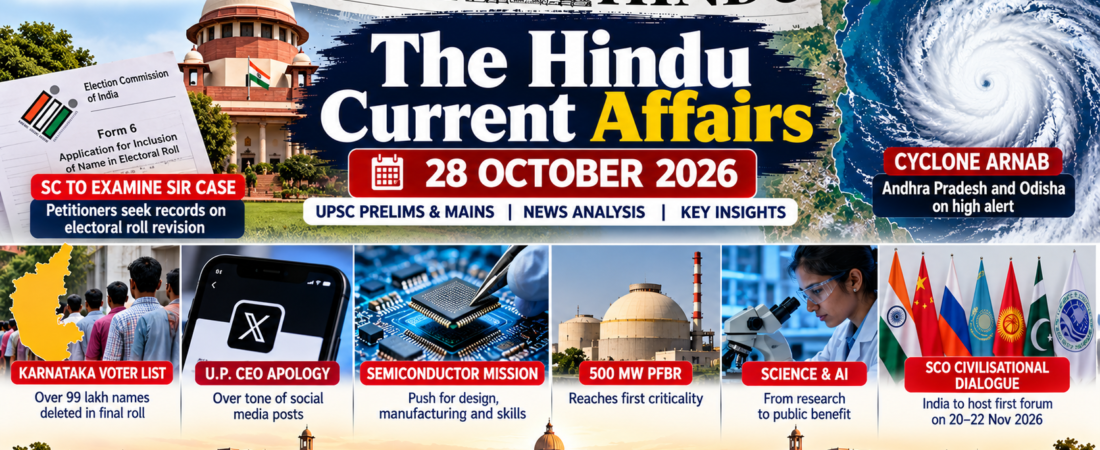
The 28 October 2026 edition of The Hindu highlights several important issues for the UPSC Civil Services Examination, particularly electoral integrity, the role of constitutional institutions, cyclone preparedness, semiconductor manufacturing, scientific research, nuclear energy, public health and international cooperation.
The most significant developments include the Supreme Court’s consideration of petitions concerning the Special Intensive Revision (SIR) of electoral rolls, the deletion of millions of names from Karnataka’s voter list, the approach of Cyclone Arnab towards the Andhra Pradesh coast, and India’s efforts to translate scientific research into economic and technological capabilities.
This compilation explains the context, significance, challenges and policy implications of the major developments reported in the newspaper, followed by Prelims facts and Mains practice questions.
1. Electoral Integrity: Supreme Court to Examine the Special Intensive Revision of Electoral Rolls
1.1 What happened?
The Supreme Court said it would examine the issues raised by petitioners seeking the preservation or submission of complete records relating to the Election Commission of India’s (ECI) Special Intensive Revision of electoral rolls. The Court listed the matter for hearing in mid-November.
The petitioners, including Leader of the Opposition Rahul Gandhi, asked the Court to ensure that records of decisions and consultations concerning the revision were preserved. The Court also issued notice on a separate petition challenging the ECI’s functioning and alleged tampering with Form 6, which is used to seek inclusion in the electoral roll.
th.th_delhi.28_10_2026.pdf
The ECI has maintained that the SIR exercise is authorised by law and that its decisions were approved unanimously by its three members. It has disputed allegations concerning changes to Form 6, arguing that the additional declaration required for certain applications is separate from the statutory form itself.
These are contested legal and political issues. The Court’s decision to examine the petitions does not, by itself, establish that the ECI acted unlawfully.
1.2 What is the Special Intensive Revision?
Electoral-roll revision is intended to maintain accurate voter lists by identifying eligible voters, adding new electors and removing entries that are no longer valid, such as confirmed duplicate or deceased entries.
An intensive revision involves more extensive verification than routine updating. It may require verification of identity, residence and existing electoral records.
Such exercises can improve the quality of electoral rolls, but they also carry risks. Errors in digitisation, transliteration, data matching or verification can wrongly exclude eligible voters.
The key governance question is how to improve the accuracy of electoral rolls without placing unreasonable procedural burdens on citizens.
1.3 Why is the issue constitutionally significant?
Article 324 of the Constitution vests the superintendence, direction and control of elections in the Election Commission. Article 326 establishes the principle of adult suffrage for elections to the Lok Sabha and State Legislative Assemblies, subject to constitutional and statutory conditions.
An accurate electoral roll is essential to the exercise of electoral rights. A person whose name is wrongly excluded may be unable to vote even if otherwise eligible.
At the same time, an electoral roll must exclude genuinely ineligible or duplicate entries. The challenge is to achieve accuracy through transparent, fair and reviewable procedures.
1.4 Karnataka’s voter-list revision: Scale of the issue
The newspaper reports that Karnataka’s final electoral roll contained approximately 4.55 crore general electors, following the deletion of about 99.32 lakh names from the pre-revision roll.
The final list showed a net increase of approximately 8.19 lakh names compared with the draft roll. However, the newspaper notes that this net increase does not establish how many people who were wrongly excluded were restored to the list.
th.th_delhi.28_10_2026.pdf
This distinction matters: the number of names added after the draft stage cannot, on its own, demonstrate whether the revision was accurate or whether all eligible voters were protected.
1.5 Concerns about digital verification
The newspaper’s opinion coverage raises concerns about automated matching of old and new electoral records. Differences in spelling, transliteration, family details or historical records can produce discrepancies even when a voter is eligible.
Digital systems can improve speed and consistency, but errors can become widespread when automated decisions are applied without adequate human review.
A reliable system should allow individuals to understand why their names were flagged, correct mistakes and appeal adverse decisions within a reasonable period.
1.6 The way forward
- Maintain complete and auditable records of electoral-roll decisions.
- Provide clear reasons when a name is deleted or an application is rejected.
- Ensure accessible correction and appeal mechanisms.
- Use technology as an aid to verification, not as an unquestionable substitute for administrative judgment.
- Publish disaggregated information on additions, deletions, rejected applications and successful appeals.
- Ensure that citizens have adequate time and assistance to submit claims.
UPSC relevance: GS Paper II — Election Commission, constitutional bodies, electoral reforms, adult suffrage, judicial review and accountability.
2. Election Commission Communication: Apology over Uttar Pradesh CEO’s Social Media Posts
2.1 What happened?
The newspaper reports that the office of Uttar Pradesh’s Chief Electoral Officer apologised for the tone and language used in social media posts responding to erroneous voter-list entries.
The controversy followed a complaint about a voter’s name being incorrectly rendered by translation software. The CEO’s office attributed the error to a software glitch but responded with remarks that were widely criticised as sarcastic and inappropriate for an official account. The office subsequently apologised.
th.th_delhi.28_10_2026.pdf
2.2 Why does official communication matter?
Public institutions must communicate in a manner that is factual, impartial and respectful. This is particularly important for institutions responsible for democratic processes, where public confidence is essential.
An administrative error may be technical, but the institutional response must demonstrate accountability. Mocking citizens or political representatives can undermine trust and distract from correcting the underlying problem.
2.3 Lessons for public administration
- Acknowledge errors promptly.
- Explain their cause without dismissing legitimate concerns.
- Correct the affected records and communicate the remedy.
- Maintain political neutrality in official communications.
- Establish standards for social media use by public institutions.
UPSC relevance: GS Paper II — Electoral administration and accountability; GS Paper IV — Political neutrality, impartiality, courtesy and public-service ethics.
3. Cyclone Arnab: Andhra Pradesh and Odisha on Alert
3.1 What does the newspaper report?
The newspaper reports that heavy rain affected northern Andhra Pradesh on Tuesday, with one death attributed to contact with live electrical wires that had fallen into water. The report states that Cyclone Arnab was moving towards the coast, with the India Meteorological Department forecasting landfall near the Yanam–Kakinada region in the early hours of Wednesday, around 2 a.m. to 4 a.m.
Visakhapatnam experienced heavy rainfall, strong winds and uprooted trees. The newspaper also reports flight cancellations in Vijayawada and Visakhapatnam.
th.th_delhi.28_10_2026.pdf
Important: These are the forecast and impacts reported in the 28 October edition. Cyclone tracks, intensity and landfall timings can change. Check the latest official IMD bulletin before using this as a current operational update.
3.2 Why are cyclones dangerous?
Tropical cyclones can cause multiple hazards simultaneously:
- Destructive winds and damage to buildings.
- Storm surges and coastal flooding.
- Intense rainfall and river flooding.
- Landslides in vulnerable terrain.
- Disruption of electricity, telecommunications and transport.
- Damage to agriculture, fisheries and other livelihoods.
Secondary hazards can also be deadly. Fallen electrical wires, damaged roads, unsafe buildings and delayed medical access may cause injuries and deaths even after the strongest winds have passed.
3.3 Disaster preparedness priorities
A comprehensive response should combine forecasting, evacuation, public communication and restoration of essential services.
Before landfall: Authorities need to issue clear warnings, move people from high-risk areas, suspend unsafe marine activity and ensure that shelters have drinking water, sanitation and essential supplies.
During the cyclone: Emergency services should maintain communication, protect vulnerable residents and prevent access to dangerous areas.
After landfall: Authorities must inspect damaged electrical infrastructure, clear roads, assess housing damage, restore communications and provide timely assistance to affected households.
3.4 Climate resilience beyond emergency response
Repeated cyclone impacts underline the need for resilient infrastructure and better coastal planning. Cyclone shelters, early-warning systems, mangrove protection, safer housing and reliable emergency communication can reduce the human and economic costs of extreme weather.
The effectiveness of disaster management should be assessed not only by the accuracy of forecasts but also by whether warnings reach people in time and enable them to act safely.
UPSC relevance: GS Paper III — Disaster management, tropical cyclones, coastal vulnerability, climate adaptation and resilient infrastructure.
4. Science and Technology: From Laboratory Research to Public Benefit
4.1 What was the key message?
Addressing the Emerging Science, Technology and Innovation Conclave, Prime Minister Narendra Modi said that science succeeds when it moves from the laboratory to practical applications that improve people’s lives.
The newspaper reports that he highlighted the importance of research, stronger links between scientific institutions and industry, and the translation of discoveries into products and technologies. He also emphasised that artificial intelligence should improve productivity without replacing independent scientific judgment.
th.th_delhi.28_10_2026.pdf
4.2 Why is research and development important?
Research and development (R&D) can improve productivity, create new industries, strengthen national security and reduce dependence on imported technologies.
However, scientific research does not automatically produce commercial or social benefits. It must be supported by laboratories, skilled researchers, funding, testing facilities, intellectual-property systems, industry collaboration and pathways for commercialisation.
A gap between research and manufacturing can prevent discoveries from becoming affordable products or widely available public services.
4.3 Research funding and commercialisation
The newspaper reports that the government highlighted research-funding commitments, including a commitment of ₹1 lakh crore, with a portion intended to help move research from laboratories towards the market. It also referred to further funding commitments and the growing number of patent filings in India.
th.th_delhi.28_10_2026.pdf
Patent numbers are one indicator of innovation, but they are not a complete measure of scientific capability. The quality of inventions, their commercial use, licensing, productivity effects and social value are equally important.
4.4 Artificial intelligence and scientific judgment
AI can help researchers analyse large datasets, identify patterns, automate routine tasks and generate hypotheses. However, AI-generated outputs may contain errors or reflect limitations in the data on which a system was trained.
Scientific research requires the ability to question assumptions, test hypotheses, reproduce results and reject explanations that are not supported by evidence.
Therefore, AI should strengthen scientific inquiry rather than encourage researchers to accept machine-generated answers without verification.
4.5 Policy priorities
- Strengthen university and laboratory research.
- Improve coordination between academia, industry and government.
- Expand access to testing and prototyping facilities.
- Support research-led start-ups and technology transfer.
- Develop specialised scientific and engineering skills.
- Promote responsible use of AI in research.
- Evaluate research funding through measurable scientific, industrial and social outcomes.
UPSC relevance: GS Paper III — Science and technology, R&D, innovation, AI, intellectual property and technology commercialisation.
5. Semiconductor Manufacturing: Building a Resilient Domestic Ecosystem
5.1 Why is this important?
The semiconductor industry is central to modern electronics, telecommunications, automobiles, defence systems, renewable-energy equipment and AI infrastructure.
The newspaper’s coverage of the Semiconductor Summit 2026 highlights the need for India to strengthen capabilities across the semiconductor value chain. Although India has a significant presence in chip design, it remains dependent on foreign suppliers for several critical inputs and technologies.
th.th_delhi.28_10_2026.pdf
5.2 The semiconductor value chain
A semiconductor ecosystem includes more than chip fabrication. Its major components include:
- Design: Developing the architecture and circuits of a chip.
- Electronic design automation: Software used to design, simulate and verify integrated circuits.
- Fabrication: Manufacturing chips on semiconductor wafers.
- Materials and equipment: Supplying specialised chemicals, gases, machinery and raw materials.
- Assembly, packaging and testing: Preparing chips for integration into electronic devices.
- Research and skills: Developing new processes and training engineers and technicians.
Weaknesses in any of these areas can limit the growth of the wider industry.
5.3 Strategic and economic significance
Semiconductor supply chains are concentrated in a limited number of countries. Disruptions caused by geopolitical tensions, export restrictions or natural disasters can affect manufacturing worldwide.
Developing domestic capabilities can improve supply-chain resilience, support electronics manufacturing and strengthen strategic autonomy.
However, semiconductor fabrication is capital-intensive and technologically complex. It requires reliable power and water, specialised infrastructure, experienced personnel and sustained investment.
5.4 Does self-reliance mean producing everything domestically?
Not necessarily. A resilient strategy can combine domestic manufacturing with diversified international partnerships. The objective should be to reduce dangerous dependencies in critical areas while remaining connected to global research, investment and markets.
India should identify which technologies require domestic capability, where partnerships are more efficient and how domestic suppliers can become globally competitive.
UPSC relevance: GS Paper III — Industrial policy, electronics manufacturing, supply-chain security, strategic autonomy and emerging technologies.
6. Nuclear Energy: Prototype Fast Breeder Reactor Reaches First Criticality
6.1 What is reported?
The newspaper’s coverage of the science conclave refers to the 500 MW Prototype Fast Breeder Reactor (PFBR) reaching first criticality. This was presented as an important development for India’s long-term energy position.
th.th_delhi.28_10_2026.pdf
6.2 What is first criticality?
A nuclear reactor reaches criticality when the nuclear fission chain reaction becomes self-sustaining. This is a major technical milestone, but it is not the same as completing every stage of commissioning or beginning full commercial electricity generation.
Further testing, regulatory clearances and staged commissioning may be required before the reactor operates commercially.
6.3 Why are fast breeder reactors significant?
A fast breeder reactor is designed to produce additional fissile material while generating energy. Depending on the reactor design and fuel cycle, breeder technology can help use nuclear fuel resources more efficiently.
India has long pursued a three-stage nuclear power programme because its domestic uranium resources are limited relative to its potential thorium resources.
The broad strategy involves:
- Pressurised heavy-water reactors using natural uranium.
- Fast breeder reactors designed to expand fissile-material availability.
- Advanced reactors intended to use thorium-based fuel cycles.
The transition between stages depends on technological progress, fuel-cycle infrastructure, safety requirements and economic viability.
6.4 Challenges and safeguards
Nuclear power can provide low-carbon electricity, but it requires strong safety regulation, secure fuel handling, radioactive-waste management, emergency preparedness and long-term financial planning.
The first criticality milestone should therefore be understood as a technical achievement within a larger commissioning and energy-policy process.
UPSC relevance: GS Paper III — Nuclear energy, energy security, clean energy and advanced reactor technology.
7. International Relations: India to Host the SCO Civilisational Dialogue Forum
7.1 What is the development?
The newspaper reports that India will host the first Civilisational Dialogue Forum of the Shanghai Cooperation Organisation (SCO) in New Delhi from 20 to 22 November 2026. The event is expected to bring together representatives from SCO member countries and invited dialogue partners and observers. Pakistan has been invited, although the report states that its delegation leadership had not yet been confirmed.
th.th_delhi.28_10_2026.pdf
The event is planned to be organised by the Ministries of Culture and External Affairs and held at Purana Qila.
7.2 Why does the SCO matter?
The SCO is a Eurasian multilateral organisation concerned with regional cooperation. Its agenda includes security, counter-terrorism, economic and cultural engagement, and cooperation among member countries.
India’s participation gives it a platform to engage with major Eurasian countries, including China, Russia and Central Asian States, while pursuing its own regional and strategic interests.
7.3 The role of cultural diplomacy
Cultural diplomacy can create channels of communication where political and security relationships are difficult. Shared heritage, historical exchange, academic engagement and people-to-people contacts can help sustain dialogue.
However, cultural engagement cannot by itself resolve strategic disputes. Its value lies in complementing diplomatic negotiations and creating opportunities for communication.
7.4 Significance for India
Hosting the forum provides an opportunity for India to present its civilisational heritage and strengthen its diplomatic engagement with Eurasian partners.
The challenge will be to translate dialogue into sustained cooperation while recognising the political differences among participating countries.
UPSC relevance: GS Paper II — International relations, regional organisations, multilateral diplomacy and cultural diplomacy.
8. Public Health: Supreme Court Questions Policy on Essential Medicine Prices
8.1 What happened?
The newspaper reports that the Supreme Court questioned the Centre over the regulation of prices of essential medicines. The Court observed that economic policy could not take precedence over citizens’ lives.
th.th_delhi.28_10_2026.pdf
The report places the issue within the broader question of access to essential medicines and the government’s responsibility to ensure that necessary treatment remains affordable.
8.2 Why does medicine-price regulation matter?
Medicines are not ordinary consumer goods. Patients may have limited alternatives when a treatment is medically necessary, and high prices can cause households to delay treatment, reduce doses or incur substantial financial burdens.
At the same time, pricing policies must consider manufacturing costs, supply continuity, incentives for innovation and the availability of quality medicines.
8.3 Policy considerations
- Identify essential medicines for which affordability is a major concern.
- Improve transparency in pricing and supply chains.
- Strengthen access to generic medicines.
- Monitor shortages and ensure consistent availability.
- Enforce quality standards and prevent the sale of substandard medicines.
- Assess the effect of pricing policies on both patients and manufacturers.
The objective is to ensure that price regulation improves access without creating unintended supply shortages.
UPSC relevance: GS Paper II — Public health, welfare, access to healthcare and judicial review.
9. Ladakh: Women’s Protests Prompt Discussion on a Possible Dry Union Territory
9.1 What happened?
The newspaper reports that the Ladakh administration agreed to discuss the demand for declaring the Union Territory a dry region after women-led protests against an expanded liquor-licensing policy.
The report states that the administration had previously increased the number of retail outlets and simplified licensing procedures. Following the protests and discussions with community representatives, the administration said the issue required consultation with stakeholders. The report also says that the 2026–27 excise policy had been rolled back and the 2025–26 policy restored.
th.th_delhi.28_10_2026.pdf
9.2 Why is this a governance issue?
Alcohol policy involves several competing considerations: public health, individual choice, community values, tourism, local livelihoods and government revenue.
Women’s groups often highlight the social costs of harmful alcohol use, including domestic violence, household financial stress and health consequences. These concerns deserve attention in public-policy decisions.
9.3 What should a balanced approach include?
- Consult affected communities and local organisations.
- Evaluate public-health and social impacts.
- Ensure that alcohol policies are consistent and transparent.
- Strengthen prevention, counselling and treatment services.
- Assess enforcement capacity and the risk of illegal sales.
- Distinguish between community concerns and assumptions about all individuals who consume alcohol.
The central lesson is that revenue considerations should be evaluated alongside health and social outcomes.
UPSC relevance: GS Paper II — Public health, vulnerable groups, local governance and social justice.
10. Arunachal Pradesh: Dialogue over the Proposed Siang Upper Multipurpose Project
10.1 What happened?
The newspaper reports that an Arunachal Pradesh Minister held discussions with a delegation representing communities that may be affected by the proposed Siang Upper Multipurpose Project. The project is planned at approximately 11,200 MW and is being examined for its potential contribution to energy security, water storage and flood moderation.
th.th_delhi.28_10_2026.pdf
The proposed project has also raised concerns about displacement and environmental impacts, particularly for downstream communities.
10.2 Why is the Siang important?
The Siang is part of the Brahmaputra river system. Water infrastructure in the region has implications for hydropower generation, flood management, local livelihoods and strategic planning in a border State.
The newspaper also situates the project in the context of concern about possible upstream interventions in the wider Brahmaputra basin.
10.3 Development and community consent
Large hydropower projects may generate electricity and support regional development, but they can also affect land, forests, river ecosystems and community life.
Meaningful consultation should include accessible information, credible environmental and social assessments, transparent responses to objections and fair rehabilitation arrangements where displacement occurs.
UPSC relevance: GS Paper III — Hydropower, environmental impact assessment, energy security and disaster risk; GS Paper II — Tribal communities and participatory governance.
11. Uttar Pradesh Approves a Robotics and AI Park in Greater Noida
The newspaper reports that the Uttar Pradesh Cabinet approved a proposed robotics and artificial-intelligence park spread across approximately 69.52 acres in Greater Noida. The project is expected by the State government to generate more than one lakh jobs and contribute ₹2,000 crore annually to the State economy. These figures are projections, not realised outcomes.
th.th_delhi.28_10_2026.pdf
Why is this significant?
Robotics and AI can improve industrial productivity, logistics, manufacturing, healthcare and other services. A dedicated technology hub can potentially attract firms, research institutions, start-ups and specialised workers.
However, a technology park’s success depends on actual investment, demand for its services, quality of infrastructure, access to skilled workers and links with existing industries.
The employment and economic benefits should therefore be assessed against implementation milestones, private investment, the number and quality of jobs created, and the extent of local technological capability.
UPSC relevance: GS Paper III — AI, robotics, industrial policy, employment and regional economic development.
12. Tamil Nadu: Prisoners Escape from a Sub-Jail in Theni District
The newspaper reports that 17 remand prisoners escaped from a sub-jail near Andipatti in Theni district after allegedly assaulting prison staff. Police had apprehended 13 of the prisoners by the time reported, while search operations continued for the remaining escapees.
th.th_delhi.28_10_2026.pdf
The incident raises questions about prison security, staffing, emergency procedures and the management of people in judicial custody.
A secure prison system must prevent escapes while respecting the legal rights and dignity of detainees. Effective oversight requires adequate staff, reliable access controls, incident reporting and independent examination of security failures.
UPSC relevance: GS Paper II — Criminal justice administration, prisons and institutional accountability.
13. India’s Semiconductor Ambitions: From Chip Design to Manufacturing
The newspaper’s Semiconductor Summit coverage emphasises that India must develop capabilities across chip design, fabrication, materials, machinery, research and specialised skills. It reports that the first phase of the India Semiconductor Mission involved ₹76,000 crore in funding support and 12 approved projects, with five reported as operationalised.
th.th_delhi.28_10_2026.pdf
The second phase is described as broadening the focus to include research and development and skill development alongside design, manufacturing, materials and machinery.
Key policy challenge
India’s semiconductor ambitions require sustained investment, reliable utilities, specialised equipment, technology partnerships and a trained workforce. Domestic capability does not require complete isolation from global supply chains; rather, it requires the ability to withstand disruptions and participate competitively in international production networks.
UPSC relevance: GS Paper III — Industrial policy, electronics, technological self-reliance, global supply chains and manufacturing.
14. Editorial and Analytical Themes
14.1 Electoral-roll revision: Accuracy must not undermine inclusion
The edition’s reporting and opinion coverage raise a fundamental democratic question: how can the state maintain accurate electoral rolls without wrongly excluding eligible voters?
The solution is not to abandon verification. It is to ensure that verification is evidence-based, transparent, accessible and subject to timely correction.
14.2 Science policy: Innovation requires an ecosystem
Scientific progress depends on more than funding or patents. Research institutions need skilled personnel, laboratories, access to equipment, collaboration with industry and a route from discovery to application.
14.3 Semiconductor resilience: Strategic autonomy through diversification
India can strengthen technological autonomy by building domestic capacity in critical areas while diversifying suppliers and continuing international collaboration.
14.4 Public administration: Respectful communication is part of accountability
The controversy over official social media posts illustrates that public institutions are judged not only by their formal powers but also by how they treat citizens, acknowledge errors and explain decisions.
15. Important Facts for UPSC Prelims
| Topic | Key fact |
|---|---|
| Article 324 | Provides the constitutional basis for the Election Commission’s superintendence, direction and control of elections. |
| Article 326 | Provides for elections to the Lok Sabha and State Legislative Assemblies on the basis of adult suffrage, subject to constitutional and statutory provisions. |
| Form 6 | Used to apply for inclusion of a name in the electoral roll. |
| SIR | Special Intensive Revision is an extensive electoral-roll verification exercise. |
| IMD | India’s national meteorological agency; issues weather forecasts and cyclone warnings. |
| PFBR | A prototype fast breeder reactor; first criticality indicates that a self-sustaining nuclear fission chain reaction has been achieved. |
| Fast breeder reactor | Designed to generate energy while producing additional fissile material under appropriate reactor and fuel-cycle conditions. |
| Semiconductor | A material whose electrical conductivity lies between that of a conductor and an insulator and can be controlled for electronic applications. |
| SCO | A Eurasian multilateral organisation concerned with regional cooperation, including security and economic engagement. |
| AI and research | AI can support scientific work, but results require validation, independent judgment and reproducibility. |
| Essential medicines | Medicine-price policy must balance affordability, quality, availability and supply sustainability. |
| Cyclone preparedness | Effective disaster management includes forecasting, evacuation, shelter, communication and post-disaster restoration. |
16. UPSC Mains Practice Questions
GS Paper II — Polity and Governance
1. “Electoral-roll accuracy and universal adult suffrage must be pursued together.” Discuss the safeguards required during intensive electoral-roll revision. (150 words)
2. Examine the role of judicial review in ensuring accountability of constitutional institutions. (150 words)
3. Discuss the importance of impartiality, transparency and respectful communication in electoral administration. (150 words)
4. How can community participation improve the legitimacy and sustainability of large infrastructure projects? (250 words)
5. Examine the role of public consultation in shaping alcohol policy in regions with distinct social and cultural concerns. (150 words)
GS Paper III — Science, Technology and Environment
6. Discuss the challenges India faces in building a competitive domestic semiconductor ecosystem. How can international cooperation complement domestic manufacturing? (250 words)
7. “The value of scientific research lies in its ability to produce measurable social and economic benefits.” Discuss the institutional reforms required to strengthen research commercialisation in India. (250 words)
8. Explain the significance of fast breeder reactors in India’s nuclear-energy strategy. What safety and technological challenges must be addressed? (250 words)
9. Evaluate the potential of AI in scientific research. How can researchers preserve independent judgment and scientific integrity? (150 words)
10. Discuss the importance of an integrated approach to cyclone preparedness and coastal resilience. (250 words)
GS Paper IV — Ethics
11. A public official discovers that a software system has incorrectly excluded eligible citizens from a public register. What ethical principles should guide the official’s response? (150 words)
12. How should administrators balance national development priorities with the rights and concerns of communities affected by infrastructure projects? (150 words)
17. Conclusion
The 28 October edition highlights the importance of combining institutional accountability with effective public administration.
The debate over electoral-roll revision demonstrates that administrative accuracy must be accompanied by procedural fairness and accessible remedies. Cyclone preparedness shows why forecasting must be supported by evacuation planning, resilient infrastructure and public communication. Semiconductor manufacturing and scientific research underline the importance of skills, infrastructure and collaboration in building technological capacity. Nuclear energy, hydropower and AI also illustrate that technological progress requires careful attention to safety, environmental impact and public benefit.
For UPSC aspirants, the central task is to connect these developments with constitutional provisions, public-policy frameworks, institutional responsibilities and practical reforms.