
Introduction
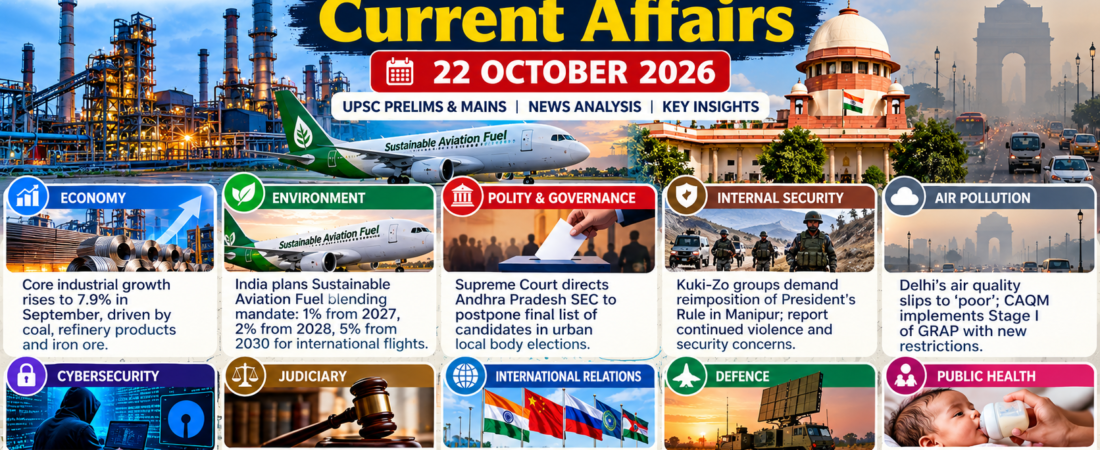
The The Hindu Delhi edition dated 22 October 2026 covers important developments in economic growth, aviation decarbonisation, electoral fairness, federal governance, internal security, environmental protection, digital privacy and international relations. The major issues for UPSC aspirants include the acceleration of core-sector growth, India’s proposed Sustainable Aviation Fuel (SAF) mandate, the Supreme Court’s intervention in Andhra Pradesh’s urban local body elections, renewed violence in Manipur, and the balance between public health and commercial interests in infant nutrition.
This compilation organises the major developments under the UPSC Civil Services Examination syllabus and highlights their broader policy implications.
1. Indian Economy
1.1 Index of Eight Core Industries records 7.9% growth
India’s core industrial growth accelerated to 7.9% in September 2026, the highest growth recorded since the current data series began in April 2024. The performance was driven by coal, refinery products and iron ore.
Sector-wise performance
- Coal: Output grew by 10.7%, partly aided by a low base in the corresponding month of the previous year.
- Refinery products: Growth accelerated to 10.3%, compared with 5.6% in August.
- Iron ore: Output increased by 18.4%, continuing a prolonged period of strong growth.
- Electricity: Growth stood at 11.4%, lower than the 13.1% recorded in August.
- Cement: Output grew by 9.8%.
- Steel: Growth accelerated to 4.9%.
- Crude oil: Production contracted by 1.4%.
- Natural gas: Output declined by 4.6%.
- Fertilisers: Production contracted by 11.7%, marking the seventh consecutive month of decline.
What is the Index of Eight Core Industries?
The Index of Eight Core Industries tracks the performance of eight infrastructure-related industries that have a substantial influence on industrial production.
The eight industries are:
- Coal
- Crude oil
- Natural gas
- Petroleum refinery products
- Fertilisers
- Steel
- Cement
- Electricity
Together, these industries account for approximately 40.27% of the weight of the Index of Industrial Production (IIP).
Significance for the economy
Positive indicators
- Growth in coal and electricity may indicate stronger industrial and power-sector activity.
- Rising cement and steel output can reflect construction activity and infrastructure investment.
- Higher iron ore production supports the steel value chain.
- Stronger industrial production can improve employment and investment prospects.
Areas of concern
The headline growth rate should not obscure persistent weaknesses in crude oil, natural gas and fertiliser production. The refinery-products figure also needs to be interpreted alongside the relatively low average growth recorded during the first half of the financial year.
The performance of individual sectors suggests that industrial recovery remains uneven rather than broad-based.
UPSC relevance: GS Paper III — Indian Economy, industrial growth, infrastructure, energy security and economic indicators.
1.2 Bihar expands rural employment works in flood- and drought-affected districts
Bihar’s Rural Development Department announced employment opportunities under the Viksit Bharat–Guarantee for Rozgar and Ajeevika Mission (Gramin), referred to in the report as VB-G RAM G.
The initiative covers:
- 22 flood-affected districts requiring infrastructure restoration.
- 16 districts experiencing drought-like conditions and damage to rabi crops.
The department indicated that employment-generating activities would help restore damaged roads, bridges, culverts, embankments and other infrastructure. The reported funding arrangement is a 60:40 contribution by the Centre and the State.
The decision also responds to reduced demand for agricultural labour following crop damage and the need to provide employment to returning workers during the festival season.
Policy significance
The development illustrates how rural employment programmes can serve both livelihood and disaster-recovery objectives. Labour-intensive public works can restore community assets while supporting rural consumption during periods of agricultural distress.
However, effective implementation requires timely wage payments, identification of genuinely damaged infrastructure, transparent work allocation and coordination between disaster management and rural development authorities.
UPSC relevance: GS Paper II — welfare schemes and governance; GS Paper III — agriculture, rural development and disaster management.
2. Environment and Climate Change
2.1 India considers Sustainable Aviation Fuel blending requirements
India is expected to introduce a Sustainable Aviation Fuel blending mandate for international flights, according to industry sources cited in the newspaper.
The proposed schedule is:
- 1% blending from 2027.
- 2% from 2028.
- 5% from 2030.
The report describes these targets as expected policy measures; an official announcement was still awaited at the time of publication.
What is Sustainable Aviation Fuel?
Sustainable Aviation Fuel is an alternative aviation fuel produced from eligible non-petroleum feedstocks or other approved pathways. Depending on the production pathway and lifecycle assessment, it can reduce aviation’s lifecycle greenhouse-gas emissions compared with conventional fossil-based jet fuel.
Potential feedstocks include used cooking oil, agricultural residues and other sustainable materials. Production methods can include hydroprocessed fuels and alcohol-to-jet pathways.
SAF is designed to work within existing aviation systems when it meets the applicable technical standards and fuel specifications.
What is CORSIA?
The Carbon Offsetting and Reduction Scheme for International Aviation (CORSIA) is a global mechanism adopted by the International Civil Aviation Organization (ICAO) in 2016 to address carbon emissions from international aviation.
Its framework uses eligible emissions-reduction measures, including sustainable aviation fuels and eligible carbon credits, to address emissions covered by the scheme.
The newspaper reports that the mandatory phase is scheduled to begin in 2027. Airlines operating internationally must therefore prepare for the associated compliance requirements.
Challenges for India
1. High production costs: SAF can cost several times as much as conventional aviation turbine fuel, creating pressure on airlines and potentially affecting ticket prices.
2. Domestic production capacity: India must expand production facilities and establish dependable supply chains.
3. Feedstock availability: Large-scale production must not create excessive competition for agricultural residues or waste materials needed for other purposes.
4. Regulatory clarity: A comprehensive national policy would need to address blending obligations, pricing, domestic production, exports and carbon-credit eligibility.
5. Investment requirements: Producers may seek policy support, subsidies or long-term purchase commitments to reduce investment risks.
Opportunities
India has the potential to develop a SAF industry using suitable waste-based and agricultural feedstocks. A well-designed policy could encourage domestic manufacturing, create rural value chains and position India as a potential exporter.
However, the environmental benefit depends on the sustainability of the feedstock, the energy used during production and the fuel’s lifecycle emissions.
UPSC relevance: GS Paper III — climate change, energy transition, sustainable development and environmental technology.
2.2 Delhi introduces Stage I of the Graded Response Action Plan
Delhi’s air quality deteriorated to the “poor” category, prompting the Commission for Air Quality Management (CAQM) to implement Stage I of the Graded Response Action Plan (GRAP).
The newspaper reported a 24-hour average Air Quality Index (AQI) of 245 at 4 p.m. on Wednesday, compared with 179 a day earlier.
Measures reported
- Diesel generator sets should not be used as a regular source of power.
- Restrictions apply to certain inter-State buses entering Delhi-NCR, with exemptions for specified cleaner vehicle categories.
- Authorities are expected to enforce existing pollution-control norms.
- The broader action plan includes traffic management, dust control, industrial-emission monitoring and increasing green cover.
The report also carried the Delhi government’s claim that 78 lakh saplings had been planted against a target of 70 lakh. These are official figures reported in the newspaper, not an independent assessment of plantation survival or ecological impact.
Understanding GRAP
GRAP is a set of graded emergency measures designed to respond to worsening air pollution in Delhi-NCR. Its stages correspond to different levels of air-quality deterioration and anticipated pollution conditions.
The framework seeks to coordinate action across multiple agencies rather than relying on a single intervention.
Why episodic measures are insufficient
Short-term restrictions can help reduce emissions during pollution episodes, but persistent improvement requires structural changes:
- Cleaner public transport and better last-mile connectivity.
- Reliable electricity to reduce dependence on diesel generators.
- Dust management at construction sites and roads.
- Cleaner industrial fuels and enforcement of emission standards.
- Regional coordination on transport, industry and other pollution sources.
- Scientific monitoring of the survival and ecological value of urban plantations.
UPSC relevance: GS Paper III — air pollution, urban governance, environmental regulation and public health.
2.3 Blue whale strandings on India’s western coast
A science feature in the newspaper highlights records of blue whale strandings along India’s coast, particularly the western coastline.
The article reports that approximately 470 blue whale strandings have been recorded globally, with India accounting for around one in seven. About three-quarters of the Indian records are from the west coast.
The article also notes that recorded strandings have become more frequent in recent decades and that a growing share involves calves. Gujarat historically accounted for several recorded strandings, particularly around the Gulf of Khambhat and river mouths near Surat.
An important qualification
The article draws attention to a major limitation in interpreting historical wildlife data: an absence of recorded strandings does not necessarily mean an absence of strandings.
In Gujarat, many historical records came from a small number of naturalists and compilations. The apparent decline in recorded strandings after 2000 may therefore reflect gaps in systematic observation, rather than a confirmed decline in whale occurrence.
Conservation implications
- Develop systematic marine-mammal stranding databases.
- Improve coordination between coastal communities, researchers and wildlife authorities.
- Record species, location, date, age class and condition consistently.
- Investigate possible causes of strandings rather than inferring causation from the available records.
- Use citizen science carefully, with expert verification of observations.
The case demonstrates the importance of long-term ecological monitoring and the distinction between biological trends and trends in data collection.
UPSC relevance: GS Paper III — biodiversity, marine conservation, ecological monitoring and scientific research.
3. Polity and Governance
3.1 Supreme Court intervenes in Andhra Pradesh urban local body elections
The Supreme Court directed the Andhra Pradesh State Election Commission (SEC) to postpone publication of the final list of candidates contesting urban local body elections.
The order followed a petition by the Yuvajana Sramika Rythu Congress Party (YSRCP), which alleged that 63.5% of its candidates had been physically prevented from filing nominations.
The Court extended publication of the final list until October 25 and directed the SEC to consider representations and evidence from political parties and candidates. It also said the SEC could extend nomination deadlines in constituencies where it was satisfied that candidates had been prevented from filing.
The State Director General of Police was directed to provide security, preserve CCTV footage and file a compliance report.
The allegations in the petition should not be treated as judicially established facts.
Constitutional significance
The case highlights the relationship between electoral administration and the constitutional requirement of free and fair elections.
Article 243K provides for State Election Commissions to supervise, direct and control elections to Panchayats. Article 243ZA provides for the corresponding role in municipal elections.
The State Election Commission is institutionally distinct from the Election Commission of India, which conducts elections to Parliament, State Legislatures, and the offices of President and Vice-President.
Why the right to file nominations matters
A meaningful electoral process requires more than voting on polling day. Candidates must have a genuine opportunity to participate in the nomination process without intimidation or obstruction.
Where credible evidence indicates that candidates were prevented from filing nominations, an effective remedy may be necessary to protect electoral fairness.
UPSC relevance: GS Paper II — constitutional bodies, local government, electoral reforms and democratic accountability.
3.2 Manipur: demand for reimposition of President’s Rule
Kuki-Zo organisations demanded the reimposition of President’s Rule in Manipur, citing continuing violence and insecurity.
According to claims reported by the newspaper, the Kuki-Zo Women’s Forum said at least 32 people from the community had been killed since March 2026 and approximately 55 houses in 14 villages had been burnt. The organisations also alleged severe economic hardship and obstruction of essential supplies in affected areas.
The groups argued that a separate administration for the Kuki-Zo community was necessary. These figures and allegations were attributed to the organisations making the claims.
The newspaper also reported continuing tensions involving Meitei, Kuki-Zo and Naga communities, alongside political criticism of the government’s handling of the conflict.
Constitutional background
Article 356 of the Constitution permits the President to assume certain functions of a State government when satisfied that the government cannot be carried on in accordance with the Constitution, subject to constitutional safeguards and parliamentary approval.
President’s Rule is an exceptional constitutional arrangement. Its continuation or reimposition must be considered in the context of constitutional governance, public order, representative government and the protection of citizens.
Key governance challenges
- Restoring security without deepening inter-community mistrust.
- Protecting civilians and preventing retaliatory violence.
- Ensuring reliable access to food, fuel, medicines and other essentials.
- Rehabilitating displaced families and restoring livelihoods.
- Building credible dialogue and accountability mechanisms.
- Addressing the political roots of conflict alongside immediate security concerns.
A purely security-led response may not resolve a conflict rooted in identity, political representation, territorial concerns and historical mistrust. Sustainable peace requires a credible political process alongside law enforcement and humanitarian support.
UPSC relevance: GS Paper II — Article 356, federalism and constitutional governance; GS Paper III — internal security and conflict management.
3.3 Television news channels receive advisory on responsible broadcasting
The Ministry of Information and Broadcasting advised television news channels to comply with the Programme Code under the Cable Television Networks (Regulation) Act and Rules.
The advisory called for action against abusive remarks, communal disharmony, sensationalism and the irresponsible use of artificial intelligence.
It also highlighted restrictions on live coverage of anti-terror operations. Coverage during such operations is to be limited to authorised briefings until the operation concludes. Channels were advised to use timestamps where necessary and exercise caution with disturbing visuals, particularly those involving women and children.
Broader significance
The issue involves balancing press freedom with public order, national security, privacy and responsible reporting.
AI-generated or manipulated content adds a further challenge: newsrooms need procedures for source verification, labelling synthetic content where appropriate and correcting errors quickly.
At the same time, regulatory action should remain transparent and consistent with constitutional protections for freedom of speech and expression.
UPSC relevance: GS Paper II — freedom of speech, media regulation, governance and technology.
3.4 Special Executive Magistrates and preventive powers
A report examines the role of Special Executive Magistrates (SEMs) following the detention and subsequent release of two protest leaders.
Section 15 of the Bharatiya Nagarik Suraksha Sanhita (BNSS) provides for the appointment of police officers of at least Superintendent of Police rank, or equivalent, as Executive Magistrates for specified functions or areas.
Section 163 of the BNSS empowers Executive Magistrates to issue orders to prevent certain urgent dangers or disturbances, including restrictions on assemblies where legally justified.
The constitutional question
Preventive powers can be important for averting violence and maintaining public order. However, they must not become a substitute for ordinary criminal procedure or be used arbitrarily against peaceful dissent.
The exercise of such powers should be based on specific grounds, legally relevant material, proportionality and effective judicial review.
Relevant constitutional provisions include:
- Article 19(1)(a): freedom of speech and expression.
- Article 19(1)(b): the right to assemble peaceably and without arms.
- Article 19(2): reasonable restrictions on speech and expression on specified grounds.
- Article 19(3): reasonable restrictions on peaceful assembly on specified grounds.
- Article 21: protection of life and personal liberty.
UPSC relevance: GS Paper II — civil liberties, preventive detention, criminal procedure and public order.
3.5 Jamia Millia Islamia moves towards a students’ union constitution
Jamia Millia Islamia constituted a five-member committee to draft a constitution for its students’ union, which had been dissolved in 2006. The committee was asked to consult stakeholders and submit a draft by December 20.
The development came amid student protests seeking the restoration of elected student representation. The university also announced a review of certain disciplinary actions relating to the protests.
Significance
Student unions can provide institutional channels for representation, leadership development and peaceful expression of grievances. Their functioning also raises questions concerning campus discipline, democratic participation and the autonomy of educational institutions.
The central governance challenge is to create transparent rules that protect legitimate student representation while ensuring safety and continuity of academic activity.
UPSC relevance: GS Paper II — democratic institutions, education governance and civil liberties.
4. Judiciary and Legal Developments
4.1 Supreme Court temporarily stays investigation in the CMRL–Exalogic case
The Supreme Court stayed for seven days the investigation into an FIR concerning the alleged ₹2.78-crore CMRL–Exalogic pay-off case involving former Kerala Chief Minister Pinarayi Vijayan, his daughter T. Veena and son-in-law P.A. Mohamed Riyas.
The Court set aside an earlier Kerala High Court Division Bench order and sent the appeals back to the High Court for adjudication. The FIR itself was not quashed.
The Court examined the relationship between the Enforcement Directorate’s powers under the Prevention of Money Laundering Act (PMLA) and the statutory powers of State police.
It emphasised that information shared by a central agency does not automatically remove the responsibility of the relevant State agency to apply the appropriate law and make its own legal assessment.
The Court also raised questions concerning the applicability of prior approval requirements under Section 17A of the Prevention of Corruption Act, 1988.
Legal significance
The case raises important questions about:
- Federal relations in criminal investigation.
- The limits of statutory powers.
- The distinction between sharing information and directing another agency to register an FIR.
- Procedural fairness and the right to be heard.
- The relationship between anti-corruption law and money-laundering investigations.
The interim stay is not a final determination of the allegations or the merits of the FIR.
UPSC relevance: GS Paper II — judiciary, federalism, criminal justice and accountability institutions.
4.2 Patna High Court rules on compensation for land acquired in 1976
The Patna High Court ruled that former Lok Sabha Speaker Meira Kumar was entitled to compensation for land acquired by the Bihar government in 1976 for drainage construction.
The Court quashed a 2023 order by the Patna Collector that had cancelled the land revenue records. It restored the jamabandi in favour of Meira Kumar’s mother, Indrani Devi, and held that compensation was payable under the Right to Fair Compensation and Transparency in Land Acquisition, Rehabilitation and Resettlement Act, 2013.
The Court also examined the relevance of the original settlement and the limits of the Collector’s authority under the Bihar Land Reforms Act, 1950.
Significance
The case illustrates the importance of lawful acquisition, maintenance of land records, administrative jurisdiction and compensation for property acquired for public purposes.
Development projects require legal certainty. Administrative convenience cannot substitute for compliance with the applicable land-acquisition framework.
UPSC relevance: GS Paper II — judicial review, administrative law and land acquisition.
4.3 Jammu and Kashmir High Court questions a preventive detention order
The Jammu and Kashmir High Court sought the personal appearance of the Srinagar Deputy Commissioner in a case concerning a preventive detention order under the Public Safety Act.
The Court expressed concern about whether the order had been passed with adequate application of mind and specific supporting material. It emphasised that personal liberty is constitutionally important and that preventive detention must be used with strict adherence to legal safeguards.
Key principle
Preventive detention is an exceptional departure from the ordinary criminal justice process. Its use requires careful compliance with the relevant statutory and constitutional requirements.
The case provides an opportunity to examine the tension between national security, preventive powers and individual liberty.
UPSC relevance: GS Paper II — fundamental rights, preventive detention and judicial review.
4.4 Supreme Court questions high medicine trade margins
The Supreme Court asked the Union government to consider broader measures to address high trade margins in medicines and medical products.
The report notes that the Centre had informed the Court of its decision to cap trade margins at 30% for non-scheduled anti-cancer medicines. The Bench questioned why similar restrictions could not be considered for other medicines and medical products.
Policy issues
- Affordability and access to essential medicines.
- The difference between regulated prices and trade margins.
- Incentives for pharmaceutical distribution and retail.
- The role of price regulation in protecting consumers.
- The need to balance access, competition and innovation.
The matter was scheduled for further hearing on October 27.
UPSC relevance: GS Paper II — public health and governance; GS Paper III — economic regulation and pharmaceutical policy.
5. Banking, Cybersecurity and Digital Privacy
5.1 SBI reports suspected exposure of customer information
The State Bank of India informed stock exchanges about a suspected exposure of customer information on the Dark Web.
The bank reported that preliminary analysis of approximately 3,75,000 records identified 3,897 customer records containing personally identifiable information. The information described in the report included names, mobile numbers, dates of birth, email and residential addresses, branch and customer identifiers, and metadata associated with loan or lead records.
SBI said that incident-response measures had been activated and an independent CERT-In-empanelled cybersecurity agency had been engaged to assess the incident.
The bank stated that its core business functions continued normally. The report also carried concerns raised by the Internet Freedom Foundation regarding the timing and completeness of the bank’s disclosure and communication with affected customers.
The full source, authenticity and extent of the exposed material remained under investigation.
Why this matters
Financial institutions hold extensive personal and financial information, making them important targets for cybercrime.
A data exposure can facilitate:
- Phishing and impersonation.
- Fraudulent calls and messages using personal information.
- Identity theft.
- Social engineering targeting bank customers.
- Reputational and regulatory risks for institutions.
Governance priorities
Effective cybersecurity requires more than protecting banking transactions. It also requires robust data governance, prompt incident assessment, appropriate customer notification, independent investigation and safeguards against misuse of personal information.
The case also highlights the importance of clear disclosure standards that inform both investors and affected customers.
UPSC relevance: GS Paper III — cybersecurity, digital infrastructure and financial-sector resilience; GS Paper II — regulatory accountability and data protection.
6. International Relations and Strategic Affairs
6.1 India raises terrorism concerns at the Shanghai Cooperation Organisation
Defence Minister Rajnath Singh used the Shanghai Cooperation Organisation (SCO) Council of Heads of Government meeting in Tajikistan to reiterate India’s position that regional cooperation cannot be meaningful if terrorism is addressed selectively.
The editorial argues that regional economic cooperation depends on a stable security environment. Trade routes, investment and transport connectivity can be disrupted by terrorism and insecurity.
It highlights the potential relevance of the International North-South Transport Corridor and Chabahar Port for connectivity between India, Central Asia and wider markets.
The SCO’s significance
The SCO is a regional organisation whose agenda includes security cooperation, economic relations and connectivity. Its members have different strategic interests and security priorities, making consensus on sensitive political issues difficult.
India faces a dual challenge: maintaining a clear position against terrorism while working with regional partners on trade, connectivity and development.
Way forward
- Improve intelligence-sharing and cooperation against terror financing.
- Disrupt recruitment and logistical networks.
- Prevent terrorist groups from using safe havens.
- Preserve channels for regional economic cooperation.
- Support connectivity projects while respecting sovereignty and territorial integrity.
UPSC relevance: GS Paper II — regional organisations, India’s foreign policy, counterterrorism and connectivity.
6.2 U.S. Secretary of State’s meetings with Indian industry leaders
The newspaper reported that U.S. Secretary of State Marco Rubio met Adani Group chairman Gautam Adani and Tata Sons chairman N. Chandrasekaran in Mumbai before travelling to Jamnagar to visit Reliance Industries’ oil-refining complex.
The report places the engagements against the backdrop of wider India–U.S. relations and commercial interests. The meetings should not, by themselves, be interpreted as evidence of a concluded agreement.
Areas of strategic interest
India–U.S. relations involve trade, energy, technology, investment, defence cooperation and supply-chain resilience. Engagement with major industrial groups can provide insight into the commercial dimension of the relationship, although official outcomes must be assessed through subsequent announcements.
UPSC relevance: GS Paper II — bilateral relations, economic diplomacy and strategic partnerships.
6.3 Russia signals possible renewed U.S.-mediated talks with Ukraine
The international pages reported that Russia had agreed in principle to resume U.S.-mediated peace talks with Ukraine as early as the following month. The Kremlin indicated that discussions could take place in Abu Dhabi and focus on security arrangements for both countries after the war.
Ukrainian President Volodymyr Zelenskyy was reported to have described freezing the conflict as a minimum step towards ending the war.
These were reported diplomatic developments, not confirmation that a peace agreement had been reached.
Issues to watch
- Territorial questions and the status of occupied areas.
- Security guarantees for Ukraine.
- The future of European security arrangements.
- Sanctions and reconstruction.
- The role of the United States and other external powers.
- The relationship between a ceasefire and a durable political settlement.
UPSC relevance: GS Paper II — international security, diplomacy and the changing global order.
7. Defence and Internal Security
7.1 Army prepares to release a Land Warfare Doctrine
The Army Commanders’ Conference began in New Delhi on October 21 and was scheduled to continue until October 23.
According to the Defence Ministry, a key feature of the conference would be the release of a Land Warfare Doctrine intended to provide an overarching framework for preparing the Army for evolving forms of warfare and future conflicts.
Significance
Modern land warfare increasingly involves the integration of conventional forces with drones, electronic warfare, cyber capabilities, precision weapons, intelligence systems and real-time surveillance.
A doctrine can help establish common operational concepts, guide capability development and improve coordination between different elements of the armed forces.
UPSC relevance: GS Paper III — defence modernisation, military preparedness and emerging technologies.
7.2 India signs ₹770-crore contract for low-level lightweight radars
The Defence Ministry signed a contract worth nearly ₹770 crore with Bharat Electronics Limited for Improved Low Level Light Weight Radar systems.
According to the report, the systems can detect and track fighter-sized targets as well as mini- and micro-drones, and can prioritise aerial targets.
Significance
Low-level radar capability is important because small and low-flying aerial threats can be difficult to detect using conventional surveillance arrangements alone.
The procurement reflects the growing importance of layered air defence and counter-drone capability.
UPSC relevance: GS Paper III — defence technology, indigenous manufacturing and national security.
8. Media, Public Health and Social Policy
8.1 FSSAI proposes removing added sugar allowance in infant foods
An editorial examined the Food Safety and Standards Authority of India’s draft proposal to eliminate the existing allowance for adding sucrose and fructose to foods intended for infants aged zero to six months.
The newspaper reports that current regulations allow the combined total of these sugars to reach 20% of the carbohydrates in such products. The draft proposal seeks to remove this allowance.
The editorial links the proposal to the World Health Organization’s recommendation for exclusive breastfeeding during the first six months and avoidance of added sugars in complementary foods until 24 months.
Why the issue matters
Infant nutrition influences early dietary preferences and long-term health. Added sugar may make products more palatable, but commercial appeal does not necessarily translate into better nutritional quality.
A narrow restriction on sucrose and fructose may also be insufficient if manufacturers can substitute other sweetening ingredients or rely on processing that increases free sugars.
Policy considerations
- Evaluate the nutritional profile of the finished product, not merely individual ingredients.
- Align food standards with evidence-based infant-feeding recommendations.
- Strengthen consumer information and transparent labelling.
- Monitor marketing practices involving infant foods.
- Balance regulatory clarity with effective enforcement.
The editorial argues that a comprehensive approach should assess both ingredients and the nutritional characteristics of the final product.
UPSC relevance: GS Paper II — public health regulation; GS Paper III — food safety and nutrition.
8.2 West Bengal sets up an SIT after a Durga Puja stampede
The West Bengal government established a Special Investigation Team to investigate the stampede at Chorbagan Sarbojanin Durga Puja Pandal in Kolkata, which claimed 19 lives on October 17.
The six-member SIT is headed by retired Justice Anindita Roy Saraswati and includes State officials and a National Disaster Response Force representative.
The report noted that a High Court Bench had indicated that a sitting High Court judge could not be appointed to head the inquiry in the manner initially proposed.
Governance lessons
Large public gatherings require risk assessment, crowd-flow planning, emergency exits, capacity management, trained personnel and coordination among police, fire services, health authorities and organisers.
An inquiry should establish responsibility, identify procedural failures and recommend measures that reduce the likelihood of similar incidents.
UPSC relevance: GS Paper II — public administration and accountability; GS Paper III — disaster management and urban safety.
9. Urban Governance and Infrastructure
9.1 Delhi Police identifies safety gaps in parks and educational institutions
Delhi Police completed an audit of approximately 1,600 parks following a Supreme Court directive concerning safety in public spaces.
The survey identified problems in some locations, including broken boundary walls, non-functional CCTV cameras, inadequate lighting and insufficient security arrangements.
Recommendations included better lighting, regular inspections, improved CCTV coverage, police booths in larger parks, pruning vegetation that obstructs visibility and more effective monitoring of surveillance systems.
The audit also examined security arrangements at educational institutions, including boundary walls, staff verification and CCTV coverage.
Significance
Public safety is not solely a policing issue. It also depends on urban design, maintenance, lighting, institutional accountability and coordination among civic bodies and law-enforcement agencies.
Infrastructure audits are useful only when findings are translated into time-bound repairs, measurable standards and ongoing maintenance.
UPSC relevance: GS Paper II — urban governance and public safety; GS Paper III — urban infrastructure.
9.2 RTR flyover ramp closed for urgent repairs
A ramp of the Rao Tula Ram flyover towards Vasant Vihar was closed after authorities identified cracks, concrete deterioration and exposed reinforcement.
The closure caused traffic congestion on a route connecting Gurugram and Indira Gandhi International Airport with south Delhi. Authorities initiated repairs and diverted traffic.
Broader significance
The incident highlights the need for regular structural audits, preventive maintenance and clear accountability for urban infrastructure.
Repairing visible damage after it emerges is important, but asset-management systems should also identify deterioration before it creates safety risks or disrupts essential transport links.
UPSC relevance: GS Paper III — infrastructure development, urban transport and public asset management.
10. Important Additional Developments
Banking and finance
- SBI’s disclosure of suspected customer-data exposure has implications for cybersecurity, data protection and trust in digital banking.
Wildlife protection
- Delhi Police reportedly rescued 103 protected birds and turtles from a pet shop in Moti Nagar. Legal action was stated to be under way, and release into the wild was subject to clearance.
Maritime safety
- A cargo vessel carrying construction materials sank off the Beypore coast in Kerala. All eight crew members were rescued by the Indian Coast Guard.
Telangana: event infrastructure safety
- Police said the iron truss that collapsed during a college dandiya event in Nadargul, killing a student and injuring 22 others, had been erected on two pillars rather than four. Three organisers surrendered, while two faculty members were reported to be absconding. The incident raises questions about structural safety, event permissions and institutional responsibility.
Manipur
- The State DGP visited Kamjong district to review security coordination amid tensions involving Naga and Kuki communities. The report also mentioned an alleged arson incident in a Kuki village.
Haryana electricity distribution
- The Haryana Electricity Regulatory Commission granted a 25-year parallel distribution licence to Eleven Power Private Limited for Gurugram and Nuh. The State government said it would challenge the decision, while electricity employees’ unions announced a strike. The debate concerns competition, the role of State-owned distribution companies and consumer interests.
11. Editorial Analysis
11.1 Economic cooperation requires a stable security environment
The editorial “Peace for progress” argues that regional economic integration cannot be separated from security concerns.
Transport corridors, ports and trade networks require predictable conditions. Terrorism and cross-border insecurity can raise costs, disrupt logistics and undermine investor confidence.
For India, the challenge is to uphold its concerns about terrorism while continuing to pursue practical cooperation with regional partners.
Mains analytical framework:
- Problem: Divergent security priorities among regional states.
- Impact: Reduced trust, disrupted connectivity and constrained economic integration.
- Response: Intelligence-sharing, action against terror financing, denial of safe havens and continued economic engagement.
- Conclusion: Security cooperation and economic cooperation should reinforce one another rather than be treated as mutually exclusive.
11.2 Infant nutrition requires regulation based on outcomes
The editorial on added sugar in infant foods argues that removing a specific sugar allowance is a positive step, but regulation should consider the finished product’s nutritional profile.
The broader lesson is that food regulation should not focus exclusively on narrow ingredient definitions when manufacturers can substitute similar ingredients or alter processing methods.
A robust regulatory framework should combine scientific evidence, transparent labelling, enforcement and protection against misleading marketing.
11.3 Democratic participation depends on effective safeguards
The developments concerning urban local body nominations in Andhra Pradesh and preventive powers exercised by magistrates highlight different aspects of democratic participation.
Electoral fairness requires candidates to have a genuine opportunity to contest elections. Civil liberties require preventive powers to be exercised on legally relevant grounds and subject to scrutiny.
In both cases, institutions must balance public order with the effective protection of democratic rights.
12. UPSC Prelims Quick Revision
| Topic | Key fact to remember |
|---|---|
| Index of Eight Core Industries | Covers coal, crude oil, natural gas, refinery products, fertilisers, steel, cement and electricity |
| IIP | The eight core industries together account for approximately 40.27% of its weight |
| SAF | Sustainable Aviation Fuel is an alternative aviation fuel made through eligible sustainable pathways |
| CORSIA | ICAO’s Carbon Offsetting and Reduction Scheme for International Aviation |
| GRAP | Graded Response Action Plan for managing air pollution episodes in Delhi-NCR |
| CAQM | Commission for Air Quality Management in NCR and adjoining areas |
| State Election Commission | Articles 243K and 243ZA concern Panchayat and municipal elections, respectively |
| Article 356 | Constitutional provision concerning failure of constitutional machinery in a State |
| BNSS Section 163 | Provides for specified urgent preventive orders by Executive Magistrates |
| Article 19(1)(a) | Freedom of speech and expression |
| Article 19(1)(b) | Right to assemble peaceably and without arms |
| PMLA | Prevention of Money Laundering Act, 2002 |
| Prevention of Corruption Act | Section 17A concerns prior approval for certain inquiries or investigations involving public servants |
| Public Safety Act | Relevant to the reported preventive detention proceedings in Jammu and Kashmir |
| BEL | Bharat Electronics Limited, a defence electronics public-sector enterprise |
| Wildlife protection | The newspaper reported the rescue of protected birds and turtles in Delhi |
13. UPSC Mains Practice Questions
1. GS Paper II — Electoral reforms
“The right to contest an election is meaningful only when candidates can participate in the nomination process without intimidation or obstruction.” Discuss in the context of the role of State Election Commissions.
2. GS Paper II — Federalism and internal security
Examine the constitutional and governance challenges involved in restoring peace in a State affected by prolonged ethnic conflict. How can security measures be complemented by political dialogue and rehabilitation?
3. GS Paper III — Economy
The growth of core industries provides important signals about economic activity, but aggregate growth can conceal sectoral weaknesses. Analyse with reference to the September 2026 performance reported in the newspaper.
4. GS Paper III — Environment
Discuss the opportunities and challenges associated with the adoption of Sustainable Aviation Fuel in India. What should a comprehensive national policy address?
5. GS Paper III — Cybersecurity
A breach of personal information can cause harm even when the core banking system continues to operate normally. Examine the implications for cybersecurity governance and consumer protection.
6. GS Paper II — Civil liberties
Preventive powers are intended to maintain public order, but their arbitrary use can undermine democratic freedoms. Discuss the legal and institutional safeguards needed to prevent misuse.
7. GS Paper II — Public health
Critically examine the role of food regulation in protecting infant nutrition. Why should regulatory standards consider the nutritional profile of the final product as well as individual ingredients?
8. GS Paper III — Disaster management
What institutional and technical measures are required to improve safety at large public gatherings in Indian cities?
Conclusion
The most significant themes from the 22 October 2026 edition are uneven industrial growth, the transition towards cleaner aviation fuels, the protection of electoral and civil liberties, persistent security challenges in Manipur, and the growing importance of cybersecurity and public-health regulation.
For UPSC preparation, aspirants should connect these developments with the relevant constitutional provisions, regulatory institutions, economic indicators and policy frameworks. The objective is not merely to remember the news, but to understand the underlying governance challenges, competing interests and possible policy responses.
Source note: This compilation is based on the uploaded The Hindu Delhi edition dated 22 October 2026. Allegations, proposed policies and interim judicial directions are presented as reported, not as final findings or completed policy decisions.