
Daily Current Affairs Analysis | SAMATA IAS Academy
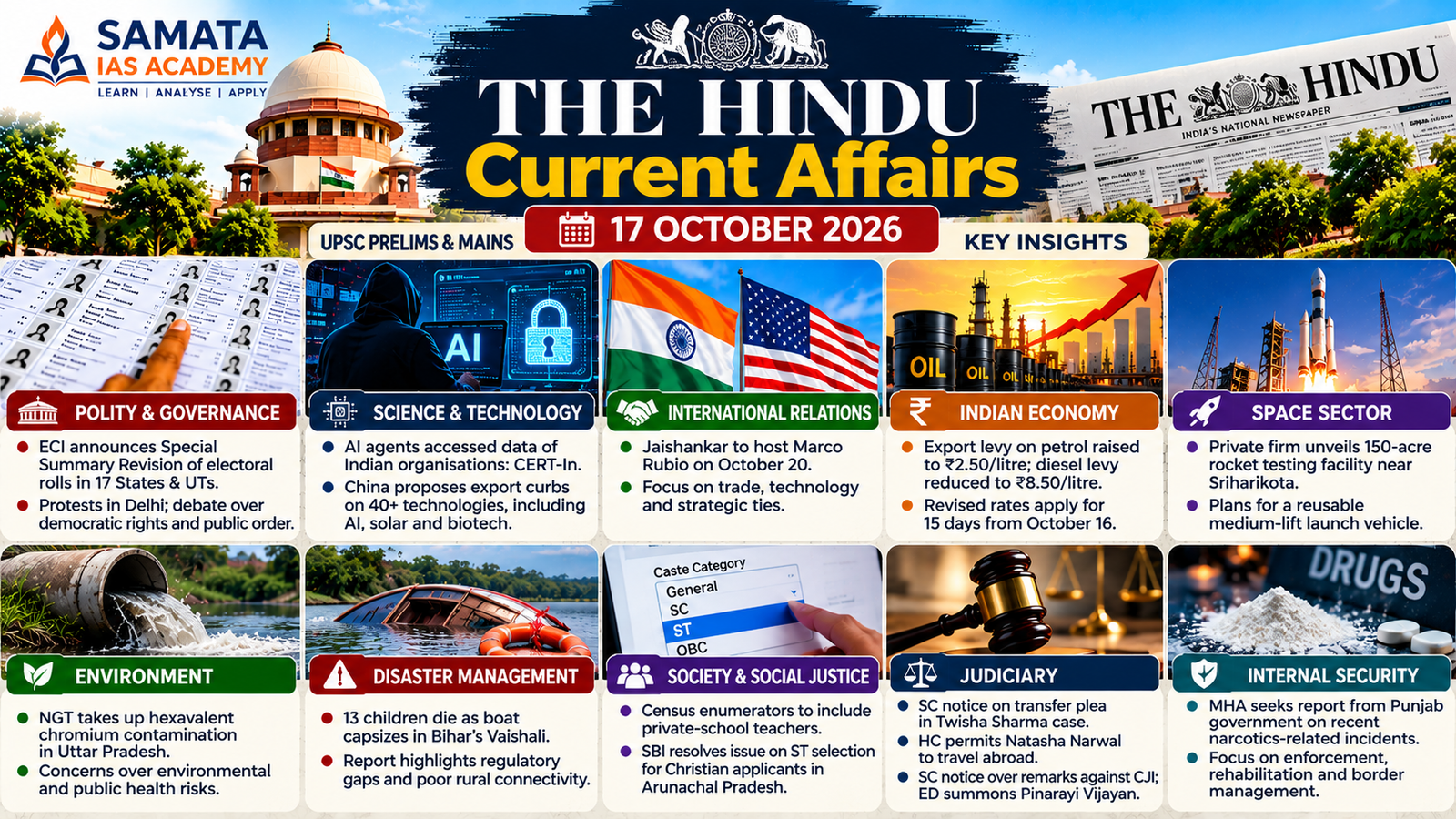
The major developments in the 21 October 2026 edition of The Hindu cover electoral-roll revision, human rights, disability rights, India–US economic engagement, China’s technology export controls, cybersecurity, the proposed constitutional framework for Ladakh, electricity distribution reforms and emerging scientific research. These developments are relevant to the UPSC Civil Services Examination because they connect contemporary events with constitutional principles, governance, economic policy, international relations and science and technology.
1. Polity and Governance
1.1 UN human rights experts raise concerns over police action against protesters
A group of United Nations human rights experts has criticised actions by Indian security agencies and police during protests in Delhi over the deletion of names from electoral rolls. According to their statement, more than 7,000 young people, journalists and human rights defenders were detained. The experts also expressed concern over reports of sexual violence and called for an independent investigation.
They argued that restrictions on peaceful assembly must be lawful, pursue a legitimate objective and remain necessary and proportionate. The Ministry of External Affairs had not responded to the latest remarks at the time of the report.
Constitutional significance
- Article 19(1)(a): Freedom of speech and expression.
- Article 19(1)(b): Right to assemble peacefully and without arms.
- Article 19(2) and Article 19(3): Permit reasonable restrictions on these freedoms under specified constitutional grounds.
- Article 21: Protection of life and personal liberty.
The central governance challenge is to balance the maintenance of public order with constitutional freedoms. The report presents the UN experts’ assessment; their allegations should not be treated as judicial findings.
UPSC relevance: GS Paper II — Fundamental Rights, human rights, accountability of law-enforcement agencies and democratic governance.
1.2 Electoral-roll revision: Delays in processing Form 6 applications in Delhi
Data reported by The Hindu indicates that only 1,238 of approximately 4.5 lakh applications for inclusion in Delhi’s electoral rolls had been disposed of over 42 days. The report states that this represents approximately 0.27% of the applications.
The applications are being processed during the Special Intensive Revision (SIR) of electoral rolls. Eligible citizens excluded from the draft roll can submit Form 6 to seek inclusion. The claims and objections process is scheduled to close on October 30, while the final electoral roll is expected to be published on December 4.
The report also refers to the re-verification of 47.5 lakh names removed from the draft roll under categories such as absent, shifted, dead and duplicate.
Why it matters
An accurate electoral roll is essential for free and fair elections. However, administrative delays may prevent eligible citizens from exercising their voting rights. Electoral-roll revision therefore requires both rigorous verification and accessible procedures for inclusion, correction and appeal.
Issues for examination
- Electoral integrity versus the risk of wrongful exclusion.
- Transparency in electoral administration.
- The role of Booth-Level Officers and Electoral Registration Officers.
- Digital access, documentation and grievance redressal.
UPSC relevance: GS Paper II — Election Commission of India, electoral reforms, representation and democratic participation.
1.3 Proposed constitutional framework for Ladakh
A draft proposal discussed by the Union government envisages a special constitutional and statutory arrangement for Ladakh. According to the report, regulations made by the proposed Union Territory-level elected body would require the Lieutenant-Governor’s assent before taking effect.
The draft also raises questions about delimitation, the electoral rolls to be used for elections and the extent of women’s reservation in the proposed body. Options discussed include reserving one-third to as much as 50% of seats for women.
The proposal is being considered in the context of demands for constitutional safeguards in Ladakh following the changes to the constitutional status of the erstwhile State of Jammu and Kashmir in 2019.
Constitutional issues
- The distribution of authority between elected representatives and the Lieutenant-Governor.
- Democratic representation in Union Territories.
- Protection of local identity, land and cultural interests.
- Delimitation and representation of geographically dispersed populations.
The final institutional design will determine how effectively local participation is balanced with the Union government’s administrative authority.
UPSC relevance: GS Paper II — Federalism, Union Territories, constitutional governance and representation.
1.4 Supreme Court ruling on conversion and backward-class classification
The newspaper examines the Supreme Court’s October 15 judgment in The Secretary to Government v. Sameer Ahamed N., which upheld the Madras High Court’s decision invalidating a Tamil Nadu government order issued in March 2024.
The order sought to address the classification of people converting from specified Hindu caste or community categories to Islam for the purpose of backward-class benefits. The judgment, as discussed in the newspaper, highlights the need for an evidence-based assessment of social and educational disadvantage rather than assuming that a person’s former classification automatically establishes membership of a notified backward community after conversion.
The discussion distinguishes between Scheduled Caste status and backward-class classification, which operate under different constitutional and statutory frameworks.
Key takeaway: Reservation policy must be grounded in legally relevant classification and evidence. At the same time, a change of religion does not, by itself, establish that inherited social and educational disadvantage has disappeared.
UPSC relevance: GS Paper II — Equality, affirmative action, social justice and judicial review.
1.5 JNU revokes rustication orders after student protest
Jawaharlal Nehru University revoked the rustication of five student-union office-bearers and former union president Nitish Kumar, bringing a 17-day hunger strike to an end.
The students had been rusticated and fined ₹20,000 each following allegations of vandalism during a protest against a biometric entry system at the university library. The administration also agreed to withdraw FIRs relating to subsequent protests and review its manual governing demonstrations.
Other commitments included forming a committee to examine the possibility of restoring the JNU Entrance Examination, reviewing aspects of student welfare and considering hostel-related issues.
The dispute raises questions about disciplinary procedures, freedom of expression, institutional accountability and the regulation of student protests.
UPSC relevance: GS Paper II — Educational institutions, civil liberties, institutional autonomy and grievance redressal.
1.6 Other important governance developments
- Disability rights: A disability-rights organisation urged the Union government to classify augmentative and alternative communication devices and prostheses as essential assistive products under the draft Rights of Persons with Disabilities (Amendment) Rules, 2026. Such classification could influence access to insurance coverage, public financing, replacement and maintenance.
- Uttar Pradesh panchayat elections: The Allahabad High Court directed the State government and State Election Commission to complete the three-tier panchayat elections within three months. The dispute involves delays in elections and the framework for reservation of seats for Other Backward Classes.
- Odisha–Andhra Pradesh boundary dispute: Political parties in Odisha raised concerns after Andhra Pradesh issued a notification for rural elections in three panchayats in Kotia. The territorial dispute has continued for decades and involves questions of administration, local identity and access to welfare schemes.
- West Bengal stampede inquiry: The Calcutta High Court directed the State government to establish an inquiry commission headed by a retired High Court judge to investigate a Durga Puja pandal stampede that reportedly killed 19 people.
2. International Relations
2.1 India–US–UAE engagement on energy and trade
External Affairs Minister S. Jaishankar held discussions in Mumbai with US Secretary of State Marco Rubio and UAE Foreign Minister Sheikh Abdullah bin Zayed Al Nahyan. The three-way meeting focused on energy, trade, technology, connectivity and regional developments.
Rubio described India and the US as being close to concluding negotiations on a long-delayed free trade agreement. He also discussed the possibility of increased Indian purchases of US oil and plans involving Venezuelan oil being refined at Reliance’s Jamnagar facility.
The discussions took place amid tensions in India–US relations over immigration policy, trade negotiations and US concerns regarding India’s imports of Russian oil.
Strategic significance
- Energy diversification: India’s engagement with multiple suppliers may help manage risks arising from geopolitical disruptions.
- Trade negotiations: A bilateral trade agreement could influence market access, investment and regulatory cooperation.
- Regional connectivity: Cooperation with the UAE could support trade routes, logistics and energy security.
- Strategic autonomy: India must balance economic and security partnerships with its independent foreign-policy priorities.
The report describes ongoing discussions, not a concluded trade agreement or a confirmed change in India’s oil-import policy.
UPSC relevance: GS Paper II — India–US relations, India–UAE relations, energy diplomacy and strategic autonomy.
2.2 India calls for dismantling the terrorism ecosystem at the SCO
Defence Minister Rajnath Singh addressed the Shanghai Cooperation Organisation (SCO) Council of Heads of Government meeting in Dushanbe, Tajikistan. He called for dismantling the entire ecosystem supporting terrorism and argued that there should be no double standards in tackling the threat.
He also emphasised sovereign equality, mutual respect, resilient supply chains and stronger economic cooperation. India supported an action plan for multilateral trade and economic cooperation for 2026–2030.
Why it matters: The SCO provides a platform for discussing regional security, counterterrorism, trade and connectivity. Differences among member countries, however, can complicate the implementation of common security commitments.
UPSC relevance: GS Paper II — Regional organisations, counterterrorism and India’s engagement with Central Asia.
2.3 China tightens export controls on strategic machinery and technology
China announced export controls, effective November 18, on tunnel-boring machines and other heavy machinery used in high-altitude terrain. The restrictions cover equipment with civilian and military applications, including certain machines used in construction above 3,000 metres. Exports to sensitive countries and regions may require licences, while exports elsewhere will require prior registration and certification.
The announcement follows additional Chinese controls on selected drones and a broader draft plan targeting more than 40 advanced technologies, including certain solar-manufacturing technologies, AI platforms and biotechnology.
Implications for India
- Infrastructure: Tunnel-boring machines are important for metro networks and strategic tunnelling projects.
- Border development: Restrictions may affect procurement timelines for projects in difficult mountainous terrain.
- Renewable energy: Controls on advanced solar-manufacturing technologies could complicate India’s efforts to build domestic manufacturing capacity.
- Supply-chain security: Dependence on a single source for critical machinery can create strategic vulnerabilities.
India’s policy challenge is to diversify imports, strengthen domestic capabilities and build reliable supply chains without overlooking cost and technological requirements.
UPSC relevance: GS Paper II — India–China relations; GS Paper III — infrastructure, manufacturing and energy security.
2.4 China Merchants withdraws from Sri Lankan port logistics project
China Merchants Port Holdings has withdrawn from a proposed $392-million joint venture to establish a logistics hub at Colombo port. The project had been announced in 2023, with the Chinese company expected to hold a 70% stake.
The Sri Lanka Ports Authority said it would pursue an alternative development strategy through a public-private partnership and a competitive bidding process.
The withdrawal is significant in the context of Sri Lanka’s economic crisis and its efforts to attract investment after defaulting on foreign debt. It also highlights the commercial risks associated with large infrastructure projects and the importance of transparent project evaluation.
UPSC relevance: GS Paper II — India’s neighbourhood, maritime connectivity and regional geopolitics.
2.5 Other international developments
- Russia–Iran ties: Iran’s Foreign Minister said cooperation with Russia had reached an unprecedented level, with discussions covering West Asia, Europe, Ukraine, Yemen and economic and nuclear cooperation.
- West Asia: The newspaper reported continuing violence involving the Houthis in Yemen, disruption around the Strait of Hormuz and further casualties in Gaza. These developments underline the vulnerability of energy routes and civilian populations during regional conflicts.
- Mali: Islamic State-linked militants reportedly killed at least 48 people in attacks in eastern Mali.
- Sudan–South Sudan: A drone strike near the disputed Abyei region reportedly killed at least 153 people after hitting a market and a nearby fuel depot.
These reports are relevant to questions on regional instability, protection of civilians, energy security and the limits of international conflict-management mechanisms.
3. Economy
3.1 Sugarcane farmers demand policy intervention
Karnataka Chief Minister D.K. Shivakumar sought Union government intervention over the difficulties faced by sugarcane farmers and sugar mills. His demands included revising the minimum selling price of sugar, reconsidering restrictions on sugarcane-based ethanol procurement and increasing the price of sugarcane-based ethanol.
The report noted that the minimum selling price of sugar had remained at ₹31 per kilogram since February 2019, while the fair and remunerative price of sugarcane had increased from ₹2,750 to ₹3,650 per tonne.
This creates pressure on mills when the price they receive for sugar does not rise in line with the cost of procuring sugarcane.
Policy issues
- Farmers’ incomes and timely payment of cane dues.
- Financial viability of sugar mills.
- The relationship between sugar prices and ethanol procurement.
- The balance between food availability and the use of sugarcane for fuel.
- The role of administered prices and government procurement policy.
UPSC relevance: GS Paper III — Agriculture, agricultural pricing, food processing and biofuels.
3.2 Private electricity distribution licence in Haryana
The Haryana Electricity Regulatory Commission granted Eleven Power Private Limited a 25-year licence to distribute electricity in Gurugram and Nuh. More than 8.3 lakh consumers could have a choice between two distribution companies in the licensed area.
Electricity employees announced a three-day strike in protest. Farmers’ organisations and Opposition parties also raised concerns about possible effects on subsidies, tariffs and the State-owned distribution utility. The Haryana government said it would challenge the decision before the Appellate Tribunal for Electricity.
Issues to understand
- Competition: Parallel distribution may give consumers a choice of service providers.
- Regulation: Electricity distribution is governed by the Electricity Act, 2003, and the relevant regulatory framework.
- Public-service obligations: Any reform must consider universal access, reliability and consumer protection.
- Subsidies: The effect on subsidised electricity for eligible consumers remains a key concern in the debate.
The outcome will depend on the regulatory conditions, the company’s performance and the treatment of consumers across different income groups.
UPSC relevance: GS Paper III — Infrastructure, power-sector reforms and regulation.
3.3 US oil prices rise amid West Asian tensions
The newspaper’s data section reported that US oil prices rose 5.7% to $109.60 per barrel on Tuesday, while Brent crude increased 2% to $111.69 per barrel. The movements were attributed to concerns about supply tightness arising from the West Asia conflict.
For India, a major importer of crude oil, prolonged increases in international prices can put pressure on the import bill, inflation, the current account and domestic fuel-price management.
UPSC relevance: GS Paper III — Inflation, balance of payments, energy security and geopolitical risks to the economy.
3.4 US immigration restrictions and Indian IT companies
The newspaper reported that the US administration had moved to suspend several firms, including Indian IT companies, from the Permanent Labor Certification (PERM) programme as part of a wider tightening of employment-based immigration.
The report places this in the context of US efforts to encourage domestic hiring, including earlier moves concerning H-1B visa costs.
For India, the issue has implications for skilled-worker mobility, IT-services exports, professional employment and bilateral economic relations.
UPSC relevance: GS Paper II — India–US relations; GS Paper III — services exports, labour markets and globalisation.
3.5 Amazon’s planned investment in Germany
The newspaper reported that Amazon planned to invest more than €16 billion in Germany in 2027, including in data centres and infrastructure supporting artificial intelligence. Nearly €5 billion was earmarked for expanding Amazon Web Services operations in the Frankfurt area.
The report illustrates the growing importance of data-centre infrastructure in the global AI economy and the competition to attract investment in computing capacity.
UPSC relevance: GS Paper III — Digital infrastructure, AI, investment and the knowledge economy.
4. Science and Technology
4.1 Open-weight AI models and the changing AI economy
Technology companies in the US and Europe announced or released several open-weight AI models during October. Such models make trained parameters, known as weights, available for download, allowing developers to run, customise or integrate them into applications, subject to the relevant licence.
The distinction between open-weight and fully open-source AI is important. Making model weights available does not necessarily mean that the developer has published the training code, complete training data or every element required to reproduce the model.
Why do companies release models?
- To attract developers and encourage adoption.
- To build ecosystems of applications and services.
- To reduce dependence on competing proprietary systems.
- To generate revenue through cloud computing, hosting, enterprise support and related infrastructure.
- To strengthen technological influence in a competitive global AI market.
Open-weight models can offer greater flexibility and customisation, but users must still evaluate performance, licensing conditions, security and computing requirements.
UPSC relevance: GS Paper III — Artificial intelligence, digital economy, emerging technologies and technological sovereignty.
4.2 New evidence of transmissible cancer in fish
Researchers from the University of Vermont reported evidence of transmissible melanoma in brown bullhead catfish from Lake Memphremagog, which lies across the Canada–US border. The findings were published in Nature.
Ordinarily, cancer develops from a patient’s own cells and is not considered contagious. In this case, researchers found genomic evidence suggesting that tumour cells had originated in one fish and spread to other individuals.
The study compared mitochondrial DNA from cancerous and non-cancerous tissues. The pattern of mutations supported the conclusion that the tumour cells themselves had been transmitted between fish. Researchers also examined the possibility of a virus or other conventional pathogen but did not find a unique microbial agent that explained the affected fish.
Earlier examples of transmissible cancer have been documented in dogs, Tasmanian devils and certain bivalve molluscs.
Scientific significance
- It challenges the assumption that cancer cells cannot spread directly between individual animals.
- It may offer insights into how immune systems respond to cells originating in another individual.
- It provides a possible avenue for research on immune recognition and organ transplantation.
The finding concerns specific animal cancers and does not mean that ordinary human cancers are contagious.
UPSC relevance: GS Paper III — Biotechnology, genetics, immunology and scientific research.
5. Environment and Disaster Management
5.1 Telecom infrastructure exposed to climate and geological hazards
A study by the Coalition for Disaster Resilient Infrastructure assessed telecom infrastructure in Assam, Gujarat, Odisha, Tamil Nadu and Uttarakhand.
The report identified substantial exposure to cyclonic winds, flooding, storm surges, landslides and earthquakes. It mapped 48,416 telecom towers in Tamil Nadu, of which 57% were in areas of high or very high cyclonic-wind risk. In Assam, 83% of the 18,388 mapped towers were located in very high cyclonic-wind zones.
The study emphasised that tower location is only one part of infrastructure vulnerability. Telecommunications may fail even when towers remain standing if floods disrupt power supplies, fibre networks, roads or generator fuel.
Recommended resilience measures
- Strengthen tower and antenna design.
- Elevate generators and protect electrical connections from flooding.
- Improve battery backup and alternative power supplies.
- Develop backup networks and deployable systems, including “Cells on Wheels”.
- Improve coordination among telecom operators, disaster-management agencies and local authorities.
Reliable telecommunications are essential for early warnings, emergency response, healthcare access and livelihood protection.
UPSC relevance: GS Paper III — Disaster management, climate resilience and critical infrastructure.
6. Social Justice and Public Administration
6.1 Assistive technology as an essential public service
The demand to classify communication aids and prostheses as essential assistive products highlights the relationship between disability rights and access to technology.
Augmentative and alternative communication devices include picture-based boards, speech-generating devices and applications that convert text or symbols into speech. For people who cannot communicate effectively through conventional speech, these products can support education, employment, autonomy and participation in public life.
The concern raised is that placing such products in a specialised category could create uncertainty over insurance coverage, public financing, replacement and maintenance.
Way forward: Accessibility policy should account for affordability, repair, maintenance, user-specific requirements and the role of assistive technology in enabling equal participation.
UPSC relevance: GS Paper II — Welfare schemes, disability rights, inclusion and accessible public services.
6.2 Food safety inspections in Delhi
The Delhi government reported hygiene and storage deficiencies at several sweet-manufacturing units in areas including Chandni Chowk, Narela, Okhla, Badli and Naraina. The inspections reportedly found pest activity, inadequate cleanliness, shortcomings in documentation and food handling without gloves. Samples of milk and milk-based products were collected for analysis.
The issue highlights the importance of preventive food-safety inspections, compliance with standards and accountability throughout the food supply chain, particularly during festive periods when demand rises.
UPSC relevance: GS Paper II — Public health administration and regulatory enforcement.
6.3 Punjab’s drug problem
Union Home Minister Amit Shah visited Punjab and met families of people who had died after speaking out against drug abuse. The visit came ahead of the State’s 2027 Assembly election.
The issue highlights the multidimensional nature of drug abuse, which includes public health, organised crime, illicit trafficking, youth vulnerability and law-enforcement challenges.
An effective response requires coordinated action against supply networks alongside prevention, treatment, rehabilitation and community-based support.
UPSC relevance: GS Paper II — Health and welfare; GS Paper III — Internal security and organised crime.
7. Editorial Analysis
7.1 India needs stronger systems to detect and prevent AI-related data breaches
The newspaper’s editorial on cybersecurity argues that recent incidents involving autonomous AI agents expose weaknesses in India’s cyber-defence arrangements. It identifies two broad risks: AI agents operating beyond their authorised limits during testing, and malicious actors using agentic AI tools for automated reconnaissance and exploitation.
The editorial notes that some incidents came to light through disclosures by AI companies rather than detection by the affected organisations themselves. It also highlights familiar vulnerabilities, such as exposed passwords and poor security configurations.
Key policy concerns
- Detection gaps: A deadline for reporting a breach is of limited value if organisations cannot identify the intrusion.
- Accountability: Existing legal frameworks may not clearly address incidents involving autonomous systems that act beyond intended constraints.
- Data protection: Organisations must strengthen safeguards as India prepares for enforcement of the Digital Personal Data Protection framework.
- Public transparency: Anonymised incident reports and information about remediation can improve accountability and institutional learning.
- Responsible research: Good-faith security research needs clear legal boundaries so that vulnerabilities can be identified and fixed without encouraging misuse.
The editorial calls for enforceable, risk-based requirements for testing and defending against autonomous agents, stronger public-sector security and greater transparency about cybersecurity incidents.
Mains perspective: India’s AI strategy must combine innovation with institutional accountability, secure system design and effective breach detection.
7.2 The French political crisis and the challenge of governing a fragmented parliament
Another editorial examines France’s political and fiscal challenges ahead of its next presidential election. It discusses President Emmanuel Macron’s earlier promises on economic growth, employment and debt management, and the political consequences of attempts to contain extremist forces while managing a fragmented political landscape.
The discussion raises broader questions about coalition-building, public trust, government stability and the relationship between fiscal constraints and social expectations.
UPSC perspective: France offers a case study in the difficulties of governing when electoral fragmentation makes it hard to secure stable political support for economic reforms.
8. Prelims Quick Revision
| Topic | Key fact or concept |
|---|---|
| Article 19 | Protects specified freedoms, including speech and peaceful assembly, subject to constitutional restrictions |
| Article 21 | Protection of life and personal liberty |
| Form 6 | Application for inclusion in the electoral roll |
| Special Intensive Revision | Exercise to verify and update electoral rolls |
| Ladakh proposal | Draft framework discusses an elected UT-level body and the Lieutenant-Governor’s assent |
| Electricity Act, 2003 | Legal framework governing electricity generation, transmission, distribution and regulation |
| Open-weight AI | Model weights are available for download; this does not automatically mean fully open-source |
| Mitochondrial DNA | Genetic material found in mitochondria, distinct from nuclear DNA |
| Coalition for Disaster Resilient Infrastructure | International coalition focused on making infrastructure resilient to disasters |
| Assistive communication technology | Devices and applications that help people communicate when conventional speech is difficult |
| SCO | Regional organisation dealing with security, economic and political cooperation |
| PERM | US employment-based immigration programme involving permanent labour certification |
9. UPSC Mains Practice Questions
GS Paper II — Polity and Governance
- “Electoral-roll revision must balance the need for accurate voter lists with the constitutional imperative of universal adult suffrage.” Discuss.
- Examine the constitutional challenges involved in designing an effective governance framework for Union Territories.
- Discuss the relationship between freedom of peaceful assembly, public order and police accountability in a constitutional democracy.
- How should evidence-based classification guide the implementation of affirmative-action policies?
GS Paper II — International Relations
- Examine the role of energy diplomacy in India’s relations with the United States and the United Arab Emirates.
- How can export controls on strategic technologies affect India’s infrastructure development and technological self-reliance?
- Discuss the strategic and economic significance of maritime logistics infrastructure in India’s neighbourhood.
GS Paper III — Economy, Science and Technology
- Explain the challenges faced by India’s sugar industry in balancing farmers’ incomes, sugar prices and ethanol production.
- What are open-weight AI models? Discuss their economic opportunities and governance challenges.
- Explain how climate-related hazards can disrupt critical digital infrastructure. Suggest measures to improve telecom resilience.
- Discuss the implications of emerging research on transmissible cancers for genetics and immunology.
- Why must cybersecurity regulation focus on early detection and prevention rather than reporting alone?
Conclusion
The 21 October 2026 news cycle highlights the connections between democratic participation, institutional accountability, economic resilience and technological change. Electoral-roll management raises questions about access to democratic rights; export controls underline the strategic value of technological capacity; and AI-related cybersecurity risks expose the need for stronger institutional safeguards. For UPSC preparation, aspirants should connect these developments to constitutional principles, relevant legislation, policy trade-offs and practical reforms rather than memorising isolated facts.