
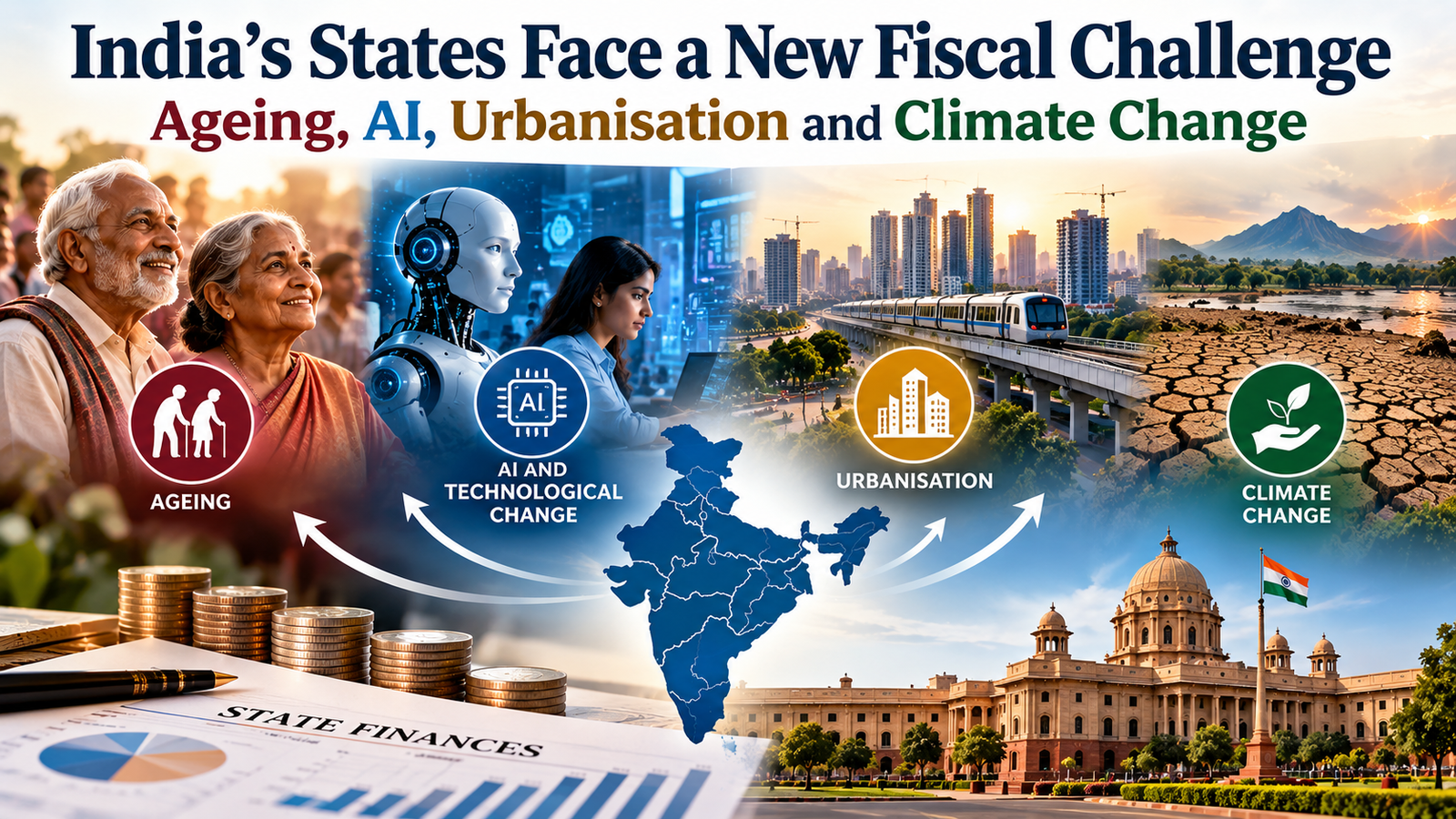
India’s development journey towards 2047 is increasingly becoming a State-level fiscal challenge. States are responsible for a large share of expenditure on health, education, agriculture, infrastructure, social protection and public services. At the same time, States are experiencing very different demographic, economic, technological and environmental transitions.
A new dimension has therefore emerged in the debate on fiscal federalism: State governments must prepare not only for conventional fiscal pressures such as deficits and debt, but also for structural changes arising from demographic ageing, Artificial Intelligence, urbanisation and climate change.
The issue gained renewed attention following the Conference on “Financing India’s Journey towards Viksit Bharat”, held in New Delhi on 18–19 September 2026. The conference brought together Finance Ministers and Finance Secretaries of States and Union Territories, along with experts from academia, industry, banking and policymaking, to discuss India’s financing requirements and pathways for sustained, inclusive and broad-based growth.
The Reserve Bank of India’s State Finances: A Study of Budgets of 2025–26 adds an important structural dimension to the discussion. The report’s theme is “Demographic Transition in India – Implications for State Finances”, highlighting the fact that Indian States are at different stages of demographic transition and consequently face different fiscal opportunities and risks.
The central question is no longer merely whether States can control their deficits, but whether they can create sufficient fiscal space to finance the structural transformations that lie ahead.
1. Why State Finances Matter
India’s federal structure distributes responsibilities and financial resources among the Union, States and local governments.
States play a particularly important role in delivering development-oriented public services.
Their responsibilities include:
- Health
- Education
- Agriculture
- Rural development
- State infrastructure
- Urban services
- Social protection
- Public order
- Water supply
- Transport
- State-level economic development
Consequently, the quality of India’s development will depend significantly on the fiscal capacity and expenditure efficiency of State governments.
The September 2026 conference underlined this interdependence, focusing on the policy complementarities between the Centre and States and the financing requirements of India’s development journey.
The broader fiscal framework can therefore be understood as:
Union finances → State finances → Local government finances → Public services → Human capital and infrastructure → Economic growth
For UPSC aspirants, this connects directly with Indian economy and public finance, as well as the broader questions of fiscal capacity, development expenditure and resource mobilisation.
2. The Current Fiscal Position of States
The RBI’s State Finances: A Study of Budgets of 2025–26 provides an important baseline for understanding the current position of State finances.
The consolidated gross fiscal deficit of States increased to 3.3% of GDP in 2024–25, after remaining below 3% during the preceding three years.
For 2025–26, States budgeted their consolidated gross fiscal deficit at 3.3% of GDP.
At the same time, States continued to maintain a significant emphasis on capital expenditure. Capital expenditure remained around 2.7% of GDP in 2023–24 and 2024–25, and was budgeted at around 3.2% of GDP in 2025–26. Consolidated outstanding liabilities were budgeted at 29.2% of GDP by end-March 2026.
The picture is therefore mixed:
Fiscal pressures remain significant
but
States are also attempting to preserve growth-enhancing capital expenditure.
This distinction is important. Fiscal consolidation should not simply mean reducing expenditure; it should involve improving the quality and sustainability of public expenditure.
3. The Four Emerging Structural Pressures
Traditional discussions of State finances usually focus on:
- Fiscal deficit
- Public debt
- Revenue mobilisation
- GST
- Transfers from the Centre
- Subsidies
- Salaries and pensions
- Capital expenditure
These remain important.
However, four structural transformations are increasingly influencing the fiscal outlook:
1. Demographic transition
2. Technological change and Artificial Intelligence
3. Urbanisation
4. Climate change
These forces interact with one another.
For example:
Urbanisation → infrastructure demand → higher public investment
while:
Ageing → higher healthcare and social-security expenditure → greater fiscal pressure
Similarly:
AI → labour-market transformation → reskilling expenditure
and:
Climate change → disasters and adaptation → additional public expenditure
4. Demographic Transition: A Fiscal Transition
One of the most important findings of the RBI’s report is that Indian States are at different stages of demographic transition.
This creates a significant divergence in their fiscal requirements.
Broadly, States can be understood in terms of:
- Youthful States
- Intermediate States
- Ageing States
The distinction is important because population structure influences:
- Labour supply
- Healthcare demand
- Education requirements
- Social-security expenditure
- Pension obligations
- Tax-base expansion
- Economic growth
Thus, demographic change is not merely a population issue.
It is increasingly a public-finance issue.
For UPSC preparation, this connects demographic transition and ageing with the broader themes covered under GS Paper I — Population and Demography.
Official PIB — Financing India’s Journey towards Viksit Bharat
RBI — State Finances: A Study of Budgets of 2025–26
Samata IAS Academy — Indian Economy
Samata IAS Academy — GS Paper I

5. Youthful States: Converting Demography into a Dividend
States with relatively young populations have a potentially large demographic opportunity.
A growing working-age population can generate:
Higher labour supply → higher production → higher incomes → larger tax base → greater fiscal capacity
However, a young population becomes a demographic dividend only when supported by:
- Quality education
- Healthcare
- Skill development
- Employment opportunities
- Infrastructure
- Female labour-force participation
The fiscal priority for youthful States should therefore be investment in human capital.
Failure to generate productive employment can instead produce unemployment, underemployment and social pressures.
Therefore:
Demographic dividend is an opportunity, not an automatic outcome.
6. Ageing States: A Different Fiscal Challenge
States further along the demographic transition face a different problem.
As the proportion of elderly people rises, expenditure requirements may increase in areas such as:
- Healthcare
- Long-term care
- Social security
- Pensions
- Elderly welfare
At the same time, a declining working-age population can eventually constrain the expansion of the tax base.
This creates a potential fiscal squeeze:
Ageing population
↓
Smaller working-age population
↓
Slower expansion of tax base
Higher health and social-security expenditure
↓
Reduced fiscal space
The RBI’s analysis highlights the fiscal pressures facing ageing States from a shrinking tax base and rising obligations from committed expenditure.
7. Why Demographic Diversity Matters for Fiscal Federalism
Consider two hypothetical States.
| Feature | Young State | Ageing State |
|---|---|---|
| Population profile | Large working-age population | Rising elderly population |
| Main priority | Education and skills | Healthcare and social security |
| Labour force | Expanding | Slower-growing |
| Fiscal challenge | Create jobs | Manage committed expenditure |
| Infrastructure | New capacity | Upgrading existing systems |
| Policy objective | Harness demographic dividend | Manage demographic ageing |
Both are part of the same Union.
But their fiscal priorities are different.
This creates an important policy question:
How should India’s fiscal architecture respond to increasingly divergent demographic needs among States?
This has implications for tax devolution, grants, State expenditure planning and the broader functioning of fiscal federalism.
8. Artificial Intelligence and State Finances
The second major structural pressure is technological transformation, particularly Artificial Intelligence.
AI is likely to affect State finances through both the expenditure side and the revenue side.
Expenditure side
States may need to invest more in:
- Digital education
- Reskilling
- Vocational training
- STEM education
- Digital infrastructure
- Cybersecurity
- AI-enabled public services
Revenue side
AI and data analytics can potentially improve:
- Tax compliance
- Detection of evasion
- Revenue forecasting
- Welfare targeting
- Property-tax administration
- Public expenditure monitoring
The September 2026 conference also included a dedicated session on the role of technology, reflecting the increasing relevance of technological transformation to India’s financing and development strategy.
For students, this connects with Samata IAS Academy’s material on Artificial Intelligence and Science & Technology.
Thus, technology has a dual fiscal effect:
AI can create new expenditure requirements while simultaneously strengthening State fiscal capacity.
9. AI and the Future of Employment
The more difficult question concerns the labour market.
Technological transformation can alter the demand for skills and potentially displace certain categories of work while creating new occupations.
This means State governments need to move from a model of:
One-time education → one-time skill training
towards:
Continuous learning → reskilling → upskilling → lifelong employability
The fiscal implication is significant.
States may need to increase investment in:
- Industrial training
- Apprenticeships
- Digital skills
- Higher education
- Industry–university collaboration
- Employment services
Therefore, human-capital expenditure should increasingly be viewed as a productivity-enhancing investment rather than merely a social expenditure.
10. Urbanisation: The Hidden Fiscal Challenge
India’s urbanisation is another major structural force affecting State finances.
The Economic Survey 2025–26 highlighted the growing economic significance of Indian cities and argued that cities should be recognised as economic infrastructure requiring deliberate investment and strategic planning.
The Survey noted that satellite-based analysis placed India at 63% urban in economic and functional terms in 2015, significantly higher than the urbanisation rate recorded by the 2011 Census.
It also cited projections that India’s towns and cities could house around 600 million people by 2036, or approximately 40% of the population, with urban areas contributing almost 70% of GDP.
Urbanisation therefore creates enormous infrastructure requirements.
Cities require:
- Roads
- Public transport
- Housing
- Water supply
- Sewerage
- Solid-waste management
- Drainage
- Healthcare
- Schools
- Digital infrastructure
- Climate-resilient infrastructure
The Economic Survey consequently emphasised the importance of integrated urban planning and investment.
For a broader UPSC treatment of urbanisation, urban infrastructure and urban governance, see Samata IAS Academy’s GS Paper I material.
11. The Urban Fiscal Challenge
Rapid urbanisation creates a major financing question.
The demand for infrastructure is concentrated at the city level, but municipal governments often have limited financial and institutional capacity.
This creates a multi-level governance chain:
Union Government
↓
State Government
↓
Urban Local Government
↓
Public Services
The fiscal capacity of municipalities therefore becomes an important determinant of the quality of urbanisation.
Potential sources of municipal finance include:
- Property tax
- User charges
- Municipal bonds
- Land-value capture
- Development charges
- Better asset management
- Public-private partnerships
The challenge is not merely to spend more, but to develop financially sustainable urban institutions.
12. Climate Change as a Fiscal Risk
Climate change is increasingly becoming a public-finance issue.
States face growing risks from:
- Floods
- Cyclones
- Droughts
- Heat waves
- Landslides
- Water stress
- Coastal erosion
- Agricultural losses
Climate-related disasters can affect both sides of the government budget.
Expenditure effect
Governments may need to spend more on:
- Relief
- Rehabilitation
- Reconstruction
- Adaptation
- Resilient infrastructure
Revenue effect
Disasters can reduce:
- Agricultural incomes
- Industrial activity
- Consumption
- Local economic activity
- Tax collections
Climate change can therefore generate a negative fiscal shock.
13. From Disaster Relief to Climate-Resilient Budgeting
Traditional policy often follows:
Disaster → Relief → Reconstruction
A more sustainable approach is:
Risk assessment → Prevention → Adaptation → Resilience → Lower future losses
For example, repeatedly rebuilding flood-damaged infrastructure may be more expensive over time than investing initially in:
- Better drainage
- Flood-resilient roads
- Early-warning systems
- Elevated infrastructure
- Watershed management
- Coastal protection
This makes climate-responsive budgeting increasingly relevant to State governments.
14. The Problem of Committed Expenditure
A major constraint on State fiscal space is committed expenditure.
This broadly includes obligations such as:
- Salaries
- Pensions
- Interest payments
When a large share of revenue is already committed, governments have less flexibility to finance:
- Infrastructure
- Education
- Healthcare
- Climate adaptation
- Innovation
- New development programmes
The RBI’s demographic analysis also highlights the importance of managing committed expenditure as States move through different stages of demographic transition.
Therefore, fiscal sustainability depends not only on the size of expenditure but also on its composition.
15. Revenue Mobilisation: The Other Side of Fiscal Sustainability
States cannot finance all emerging expenditure requirements through borrowing.
They need to strengthen their own-source revenues.
State tax revenues
- SGST
- State excise
- Stamp duty
- Registration fees
- Motor vehicle taxes
- Electricity-related taxes and duties
Non-tax revenues
- User charges
- Fees
- Royalties
- Dividends
- Returns from public assets
Technology can strengthen revenue mobilisation through:
Better data → improved compliance → wider tax base → higher revenue
The September 2026 conference also discussed financing sources, fiscal resilience and the role of technology in strengthening India’s development financing framework.
16. Fiscal Federalism: Why the Centre–State Relationship Matters
India’s fiscal system operates through a combination of:
Tax assignment + Tax devolution + Grants + Centrally Sponsored Schemes + Borrowing + State taxation
The Finance Commission plays a constitutional role in addressing vertical and horizontal fiscal imbalances.
The changing demographic and economic structure of States makes this framework increasingly important.
A youthful State may require greater investment in:
- Education
- Skills
- Healthcare
- Employment infrastructure
An ageing State may require greater expenditure on:
- Healthcare
- Social security
- Pensions
- Elderly care
A climate-vulnerable State may require greater expenditure on:
- Disaster resilience
- Adaptation
- Climate-resilient infrastructure
This does not mean abandoning fiscal equalisation.
Rather, it highlights the importance of continuously examining whether fiscal arrangements adequately respond to changing expenditure needs and fiscal capacities.
For a deeper understanding of fiscal federalism, financial relations, cooperative federalism and Centre–State relations, see Samata IAS Academy’s GS Paper II material.
17. The Capital Expenditure Question
One of the central challenges is maintaining growth-enhancing capital expenditure while ensuring fiscal sustainability.
Capital expenditure can create:
- Roads
- Bridges
- Irrigation systems
- Schools
- Hospitals
- Urban infrastructure
- Energy infrastructure
These assets can raise productivity and crowd in private investment.
The RBI has emphasised the continued thrust on capital expenditure by States. For 2025–26, State capital expenditure was budgeted at around 3.2% of GDP.
Therefore:
Fiscal consolidation should not become synonymous with indiscriminate expenditure compression.
The objective should instead be:
Lower fiscal vulnerability + better expenditure composition + stronger productive investment
18. From Fiscal Discipline to Fiscal Quality
A narrow understanding of fiscal discipline focuses primarily on the deficit.
A broader understanding of fiscal sustainability includes:
Manageable deficit
Sustainable debt
Strong revenue capacity
Quality expenditure
Growth-enhancing capital investment
Contingency preparedness
This is especially important because two States with identical fiscal deficits can have very different economic prospects depending on how their borrowed resources are used.
For example:
Borrowing → Infrastructure → Productivity → Higher future revenue
is fundamentally different from:
Borrowing → Persistent recurring expenditure → Limited asset creation → Continuing fiscal pressure
19. Towards a New Fiscal-Federal Framework
The emerging fiscal challenge can be summarised as:
Demographic change
↓
Changing expenditure needs
↓
Technology and AI
↓
Changing labour market and revenue capacity
↓
Urbanisation
↓
Infrastructure financing requirements
↓
Climate change
↓
Higher fiscal risks
↓
Need for stronger fiscal capacity
↓
Sustainable State finances
↓
Viksit Bharat 2047
The objective should therefore be to make State finances forward-looking rather than merely reactive.
20. What Should States Do?
1. Adopt demographic-sensitive budgeting
States should incorporate demographic projections into medium- and long-term fiscal planning.
2. Invest in human capital
Youthful States should prioritise:
- Education
- Health
- Skills
- Employment
3. Prepare early for ageing
Ageing States need stronger systems for:
- Geriatric healthcare
- Social security
- Long-term care
- Pension sustainability
4. Strengthen own-source revenues
States should improve tax compliance and broaden their revenue base without relying excessively on higher tax rates.
5. Protect productive capital expenditure
Growth-enhancing public investment should be protected during fiscal consolidation.
6. Strengthen municipal finances
Urbanisation requires stronger and financially sustainable local governments.
7. Introduce climate-responsive budgeting
Climate risk should be incorporated into infrastructure and investment decisions.
8. Prepare workers for AI
Skill systems must move towards continuous reskilling and lifelong learning.
9. Improve expenditure efficiency
The question should shift from:
“How much has been spent?”
to:
“What outcomes have been achieved?”
21. Cooperative Federalism Becomes More Important
The emerging fiscal challenges cannot be addressed by States alone.
The September 2026 Conference of State Finance Ministers demonstrated the importance of Union–State coordination in financing India’s development journey. The conference specifically focused on policy complementarities between the Centre and States and brought together policymakers, experts, financial institutions and other stakeholders.
Many challenges cross administrative boundaries.
Climate change requires coordinated adaptation.
Urbanisation requires coordination between Union, State and local governments.
Energy transition requires national and State-level investment.
Agricultural transformation requires coordination across markets and infrastructure.
AI and skills require cooperation among governments, universities and industry.
Thus, fiscal federalism is increasingly about more than tax sharing.
It is also about policy coordination, institutional capacity and joint financing of development.
22. The Larger Economic Argument
The debate over State finances is ultimately a debate about the quality and sustainability of India’s growth model.
High GDP growth is necessary, but it does not automatically guarantee:
- Strong public services
- Productive cities
- Human-capital development
- Climate resilience
- Sustainable State debt
- Balanced regional development
Fiscal capacity determines whether governments can convert economic growth into durable development.
The State therefore remains a crucial institution in India’s development strategy.
Conclusion
India is entering a phase in which demography, technology, urbanisation and climate change will increasingly shape public finances.
The fiscal challenge before States is therefore more complex than controlling the budget deficit.
A youthful State must convert its demographic advantage into human capital, productivity and employment.
An ageing State must prepare for healthcare, pensions and changing revenue dynamics.
A rapidly urbanising State must finance infrastructure and financially sustainable cities.
A climate-vulnerable State must invest in adaptation and resilience.
Every State must also prepare its workforce and administration for AI and technological transformation.
The central policy lesson is:
India’s fiscal federalism must become more forward-looking, outcome-oriented and sensitive to the structural differences among States.
The objective should be to combine:
Fiscal discipline + revenue mobilisation + quality expenditure + demographic preparedness + climate resilience + technological adaptation
to create the fiscal foundations necessary for sustained, inclusive and broad-based growth towards Viksit Bharat 2047.
UPSC Prelims Corner
| Area | Key fact |
|---|---|
| RBI State Finances Report 2025–26 | Theme: Demographic Transition in India – Implications for State Finances |
| States’ GFD, 2024–25 | 3.3% of GDP |
| Budgeted GFD, 2025–26 | 3.3% of GDP |
| State capital expenditure, 2025–26 | Budgeted at around 3.2% of GDP |
| State liabilities, end-March 2026 | Budgeted at around 29.2% of GDP |
| Major structural pressures | Demography, AI/technology, urbanisation and climate change |
| Major constitutional institution | Finance Commission |
| Important State tax | SGST |
| Fiscal concepts | Fiscal deficit, revenue deficit, primary deficit and public debt |
UPSC Mains Corner
GS Paper II
Fiscal Federalism | Centre–State Relations | Finance Commission | Local Government
GS Paper III
Public Finance | Inclusive Growth | Infrastructure | Artificial Intelligence | Climate Change
GS Paper I
Population | Demographic Transition | Urbanisation | Indian Society
Possible UPSC Mains Question
“India’s demographic transition is increasingly becoming a fiscal transition for its States.” Discuss the implications of demographic change, technological transformation, urbanisation and climate change for State finances in India.
Answer framework
Introduction:
Explain why State finances are central to India’s development trajectory.
Body:
- Demographic transition and divergent State needs
- AI and labour-market transformation
- Urban infrastructure and municipal finance
- Climate-related fiscal risks
- Revenue mobilisation
- Committed expenditure
- Debt sustainability
- Capital expenditure
- Finance Commission and fiscal federalism
Way Forward:
- Demography-sensitive fiscal planning
- Stronger own revenues
- Better municipal finances
- Outcome-based budgeting
- Climate-responsive budgeting
- Human-capital investment
- Continuous reskilling
- Cooperative federalism
Conclusion:
Link fiscal resilience at the State level with India’s long-term development objectives.
🔑 Key Takeaway
The next phase of Indian fiscal federalism will depend not only on how resources are distributed between the Union and States, but also on how effectively States anticipate demographic, technological, urban and climate transitions and convert limited fiscal resources into productive assets and better public services.