
India’s Patent Office rejected a patent application relating to the BPaL combination of tuberculosis medicines on 27 October 2026. The decision concerns a combination of bedaquiline, pretomanid and linezolid, used in the treatment of drug-resistant tuberculosis (DR-TB).
The application, filed by the Global Alliance for TB Drug Development (TB Alliance), faced two pre-grant oppositions in 2020 from individuals and organisations working on access to medicines and the rights of people affected by tuberculosis.
The decision has brought renewed attention to the relationship between intellectual property rights (IPR), pharmaceutical innovation and public health. It also raises an important policy question: how can India encourage research and innovation in medicines while ensuring that essential treatments remain affordable and accessible?
The issue is particularly significant for India, which continues to carry one of the world’s largest tuberculosis burdens. A patent decision, however, is only one part of the larger challenge. Drug affordability, regulatory approval, manufacturing capacity, quality assurance, public procurement and timely treatment are equally important.
1. What is the BPaL Patent Decision?
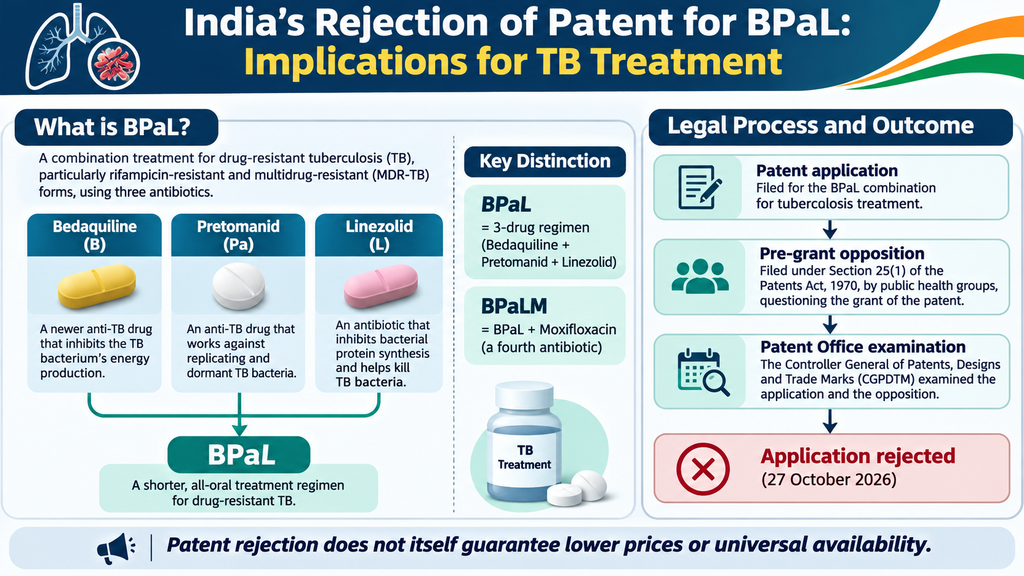
The Indian Patent Office rejected the patent application for a fixed-dose combination relating to BPaL on 27 October 2026.
The application had been filed by the Global Alliance for TB Drug Development, commonly known as TB Alliance. It sought patent protection for a combination of three medicines:
- Bedaquiline (B)
- Pretomanid (Pa)
- Linezolid (L)
The application faced two pre-grant oppositions filed in July 2020. The opponents questioned whether the claimed combination represented a sufficiently new and inventive contribution to qualify for patent protection.
The objections included concerns relating to prior disclosure, inventive step, patentability and the sufficiency of the claimed invention.
The Patent Office ultimately refused the application. The decision was taken under the framework of the Patents Act, 1970.
Why is this decision important?
A granted patent can provide its holder with exclusive rights over the patented invention for a specified period, subject to the law. Such exclusivity may restrict other manufacturers from commercially exploiting the patented subject matter without authorisation.
The rejection means that the applicant does not obtain the exclusive rights sought through this particular application in India.
This may create greater scope for competition in the relevant product category. However, the rejection does not automatically guarantee lower prices, immediate market entry by generic manufacturers or universal availability of the treatment.
The distinction between a patent decision and actual access to medicines is central to understanding the issue.
2. Understanding BPaL and Drug-Resistant Tuberculosis
Tuberculosis is an infectious disease caused by Mycobacterium tuberculosis. It primarily affects the lungs but can also affect other organs.
TB is transmitted through the air when an infected person releases infectious particles while coughing, speaking or sneezing.
Although tuberculosis is preventable and curable, the emergence of drug-resistant strains has complicated its control.
2.1 What is drug-resistant tuberculosis?
Drug-resistant tuberculosis occurs when the bacteria causing TB develop resistance to one or more medicines used to treat the disease.
Important categories include:
Multidrug-resistant tuberculosis (MDR-TB): TB caused by bacteria resistant to at least isoniazid and rifampicin, the two most powerful first-line anti-TB drugs.
Rifampicin-resistant tuberculosis (RR-TB): TB caused by bacteria resistant to rifampicin, with or without resistance to other medicines. It is generally managed using treatment approaches similar to those used for MDR-TB.
Pre-extensively drug-resistant tuberculosis (pre-XDR-TB): MDR/RR-TB with additional resistance to any fluoroquinolone.
Drug resistance makes treatment more complex because conventional first-line medicines may no longer be effective.
Historically, many drug-resistant TB treatment regimens required prolonged treatment, multiple medicines and, in some cases, injectable drugs. These could impose considerable physical, financial and social burdens on patients.
2.2 What is the BPaL regimen?
BPaL is a combination of three medicines used for eligible patients with drug-resistant TB.
| Medicine | Role |
|---|---|
| Bedaquiline | A diarylquinoline antibiotic that inhibits the energy-producing ATP synthase enzyme of TB bacteria. |
| Pretomanid | A nitroimidazole-class anti-TB medicine with activity against replicating and non-replicating TB bacteria. |
| Linezolid | An oxazolidinone antibiotic that inhibits bacterial protein synthesis. |
The combination is important because the medicines act through different mechanisms, helping to address drug-resistant infection.
The World Health Organization recommends BPaL for specified groups of patients with MDR/RR-TB, particularly those with additional fluoroquinolone resistance, subject to eligibility criteria and clinical assessment.
2.3 Difference between BPaL and BPaLM
An important distinction for students is the difference between BPaL and BPaLM.
| Regimen | Medicines |
|---|---|
| BPaL | Bedaquiline + Pretomanid + Linezolid |
| BPaLM | Bedaquiline + Pretomanid + Linezolid + Moxifloxacin |
Moxifloxacin is a fluoroquinolone antibiotic. Under WHO recommendations, the decision to retain or remove it is guided by fluoroquinolone drug-susceptibility testing.
The BPaLM regimen is a six-month treatment option for eligible patients. In appropriate circumstances, when fluoroquinolone resistance is identified, moxifloxacin may be omitted and BPaL used or continued.
BPaL and BPaLM are not interchangeable labels. The medicines used and the clinical eligibility criteria matter.
3. Why Are Shorter TB Treatment Regimens Important?
The duration and complexity of treatment have a direct bearing on patient outcomes.
Longer treatment regimens can create several challenges:
- Treatment adherence: Patients may find it difficult to continue taking multiple medicines over a prolonged period.
- Adverse effects: Some anti-TB medicines can cause significant side effects that require monitoring and treatment modification.
- Economic burden: Frequent hospital visits, travel costs and loss of income can impose financial pressure on households.
- Treatment interruption: Prolonged treatment can increase the risk of patients being lost to follow-up.
- Public health consequences: Inadequately treated TB can contribute to continued transmission and further drug resistance.
Shorter, effective, all-oral regimens can reduce the duration of treatment and avoid the need for injectable medicines in eligible patients.
The WHO’s 2025 consolidated guidance includes six-month regimens such as BPaLM and BPaL for specified patient groups. The recommendations are conditional on clinical eligibility, drug-susceptibility information and other treatment considerations.
The importance of these regimens therefore extends beyond convenience. They can improve treatment completion, reduce the burden on patients and health systems, and strengthen TB control.
4. India’s Tuberculosis Burden and the National TB Elimination Programme
India remains a country with a very high burden of tuberculosis.
According to the WHO estimates reported for 2024, India recorded approximately 2.71 million new TB cases, accounting for about one-fourth of the global burden. The estimated incidence rate was 187 cases per 100,000 population.
The burden is influenced by several structural and social factors:
- Poverty and undernutrition.
- Overcrowded housing and poor ventilation.
- Diabetes and other co-morbidities.
- Delayed diagnosis and incomplete treatment.
- Occupational exposure and migration.
- Stigma and limited access to healthcare.
- Drug resistance and treatment interruption.
4.1 National TB Elimination Programme (NTEP)
The Government of India implements the National TB Elimination Programme under the Ministry of Health and Family Welfare.
The programme follows the strategic framework of:
Detect – Treat – Prevent – Build
Its major components include:
- Early diagnosis and case notification.
- Free diagnostic services.
- Quality-assured anti-TB medicines.
- Drug-resistance testing.
- Treatment support and patient follow-up.
- Contact tracing and preventive treatment.
- Community participation.
- Strengthening public and private healthcare partnerships.
The programme also uses the Ni-kshay digital platform for notification and monitoring of TB patients.
4.2 Pradhan Mantri TB Mukt Bharat Abhiyaan
Launched in September 2022, the initiative seeks to strengthen community participation and provide additional support to people undergoing TB treatment.
An important feature is the Ni-kshay Mitra initiative, through which individuals, organisations and institutions can support TB patients with nutritional and other assistance.
The initiative recognises that TB is not merely a medical problem. It is closely connected with poverty, nutrition, social vulnerability and access to healthcare.
4.3 BPaLM under India’s TB programme
India has introduced the shorter BPaLM regimen for eligible patients with drug-resistant TB under the national programme.
The Government reported in March 2026 that more than 15,000 patients had been initiated on the BPaLM regimen.
The introduction of shorter regimens represents an important shift in the management of drug-resistant TB. However, their effective implementation requires:
- Timely drug-susceptibility testing.
- Trained medical personnel.
- Reliable medicine procurement.
- Monitoring of adverse effects.
- Patient counselling and follow-up.
- Quality-assured drug supply.
The patent decision should therefore be understood within the larger objective of expanding access to effective treatment.
5. India’s Patent Framework: How Does the Law Balance Innovation and Public Health?
India’s patent system is governed by the Patents Act, 1970, which has undergone several amendments, including important changes in 2005.
A patent grants an inventor or applicant a legally enforceable right over a qualifying invention for a limited period, subject to statutory conditions.
The objective of patent protection is to encourage innovation by providing an incentive for investment in research and development.
However, patent protection is not automatic. An invention must satisfy the requirements of the law.
5.1 Conditions for patentability
In general, an invention must satisfy the following conditions:
Novelty: The invention must be new and must not have been anticipated by prior public knowledge or disclosure.
Inventive step: The invention must involve a technical advance or economic significance and must not be obvious to a person skilled in the relevant field.
Industrial applicability: The invention must be capable of being made or used in an industry.
The patent system also excludes certain categories of subject matter from patentability.
5.2 Section 3(d): Preventing evergreening
Section 3(d) of the Patents Act is particularly important in pharmaceutical patent disputes.
It excludes the mere discovery of a new form of a known substance from patentability unless it results in enhancement of the known efficacy of that substance.
The provision also addresses certain derivatives and forms of known substances.
Its purpose is to prevent the practice commonly described as evergreening, in which incremental changes to an existing medicine are used to seek additional patent protection without demonstrating a sufficient improvement in efficacy.
The provision does not prohibit genuine pharmaceutical innovation. It seeks to distinguish a meaningful therapeutic advance from a minor modification that does not satisfy the statutory standard.
5.3 Section 3(e): Mere admixtures
Section 3(e) excludes a substance obtained by a mere admixture resulting only in the aggregation of the properties of its components.
This provision is relevant to patent claims involving combinations of known substances.
However, not every combination of known medicines is automatically unpatentable. The specific claims and evidence must be assessed under the law.
5.4 Section 25: Pre-grant opposition
Section 25(1) of the Patents Act provides for pre-grant opposition.
Where a patent application has been published but the patent has not yet been granted, any person may submit a written representation opposing the grant on specified statutory grounds.
These grounds include:
- Prior publication or anticipation.
- Lack of inventive step.
- Non-patentable subject matter.
- Insufficient disclosure.
- Wrongful obtaining of the invention.
- Failure to disclose specified information.
Pre-grant opposition enables researchers, civil society organisations, patient groups and other stakeholders to participate in scrutiny of patent applications.
In the BPaL case, two pre-grant oppositions were filed in July 2020.
This illustrates how the patent system can incorporate public participation and legal scrutiny before exclusive rights are granted.
6. Why Are Pharmaceutical Patents Contested?
Pharmaceutical patents involve a difficult balance between two important objectives.
On one hand, the development of new medicines requires substantial investment in research, clinical trials, regulatory compliance and manufacturing.
On the other hand, excessive or unjustified market exclusivity can restrict competition and make essential medicines unaffordable.
6.1 The case for patent protection
Patent protection can:
- Encourage pharmaceutical research and development.
- Provide incentives for investment in drug discovery.
- Support innovation in new molecules and formulations.
- Enable companies to recover research and development costs.
- Encourage disclosure of technical knowledge through patent specifications.
Without a predictable intellectual property framework, firms may be less willing to invest in high-risk research.
6.2 The public-health concerns
However, patent protection can also create challenges:
- Exclusive rights may restrict generic competition.
- High prices can limit affordability.
- Public health programmes may face higher procurement costs.
- Low-income patients may experience difficulties accessing treatment.
- Market concentration can create supply vulnerabilities.
The issue becomes particularly important in diseases such as tuberculosis, HIV/AIDS, malaria and certain neglected tropical diseases, where affordable access is central to public-health outcomes.
6.3 Generic medicines and competition
Generic medicines are medicines that contain the same active pharmaceutical ingredients as an existing reference medicine and meet applicable regulatory standards.
They are generally introduced after the relevant patent or other exclusivity barriers have expired, been rejected, invalidated, licensed or otherwise ceased to prevent their lawful production and sale.
Generic competition can:
- Increase the number of suppliers.
- Reduce dependence on a single manufacturer.
- Improve procurement bargaining power.
- Reduce medicine prices.
- Strengthen supply-chain resilience.
However, generic competition must be accompanied by robust quality regulation, pharmacovigilance and reliable manufacturing standards.
7. The TRIPS Agreement and India’s Public-Health Safeguards
The Agreement on Trade-Related Aspects of Intellectual Property Rights (TRIPS) is part of the World Trade Organization framework.
It establishes minimum standards for intellectual property protection among WTO members, including patents.
The agreement requires member countries to provide patent protection for qualifying inventions in all fields of technology, subject to specified conditions and exceptions.
However, TRIPS also recognises the importance of public health.
7.1 Doha Declaration on TRIPS and Public Health, 2001
The Doha Declaration clarified that the TRIPS Agreement should be interpreted and implemented in a manner supportive of WTO members’ right to protect public health and promote access to medicines for all.
It affirmed the flexibility available to countries under TRIPS.
These flexibilities include:
- Compulsory licensing.
- Parallel imports, subject to national legal frameworks.
- Determination of grounds for granting compulsory licences.
- Flexibility in defining national emergencies and circumstances of extreme urgency.
7.2 Compulsory licensing in India
Section 84 of the Patents Act, 1970 provides for compulsory licensing under specified conditions.
After the expiry of three years from the date of grant of a patent, an interested person may apply for a compulsory licence on grounds such as:
- The reasonable requirements of the public have not been satisfied.
- The patented invention is not available to the public at a reasonably affordable price.
- The patented invention is not worked in the territory of India.
Compulsory licensing permits the authorised use of a patented invention without the consent of the patent holder, subject to statutory conditions and remuneration.
India’s first compulsory licence was granted in 2012 for the anti-cancer drug sorafenib tosylate, commonly associated with the brand Nexavar.
The decision became an important example of the relationship between patent rights and access to essential medicines.
Important distinction: The rejection of the BPaL patent application is not a compulsory licence. A compulsory licence concerns the authorised use of an existing patent under specified conditions, whereas the BPaL case involved refusal of a patent application.
8. What Does the BPaL Decision Mean for India?
The rejection may have implications for the pharmaceutical industry, public procurement and access to treatment.
8.1 Scope for generic competition
The refusal of the particular patent application removes the exclusivity that the applicant sought through those claims in India.
This may create greater scope for generic competition in the relevant combination, subject to other applicable patents, regulatory approvals and legal requirements.
8.2 Potential reduction in procurement costs
The Government is a major purchaser of anti-TB medicines under the National TB Elimination Programme.
If competition increases and quality-assured manufacturers enter the relevant market, procurement costs may decline.
Lower procurement costs could allow the public health system to treat more eligible patients within a given budget.
However, the actual effect will depend on market entry, production costs, quality standards and procurement arrangements.
8.3 Improved supply-chain resilience
Dependence on a limited number of suppliers can expose public health programmes to production disruptions, shortages and pricing pressures.
A wider pool of quality-assured manufacturers can improve supply security.
8.4 Importance of patient access
The ultimate objective is not merely to increase the number of manufacturers. It is to ensure that eligible patients receive timely and effective treatment.
Patients may continue to face barriers such as:
- Delayed diagnosis.
- Inadequate access to drug-susceptibility testing.
- Distance from treatment centres.
- Social stigma.
- Undernutrition.
- Loss of income.
- Treatment-related adverse effects.
Therefore, the patent decision must be complemented by improvements in healthcare delivery.
9. Limitations: Why Patent Rejection Does Not Automatically Mean Affordable Treatment
It is important to avoid overstating the immediate impact of the decision.
9.1 Patent rights and regulatory approval are different
A patent determines whether an applicant has exclusive rights over a qualifying invention.
Drug regulatory authorities assess the quality, safety and efficacy of medicines and decide whether they may be manufactured, marketed or used under specified conditions.
Rejection of a patent application does not itself grant marketing approval to a generic medicine.
9.2 Other patents may remain relevant
The decision relates to the particular patent application and claims that were examined.
It should not be interpreted as a blanket cancellation of every patent relating to each individual medicine or every possible formulation.
Other relevant patent claims, regulatory requirements and legal restrictions must still be examined.
9.3 Manufacturing capacity and quality assurance
Generic manufacturers must demonstrate compliance with applicable quality standards.
The Government and regulatory authorities must ensure that greater competition does not compromise medicine quality.
9.4 Public procurement and distribution
Even if prices decline, patients will benefit only when medicines are procured in adequate quantities and distributed through accessible healthcare facilities.
9.5 Clinical eligibility
BPaL and BPaLM are not suitable for every person with tuberculosis.
Treatment decisions must be based on drug susceptibility, medical history, contraindications and professional clinical assessment.
The patent decision does not change WHO treatment recommendations or automatically alter national treatment protocols.
10. Way Forward: Balancing Innovation with Access to Medicines
India needs a pharmaceutical policy that encourages genuine innovation while protecting public-health interests.
The following measures are important.
1. Strengthen public-sector research: Increase investment in TB research, new drug development, diagnostics and vaccine development through public institutions and research partnerships.
2. Encourage genuine pharmaceutical innovation: Patent protection should reward demonstrable technical advances and meaningful therapeutic improvements.
3. Prevent evergreening: Apply the standards of the Patents Act consistently to distinguish genuine inventions from minor modifications that do not meet patentability requirements.
4. Expand quality-assured generic manufacturing: Support domestic manufacturers while maintaining rigorous quality and safety standards.
5. Strengthen public procurement: Use transparent procurement systems, pooled purchasing and long-term supply contracts to improve affordability and availability.
6. Expand drug-susceptibility testing: Ensure that treatment regimens are selected on the basis of reliable diagnostic evidence.
7. Improve patient support: Address nutrition, transport, income loss, stigma and treatment adherence.
8. Strengthen international cooperation: Promote technology transfer, research collaboration and affordable access to medicines, particularly for diseases that disproportionately affect developing countries.
9. Improve access to clinical research: Encourage ethical clinical trials and transparent sharing of research findings while protecting patient rights.
11. Conclusion
The rejection of the BPaL patent application by the Indian Patent Office is an important development in the continuing debate over intellectual property rights and public health.
It demonstrates the role of India’s patent framework in examining whether a claimed pharmaceutical invention satisfies the legal requirements for protection. It also highlights the significance of pre-grant opposition as a mechanism through which public-interest concerns can be placed before the Patent Office.
However, the larger objective is to translate legal and policy developments into better health outcomes.
Affordable medicines, quality-assured manufacturing, reliable procurement, accessible diagnostics and effective treatment delivery must work together.
The central policy challenge is to create an innovation ecosystem in which pharmaceutical research is rewarded, but access to life-saving medicines is not unnecessarily restricted.
For India, this balance is essential not only for tuberculosis elimination but also for building a resilient, equitable and innovation-driven public health system.
UPSC Examination Relevance
GS Paper II – Social Justice and Governance
- Public health infrastructure.
- Universal health coverage.
- Affordable access to essential medicines.
- Government interventions in healthcare.
- International organisations and global health governance.
GS Paper III – Science and Technology
- Intellectual property rights.
- Pharmaceutical research and innovation.
- Biotechnology and medical technology.
- Technology transfer and domestic manufacturing.
- TRIPS Agreement and India’s policy choices.
GS Paper IV – Ethics
- Equity in healthcare.
- Ethical dimensions of pharmaceutical pricing.
- Corporate responsibility.
- Public interest versus private commercial rights.
Prelims Practice Questions
Q1. With reference to the BPaL regimen, consider the following statements:
- It consists of bedaquiline, pretomanid and linezolid.
- BPaLM includes moxifloxacin as an additional medicine.
- The regimen is used in the treatment of eligible patients with drug-resistant tuberculosis.
Which of the statements given above are correct?
(a) 1 and 2 only
(b) 2 and 3 only
(c) 1 and 3 only
(d) 1, 2 and 3
Answer: (d) 1, 2 and 3
Explanation: BPaL consists of bedaquiline, pretomanid and linezolid. BPaLM adds moxifloxacin. These are shorter treatment options for specified categories of drug-resistant TB patients, subject to clinical eligibility.
Q2. Consider the following statements about the Patents Act, 1970:
- Section 3(d) seeks to prevent the patenting of certain new forms of known substances without enhanced efficacy.
- Section 25(1) provides for pre-grant opposition to patent applications.
- Section 84 provides for compulsory licensing under specified conditions.
Which of the statements given above are correct?
(a) 1 only
(b) 1 and 2 only
(c) 2 and 3 only
(d) 1, 2 and 3
Answer: (d) 1, 2 and 3
Explanation: All three statements are correct. Section 3(d) deals with certain new forms of known substances, Section 25(1) provides for pre-grant opposition, and Section 84 deals with compulsory licensing.
Mains Practice Question
“The protection of intellectual property rights must be balanced with the public-health imperative of affordable access to essential medicines.” Discuss with reference to India’s patent framework and the recent BPaL patent decision. (15 marks)
Key dimensions: Innovation incentives, pharmaceutical patents, Section 3(d), pre-grant opposition, TRIPS flexibilities, generic competition, compulsory licensing, public procurement, quality assurance and universal health coverage.
Keywords for Mains: Evergreening, patentability, inventive step, pre-grant opposition, compulsory licensing, generic competition, TRIPS flexibilities, health equity, access to medicines and public interest.