

The Ministry of Finance released the Monthly Review of Accounts of the Government of India up to September 2026 on 30 October 2026. The report provides an important assessment of the Union Government’s fiscal position during the first six months of the financial year 2026–27.
The accounts indicate that the Union Government received ₹18.35 lakh crore in total receipts and incurred expenditure of ₹25.50 lakh crore up to September 2026. The resulting fiscal deficit stood at approximately ₹7.14 lakh crore, equivalent to 42.1% of the full-year Budget Estimate.
The data also reveal important trends in tax revenue, non-tax receipts, transfers to states, capital expenditure, interest payments and major subsidies. These indicators are significant for understanding the government’s fiscal priorities and the challenges involved in maintaining fiscal discipline while financing economic growth.
The monthly accounts should not be read merely as a statement of revenue and expenditure. They offer insights into the relationship between fiscal consolidation, public investment, welfare commitments, debt servicing and cooperative federalism.
1. What are the Monthly Accounts of the Union Government?
The monthly accounts of the Union Government are consolidated financial statements that present the receipts and expenditure of the Central Government during a financial year.
They are published by the Controller General of Accounts (CGA) under the Ministry of Finance.
The accounts provide information on:
- Tax and non-tax revenue received by the Union Government.
- Non-debt capital receipts.
- Revenue and capital expenditure.
- Transfers to state governments.
- Fiscal deficit, revenue deficit and primary deficit.
- Interest payments and major subsidies.
- Sources of financing the fiscal deficit.
The accounts are useful for assessing the pace of government spending and revenue mobilisation against the annual targets announced in the Union Budget.
An important limitation: These are provisional monthly accounts. They reflect the position at a particular point in the financial year and may be affected by the timing of tax collections, transfers, expenditure and other transactions.
2. Key Findings of the September 2026 Government Accounts
The major fiscal indicators up to September 2026 are presented below.
| Indicator | Actuals up to September 2026 | Percentage of Budget Estimate |
|---|---|---|
| Total receipts | ₹18,35,422 crore | 50.3% |
| Net tax revenue | ₹12,76,088 crore | 44.5% |
| Non-tax revenue | ₹4,80,732 crore | 72.2% |
| Non-debt capital receipts | ₹78,602 crore | 66.4% |
| Revenue expenditure | ₹18,95,288 crore | 45.9% |
| Capital expenditure | ₹6,54,547 crore | 53.6% |
| Total expenditure | ₹25,49,835 crore | 47.7% |
| Fiscal deficit | ₹7,14,413 crore | 42.1% |
| Revenue deficit | ₹1,38,468 crore | 23.4% |
| Primary deficit | ₹68,403 crore | 23.4% |
Source: Controller General of Accounts, Union Government Accounts at a Glance, September 2026. Figures are provisional.
Three broad observations emerge.
First, total receipts have crossed half of the annual Budget Estimate, while total expenditure is at 47.7% of the annual estimate.
Second, capital expenditure has reached 53.6% of the annual allocation, indicating a relatively faster pace of capital spending compared with revenue expenditure.
Third, the fiscal deficit has reached 42.1% of the annual target. This is higher than the corresponding proportion recorded during the same period of the previous financial year, although the monthly figure should not be treated as a reliable prediction of the final annual outcome.
3. Government Receipts: Understanding the Revenue Position
The Union Government received ₹18.35 lakh crore up to September 2026, representing 50.3% of the total receipts estimated in the Union Budget for 2026–27.
The receipts comprise three broad components.
3.1 Tax Revenue
Net tax revenue to the Centre stood at ₹12.76 lakh crore, equivalent to 44.5% of the annual Budget Estimate.
Tax revenue is the most important recurring source of revenue for the Union Government. It includes the Centre’s share of direct and indirect taxes after accounting for the share devolved to states.
Major sources include:
- Corporation tax.
- Income tax.
- Goods and Services Tax (GST).
- Customs duties.
- Union excise duties.
- Other taxes and duties.
The real significance of tax revenue lies not merely in the amount collected but also in the sustainability and buoyancy of the tax system.
Tax buoyancy refers to the responsiveness of tax revenue to changes in national income. A tax system with higher buoyancy can generate additional revenue as the economy expands without requiring proportionate increases in tax rates.
The collection of ₹12.76 lakh crore represents 44.5% of the annual estimate. This should be interpreted in the context of the seasonal pattern of tax payments, refunds, settlements and devolution.
3.2 Non-Tax Revenue
Non-tax revenue stood at ₹4.81 lakh crore, representing 72.2% of the annual Budget Estimate.
It includes receipts from sources other than taxes, such as:
- Dividends and profits from public sector enterprises.
- Surplus transfers from the Reserve Bank of India.
- Interest receipts.
- Fees and user charges.
- Receipts from various government services.
- Other administrative and economic receipts.
Non-tax revenue can fluctuate significantly depending on dividend transfers, central bank surplus transfers, disinvestment-related receipts and other one-time or irregular transactions.
Therefore, a high proportion of non-tax revenue collected by September does not necessarily indicate that the same pace will continue throughout the year.
3.3 Non-Debt Capital Receipts
Non-debt capital receipts amounted to ₹78,602 crore, or 66.4% of the annual Budget Estimate.
These receipts include:
- Recovery of loans extended by the government.
- Disinvestment and other capital receipts.
They are described as non-debt receipts because they do not create a fresh repayment obligation in the same way as borrowings.
This distinction is important because government borrowing finances the fiscal deficit but is not counted as a receipt in the calculation of total receipts used in the fiscal deficit formula.
4. Expenditure Trends: Revenue Spending and Capital Investment
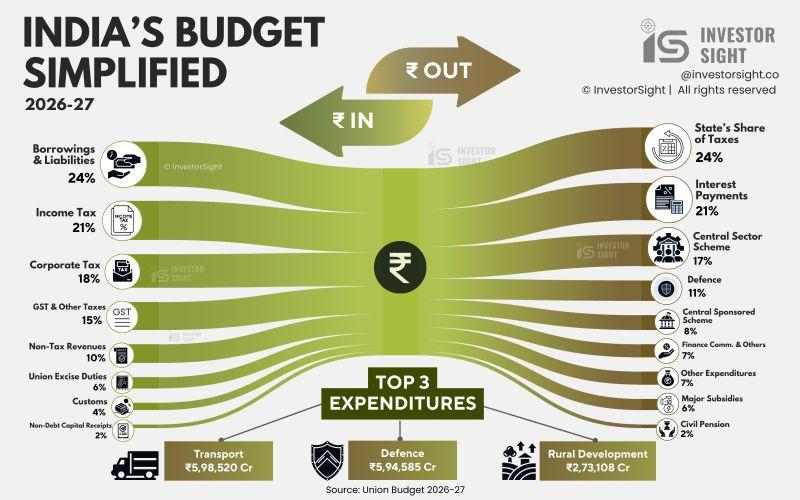
Total expenditure of the Union Government stood at ₹25.50 lakh crore, equivalent to 47.7% of the annual Budget Estimate.
It is divided into revenue expenditure and capital expenditure.
4.1 Revenue Expenditure
Revenue expenditure amounted to ₹18.95 lakh crore, representing 45.9% of the annual estimate.
Revenue expenditure is expenditure that generally does not directly create government assets or reduce liabilities.
It includes:
- Salaries and pensions.
- Interest payments.
- Subsidies.
- Grants and transfers.
- Administrative expenditure.
- Operational expenses of government departments.
Revenue expenditure is necessary for the functioning of the state and the delivery of public services. However, persistent growth in committed revenue expenditure can reduce the fiscal space available for productive public investment.
4.2 Capital Expenditure
Capital expenditure stood at ₹6.55 lakh crore, representing 53.6% of the annual Budget Estimate.
Capital expenditure is particularly important because it creates assets or reduces liabilities. It includes expenditure on:
- Roads and highways.
- Railways and transport infrastructure.
- Irrigation and water infrastructure.
- Public buildings.
- Defence capital assets.
- Loans and advances to states and other entities.
Capital expenditure can generate a multiplier effect by stimulating demand for construction materials, machinery, labour, logistics and related services.
It can also improve the productive capacity of the economy by reducing infrastructure bottlenecks and lowering the cost of doing business.
The fact that 53.6% of the annual capital expenditure allocation had been utilised by September indicates that capital spending was progressing faster than revenue expenditure as a proportion of the respective annual estimates.
However, the quality of capital expenditure matters as much as its quantity. Projects should be assessed in terms of completion, utilisation, economic returns, environmental sustainability and the services they deliver.
5. Fiscal Deficit: The Central Indicator of Government Finances
The fiscal deficit up to September 2026 stood at ₹7.14 lakh crore, equivalent to 42.1% of the annual Budget Estimate of approximately ₹16.96 lakh crore.
The fiscal deficit represents the excess of total government expenditure over total receipts, excluding borrowings.
Fiscal Deficit = Total Expenditure − Total Receipts (excluding borrowings)
It indicates the borrowing requirement of the government.
A fiscal deficit is not necessarily undesirable. Governments borrow to finance infrastructure, support economic activity during downturns and meet developmental requirements. However, persistently high deficits can increase public debt, interest obligations and macroeconomic vulnerabilities.
Why is the September fiscal deficit figure important?
The fiscal deficit reached 42.1% of the annual target by the end of September. The corresponding proportion in the previous year was 36.5%.
This indicates that the cumulative deficit was higher relative to the annual target than in the corresponding period of the previous financial year.
However, the CGA explicitly cautions that the monthly fiscal deficit is not necessarily an indicator of the final annual deficit. The timing of non-debt receipts and expenditure can create temporary mismatches that may be offset in subsequent months.
For example, tax receipts, dividend transfers, grants and expenditure payments do not necessarily occur uniformly throughout the financial year.
Therefore, the appropriate approach is to examine the monthly figure alongside revenue trends, expenditure commitments, borrowing requirements and the full-year fiscal target.
6. Revenue Deficit and Primary Deficit
Apart from the fiscal deficit, the monthly accounts provide two additional indicators that help assess the quality and sustainability of government finances.
6.1 Revenue Deficit
The revenue deficit stood at ₹1.38 lakh crore, or 23.4% of the annual Budget Estimate.
Revenue Deficit = Revenue Expenditure − Revenue Receipts
A revenue deficit indicates that the government’s revenue receipts are insufficient to meet its revenue expenditure.
A persistent revenue deficit implies that a portion of government borrowing may be financing current consumption or recurring expenditure rather than asset creation.
This can weaken intergenerational equity because future taxpayers may have to service debt incurred without corresponding creation of productive assets.
6.2 Primary Deficit
The primary deficit stood at ₹68,403 crore, or 23.4% of the annual Budget Estimate.
Primary Deficit = Fiscal Deficit − Interest Payments
The primary deficit excludes interest payments on past debt and therefore provides an indication of the current fiscal imbalance arising from government expenditure and receipts, apart from the legacy burden of accumulated debt.
A lower primary deficit can indicate improvement in the government’s current fiscal position. However, it must be assessed alongside the growth of public debt, interest obligations and the quality of expenditure.
7. Interest Payments: The Burden of Public Debt
Interest payments amounted to ₹6.46 lakh crore up to September 2026, representing 46% of the annual Budget Estimate.
Interest payments are a committed component of revenue expenditure. They arise from the accumulated stock of government debt.
The interest burden has several implications:
- Reduced fiscal space: A larger share of revenue must be used to service past borrowing.
- Opportunity cost: Funds spent on interest cannot be directly allocated to education, healthcare, infrastructure or other developmental priorities.
- Debt sustainability: Persistent increases in interest obligations can make debt management more difficult.
- Intergenerational equity: Future taxpayers bear the cost of servicing debt accumulated by previous governments.
An important indicator is the interest-to-revenue receipts ratio, which measures the proportion of revenue receipts absorbed by interest payments.
The September accounts show that interest payments are a substantial component of government expenditure. This underlines the importance of maintaining a sustainable debt trajectory and improving the efficiency of public spending.
8. Major Subsidies: Welfare Commitments and Fiscal Management
Major subsidies amounted to approximately ₹2.23 lakh crore, representing 54% of the annual Budget Estimate.
The major subsidy components reported by the CGA are:
| Subsidy component | Expenditure up to September 2026 |
|---|---|
| Food subsidy | ₹1,02,506 crore |
| Nutrient-based fertiliser subsidy | ₹33,664 crore |
| Urea subsidy | ₹85,586 crore |
| Petroleum subsidy | ₹1,149 crore |
| Total major subsidies | ₹2,22,905 crore |
Food and fertiliser subsidies constitute the major components of the subsidy bill.
Significance of food subsidy
Food subsidy supports the provision of subsidised foodgrains under the public distribution system and related food security commitments.
It is closely connected with the objectives of:
- Food security.
- Poverty reduction.
- Nutritional support.
- Protection of vulnerable households from food price volatility.
Significance of fertiliser subsidy
Fertiliser subsidies reduce the cost of agricultural inputs and help maintain farm affordability.
They are important for agricultural productivity and food security. However, the design of fertiliser subsidies also raises concerns regarding nutrient imbalance, soil health and fiscal sustainability.
The policy challenge
Subsidies are an important instrument of social protection and economic stabilisation. The objective should not be the indiscriminate reduction of subsidies but their improved targeting and effectiveness.
Reforms should focus on reducing leakages, ensuring timely payments, promoting balanced fertiliser use and improving the efficiency of welfare delivery.
9. Tax Devolution and Cooperative Federalism
The Union Government transferred ₹6.99 lakh crore to state governments as their share of taxes up to September 2026.
This was ₹67,658 crore higher than the corresponding period of the previous year.
Tax devolution is a constitutional mechanism through which a share of the divisible pool of central taxes is transferred to states.
Article 280 provides for the establishment of the Finance Commission, which recommends the distribution of tax revenues between the Union and the states and among the states.
Tax devolution is significant because states carry major responsibilities in areas such as:
- Public health.
- School education.
- Agriculture.
- Rural development.
- Police and public order.
- Local infrastructure.
- Welfare services.
Timely and predictable transfers improve the fiscal capacity of state governments and strengthen cooperative federalism.
The increase in tax devolution recorded in the September accounts is therefore relevant not only from the perspective of Union finances but also for the fiscal position of states.
10. What Do the September Accounts Tell Us About India’s Fiscal Strategy?
The monthly accounts reveal several important features of the government’s fiscal management.
10.1 Continued emphasis on capital expenditure
Capital expenditure had reached 53.6% of the annual Budget Estimate by September.
This is consistent with the broader policy emphasis on public investment as an instrument for strengthening infrastructure, improving productivity and crowding in private investment.
10.2 Revenue mobilisation remains important
Net tax revenue stood at 44.5% of the annual estimate. Sustained revenue mobilisation is necessary to finance welfare expenditure and capital investment without excessive borrowing.
Improving tax compliance, broadening the tax base, simplifying the tax system and strengthening tax administration remain important policy priorities.
10.3 Non-tax receipts have progressed faster
Non-tax revenue had reached 72.2% of the annual estimate. However, the composition and timing of these receipts must be examined before drawing conclusions about their sustainability.
10.4 Debt servicing constrains fiscal flexibility
Interest payments of ₹6.46 lakh crore represent a significant expenditure commitment. This highlights the importance of reducing the cost of public debt over time through credible fiscal management and stronger economic growth.
10.5 Fiscal federalism remains a major component
Tax devolution of ₹6.99 lakh crore demonstrates the scale of transfers to states. The financial capacity of states is central to the implementation of national development priorities.
11. Challenges in Maintaining Fiscal Discipline
India faces the challenge of balancing developmental expenditure with fiscal consolidation.
The major challenges include:
1. High committed expenditure: Salaries, pensions, interest payments and subsidies reduce the flexibility available for new spending priorities.
2. Infrastructure financing requirements: India requires sustained investment in transport, energy, urban infrastructure, logistics and digital connectivity.
3. Revenue uncertainty: Tax collections are influenced by economic growth, consumption, corporate profitability, imports and changes in the tax system.
4. Interest burden: A large public debt stock creates recurring interest obligations and limits fiscal space.
5. Quality of expenditure: Higher expenditure does not automatically translate into better developmental outcomes. Project selection, implementation and monitoring are equally important.
6. Centre-state fiscal coordination: States require adequate and predictable resources to implement programmes in sectors where they have primary responsibility.
7. Fiscal transparency: Timely reporting, consistent accounting standards and transparent disclosure of liabilities are essential for credible fiscal management.
12. Way Forward: Towards Sustainable and Development-Oriented Public Finance
India’s fiscal strategy should combine fiscal discipline with the financing of long-term developmental priorities.
The following measures are important:
- Improve tax buoyancy: Strengthen compliance, reduce evasion and expand the effective tax base.
- Rationalise expenditure: Review low-priority expenditure while protecting essential welfare and developmental programmes.
- Prioritise productive capital expenditure: Direct public investment towards projects with high economic and social returns.
- Improve subsidy targeting: Use technology and better beneficiary identification to reduce leakages without excluding eligible households.
- Strengthen debt management: Maintain a credible medium-term debt strategy and reduce the interest burden over time.
- Enhance fiscal transparency: Improve the reporting of guarantees, off-budget borrowings and contingent liabilities.
- Strengthen cooperative federalism: Ensure predictable transfers and improve coordination between the Union and state governments.
- Link expenditure with outcomes: Evaluate public spending through measurable improvements in infrastructure, education, healthcare, employment and service delivery.
13. Conclusion
The September 2026 monthly accounts present a mixed but important picture of India’s fiscal position. Total receipts have reached 50.3% of the annual estimate, while expenditure stands at 47.7%. Capital expenditure has progressed faster than revenue expenditure as a proportion of the respective Budget Estimates. At the same time, the fiscal deficit has reached 42.1% of the annual target, and interest payments continue to absorb a substantial amount of public resources.
The central challenge for fiscal policy is not simply to reduce the fiscal deficit. It is to ensure that public borrowing supports productive investment, essential welfare and long-term economic capacity without creating an unsustainable debt burden.
Fiscal consolidation and developmental expenditure must therefore be treated as complementary objectives rather than competing priorities. A credible fiscal strategy should aim to improve the quality of expenditure, strengthen revenue mobilisation and maintain a sustainable public debt trajectory.
UPSC Examination Relevance
GS Paper III – Indian Economy
- Government budgeting.
- Fiscal policy and fiscal consolidation.
- Fiscal deficit, revenue deficit and primary deficit.
- Public debt and debt sustainability.
- Capital expenditure and infrastructure investment.
- Taxation and resource mobilisation.
- Subsidies and welfare expenditure.
- Centre-state financial relations.
Prelims – Important Concepts
- Fiscal deficit is the excess of total expenditure over total receipts excluding borrowings.
- Revenue deficit is the excess of revenue expenditure over revenue receipts.
- Primary deficit is fiscal deficit minus interest payments.
- Borrowings are not included in total receipts for calculating fiscal deficit.
- Capital expenditure generally creates assets or reduces liabilities.
- The Controller General of Accounts functions under the Ministry of Finance.
- Article 280 provides for the constitution of the Finance Commission.
Practice Questions
Prelims MCQ
Q1. With reference to the fiscal indicators of the Union Government, consider the following statements:
- Fiscal deficit represents the excess of total expenditure over total receipts, including borrowings.
- Primary deficit is obtained by subtracting interest payments from fiscal deficit.
- Revenue deficit indicates that revenue expenditure exceeds revenue receipts.
Which of the statements given above is/are correct?
(a) 1 only
(b) 2 and 3 only
(c) 1 and 3 only
(d) 1, 2 and 3
Answer: (b) 2 and 3 only
Explanation: Fiscal deficit is calculated by excluding borrowings from total receipts. Primary deficit is fiscal deficit minus interest payments. Revenue deficit occurs when revenue expenditure exceeds revenue receipts.
Mains Question
Q2. “The quality of public expenditure is as important as the extent of fiscal consolidation.” Discuss in the context of India’s developmental priorities and debt sustainability. (15 marks)
Key dimensions for an answer: Meaning of fiscal consolidation; distinction between revenue and capital expenditure; public investment multiplier; interest burden; welfare commitments; subsidy rationalisation; fiscal federalism; expenditure outcomes; and a balanced way forward.
Keywords for Mains: Fiscal space, expenditure quality, capital formation, crowding-in effect, debt sustainability, tax buoyancy, intergenerational equity, outcome budgeting and cooperative federalism.