
UPSC Civil Services Examination | General Studies Paper IV – Ethics, Integrity and Aptitude
1. Introduction
Human values constitute the moral foundation of individual personality and social life. Values such as honesty, integrity, compassion, tolerance, respect, responsibility, justice and empathy guide individuals in distinguishing between right and wrong and influence their conduct towards other members of society.
However, human values do not develop automatically. Although individuals may possess certain natural emotional and psychological capacities, the development of a coherent value system takes place through a continuous process of socialisation, education, interaction and personal experience.
An individual learns the meaning of honesty through family experiences, develops respect for diversity through social interactions, understands justice through educational institutions and acquires a sense of public responsibility through participation in community life.
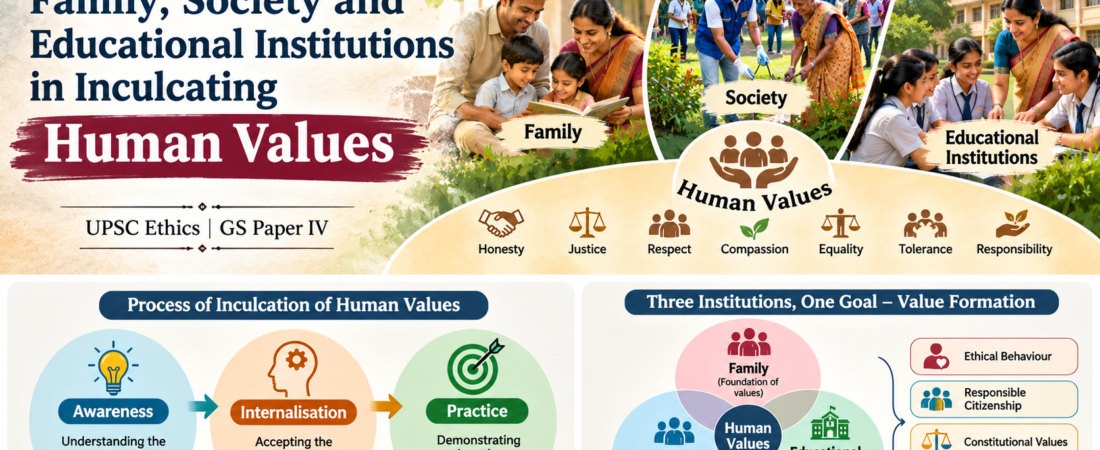
Consequently, the development of human values is a collective process in which three institutions play particularly significant roles:
- Family – The primary institution of value formation.
- Society – The broader environment in which values are reinforced, tested and transformed.
- Educational institutions – Formal platforms for imparting ethical understanding, rational thinking and social responsibility.
These institutions are not independent of one another. They interact continuously and collectively shape the moral character of individuals.
For civil servants, understanding this process is important because ethical behaviour in public administration is not merely the product of laws, rules and institutional controls. It is also influenced by the values individuals internalise during their formative years.
2. Understanding the Process of Inculcation of Human Values
Inculcation of human values refers to the systematic process through which individuals acquire, internalise and practise moral principles, ethical standards and desirable behavioural orientations.
It involves more than simply teaching individuals what is right and wrong. The objective is to transform moral knowledge into personal conviction and consistent behaviour.
For example, telling a child that honesty is important amounts to communicating a value. However, when parents themselves demonstrate honesty in everyday situations, explain why dishonesty is harmful and encourage the child to act truthfully, the value is more likely to become internalised.
Thus, value inculcation involves three interconnected stages:
princesselizabethpri.moe.edu.sg
Stage 1 – Awareness: Understanding the meaning and importance of a particular value.
Stage 2 – Internalisation: Accepting the value as an important principle governing one’s own conduct.
Stage 3 – Practice: Demonstrating the value consistently through actions and behaviour.
The distinction is significant. An individual may possess knowledge of ethical principles without necessarily practising them. The real objective of value education is to bridge this gap between knowing what is right and actually doing what is right.
3. Role of Family in Inculcating Human Values
3.1 Family as the primary institution of socialisation
Family is generally the first social institution with which an individual interacts. It provides the initial environment for emotional development, behavioural learning and moral orientation.
During childhood, individuals observe the behaviour of parents, grandparents, siblings and other family members. These observations influence their understanding of relationships, responsibilities, acceptable behaviour and social expectations.
The family therefore performs a foundational role in developing an individual’s value system.

3.2 Transmission of values through parental behaviour
Children learn not merely through instructions but also through observation and imitation.
Parents who demonstrate honesty, respect, compassion and responsibility in their everyday conduct provide practical examples for children to follow.
For instance:
- Parents who treat domestic workers with dignity teach children the importance of human equality.
- Parents who admit their mistakes demonstrate accountability.
- Parents who help disadvantaged people encourage compassion and social responsibility.
- Parents who respect different opinions promote tolerance and open-mindedness.
This process demonstrates that parental conduct often has a greater influence than parental instructions.
3.3 Development of emotional values
Family provides the first environment in which individuals experience affection, care, attachment, sympathy and emotional security.
These experiences contribute to the development of:
- Empathy towards others.
- Compassion for vulnerable individuals.
- Respect for relationships.
- Cooperation and mutual support.
- Emotional sensitivity.
- Sense of belonging and responsibility.
A child who grows up in an environment characterised by affection and mutual respect is more likely to develop healthy interpersonal relationships.
3.4 Development of discipline and responsibility
Family introduces children to basic expectations regarding discipline, duties and responsibilities.
Daily activities such as completing assigned tasks, respecting elders, sharing responsibilities and following household rules contribute to the development of self-discipline.
Such experiences help individuals understand that personal freedom must coexist with responsibility towards others.
3.5 Development of respect for diversity
In many Indian households, children grow up observing different religious traditions, languages, cultural practices and social customs.
Families that encourage mutual respect and peaceful coexistence contribute to the development of secular and inclusive values.
This is particularly important in a diverse society such as India.
3.6 Family and constitutional values
Family can contribute significantly to the internalisation of constitutional values.
| Constitutional value | Role of family |
|---|---|
| Equality | Treating children without gender discrimination |
| Liberty | Encouraging independent thinking and expression |
| Fraternity | Promoting affection, cooperation and mutual respect |
| Dignity | Respecting the individuality of every family member |
| Secularism | Respecting different religions and beliefs |
| Justice | Ensuring fairness in the distribution of responsibilities and opportunities |
The family therefore provides an informal foundation for the development of constitutional morality.
3.7 Limitations and challenges
Despite its importance, the family may sometimes become a source of undesirable values and prejudices.
Some of the major challenges include:
Caste-based prejudices: Children may internalise discriminatory attitudes through family conversations and social practices.
Gender stereotypes: Unequal treatment of boys and girls can reinforce patriarchal attitudes.
Religious intolerance: Negative attitudes towards other communities may develop through biased family environments.
Materialistic orientation: Excessive emphasis on wealth, status and social recognition may weaken values such as simplicity and contentment.
Corruption and unethical practices: Children observing dishonest behaviour may begin to regard such conduct as socially acceptable.
Therefore, the family is not automatically a source of positive values. Its influence depends substantially on the quality of its moral environment.
4. Role of Society in Inculcating Human Values
4.1 Society as a broader environment of value formation
While family provides the initial foundation of values, society exposes individuals to a wider range of experiences, relationships, institutions and social expectations.
An individual interacts with neighbours, friends, community organisations, religious institutions, voluntary organisations, workplaces and public institutions.
These interactions influence attitudes towards justice, equality, cooperation, tolerance and social responsibility.
Society also determines, to a considerable extent, which behaviours are socially appreciated, tolerated or condemned.
4.2 Role of social customs and traditions
Customs and traditions transmit values across generations.
Indian society has historically emphasised several important values, including:
- Respect for elders.
- Hospitality towards guests.
- Compassion towards living beings.
- Community cooperation.
- Respect for teachers.
- Family and social responsibility.
The principle of Atithi Devo Bhava reflects the importance traditionally attached to hospitality.
Similarly, the philosophy of Vasudhaiva Kutumbakam promotes the idea of universal human fraternity.
However, traditions must also be evaluated critically. Not every traditional practice necessarily promotes human dignity or equality.
Practices involving untouchability, caste discrimination, gender inequality and social exclusion cannot be justified merely on the grounds of tradition.
Thus, society must preserve constructive traditions while reforming those that conflict with human dignity and constitutional values.
4.3 Role of community participation
Participation in community activities provides practical opportunities to develop values.
Examples include:
- Participation in village development activities.
- Voluntary service during natural disasters.
- Community cleanliness programmes.
- Blood donation campaigns.
- Support for disadvantaged families.
- Participation in environmental conservation initiatives.
Such activities promote cooperation, empathy, solidarity and a sense of collective responsibility.
4.4 Role of religious and spiritual institutions
Religious and spiritual institutions have historically contributed to the development and transmission of moral values.
Different religious and philosophical traditions emphasise principles such as compassion, truthfulness, non-violence, forgiveness, charity, self-discipline and service.
For example:
| Tradition | Important ethical values |
|---|---|
| Hindu philosophical traditions | Dharma, truthfulness, non-violence and selfless action |
| Buddhism | Compassion, right conduct and the Middle Path |
| Jainism | Ahimsa, truthfulness and non-possession |
| Islam | Charity, justice, compassion and equality before God |
| Christianity | Love, forgiveness, compassion and service |
| Sikhism | Seva, equality, honest labour and sharing |
These teachings can promote universal human values when interpreted in an inclusive and non-discriminatory manner.
4.5 Role of peer groups
Friends and peer groups exert considerable influence, particularly during adolescence and early adulthood.
Individuals often modify their behaviour to gain social acceptance or avoid rejection.
Positive peer groups can encourage:
- Academic discipline.
- Respect for others.
- Cooperation.
- Social awareness.
- Voluntary service.
- Responsible citizenship.
Conversely, negative peer pressure may encourage substance abuse, bullying, violence, discrimination and other undesirable behaviour.
4.6 Role of media and digital society
Modern society is increasingly influenced by television, newspapers, cinema, social media and digital communication platforms.
Media can contribute to value formation by:
- Promoting gender equality.
- Creating awareness about social justice.
- Encouraging environmental responsibility.
- Highlighting corruption and injustice.
- Promoting scientific temper.
- Giving visibility to marginalised communities.
However, irresponsible media practices can also weaken human values through misinformation, sensationalism, hate speech, stereotyping and the normalisation of violence.
The increasing influence of digital platforms makes digital ethics, responsible communication and critical media literacy essential dimensions of contemporary value education.
4.7 Society as an instrument of social reform
Society is not merely a transmitter of existing values; it can also become an instrument of social transformation.
Social reform movements in India challenged practices such as sati, untouchability, caste discrimination, child marriage and gender inequality.
Reformers including Raja Ram Mohan Roy, Jyotiba Phule, Savitribai Phule and Dr. B.R. Ambedkar helped reshape social consciousness by advocating equality, dignity, education and justice.
Their contributions demonstrate that progressive social values can transform institutions and established social practices.
5. Role of Educational Institutions in Inculcating Human Values
5.1 Education as an instrument of moral development
Educational institutions play a crucial role in shaping the intellectual, emotional, social and moral development of individuals.
Unlike family and society, educational institutions provide organised opportunities for value education through curricula, classroom interactions, extracurricular activities and institutional practices.
The purpose of education should not be restricted to the acquisition of information and professional qualifications. It must also prepare individuals to become responsible, ethical and socially conscious citizens.
Education should develop not merely the capacity to earn a livelihood but also the capacity to lead a meaningful and responsible life.

5.2 Formal value education
Schools and universities can introduce ethical principles through subjects such as:
- Moral science.
- Ethics and philosophy.
- Civics and political science.
- Environmental studies.
- History and social studies.
- Human rights education.
These subjects help students understand concepts such as justice, equality, liberty, tolerance, dignity and responsibility.
However, value education should not be confined to a separate subject. It should be integrated across the entire educational experience.
5.3 Role of teachers as role models
Teachers exercise significant influence on students through their behaviour, communication and professional conduct.
A teacher who demonstrates impartiality, punctuality, honesty and respect for students provides a practical example of ethical conduct.
For instance:
- Treating all students equally promotes fairness.
- Encouraging questions develops intellectual freedom.
- Acknowledging mistakes demonstrates honesty.
- Avoiding discrimination promotes dignity and equality.
- Appreciating different viewpoints develops tolerance.
Therefore, teachers must practise the values they seek to communicate.
5.4 Development of critical thinking and rationality
Education should encourage students to question irrational beliefs, examine social practices and distinguish between ethical principles and social prejudices.
Critical thinking helps individuals evaluate situations independently rather than blindly accepting prevailing social attitudes.
It also promotes scientific temper, rationality and respect for evidence.
This is especially important in combating superstition, misinformation, communal prejudice and discriminatory practices.
5.5 Learning through practical activities
Values are internalised more effectively when students have opportunities to practise them.
Educational institutions can promote practical value education through:
- National Service Scheme (NSS).
- National Cadet Corps (NCC).
- Community service programmes.
- Environmental protection activities.
- Social awareness campaigns.
- Group projects and collaborative learning.
- Visits to rural and disadvantaged communities.
Such activities provide students with direct exposure to social realities and develop empathy, cooperation, leadership and responsibility.
5.6 Promotion of constitutional values
Educational institutions have an important responsibility to familiarise students with constitutional ideals.
The Constitution of India provides a normative framework for developing values such as justice, liberty, equality and fraternity.
The Fundamental Duties under Article 51A also provide an important foundation for citizenship-oriented value education.
Particularly relevant are:
- Article 51A(a): Respect for the Constitution, its ideals and institutions.
- Article 51A(e): Renunciation of practices derogatory to the dignity of women.
- Article 51A(f): Preservation of India’s composite cultural heritage.
- Article 51A(g): Protection of the natural environment.
- Article 51A(h): Development of scientific temper, humanism and the spirit of inquiry and reform.
- Article 51A(j): Striving towards excellence in all spheres of individual and collective activity.
Educational institutions can translate these constitutional responsibilities into everyday learning and conduct.
5.7 National Education Policy 2020 and value education
The National Education Policy 2020 recognises the importance of ethical, social and constitutional values in the educational system.
It emphasises the development of values and dispositions such as:
- Empathy.
- Respect for others.
- Cleanliness.
- Courtesy.
- Democratic spirit.
- Responsibility.
- Scientific temper.
- Freedom.
- Equality.
- Justice.
- Tolerance.
- Respect for diversity.
The policy also emphasises holistic development, experiential learning, critical thinking and the integration of Indian knowledge systems.
This reflects a broader understanding of education in which intellectual development and ethical development are complementary rather than separate objectives.
6. Comparative Role of Family, Society and Educational Institutions
The three institutions perform complementary functions in the process of value formation.
| Dimension | Family | Society | Educational institutions |
|---|---|---|---|
| Nature | Primary socialisation | Informal and collective socialisation | Organised and formal learning |
| Main influence | Emotional and moral foundation | Social norms and collective behaviour | Intellectual and ethical development |
| Method | Observation, imitation and upbringing | Social interaction and participation | Curriculum, teachers and activities |
| Major values | Love, care, discipline and responsibility | Cooperation, tolerance and solidarity | Justice, equality, rationality and citizenship |
| Limitation | Inherited prejudices | Harmful social customs and peer pressure | Excessive examination orientation and inadequate practical learning |
Three Pillars of a Learner’s Educational Journey: Home, School, and Community.
Complementarity among the three institutions
The process of value inculcation becomes effective when all three institutions reinforce one another.
For example, consider the development of gender equality:
- Family: Treats boys and girls equally and avoids gender-based discrimination.
- Society: Challenges patriarchal practices and promotes equal opportunities.
- Educational institutions: Teach gender equality, constitutional rights and respect for dignity.
When these three institutions communicate consistent values, individuals are more likely to internalise and practise them.
Conversely, contradictory messages can create confusion and weaken value formation.
For instance, a school may teach gender equality, but if the family discriminates between boys and girls, the individual’s ability to internalise equality may be affected.
7. Challenges in Inculcating Human Values in Contemporary Society
Despite the importance of family, society and educational institutions, several factors obstruct effective value formation.
7.1 Increasing materialism and consumerism
Contemporary society increasingly associates success with wealth, consumption, status and material possessions.
This may weaken values such as simplicity, contentment, compassion and social responsibility.
7.2 Declining quality of interpersonal relationships
Urbanisation, migration, nuclearisation of families and changing lifestyles may reduce opportunities for sustained intergenerational interaction.
This can affect the transmission of traditional ethical values.
However, nuclear families and urban societies can also develop strong ethical environments when relationships are based on care and mutual respect.
7.3 Commercialisation of education
Increasing emphasis on examinations, rankings, placements and financial returns may overshadow moral development.
Students may become academically successful without developing adequate social sensitivity and ethical responsibility.
7.4 Social inequalities and discrimination
Caste-based exclusion, gender discrimination, communal prejudice and economic inequalities undermine the development of universal human values.
Such practices normalise injustice and contradict the constitutional vision of an egalitarian society.
7.5 Digital misinformation and intolerance
Social media platforms can facilitate the spread of misinformation, hate speech and polarising narratives.
The absence of critical digital literacy may weaken tolerance, rationality and respect for diversity.
7.6 Inconsistency between preaching and practice
Perhaps the most significant challenge is the contradiction between professed values and actual behaviour.
For example:
- Schools teach honesty while examination malpractice continues.
- Families preach equality while practising gender discrimination.
- Institutions advocate integrity while tolerating corruption.
- Society celebrates compassion but ignores vulnerable groups.
Such contradictions weaken the credibility of value education.
8. Measures to Strengthen the Inculcation of Human Values
A comprehensive approach is required to ensure that values become an integral part of individual and collective behaviour.
At the family level:
- Parents should demonstrate ethical conduct through their own behaviour.
- Children should be encouraged to respect diversity and individual dignity.
- Family discussions should promote honesty, responsibility and empathy.
- Gender equality should be practised within household responsibilities and opportunities.
At the societal level:
- Community participation and voluntary service should be encouraged.
- Social reform movements should challenge discriminatory practices.
- Media organisations should promote responsible and ethical communication.
- Religious and community institutions should emphasise universal human values.
- Digital literacy and critical thinking should be strengthened.
At the educational level:
- Value education should be integrated into all stages of learning.
- Teachers should be trained to act as ethical role models.
- Experiential learning and community service should be encouraged.
- Schools should promote constitutional values and scientific temper.
- Assessment systems should recognise cooperation, responsibility and ethical conduct alongside academic achievement.
9. Relevance to Civil Services and Public Administration
The process of inculcating human values has direct implications for the quality of public administration.
Civil servants are not merely implementers of laws and government programmes. They are also public institutions’ representatives who interact with citizens and exercise authority on their behalf.
Their conduct must therefore reflect values that promote constitutional governance.
9.1 Family background and administrative conduct
Values acquired during childhood may influence an administrator’s approach towards honesty, discipline, responsibility and interpersonal relationships.
However, family background does not permanently determine ethical conduct. Individuals can critically examine and modify inherited attitudes.
9.2 Society and public accountability
Administrators operate within a social environment. A society that values transparency, fairness and accountability creates stronger expectations of ethical governance.
Civil servants must also be willing to challenge social practices that violate constitutional principles.
9.3 Educational institutions and professional ethics
Educational institutions prepare future administrators by developing rational thinking, constitutional awareness, ethical reasoning and social sensitivity.
Professional training institutions must further strengthen these qualities through ethical case studies, field exposure and practical exercises.
9.4 Civil servants as role models
Just as parents and teachers influence children through their conduct, civil servants influence public attitudes through their decisions and behaviour.
An administrator who demonstrates impartiality, integrity and compassion can strengthen public trust in government institutions.
Conversely, discriminatory or corrupt conduct can undermine institutional legitimacy.
10. Conclusion
Human values are not acquired through theoretical instruction alone. They develop through continuous interaction between individuals and their social environment.
Family provides the initial moral foundation, society reinforces and transforms values through collective experience, and educational institutions provide organised opportunities for intellectual and ethical development.
These institutions must function in a complementary manner to ensure that individuals not only understand ethical principles but also internalise and practise them.
In the Indian context, the ultimate objective of value inculcation should be the development of citizens committed to constitutional ideals, social justice, human dignity, fraternity and responsible citizenship.
For civil services, this process is particularly significant because ethical governance ultimately depends not merely on institutional rules but also on the character, values and conduct of those entrusted with public authority.
11. UPSC Mains Practice Questions
Question 1. Family, society and educational institutions are the three major agencies responsible for inculcating human values. Examine their respective roles and explain how they complement one another. (15 Marks)
Question 2. Parents and teachers can communicate moral values through instructions, but their personal conduct often has a greater influence on children. Discuss. (10 Marks)
Question 3. In the contemporary world, social media and digital platforms have emerged as important agents of value formation. Examine their positive and negative implications. (10 Marks)
Question 4. Education should not merely impart knowledge and professional skills but also develop ethical and socially responsible citizens. Discuss with reference to the National Education Policy 2020. (15 Marks)
Question 5. How can family, society and educational institutions contribute to the internalisation of constitutional values among citizens? (10 Marks)
12. Prelims Practice Questions
1. Consider the following statements regarding the inculcation of human values:
- Family is generally the first institution of socialisation.
- Educational institutions contribute to value formation only through formal classroom teaching.
- Social interactions can reinforce or modify existing values.
Which of the statements given above are correct?
(a) 1 and 2 only
(b) 1 and 3 only
(c) 2 and 3 only
(d) 1, 2 and 3
2. Which of the following Fundamental Duties under Article 51A directly emphasises the development of scientific temper, humanism and the spirit of inquiry and reform?
(a) Article 51A(e)
(b) Article 51A(f)
(c) Article 51A(g)
(d) Article 51A(h)
3. Consider the following statements regarding value education:
- Value education should focus exclusively on religious and spiritual teachings.
- Experiential learning can contribute to the internalisation of values.
- Teachers can influence students through their personal conduct.
Which of the statements given above are correct?
(a) 1 only
(b) 2 only
(c) 2 and 3 only
(d) 1, 2 and 3
Answer key: 1 – (b); 2 – (d); 3 – (c).