
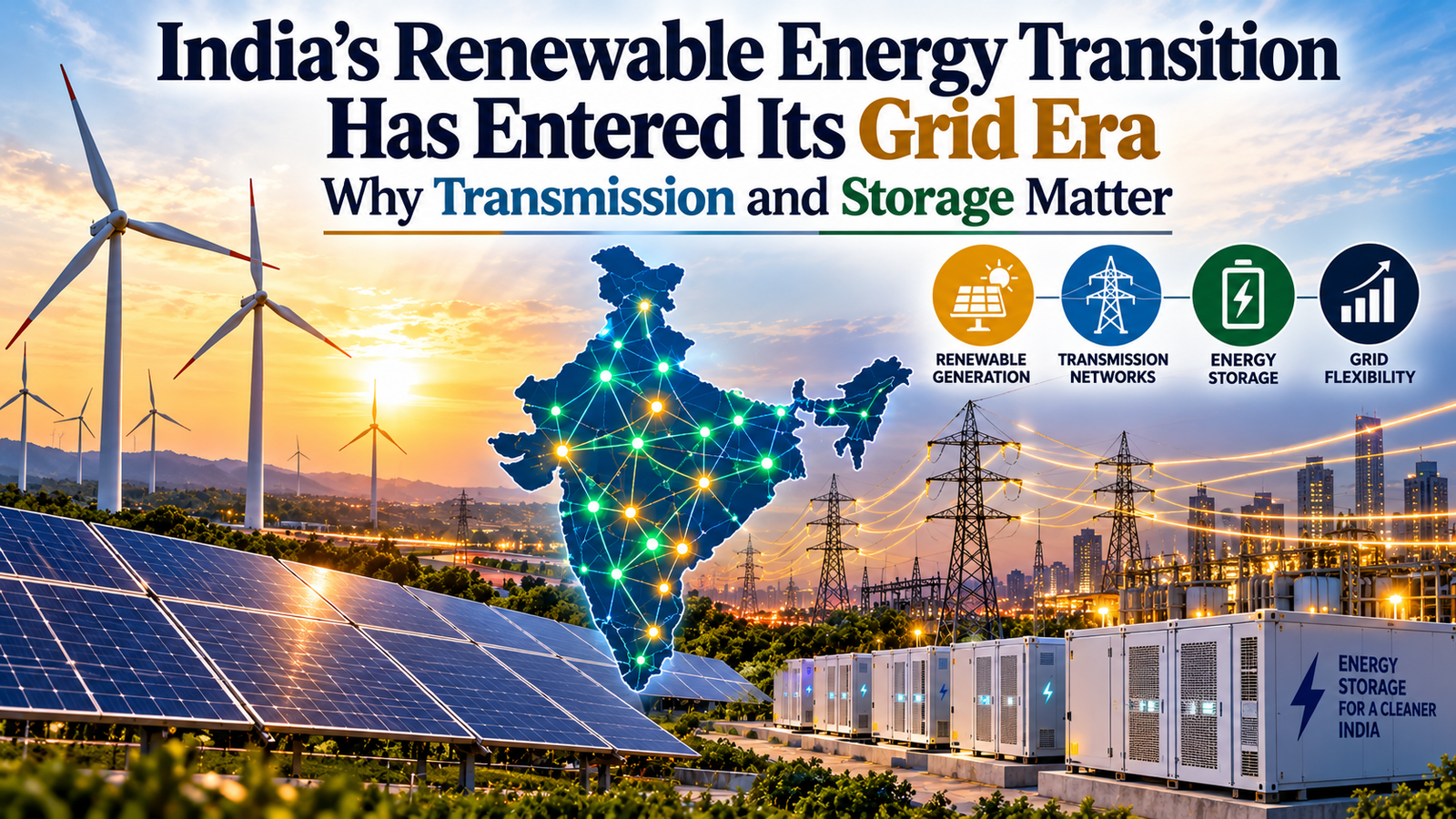
India’s renewable-energy transition has entered a new phase.
The central challenge is no longer simply how much renewable-energy capacity India can install. Increasingly, the question is whether the country’s transmission networks, energy-storage systems and grid-management capabilities can absorb that capacity while maintaining reliable electricity supply.
This issue has acquired immediate policy significance. On 30 September 2026, the Union Cabinet approved Green Energy Corridor Phase-III (GEC-III), with a total outlay of ₹1,86,405 crore. The scheme is designed to strengthen intra-State transmission systems so that up to 135 GW of renewable energy can be evacuated, while also supporting 50 GWh of Battery Energy Storage Systems (BESS). Press Information Bureau
The significance of GEC-III goes beyond the construction of transmission lines. It reflects a broader shift in India’s energy policy:
The renewable-energy transition is becoming a grid-infrastructure challenge.
Why Transmission Has Become Central to India’s Energy Transition
Electricity generated from a power plant is useful only when it can be transported to the place where it is required.
This becomes particularly important for renewable energy because India’s major renewable-energy resources and major electricity-demand centres are not always located in the same places.
Large solar and wind projects are concentrated in resource-rich regions, while major industrial, commercial and residential demand is spread across the country.
This creates a basic infrastructure chain:
Renewable resource → Generation → Transmission → Storage/Grid balancing → Distribution → Consumer
If any link is inadequate, additional generation capacity may not translate into equivalent usable electricity.
The Government’s Green Energy Corridor programme was conceived precisely around this problem. The Ministry of New and Renewable Energy notes that an assessment conducted by Power Grid Corporation of India identified inadequate transmission infrastructure near potential large-scale solar and wind sites, leading to the development of dedicated transmission infrastructure for renewable energy. Implementation began in 2015. Ministry of New and Renewable Energy
India’s Renewable-Energy Expansion
India has made substantial progress in expanding non-fossil electricity capacity.
As of 31 July 2026, India had crossed 300 GW of installed non-fossil-fuel electricity capacity, including:
- 164.59 GW solar
- 58.14 GW wind
- 57.24 GW hydro
- 11.75 GW bio-power
- 8.78 GW nuclear
The Government reported that non-fossil sources accounted for more than 54% of total installed electricity-generation capacity at that point. Press Information Bureau
India had already achieved the milestone of obtaining 50% of cumulative installed electricity capacity from non-fossil sources in June 2025, ahead of the timeline associated with its 2030 climate commitment. Press Information Bureau
The Government continues to work towards 500 GW of non-fossil electricity capacity by 2030. Press Information Bureau
The rapid increase in renewable generation makes transmission planning increasingly important.
What Is the Green Energy Corridor?
The Green Energy Corridor (GEC) is a dedicated transmission-infrastructure initiative designed to facilitate the integration and evacuation of renewable electricity.
Its purpose is not to generate renewable electricity itself.
Instead, it creates the electrical highways through which renewable power can reach the wider grid.
The programme has both intra-State and inter-State dimensions.
The earlier intra-State GEC phases have focused on strengthening transmission networks within States with substantial renewable-energy potential. Under GEC-II, for example, approximately 10,750 circuit kilometres of transmission lines and 27,500 MVA of substation capacity were planned to facilitate integration of about 20 GW of renewable generation. Press Information Bureau
The next phase is considerably larger.
GEC-III
The newly approved GEC-III comprises:
- ₹1,36,378 crore for intra-State transmission systems
- ₹50,000 crore for 50 GWh of BESS
- ₹1,86,405 crore total outlay
- evacuation capability of up to 135 GW of renewable energy
- implementation target of FY 2032–33
The scheme also specifically addresses intermittency, congestion, peak-hour curtailment and demand during non-solar hours. Press Information Bureau
This last element is particularly important.
Because renewable energy is variable, simply adding generation capacity does not automatically guarantee electricity availability at every hour.
The Intermittency Problem
Solar and wind power have a fundamental characteristic that distinguishes them from conventional dispatchable generation.
Solar power
Solar generation varies with:
- time of day;
- cloud cover;
- season;
- weather conditions.
Production falls sharply after sunset.
Wind power
Wind generation varies with:
- wind speed;
- weather;
- season;
- geographical conditions.
Consequently, electricity generation from solar and wind cannot always be perfectly matched with electricity demand.
This creates what is commonly described as the intermittency or variability challenge.
For example:
Solar generation
Morning → increasing generation
Midday → high generation
Evening → rapidly declining generation
Night → negligible generation
But electricity demand can remain substantial during the evening.
This creates the classic duck-curve-type challenge associated with high solar penetration.
The solution is not to abandon renewable energy.
The solution is to develop a more flexible electricity system.
That requires:
Transmission + Storage + Flexible generation + Demand management + Better forecasting + Grid modernisation
Why Energy Storage Matters
Energy storage allows electricity generated at one time to be used later.
This makes storage particularly valuable for renewable energy.
A simplified example:
Solar electricity generated at noon
↓
Stored in BESS
↓
Released during evening peak demand
In this way, storage helps convert variable renewable electricity into a more flexible electricity resource.
The Government’s National Electricity Plan projections indicate a substantial future requirement for energy storage.
For 2031–32, the projected requirement includes approximately:
- 47.24 GW / 236 GWh of BESS
- 26.69 GW / 175 GWh of pumped-storage capacity
The Government has estimated investment requirements of about ₹3.49 lakh crore for BESS and ₹1.29 lakh crore for pumped-storage plants by 2031–32. Press Information Bureau
More recent government data also indicate substantial BESS and pumped-storage capacity already under construction, awarded or under tendering. Press Information Bureau
Battery Storage vs Pumped Storage
India’s future energy system is likely to require multiple forms of storage, rather than relying on a single technology.
Battery Energy Storage Systems
BESS generally use electrochemical batteries to store electricity.
They can respond rapidly and are particularly useful for:
- short-duration balancing;
- peak shifting;
- frequency regulation;
- renewable integration;
- reducing congestion;
- providing flexibility.
Pumped-Storage Hydropower
Pumped storage uses two reservoirs at different elevations.
When electricity is abundant, water is pumped to the upper reservoir.
When electricity is required, the water flows downward through turbines to generate electricity.
It functions somewhat like a large-scale rechargeable battery, although through mechanical and gravitational storage rather than electrochemical storage.
Pumped storage can provide longer-duration storage and grid-balancing services.
India’s policy planning therefore increasingly treats BESS and pumped storage as complementary technologies rather than competing solutions. Press Information Bureau
Why GEC-III Includes Battery Storage
The inclusion of 50 GWh of BESS within GEC-III is one of the most significant aspects of the new scheme.
It shows that transmission and storage are increasingly being planned together.
Traditionally, the sequence might have been:
Build renewable capacity → Build transmission → Integrate electricity
The emerging model is closer to:
Generation + Transmission + Storage + Grid management
The GEC-III announcement explicitly identifies several problems that BESS is intended to address:
- intermittency;
- congestion;
- peak-hour curtailment;
- non-solar-hour demand;
- grid flexibility. Press Information Bureau
This represents a conceptual shift in infrastructure planning.
What Is Curtailment?
Curtailment occurs when electricity that could technically be generated is not allowed to enter the grid or is reduced because the system cannot absorb it economically or technically at that moment.
For renewable energy, this can occur when:
- transmission capacity is insufficient;
- demand is low;
- the grid is congested;
- system balancing becomes difficult;
- generation exceeds what the network can safely accommodate.
Imagine a large solar park producing electricity at midday.
If the local transmission network cannot carry all that electricity to demand centres, some generation may have to be curtailed.
Thus:
Generation capacity without adequate transmission can create stranded or underutilised renewable potential.
Storage can help by absorbing electricity during periods of surplus and releasing it when the system needs it.
From Energy Capacity to Energy Quality
This leads to an important distinction.
A country can measure its energy transition through installed capacity.
But installed capacity alone does not answer several critical questions:
- Is electricity available when required?
- Can the grid handle sudden changes in generation?
- Can renewable electricity reach consumers?
- Can peak demand be met?
- Is the system resilient?
- How much renewable energy is curtailed?
- How much storage is available?
- Is electricity affordable?
Therefore, the next stage of India’s energy transition is about the quality and flexibility of the electricity system, not just the quantity of generation capacity.
India’s Transmission Expansion
India’s National Electricity Plan (Transmission) provides a broader picture.
The transmission network at 220 kV and above is planned to expand from roughly 5.09 lakh circuit kilometres in June 2026 to 6.48 lakh circuit kilometres by 2032.
Transformation capacity is planned to rise from approximately 1,478 GVA to 2,345 GVA over the same period.
Inter-regional transmission capacity is also planned to expand as electricity flows increasingly need to move across regions. Press Information Bureau
The Government has stated that transmission planning is being aligned not only with renewable-energy expansion but also with emerging demand from:
- electric mobility;
- data centres;
- industrial expansion;
- green hydrogen;
- other new electricity-intensive sectors. Press Information Bureau
This is important because India’s electricity system is simultaneously facing two transformations:
Supply transformation:
Increasing renewable generation.
Demand transformation:
Electrification of transport, industry, cooling, data centres and other sectors.
Renewable Energy and India’s Federal Structure
The electricity sector has an important federal dimension.
Transmission systems involve both Central and State institutions, while much of the intra-State electricity infrastructure falls within the responsibility of State-level entities.
This makes renewable-energy integration a practical example of cooperative federalism.
GEC-II, for example, was implemented through the respective State Transmission Utilities (STUs) in participating States, with Central Financial Assistance from MNRE and additional financing arrangements. Ministry of New and Renewable Energy
GEC-III similarly places considerable emphasis on strengthening intra-State transmission systems.
The challenge is therefore not simply technological.
It involves coordination among:
- Union Government;
- State Governments;
- Central Electricity Authority;
- transmission utilities;
- distribution companies;
- renewable-energy developers;
- regulators;
- financial institutions;
- local communities.
Read more on Indian Economy and Infrastructure at Samata IAS Academy.
The Renewable-Energy Geography Problem
India’s renewable resources are geographically uneven.
Some regions have exceptional solar potential.
Others have strong wind resources.
Hydropower is concentrated in particular geographical environments.
But electricity demand is distributed across:
- large cities;
- industrial clusters;
- manufacturing centres;
- commercial centres;
- agricultural regions;
- households.
Therefore, renewable-energy development creates a geographical mismatch between generation and demand.
Transmission infrastructure allows the country to address this mismatch.
The basic principle is:
Generate where resources are abundant → transmit efficiently → consume where demand exists.
This is one reason why renewable-energy policy cannot be separated from national transmission planning.
Why Grid Stability Becomes More Important
A power grid must continuously balance electricity generation and electricity consumption.
Unlike many other commodities, electricity cannot simply be stored indefinitely in the grid itself.
At every moment:
Generation ≈ Demand + System losses + Storage charging
When this balance is disturbed significantly, grid frequency and stability can be affected.
Large-scale renewable integration therefore requires:
- accurate forecasting;
- flexible generation;
- energy storage;
- stronger transmission;
- advanced grid-management systems;
- demand response;
- inter-regional power flows.
The Government says grid readiness is assessed through system studies including load-flow studies, dynamic-stability studies and contingency analysis to evaluate renewable variability, intermittency and peak-load requirements. Press Information Bureau
The Role of Smart Grids
The future electricity system will increasingly require digital management.
Smart-grid technologies can help utilities:
- monitor electricity flows;
- detect faults;
- forecast demand;
- integrate distributed generation;
- manage storage;
- improve grid visibility;
- respond rapidly to disturbances.
This is particularly important as electricity generation becomes more geographically dispersed.
India is moving from a relatively centralised model towards a system involving:
Utility-scale solar + wind + hydro + rooftop solar + batteries + pumped storage + electric vehicles + flexible loads
Managing such a system requires much more sophisticated digital control.
Renewable Energy and Electric Vehicles
Electric vehicles introduce another major change in electricity demand.
If EV charging occurs primarily during periods of high electricity demand, it can increase pressure on the grid.
But if charging is managed intelligently, EV batteries could eventually contribute to grid flexibility through technologies such as smart charging and vehicle-to-grid systems.
Thus, the energy transition increasingly involves interaction between:
Renewable electricity ↔ Storage ↔ EVs ↔ Grid ↔ Consumers
The boundary between the transport sector and the electricity sector is becoming less distinct.
Renewable Energy and Green Hydrogen
India’s emerging green-hydrogen economy will also require significant electricity and transmission infrastructure.
Green hydrogen is produced through electrolysis using electricity, ideally from renewable sources.
This creates another chain:
Renewable electricity → Electrolysis → Green hydrogen → Industry/transport/export
Large green-hydrogen production facilities may be located near ports and industrial clusters.
The National Electricity Plan’s transmission planning has already considered electricity requirements associated with green hydrogen and green ammonia manufacturing hubs. Press Information Bureau
This demonstrates why transmission planning has to anticipate future industrial demand, rather than simply responding to existing demand.
The Environmental Dimension
Transmission and storage infrastructure are essential for renewable integration, but they also have environmental footprints.
Transmission projects can involve:
- land requirements;
- forest crossings;
- wildlife impacts;
- right-of-way issues;
- construction impacts.
Large pumped-storage projects can involve:
- land-use changes;
- impacts on local ecosystems;
- water-resource considerations;
- rehabilitation and resettlement issues in some projects.
Battery systems involve questions surrounding:
- mineral requirements;
- manufacturing;
- battery degradation;
- recycling;
- end-of-life management.
Therefore, a green grid is not automatically impact-free.
The policy objective should be to maximise the climate and energy-security benefits of clean-energy infrastructure while minimising local environmental and social costs.
The Right-of-Way Challenge
One of the less visible constraints on transmission expansion is Right of Way (RoW).
Transmission lines cross land belonging to multiple owners and jurisdictions.
Disagreements over compensation can delay projects.
The Ministry of Power has introduced guidelines relating to compensation for Right of Way for transmission lines, including provisions linking land rates to prevailing market rates. Press Information Bureau
This illustrates a broader lesson:
Infrastructure expansion depends not only on capital but also on institutions, land governance and social consent.
Financing the Grid
Transmission infrastructure is capital-intensive.
GEC-III itself involves a total outlay of ₹1.864 lakh crore, demonstrating the scale of investment required to support the next phase of renewable-energy integration. Press Information Bureau
But financing cannot be considered separately from the economics of electricity.
Transmission investment ultimately has implications for:
- tariffs;
- electricity affordability;
- State finances;
- utility finances;
- private investment;
- renewable-energy project economics.
This is particularly relevant because State-owned electricity distribution companies remain important actors in India’s power sector.
The renewable transition will therefore require not merely generation investment but also financially sustainable electricity institutions.
What Happens If Transmission Does Not Keep Pace?
Several problems can emerge.
1. Renewable curtailment
Potential renewable generation may remain unused.
2. Grid congestion
Electricity may not move efficiently between regions.
3. Delayed projects
Generation projects may face delays because associated transmission is unavailable.
4. Higher system costs
Additional balancing infrastructure may be required.
5. Reliability concerns
Rapid renewable expansion without adequate flexibility can complicate grid management.
6. Regional imbalances
Resource-rich regions may have surplus electricity while demand centres face constraints.
Thus, transmission capacity can become a bottleneck for the entire energy transition.
What Should India Do?
India’s next phase of energy policy needs an integrated approach.
1. Plan generation and transmission together
Transmission should be planned sufficiently ahead of renewable-energy projects.
2. Scale up energy storage
BESS and pumped storage should develop alongside renewable generation.
3. Strengthen inter-State connectivity
A stronger national grid allows renewable electricity to move between regions.
4. Improve forecasting
Better solar and wind forecasting can reduce balancing requirements.
5. Modernise State grids
Intra-State transmission and distribution networks must keep pace with renewable capacity.
6. Promote smart-grid technologies
Digital monitoring and automated control can improve grid flexibility.
7. Address Right-of-Way issues
Transparent compensation and effective stakeholder engagement can reduce project delays.
8. Develop domestic manufacturing
India needs capabilities in:
- transformers;
- conductors;
- power electronics;
- batteries;
- grid-control equipment;
- high-voltage equipment.
9. Integrate renewable energy with new demand
EVs, green hydrogen, data centres and industrial electrification should be incorporated into transmission planning.
10. Maintain environmental safeguards
Transmission, storage and generation projects should incorporate environmental and social considerations from the planning stage.
From Green Energy to a Green Power System
India’s energy transition is sometimes described primarily through the growth of solar and wind capacity.
That description is incomplete.
A modern renewable-energy system requires an entire ecosystem:
Generation
↓
Transmission
↓
Storage
↓
Grid Management
↓
Distribution
↓
Flexible Demand
↓
Reliable Electricity
The significance of GEC-III lies precisely in this transition.
It recognises that India’s renewable-energy ambitions require physical infrastructure capable of moving, storing and balancing electricity.
The country’s clean-energy transition is therefore entering its grid era.
The Larger Economic Argument
Reliable electricity infrastructure is a foundation for economic development.
India’s future electricity demand is likely to be shaped not only by population and industrialisation but also by:
- electric mobility;
- air-conditioning;
- data centres;
- artificial intelligence;
- green hydrogen;
- manufacturing;
- urbanisation;
- household electrification.
At the same time, India is trying to reduce the carbon intensity of its energy system.
This creates a dual challenge:
More electricity + cleaner electricity
Meeting both objectives requires investment in generation, transmission, storage and distribution simultaneously.
The energy transition should therefore be understood not merely as an environmental policy, but also as an infrastructure and economic-development strategy.
Explore GS Paper III at Samata IAS Academy.
Conclusion
India’s renewable-energy journey has reached a point where adding generation capacity alone is insufficient.
The country has already crossed 300 GW of non-fossil installed electricity capacity, and the Government is pursuing the much larger objective of 500 GW of non-fossil capacity by 2030. Press Information Bureau
The next challenge is to make this capacity usable, reliable, flexible and economically viable.
That requires:
More transmission.
More storage.
More flexible grids.
Better forecasting.
Stronger State electricity infrastructure.
Greater coordination between generation and demand.
The approval of Green Energy Corridor Phase-III, with ₹1.864 lakh crore of planned investment, 135 GW of renewable-energy evacuation capability and 50 GWh of BESS, represents an important step in that direction. Press Information Bureau
The larger lesson is important for India’s development trajectory:
A successful energy transition is not simply about producing green electricity. It is about building the infrastructure that allows green electricity to reach the economy when and where it is needed.
India’s renewable-energy transition has therefore entered its grid era.
UPSC Prelims Corner
Key facts
- Green Energy Corridor: transmission infrastructure designed to facilitate integration and evacuation of renewable electricity.
- GEC-III: approved on 30 September 2026. Press Information Bureau
- GEC-III total outlay: ₹1,86,405 crore. Press Information Bureau
- GEC-III renewable evacuation capability: up to 135 GW. Press Information Bureau
- BESS under GEC-III: 50 GWh. Press Information Bureau
- India’s non-fossil installed capacity as of 31 July 2026: 300.50 GW. Press Information Bureau
- BESS projected requirement by 2031–32: approximately 47.24 GW / 236 GWh. Press Information Bureau
- Pumped-storage requirement by 2031–32: approximately 26.69 GW / 175 GWh. Press Information Bureau
- Transmission network planned for 2032: approximately 6.48 lakh circuit km at 220 kV and above. Press Information Bureau
UPSC Mains Corner
GS Paper III
Energy
- Renewable energy
- Energy security
- Grid management
- Energy storage
Infrastructure
- Transmission networks
- Power infrastructure
- Multimodal infrastructure
Environment
- Climate change
- Energy transition
- Low-carbon development
Economy
- Infrastructure investment
- Industrialisation
- Electricity demand
- Green growth
Possible Mains Question
“India’s renewable-energy transition is increasingly constrained not by generation capacity alone but by transmission and storage requirements. Discuss the challenges and examine the significance of the Green Energy Corridor Phase-III.”
Answer framework
Introduction:
India’s rapid renewable-energy expansion has made grid integration and electricity storage increasingly important.
Body:
Why transmission matters
- geographical mismatch between generation and demand;
- renewable-energy evacuation;
- congestion;
- curtailment;
- regional power balancing.
Why storage matters
- intermittency;
- peak demand;
- non-solar hours;
- grid flexibility;
- renewable-energy firming.
Challenges
- financing;
- land and Right of Way;
- State-level implementation;
- storage costs;
- environmental impacts;
- grid modernisation;
- DISCOM finances.
Way forward
- integrated generation-transmission planning;
- BESS + pumped storage;
- smart grids;
- stronger inter-State connectivity;
- domestic manufacturing;
- improved forecasting;
- cooperative federalism.
Conclusion:
India’s energy transition requires not merely more renewable generation but a flexible, resilient and interconnected electricity system.
Key Takeaway
India’s renewable-energy challenge is evolving from “How much can we generate?” to “How efficiently can we transmit, store and use what we generate?”
The approval of GEC-III demonstrates that India’s next phase of energy transition will depend increasingly on transmission, storage and grid flexibility. Press Information Bureau
Useful Samata resources:
Indian Economy · GS Paper III · Science & Technology