
Introduction
India’s transition towards electric mobility is increasingly becoming an important component of its energy, transport, industrial and climate strategies. The transition is not limited to replacing internal-combustion-engine vehicles with electric vehicles (EVs). It involves the simultaneous development of charging infrastructure, battery technology, manufacturing capabilities, research and innovation, electricity systems, state-level policies and consumer adoption.
Against this background, the India Electric Mobility Index (IEMI) 2025 provides a framework to assess how India’s States and Union Territories are progressing towards an electric mobility ecosystem.
The second edition of the IEMI was developed by NITI Aayog in partnership with WRI India. It assesses all 28 States and 8 Union Territories using 16 indicators grouped under three broad themes: Transport Electrification Progress, Charging Infrastructure Readiness, and EV Research and Innovation Status.
The report was published by NITI Aayog on 15 September 2026.
Report at a Glance
| Particular | Details |
|---|---|
| Report | India Electric Mobility Index (IEMI) 2025 |
| Institution | NITI Aayog |
| Partner institution | WRI India |
| Edition | Second edition |
| Assessment coverage | 28 States + 8 Union Territories |
| Number of indicators | 16 |
| Assessment themes | 3 |
| Scoring scale | 0–100 |
| Assessment categories | Large States; Hilly & Northeastern States; UTs & City States |
| Assessment period | Primarily 2025 data |
| UPSC relevance | GS-II, GS-III, Essay and Prelims |
The report describes the IEMI as a composite index assessing both the policy framework and implementation outcomes for e-mobility at the State and Union Territory level.
1. Why is Electric Mobility Important for India?
The importance of electric mobility extends well beyond the automobile sector.
1.1 Energy security
Road transport has a very high dependence on petroleum products. According to the IEMI 2025 report, road transport accounts for around 70% of India’s diesel consumption and 99.6% of petrol consumption.
Consequently, transport electrification can potentially reduce India’s dependence on imported fossil fuels and improve energy security.
1.2 Climate change
The report estimates that road transport contributes approximately 12% of India’s energy-related carbon dioxide emissions.
Electrification of transport therefore forms part of India’s broader effort towards reducing the carbon intensity of economic activity.
1.3 Urban air pollution
Internal combustion engine vehicles are an important source of urban air pollutants. The report notes that road transport contributes substantially to nitrogen oxide emissions and releases particulate matter and other pollutants in urban areas.
1.4 Industrial transformation
India’s automotive industry contributes around 7.1% of national GDP and supports nearly 19 million direct and indirect jobs, according to the report.
Therefore, the transition to EVs is simultaneously an environmental transition and an industrial transition.
1.5 Growing vehicle ownership
Vehicle registrations have increased significantly, from around 2 crore vehicles in 2020 to 3.1 crore in 2025–26, according to the report.
This increases both the potential market for EVs and the importance of transforming the transport-energy relationship.
2. Growth of Electric Vehicles in India
India’s electric mobility ecosystem has expanded significantly in recent years.
According to the IEMI 2025 report:
- EV penetration reached 8.25% in 2025–26, compared with around 0.5% in 2018.
- More than 8.7 million EVs were operating on Indian roads by 2025–26.
- Nearly 2.5 million EVs were registered during 2025–26 alone.
- EV registrations during 2025–26 increased by approximately 25% over the previous financial year.
This indicates that India’s EV transition has moved beyond an experimental stage and is increasingly becoming part of the mainstream transport system.
However, aggregate EV growth alone does not indicate the strength of the entire ecosystem. A State may have high EV adoption but inadequate charging infrastructure, or strong charging infrastructure but relatively weak consumer adoption.
This is one of the important reasons for developing the IEMI.
3. What is the India Electric Mobility Index?
The India Electric Mobility Index is a composite framework designed to assess the progress of States and Union Territories towards electric mobility.
The index evaluates both:
Outcomes
→ What has actually been achieved?
and
Enablers
→ What policies, institutions and infrastructure are supporting the transition?
The 2025 edition is the second edition and introduces improvements over the 2024 framework based on feedback from States and Union Territories.
The index has three major themes.
Structure of IEMI
India Electric Mobility Index
↓
Transport Electrification Progress — 50%
Charging Infrastructure Readiness — 30%
EV Research & Innovation Status — 20%
Together, these three themes contain 16 indicators.
4. Three Pillars of the IEMI
A. Transport Electrification Progress — 50%
This is the highest-weighted component of the index.
It primarily measures the extent to which electric vehicles are actually being adopted and used.
The indicators include:
- Private EV adoption
- Commercial EV adoption
- Governance initiatives
- Purchase incentives
- Transition incentives
- Operational support initiatives
- Fuel-price parity
The inclusion of both outcomes and policy enablers is significant.
For example, merely having an EV policy does not necessarily mean that EV adoption is taking place. The index therefore attempts to examine the relationship between policy intervention and actual market absorption.
B. Charging Infrastructure Readiness — 30%
Electric vehicle adoption cannot be sustained without adequate charging infrastructure.
This theme evaluates:
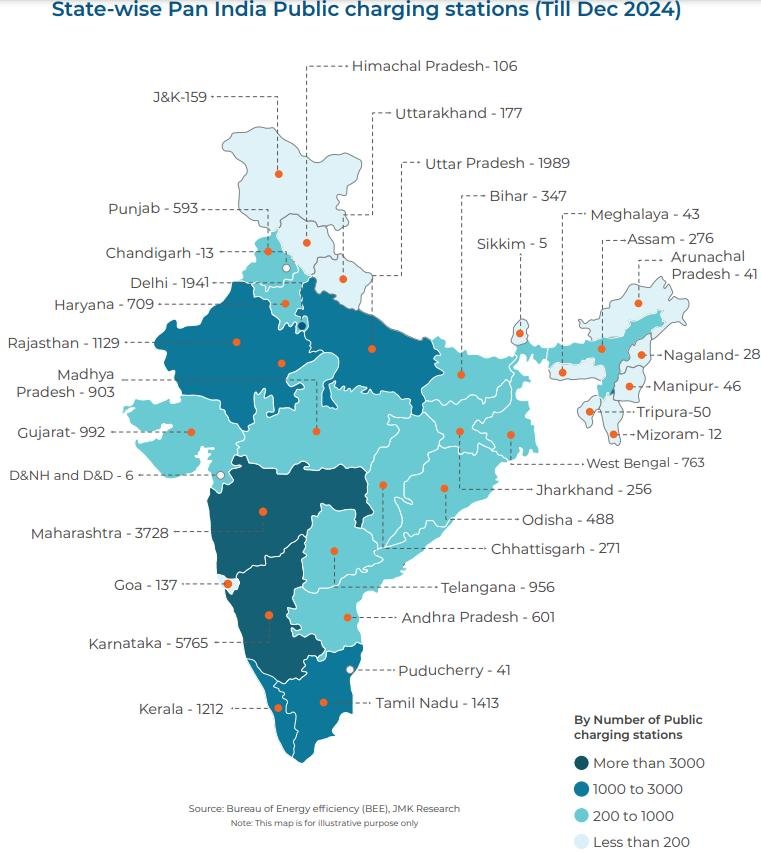
- Charger-to-vehicle ratio
- Capital subsidies for public charging
- Charging infrastructure development initiatives
- Building bye-laws and charging mandates
- Renewable-energy generation capacity
- Power availability
The charger-to-vehicle ratio, for example, measures the number of public charging points per lakh registered vehicles.
This is important because range anxiety and charging availability remain major factors influencing consumer adoption.
C. EV Research and Innovation Status — 20%
The third pillar focuses on the technological and innovation ecosystem.
It includes:
- EV startups
- State-level R&D initiatives
- EV-related patents
The report also considers whether State policies promote:
- R&D centres,
- Centres of Excellence,
- polytechnic or short-term e-mobility courses,
- skill development.
The inclusion of research and innovation is important because the EV transition is not merely about vehicle sales. It also involves battery technology, charging technologies, software, power electronics, manufacturing processes and new mobility solutions.
5. How is the IEMI Calculated?
Each indicator, theme and the composite IEMI score is calculated on a 0–100 scale.
For more meaningful comparison, States and UTs are divided into three peer groups:
- Large States — 17
- Hilly and Northeastern States — 12
- UTs and City States — 7
The report then places jurisdictions into four performance categories:
| Score | Category |
|---|---|
| 65 and above | Top Performers |
| 50–64 | Frontrunners |
| 35–49 | Emerging Performers |
| Below 35 | Aspirants |
The peer-group approach is important because comparing a large industrial State directly with a small island territory can produce misleading conclusions. The 2025 methodology therefore attempts to make comparisons more context-sensitive.
6. What Changed in IEMI 2025?
The 2025 edition incorporated feedback from 11 States and Union Territories.
The methodology was modified through:
- introduction of peer grouping;
- expansion of data points;
- use of more reliable datasets;
- improved normalisation of indicators;
- refinement of data sources;
- changes in the assessment of policy duration.
For example, policy-based indicators were scored on a pro-rata basis according to the number of months for which a policy remained active during the assessment year, rather than simply treating the policy as active or inactive.
The report also replaced some earlier data sources with updated official datasets, including the Central Electricity Authority, Petroleum Planning & Analysis Cell, and Bureau of Energy Efficiency for relevant indicators.
7. Overall IEMI 2025 Results
The overall results show considerable variation across India’s States and Union Territories.
The five jurisdictions classified as Top Performers were:
| Position | State/UT | IEMI Score |
|---|---|---|
| 1 | Delhi | 84 |
| 2 | Maharashtra | 78 |
| 3 | Karnataka | 73 |
| 4 | Chandigarh | 71 |
| 5 | Goa | 65 |
The overall scores ranged from 10 to 84, with a national median score of 40.
The report also shows that the median score increased from 36 in 2024 to 40 in 2025, while the highest score increased from 77 to 84.
8. Performance of Large States
Among the 17 Large States:
| Category | States |
|---|---|
| Top Performers | Maharashtra (78), Karnataka (73) |
| Frontrunners | Tamil Nadu (61), Madhya Pradesh (59), Odisha (55), Andhra Pradesh (52), Telangana (51), Haryana (51), Rajasthan (51), Uttar Pradesh (51) |
| Emerging Performers | Chhattisgarh (49), West Bengal (42), Bihar (40), Kerala (40), Jharkhand (40), Punjab (39), Gujarat (38) |
| Aspirants | None |
Thus, no Large State was placed in the Aspirant category in the overall index.
Telangana
Telangana recorded an overall IEMI score of 51, placing it in the Frontrunner category among Large States.
Its performance, however, differs significantly across the three pillars. In particular, Telangana recorded 71 in EV Research and Innovation Status, while its Transport Electrification Progress score was 49.
This illustrates an important point:
A composite index can hide significant differences between the individual dimensions of performance.
9. Hilly and Northeastern States
The Hilly and Northeastern States show a substantially different pattern.
| State | IEMI Score |
|---|---|
| Manipur | 46 |
| Tripura | 36 |
| Assam | 35 |
| Ladakh | 32 |
| Meghalaya | 32 |
| Jammu & Kashmir | 31 |
| Himachal Pradesh | 28 |
| Uttarakhand | 26 |
| Mizoram | 24 |
| Arunachal Pradesh | 21 |
| Sikkim | 16 |
| Nagaland | 14 |
Manipur was the highest-scoring State in this group.
The report identifies research and innovation as a major constraint. Half of the States in this category scored 10 or below on the EV Research and Innovation theme.
The geography of these States also creates distinct challenges:
Dispersed settlements + difficult terrain + smaller vehicle markets + limited charging networks
can make the EV transition different from that of large metropolitan or industrial States.
10. Transport Electrification: The Major Challenge
One of the most important findings of the report is that transport electrification itself remains the largest area of opportunity.
Only three jurisdictions achieved the Top Performer category in this theme:
- Delhi — 77
- Chandigarh — 75
- Maharashtra — 68
Furthermore, 14 of the 36 States and UTs were classified as Aspirants on Transport Electrification Progress.
This produces an important analytical distinction:
Having an EV policy is not the same as achieving EV adoption.
The transition ultimately depends upon whether policies translate into:
consumer demand → vehicle adoption → fleet electrification → sustained usage.
11. Charging Infrastructure: A Different Picture
Charging infrastructure presents a somewhat stronger picture than actual transport electrification.
Six States and UTs reached the Top Performer category in this theme, while nearly two-thirds of all jurisdictions remained below the Frontrunner threshold.
Among Large States:
| State | Charging Infrastructure Readiness |
|---|---|
| Karnataka | 97 |
| Maharashtra | 91 |
| Haryana | 91 |
| Tamil Nadu | 73 |
| Rajasthan | 64 |
| Andhra Pradesh | 62 |
| Odisha | 57 |
| Kerala | 55 |
The report highlights an important mismatch.
Haryana
→ Charging Infrastructure Readiness: 91
→ Transport Electrification Progress: 19
In contrast:
Uttar Pradesh
→ Transport Electrification Progress: 58
→ Charging Infrastructure Readiness: 36
Therefore:
Infrastructure availability and EV adoption do not necessarily progress at the same pace.
This is one of the most useful analytical insights of the report.
12. Research and Innovation
The third pillar reveals a strong concentration of innovation capacity.
Among Large States:
| State | EV Research & Innovation Score |
|---|---|
| Maharashtra | 85 |
| Karnataka | 82 |
| Tamil Nadu | 77 |
| Haryana | 74 |
| Telangana | 71 |
| Madhya Pradesh | 65 |
The report attributes much of this concentration to the presence of automotive manufacturing and technology clusters.
By contrast, several Hilly and Northeastern States have limited measurable activity in EV research, innovation and start-up ecosystems.
This has an important policy implication:
India’s EV transition requires not only vehicle adoption but also the creation of domestic technological capabilities.
13. State Action and Cooperative Federalism
The IEMI highlights the importance of State governments in India’s electric mobility transition.
This is because States exercise important responsibilities relating to:
- road transport;
- power distribution;
- urban planning;
- industrial development;
- charging infrastructure;
- skill development;
- local regulation.
According to the report, 29 States and UTs had notified EV policies by December 2025, while 26 had active EV policies.
The first State EV policy was implemented by Karnataka in September 2017.
The report therefore demonstrates how electric mobility has become an example of cooperative and competitive federalism.
States can:
formulate policies → develop infrastructure → attract investment → promote innovation → learn from other States.
14. Policy Support at the Union Level
India’s electric mobility transition is supported by several policy interventions.
The IEMI report identifies major components of the Union government’s support architecture, including:
- FAME
- PM E-DRIVE
- PM-eBus Sewa
- PLI scheme for Advanced Chemistry Cell battery storage
- PLI scheme for automobile and auto components
- e-mobility-related research and development support.
The report estimates that more than ₹90,000 crore has been committed across these different interventions towards demand incentives, charging infrastructure, bus electrification, manufacturing and R&D.
The significance of this approach is that India is attempting to address both sides of the transition:
Demand side
→ consumer incentives
→ fleet electrification
→ public transport
Supply side
→ batteries
→ automobiles
→ components
→ manufacturing
→ R&D
15. EVs and the Electricity Sector
A major conceptual issue is frequently overlooked:
Electric vehicles are only as clean as the electricity system that powers them.
EV adoption shifts energy demand from:
Petroleum
to
Electricity
Therefore, large-scale EV adoption has implications for:
- electricity generation;
- transmission;
- distribution;
- renewable energy;
- grid management;
- energy storage;
- time-of-day pricing.
This explains why the IEMI includes renewable-energy generation capacity and power availability within its Charging Infrastructure Readiness framework.
Thus:
EV transition
→ higher electricity demand
→ greater importance of grid capacity
→ greater importance of renewable generation
→ greater importance of storage and smart charging
→ broader energy transition.
16. EV Transition and Critical Minerals
Another important dimension is the battery supply chain.
The transition from oil dependence to electric mobility does not eliminate resource dependence; it can change its nature.
Conventional vehicles depend heavily on:
Crude oil → refining → petroleum products
EVs depend increasingly on:
Lithium + cobalt + nickel + graphite + rare-earth-related technologies + advanced batteries
Therefore, India’s EV strategy needs to be linked with:
- critical mineral security;
- domestic exploration;
- international mineral partnerships;
- recycling;
- battery technology;
- supply-chain diversification.
This makes electric mobility relevant not only to GS-III: Environment and Technology, but also to International Relations and Economic Security.
17. The Most Important Lesson from IEMI 2025
The report demonstrates that electric mobility is an ecosystem rather than a single technology.
A State may have:
High EV adoption but weak charging infrastructure
or
Strong charging infrastructure but low EV adoption
or
Strong automotive manufacturing but limited innovation
or
Strong research capacity but weak market adoption.
Therefore, a successful EV transition requires simultaneous progress across:
Demand + Infrastructure + Technology + Policy + Manufacturing + Electricity
This is perhaps the most important conceptual takeaway for UPSC aspirants.
18. Challenges in India’s Electric Mobility Transition
18.1 High upfront cost
EVs can involve higher initial purchase costs, particularly because of battery costs.
18.2 Charging infrastructure
A reliable and geographically distributed charging network is essential.
18.3 Battery dependence
India needs greater domestic capability across the battery value chain.
18.4 Critical minerals
Access to lithium, cobalt, nickel, graphite and other strategic minerals has become an important economic and geopolitical issue.
18.5 Grid readiness
Large-scale electrification will increase electricity demand and require adequate distribution infrastructure.
18.6 Regional disparities
Metropolitan and industrial States have structural advantages over remote, hilly and island regions.
18.7 Research and innovation
The IEMI shows that research and innovation capabilities remain concentrated in a relatively small number of States and urban centres.
18.8 Policy implementation
The transition is increasingly moving from the stage of policy notification to policy implementation.
The existence of an EV policy alone cannot guarantee adoption.
19. Way Forward
The IEMI 2025 points towards a broader ecosystem-based approach.
1. Move from policy announcement to implementation
States need to focus on measurable outcomes rather than merely notifying EV policies.
2. Expand charging infrastructure
Charging infrastructure needs to be integrated into:
- buildings;
- parking systems;
- highways;
- urban planning;
- public transport systems.
3. Promote public transport electrification
Electric buses and shared mobility can produce significant benefits in urban areas.
4. Strengthen domestic manufacturing
The objective should be to develop the entire value chain:
Battery cells → battery packs → power electronics → components → vehicles → recycling
5. Build research ecosystems
Universities, startups, industry and government research institutions should collaborate on:
- batteries;
- charging;
- vehicle software;
- power electronics;
- recycling;
- alternative battery chemistries.
6. Strengthen critical-mineral security
India needs a combination of:
domestic exploration + international partnerships + recycling + technological innovation.
7. Adopt region-specific strategies
The needs of:
- Delhi,
- a large industrial State,
- a Himalayan State,
- a Northeastern State,
- an island UT
cannot be identical.
The IEMI’s peer-group methodology itself recognises this reality.
20. Significance for UPSC
Prelims
The report is relevant for questions relating to:
- NITI Aayog
- India Electric Mobility Index
- electric vehicles
- EV charging infrastructure
- FAME
- PM E-DRIVE
- PLI schemes
- advanced chemistry cells
- critical minerals
- energy transition
- renewable energy
- State EV policies.
Important facts
IEMI 2025
→ Developed by NITI Aayog with WRI India
→ 16 indicators
→ 3 themes
→ Transport Electrification Progress — 50%
→ Charging Infrastructure Readiness — 30%
→ EV Research & Innovation Status — 20%
→ Score: 0–100
→ Top Performer: 65 and above
→ Frontrunner: 50–64
→ Emerging Performer: 35–49
→ Aspirant: below 35.
21. UPSC Mains Relevance
GS Paper II
Federalism and State governments
The EV transition demonstrates how Union and State governments must coordinate in areas involving transport, electricity, urban planning and industrial policy.
GS Paper III
Environment
Transport decarbonisation and air pollution.
Energy
Electrification and renewable-energy integration.
Infrastructure
Charging networks and electricity distribution.
Science & Technology
Battery technologies, EV innovation and R&D.
Economy
Automobile manufacturing, employment and industrial transformation.
Internal and external economic security
Critical minerals and supply-chain resilience.
22. Possible UPSC Mains Questions
Question 1
Electric mobility is not merely a transport-sector transition but an energy and industrial transition. Discuss in the context of India.
Question 2
The success of India’s electric vehicle transition depends as much on charging infrastructure and electricity systems as on vehicle adoption. Examine.
Question 3
How can State-level policies complement national initiatives in accelerating India’s transition towards electric mobility?
Question 4
Electric mobility can reduce India’s dependence on imported fossil fuels, but may create new dependencies in critical minerals and battery technologies. Discuss.
23. Prelims Practice Questions
Q1. With reference to the India Electric Mobility Index 2025, consider the following statements:
- It is developed by NITI Aayog in collaboration with WRI India.
- It assesses States and Union Territories using 16 indicators.
- Charging Infrastructure Readiness carries the highest weight in the index.
Which of the statements given above is/are correct?
Answer: 1 and 2 only.
Q2. Which one of the following is NOT one of the three major themes of the India Electric Mobility Index 2025?
(a) Transport Electrification Progress
(b) Charging Infrastructure Readiness
(c) EV Research and Innovation Status
(d) Battery Mineral Security
Answer: (d)
Q3. Consider the following pairs:
| Theme | Weight |
|---|---|
| Transport Electrification Progress | 50% |
| Charging Infrastructure Readiness | 30% |
| EV Research and Innovation Status | 20% |
Which of the above pairs are correctly matched?
Answer: All three.
24. Conclusion
The India Electric Mobility Index 2025 provides an important insight into the changing nature of India’s electric vehicle transition.
The transition cannot be measured simply by counting the number of electric vehicles on Indian roads.
A sustainable and scalable electric mobility ecosystem requires simultaneous progress in:
Vehicle adoption
↓
Charging infrastructure
↓
Electricity systems
↓
Manufacturing
↓
Battery ecosystem
↓
Research & innovation
↓
Skilled workforce
↓
Policy and institutional capacity
The IEMI is therefore significant because it shifts attention from EV adoption alone to the broader ecosystem required for transport electrification.
For India, electric mobility is ultimately connected with energy security, climate action, urban air quality, industrial competitiveness, technological capability and cooperative federalism.
For UPSC aspirants, the report is particularly valuable because it provides a single framework through which several seemingly separate themes of GS-II and GS-III can be connected.
Key Takeaways for Revision
IEMI 2025 = 28 States + 8 UTs + 16 indicators + 3 themes
50% Transport Electrification + 30% Charging Infrastructure + 20% Research & Innovation
Delhi — 84; Maharashtra — 78; Karnataka — 73; Chandigarh — 71; Goa — 65
Median score: 40
Transport electrification remains a major area of improvement.
EV transition requires an ecosystem approach rather than vehicle-level adoption alone.
Official Government Report
The original India Electric Mobility Index 2025 is available through NITI Aayog’s official publication page. The report was prepared by WRI India in partnership with NITI Aayog and is explicitly described as an independent policy-oriented research publication rather than a formal statement of NITI Aayog policy.
India Electric Mobility Index 2025 — Official NITI Aayog Report
NITI Aayog — IEMI Dashboard and Downloads