
Samata IAS Academy | UPSC Civil Services Examination
Date: 2 November 2026
Newspaper: The Hindu – Delhi Edition
Coverage: General Studies Papers I, II, III and IV
Introduction
The edition of The Hindu dated 2 November 2026 highlights important developments concerning India’s democratic institutions, electoral integrity, disaster preparedness, economic performance, employment conditions, defence modernisation and scientific research.
The major issues include the controversy surrounding electoral-roll revision, discrepancies in the final electoral rolls of Bengaluru, the approaching Cyclone Murasu, rising GST collections, concerns regarding the quality of employment, India’s proposed next-generation naval destroyers and the challenges confronting ISRO’s NavIC programme.
The newspaper’s science coverage also examines the relationship between El Niño, the Indian Ocean Dipole and India’s monsoon variability.
These developments have considerable relevance for the UPSC Civil Services Examination, particularly in the areas of constitutional governance, Indian economy, disaster management, internal and external security, environment and science and technology.
1. POLITY AND GOVERNANCE
1.1 Electoral Integrity and the Special Intensive Revision of Electoral Rolls
GS Paper II – Constitutional Bodies, Electoral Reforms and Democracy
Why is this in the news?
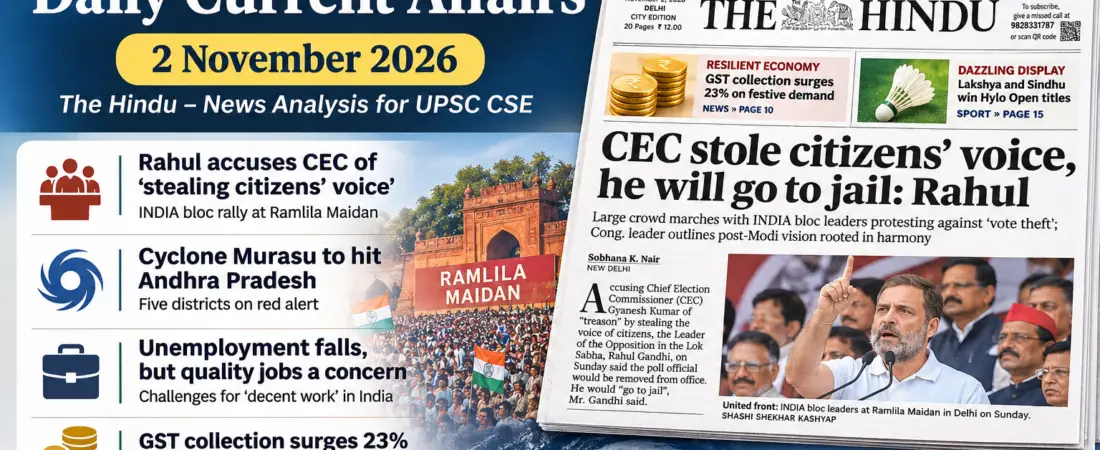
The INDIA bloc organised a large public rally at Ramlila Maidan, New Delhi, on November 1, protesting against alleged electoral irregularities and the functioning of the Election Commission of India.
Congress leader Rahul Gandhi accused Chief Election Commissioner Gyanesh Kumar of facilitating what the Opposition described as vote theft through manipulation of electoral rolls.
Other Opposition leaders, including Akhilesh Yadav, Mamata Banerjee and Tejashwi Yadav, also criticised the Special Intensive Revision (SIR) exercise.
The Opposition alleged that additions and deletions in electoral rolls had affected the voting rights of eligible citizens.
These statements represent political allegations and should be distinguished from independently established findings.
What is Special Intensive Revision?
The Special Intensive Revision is an exercise undertaken by the Election Commission to comprehensively verify electoral rolls.
Its principal objectives include:
- Identifying eligible voters who are missing from electoral rolls.
- Removing duplicate entries.
- Removing the names of deceased voters.
- Identifying voters who have permanently shifted residence.
- Improving the accuracy and reliability of electoral rolls.
Constitutional framework
| Constitutional provision | Significance |
|---|---|
| Article 324 | Vests the superintendence, direction and control of elections in the Election Commission. |
| Article 325 | Provides for one general electoral roll and prohibits exclusion on specified discriminatory grounds. |
| Article 326 | Provides for elections based on adult suffrage. |
| Article 327 | Empowers Parliament to make laws relating to elections. |
| Article 329 | Restricts judicial interference in electoral matters, subject to constitutional provisions. |
The Representation of the People Act, 1950, provides the statutory framework for electoral rolls.
The Representation of the People Act, 1951, deals with the conduct of elections and related matters.
Major concerns associated with electoral-roll revision
1. Risk of wrongful exclusion
Inaccurate documentation, migration and administrative errors can result in eligible citizens being excluded.
2. Transparency
The methodology used for additions, deletions and corrections must be transparent and open to scrutiny.
3. Institutional independence
The Election Commission must function independently and maintain public confidence across political parties.
4. Digital governance and accountability
Digitisation can improve electoral administration, but inadequate data management and technical errors can undermine the reliability of electoral rolls.
Way forward
- Ensure transparent procedures for electoral-roll revision.
- Provide adequate opportunities for citizens to verify their entries.
- Strengthen accessible grievance-redressal mechanisms.
- Introduce independent audits of electoral databases.
- Ensure accountability for wrongful deletion and manipulation.
- Strengthen institutional trust through regular public disclosure of revision-related data.
UPSC perspective: Electoral integrity involves more than the conduct of polling. It includes the accuracy of electoral rolls, universal adult franchise, institutional independence and public confidence in democratic institutions.
1.2 Errors in Bengaluru’s Final Electoral Rolls After SIR
GS Paper II – Electoral Governance and Digital Administration
Why is this in the news?
An investigation published in The Hindu identified significant discrepancies in Bengaluru’s final electoral rolls following the Special Intensive Revision.
The newspaper found errors in at least 1,000 entries.
Some electoral-roll entries reportedly contained:
- Names replaced by symbols or meaningless characters.
- Incorrectly recorded names of voters’ relatives.
- Blank entries in the relatives’ name column.
- Entries containing terms such as “NA”, “None” or single letters.
- Incorrect transliteration between English and Kannada.
In certain polling parts of Dasarahalli Assembly constituency, consecutive electoral entries contained garbled names.
Some officials attributed the errors to problems in transliteration and the use of special font codes for Kannada characters.
Why is this significant?
The issue illustrates how technological and administrative errors can directly affect democratic participation.
Electoral databases must be accurate not only in terms of the number of registered voters but also in the correctness of individual records.
Broader implications
1. Digital governance: Digitisation must be accompanied by data validation and quality control.
2. Electoral inclusion: Errors in voter identification can create difficulties during electoral verification.
3. Accountability: Responsibility must be fixed for errors occurring during data entry, conversion and publication.
4. Transparency: Citizens should have easy access to correction mechanisms.
Way forward
- Introduce automated validation of electoral-roll entries.
- Conduct sample-based manual verification.
- Improve regional-language data processing.
- Establish clear responsibility for data quality.
- Provide accessible correction facilities for affected voters.
Mains takeaway: Digital governance must be evaluated not merely by the speed of service delivery but also by the accuracy, inclusiveness and accountability of digital systems.
1.3 Anti-Defection Law: Controversy Over Independent MLCs in Bihar
GS Paper II – Parliament and State Legislatures, Constitutional Provisions
Why is this in the news?
The Opposition in Bihar demanded the disqualification of two recently elected Independent Members of the Legislative Council, Bansidhar Brajwasi and Rahul Raj, after the BJP issued a statement welcoming them to the party.
However, one of the legislators subsequently clarified that he had only extended support to the BJP and had not formally joined it.
The controversy has raised questions about the applicability of the Tenth Schedule of the Constitution to elected Independent legislators.
Understanding the Tenth Schedule
The Tenth Schedule was inserted into the Constitution through the 52nd Constitutional Amendment Act, 1985.
It provides for the disqualification of legislators on grounds of defection.
Grounds of disqualification
A member of a legislature may be disqualified if:
- A member belonging to a political party voluntarily gives up membership of that party.
- A member votes or abstains from voting contrary to the direction issued by the political party, without obtaining permission and without condonation within the prescribed period.
- An elected Independent member joins a political party after the election.
- A nominated member joins a political party after the expiry of six months from the date on which they take their seat.
Important distinction
An elected Independent member is not permitted to join a political party after election without attracting disqualification under the Tenth Schedule.
However, the legal assessment must distinguish between formal joining of a political party and the provision of external support.
The precise facts and evidence are therefore important in determining whether disqualification is attracted.
Role of the Presiding Officer
Under the Tenth Schedule, the question of disqualification is decided by the Speaker or Chairman of the concerned House.
In Kihoto Hollohan v. Zachillhu (1992), the Supreme Court upheld the constitutional validity of the Anti-Defection Law while recognising judicial review of decisions taken by the Presiding Officer.
Challenges
- Political instability.
- Delays in deciding disqualification petitions.
- Allegations of partisan conduct by Presiding Officers.
- Conflicts between political loyalty and legislative independence.
Way forward: Establish time-bound adjudication, strengthen the neutrality of the decision-making process and improve transparency in proceedings.
2. DISASTER MANAGEMENT AND GEOGRAPHY
2.1 Cyclone Murasu: Andhra Pradesh Braces for Another Cyclone
GS Paper III – Disaster Management | GS Paper I – Indian Geography
Why is this in the news?
Barely a week after being affected by Cyclone Arnab, Andhra Pradesh was preparing for another cyclonic storm, Cyclone Murasu, over the Bay of Bengal.
According to the India Meteorological Department, the storm was expected to intensify and move west-northwestwards before crossing the Andhra Pradesh coast.
The newspaper reported that the system was located approximately 350 km east of Chennai on Sunday night.
It was expected to cross between Nellore and Narsapur, with wind speeds potentially reaching 120 km per hour.
Five districts in Andhra Pradesh were placed under red alert for November 2:
- SPSR Nellore
- Prakasam
- Guntur
- Bapatla
- Krishna
Officials also identified 20 mandals that could experience extremely heavy rainfall.
Expected regional impact
Andhra Pradesh: Coastal districts were expected to experience strong winds, heavy rainfall and possible flooding.
Tamil Nadu: Heavy to very heavy rainfall was forecast at isolated places, including Chennai and Tiruvallur districts.
Odisha: Authorities identified 150 landslide-prone locations in Gajapati district in preparation for the storm.
Understanding tropical cyclones
Tropical cyclones are intense low-pressure systems that develop over warm tropical oceans.
They are characterised by:
- A central low-pressure region.
- Strong rotating winds.
- Heavy rainfall.
- Storm surges in coastal areas.
- Potential coastal flooding and infrastructure damage.
Conditions favourable for cyclone formation
- Sea surface temperatures generally around 26.5°C or higher.
- Sufficient atmospheric moisture.
- Low vertical wind shear.
- A pre-existing low-pressure disturbance.
- Adequate Coriolis force, which is weak near the Equator.
Why is the Bay of Bengal vulnerable?
The Bay of Bengal experiences frequent tropical cyclones due to a combination of:
- Warm ocean waters.
- High moisture availability.
- Seasonal atmospheric circulation.
- Coastal geography.
- The funnel-shaped northern Bay, which can intensify storm-surge impacts in certain locations.
Disaster-management priorities
1. Early warning systems
Accurate forecasting and timely dissemination of warnings are essential.
2. Evacuation
Vulnerable coastal populations must be moved to safe shelters before the arrival of the cyclone.
3. Critical infrastructure
Hospitals, electricity networks, telecommunications and transport facilities must be protected.
4. Community preparedness
Local communities should be trained in evacuation procedures and emergency response.
5. Inter-State coordination
Cyclones affect multiple States, making coordination between Andhra Pradesh, Tamil Nadu and Odisha important.
Institutional framework
- India Meteorological Department.
- National Disaster Management Authority.
- National Disaster Response Force.
- State Disaster Management Authorities.
- State Disaster Response Forces.
Way forward
India must strengthen its transition from relief-centred disaster management to risk-informed resilience.
Priority should be given to cyclone shelters, resilient coastal infrastructure, mangrove conservation, early-warning dissemination and community-based disaster preparedness.
UPSC takeaway: Cyclone Murasu highlights the importance of multi-State coordination and preparedness, especially when coastal regions are exposed to successive extreme-weather events.
2.2 Delhi’s Winter Air Pollution Measures: Early Implementation Challenges
GS Paper III – Environmental Pollution and Urban Governance
Why is this in the news?
The Delhi government’s restrictions on the entry of non-BS-VI vehicles registered outside the city came into effect on November 1.
The newspaper reported that on the first day:
- 7,279 vehicles were checked.
- 714 non-destined vehicles were turned away.
- 38 end-of-life vehicles were impounded.
- 10 challans were issued for non-compliance.
The restrictions are scheduled to continue until January 31.
Only specified compliant vehicles, including BS-VI vehicles with valid PUC certificates, CNG vehicles and electric vehicles, are permitted under the notified restrictions.
Significance
The enforcement highlights the difficulty of controlling vehicular emissions in a metropolitan region with substantial inter-State traffic.
It also illustrates the importance of regional coordination in air-pollution management.
Challenges
- Traffic congestion at border checkpoints.
- Livelihood implications for transport workers.
- Enforcement difficulties.
- Inter-State coordination.
- Dependence on private vehicles.
- Need for affordable and reliable public transport.
Way forward
- Strengthen public transport connectivity across NCR.
- Expand electric public and commercial transport.
- Improve vehicle-emission monitoring.
- Coordinate pollution-control measures across neighbouring States.
- Combine short-term restrictions with long-term structural interventions.
3. INDIAN ECONOMY
3.1 GST Collections Rise 23% to ₹2.31 Lakh Crore
GS Paper III – Indian Economy, Taxation and Public Finance
Why is this in the news?
India’s gross Goods and Services Tax collection increased by approximately 23% year-on-year to over ₹2.31 lakh crore in October 2026.
The increase was attributed primarily to higher festive-season demand and increased economic activity.
October marked the second consecutive month in which monthly gross GST collections crossed ₹2 lakh crore.
Key figures
| Indicator | October 2026 |
|---|---|
| Gross GST collection | Over ₹2.31 lakh crore |
| Year-on-year growth | Approximately 23% |
| Domestic sales revenue | Over ₹1.59 lakh crore |
| Revenue from imports | ₹72,246 crore |
| Central GST | ₹42,935 crore |
| State GST | ₹51,340 crore |
| Integrated GST | Over ₹1.37 lakh crore |
| GST refunds | ₹27,934 crore |
| Net GST collection | Over ₹2.03 lakh crore |
The gross collection was the second-highest monthly collection, after approximately ₹2.43 lakh crore in April.
For April–October 2026:
- Gross GST collections increased 13.2% to over ₹14.77 lakh crore.
- Net collections increased 13% to over ₹12.69 lakh crore.
Why are GST collections important?
GST collections are an important indicator of economic activity, consumption, tax compliance and revenue mobilisation.
Higher collections can reflect:
- Increased consumer spending.
- Greater movement of goods and services.
- Expansion of the formal economy.
- Improved tax compliance.
- Better tax administration.
- Increased import-related tax revenue.
Understanding the GST structure
The Goods and Services Tax is a destination-based indirect tax introduced in India on July 1, 2017.
It replaced multiple indirect taxes imposed by the Union and State governments.
| Component | Meaning |
|---|---|
| CGST | Central Goods and Services Tax |
| SGST | State Goods and Services Tax |
| IGST | Integrated Goods and Services Tax |
| UTGST | Union Territory Goods and Services Tax |
For intra-State supplies, CGST and SGST are generally levied together.
For inter-State supplies and imports, IGST applies.
Significance of GST 2.0
The newspaper highlights the need to ensure that the benefits of GST reforms translate into:
- Improved tax compliance.
- Smoother input tax credit flows.
- Faster refunds.
- Greater predictability for businesses.
- Sustained domestic revenue growth.
Challenges
- Inverted duty structures.
- Delays in refunds.
- Compliance costs for smaller businesses.
- Classification disputes.
- Tax evasion and fake invoicing.
- Uneven tax buoyancy across sectors.
Way forward
The next stage of GST reform should focus on simplifying compliance, improving tax administration, reducing litigation and ensuring that businesses receive timely input tax credits and refunds.
UPSC takeaway: GST collections should be interpreted alongside consumption, imports, refunds, inflation and the broader economic cycle. Gross collections alone do not provide a complete picture of economic performance.
3.2 Employment in India: Unemployment Declines but Decent Work Remains Scarce
GS Paper III – Employment, Inclusive Growth and Human Development
Why is this in the news?
An important editorial and analytical article in The Hindu examines the quality of employment in India.
According to the article, India’s unemployment rate declined from 6.1% in 2017–18 to 3.2% in 2023–24.
Female workforce participation also increased.
However, the central argument is that an increase in employment does not necessarily translate into an improvement in the quality of work.
The article argues that India must move beyond measuring employment only through the number of jobs created.
What is decent work?
Decent work refers to employment that provides:
- Fair income.
- Workplace safety.
- Social security.
- Equal opportunities.
- Labour rights.
- Job security.
- Dignity and freedom from discrimination.
The International Labour Organization places decent work at the centre of inclusive and sustainable development.
Major concerns highlighted
1. High informality
Nearly 90% of India’s workforce remains informally employed, according to the India Employment Report 2024 cited in the article.
Informal employment often involves inadequate social security, unstable income and weak labour protections.
2. Agricultural employment
Agriculture continues to employ the largest share of India’s workforce.
However, a large number of agricultural workers are self-employed or unpaid family workers without stable incomes and adequate labour protections.
3. Construction and retail
These sectors depend significantly on casual labour, subcontracting and insecure employment arrangements.
4. Gig and platform economy
Workers in app-based services and other platform activities often lack adequate access to social security, insurance and stable working conditions.
5. Gender and caste inequalities
The article highlights the worsening decent-work outcomes among women from Scheduled Tribes and Other Backward Classes during the period 2017–18 to 2023–24, even as outcomes for men improved.
6. Regional disparities
States such as Goa, Kerala, Tamil Nadu and Haryana perform relatively better in decent-work creation, while Bihar, Jharkhand and Uttar Pradesh continue to lag behind.
Decent Work Index
The article discusses the Decent Work Index (DWI), which attempts to assess the quality of employment beyond the mere existence of a job.
It reports that the agricultural sector’s DWI marginally increased from 0.211 to 0.267 during the study period.
Despite the improvement, the article points out that many agricultural workers continue to lack stable income and labour protection.
Why is poor-quality employment a problem?
Economic consequences
- Low and unstable household consumption.
- Inadequate savings.
- Reduced productivity.
- Weak social-security coverage.
- Increased vulnerability to economic shocks.
- Greater income inequality.
Social consequences
- Persistent poverty.
- Gender inequality.
- Caste-based labour-market disadvantages.
- Intergenerational transmission of deprivation.
- Limited social mobility.
Way forward
1. Universal social protection
Social-security systems must cover gig workers, platform workers, self-employed persons, farmers and informal workers.
2. Strengthening e-Shram
Registration should translate into actual access to social-security benefits rather than merely creating a worker database.
3. Formalisation with worker protection
Formalisation should include written employment contracts, paid leave, insurance and social-security contributions.
4. Gender-responsive employment policy
Childcare facilities, safe transport, skill development and protection against workplace discrimination are essential.
5. Skill development
Education and vocational training should be linked to productive and secure employment opportunities.
6. Effective implementation of Labour Codes
The four Labour Codes must be implemented in a manner that balances ease of doing business with the protection of workers’ rights.
Conclusion
India’s employment policy must shift from a job-counting approach to a job-quality approach.
The creation of employment is important, but the real measure of development is whether employment provides dignity, security and a stable livelihood.
UPSC takeaway: The distinction between employment quantity and employment quality is central to understanding inclusive growth and the objective of Viksit Bharat 2047.
3.3 Commercial LPG and Aviation Turbine Fuel Prices Increased
GS Paper III – Energy, Inflation and Petroleum Economics
Why is this in the news?
Oil-marketing companies increased the price of commercial LPG cylinders by approximately ₹10 per cylinder on November 1.
The price of the 5-kg free-trade LPG refill, primarily used by migrant workers, increased by nearly ₹2.50.
However, domestic LPG prices remained unchanged.
The price of aviation turbine fuel for domestic carriers increased by ₹1.37 per litre to ₹138.50.
City-wise commercial LPG prices
| City | 19-kg commercial cylinder price |
|---|---|
| Delhi | ₹2,820 |
| Mumbai | ₹2,775 |
| Kolkata | ₹2,971 |
| Chennai | ₹2,994.50 |
The newspaper reports that the latest revision represents the third consecutive increase since July and August.
Economic implications
1. Restaurant and hospitality sector
Commercial LPG is an important input for hotels, restaurants and food-service businesses.
Higher fuel costs can increase operating expenses.
2. Food inflation
Businesses may pass on higher input costs to consumers, potentially contributing to food-service inflation.
3. Migrant workers
Price increases in 5-kg LPG refills can affect low-income migrant households.
4. Aviation sector
Higher ATF prices increase operating costs for airlines and may influence airfares.
Policy considerations
India remains dependent on imported petroleum products and international energy markets.
Reducing import dependence through energy diversification, renewable energy and efficiency improvements remains an important long-term priority.
3.4 Foreign Portfolio Investors Withdraw ₹34,843 Crore in October
GS Paper III – Capital Markets and External Sector
Why is this in the news?
Foreign Portfolio Investors withdrew ₹34,843 crore from Indian equities in October 2026.
This marked the second consecutive month of significant outflows.
The newspaper identifies the following factors:
- Higher crude oil prices.
- Global interest-rate concerns.
- Uncertainty surrounding corporate earnings.
- Changing international investment preferences.
However, foreign investors became net buyers towards the end of October, investing approximately ₹6,300 crore between October 26 and 30.
Understanding FPI
Foreign Portfolio Investment refers to investment by foreign investors in financial assets such as:
- Shares.
- Bonds.
- Government securities.
- Other marketable financial instruments.
Unlike Foreign Direct Investment, FPI generally does not involve a controlling interest in an enterprise.
Economic implications of FPI outflows
- Pressure on domestic equity markets.
- Potential depreciation pressure on the rupee.
- Changes in liquidity conditions.
- Increased market volatility.
- Possible effects on investor confidence.
Way forward
India needs to strengthen macroeconomic stability, improve corporate earnings prospects, deepen domestic institutional investment and maintain predictable policy conditions.
4. INTERNAL SECURITY AND DEFENCE
4.1 Indian Navy’s ₹80,000-Crore Next-Generation Destroyer Programme
GS Paper III – Defence Modernisation and Maritime Security
Why is this in the news?
The government has given a major push to the Indian Navy’s next-generation destroyer programme under Project 18A.
The proposed programme is estimated to cost approximately ₹80,000 crore.
The Defence Acquisition Council, chaired by Defence Minister Rajnath Singh, has accorded in-principle approval to the futuristic warships.
Major features
- Development of next-generation stealth-guided missile destroyers.
- Advanced weapons and surveillance sensors.
- Improved air-defence capabilities.
- Enhanced anti-submarine warfare systems.
- Greater multi-domain combat capability.
- Approximately 75% indigenous content.
Both defence public sector undertakings and private-sector companies are expected to be eligible for competitive bidding.
Delivery of the warships is expected to begin five to ten years after the contract is signed.
Strategic significance
1. Indian Ocean Region
China’s growing naval presence and submarine capabilities in the Indian Ocean Region have increased India’s maritime-security requirements.
2. Maritime deterrence
Advanced destroyers strengthen India’s ability to maintain a credible naval presence.
3. Fleet replacement
Several existing destroyers are expected to be decommissioned in the coming years.
4. Indigenous defence manufacturing
The programme creates opportunities for domestic defence manufacturers and technology developers.
5. Defence industrial ecosystem
Private-sector participation can support innovation, competition and specialised component manufacturing.
Existing guided-missile destroyers
The Indian Navy operates destroyers belonging to classes including:
- Visakhapatnam class.
- Kolkata class.
- Delhi class.
These vessels perform multiple roles, including air defence, anti-surface warfare and anti-submarine operations.
Challenges
- High capital expenditure.
- Long development and procurement timelines.
- Dependence on specialised components.
- Need for advanced sensors and weapons integration.
- Technological challenges in stealth and underwater warfare.
Way forward
India must strengthen indigenous propulsion systems, sensors, electronic warfare, weapons integration and specialised component manufacturing.
A strong domestic defence industrial base is essential for long-term maritime security.
UPSC takeaway: Project 18A illustrates the connection between defence indigenisation, maritime deterrence, strategic autonomy and India’s expanding role in the Indian Ocean Region.
4.2 New Air Chief Outlines VAYU Framework for the Indian Air Force
GS Paper III – Defence and National Security
Why is this in the news?
Newly appointed Air Chief Marshal Ashutosh Dixit outlined the priorities of the Indian Air Force under the acronym VAYU.
He assumed charge as the 29th Chief of the Air Staff, succeeding Air Chief Marshal A.P. Singh.
Understanding VAYU
| Letter | Meaning | Focus |
|---|---|---|
| V | Vigilance and readiness | Operational preparedness |
| A | Aatmanirbharta | Indigenous platforms, weapons and systems |
| Y | Yukti | Strategy, innovation and technological ingenuity |
| U | Unity of effort | Joint planning and operations |
Major priorities
1. Restoring combat strength
The IAF intends to restore its combat strength to the sanctioned level.
2. Indigenous aircraft
Priorities include Tejas Mk1A, Tejas Mk2 and the Advanced Medium Combat Aircraft programme.
3. AI-enabled warfare
The framework highlights networked and AI-enabled command-and-control systems.
4. Counter-drone capabilities
Layered counter-drone defence is an important emerging requirement.
5. Jointness
The Air Chief stressed coordination with the Army, Navy and national agencies.
Emerging character of warfare
Modern warfare increasingly involves:
- Unmanned aerial systems.
- Long-range precision weapons.
- Space-based capabilities.
- Cyber operations.
- Artificial intelligence.
- Electromagnetic-spectrum operations.
Significance
The VAYU framework reflects the need to modernise the Indian Air Force through technological innovation, operational preparedness and indigenous defence capabilities.
5. SCIENCE AND TECHNOLOGY
5.1 ISRO’s Slow Recovery and the Challenges Facing NavIC
GS Paper III – Space Technology and Strategic Autonomy
Why is this in the news?
The editorial titled Slow Recovery examines the challenges facing the Indian Space Research Organisation following recent launch failures.
The successful launch of the GSLV-F18 mission carrying the NVS-03 satellite has provided some relief to ISRO.
However, the editorial argues that the organisation requires stronger institutional, financial and technological support to fulfil its expanding mandate.
Background
ISRO faced the consequences of two launch failures involving PSLV rockets over the preceding 18 months.
The GSLV-F18 mission was described as only the second successful launch of 2026.
The NVS-03 satellite is part of India’s second-generation Navigation with Indian Constellation (NavIC) programme.
What is NavIC?
NavIC was originally known as the Indian Regional Navigation Satellite System (IRNSS).
It is India’s indigenous satellite-navigation system.
It provides positioning, navigation and timing services over India and the surrounding region.
Importance of NVS-03
The editorial points out that NavIC had been operating with at least one fewer functional satellite than required for its primary standalone positioning services.
The successful launch of NVS-03 offers an opportunity to strengthen the constellation.
However, successful launch alone is not sufficient; the satellite must be manoeuvred into its intended orbit and commissioned.
Indigenous atomic clocks
The second-generation NVS satellites carry at least one indigenously developed atomic clock.
This represents an important technological improvement over the first-generation IRNSS satellites, which used imported clocks.
Atomic clocks are essential for satellite navigation because positioning calculations depend on extremely precise time measurements.
Major challenges identified by the editorial
1. Launch reliability
Repeated launch failures can affect India’s space programme and delay critical missions.
2. Procurement bottlenecks
ISRO faces difficulties in obtaining specialised components and ensuring vendor readiness.
3. Indigenous manufacturing
The development of domestic electronic components and reliable atomic clocks is essential.
4. Human resources
The editorial identifies inadequate workforce strength as a major institutional constraint.
5. Financial resources
It argues for increased allocation to the Department of Space.
The editorial suggests that the allocation should rise to approximately ₹17,000 crore in the 2027–28 Union Budget, compared with ₹13,705.6 crore in 2026–27.
6. Institutional framework
The editorial argues that NavIC requires a dedicated operator so that ISRO can focus on its core mandate.
It also highlights the need for a national space law addressing private participation and liability.
Way forward
- Strengthen indigenous component manufacturing.
- Improve the reliability of launch vehicles.
- Develop specialised suppliers.
- Increase investment in research and development.
- Strengthen recruitment and technical capacity.
- Establish a dedicated operational framework for NavIC.
- Develop a comprehensive national space-law framework.
- Support the country’s long-term ambitions in human spaceflight, space stations and reusable launch vehicles.
UPSC takeaway: The development of a successful space programme requires more than scientific expertise. It also depends on reliable supply chains, institutional capacity, financial resources and long-term policy support.
6. GEOGRAPHY AND ENVIRONMENT
6.1 El Niño and the Indian Monsoon: Why Did 1997 Differ from 2015?
GS Paper I – Physical Geography | GS Paper III – Climate Change and Agriculture
Why is this in the news?
The science page of The Hindu examines an important climatological question:
Why did India receive nearly normal monsoon rainfall during the strong El Niño of 1997, while the strong El Niño of 2015 was associated with a significant rainfall deficit?
The article also examines the influence of the Indian Ocean Dipole (IOD).
Understanding El Niño
El Niño is the warm phase of the El Niño–Southern Oscillation (ENSO).
It involves the abnormal warming of surface waters in the central and eastern equatorial Pacific Ocean.
Under normal conditions, trade winds blow from east to west across the equatorial Pacific.
These winds push warm surface waters towards Indonesia and the western Pacific.
During El Niño, these trade winds weaken, allowing warm water to move eastwards.
This alters atmospheric circulation and rainfall patterns across the tropics.
How does El Niño affect the Indian monsoon?
El Niño can weaken the Indian summer monsoon.
The associated changes in atmospheric circulation can create warmer and drier conditions over parts of India, reducing the formation of rain-bearing clouds.
However, El Niño does not automatically produce drought in India.
The relationship is influenced by several other oceanic and atmospheric factors.
Indian Ocean Dipole (IOD)
The Indian Ocean Dipole is an ocean-atmosphere phenomenon involving differences in sea-surface temperatures between the western and eastern equatorial Indian Ocean.
It has three phases:
| Phase | Characteristics |
|---|---|
| Positive IOD | Western Indian Ocean is warmer and eastern Indian Ocean is cooler than normal. |
| Negative IOD | Eastern Indian Ocean is warmer and western Indian Ocean is cooler than normal. |
| Neutral IOD | No significant temperature difference between the two regions. |
Why was 1997 different from 2015?
According to the article:
- The 1997 El Niño was strong, with equatorial Pacific sea-surface temperatures approximately 1.64°C above normal.
- In 2015, the corresponding anomaly was approximately 1.59°C.
- In 2026, it was approximately 1.98°C.
Despite the strong El Niño, India received nearly normal monsoon rainfall in 1997.
The article attributes this partly to a favourable positive Indian Ocean Dipole, which helped offset the adverse influence of El Niño.
In 2015, the IOD did not shift sufficiently in India’s favour.
Role of the Madden-Julian Oscillation
The article also discusses the Madden-Julian Oscillation (MJO).
The MJO is an eastward-moving pattern of clouds, rainfall and atmospheric circulation across the tropics.
It generally moves around the tropics over a period of approximately 30–60 days.
Its location and movement can influence the timing and distribution of monsoon rainfall.
Implications for India
1. Agriculture
Monsoon variability affects crop production, irrigation requirements and rural incomes.
2. Water security
Deficient rainfall can affect reservoirs, groundwater recharge and drinking-water availability.
3. Food inflation
Agricultural production shocks can influence food prices.
4. Disaster management
Forecasting seasonal rainfall variability helps governments prepare for droughts and floods.
Way forward
- Strengthen seasonal monsoon forecasting.
- Improve ocean-atmosphere observation systems.
- Expand climate-resilient agriculture.
- Improve irrigation efficiency.
- Strengthen crop insurance.
- Promote water conservation and watershed management.
UPSC takeaway: El Niño influences the Indian monsoon, but its impact is not uniform. The Indian Ocean Dipole, Madden-Julian Oscillation and regional atmospheric circulation also influence rainfall outcomes.
7. INTERNATIONAL RELATIONS
7.1 UN General Assembly Resolution on the U.S. Embargo Against Cuba
GS Paper II – International Institutions and India’s Foreign Policy
Why is this in the news?
The United Nations General Assembly adopted a resolution titled Necessity of ending the economic, commercial and financial embargo imposed by the United States of America against Cuba on October 30, 2026.
The newspaper reports a significant decline in international support for the resolution.
Voting pattern
| Voting position | Number of countries |
|---|---|
| In favour | 130 |
| Abstained | 25 |
| Against | 17 |
In the preceding decade, more than 180 countries had generally supported resolutions calling for an end to the embargo.
The support declined to 165 in 2025 and fell further in 2026.
Background
The United States has maintained economic restrictions against Cuba for several decades.
The embargo has affected Cuba’s access to international trade, finance and economic resources.
The annual UNGA resolution reflects the international debate over unilateral economic sanctions and their humanitarian consequences.
India’s position
India supported the resolution and called for dialogue and diplomacy.
The newspaper notes that India’s position was consistent with the BRICS New Delhi Declaration, which had expressed concern about tightening unilateral blockade measures against Cuba and their humanitarian impact.
Significance for India
1. Strategic autonomy
India’s position reflects its independent approach to international issues.
2. Global South
India has traditionally supported the interests of developing countries and advocated reform of the international economic order.
3. Multilateralism
The issue highlights the role of the United Nations in discussing international disputes and economic restrictions.
4. Unilateral sanctions
The debate raises questions about the impact of unilateral economic measures on smaller and developing economies.
Mains perspective
India must balance its strategic partnerships with major powers with its commitment to multilateralism, sovereign equality and the interests of the Global South.
7.2 U.S. Midterm Elections and the Question of Electoral Integrity
GS Paper II – Comparative Politics and Democratic Institutions
The newspaper’s editorial coverage examines the U.S. congressional elections scheduled for November 3, 2026.
The central issue is whether the election outcome will be accepted by all political stakeholders.
How does the U.S. electoral system differ from India’s?
| Feature | India | United States |
|---|---|---|
| Electoral administration | Election Commission of India | Decentralised State and local administration |
| Election machinery | EVMs and associated procedures | Different voting systems across States |
| Counting | Generally completed within a short period | May take several days or longer |
| Postal voting | Available under specified categories and procedures | Widely used, with State-specific rules |
| Election laws | Substantial national-level framework | Significant variation among States |
The U.S. Election Assistance Commission has responsibilities relating to voting-system standards, certification and election administration support.
However, the conduct of elections is largely decentralised across States and local jurisdictions.
Relevance to India
The comparison highlights the importance of:
- Independent electoral institutions.
- Transparent counting procedures.
- Public confidence in results.
- Effective grievance-redressal systems.
- Peaceful acceptance of electoral outcomes.
UPSC takeaway: Electoral legitimacy depends not only on the technical conduct of elections but also on public confidence in institutions and the acceptance of constitutional procedures.
8. IMPORTANT PRELIMS FACTS – QUICK REVISION
| Topic | Important fact |
|---|---|
| Article 324 | Election Commission’s constitutional authority |
| Article 325 | One general electoral roll |
| Article 326 | Adult suffrage |
| Tenth Schedule | Anti-Defection Law |
| 52nd Amendment | Introduced the Anti-Defection Law |
| Kihoto Hollohan case | Judicial review of decisions under the Tenth Schedule |
| Cyclone Murasu | Cyclonic storm over the Bay of Bengal |
| IMD | India Meteorological Department |
| NDMA | National Disaster Management Authority |
| GST | Destination-based indirect tax |
| CGST | Central Goods and Services Tax |
| SGST | State Goods and Services Tax |
| IGST | Integrated Goods and Services Tax |
| FPI | Foreign Portfolio Investment |
| Project 18A | Indian Navy’s next-generation destroyer programme |
| VAYU | IAF’s new strategic priorities |
| NavIC | Navigation with Indian Constellation |
| NVS-03 | Second-generation navigation satellite |
| GSLV-F18 | Launch vehicle mission associated with NVS-03 |
| El Niño | Warm phase of ENSO |
| IOD | Indian Ocean Dipole |
| MJO | Madden-Julian Oscillation |
| Positive IOD | Western Indian Ocean warmer than eastern Indian Ocean |
| ILO | International Labour Organization |
9. MAINS ANSWER WRITING PRACTICE
GS Paper II
Question 1. The credibility of democratic institutions depends on the accuracy and transparency of electoral processes. Discuss in the context of electoral-roll revision in India. (15 marks, 250 words)
Question 2. Examine the constitutional and institutional challenges associated with the implementation of the Anti-Defection Law in India. (15 marks, 250 words)
Question 3. Discuss India’s approach towards unilateral economic sanctions in the context of its commitment to multilateralism and the interests of the Global South. (10 marks, 150 words)
GS Paper III
Question 4. India must move beyond employment generation towards the creation of decent and secure employment. Analyse the challenges and suggest suitable policy measures. (15 marks, 250 words)
Question 5. Discuss the importance of indigenous defence manufacturing in strengthening India’s maritime security in the Indian Ocean Region. (15 marks, 250 words)
Question 6. Explain the relationship between El Niño, the Indian Ocean Dipole and the Indian summer monsoon. (10 marks, 150 words)
Question 7. India’s space programme requires stronger institutional and industrial support to achieve its long-term ambitions. Examine. (15 marks, 250 words)
GS Paper I
Question 8. Tropical cyclones in the Bay of Bengal pose recurring challenges to India’s coastal States. Examine the geographical factors responsible and suggest measures to minimise their impact. (15 marks, 250 words)
10. PRELIMS DAILY PRACTICE – MCQs
Q1. With reference to the Anti-Defection Law, consider the following statements:
- The Tenth Schedule was inserted into the Constitution by the 52nd Constitutional Amendment Act.
- An elected Independent legislator is liable to disqualification if they join a political party after the election.
- The decision on disqualification is taken by the Election Commission of India.
Which of the statements given above are correct?
(a) 1 and 2 only
(b) 2 and 3 only
(c) 1 and 3 only
(d) 1, 2 and 3
Q2. Consider the following statements regarding the Indian Ocean Dipole:
- It involves differences in sea-surface temperatures between the western and eastern equatorial Indian Ocean.
- A positive IOD is generally characterised by warmer waters in the western Indian Ocean.
- A positive IOD can sometimes offset the adverse effects of El Niño on the Indian monsoon.
Which of the statements given above are correct?
(a) 1 only
(b) 1 and 2 only
(c) 2 and 3 only
(d) 1, 2 and 3
Q3. With reference to GST in India, consider the following statements:
- GST is a destination-based tax.
- IGST is generally applicable to inter-State supplies.
- GST was introduced in India on July 1, 2017.
Which of the statements given above are correct?
(a) 1 only
(b) 1 and 2 only
(c) 2 and 3 only
(d) 1, 2 and 3
Q4. Consider the following statements regarding NavIC:
- It was originally known as IRNSS.
- It provides positioning, navigation and timing services.
- It is designed exclusively for military applications.
Which of the statements given above are correct?
(a) 1 and 2 only
(b) 2 and 3 only
(c) 1 and 3 only
(d) 1, 2 and 3
Q5. With reference to tropical cyclones, consider the following statements:
- Tropical cyclones generally require warm ocean waters for their development.
- High vertical wind shear is favourable for the intensification of tropical cyclones.
- The Coriolis force is very weak near the Equator.
Which of the statements given above are correct?
(a) 1 and 2 only
(b) 1 and 3 only
(c) 2 and 3 only
(d) 1, 2 and 3
Q6. Which of the following is associated with the Madden-Julian Oscillation?
(a) A periodic reversal of ocean currents in the North Atlantic.
(b) An eastward-moving pattern of tropical clouds, rainfall and atmospheric circulation.
(c) A permanent shift in the direction of trade winds.
(d) A sudden increase in stratospheric ozone concentration.
Q7. With reference to Foreign Portfolio Investment, consider the following statements:
- FPI generally involves investment in financial assets.
- FPI necessarily gives the investor managerial control over the enterprise.
- FPI flows can influence domestic equity markets and exchange rates.
Which of the statements given above are correct?
(a) 1 and 2 only
(b) 1 and 3 only
(c) 2 and 3 only
(d) 1, 2 and 3
Q8. Which of the following is correctly associated with Project 18A?
(a) Development of India’s next-generation guided-missile destroyers.
(b) Development of a new generation of nuclear-powered aircraft carriers.
(c) Expansion of India’s civilian satellite-navigation system.
(d) Development of indigenous fifth-generation submarines.
Q9. Consider the following statements regarding decent work:
- Decent work includes fair income and workplace safety.
- Social protection is an important component of decent work.
- The concept is associated with the International Labour Organization.
Which of the statements given above are correct?
(a) 1 only
(b) 1 and 2 only
(c) 2 and 3 only
(d) 1, 2 and 3
Q10. With reference to the IAF’s VAYU framework, consider the following pairs:
- V – Vigilance and readiness
- A – Aatmanirbharta
- Y – Yukti
- U – Unity of effort
How many of the pairs given above are correctly matched?
(a) Only one
(b) Only two
(c) Only three
(d) All four
11. PRELIMS ANSWER KEY AND EXPLANATIONS
| Question | Answer | Explanation |
|---|---|---|
| 1 | (a) | The 52nd Amendment inserted the Tenth Schedule. Independent legislators joining a party after election can be disqualified. The decision is made by the Speaker or Chairman, not the ECI. |
| 2 | (d) | All three statements correctly describe the IOD and its potential influence on the Indian monsoon. |
| 3 | (d) | GST is destination-based, IGST generally applies to inter-State supplies and GST commenced on July 1, 2017. |
| 4 | (a) | NavIC was originally called IRNSS and provides navigation services for civilian and strategic applications. |
| 5 | (b) | Warm ocean water and Coriolis force are important for cyclone development. High vertical wind shear generally inhibits intensification. |
| 6 | (b) | MJO is an eastward-moving tropical atmospheric disturbance involving clouds, rainfall and circulation. |
| 7 | (b) | FPI involves financial-asset investment and can influence markets and exchange rates. It does not necessarily confer managerial control. |
| 8 | (a) | Project 18A concerns next-generation Indian Navy destroyers. |
| 9 | (d) | Fair income, workplace safety and social protection are all components of decent work. |
| 10 | (d) | All four pairs correctly describe the VAYU framework. |
12. CONCLUSION
The developments reported on 2 November 2026 highlight the multidimensional nature of India’s developmental and governance challenges.
The debate over electoral-roll revision and the errors identified in Bengaluru demonstrate the importance of accuracy, transparency and accountability in democratic administration.
The approaching Cyclone Murasu highlights the need for stronger disaster preparedness and resilient coastal infrastructure.
The rise in GST collections indicates the strength of tax mobilisation and festive-season economic activity, while the discussion on decent work reminds us that employment generation must be accompanied by income security, labour rights and social protection.
Similarly, the Navy’s proposed destroyer programme and the VAYU framework reflect India’s emphasis on defence modernisation and strategic autonomy.
The editorial on ISRO and the scientific analysis of El Niño and the Indian Ocean Dipole demonstrate the importance of institutional capacity and scientific understanding in addressing national challenges.
For UPSC aspirants, the key is to connect current developments with constitutional principles, economic concepts, geographical processes and long-term public-policy objectives.
Current affairs preparation must go beyond remembering events. It must develop the ability to understand causes, assess consequences and evaluate policy responses.
Source: The Hindu, Delhi Edition, 2 November 2026.
Prepared by: Samata IAS Academy
Target examination: UPSC Civil Services Examination – Prelims and Mains