
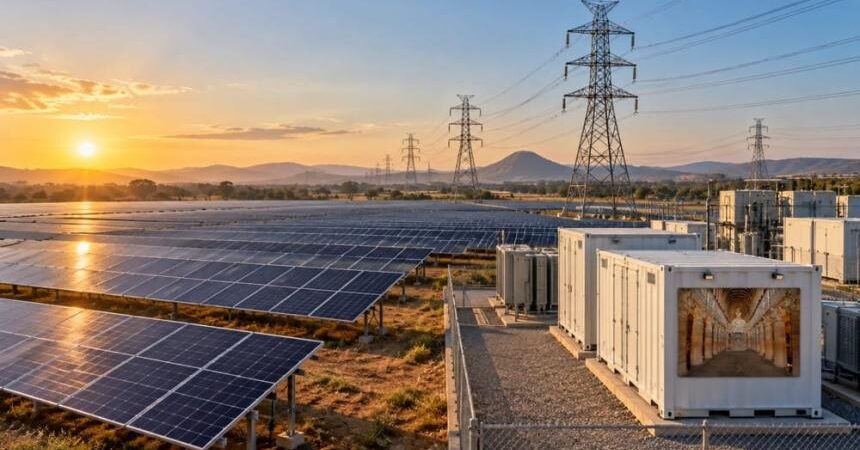
GS Paper III | CURRENT AFFAIRS ANALYSIS | 5 NOVEMBER 2026 | 15–18 MIN READ
1. Introduction
India’s energy transition is entering a new phase. For several years, the country’s renewable energy strategy has primarily focused on expanding solar and wind power generation capacity. However, increasing renewable energy capacity alone cannot guarantee a reliable electricity supply.
Solar power generation is concentrated during daylight hours, while electricity demand often remains high during the evening and night. Similarly, wind power generation fluctuates depending on weather conditions. This creates a fundamental challenge for electricity-grid management: how can electricity generated intermittently be made available whenever consumers need it?
Energy storage systems provide an important solution to this problem.
On 4 November 2026, the Union Cabinet approved a ₹14,500 crore Viability Gap Funding (VGF) Scheme to support the development of 92 GWh of grid-scale energy storage capacity during FY 2026–27 to FY 2030–31.
The scheme includes:
- 60 GWh of pumped storage projects.
- 30 GWh of Battery Energy Storage Systems (BESS).
- 2 GWh through emerging energy storage technologies.
The projects are expected to attract an estimated investment of ₹97,600 crore. The initiative is also intended to strengthen domestic battery manufacturing through a mandatory domestic content requirement of 40% for BESS projects. Press Information Bureau+1
This development highlights an important shift in India’s electricity policy: from merely expanding renewable energy generation to developing the infrastructure required to store, manage, transmit and distribute renewable electricity efficiently.
2. Why in News?
The Union Cabinet approved the Viability Gap Funding Scheme for Development of Grid-Scale Energy Storage Systems on 4 November 2026.
The scheme is designed to address the growing requirement for energy storage as India expands renewable energy capacity.
Key features of the scheme
| Particular | Details |
|---|---|
| Scheme | VGF Scheme for Development of Grid-Scale Energy Storage Systems |
| Approval | Union Cabinet, 4 November 2026 |
| Total financial support | ₹14,500 crore |
| Implementation period | FY 2026–27 to FY 2030–31 |
| Total storage capacity supported | 92 GWh |
| Pumped storage | 60 GWh |
| Battery energy storage | 30 GWh |
| Emerging technologies | 2 GWh |
| Estimated total investment | ₹97,600 crore |
| Domestic content requirement | Minimum 40% for BESS projects |
| Capacity allocation | Tariff-based competitive bidding |
The proposed capacity addition is equivalent to approximately 170% of India’s present grid-scale energy storage capacity. It is intended to contribute towards meeting the estimated requirement of 411 GWh by 2031–32. Press Information Bureau+2
The significance of this announcement extends beyond financial assistance. It represents an attempt to develop a complete ecosystem for renewable energy integration, grid flexibility and energy security.
3. Understanding Energy Storage Systems
3.1 What is an Energy Storage System?
An Energy Storage System (ESS) is a technology that stores energy produced at one point in time and makes it available for use at a later time.
In the electricity sector, an ESS generally stores electricity in another form of energy and converts it back into electricity when required.
For example:
- Solar power plants generate excess electricity during the afternoon.
- The surplus electricity is used to charge batteries or pump water to an elevated reservoir.
- The stored energy is retained for subsequent use.
- During evening peak demand, the stored energy is converted into electricity and supplied to the grid.
This process helps balance electricity generation and consumption.
ACME Solar Commissions Phase V Of Rajasthan BESS Project
3.2 Why is energy storage necessary?
Electricity grids must maintain a continuous balance between electricity generation and consumption.
Unlike many conventional commodities, electricity cannot be stored easily in large quantities within the ordinary transmission and distribution network itself.
When electricity demand exceeds available supply, grid frequency may decline. When generation exceeds demand, frequency may rise.
Such imbalances can affect grid stability and, in severe cases, result in disruptions.
Energy storage systems help address this challenge by:
- Absorbing surplus electricity.
- Supplying electricity during peak demand.
- Balancing fluctuations in renewable energy generation.
- Supporting grid frequency regulation.
- Reducing renewable energy curtailment.
- Improving the utilisation of existing transmission infrastructure.
3.3 The difference between GW and GWh
This distinction is particularly important for UPSC examinations.
| Unit | Meaning | What it measures |
|---|---|---|
| GW (Gigawatt) | Power | Rate at which electricity can be generated or discharged |
| GWh (Gigawatt-hour) | Energy | Quantity of electricity generated, stored or consumed over time |
For example, a battery system with a capacity of 1 GW/4 GWh can theoretically discharge at a power of 1 GW for four hours, assuming the full rated energy is usable and ignoring losses.
Therefore, the Cabinet’s announcement of 92 GWh refers to the energy storage capacity, not 92 GW of installed power capacity.
This distinction is important when interpreting government announcements concerning electricity infrastructure.
4. Major Types of Grid-Scale Energy Storage Technologies
Energy storage technologies can be classified into several categories depending on the physical or chemical process through which energy is stored.
4.1 Pumped Storage Hydropower (PSP)
Pumped Storage Hydropower is one of the most established large-scale electricity storage technologies.
It uses two water reservoirs situated at different elevations.
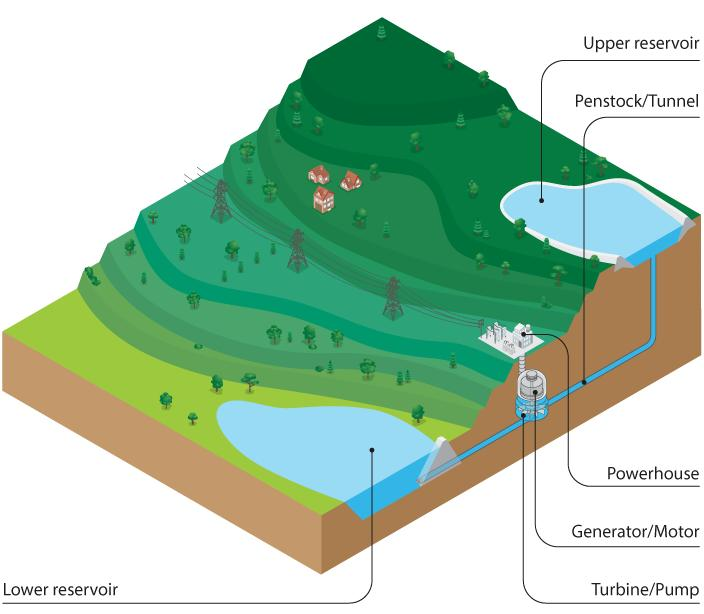
Pumped storage plants – hydropower plant plus energy storage | Voith
Working mechanism
Pumped storage generally operates through two cycles.
A. Charging mode
- During periods of surplus electricity, water is pumped from a lower reservoir to an upper reservoir.
- Electricity is converted into gravitational potential energy.
- The water is stored at a higher elevation.
B. Discharging mode
- When electricity demand increases, water is released from the upper reservoir.
- It flows through turbines towards the lower reservoir.
- The turbines drive generators and produce electricity.
Thus, PSP converts electrical energy into gravitational potential energy and subsequently converts it back into electricity.
Advantages
- Suitable for large-scale energy storage.
- Can provide long-duration storage.
- Supports grid balancing and peak-load management.
- Has a long operational life.
- Can provide ancillary grid services.
Limitations
- High initial capital expenditure.
- Requirement of suitable geographical locations.
- Land acquisition and rehabilitation challenges.
- Potential ecological impacts on rivers and surrounding ecosystems.
- Long construction and approval timelines.
India has substantial potential for pumped storage development, particularly in regions with suitable topographical conditions.
The new VGF scheme proposes 60 GWh of pumped storage capacity, making it the largest component of the announced programme.
4.2 Battery Energy Storage Systems (BESS)
Battery Energy Storage Systems store electricity through electrochemical processes.
When electricity is supplied to a battery, chemical reactions store energy. During discharge, these reactions are reversed to release electricity.
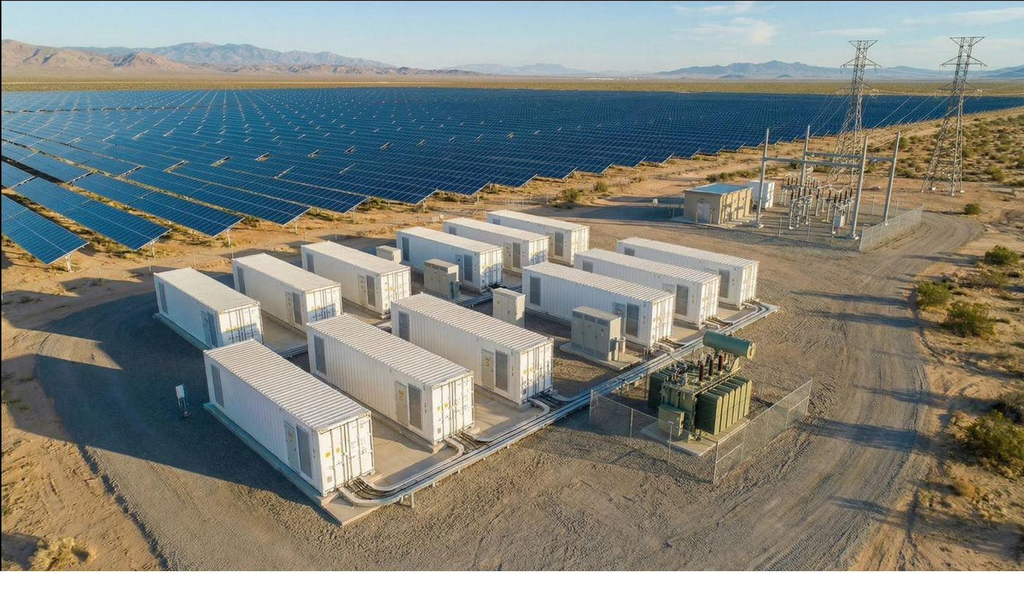
Finanțare Baterii Stocare 2026: Fondul de Modernizare
Major components of a BESS
- Battery cells.
- Battery modules and packs.
- Battery Management System (BMS).
- Power Conversion System (PCS).
- Thermal management system.
- Energy Management System (EMS).
- Safety and fire-protection systems.
Major battery technologies
| Technology | Characteristics | Applications |
|---|---|---|
| Lithium-ion batteries | High energy density and efficiency | Grid storage, EVs and consumer electronics |
| Sodium-ion batteries | Uses more widely available sodium resources | Stationary storage and emerging applications |
| Flow batteries | Energy stored in liquid electrolytes | Long-duration stationary storage |
| Lead-acid batteries | Mature and relatively inexpensive technology | Backup power and limited storage applications |
| Solid-state batteries | Use solid electrolytes | Emerging high-performance applications |
Advantages of BESS
- Rapid response to fluctuations in electricity demand.
- Modular and scalable installation.
- Suitable for decentralised as well as grid-scale applications.
- Can be installed near renewable energy generation facilities.
- Useful for frequency regulation and peak-load management.
Limitations
- High initial investment.
- Battery degradation over time.
- Dependence on critical minerals and specialised manufacturing.
- Fire and thermal runaway risks in certain battery chemistries.
- Recycling and end-of-life management challenges.
4.3 Emerging Energy Storage Technologies
Apart from pumped storage and conventional batteries, several emerging technologies are being explored.
| Technology | Working principle | Potential application |
|---|---|---|
| Green hydrogen | Electricity is used to produce hydrogen through electrolysis | Long-duration and seasonal energy storage |
| Compressed Air Energy Storage (CAES) | Electricity compresses air, which is stored and later used to generate electricity | Large-scale stationary storage |
| Flywheel storage | Energy is stored in a rotating mass | Short-duration grid balancing |
| Thermal energy storage | Energy is stored as heat or cold | Industrial processes, cooling and power generation |
| Gravity-based storage | Potential energy is stored by lifting heavy masses | Stationary electricity storage |
These technologies have different levels of technological maturity, commercial viability and geographical suitability.
The Cabinet’s allocation of 2 GWh to emerging technologies is significant because it can support technological diversification and innovation.
5. Why Does India Need Large-Scale Energy Storage?
India’s increasing dependence on renewable energy makes energy storage a critical component of electricity-sector planning.
5.1 Intermittency of renewable energy
Solar and wind energy are variable renewable energy sources.
Solar generation depends on sunlight and therefore declines after sunset. Wind generation depends on weather conditions and may fluctuate over relatively short periods.
This creates a mismatch between the timing of electricity generation and consumption.
For example:
Illustrative daily electricity generation pattern
Conceptual representation, not actual measured Indian grid data.
Illustrative relative generation profile across a 24-hour period.
Solar generationElectricity demand
0 index30 index60 index90 index120 index6 AM9 AM12 PM3 PM6 PM9 PM12 AM3 AM
Illustration: Solar output declines as evening electricity demand increases. Wind and other generation sources are not represented.
Energy storage can absorb surplus solar electricity during the afternoon and release it during evening peak demand.
5.2 Achieving round-the-clock renewable electricity
India’s energy transition requires moving beyond the concept of electricity generation capacity towards reliable electricity availability.
A solar power plant may have substantial installed capacity, but it cannot independently provide electricity throughout the night.
Combining solar and wind generation with energy storage, transmission infrastructure and other flexible generation sources can help provide more reliable electricity.
This is particularly important for industrial consumers, commercial establishments and essential public services.
5.3 Reducing renewable energy curtailment
Renewable energy curtailment refers to the reduction or restriction of electricity generation from available renewable energy sources because the grid cannot absorb or transmit all the electricity being produced.
It may occur due to:
- Transmission congestion.
- Excess generation relative to demand.
- Grid-balancing requirements.
- Technical limitations.
- Network constraints.
Energy storage can absorb surplus electricity that might otherwise be curtailed and make it available when demand rises.
5.4 Reducing pressure on transmission infrastructure
Electricity storage can improve the utilisation of existing transmission networks.
For instance, a battery installed near a renewable energy generation cluster can store surplus electricity during periods of low demand and discharge it during peak-demand periods.
This can reduce the need for immediate transmission capacity expansion in certain locations.
However, energy storage cannot replace transmission networks. Both are complementary components of electricity infrastructure.
5.5 Enhancing energy security
Large-scale storage can improve the resilience of India’s electricity system.
It can reduce dependence on imported fossil fuels for certain balancing requirements, improve renewable energy utilisation and support a more diversified electricity supply.
However, energy storage also creates new supply-chain dependencies, particularly in battery materials and advanced manufacturing.
Therefore, domestic manufacturing and recycling capabilities are important for long-term energy security.
6. India’s Energy Storage Requirements: What Do the Numbers Indicate?
The Central Electricity Authority’s National Electricity Plan (2022–32) identifies energy storage as a critical requirement for integrating large quantities of variable renewable energy into the national electricity grid.
According to the plan, India’s estimated energy storage requirement is approximately 411.4 GWh by 2031–32.
The projected requirement includes:
| Storage technology | Power capacity | Energy storage |
|---|---|---|
| Battery Energy Storage Systems | 47.24 GW | 236.22 GWh |
| Pumped Storage Projects | 26.69 GW | 175.18 GWh |
| Total | 73.93 GW | 411.40 GWh |
CDN BBSR+1
The new Cabinet-approved scheme supports 92 GWh of additional storage capacity.
This represents an important contribution towards the projected requirement, but it does not eliminate the need for further investment.
The challenge is to ensure that storage projects are commissioned on time and are commercially and technically integrated into the electricity grid.
7. Viability Gap Funding: Understanding the Financial Instrument
One of the most important aspects of the new initiative is the use of Viability Gap Funding (VGF).
7.1 What is VGF?
Viability Gap Funding is a financial assistance mechanism through which the government supports infrastructure projects that are economically or socially desirable but may not be financially viable on purely commercial terms.
Such projects may generate long-term public benefits but face difficulties attracting private investment because of:
- High initial capital costs.
- Long gestation periods.
- Uncertain revenue streams.
- Technological risks.
- Relatively low initial returns.
Under VGF, the government provides financial assistance to bridge the gap between the project’s cost and the revenue or returns expected by investors.
7.2 Why is VGF required for energy storage?
Energy storage projects involve significant upfront investment.
Their commercial viability depends on several revenue streams, including:
- Buying electricity when prices are low and selling it during peak periods.
- Providing ancillary services to the electricity grid.
- Supporting renewable energy developers.
- Deferring certain transmission investments.
- Providing capacity and reliability services.
However, the market mechanisms for compensating all these services may not be sufficiently developed.
Consequently, investors may be reluctant to undertake large-scale storage projects without financial support.
VGF can improve project viability and encourage private investment.
7.3 How does the new scheme operate?
The ₹14,500 crore financial support is intended to improve the financial viability of eligible energy storage projects.
Important features include:
- Financial support for new, yet-to-be-commissioned storage capacity.
- Participation of public and private sector entities.
- Tariff-based competitive bidding for capacity allocation.
- Support for battery storage, pumped storage and alternative technologies.
- A minimum 40% domestic content requirement for BESS projects.
The total estimated investment of ₹97,600 crore indicates the potential of public financial support to mobilise much larger infrastructure investment. Press Information Bureau+1
UPSC analytical perspective: VGF represents a form of targeted public intervention intended to address market failures and mobilise private capital for infrastructure development.
8. Domestic Manufacturing and Critical Mineral Security
The new scheme also has an important industrial-policy dimension.
India currently faces significant challenges in developing a competitive domestic battery manufacturing ecosystem.
Although the country has made progress in electric vehicle adoption, renewable energy deployment and battery manufacturing, several critical components and raw materials remain dependent on international supply chains.
8.1 Why are critical minerals important?
Modern battery technologies depend on several minerals and processed materials.
| Mineral/material | Significance |
|---|---|
| Lithium | Used in several rechargeable battery chemistries |
| Cobalt | Used in certain lithium-ion battery cathodes |
| Nickel | Used in high-energy-density battery chemistries |
| Graphite | Commonly used in battery anodes |
| Manganese | Used in several battery cathode chemistries |
| Copper | Essential for electrical connections and infrastructure |
| Rare earth elements | Important in certain electrical and energy technologies, though not a standard core component of lithium-ion batteries |
The availability of these minerals, together with processing and refining capacity, influences the competitiveness and security of battery supply chains.
8.2 Why does India need domestic battery manufacturing?
India’s dependence on imported battery cells, materials and specialised components creates several vulnerabilities:
- Exposure to international price fluctuations.
- Geopolitical supply-chain disruptions.
- Import dependence in strategic sectors.
- Limited domestic technological capabilities.
- Potential constraints on large-scale energy storage deployment.
The 40% Domestic Content Requirement under the new scheme is intended to strengthen indigenous manufacturing.
However, domestic content requirements must be accompanied by investment in research, technological innovation, quality standards and competitive production capabilities.
8.3 Government initiatives supporting battery manufacturing
Production Linked Incentive Scheme for Advanced Chemistry Cell Battery Storage
The government introduced a PLI scheme with an outlay of ₹18,100 crore to support the establishment of 50 GWh of Advanced Chemistry Cell manufacturing capacity.
The scheme aims to develop domestic battery manufacturing capabilities and reduce import dependence. 23.03.2026.docx+1
National Critical Mineral Mission
The National Critical Mineral Mission aims to strengthen India’s critical mineral value chain, including exploration, mining, processing, recycling and international cooperation.
It is important for reducing vulnerabilities in the supply chains of minerals essential for clean energy technologies.
Critical Mineral Processing Support
The Union Cabinet also approved a separate ₹2,814 crore Capex Support Scheme for Critical Mineral Processing on 4 November 2026. This complements India’s broader efforts to develop domestic processing capabilities. Press Information Bureau+1
8.4 Battery recycling and circular economy
Domestic manufacturing alone cannot guarantee long-term mineral security.
India must also develop a comprehensive battery recycling ecosystem.
Important interventions include:
- Recovery of lithium, nickel, cobalt and other valuable materials.
- Scientific collection and dismantling of used batteries.
- Extended Producer Responsibility.
- Development of recycling technologies.
- Safe management of battery waste.
- Creation of a secondary market for recovered materials.
Battery recycling can reduce pressure on primary mineral extraction while minimising environmental damage.
9. Existing Policy Framework for Energy Storage in India
The new VGF scheme should be understood as part of a broader policy framework.
India has already introduced several measures to promote energy storage and renewable energy integration.
| Initiative / framework | Major objective |
|---|---|
| National Framework for Promoting Energy Storage Systems | Establish a framework for developing and deploying storage technologies |
| National Electricity Plan 2022–32 | Identify future generation and energy storage requirements |
| PLI Scheme for Advanced Chemistry Cell Batteries | Promote domestic battery manufacturing |
| Green Energy Corridor | Strengthen transmission infrastructure for renewable energy |
| VGF support for BESS | Improve commercial viability of battery storage projects |
| Guidelines for Pumped Storage Projects | Facilitate the development of pumped hydro storage |
| Electricity (Amendment) and regulatory measures | Facilitate energy storage participation in electricity markets and grid services |
The Central Electricity Authority has an Energy Storage and System Division responsible for policy formulation, technical regulations, storage planning, VGF-related work and research coordination. Energy Storage & System+1
9.1 Green Energy Corridor
The Green Energy Corridor programme aims to strengthen transmission infrastructure to facilitate the evacuation of electricity generated from renewable energy sources.
This is particularly important because renewable energy generation is often concentrated in geographically favourable regions, while electricity demand is distributed across the country.
Transmission infrastructure and energy storage must therefore develop together.
9.2 Electricity market reforms
Energy storage systems can participate in electricity markets by supplying stored electricity and providing grid-support services.
Under the Central Electricity Regulatory Commission’s Ancillary Services Regulations, 2022, eligible energy storage systems can provide secondary and tertiary reserve ancillary services, subject to specified conditions. Press Information Bureau
This creates opportunities for storage operators to generate revenue beyond simply buying and selling electricity.
10. Challenges in Scaling Up Energy Storage in India
Despite its potential, the development of large-scale storage infrastructure faces several challenges.
10.1 High capital expenditure
Both battery storage and pumped storage projects require substantial initial investment.
Battery systems require cells, power conversion equipment, thermal management and safety infrastructure.
Pumped storage requires reservoirs, tunnels, turbines, generators and associated civil works.
Financing these projects at competitive tariffs remains a major challenge.
10.2 Dependence on imported battery technologies
India’s battery manufacturing ecosystem is still developing.
Dependence on imported cells, materials and specialised equipment can expose projects to international supply-chain disruptions.
Building domestic manufacturing capabilities requires sustained investment in technology, skills and research.
10.3 Environmental challenges associated with pumped storage
Pumped storage projects may involve significant land requirements and changes in local hydrological systems.
Potential environmental concerns include:
- Forest diversion.
- Biodiversity loss.
- Changes in local water availability.
- Displacement of communities.
- Impacts on aquatic ecosystems.
- Construction-related ecological disturbances.
Closed-loop pumped storage systems, which use two reservoirs that are not continuously connected to a natural river system, can reduce certain environmental impacts, although they do not eliminate all ecological concerns.
10.4 Battery safety and disposal
Lithium-ion batteries can experience thermal runaway under certain conditions, potentially resulting in fires.
Large battery installations therefore require robust fire detection, thermal management and emergency-response systems.
Additionally, improper disposal can create environmental and public-health risks.
10.5 Regulatory and market uncertainty
Energy storage projects require clear rules concerning:
- Ownership of storage assets.
- Charging and discharging tariffs.
- Grid access.
- Ancillary service payments.
- Transmission charges.
- Scheduling and dispatch.
- Commercial settlement mechanisms.
Regulatory uncertainty can discourage private investment.
10.6 Transmission infrastructure constraints
Energy storage cannot independently solve all the problems of renewable energy integration.
Electricity must still be transmitted from generation locations to demand centres.
Insufficient transmission capacity, congestion and delays in network expansion can restrict the effectiveness of storage investments.
10.7 Geographical limitations
Pumped storage depends on suitable topography and water availability.
Battery storage is geographically more flexible but requires a reliable supply of materials, suitable land, grid connectivity and appropriate safety infrastructure.
Therefore, a combination of technologies is necessary.
11. International Experiences: Lessons for India
Several countries have invested heavily in energy storage to support renewable energy integration.
China
China has expanded pumped hydro and battery storage alongside its rapid renewable energy expansion. Its experience demonstrates the importance of coordinated investment in generation, storage and transmission.
Hornsdale Power Reserve earns record revenue in September 2019
Australia
Large battery installations, including the Hornsdale Power Reserve, demonstrate how batteries can provide rapid grid-response services and support electricity system stability.
Voici la nouvelle plus grande batterie du monde alimentée à l’énergie solaire
United States
Utility-scale battery storage is increasingly being integrated with solar generation to improve peak-load management and electricity-grid flexibility.
Germany
Germany’s experience highlights the importance of combining renewable energy expansion with grid modernisation, storage and cross-border electricity connectivity.
The broader lesson is that renewable energy transitions require an integrated electricity system rather than isolated investments in generation technologies.
12. The Way Forward: Building an Integrated Energy Storage Ecosystem
India needs a comprehensive strategy that combines financial incentives, domestic manufacturing, technology development, regulatory reforms and environmental safeguards.
12.1 Diversify energy storage technologies
India should avoid excessive dependence on any single storage technology.
A diversified approach involving pumped storage, lithium-ion batteries, sodium-ion batteries, flow batteries, thermal storage and green hydrogen can improve the resilience of the energy system.
12.2 Strengthen domestic research and development
Greater investment is required in:
- Advanced battery chemistries.
- Battery management systems.
- Recycling technologies.
- Grid-scale storage optimisation.
- Long-duration storage.
- Indigenous power electronics.
- Thermal management and safety systems.
Collaboration between research institutions, universities and private industry should be encouraged.
12.3 Develop a predictable regulatory framework
Electricity regulators should establish transparent mechanisms for storage procurement, tariff determination, market participation and ancillary service payments.
Clear regulations can improve investor confidence.
12.4 Integrate storage with renewable energy planning
Solar parks, wind energy zones and renewable energy corridors should incorporate appropriate storage planning.
This will help reduce curtailment and improve the utilisation of renewable electricity.
12.5 Promote environmentally responsible pumped storage
Pumped storage projects should undergo rigorous environmental and social impact assessments.
Priority should be given to suitable sites, including technically feasible closed-loop systems, while protecting biodiversity, water resources and local livelihoods.
12.6 Strengthen recycling and circularity
Battery recycling should be integrated into the entire battery value chain.
This will improve material recovery, reduce waste and enhance long-term resource security.
12.7 Improve DISCOM financial health
Electricity distribution companies play a central role in procuring and distributing electricity.
Their financial weaknesses can affect payment security, project implementation and investment in storage infrastructure.
Therefore, energy storage reforms must be accompanied by improvements in distribution-sector efficiency.
12.8 Develop appropriate storage technologies for different durations
Short-duration battery storage, long-duration pumped hydro and emerging technologies such as green hydrogen should be deployed according to their technical and economic suitability.
A technology-neutral but performance-oriented approach can prevent inefficient allocation of public resources.
13. Conclusion
India’s renewable energy transition is moving from the generation-centric phase towards a more integrated electricity-system transformation.
Solar and wind capacity expansion is essential, but the long-term success of renewable energy depends on the ability to store surplus electricity, manage fluctuations in generation and ensure reliable power supply.
The ₹14,500 crore VGF scheme for 92 GWh of grid-scale energy storage represents an important step towards addressing this challenge.
However, the ultimate success of the initiative will depend on timely project execution, domestic technological capabilities, sustainable financing, effective regulation and environmentally responsible infrastructure development.
Energy storage should therefore be treated not merely as a supporting technology for renewable energy, but as a strategic pillar of India’s electricity infrastructure and long-term energy security.
For India to achieve its clean energy ambitions while ensuring affordable and reliable electricity, it must build an electricity system that is not only capable of generating renewable power but also capable of storing and delivering it when required.
14. UPSC Examination Perspective
GS Paper III – Science & Technology, Infrastructure and Environment
Important syllabus linkages:
- Infrastructure: Energy, Ports, Roads, Airports, Railways.
- Conservation, environmental pollution and degradation.
- Science and Technology: Developments and their applications.
- Indian Economy: Energy security and infrastructure financing.
- Investment models and public-private partnerships.
Prelims Facts to Remember
| Concept | Important fact |
|---|---|
| Energy Storage System | Stores energy for subsequent use |
| BESS | Battery Energy Storage System |
| PSP | Pumped Storage Project |
| VGF | Viability Gap Funding |
| GW | Unit of power |
| GWh | Unit of energy |
| CEA | Central Electricity Authority |
| National Electricity Plan | Prepared under Section 3(4) of Electricity Act, 2003 |
| BESS domestic content requirement | 40% under the new scheme |
| New VGF scheme | ₹14,500 crore |
| Storage supported | 92 GWh |
| Projected storage requirement | 411.4 GWh by 2031–32 |
Possible UPSC Mains Questions
Question 1 – GS Paper III (15 marks)
Renewable energy expansion alone cannot ensure energy security unless supported by adequate energy storage infrastructure. Discuss the importance of grid-scale energy storage systems in India’s energy transition.
Question 2 – GS Paper III (15 marks)
Examine the role of pumped storage hydropower and Battery Energy Storage Systems in ensuring grid stability and facilitating the integration of renewable energy into India’s electricity network.
Question 3 – GS Paper III (15 marks)
Discuss how Viability Gap Funding can facilitate private investment in emerging infrastructure sectors. Examine its relevance in the context of India’s energy storage ambitions.
Question 4 – GS Paper III (10 marks)
India’s dependence on imported critical minerals poses challenges to its clean energy transition. Discuss the importance of domestic battery manufacturing, mineral processing and recycling.
Practice Prelims MCQs
Q1. Consider the following statements regarding pumped storage hydropower:
- It stores energy by pumping water to an upper reservoir.
- It generates electricity by releasing stored water through turbines.
- It is a primary energy source like solar and wind energy.
Which of the statements given above are correct?
(a) 1 and 2 only
(b) 2 and 3 only
(c) 1 and 3 only
(d) 1, 2 and 3
Q2. With reference to Battery Energy Storage Systems, consider the following statements:
- They can provide grid frequency regulation.
- They can store surplus renewable electricity.
- They are entirely free from environmental concerns throughout their life cycle.
Which of the statements given above are correct?
(a) 1 only
(b) 1 and 2 only
(c) 2 and 3 only
(d) 1, 2 and 3
Answer key: Q1 – (a); Q2 – (b).