
Samata IAS Academy | UPSC Civil Services Examination
Date: 4 November 2026
Newspaper: The Hindu – Delhi Edition
Coverage: GS Papers I, II, III and IV
Introduction
The 4 November 2026 edition of The Hindu highlights several important developments in Indian governance, international relations, economic policy, environmental management and science and technology.
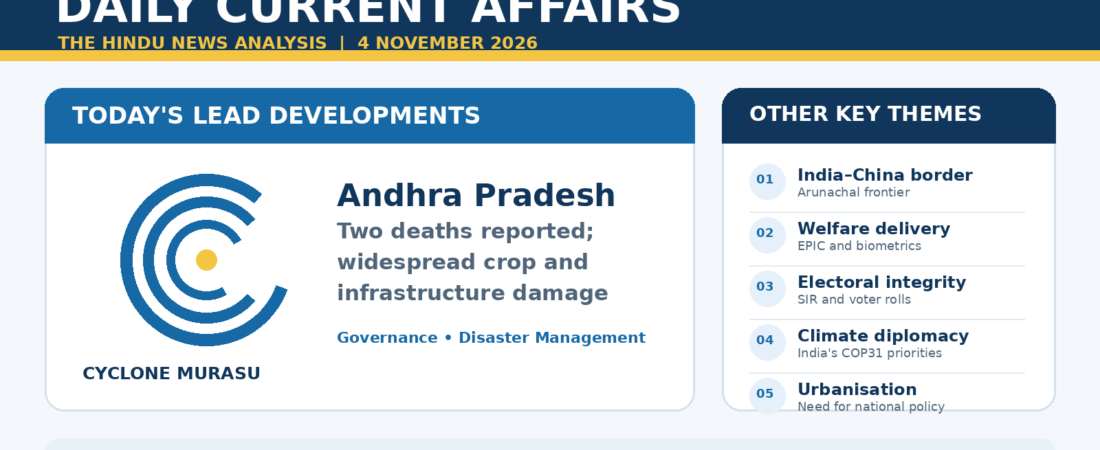
The most significant issues include reports of Chinese military transgressions along the Arunachal Pradesh frontier, the impact of Cyclone Murasu on coastal Andhra Pradesh, the proposed changes in identification of beneficiaries of welfare schemes, irregularities in electoral rolls following the Special Intensive Revision (SIR), and the need for a comprehensive National Urbanisation Policy.
The newspaper also examines India’s negotiating priorities ahead of COP31, the declining number of education-loan accounts despite rising borrowing amounts, cryptocurrency regulation, the Ganga Water Treaty and the rehabilitation of government schools.
These developments provide important insights into India’s challenges in strengthening national security, improving institutional accountability, promoting inclusive development and ensuring sustainable economic growth.
PART I – POLITY AND GOVERNANCE
1. Welfare Payments to Be Based on EPIC and Biometric Authentication Instead of Aadhaar as Primary Identification
GS Paper II – Government Policies and Interventions
Why is this in the news?
Union Minister for Panchayati Raj Rajiv Ranjan Singh stated that voter identity cards, along with biometric authentication, would be used as the basis for identifying beneficiaries and processing payments under welfare schemes within the ambit of the Panchayati Raj Ministry.
The announcement represents a proposed shift from the existing Aadhaar-based identification arrangement.
The Minister argued that the new arrangement would improve beneficiary verification and help eliminate fraudulent entries.
What is the proposed arrangement?
Under the proposed framework:
- Beneficiaries will provide their Elector Photo Identity Card (EPIC) numbers.
- Biometric authentication will be used alongside EPIC.
- Aadhaar will no longer be the primary means of identification for the relevant welfare payments.
- The system is intended to improve the identification of eligible beneficiaries.
The Minister argued that Aadhaar cards could be obtained easily through fraudulent means, making additional verification necessary.
What is EPIC?
EPIC – Elector Photo Identity Card is the identity document issued by the Election Commission of India to registered voters.
It is associated with electoral registration and voter identification.
Aadhaar versus EPIC
| Parameter | Aadhaar | EPIC |
|---|---|---|
| Issuing authority | Unique Identification Authority of India (UIDAI) | Election Commission of India |
| Primary purpose | Establishing identity through a unique identification number | Identification of registered electors |
| Coverage | Residents enrolled under the Aadhaar framework | Eligible registered electors |
| Authentication | Biometric and demographic authentication | Voter identity verification; proposed arrangement adds biometric authentication |
| Main application | Identity verification across multiple services | Electoral identification |
Constitutional and governance dimensions
Article 14 – Equality before law
Welfare benefits should be delivered without arbitrary discrimination.
Identification procedures must not result in the exclusion of otherwise eligible beneficiaries.
Article 21 – Right to life
Access to food, pensions and other welfare benefits is closely connected with the right to live with dignity.
Article 38 – Social order
The State must promote a social order in which justice informs all institutions of national life.
Article 41 – Right to work, education and public assistance
The State shall, within its economic capacity and development, make effective provision for public assistance in cases of unemployment, old age, sickness and disablement.
Potential benefits
- Strengthening beneficiary verification.
- Reducing duplicate entries.
- Improving accountability in welfare delivery.
- Preventing certain forms of identity fraud.
- Improving the reliability of beneficiary databases.
Concerns and challenges
1. Exclusion errors
A person may be eligible for a welfare benefit but may not possess an EPIC or may face difficulties with biometric authentication.
2. Database mismatch
Electoral databases and welfare databases may contain different information.
3. Migration
Migrant workers and persons who move between States may face difficulties in establishing their identity and eligibility.
4. Privacy
The collection and processing of biometric information raise concerns regarding data security and privacy.
5. Constitutional validity and implementation
The proposed arrangement must operate within the existing legal framework governing welfare eligibility, identity verification and data protection.
Way forward
- Maintain alternative identification procedures.
- Provide offline authentication mechanisms.
- Ensure that technical failures do not automatically deny welfare benefits.
- Strengthen grievance-redressal mechanisms.
- Conduct independent audits of beneficiary exclusion.
- Ensure compliance with privacy and data-protection requirements.
UPSC Mains perspective: Digital identification can improve welfare delivery, but technological efficiency must not come at the cost of social exclusion. The objective should be inclusive authentication rather than authentication-driven exclusion.
2. Electoral Roll Revision: ECI Clarifies Rules on Re-enrolment Through Form 6
GS Paper II – Election Commission and Electoral Reforms
Why is this in the news?
The Election Commission of India clarified that no action would be taken against voters merely because they were included in an earlier electoral roll and subsequently submitted Form 6 during the Special Intensive Revision (SIR) process.
The clarification is intended to address concerns that voters whose names were missing from the draft electoral roll could face penal action for submitting Form 6.
What is Form 6?
Form 6 is the prescribed application for inclusion of a name in the electoral roll.
The Election Commission clarified that a person who was previously enrolled but whose name does not appear in the draft electoral roll may apply afresh for inclusion.
The mere fact that the applicant appeared in an earlier electoral roll does not automatically make the declaration false.
Election Commission’s clarification
The ECI directed Electoral Registration Officers not to initiate action under Section 31 of the Representation of the People Act, 1950, merely because:
- The elector appeared on a previous electoral roll.
- The elector submitted Form 6 during the SIR process.
- The elector sought inclusion afresh after the SIR process.
This protection applies provided the elector is not already enrolled in another Lok Sabha or Assembly constituency and the declaration is otherwise lawful.
Judicial background
The clarification follows the Delhi High Court judgment in Nilotpal Datta v. Election Commission of India, decided on October 14, 2026.
The High Court held that the concern that submission of Form 6 would amount to a false declaration merely because the applicant had previously been enrolled was misplaced.
Why is this important?
The electoral roll is the foundation of representative democracy.
Incorrect exclusion of eligible voters can undermine the principle of universal adult franchise.
The clarification attempts to prevent procedural requirements from becoming barriers to electoral participation.
Relevant constitutional provisions
- Article 324: Superintendence, direction and control of elections vested in the Election Commission.
- Article 325: One general electoral roll for every territorial constituency; no exclusion on grounds of religion, race, caste or sex.
- Article 326: Elections to the Lok Sabha and State Legislative Assemblies on the basis of adult suffrage.
Way forward
- Ensure transparency in electoral-roll revision.
- Provide accessible correction and appeal mechanisms.
- Publish clear procedures for re-enrolment.
- Improve verification without arbitrary exclusion.
- Strengthen independent monitoring of the SIR process.
UPSC takeaway: Electoral integrity requires both the removal of ineligible entries and the protection of every eligible citizen’s right to vote.
3. Voter ID Irregularities in Karnataka: 803 EPIC Numbers Linked to 397 Names
GS Paper II – Electoral Governance
Why is this in the news?
An investigation reported by The Hindu found that 803 voter identity card entries in Karnataka’s Mahadevapura Assembly constituency were linked to only 397 individuals after the Special Intensive Revision exercise.
In several cases, more than three voter IDs had reportedly been issued under the name of one person.
The constituency had earlier been at the centre of allegations concerning manipulation of electoral rolls.
Nature of irregularities
The investigation identified different types of anomalies:
- The same EPIC number appearing against two entries.
- Multiple EPIC numbers being issued to one individual.
- Duplicate entries within the same polling station.
- Duplicate entries across different polling stations.
- Inconsistencies in names, addresses and other particulars.
The report identified more than 500 cases in which the same person had two or more voter IDs within a polling station and another 300 cases involving multiple IDs across different polling stations.
The Chief Electoral Officer’s office stated that it was monitoring complaints and that the reported cases would be verified.
Why is this significant?
The credibility of elections depends on accurate electoral rolls.
Duplicate entries may create opportunities for impersonation and electoral malpractice, although the existence of duplicate entries by itself does not establish that fraudulent voting has occurred.
Challenges in electoral-roll management
- Inaccurate digitisation of records.
- Migration and change of residence.
- Inadequate coordination between electoral offices.
- Data-entry errors.
- Weak verification mechanisms.
- Delays in correcting duplicate records.
Way forward
- Strengthen database deduplication.
- Use technology to identify anomalous records.
- Maintain transparent verification procedures.
- Provide citizens with opportunities to correct errors.
- Ensure that deletion of names follows due process.
- Conduct independent audits of electoral databases.
UPSC Mains perspective: Electoral reforms must address both electoral fraud and wrongful disenfranchisement. Accuracy, transparency and due process must remain equally important.
4. Public Accounts Committees: Strengthening Legislative Oversight of Public Expenditure
GS Paper II – Parliament and State Legislatures
Why is this in the news?
Lok Sabha Speaker Om Birla emphasised the role of Public Accounts Committees (PACs) in ensuring the efficient and accountable utilisation of public money.
He was speaking at a two-day conference of PAC chairpersons from 25 States hosted by the Kerala Legislative Assembly.
He also highlighted the problem of reports remaining pending for 15–20 years and called for the use of technology, data analytics and Artificial Intelligence in financial scrutiny.
What is the Public Accounts Committee?
The Public Accounts Committee is one of the important financial committees of Parliament.
It examines government expenditure and scrutinises whether public money has been spent in accordance with the authorisation of Parliament.
It plays an important role in ensuring legislative control over public finances.
Composition and significance
The parliamentary PAC consists of members from both Houses of Parliament.
Its chairperson is conventionally appointed from the Opposition.
This arrangement strengthens the role of the legislature in holding the executive accountable.
Major functions
- Examining appropriation accounts.
- Examining finance accounts.
- Scrutinising audit reports of the Comptroller and Auditor General.
- Examining instances of excess expenditure.
- Identifying financial irregularities.
- Recommending corrective administrative action.
Relationship between PAC and CAG
The Comptroller and Auditor General of India conducts audits of government expenditure.
The PAC examines the findings of these audits and evaluates the government’s financial and administrative accountability.
The relationship can be represented as:
Parliamentary authorisation → Government expenditure → CAG audit → PAC examination → Legislative accountability.
Challenges
- Long delays in submission of reports.
- Non-cooperation by departments.
- Limited technical expertise.
- Increasing complexity of public expenditure.
- Inadequate follow-up on recommendations.
- Difficulty in analysing large volumes of financial data.
The PAC chairperson also expressed concern over the absence of chief secretaries of six States from a recent meeting concerning scholarships for Scheduled Caste students.
Role of Artificial Intelligence
AI and data analytics can help:
- Identify abnormal expenditure patterns.
- Detect suspicious transactions.
- Analyse large financial datasets.
- Monitor compliance with audit recommendations.
- Identify recurring irregularities.
- Improve the efficiency of legislative scrutiny.
Way forward
- Establish time-bound procedures for PAC reports.
- Improve departmental accountability.
- Strengthen technical research support.
- Use digital dashboards for tracking audit observations.
- Ensure regular follow-up on committee recommendations.
- Improve coordination between the CAG, legislatures and executive departments.
UPSC takeaway: Parliamentary financial committees are essential instruments of legislative oversight. Their effectiveness determines the quality of financial accountability in a parliamentary democracy.
5. Supreme Court on Protest Economy: Balancing Right to Protest and Right to Livelihood
GS Paper II – Fundamental Rights and Judiciary
Why is this in the news?
The Supreme Court observed that protests are not necessarily hostile to business and that they may generate economic activity for hawkers, vendors and small traders.
The observation came while hearing a petition filed by traders in Delhi who claimed that demonstrations during the festive season had affected commercial activity.
The Court highlighted the competing interests of traders and protesters.
Constitutional provisions
Article 19(1)(a): Freedom of speech and expression.
Article 19(1)(b): Right to assemble peacefully and without arms.
Article 19(1)(g): Freedom to practise any profession or carry on any occupation, trade or business.
Article 21: Right to life and personal liberty.
The constitutional dilemma
Peaceful demonstrations are an important feature of participatory democracy.
However, protests may affect:
- Commercial activity.
- Public transport.
- Emergency services.
- Movement of citizens.
- Livelihoods of traders and workers.
The Supreme Court did not issue a blanket prohibition on protests. It issued notice to the concerned parties and declined to pass an interim order without hearing the protest organisers.
Jantar Mantar controversy
The Delhi Police Commissioner submitted before the Supreme Court that Jantar Mantar should be viewed as a public road rather than an exclusive protest site.
The police cited concerns regarding public safety, traffic, emergency services and security.
The affidavit referred to the large number of protests, distress calls and police cases in the area.
The larger constitutional question is whether the State can regulate the location and manner of protests without effectively extinguishing the right to peaceful dissent.
Way forward
- Designate appropriate protest areas.
- Ensure reasonable restrictions based on public safety.
- Protect access to emergency services.
- Provide alternative locations when restrictions are necessary.
- Avoid arbitrary restrictions on peaceful demonstrations.
- Balance livelihood interests with democratic freedoms.
UPSC Mains perspective: The right to protest is essential to democracy, but its exercise must be harmonised with the rights of other citizens.
6. India to Simplify Visa Application Forms
GS Paper II – Governance and International Relations
Why is this in the news?
The Union government is planning to simplify visa application forms by removing redundant and repetitive fields.
The changes are expected to apply across all 22 visa categories.
The number of fields is expected to be reduced by approximately 70%.
Significance
Simplifying visa procedures can:
- Improve the ease of travel.
- Promote tourism.
- Facilitate business mobility.
- Reduce administrative delays.
- Improve India’s attractiveness as an international destination.
- Support international educational and professional exchanges.
India currently provides e-visas across nine subcategories to citizens of 147 countries, according to the newspaper report.
Challenges
- Balancing security and facilitation.
- Preventing misuse of simplified procedures.
- Improving coordination among immigration agencies.
- Ensuring uniform implementation.
- Strengthening digital application infrastructure.
UPSC takeaway: Ease of travel is an important component of India’s soft power, tourism potential and economic diplomacy.
PART II – INTERNATIONAL RELATIONS AND NATIONAL SECURITY
7. Chinese Transgressions Along the Arunachal Pradesh Frontier: India’s Border Security Challenge
GS Paper II – India-China Relations
Why is this in the news?
An editorial titled On the Arunachal frontier, silence is not a strategy examines reports of Chinese People’s Liberation Army (PLA) transgressions in the Asaphila, Taksing and Longju areas of Arunachal Pradesh.
The editorial argues that India must closely examine these developments and respond with greater strategic clarity.
Background
India and China have a long-standing unresolved boundary dispute.
The Line of Actual Control (LAC) separates the areas under the effective control of the two countries.
However, the two countries have different perceptions of the alignment of the LAC in certain sectors.
Reported developments
The editorial discusses the following developments:
- Reports of a stand-off near Asaphila, close to Taksing, since July 2026.
- A reported face-off near Maja, close to Longju.
- Allegations that Chinese forces pitched tents approximately six to seven kilometres inside the LAC as perceived by India.
- Reports of restrictions on Indian patrol access in certain areas.
- Statements by the Director General of the Indo-Tibetan Border Police confirming face-offs at several locations in Arunachal Pradesh.
The Arunachal Pradesh Chief Minister also referred to the occurrence of transgressions.
However, the editorial acknowledges that the precise facts and extent of the reported developments remain unclear and that some earlier allegations were disputed by the Army.
Therefore, these reports should be understood as developments requiring verification, not as an independently established determination of territorial control.
The 1959 Line
China has historically referred to the so-called LAC of November 7, 1959.
India does not accept the Chinese interpretation of this line.
The Indian position is that the LAC represents the line of actual control on the ground, rather than a unilateral historical claim.
Important bilateral agreements
| Agreement | Significance |
|---|---|
| 1993 Agreement | Agreement on the Maintenance of Peace and Tranquillity along the LAC |
| 1996 Agreement | Confidence-building measures in the military field along the LAC |
| 2005 Agreement | Political Parameters and Guiding Principles for the Settlement of the India-China Boundary Question |
| 2013 Agreement | Border Defence Cooperation Agreement |
These agreements seek to maintain peace, prevent escalation and establish mechanisms for addressing differences.
The Eastern Sector
The Eastern Sector of the India-China boundary dispute primarily concerns Arunachal Pradesh.
China claims large parts of the State as part of what it describes as South Tibet.
India considers Arunachal Pradesh an integral part of its territory.
The McMahon Line, drawn during the 1914 Simla Convention, forms the basis of the boundary alignment recognised by India.
China does not recognise the McMahon Line.
Strategic significance of Arunachal Pradesh
Arunachal Pradesh is important because of:
- Its geographical location along the eastern Himalayas.
- Its proximity to Tibet.
- Its strategic importance for India’s northeastern security.
- Its connection with the Brahmaputra river system.
- Its significance for India’s border infrastructure and regional connectivity.
Why does the editorial criticise India’s approach?
The editorial argues that excessive ambiguity and limited public communication concerning significant border developments may weaken India’s strategic position.
It suggests that India should distinguish between routine patrol-level incidents and developments involving expanded Chinese presence or denial of access to areas previously patrolled by Indian forces.
It also argues that diplomatic engagement must be sufficiently forceful when the situation warrants it.
Challenges for India
- Infrastructure asymmetry along the border.
- Difficult Himalayan terrain.
- Different perceptions of the LAC.
- Limited transparency.
- Rapid development of Chinese border infrastructure.
- The risk of escalation.
- The difficulty of maintaining a stable border-management framework.
Way forward
1. Strengthen border infrastructure
Improve roads, tunnels, bridges, surveillance and communication facilities.
2. Maintain diplomatic engagement
Continue discussions through the Working Mechanism for Consultation and Coordination on India-China Border Affairs and other established mechanisms.
3. Improve transparency
Provide accurate information concerning major developments without compromising operational security.
4. Strengthen border surveillance
Improve coordination between the Army, ITBP and local administrative institutions.
5. Develop local communities
Improve infrastructure and livelihood opportunities in border villages.
6. Maintain strategic deterrence
Strengthen military preparedness while preserving diplomatic channels.
UPSC Mains perspective: India-China border management requires a combination of military preparedness, diplomatic engagement, infrastructure development and strategic communication.
8. India-Bangladesh Relations: Ganga Water Treaty Renewal
GS Paper II – India and Neighbouring Countries
Why is this in the news?
The Ganga Water Treaty between India and Bangladesh is scheduled to expire on December 12, 2026.
The Ministry of External Affairs stated that both countries have a structured mechanism to address issues relating to the treaty and other transboundary rivers.
India referred to the Joint Rivers Commission as the institutional mechanism for discussing cross-border river issues.
Background of the treaty
The Ganga Water Treaty was signed in 1996 between India and Bangladesh.
It provides a framework for sharing Ganga waters during the dry season.
The agreement was concluded for a period of 30 years.
Why is the Ganga important?
The Ganga is one of the most important river systems of South Asia.
It supports:
- Agriculture.
- Drinking-water requirements.
- Inland navigation.
- Fisheries.
- Industrial activity.
- Ecosystems and biodiversity.
Why is treaty renewal important?
The renewal of the treaty is important for maintaining stable water-sharing arrangements between the two countries.
It also provides an opportunity to address emerging challenges related to climate change, water availability and changing river-flow patterns.
Major challenges
- Seasonal variation in river flows.
- Increasing water demand.
- Climate change.
- Agricultural requirements.
- Political and diplomatic differences.
- Competing developmental priorities.
- Lack of comprehensive basin-level cooperation.
Joint Rivers Commission
The Joint Rivers Commission provides an institutional platform for India and Bangladesh to discuss transboundary river issues.
The mechanism is important because bilateral water management cannot be restricted to one river alone.
Way forward
- Renew the treaty through constructive negotiations.
- Improve hydrological data sharing.
- Strengthen joint scientific studies.
- Promote integrated river-basin management.
- Consider climate-change projections.
- Improve cooperation on flood forecasting.
- Develop mechanisms for resolving future disputes.
UPSC Mains perspective: Water diplomacy is an essential component of India’s neighbourhood policy. Sustainable transboundary river management requires institutional cooperation, scientific data and mutual trust.
9. Myanmar Crisis: Engagement with the Military Junta and India’s Strategic Dilemma
GS Paper II – India’s Neighbourhood and Act East Policy
Why is this in the news?
An editorial titled Business, unusual examines the continued international engagement with Myanmar’s military leadership despite the country’s ongoing political and humanitarian crisis.
The editorial argues that commercial and strategic engagement without meaningful progress towards peace and political accountability may prove counterproductive.
Background
Myanmar has been under military rule since the February 2021 coup.
The military takeover displaced the elected civilian government and triggered widespread resistance.
The conflict involves:
- The military junta.
- Anti-coup People’s Defence Forces.
- Ethnic armed organisations.
- Other regional political and armed groups.
The newspaper’s editorial estimates that more than one lakh people have died since the coup, although this is an estimate rather than a universally verified count.
ASEAN Five-Point Consensus
The Association of Southeast Asian Nations adopted a Five-Point Consensus in April 2021 to address the Myanmar crisis.
Its principal elements include:
- Immediate cessation of violence.
- Constructive dialogue among all parties.
- Appointment of an ASEAN special envoy.
- Humanitarian assistance.
- A visit by the special envoy to Myanmar to meet all concerned parties.
The editorial argues that the military leadership has not meaningfully implemented the consensus.
India’s strategic interests
Myanmar occupies an important position in India’s neighbourhood policy.
1. Act East Policy
Myanmar provides an important land and maritime link between India and Southeast Asia.
2. Kaladan Multi-Modal Transit Transport Project
The project seeks to improve connectivity between India’s eastern coast, Mizoram and Myanmar.
3. Northeastern security
Stability in Myanmar is important for managing insurgency, trafficking and illegal cross-border movement.
4. Economic connectivity
Myanmar provides opportunities for trade, energy cooperation and regional infrastructure development.
China’s interests
The editorial notes China’s interest in:
- Access to the Indian Ocean.
- Security of oil and gas pipelines.
- Access to rare earth minerals.
- Strategic influence in Myanmar.
- Engagement with both the military junta and ethnic armed organisations.
The central dilemma
India must balance its strategic interests with democratic values and humanitarian concerns.
Complete disengagement may reduce India’s influence and create strategic space for other countries.
However, unrestricted engagement may be interpreted as legitimising military rule.
Way forward
- Maintain engagement with all relevant stakeholders.
- Support ASEAN’s peace initiatives.
- Protect India’s infrastructure and connectivity projects.
- Strengthen humanitarian assistance.
- Promote inclusive political dialogue.
- Avoid measures that indirectly legitimise human-rights violations.
- Maintain coordination with neighbouring countries.
UPSC Mains perspective: India’s Myanmar policy illustrates the challenge of reconciling strategic autonomy, democratic values, neighbourhood security and regional connectivity.
10. West Asian Security: The Mecca Agreement and Regional Strategic Realignment
GS Paper II – International Relations
Why is this in the news?
An analysis in the newspaper examines an October diplomatic outreach to Tehran by an alliance involving Saudi Arabia, Türkiye and Pakistan, referred to as the Mecca Agreement.
The initiative is discussed against the background of the continuing West Asian conflict and growing instability in the region.
Background
The conflict involving the United States, Israel and Iran has altered the strategic environment in West Asia.
Iran has targeted certain American interests and military installations across Gulf countries as part of its response.
The regional security environment has also been affected by Houthi activities in Yemen and the security concerns of Saudi Arabia.
Significance of the Mecca Agreement
The initiative reflects an attempt to develop regional mechanisms for addressing security concerns.
The participating countries have an interest in preventing further escalation.
Iran’s participation in dialogue is also important because of its influence over several regional developments, including the Houthi movement.
Role of Pakistan and Türkiye
Pakistan and Türkiye are attempting to strengthen their diplomatic and strategic positions in West Asia.
The involvement of Pakistan’s military leadership also reflects the growing importance of defence and intelligence institutions in regional diplomacy.
Strategic implications
- Emergence of regional security arrangements.
- Changing balance of power in West Asia.
- Reduced exclusive dependence on U.S.-led security structures.
- Greater diplomatic engagement with Iran.
- Possibility of new regional partnerships.
- Continuing instability in the Gulf region.
Implications for India
India has significant interests in West Asia.
These include:
- Energy security.
- Trade and investment.
- Maritime security.
- Diaspora welfare.
- Connectivity projects.
- Strategic partnerships with Gulf countries.
India must maintain balanced relations with all major regional actors.
UPSC takeaway: The changing security architecture of West Asia requires India to maintain strategic autonomy while protecting its energy, economic and maritime interests.
11. Drone Attack on Indian Commercial Vessel off Oman Kills Indian Seafarer
GS Paper II – International Relations
GS Paper III – Maritime Security
Why is this in the news?
An Indian national, Gandhar Nahim Ajij from Gujarat, was killed after a drone struck an Indian commercial vessel off the coast of Oman.
The incident occurred amid the continuing conflict in West Asia.
According to the Ministry of External Affairs, the number of Indian seafarers killed since the conflict began in February 2026 has risen to 23.
Thirteen Indians aboard the vessel were rescued by Omani naval personnel.
India’s response
India called for:
- Dialogue and diplomacy.
- De-escalation of tensions.
- Protection of commercial shipping.
- Freedom of navigation.
- Restoration of unimpeded maritime commerce.
The Ministry of External Affairs emphasised that commercial shipping and civilian infrastructure must not be targeted.
Strategic significance
The incident highlights the vulnerability of commercial shipping to geopolitical conflicts.
The Strait of Hormuz and adjoining waters are vital maritime routes for international energy trade.
Disruption can affect:
- Crude oil supplies.
- LNG transportation.
- Shipping insurance.
- Freight charges.
- Global energy prices.
- International trade.
Indian Navy’s anti-piracy role
The newspaper also reported that the Indian Navy, supported by the Indian Air Force, rescued 20 Iranian crew members of the fishing vessel Azini, approximately 3,000 km from Mumbai.
The vessel’s crew had reportedly been held by pirates.
This illustrates India’s role as a first responder in the Indian Ocean Region.
Way forward
- Strengthen maritime domain awareness.
- Improve coordination with regional navies.
- Protect Indian commercial shipping.
- Strengthen evacuation and rescue capabilities.
- Diversify energy import routes.
- Maintain diplomatic engagement with regional powers.
UPSC takeaway: Maritime security is directly connected with India’s energy security, economic resilience and strategic interests in the Indian Ocean.
PART III – ECONOMY AND DEVELOPMENT
12. Need for a National Urbanisation Policy in India
GS Paper I – Urbanisation
GS Paper II – Governance
GS Paper III – Infrastructure and Inclusive Growth
Why is this in the news?
An analytical article in the newspaper argues that India needs a comprehensive National Urbanisation Policy to address the changing nature of urban growth.
The article highlights a fundamental problem: India’s administrative classification of settlements does not adequately reflect the actual geographical and economic expansion of urban areas.
How does India classify urban settlements?
According to the Census framework, a settlement is classified as urban if it is:
A. Statutory town
A place notified as an urban area by the State government through a municipal corporation, municipality, cantonment board or notified town-area committee.
B. Census town
A settlement satisfying all three criteria:
- Population of at least 5,000.
- Population density of at least 400 persons per square kilometre.
- At least 75% of the male main working population engaged in non-agricultural activities.
Settlements not meeting these conditions are generally classified as rural.
India’s changing urban landscape
The newspaper highlights several important demographic trends:
- In 2011, India had approximately 377 million urban residents.
- They lived across approximately 8,000 cities and towns.
- States have notified around 1,000 additional statutory towns since then.
- The United Nations estimates that 44% of Indians live in urban areas today.
- India’s urban population is projected to exceed 720 million by 2050.
- Approximately 94% of India’s urban settlements are small towns.
- Around 60% of the urban population lives in Class I cities.
An important feature of urbanisation is the rapid expansion of peri-urban areas.
These are transitional areas located between established urban settlements and rural regions.
According to the newspaper, peri-urban areas are growing at approximately 4.15% annually, compared with 2.9% growth within administrative city boundaries.
Why is the existing framework inadequate?
1. Rural-urban binary
The existing classification treats rural and urban settlements as separate categories.
However, modern urbanisation occurs gradually through the expansion of economic and residential activity beyond municipal boundaries.
2. Administrative fragmentation
Urban economic regions frequently extend across multiple administrative jurisdictions.
This creates difficulties in planning transport, housing, water supply and waste management.
3. Inadequate master plans
The article reports that approximately 52% of statutory towns and 76% of census towns do not have master plans.
4. Inadequate municipal finances
India’s municipal revenue is estimated at around 1% of GDP, significantly below the levels cited for Brazil and South Africa.
5. Weak planning institutions
Many States have not adequately updated their urban-planning legislation after the 74th Constitutional Amendment.
Constitutional framework
| Article | Provision |
|---|---|
| Article 243P | Definitions relating to municipalities |
| Article 243Q | Constitution of municipalities |
| Article 243R | Composition of municipalities |
| Article 243S | Wards Committees |
| Article 243W | Powers and responsibilities of municipalities |
| Article 243ZD | District Planning Committees |
| Article 243ZE | Metropolitan Planning Committees |
The Twelfth Schedule contains 18 functions that may be devolved to municipalities.
These include urban planning, regulation of land use, roads, water supply, public health, sanitation, slum improvement and urban poverty alleviation.
Recommendations for a National Urbanisation Policy
The newspaper’s analysis, drawing on WRI India’s recommendations, identifies seven broad transformations.
1. Standardise urban classification
Develop common principles for identifying statutory and transitional urban settlements.
2. Modernise spatial planning
Develop integrated regional and metropolitan plans.
3. Reform urban finance
Strengthen municipal revenue and predictable fiscal transfers.
4. Establish coordination mechanisms
Create a National Urbanisation Council to coordinate across levels of government.
5. Adopt functional planning units
Plan around economic regions, river basins and airsheds rather than only administrative boundaries.
6. Align political incentives
Improve accountability and encourage local-level institutional reforms.
7. Promote innovation and knowledge sharing
Strengthen the technical capacity of local governments.
Significance of the 16th Finance Commission
The article refers to measures that encourage a shift towards a wider urban economic-region approach.
These include:
- Increased local grants for urban local bodies.
- An urbanisation premium intended to encourage States to integrate peri-urban settlements into adjoining urban areas.
- Greater emphasis on regional planning.
Way forward
India requires a transition from city-centric planning to functional-region planning.
This must include:
- Integrated land-use planning.
- Strengthening metropolitan governance.
- Improving municipal finances.
- Promoting public transport.
- Developing affordable housing.
- Strengthening climate-resilient infrastructure.
- Improving coordination among rural and urban local governments.
UPSC Mains perspective: India’s urbanisation challenge is no longer merely about managing cities. It is about governing expanding economic regions through integrated planning, fiscal coordination and institutional reform.
13. Educational Loans: Fewer Students Borrowing, but Loan Amounts Increasing
GS Paper II – Education and Social Justice
GS Paper III – Financial Inclusion and Human Development
Why is this in the news?
A data analysis based on Reserve Bank of India data shows that the number of educational-loan accounts has declined over the last decade, even as the average outstanding loan amount has increased significantly.
Important data
| Indicator | June 2016 | June 2026 |
|---|---|---|
| Number of education-loan accounts | 25.76 lakh | 21.84 lakh |
| Average outstanding per account | ₹2.60 lakh | ₹7.25 lakh |
| Total outstanding education loans | ₹67,175 crore | ₹1,58,468 crore |
| Share of loans up to ₹2 lakh | 11.44 lakh accounts | 3 lakh accounts |
The number of educational-loan accounts declined by 15.2%.
However, the average outstanding amount per account increased by 178.2%.
What does the data indicate?
1. Rising cost of education
The increase in average borrowing may reflect the rising cost of higher education.
2. Reduced access to smaller loans
The number of smaller educational-loan accounts has fallen considerably.
3. Growing dependence on larger loans
The growth in borrowing is increasingly concentrated in loans exceeding ₹2 lakh.
4. Declining share in total bank credit
Education loans accounted for 0.93% of total bank credit in June 2016, compared with 0.74% in June 2026.
Why is this concerning?
Education is an important instrument of social mobility.
If the cost of higher education increases faster than household incomes, economically weaker students may find it difficult to access quality institutions.
The decline in smaller loan accounts also raises questions about access to affordable educational finance.
Policy implications
- Strengthen interest-subvention schemes.
- Improve access to collateral-free education loans.
- Expand scholarships.
- Strengthen public higher education.
- Improve vocational and skill-based education.
- Ensure transparency in education-loan procedures.
- Strengthen financial assistance for economically weaker students.
UPSC takeaway: Access to education must be evaluated not only through enrolment rates but also through affordability and access to institutional finance.
14. PM Surya Ghar Yojana: Accelerating Rooftop Solar Installations
GS Paper III – Renewable Energy
Why is this in the news?
Union Minister for New and Renewable Energy Pralhad Joshi stated that the PM Surya Ghar Yojana is currently adding approximately one lakh rooftop solar installations every six days.
The government expects to increase the pace to one lakh installations every four to five days.
The stated target is to install one crore rooftop solar systems by March 31, 2027.
What is PM Surya Ghar Yojana?
The PM Surya Ghar: Muft Bijli Yojana is a government initiative to promote rooftop solar installations in residential households.
Its principal objectives include:
- Promoting decentralised solar energy.
- Reducing household electricity expenditure.
- Encouraging renewable-energy adoption.
- Reducing dependence on conventional electricity.
- Supporting India’s energy-transition objectives.
Benefits
1. Household savings
Rooftop solar can reduce electricity bills.
2. Energy security
Distributed generation can reduce pressure on conventional power sources.
3. Climate mitigation
Solar energy reduces dependence on fossil-fuel-based electricity generation.
4. Employment generation
The installation and maintenance ecosystem creates opportunities for technicians, entrepreneurs and service providers.
Challenges
- High initial installation costs.
- Rooftop suitability.
- Distribution-company coordination.
- Maintenance and service quality.
- Consumer awareness.
- Integration with distribution networks.
Way forward
- Improve access to affordable financing.
- Strengthen local installation networks.
- Promote battery storage.
- Improve grid integration.
- Strengthen consumer grievance-redressal systems.
UPSC takeaway: Rooftop solar is an important component of India’s transition towards decentralised and clean energy systems.
15. Tata Motors Completes €3.8-Billion Acquisition of Iveco Group
GS Paper III – Indian Industry and Globalisation
Why is this in the news?
Tata Motors completed its €3.8-billion acquisition of Iveco Group NV, marking a major step in the international expansion of India’s commercial vehicle industry.
The combined entity is expected to become the fourth-largest commercial vehicle manufacturer globally, with a presence in more than 130 countries.
The combined business is expected to generate annual revenues exceeding €21 billion.
Strategic significance
1. Global market access
The acquisition provides access to Iveco’s established markets and distribution networks.
2. Technology sharing
The companies can benefit from technology transfer and product innovation.
3. Industrial scale
Larger production and distribution networks can generate economies of scale.
4. Market diversification
Tata Motors can strengthen its international commercial vehicle business.
5. Sustainable mobility
The partnership offers opportunities in developing cleaner and more efficient transport technologies.
Challenges
- Integrating different corporate cultures.
- Managing international operations.
- Maintaining product quality.
- Managing regulatory differences.
- Competing with global commercial vehicle manufacturers.
UPSC takeaway: Indian companies expanding internationally can improve industrial competitiveness through technology, scale and global market integration.
16. SBI Reports 14.3% Growth in Second-Quarter Net Profit
GS Paper III – Banking and Financial Sector
Why is this in the news?
State Bank of India reported a 14.28% year-on-year increase in net profit to ₹23,038 crore for the quarter ended September 30, 2026.
Major financial indicators
| Indicator | Reported performance |
|---|---|
| Net profit | ₹23,038 crore |
| Growth in net profit | 14.28% |
| Net interest income | ₹49,143 crore |
| Growth in net interest income | 14.69% |
| Net interest margin | 3.11% |
| Gross NPA ratio | 1.39% |
| Net NPA ratio | 0.36% |
| Gross advances | ₹52.08 lakh crore |
| Deposits | ₹62.78 lakh crore |
What is Net Interest Income?
Net Interest Income (NII) is the difference between interest earned by a bank on loans and investments and interest paid on deposits and borrowings.
What is Net Interest Margin?
Net Interest Margin (NIM) measures the profitability of a bank’s interest-earning activities relative to its interest-earning assets.
What is an NPA?
A Non-Performing Asset is a loan or advance for which the borrower has stopped making scheduled interest or principal payments for the prescribed period.
A reduction in the gross NPA ratio generally indicates improvement in asset quality.
Significance
The results indicate:
- Growth in banking operations.
- Improved asset quality.
- Lower loan-loss provisions.
- Expansion of credit.
- Strong deposit mobilisation.
UPSC takeaway: Banking-sector performance is an important indicator of credit availability, financial intermediation and economic activity.
17. NMDC’s Iron Ore Production Rises Despite Railway Disruptions
GS Paper III – Mineral Resources and Infrastructure
State-owned NMDC reported an 18% year-on-year increase in iron ore production in October 2026 to 5.04 million tonnes.
However, sales declined by more than 11% to 3.44 million tonnes.
The decline in sales was associated with disruption to the Kottavalasa–Kirandul railway line following heavy monsoon damage.
The railway route is important for transporting iron ore from NMDC’s Bailadila mines in Chhattisgarh.
Significance
The development demonstrates the importance of multimodal logistics and resilient infrastructure.
Mining output alone does not translate into economic gains unless adequate transport and evacuation facilities are available.
UPSC relevance
- Mineral resource management.
- Infrastructure bottlenecks.
- Industrial supply chains.
- Railway connectivity.
- Disaster-resilient infrastructure.
PART IV – ENVIRONMENT AND CLIMATE CHANGE
18. India Outlines Priorities for COP31 Climate Negotiations
GS Paper II – International Environmental Diplomacy
GS Paper III – Climate Change
Why is this in the news?
India has outlined its negotiating priorities ahead of the 31st Conference of the Parties (COP31) to the United Nations Framework Convention on Climate Change.
The conference is scheduled to be held in Antalya, Türkiye, from November 9 to 20, 2026.
Union Environment Minister Bhupender Yadav stated that climate finance, technology transfer and equitable approaches to climate mitigation and adaptation would be among India’s key priorities.
India’s major demands
1. Predictable climate finance
India will seek predictable financial support from developed countries for developing nations.
The funding should be largely public and concessional.
2. Technology transfer
Developing countries require access to advanced technologies to undertake climate mitigation and adaptation.
3. Equity and climate justice
India will reiterate that developed countries have greater historical responsibility for greenhouse-gas emissions.
4. Just Transition
India will support continuation of the Just Transition Work Programme.
5. Nationally determined approaches
India opposes the imposition of uniform, top-down mitigation targets on developing countries.
Article 9.1 of the Paris Agreement
Article 9.1 provides that developed-country Parties shall provide financial resources to assist developing-country Parties with respect to mitigation and adaptation.
This provision is central to the principle of climate finance responsibility.
Global Goal on Adaptation
The Global Goal on Adaptation seeks to enhance adaptive capacity, strengthen resilience and reduce vulnerability to climate change.
India has argued that indicators developed under this framework should remain voluntary and should not become conditions for accessing climate finance.
Why does climate finance matter?
Developing countries face significant financial constraints in:
- Renewable energy expansion.
- Climate-resilient infrastructure.
- Disaster preparedness.
- Coastal protection.
- Agricultural adaptation.
- Water-resource management.
Climate finance is therefore essential to ensure that climate action does not deepen existing developmental inequalities.
Climate justice
The principle of climate justice recognises that the effects of climate change are not distributed equally.
Countries that have contributed relatively little to historical emissions are often highly vulnerable to climate-related disasters.
India’s policy approach
India’s position emphasises:
- Equity.
- Common but differentiated responsibilities and respective capabilities.
- Sustainable development.
- Technology transfer.
- Climate finance.
- Nationally determined contributions.
- Energy security.
Way forward
- Strengthen international climate finance mechanisms.
- Improve access to concessional funding.
- Promote affordable clean technologies.
- Improve domestic climate adaptation capacity.
- Strengthen international cooperation.
- Ensure that climate commitments are compatible with developmental needs.
UPSC Mains perspective: Effective climate action requires a fair distribution of responsibilities, financial resources and technological capabilities between developed and developing countries.
19. Green Firecrackers: Do They Really Reduce Air Pollution?
GS Paper III – Environmental Pollution and Public Health
Why is this in the news?
Following the Supreme Court’s conditional permission for the use of certified green firecrackers in Delhi-NCR, the newspaper’s science page examines their composition, functioning and environmental limitations.
What are green firecrackers?
Green firecrackers are designed to generate lower emissions compared with conventional firecrackers of the same category.
According to the CSIR-National Environmental Engineering Research Institute (NEERI), the products are designed to reduce particulate emissions by approximately 30%, or reduce particulate emissions by 20% and gaseous emissions by 10%, compared with conventional equivalents.
Types of green firecrackers
1. SWAS – Safe Water Releaser
These firecrackers contain ingredients that release water during combustion to suppress some particulate matter.
2. STAR – Safe Thermite Cracker
These use a thermite-based composition to improve combustion efficiency and reduce emissions.
3. SAFAL – Safe Minimal Aluminium
These contain lower quantities of aluminium and are designed to reduce emissions.
How are they different?
Manufacturers modify:
- Fuel and oxidiser proportions.
- Combustion efficiency.
- Additives that suppress dust formation.
- The quantities of certain metals.
Certification
Green firecrackers carry the CSIR-NEERI logo and a QR code through which the product’s certificate can be verified.
Are green firecrackers pollution-free?
No.
The newspaper’s science explainer emphasises that green firecrackers continue to produce:
- Fine particulate matter.
- Harmful gases.
- Other combustion products.
- Noise pollution.
They can affect respiratory and cardiovascular health.
Moreover, the total pollution generated depends on the number of firecrackers used, prevailing weather conditions and existing pollution levels.
Way forward
- Strengthen product certification.
- Prevent sale of counterfeit green crackers.
- Improve public awareness.
- Reduce the overall volume of firecracker use.
- Promote environmentally responsible celebrations.
- Strengthen air-quality monitoring.
UPSC takeaway: A reduction in emissions per unit does not necessarily result in a reduction in total pollution. Environmental impact depends on both emission intensity and the overall scale of consumption.
PART V – SOCIAL JUSTICE AND HUMAN DEVELOPMENT
20. Government Schools: Infrastructure and Teaching Quality Must Improve Together
GS Paper II – Education and Human Resource Development
Why is this in the news?
An opinion article by economist Jean Drèze, titled The elephant in the classroom, examines the poor condition of government-school infrastructure and the quality of classroom teaching.
The article argues that India’s school education challenge cannot be addressed merely by increasing expenditure or constructing buildings.
It requires simultaneous improvement in infrastructure, maintenance, teaching practices and administrative systems.
Major infrastructure problems
The article highlights:
- Leaking roofs.
- Poor sanitation facilities.
- Broken hand pumps.
- Missing playgrounds.
- Inadequate maintenance.
- Poor-quality construction.
- Weak monitoring of contractors.
Right to Education Act, 2009
The Right of Children to Free and Compulsory Education Act, 2009, establishes the legal framework for free and compulsory elementary education.
Section 27 of the RTE Act
Section 27 prohibits the deployment of teachers for non-educational purposes, except for:
- Population census.
- Disaster relief duties.
- Election-related duties.
The article raises concerns about the increasing administrative burden on teachers through digital attendance, record-keeping and other activities.
Teaching time
The article refers to the prescribed minimum working hours of teachers and argues that classroom teaching time should be clearly protected.
It also highlights the importance of regular and active teaching rather than merely ensuring physical attendance.
Why is infrastructure insufficient by itself?
School education requires a combination of:
- Adequate infrastructure.
- Qualified teachers.
- Effective classroom teaching.
- Continuous assessment.
- Learning-support systems.
- Accountability.
- Adequate maintenance.
A school with good infrastructure but poor teaching practices may still produce weak learning outcomes.
Way forward
- Establish regular school-infrastructure audits.
- Strengthen maintenance budgets.
- Improve accountability of contractors.
- Reduce unnecessary administrative duties.
- Provide clerical support.
- Protect classroom teaching hours.
- Improve teacher training.
- Strengthen learning-outcome assessments.
UPSC Mains perspective: Educational quality is determined not merely by access to schooling but also by the availability of functional infrastructure and effective teaching-learning processes.
21. Delhi Slum Rehabilitation: A Household-Centred Approach
GS Paper I – Urbanisation and Social Issues
GS Paper II – Welfare and Governance
Why is this in the news?
An editorial examines Delhi’s proposed 2026 slum rehabilitation policy following the revision of the cut-off date for recognising unauthorised slum clusters.
The cut-off date has reportedly been shifted from January 1, 2006 to January 1, 2025.
The proposed rehabilitation initiative could benefit approximately four lakh families.
The central issue
The editorial argues that slum rehabilitation should not be understood merely as the provision of a replacement flat.
A household’s urban life includes:
- Employment.
- Schools.
- Healthcare.
- Neighbourhood networks.
- Public transport.
- Access to essential services.
Relocation without these facilities can undermine livelihoods and increase vulnerability.
Important judicial precedents
Olga Tellis v. Bombay Municipal Corporation (1985)
The Supreme Court recognised the close relationship between livelihood and the right to life under Article 21.
Sudama Singh case
The Delhi High Court emphasised meaningful engagement and proper rehabilitation of eligible slum dwellers.
Ajay Maken case
The Court reiterated the need for procedural safeguards and rehabilitation rather than treating slum residents merely as encroachers.
Recommendations in the editorial
- Follow an in-situ rehabilitation-first approach.
- Relocate only when genuinely unavoidable.
- Ensure that replacement housing is ready before demolition.
- Provide access to public transport, schools and healthcare.
- Strengthen financial scrutiny of developers.
- Introduce performance bonds and milestone-based deadlines.
- Provide advance protection of transit rent.
- Establish public dashboards for monitoring projects.
- Provide independent legal and technical assistance to residents.
Odisha’s Jaga Mission
The editorial refers to Odisha’s Jaga Mission as an alternative model based on statutory land rights and community-led infrastructure improvement.
It emphasises the value of upgrading existing settlements instead of making demolition and reconstruction the default approach.
Way forward
Slum rehabilitation must prioritise housing security, livelihood protection and access to urban services.
UPSC takeaway: Urban poverty alleviation must focus on the household’s right to live with dignity rather than merely the physical removal of informal settlements.
PART VI – OTHER IMPORTANT NATIONAL DEVELOPMENTS
22. Punjab’s Drug Menace: A Governance and Public Health Challenge
GS Paper II – Social Justice and Governance
Punjab’s political parties have made the fight against drugs a major issue ahead of the Assembly election.
Experts quoted in the newspaper identify the profitability of drug trafficking, established smuggling networks and alleged political and institutional patronage as major obstacles to addressing the problem.
Major dimensions
- Drug trafficking networks.
- Heroin and pharmaceutical-drug abuse.
- Youth vulnerability.
- Cross-border trafficking.
- Institutional corruption.
- Public-health consequences.
- Weak continuity of anti-drug policies.
Way forward
- Strengthen intelligence-led policing.
- Improve border surveillance.
- Strengthen de-addiction facilities.
- Expand rehabilitation programmes.
- Improve coordination between police and health departments.
- Address the economic and social causes of addiction.
- Ensure continuity of anti-drug programmes across governments.
UPSC perspective: Drug abuse must be treated as a public-health and governance challenge rather than exclusively as a law-and-order issue.
23. Odisha-Andhra Pradesh Border Dispute: Kotia Villages
GS Paper II – Federalism and Inter-State Relations
Police personnel from Odisha and Andhra Pradesh confronted each other over competing jurisdictional claims in the Kotia group of villages in Odisha’s Koraput district.
The immediate trigger was Andhra Pradesh’s proposed local-body elections in the disputed area.
Odisha argued that the area formed part of its territory and referred to a Supreme Court status quo order dating from 2006.
The development highlights the challenges of inter-State boundary disputes and the importance of constitutional and judicial mechanisms for resolving them.
UPSC relevance
- Inter-State disputes.
- Cooperative federalism.
- Local self-government.
- Constitutional adjudication.
- Maintenance of public order.
Way forward
- Respect existing judicial orders.
- Promote dialogue between the two State governments.
- Avoid unilateral administrative actions.
- Protect the interests of residents.
- Strengthen inter-State coordination.
24. Supreme Court Hearing in the Tarun Tejpal Case
The Supreme Court adjourned to November 5 the hearing concerning former Tehelka editor Tarun Tejpal’s challenge to the Bombay High Court judgment convicting him in the 2013 sexual assault case.
The Court was also expected to consider his interim bail request.
UPSC relevance
- Criminal justice system.
- Appellate jurisdiction.
- Judicial procedure.
- Rights of the accused.
- Due process.
The matter remains subject to judicial determination.
PART VII – SCIENCE AND TECHNOLOGY
25. Genetic Basis of Left- and Right-Handed Shells in Snails
GS Paper III – Biotechnology and Genetics
Why is this in the news?
A scientific study involving Japanese Euhadra snails has identified a relationship between variations in a myosin gene and the left- or right-handed coiling of snail shells.
The findings were published in Current Biology on October 16, 2026.
What is chirality?
Chirality refers to the property of an object that makes it distinguishable from its mirror image.
Left-handed and right-handed forms are examples of chirality.
Role of the myosin gene
Researchers identified two variants of the myosin gene:
- S – Associated with sinistral or left-handed shell coiling.
- D – Associated with dextral or right-handed shell coiling.
Maternal effect
One of the important findings is that the handedness of the offspring is determined by the mother’s genetic variants rather than solely by the offspring’s own genetic composition.
According to the study:
- A mother carrying at least one S variant produces left-handed offspring.
- Right-handedness emerges when the mother has the DD combination.
This is an example of a maternal genetic effect.
Biological significance
Myosin is a motor protein that interacts with actin.
The actomyosin complex plays important roles in:
- Muscle contraction.
- Cell movement.
- Cell division.
- Cellular organisation.
The study provides insights into how molecular-level asymmetry can influence the physical structure of an organism.
UPSC relevance
- Genetics.
- Gene expression.
- Maternal effect.
- Molecular biology.
- Evolutionary biology.
- Developmental biology.
PART VIII – IMPORTANT PRELIMS FACTS
| Topic | Important fact |
|---|---|
| EPIC | Elector Photo Identity Card |
| ECI | Constitutional body under Article 324 |
| Article 325 | One general electoral roll for each territorial constituency |
| Article 326 | Adult suffrage |
| Form 6 | Application for inclusion in electoral roll |
| Section 31, RPA 1950 | Penal provision relating to false declarations |
| PAC | Parliamentary committee examining public expenditure and CAG reports |
| CAG | Constitutional authority under Article 148 |
| Article 243Q | Constitution of municipalities |
| Article 243W | Powers and responsibilities of municipalities |
| Article 243ZD | District Planning Committees |
| Article 243ZE | Metropolitan Planning Committees |
| Twelfth Schedule | 18 functions relating to municipalities |
| Census town | Population of 5,000; density of 400 per sq. km; 75% of male main workers in non-agricultural activities |
| Ganga Water Treaty | Signed in 1996 for 30 years |
| Joint Rivers Commission | India-Bangladesh institutional mechanism for transboundary river discussions |
| COP31 | Antalya, Türkiye, November 9–20, 2026 |
| Paris Agreement Article 9.1 | Financial assistance by developed countries to developing countries |
| PM Surya Ghar | Rooftop solar programme |
| RTE Act Section 27 | Restrictions on non-educational deployment of teachers |
| Jaga Mission | Odisha’s slum-land rights and settlement-upgradation initiative |
| Myosin | Motor protein interacting with actin |
| Chirality | Distinction between left- and right-handed forms |
| SWAS | Safe Water Releaser |
| STAR | Safe Thermite Cracker |
| SAFAL | Safe Minimal Aluminium |
PART IX – MAINS ANSWER WRITING PRACTICE
GS Paper I
Question 1. Urbanisation in India is increasingly occurring beyond the boundaries of formally recognised cities. Examine the need for a National Urbanisation Policy to address this challenge. (15 marks, 250 words)
Question 2. Slum rehabilitation must protect the livelihood and social networks of urban poor households rather than focus exclusively on providing alternative housing. Discuss. (10 marks, 150 words)
GS Paper II
Question 3. Electoral integrity requires both the removal of duplicate entries and the protection of eligible voters against wrongful exclusion. Discuss in the context of the Special Intensive Revision of electoral rolls. (15 marks, 250 words)
Question 4. Examine the constitutional and administrative challenges associated with the use of digital identity systems in welfare delivery. (15 marks, 250 words)
Question 5. Discuss the role of Public Accounts Committees in ensuring legislative control over public expenditure. What measures are necessary to improve their effectiveness? (10 marks, 150 words)
Question 6. India’s neighbourhood policy towards Myanmar must balance strategic interests with democratic values and humanitarian considerations. Examine. (15 marks, 250 words)
Question 7. Examine the importance of institutional mechanisms in managing transboundary river disputes between India and Bangladesh. (10 marks, 150 words)
GS Paper III
Question 8. India’s border-management strategy along the eastern sector must combine infrastructure development, military preparedness and diplomatic engagement. Discuss. (15 marks, 250 words)
Question 9. Climate negotiations must recognise the unequal historical responsibilities and developmental requirements of countries. Discuss India’s negotiating priorities ahead of COP31. (15 marks, 250 words)
Question 10. Explain the significance of decentralised solar energy in India’s transition towards a sustainable energy system. (10 marks, 150 words)
Question 11. The rising cost of higher education and increasing dependence on large education loans raise concerns about equitable access to education. Examine. (10 marks, 150 words)
Question 12. Cryptocurrency-related cyberattacks underline the need for a comprehensive regulatory framework that balances innovation, financial stability and consumer protection. Discuss. (15 marks, 250 words)
Question 13. Discuss the role of technological sovereignty in strengthening India’s defence preparedness and strategic autonomy. (10 marks, 150 words)
GS Paper IV
Question 14. Public institutions must balance efficiency, transparency and accountability in the delivery of welfare benefits. Discuss with reference to digital identity-based authentication. (10 marks, 150 words)
Question 15. The protection of democratic dissent requires balancing individual freedom with the rights and livelihoods of other citizens. Examine. (10 marks, 150 words)
PART X – PRELIMS DAILY PRACTICE
Multiple Choice Questions
Q1. With reference to the constitutional provisions relating to elections in India, consider the following statements:
- Article 324 vests the superintendence, direction and control of elections in the Election Commission.
- Article 325 provides for one general electoral roll for every territorial constituency.
- Article 326 provides for elections on the basis of adult suffrage.
Which of the statements given above are correct?
(a) 1 and 2 only
(b) 2 and 3 only
(c) 1 and 3 only
(d) 1, 2 and 3
Q2. Consider the following statements regarding the Public Accounts Committee:
- It examines the reports of the Comptroller and Auditor General.
- Its chairperson is conventionally appointed from the Opposition.
- It directly exercises executive authority over government departments.
Which of the statements given above are correct?
(a) 1 and 2 only
(b) 2 and 3 only
(c) 1 and 3 only
(d) 1, 2 and 3
Q3. With reference to census towns in India, consider the following criteria:
- Population of at least 5,000.
- Population density of at least 400 persons per square kilometre.
- At least 75% of male main workers engaged in non-agricultural activities.
Which of the above are necessary criteria?
(a) 1 and 2 only
(b) 2 and 3 only
(c) 1 and 3 only
(d) 1, 2 and 3
Q4. Consider the following statements regarding the 74th Constitutional Amendment:
- It gave constitutional recognition to urban local bodies.
- It introduced the Twelfth Schedule.
- It inserted provisions relating to District and Metropolitan Planning Committees.
Which of the statements given above are correct?
(a) 1 and 2 only
(b) 2 and 3 only
(c) 1 and 3 only
(d) 1, 2 and 3
Q5. With reference to the Ganga Water Treaty, consider the following statements:
- It was signed in 1996.
- It provides a framework for sharing Ganga waters between India and Bangladesh.
- The Joint Rivers Commission is an institutional mechanism for discussing transboundary rivers.
Which of the statements given above are correct?
(a) 1 and 2 only
(b) 2 and 3 only
(c) 1 and 3 only
(d) 1, 2 and 3
Q6. Consider the following statements regarding the Paris Agreement:
- Article 9.1 concerns financial resources provided by developed countries to developing countries.
- Climate adaptation and mitigation are both important areas of climate action.
- The principle of common but differentiated responsibilities is relevant to international climate negotiations.
Which of the statements given above are correct?
(a) 1 and 2 only
(b) 2 and 3 only
(c) 1 and 3 only
(d) 1, 2 and 3
Q7. Consider the following statements regarding the Right to Education Act, 2009:
- Section 27 restricts the deployment of teachers for non-educational purposes.
- Population census, disaster relief and election-related duties are exceptions.
- The Act deals with elementary education.
Which of the statements given above are correct?
(a) 1 and 2 only
(b) 2 and 3 only
(c) 1 and 3 only
(d) 1, 2 and 3
Q8. Which of the following are correctly matched?
- SWAS – Safe Water Releaser.
- STAR – Safe Thermite Cracker.
- SAFAL – Safe Minimal Aluminium.
Select the correct answer:
(a) 1 and 2 only
(b) 2 and 3 only
(c) 1 and 3 only
(d) 1, 2 and 3
Q9. With reference to myosin, consider the following statements:
- It is a motor protein.
- It interacts with actin.
- It plays a role in cellular movement and muscle contraction.
Which of the statements given above are correct?
(a) 1 and 2 only
(b) 2 and 3 only
(c) 1 and 3 only
(d) 1, 2 and 3
Q10. Consider the following statements about the Kaladan Multi-Modal Transit Transport Project:
- It is an important component of India’s connectivity with Myanmar.
- It is relevant to India’s Act East Policy.
- It is intended to improve connectivity between India’s eastern coast and the northeastern region through Myanmar.
Which of the statements given above are correct?
(a) 1 and 2 only
(b) 2 and 3 only
(c) 1 and 3 only
(d) 1, 2 and 3
PART XI – PRELIMS ANSWER KEY AND EXPLANATIONS
| Question | Answer | Explanation |
|---|---|---|
| 1 | (d) | Articles 324, 325 and 326 deal with the Election Commission, electoral rolls and adult suffrage respectively. |
| 2 | (a) | The PAC examines CAG reports and conventionally has an Opposition chairperson. It does not exercise executive authority. |
| 3 | (d) | All three conditions must be satisfied for a census town. |
| 4 | (d) | The 74th Amendment gave constitutional recognition to municipalities, introduced the Twelfth Schedule and provided for planning committees. |
| 5 | (d) | All three statements are correct. |
| 6 | (d) | Article 9.1 concerns climate finance, while adaptation and mitigation are major pillars of climate action. |
| 7 | (d) | All three statements correctly describe the RTE Act and Section 27. |
| 8 | (d) | All three are the correct expansions of the green-firecracker categories. |
| 9 | (d) | Myosin is a motor protein that interacts with actin and performs important cellular functions. |
| 10 | (d) | The Kaladan project is an important connectivity initiative under India’s Act East Policy. |
CONCLUSION
The 4 November 2026 edition highlights the multidimensional nature of India’s contemporary governance challenges.
The developments along the Arunachal Pradesh frontier demonstrate the importance of strategic preparedness and diplomatic clarity in managing India’s border disputes.
Cyclone Murasu highlights the need for effective disaster management, resilient infrastructure and regional coordination.
The debate over identification for welfare payments and the irregularities reported in electoral rolls demonstrate that technological systems must be accompanied by transparency, due process and accountability.
The discussion on urbanisation points towards the need for a comprehensive planning framework that recognises the rural-urban continuum and strengthens municipal institutions.
India’s priorities at COP31 reinforce the importance of climate justice, predictable finance and technology transfer in international climate negotiations.
Finally, developments concerning educational loans, public expenditure, renewable energy and industrial expansion underline the importance of inclusive and sustainable economic development.
For UPSC aspirants, the central lesson is to connect daily developments with constitutional provisions, institutional mechanisms, economic concepts, geographical processes and long-term public-policy objectives.
Source: The Hindu, Delhi Edition, 4 November 2026.
Prepared by: Samata IAS Academy
Examination focus: UPSC Civil Services Preliminary and Main Examinations