
Samata IAS Academy | UPSC Civil Services Examination
Date: 3 November 2026
Source: The Hindu – Delhi Edition
Coverage: GS Papers I, II, III and IV
Introduction
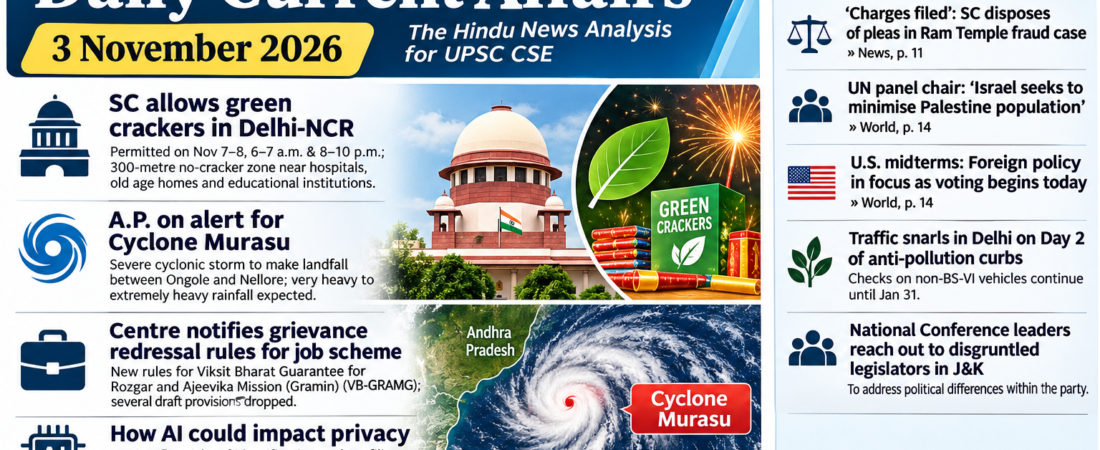
The 3 November 2026 edition of The Hindu covers several important developments concerning constitutional governance, electoral reforms, environmental protection, digital privacy, rural employment, disaster management and India’s economic transformation.
The most significant issues include the Supreme Court’s conditional permission for green firecrackers in Delhi-NCR, preparations for Census 2027, the constitutional position of State Legislative Councils, emerging challenges to privacy in the age of Artificial Intelligence, and the strategic and environmental implications of the proposed Siang Upper Multipurpose Project.
The newspaper also examines the new grievance-redressal framework under VB-G RAM G, the rehabilitation of bonded labourers, Delhi’s deteriorating air quality, regulation of airline fares and developments in India’s manufacturing and AI infrastructure.
These developments provide important material for understanding the relationship between constitutional rights, public policy, technological development, environmental sustainability and inclusive governance.
PART I – POLITY AND GOVERNANCE
1. Supreme Court Permits Conditional Use of Green Firecrackers in Delhi-NCR
GS Paper II – Fundamental Rights and Judicial Activism
GS Paper III – Environmental Pollution
Why is this in the news?
The Supreme Court permitted the conditional sale and bursting of certified green firecrackers in Delhi-NCR during Deepavali.
A Bench comprising Justices M.M. Sundresh and Prasanna B. Varale recognised the religious and cultural significance of Deepavali celebrations but emphasised that unregulated firecracker use causes severe environmental pollution and public-health hazards.
The Court observed that children, elderly persons and persons with disabilities are particularly vulnerable to the harmful effects of air and noise pollution.
Important directions issued by the Supreme Court
| Issue | Supreme Court’s direction |
|---|---|
| Permitted dates | November 7 and 8, 2026 |
| Morning timing | 6 a.m. to 7 a.m. |
| Evening timing | 8 p.m. to 10 p.m. |
| Permitted products | Certified green firecrackers |
| Restricted areas | 300-metre radius around hospitals, nursing homes, health centres, old-age homes and notified silence zones |
| Educational institutions | Covered under the no-cracker-zone restrictions |
| Certification | Manufacturers certified by CSIR-NEERI and PESO |
| QR codes | Product-specific QR codes mandatory |
| Prohibited products | Conventional crackers containing toxic barium compounds and firecrackers joined in series, including laddis and garlands |
The Court directed that the manufacture of authorised green firecrackers could take place between November 2 and November 6.
The boxes must remain sealed and cannot be mixed with unauthorised or conventional firecrackers.
Constitutional dimensions
The judgment involves an important balance between religious freedom and environmental protection.
Article 25 – Freedom of religion
Article 25 guarantees freedom of conscience and the right freely to profess, practise and propagate religion.
However, this right is subject to:
- Public order.
- Morality.
- Health.
- Other provisions of Part III of the Constitution.
The Court emphasised that a religious practice cannot be exercised in a manner that disregards these constitutional restrictions.
Article 21 – Right to life
The Supreme Court has interpreted Article 21 to include the right to a healthy and pollution-free environment.
The Court connected the protection of public health with the constitutional right to life.
Significance of green firecrackers
Green firecrackers are designed to reduce certain harmful emissions compared with conventional firecrackers.
However, they do not eliminate pollution entirely.
Their use must therefore be accompanied by effective certification, quality control and enforcement.
Implementation challenges
The newspaper’s ground report from Sadar Bazar and Jama Masjid identified continued clandestine sale of banned conventional crackers.
The police reported difficulties in distinguishing genuine green crackers from conventional products through visual inspection alone.
The North District Police had seized over 1,200 kg of firecrackers and registered at least 10 cases under the Explosives Act during the preceding ten days.
This demonstrates the gap between judicial directions and actual implementation.
Way forward
- Strengthen the certification and traceability of green firecrackers.
- Improve enforcement against illegal manufacturers and sellers.
- Use QR-based verification systems.
- Promote community awareness regarding pollution and public health.
- Encourage environmentally responsible forms of celebration.
- Strengthen pollution monitoring during festivals.
UPSC Mains perspective: The right to religious freedom must be harmonised with the right to health and environmental protection. Constitutional freedoms operate within the framework of reasonable restrictions and competing public interests.
2. Census 2027: Preparing Enumerators for Population Enumeration
GS Paper II – Governance and Public Administration
GS Paper I – Population and Society
Why is this in the news?
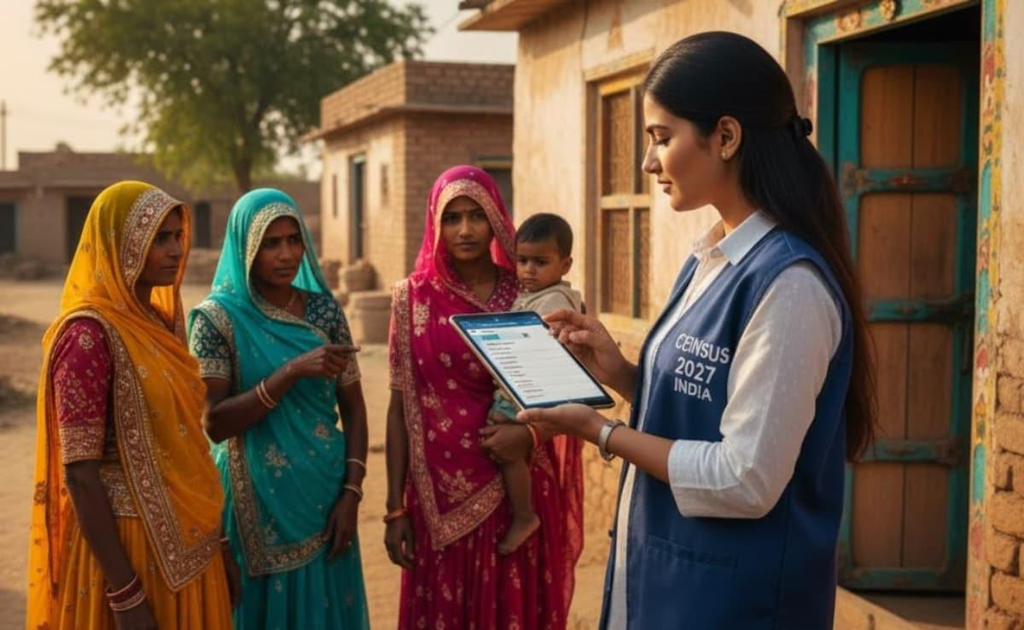
The second phase of Census 2027, known as Population Enumeration, is scheduled to begin with door-to-door enumeration in Uttar Pradesh and three other poll-bound States – Uttarakhand, Goa and Punjab – on December 1, 2026.
The exercise will begin in the remaining parts of the country in January 2027.
The government has initiated training programmes for enumerators to ensure accuracy, completeness and reliability of census data.
Scale of the exercise
- Approximately 34 lakh enumerators will participate.
- Most enumerators are expected to be government schoolteachers.
- Private-school teachers and members of institutions, societies and trusts have also been made eligible for appointment.
- Population Enumeration will involve 40 questions.
- Enumerators are expected to spend approximately 20–25 minutes with each respondent.
Digital Census
Census 2027 is India’s first digital census.
Enumerators will collect information through a mobile application installed on their phones.
This is expected to improve:
- Data collection efficiency.
- Speed of processing.
- Accuracy of information.
- Standardisation of records.
- Availability of digital datasets.
However, digital collection also requires strong safeguards against data errors, unauthorised access and misuse of personal information.
PRAMAN framework
The government has introduced a framework called PRAMAN to improve interactions between enumerators and households.
| Component | Meaning |
|---|---|
| P | Pehchaan – Identity |
| R | Rishta – Rapport |
| A | Anurodh – Request |
| M | Madad – Assistance |
| A | Aankada Shuddhata – Data Accuracy |
| N | Nishtha – Commitment |
The framework will be incorporated into training programmes and reinforced through a Seva Bhav pledge.
Training pyramid
The Census training programme follows a hierarchical structure.
National Trainers → Master Trainers → Field Trainers → Enumerators and Supervisors.
Training batches are expected to consist of approximately 35–50 participants.
Hands-on practice using the Population Enumeration mobile application is mandatory.
Sensitive information to be collected
The Population Enumeration phase will cover several sensitive demographic and socio-economic indicators.
These include:
- Religion.
- Mother tongue.
- Scheduled Caste and Scheduled Tribe status.
- Caste.
- Disability.
- Migration.
- Fertility.
- Economic activity.
- Family and parental particulars.
Caste enumeration
The Census will include a caste-related question.
The questionnaire provides predetermined categories for Scheduled Castes and Scheduled Tribes.
Other caste names are to be entered in an open text field.
Respondents will also have the options of not declaring their caste or indicating that they have no caste.
This makes the exercise significant because it represents an important stage in India’s first caste enumeration since Independence.
Aadhaar-related questions
The newspaper reports that the questionnaire includes a question seeking Aadhaar details, if available.
A field trainer reportedly advised enumerators to explain the purpose of collecting the information.
However, a senior Census official clarified that there was no instruction to link Aadhaar information with any citizenship test.
The official stated that the Aadhaar question is optional and that respondents’ answers regarding possession or non-possession of Aadhaar would be recorded accordingly.
Why is Census data important?
Census data serves several purposes:
- Population estimation.
- Delimitation-related exercises.
- Welfare programme planning.
- Resource allocation.
- Urban planning.
- Infrastructure development.
- Social-sector policy formulation.
- Demographic and economic research.
Challenges
1. Data privacy
Sensitive information concerning religion, caste, disability and fertility must be protected.
2. Digital exclusion
Enumerators must ensure that technological limitations do not compromise data collection.
3. Data accuracy
Incorrect classification and recording can affect policy decisions.
4. Social sensitivity
Questions concerning caste and religion require neutrality and sensitivity.
5. Public trust
Citizens must have confidence that census information will be used only for legitimate statistical and administrative purposes.
Way forward
- Strengthen data-protection safeguards.
- Ensure clear instructions for enumerators.
- Maintain strict confidentiality.
- Establish transparent procedures for data correction.
- Improve training and supervision.
- Avoid linking census participation with unrelated administrative purposes.
UPSC takeaway: A credible census is the foundation of evidence-based governance. The quality of demographic data directly influences the effectiveness of welfare policies and development planning.
3. State Legislative Councils: Constitutional Position, Powers and Reforms
GS Paper II – State Legislature and Constitutional Bodies
Why is this in the news?
Recent elections to Legislative Council seats in Uttar Pradesh, Bihar, Maharashtra and Karnataka have renewed public interest in the constitutional position and functioning of State Legislative Councils.
The newspaper carries a detailed explainer on their composition, powers, historical evolution and possible reforms.
What is a Legislative Council?
A Legislative Council is the upper house of a bicameral State Legislature.
A State may have either:
- A unicameral legislature consisting only of a Legislative Assembly; or
- A bicameral legislature consisting of a Legislative Assembly and a Legislative Council.
Constitutional provisions
| Article | Provision |
|---|---|
| Article 168 | Constitution of State Legislatures |
| Article 169 | Creation or abolition of Legislative Councils |
| Article 170 | Composition of Legislative Assemblies |
| Article 171 | Composition of Legislative Councils |
| Article 172 | Duration of State Legislatures |
| Article 173 | Qualification for membership |
States having Legislative Councils
According to the newspaper, the six States with Legislative Councils are:
- Andhra Pradesh.
- Telangana.
- Uttar Pradesh.
- Bihar.
- Maharashtra.
- Karnataka.
Creation and abolition – Article 169
Parliament can create or abolish a Legislative Council in a State through an ordinary law.
However, the process must begin with a resolution passed by the concerned State Legislative Assembly.
The resolution must be supported by:
- A majority of the total membership of the Assembly; and
- At least two-thirds of the members present and voting.
This is a special majority requirement.
Parliament can subsequently enact the necessary law through its ordinary legislative procedure.
Composition – Article 171
The total membership of a Legislative Council cannot exceed one-third of the total membership of the State Legislative Assembly.
However, its membership cannot be less than 40.
The composition is broadly as follows:
| Category | Share |
|---|---|
| Elected by local authorities | One-third |
| Elected by graduates | One-twelfth |
| Elected by teachers | One-twelfth |
| Elected by MLAs | One-third |
| Nominated by the Governor | Remaining one-sixth |
The Governor nominates members having special knowledge or practical experience in areas such as literature, science, art, cooperative movement and social service.
Duration – Article 172
A Legislative Council is a permanent body.
It is not subject to dissolution.
One-third of its members retire every two years.
The normal term of an individual member is six years.
Powers of Legislative Councils
Legislative Councils have significantly weaker powers than Legislative Assemblies.
1. Ordinary Bills
A Legislative Council can delay an ordinary Bill but cannot permanently block it.
If the Assembly passes a Bill again, the Assembly’s decision prevails.
There is no provision for a joint sitting to resolve disagreements between the two Houses of a State Legislature.
2. Money Bills
A Money Bill can originate only in the Legislative Assembly.
The Legislative Council can make recommendations within 14 days.
The Assembly may accept or reject those recommendations.
3. Executive accountability
The Council cannot remove the State government through a no-confidence motion.
The Council of Ministers is collectively responsible to the Legislative Assembly.
4. Ministerial membership
A person can become a Minister, including the Chief Minister, while being a member of the Legislative Council, subject to constitutional requirements.
Arguments in favour of Legislative Councils
- They provide a revising chamber.
- They enable experienced individuals to participate in legislative work.
- They provide representation to local bodies, teachers and graduates.
- They can prevent hasty legislation.
- They create opportunities for specialised debate.
Arguments against Legislative Councils
- They increase public expenditure.
- Their legislative powers are limited.
- They may become instruments of political accommodation.
- They can delay legislative processes.
- Their creation and abolition are sometimes influenced by political considerations.
Second Administrative Reforms Commission recommendation
The Second Administrative Reforms Commission, in its 2007 report on Local Governance, suggested transforming Legislative Councils into Councils of Local Governments.
It recommended that members could be elected exclusively through representatives of local bodies.
This would strengthen the representation of local self-government institutions and reduce the importance of separate graduate and teacher constituencies.
Way forward
Legislative Councils should be evaluated on the basis of their contribution to democratic deliberation rather than political convenience.
Reforms should focus on:
- Strengthening local-government representation.
- Improving the quality of legislative scrutiny.
- Ensuring financial accountability.
- Improving transparency in nominations.
- Promoting evidence-based legislative debate.
UPSC takeaway: Legislative Councils are intended to strengthen deliberative democracy through a revising chamber, but their effectiveness depends on institutional quality and meaningful representation.
4. Artificial Intelligence and the Right to Privacy: Gaps in India’s Data Protection Framework
GS Paper II – Fundamental Rights and Governance
GS Paper III – Artificial Intelligence and Emerging Technologies
Why is this in the news?
The editorial article titled How AI training models could compromise privacy examines the limitations of India’s Digital Personal Data Protection (DPDP) framework in dealing with emerging AI-related privacy risks.
It argues that AI models can identify and profile individuals even when the original data has been anonymised.
Constitutional background
The Supreme Court recognised the Right to Privacy as a fundamental right in:
Justice K.S. Puttaswamy v. Union of India (2017).
The judgment established that privacy is protected under Article 21 and other fundamental freedoms.
Evolution of India’s data-protection framework
Information Technology Act, 2000
The IT Act provided the initial legal framework for regulating electronic information and certain forms of sensitive personal data.
IT Rules, 2011
The rules prescribed requirements concerning the handling and transfer of sensitive personal data.
Digital Personal Data Protection Act, 2023
The DPDP Act established a general legal framework for processing digital personal data.
DPDP Rules, 2025
The rules were notified in November 2025, with phased implementation of different provisions.
How does AI create new privacy risks?
AI models are trained on enormous datasets obtained from multiple sources.
These datasets may include:
- Social-media content.
- Photographs and videos.
- Publicly accessible information.
- Online behavioural patterns.
- Personal preferences.
- Digital interactions.
AI systems may use such information to infer attributes that were not explicitly provided by individuals.
Important privacy risks
1. Re-identification
Even anonymised datasets may contain sufficient patterns to identify individuals.
2. Data memorisation
AI models may reproduce certain information contained in their training datasets.
3. Profiling
AI systems can infer personal attributes, behavioural patterns, preferences and other sensitive characteristics.
4. Lack of consent
Individuals may not know that their publicly available information is being used to train commercial AI models.
5. Limited control
Individuals may find it difficult to prevent their information from being used for AI training or to remove inferred information.
Gaps identified by the editorial
The article highlights several concerns.
A. Publicly available information
The DPDP Act does not extend its general protection to publicly available personal data in the same manner as other covered personal data.
This raises concerns regarding the use of publicly scraped information.
B. Inferred personal data
Information derived through AI-based analysis may reveal sensitive characteristics even when the underlying data appears harmless.
C. Sensitive-data classification
The editorial argues that the DPDP Act does not establish a separate category of sensitive personal data with stronger protections comparable to the earlier framework.
D. AI training and consent
The article highlights the absence of a clear mechanism allowing individuals to object to the use of their data in AI training.
E. Right to erasure
The scope of deletion rights in relation to information inferred from previously processed data remains a concern.
F. Research exemption
The editorial argues that the relationship between AI training and the research exemption requires greater legal clarity.
Balancing privacy and innovation
Excessive regulation can inhibit innovation and economic growth.
At the same time, insufficient safeguards can weaken fundamental rights.
India therefore needs a balanced regulatory framework that protects citizens without unnecessarily restricting legitimate technological development.
Way forward
- Extend appropriate privacy safeguards to AI training datasets.
- Establish stronger protections for sensitive personal information.
- Improve transparency concerning data collection and processing.
- Provide meaningful rights to object to certain uses of personal information.
- Clarify the application of research exemptions.
- Strengthen accountability of AI developers and data fiduciaries.
- Establish mechanisms for dealing with re-identification and data memorisation risks.
UPSC takeaway: The challenge is to ensure that technological innovation remains compatible with constitutional rights, individual autonomy and democratic accountability.
5. Supreme Court: Electoral Authorities Cannot Monopolise Voter Awareness Campaigns
GS Paper II – Election Commission and Democratic Governance
Why is this in the news?
The Supreme Court observed that electoral authorities cannot monopolise voter-awareness campaigns.
The observation came while hearing a case involving restrictions on civil-society groups conducting voter-awareness activities in West Bengal.
Justice Joymalya Bagchi observed that the Election Commission’s responsibility to conduct voter-awareness programmes does not prevent other legitimate organisations from undertaking similar activities.
However, unlawful activities and corrupt practices can be regulated.
Constitutional and institutional significance
The Election Commission derives its authority from Article 324 of the Constitution.
Its responsibilities include the superintendence, direction and control of elections.
However, democratic participation also involves civil society, voluntary organisations, educational institutions and citizens.
Significance
- Encourages participatory democracy.
- Recognises the role of civil society.
- Prevents unnecessary monopolisation of voter education.
- Strengthens democratic awareness.
- Requires a balance between public order and freedom of expression.
Mains perspective: Electoral administration must facilitate democratic participation rather than unnecessarily restrict legitimate civic engagement.
PART II – RURAL DEVELOPMENT AND SOCIAL JUSTICE
6. VB-G RAM G: New Grievance-Redressal Rules Drop Important Provisions
GS Paper II – Government Policies and Interventions
GS Paper III – Inclusive Growth and Rural Employment
Why is this in the news?
The Union Ministry of Rural Development notified new grievance-redressal rules under the Viksit Bharat Guarantee for Rozgar and Ajeevika Mission (Gramin), or VB-G RAM G.
The newspaper reports that the notified rules dropped several provisions that had been included in the draft rules circulated in May.
These provisions had also formed part of the earlier MGNREGA grievance-redressal framework.
Important provisions dropped
Two major provisions were removed:
- Mandatory registration of an FIR when prima facie evidence of financial irregularities was found.
- Mandatory placement of action-taken reports before local-body meetings for review and monitoring.
The proposal to designate one day every week for grievance officers to receive complaints was also dropped.
Provisions under the new rules
The new framework allows complaints concerning any matter related to the implementation of the scheme.
Grievances may be submitted through:
- Personal submission before the designated Grievance Redressal Officer.
- Speed Post.
- Digital grievance platforms.
- Telephone helplines.
- Other methods specified by State governments.
A complaint cannot be refused merely because of its format, language, manner of submission or procedural deficiencies.
Time limits
| Activity | Time limit |
|---|---|
| Entry of physical complaints into digital platform | Same day or next working day |
| Preliminary inquiry | Seven days |
| Resolution of grievances | 15 days |
| Escalation of unresolved complaints | After 15 days |
The complainant must receive an acknowledgement containing the registration number, date of receipt and details of the receiving authority.
Grievance officers are required to examine complaints, obtain relevant records and communicate findings and action taken.
Why is grievance redressal important?
Rural employment programmes involve large public expenditure and multiple implementing agencies.
An effective grievance-redressal system is necessary to prevent:
- Wage-related irregularities.
- Corruption.
- Fake job cards.
- Denial of employment.
- Delays in wage payments.
- Administrative discrimination.
- Misappropriation of public funds.
Concerns
The removal of certain provisions may weaken institutional accountability if alternative monitoring mechanisms are not sufficiently strong.
The absence of mandatory FIR registration in cases involving prima facie financial irregularities raises questions about deterrence.
Similarly, the removal of mandatory action-taken reports before local bodies may reduce opportunities for community-based oversight.
Way forward
- Strengthen social audits.
- Ensure transparent public disclosure of expenditure.
- Provide independent investigation of serious financial irregularities.
- Strengthen Gram Sabha oversight.
- Establish effective appellate mechanisms.
- Ensure time-bound disposal of complaints.
UPSC takeaway: The effectiveness of rural employment programmes depends not only on budgetary allocation and employment guarantees but also on transparency, accountability and accessible grievance-redressal mechanisms.
7. Supreme Court Directs Time-Bound Rehabilitation of Bonded Labourers
GS Paper II – Social Justice and Vulnerable Sections
Why is this in the news?
The Supreme Court observed that the State’s constitutional responsibility towards bonded labourers does not end with their release.
The Court directed the Union government to establish a uniform procedure for timely financial assistance and rehabilitation.
Important directions
- Financial assistance should ordinarily be disbursed within seven days of release.
- The existing rehabilitation scheme should be reconsidered within three months.
- The revised framework should provide subsistence support when financial assistance is delayed.
- All States and Union Territories should implement the revised Standard Operating Procedure within six months.
- Complaints should ordinarily be verified within 24 hours.
- Rescue operations should be undertaken promptly wherever necessary.
- Release certificates should ordinarily be issued within 24 hours after the necessary inquiry.
The Centre was also asked to issue supplementary guidelines in consultation with the National Human Rights Commission.
Constitutional provisions
Article 21: Protection of life and personal liberty.
Article 23: Prohibition of human trafficking, begar and other similar forms of forced labour.
Article 24: Prohibition of employment of children below 14 years in factories, mines and hazardous employment.
Article 39(e): Protection of workers’ health and strength and prevention of economic exploitation.
Article 39(f): Protection of children and opportunities for their development.
Bonded Labour System (Abolition) Act, 1976
The Act abolishes the bonded labour system and extinguishes the obligation to repay bonded debts.
It also provides for the release of bonded labourers and related legal measures.
Why is rehabilitation essential?
Merely releasing bonded labourers does not ensure their economic independence.
Without adequate rehabilitation, they may return to exploitative employment due to poverty, debt and lack of alternative livelihoods.
Rehabilitation must therefore include:
- Financial assistance.
- Housing.
- Skill development.
- Access to education.
- Social-security benefits.
- Livelihood opportunities.
- Legal assistance.
Way forward
India must move from a rescue-oriented approach to a comprehensive rehabilitation-oriented framework.
The focus should be on preventing re-bondage and ensuring that rescued individuals can exercise their rights with dignity.
PART III – ENVIRONMENT AND DISASTER MANAGEMENT
8. Delhi’s Air Quality Deteriorates: Stage II of GRAP Invoked
GS Paper III – Environmental Pollution
Why is this in the news?
Delhi’s air quality deteriorated to the very poor category for the first time during the winter season.
The Commission for Air Quality Management (CAQM) invoked Stage II of the Graded Response Action Plan.
The 24-hour average Air Quality Index stood at 324 at 4 p.m. on November 2, compared with 261 a day earlier.
Understanding the Air Quality Index
The AQI is a numerical indicator used to communicate the quality of ambient air.
It is based on the concentration of selected pollutants, including:
- PM2.5.
- PM10.
- Nitrogen dioxide.
- Sulphur dioxide.
- Carbon monoxide.
- Ozone.
- Ammonia.
AQI classification
| AQI range | Category |
|---|---|
| 0–50 | Good |
| 51–100 | Satisfactory |
| 101–200 | Moderate |
| 201–300 | Poor |
| 301–400 | Very Poor |
| 401–500 | Severe |
What is GRAP?
The Graded Response Action Plan is an emergency framework for implementing short-term pollution-control measures in Delhi-NCR.
It contains four stages:
- Stage I – Poor.
- Stage II – Very Poor.
- Stage III – Severe.
- Stage IV – Severe Plus.
Measures under Stage II
The measures include:
- Increased parking fees to discourage private vehicle use.
- Staggering of timings for government offices and municipal bodies.
- Increased public-transport services.
- Additional metro services.
- Strengthened dust-control measures.
- More intensive monitoring of pollution sources.
The Delhi Metro announced additional weekday trips to encourage commuters to use public transport.
Causes of Delhi’s air pollution
1. Vehicular emissions
Private vehicles and commercial transport contribute to particulate and gaseous emissions.
2. Industrial pollution
Industrial units and power-generation activities contribute to air pollution.
3. Construction dust
Construction and demolition activities generate significant particulate matter.
4. Biomass and crop-residue burning
Seasonal agricultural burning contributes to regional pollution episodes.
5. Meteorological conditions
Low wind speeds, temperature inversion and a shallow atmospheric boundary layer can trap pollutants near the surface.
6. Firecrackers
Firecracker emissions can cause temporary spikes in particulate matter and other pollutants.
Challenges
- Regional nature of air pollution.
- Weak inter-State coordination.
- Dependence on private transport.
- Limited enforcement capacity.
- Continued construction-dust emissions.
- Need for sustained rather than emergency-only measures.
Way forward
- Strengthen NCR-wide public transport.
- Accelerate cleaner industrial technologies.
- Improve construction-dust management.
- Expand electric mobility.
- Promote crop-residue management alternatives.
- Strengthen pollution monitoring.
- Develop regional airshed-based action plans.
UPSC takeaway: Air pollution is an airshed-level governance challenge. It requires coordinated action across administrative boundaries and sectors.
9. Indonesia’s Forest Fires: More Than 1.9 Million Hectares Burned
GS Paper III – Environmental Conservation and Climate Change
Why is this in the news?
An analytical report in The Hindu examines the severe forest and peatland fires in Indonesia.
According to Nusantara Atlas FireWatch data cited in the report, more than 1.9 million hectares were burned between January and September 2026.
The annual hotspot count had already exceeded the yearly totals recorded between 2019 and 2025.
Major causes
1. Land clearing
Vegetation is deliberately burned to clear land for agriculture and plantations.
2. Peatland degradation
Peatlands are wetlands containing large quantities of partially decomposed organic material.
When drained and dried for development, they become highly vulnerable to fire.
3. Unusually dry weather
Reduced rainfall increases the likelihood of vegetation fires.
4. El Niño and Indian Ocean Dipole
According to Indonesia’s meteorological agency, strong El Niño conditions and the IOD contributed to reduced rainfall in the region.
Important statistics
- More than 1.9 million hectares burned between January and September 2026.
- Burned area was 38% higher than the corresponding period in 2019.
- The burned area was more than twice that recorded by September 2023.
- An estimated 5,310 pollution-related deaths occurred in September.
- Approximately 3,560 deaths were attributed to smoke from forest and land fires.
- Around 58 million people were exposed to unhealthy or hazardous air.
- High PM2.5 exposure was associated with approximately 3,33,470 acute respiratory infection cases across seven affected provinces.
These figures are estimates cited in the newspaper’s report.
Why are peatlands environmentally important?
Peatlands perform several important ecological functions:
- Store large quantities of carbon.
- Regulate water flows.
- Support biodiversity.
- Maintain hydrological balance.
- Reduce flood risks under suitable ecological conditions.
When peatlands burn, large quantities of stored carbon are released into the atmosphere.
Peat fires can also continue underground, making them difficult to extinguish.
Transboundary implications
Smoke and haze from Indonesian fires affect neighbouring countries, including:
- Malaysia.
- Singapore.
Singapore has initiated action under its Transboundary Haze Pollution Act.
The foreign ministers of Indonesia and Singapore have also discussed the possibility of a joint task force to address the problem.
Way forward
- Protect and restore peatlands.
- Prevent illegal land clearing.
- Strengthen satellite-based fire monitoring.
- Promote sustainable plantation practices.
- Improve regional cooperation.
- Develop community-based fire-prevention mechanisms.
- Strengthen enforcement against environmentally destructive practices.
UPSC takeaway: Forest fires are not merely local environmental disasters. They have implications for climate change, public health, biodiversity and regional environmental diplomacy.
PART IV – GEOGRAPHY, WATER SECURITY AND INTERNATIONAL RELATIONS
10. Siang Upper Multipurpose Project: India, China and Transboundary River Governance
GS Paper II – India-China Relations
GS Paper I – Indian Geography
GS Paper III – Water Security and Environmental Governance
Why is this in the news?
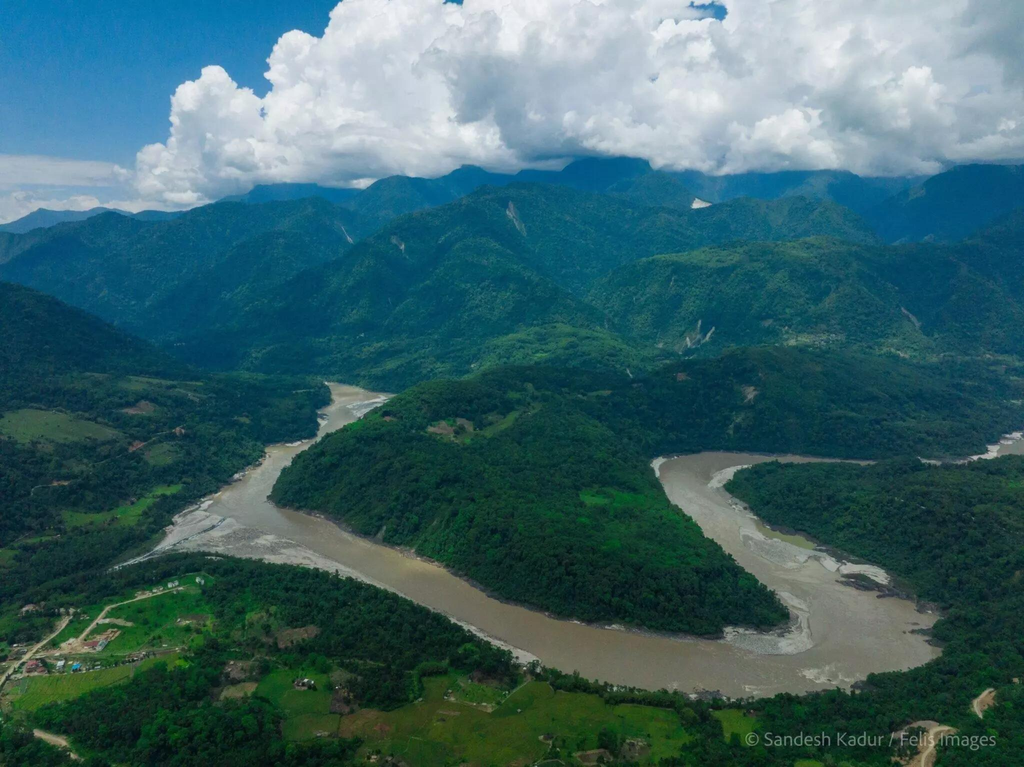
An editorial examines India’s proposed 11.2-GW Siang Upper Multipurpose Project (SUMP) in Arunachal Pradesh.
The project has gained strategic significance in the context of China’s proposed 60-GW mega-dam in Tibet on the Yarlung Tsangpo River.
The Yarlung Tsangpo flows through Tibet before entering India, where it is known as the Brahmaputra.
Strategic concerns
The editorial discusses concerns that China’s upstream infrastructure could potentially influence downstream water flows.
Two major scenarios are highlighted:
1. Water diversion
Changes in river flows could create water shortages in downstream regions under certain conditions.
2. Sudden water releases
Large-scale releases could increase the risk of flooding in Arunachal Pradesh and Assam.
These are strategic concerns discussed in the editorial; they should not be interpreted as proof that China has decided to use water as a weapon.
Siang Upper Multipurpose Project
The proposed project has an installed capacity of approximately 11.2 GW.
It is viewed by Indian authorities partly as a strategic response to China’s upstream dam development.
The project, however, has generated resistance among local communities, particularly the Adi community.
Geographical significance of the Brahmaputra
The Brahmaputra is an important transboundary river system flowing through:
- China.
- India.
- Bangladesh.
It is known as:
- Yarlung Tsangpo in Tibet.
- Siang or Dihang in Arunachal Pradesh.
- Brahmaputra in Assam.
- Jamuna in Bangladesh.
Environmental concerns
The eastern Himalayas are among the world’s most tectonically active and erosion-prone regions.
Large dams in such areas involve several risks:
- Earthquake-related risks.
- Landslides.
- Sedimentation.
- River-flow alteration.
- Biodiversity loss.
- Displacement of local communities.
- Changes in downstream ecosystems.
The problem of hydrological data sharing
The editorial points out that India has limited access to crucial engineering information concerning China’s proposed project.
China has agreed to share hydrological data on humanitarian grounds during emergencies, but broader information-sharing remains limited.
This creates uncertainty in planning the Indian project.
Local community concerns
The Adi community and civil-society organisations have raised concerns over:
- Land acquisition.
- Displacement.
- Environmental damage.
- Livelihood disruption.
- Lack of adequate consultation.
The editorial argues that strategic concerns cannot justify ignoring local rights and environmental safeguards.
Reservoir management
The editorial notes that planners have contemplated maintaining the SUMP reservoir at approximately 70% capacity to accommodate unexpected water surges.
However, the degree of protection possible without advance information from China remains uncertain.
Way forward
1. Transboundary cooperation
India should continue diplomatic engagement with China for regular hydrological data sharing and advance information.
2. Environmental assessment
Independent and comprehensive environmental impact assessments must be undertaken.
3. Community consultation
The rights and concerns of the Adi community must be addressed through meaningful consultation.
4. Disaster preparedness
Flood forecasting and emergency-response systems must be strengthened.
5. Basin-level planning
The Brahmaputra should be managed through an integrated river-basin approach.
6. International cooperation
India should promote cooperative arrangements for transboundary water management.
UPSC takeaway: Strategic infrastructure in ecologically fragile regions must balance national security, environmental sustainability, federal governance and the rights of local communities.
PART V – ECONOMY AND INFRASTRUCTURE
11. Government Can Intervene in Airline Fares During Extraordinary Situations
GS Paper III – Infrastructure and Regulatory Governance
Why is this in the news?
The Union government has notified new rules under the Bharatiya Vayuyan Adhiniyam, 2024, enabling it to issue written directions to airlines regarding airfares during extraordinary situations in the public interest.
The rules were notified through the e-Gazette on October 31.
Background
The government has intervened in airfares on previous occasions.
Examples include:
- COVID-19 pandemic.
- IndiGo’s operational crisis.
- Kumbh Mela.
- Pahalgam attacks.
- Natural disasters, including Kerala floods.
Such interventions were intended to prevent excessive fare increases during periods of exceptional demand or disruption.
Major provisions
- The government can issue written directions concerning fares in extraordinary situations.
- Airlines must submit their tariffs to the Directorate General of Civil Aviation.
- Airlines must publish fares on their websites or specified digital platforms.
- Booking platforms and tickets must display the total amount payable.
- Fare details must include base fares, taxes, fees and cancellation charges.
- Refund conditions and other applicable charges must be disclosed.
No general fare caps
The rules do not introduce permanent fare caps.
The government has retained the principle that airfares are generally market-driven and influenced by:
- Demand and supply.
- Seat occupancy.
- Fuel costs.
- Aircraft capacity.
- Seasonal variations.
Significance
The framework attempts to balance market-based pricing with consumer protection.
It can help prevent excessive price increases during emergencies and improve transparency in the aviation sector.
Challenges
- Defining extraordinary situations.
- Avoiding arbitrary intervention.
- Ensuring transparency in dynamic pricing.
- Protecting consumer interests.
- Maintaining the financial viability of airlines.
UPSC takeaway: Infrastructure regulation must balance market efficiency, consumer protection and public interest.
12. Manufacturing PMI Eases to 54.7 in October 2026
GS Paper III – Indian Economy
Why is this in the news?
The HSBC India Manufacturing Purchasing Managers’ Index declined to 54.7 in October 2026 from 55.1 in September.
However, the survey indicated that manufacturing activity remained strong by historical standards.
New export orders rose to their highest level in six months.
What is PMI?
The Purchasing Managers’ Index is an economic indicator based on surveys of purchasing managers in selected businesses.
It provides information on changes in:
- New orders.
- Production.
- Employment.
- Supplier delivery times.
- Inventory levels.
Interpretation
| PMI value | Interpretation |
|---|---|
| Above 50 | Expansion |
| Below 50 | Contraction |
| Equal to 50 | No change |
A PMI of 54.7 indicates continued expansion in manufacturing activity, although the pace of expansion moderated compared with September.
Significance
- Provides an early indication of economic activity.
- Helps assess manufacturing-sector momentum.
- Captures changes in domestic and export demand.
- Offers insights into business confidence.
UPSC takeaway: PMI is a useful high-frequency indicator, but it should be interpreted alongside official industrial production, GDP and employment data.
13. Finance Minister Reaffirms Government’s Commitment to Capital Expenditure
GS Paper III – Public Finance and Infrastructure Development
Why is this in the news?
Union Finance Minister Nirmala Sitharaman reiterated the government’s commitment to sustaining capital expenditure to support economic growth.
She emphasised that fiscal prudence would remain non-negotiable.
Why is public capital expenditure important?
Capital expenditure creates productive assets such as:
- Roads.
- Railways.
- Ports.
- Airports.
- Power infrastructure.
- Irrigation facilities.
- Digital infrastructure.
Multiplier effect
Government investment can generate demand in multiple sectors.
For example:
Government infrastructure spending → Increased demand for cement and steel → Higher industrial production → Employment generation → Increased household income → Greater consumption.
This is known as the multiplier effect.
Why is public investment important?
Private investment may remain subdued when businesses lack confidence in future demand.
Government capital expenditure can create infrastructure and stimulate economic activity, encouraging private investment.
Challenges
- Maintaining fiscal sustainability.
- Ensuring quality of expenditure.
- Preventing delays in project implementation.
- Improving project selection.
- Mobilising private investment.
Mains perspective: Public capital expenditure can act as a growth catalyst, but its effectiveness depends on productivity, project quality and fiscal sustainability.
14. Petronet LNG Reports 53.2% Growth in Net Profit
GS Paper III – Energy Security and Indian Economy
Petronet LNG reported a 53.2% increase in net profit in the September-ended quarter.
Its net profit rose to ₹1,235 crore from ₹806 crore in the corresponding period of the previous year.
The growth was attributed to improved operational efficiency.
However, LNG cargo supplies from Qatar continued to be affected by renewed conflict in West Asia.
The company also declared a dividend of ₹7 per equity share.
Significance
The development highlights the importance of:
- Natural gas infrastructure.
- LNG import terminals.
- Energy diversification.
- Operational efficiency.
- Energy supply-chain resilience.
India’s energy-security challenge
India depends significantly on imported energy resources.
Geopolitical disruptions in West Asia can influence:
- LNG availability.
- Import costs.
- Domestic energy prices.
- Industrial production.
- Energy security.
India must therefore diversify supply sources and strengthen domestic energy infrastructure.
15. Chennai Emerges as an AI Infrastructure Hub
GS Paper III – Artificial Intelligence and Digital Infrastructure
Why is this in the news?
U.S.-based cloud infrastructure company Vultr announced a 20-MW AI supercluster in Chennai.
The facility will use AMD Instinct MI355X GPUs and is expected to house approximately 10,000 GPUs in its initial configuration.
The company plans to expand the facility in 2027 using newer GPU systems and rack-scale AI architecture.
Why is AI infrastructure important?
AI models require enormous computational resources.
The infrastructure ecosystem includes:
- Graphics Processing Units.
- High-performance computing systems.
- Data centres.
- Cloud infrastructure.
- High-speed networking.
- Energy and cooling systems.
Significance for India
1. Digital economy
AI infrastructure can support the expansion of India’s digital economy.
2. Research and innovation
Access to high-performance computing can support universities, startups and research institutions.
3. Industrial applications
AI can improve manufacturing, healthcare, agriculture and logistics.
4. Strategic autonomy
Domestic computational capacity can reduce excessive dependence on foreign infrastructure.
Challenges
- High electricity consumption.
- Cooling requirements.
- Semiconductor dependence.
- Data sovereignty.
- Cybersecurity.
- High capital expenditure.
Way forward
India must develop an integrated AI ecosystem combining domestic computing infrastructure, semiconductor manufacturing, renewable energy, research institutions and skilled human resources.
PART VI – INTERNATIONAL RELATIONS
16. U.S. Midterm Elections: Foreign Policy Becomes a Domestic Political Issue
GS Paper II – International Relations
Why is this in the news?
The United States is voting in midterm elections on November 3, 2026.
The newspaper’s analysis highlights the influence of foreign policy issues on domestic electoral debates.
Three major issues dominate the discussion:
- The war involving Iran.
- Tariffs imposed by the Trump administration.
- U.S. support for Israel.
Iran war and domestic politics
The war has contributed to increased petrol and diesel prices.
Higher energy costs have affected households, farmers and businesses.
This has created political difficulties for Republican candidates, particularly in traditional party strongholds.
The newspaper reports that campaign advertisements in several competitive Senate and House races have linked the Iran war to the cost of living.
Tariff policy
The Trump administration has defended tariffs as a means of promoting domestic manufacturing and employment.
However, critics argue that tariffs can increase input costs and consumer prices.
U.S. support for Israel
The issue of U.S. support for Israel has also become a subject of political disagreement within the Democratic Party.
Why is this significant?
The developments demonstrate how foreign policy decisions can influence domestic economic conditions and electoral politics.
International conflicts can affect:
- Energy prices.
- Inflation.
- Trade.
- Public expenditure.
- Consumer confidence.
- Electoral behaviour.
UPSC takeaway: Foreign policy and domestic politics are increasingly interconnected through trade, energy security and global economic interdependence.
17. Iran Offers to Reopen the Strait of Hormuz
GS Paper II – West Asian Geopolitics
GS Paper III – Energy Security
Why is this in the news?
Iran stated that it was prepared to reopen the Strait of Hormuz within two days if the United States accepted its conditions.
The announcement came amid continuing geopolitical tensions and the ongoing conflict involving Iran.
Iran’s Foreign Ministry spokesperson Esmaeil Baqaei described the proposal as an indication of goodwill.
The two countries were reportedly exchanging messages through intermediaries.
Strategic significance of the Strait of Hormuz
The Strait of Hormuz connects the Persian Gulf with the Gulf of Oman and the Arabian Sea.
It is one of the world’s most important maritime energy corridors.
Large quantities of crude oil and LNG pass through this narrow waterway.
Why is it important for India?
India is a major energy importer.
Disruption in the Strait of Hormuz can affect:
- Crude oil imports.
- LNG supplies.
- International energy prices.
- Shipping insurance.
- Freight costs.
- India’s current account balance.
- Domestic inflation.
India’s policy priorities
- Diversify energy suppliers.
- Maintain strategic petroleum reserves.
- Strengthen maritime security.
- Promote alternative energy sources.
- Maintain diplomatic engagement with Gulf countries.
- Protect Indian commercial shipping interests.
UPSC takeaway: The Strait of Hormuz demonstrates how geopolitical instability in West Asia can directly influence India’s energy security and macroeconomic stability.
18. Israel-Palestine Conflict: UN Commission Chair Discusses Accountability
GS Paper II – International Organisations and International Law
Why is this in the news?
In an interview with The Hindu, Justice Srinivasan Muralidhar, chair of the UN-appointed Independent International Commission of Inquiry on the Occupied Palestinian Territory, discussed the Commission’s findings concerning Gaza and the West Bank.
He alleged that Israeli policies were aimed at expanding occupation and reducing the Palestinian population.
These are the views and findings attributed to the Commission chair in the newspaper interview.
Key issues raised
- Alleged violations of international humanitarian law.
- Civilian casualties.
- Displacement of Palestinians.
- Destruction of healthcare and civilian infrastructure.
- Restrictions on access to basic necessities.
- Concerns regarding children and vulnerable populations.
The interview also highlighted the absence of adequate drinking water, sanitation, shelter, healthcare and education in large parts of Gaza.
Accountability mechanisms
The Commission chair discussed the possibility of using universal jurisdiction.
Universal jurisdiction is a principle under which national courts may, subject to their domestic laws and applicable international obligations, prosecute certain serious international crimes irrespective of where they occurred or the nationality of the accused.
Two-State Solution
The two-state solution envisages the establishment of an independent Palestinian State alongside Israel.
It continues to receive broad international diplomatic support.
India’s position
India has traditionally supported a negotiated two-state solution and has maintained relations with both Israel and Palestine.
The issue requires India to balance:
- Strategic partnerships.
- Humanitarian concerns.
- International law.
- Regional stability.
- Its historical support for Palestinian statehood.
UPSC takeaway: India’s West Asia policy must reconcile strategic autonomy, humanitarian principles and the objective of a peaceful regional order.
PART VII – OTHER IMPORTANT NATIONAL DEVELOPMENTS
19. Supreme Court Closes Pleas Seeking CBI Probe into Ram Temple Donations Case
GS Paper II – Judiciary and Accountability
The Supreme Court disposed of multiple petitions seeking a CBI investigation into the alleged embezzlement of donations collected for the Ram Temple.
The Uttar Pradesh government informed the Court that its Special Investigation Team had already filed a chargesheet.
The Court allowed the petitioners to assist the trial court as victims of crime.
Significance
- Role of State investigation agencies.
- Judicial review of investigative processes.
- Accountability in public donations.
- Rights of victims to participate in criminal proceedings.
- Importance of transparent financial management.
The development should be understood as a procedural judicial decision and not as a determination of the guilt of the accused.
20. National Conference Leaders Reach Out to Dissident Legislators in Jammu and Kashmir
GS Paper II – Federalism and Regional Politics
The ruling National Conference initiated discussions with approximately 20 legislators who had expressed dissatisfaction with the party’s functioning.
The legislators reportedly sought organisational reforms, implementation of election promises and greater attention to the demand for restoration of Statehood and special status.
UPSC relevance
The development highlights:
- Internal democracy in political parties.
- Political representation in Jammu and Kashmir.
- Restoration of Statehood.
- Regional aspirations.
- Democratic accountability.
21. Supreme Court Emphasises Rehabilitation of Bonded Labourers
The Supreme Court’s directions on time-bound rehabilitation are especially important for social justice.
The Court stated that the release of a bonded labourer cannot be treated as the completion of the State’s constitutional responsibility.
The focus must extend to livelihood, financial assistance and protection against re-bondage.
This is an important issue for GS Paper II and GS Paper IV.
PART VIII – IMPORTANT PRELIMS FACTS
| Topic | Important fact |
|---|---|
| Article 21 | Right to life and personal liberty |
| Article 25 | Freedom of conscience and religion |
| Article 23 | Prohibition of trafficking and forced labour |
| Article 24 | Prohibition of child labour in specified hazardous employment |
| Puttaswamy judgment | Right to privacy recognised as a fundamental right |
| DPDP Act | Digital Personal Data Protection Act, 2023 |
| Census 2027 | First digital Census of India |
| Article 168 | State Legislatures |
| Article 169 | Creation and abolition of Legislative Councils |
| Article 171 | Composition of Legislative Councils |
| Article 172 | Duration of State Legislatures |
| Legislative Council | Permanent House; one-third members retire every two years |
| Second ARC | Recommended Councils of Local Governments |
| VB-G RAM G | Viksit Bharat Guarantee for Rozgar and Ajeevika Mission (Gramin) |
| Bonded Labour Act | Bonded Labour System (Abolition) Act, 1976 |
| GRAP | Graded Response Action Plan |
| CAQM | Commission for Air Quality Management |
| AQI 301–400 | Very Poor |
| CSIR-NEERI | National Environmental Engineering Research Institute |
| PESO | Petroleum and Explosives Safety Organisation |
| SUMP | Siang Upper Multipurpose Project |
| Yarlung Tsangpo | River that enters India as the Siang/Dihang and subsequently the Brahmaputra |
| PMI | Above 50 indicates expansion |
| Strait of Hormuz | Connects Persian Gulf with Gulf of Oman |
| Universal jurisdiction | Jurisdiction over certain serious international crimes irrespective of territorial location, subject to applicable law |
PART IX – MAINS ANSWER WRITING PRACTICE
GS Paper II
Question 1. The conduct of Census is not merely a statistical exercise but an important instrument of evidence-based governance. Examine the significance and challenges of Census 2027. (15 marks, 250 words)
Question 2. State Legislative Councils were envisaged as revising chambers to improve the quality of legislation. Critically examine their relevance in contemporary Indian federalism. (15 marks, 250 words)
Question 3. Examine the challenges posed by Artificial Intelligence to the constitutional right to privacy in India. Suggest suitable legal and institutional safeguards. (15 marks, 250 words)
Question 4. The effectiveness of rural employment programmes depends on transparency, social audits and accessible grievance-redressal mechanisms. Discuss. (10 marks, 150 words)
Question 5. Discuss the importance of rehabilitation in the constitutional framework for the abolition of bonded labour in India. (10 marks, 150 words)
GS Paper III
Question 6. Environmental protection and religious freedom need not be viewed as competing constitutional objectives. Discuss in the context of judicial regulation of firecrackers. (15 marks, 250 words)
Question 7. Examine the strategic, ecological and social implications of large hydroelectric projects in the Eastern Himalayas, with particular reference to transboundary river systems. (15 marks, 250 words)
Question 8. Air pollution in the National Capital Region is fundamentally a regional governance challenge rather than merely a local environmental problem. Analyse. (15 marks, 250 words)
Question 9. Peatland degradation and forest fires have implications far beyond the immediate areas of occurrence. Examine with reference to the Indonesian forest fires. (10 marks, 150 words)
Question 10. Public capital expenditure can stimulate economic growth through multiplier effects. Discuss its importance and limitations in the Indian context. (10 marks, 150 words)
GS Paper IV
Question 11. Discuss the ethical responsibilities of technology companies in protecting individual privacy while developing Artificial Intelligence systems. (10 marks, 150 words)
PART X – PRELIMS DAILY PRACTICE
Multiple Choice Questions
Q1. With reference to State Legislative Councils, consider the following statements:
- Parliament can create or abolish a Legislative Council through an ordinary law.
- The State Legislative Assembly must pass a resolution supported by a special majority before Parliament can act.
- A Legislative Council is subject to dissolution every five years.
Which of the statements given above are correct?
(a) 1 and 2 only
(b) 2 and 3 only
(c) 1 and 3 only
(d) 1, 2 and 3
Q2. Consider the following statements regarding the composition of Legislative Councils:
- One-third of the members are elected by local authorities.
- One-twelfth of the members are elected by graduates.
- One-twelfth of the members are elected by teachers.
- The Governor nominates one-third of the members.
Which of the statements given above are correct?
(a) 1, 2 and 3 only
(b) 1 and 4 only
(c) 2, 3 and 4 only
(d) All four
Q3. With reference to Census 2027, consider the following statements:
- It is India’s first digital Census.
- The Population Enumeration phase involves 40 questions.
- Aadhaar information is compulsory for every respondent.
Which of the statements given above are correct?
(a) 1 and 2 only
(b) 2 and 3 only
(c) 1 and 3 only
(d) 1, 2 and 3
Q4. Consider the following statements regarding the Digital Personal Data Protection Act, 2023:
- It provides a framework for the processing of digital personal data.
- The Supreme Court recognised the Right to Privacy as a fundamental right in the Puttaswamy judgment.
- The Act establishes an unrestricted right to prevent all publicly available information from being used in AI training.
Which of the statements given above are correct?
(a) 1 and 2 only
(b) 2 and 3 only
(c) 1 and 3 only
(d) 1, 2 and 3
Q5. With reference to the Indian Constitution, consider the following statements:
- Article 23 prohibits trafficking in human beings and forced labour.
- Article 24 prohibits employment of children below 14 years in factories, mines and hazardous employment.
- Article 21 has been interpreted to include the right to a pollution-free environment.
Which of the statements given above are correct?
(a) 1 and 2 only
(b) 2 and 3 only
(c) 1 and 3 only
(d) 1, 2 and 3
Q6. Consider the following statements regarding GRAP:
- GRAP is implemented in the Delhi-NCR region.
- It consists of four stages.
- Stage II is associated with very poor air quality.
Which of the statements given above are correct?
(a) 1 only
(b) 1 and 2 only
(c) 2 and 3 only
(d) 1, 2 and 3
Q7. With reference to peatlands, consider the following statements:
- Peatlands store large quantities of carbon.
- Drained and dried peatlands can become highly vulnerable to fires.
- Peatland fires can contribute to greenhouse-gas emissions.
Which of the statements given above are correct?
(a) 1 and 2 only
(b) 2 and 3 only
(c) 1 and 3 only
(d) 1, 2 and 3
Q8. The Strait of Hormuz connects which of the following water bodies?
(a) Red Sea and Mediterranean Sea
(b) Persian Gulf and Gulf of Oman
(c) Arabian Sea and Bay of Bengal
(d) Black Sea and Aegean Sea
Q9. Consider the following statements regarding the Purchasing Managers’ Index:
- A PMI value above 50 indicates expansion.
- A PMI value below 50 indicates contraction.
- PMI is based on surveys of purchasing managers.
Which of the statements given above are correct?
(a) 1 and 2 only
(b) 2 and 3 only
(c) 1 and 3 only
(d) 1, 2 and 3
Q10. With reference to the Brahmaputra river system, consider the following statements:
- The river is known as Yarlung Tsangpo in Tibet.
- It enters India through Arunachal Pradesh.
- It flows into Bangladesh, where it is known as the Jamuna.
Which of the statements given above are correct?
(a) 1 and 2 only
(b) 2 and 3 only
(c) 1 and 3 only
(d) 1, 2 and 3
PART XI – PRELIMS ANSWER KEY AND EXPLANATIONS
| Question | Answer | Explanation |
|---|---|---|
| 1 | (a) | A Legislative Council is a permanent body. It is not dissolved every five years. |
| 2 | (a) | One-third are elected by local authorities, one-twelfth by graduates, one-twelfth by teachers and the Governor nominates the remaining one-sixth. |
| 3 | (a) | Census 2027 is India’s first digital Census. The newspaper reports that Aadhaar information is optional. |
| 4 | (a) | The DPDP Act regulates digital personal data. The Puttaswamy judgment recognised privacy as a fundamental right. The Act does not provide the unrestricted right described in statement 3. |
| 5 | (d) | All three statements correctly describe the constitutional framework. |
| 6 | (d) | GRAP has four stages, and Stage II corresponds to very poor air quality. |
| 7 | (d) | Peatlands are major carbon stores and become vulnerable to fires when drained and dried. |
| 8 | (b) | The Strait of Hormuz connects the Persian Gulf with the Gulf of Oman. |
| 9 | (d) | PMI is a survey-based indicator. A value above 50 indicates expansion and below 50 indicates contraction. |
| 10 | (d) | The Brahmaputra is known as Yarlung Tsangpo in Tibet, enters India through Arunachal Pradesh and is called the Jamuna in Bangladesh. |
CONCLUSION
The developments covered in the 3 November 2026 edition highlight the complex relationship between governance, constitutional rights, technological change and sustainable development.
The Supreme Court’s directions on green firecrackers demonstrate the need to balance religious freedom with public health and environmental protection.
Census 2027 highlights the importance of reliable demographic data for evidence-based policymaking, while the discussion on Legislative Councils raises questions about the quality of legislative institutions and democratic representation.
The editorial on Artificial Intelligence and privacy illustrates how technological progress can create new challenges for fundamental rights.
Similarly, the Siang Upper Multipurpose Project demonstrates the need to reconcile national security, transboundary water governance, ecological sustainability and local community rights.
The developments concerning rural employment grievance redressal and bonded labour rehabilitation reinforce the importance of accountability and social justice in public administration.
Finally, developments in manufacturing, AI infrastructure and energy security highlight the opportunities and challenges associated with India’s economic transformation.
For UPSC aspirants, the central lesson is that current affairs must be connected with constitutional principles, institutional frameworks, scientific developments and long-term public-policy objectives.
Source: The Hindu, Delhi Edition, 3 November 2026.
Prepared by: Samata IAS Academy
Examination focus: UPSC Civil Services Preliminary and Main Examinations