
Introduction
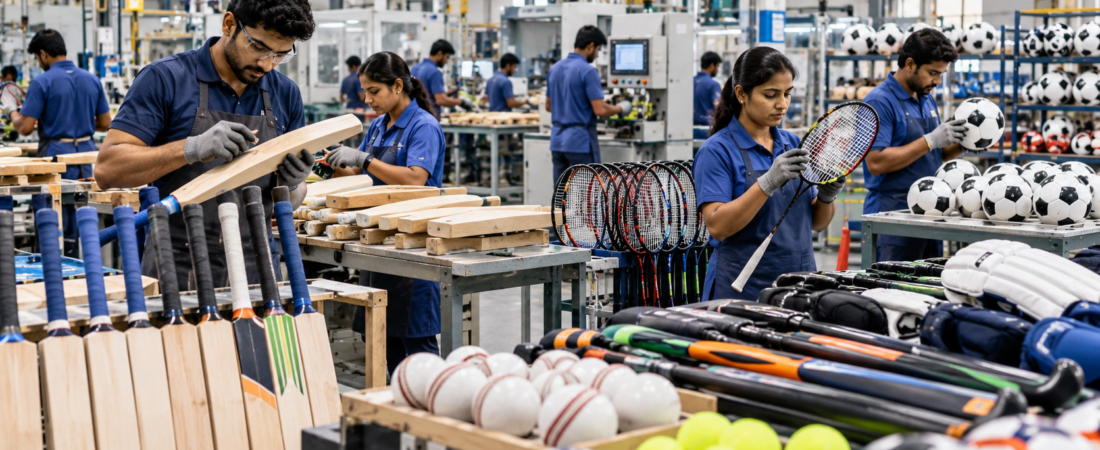
Sports are increasingly recognised not merely as a recreational activity but as an important component of economic development. The sports sector generates employment, encourages innovation, promotes tourism, supports entrepreneurship and creates opportunities for international trade. Behind the performance of athletes and the growth of sporting events lies an equally important industrial ecosystem comprising equipment manufacturers, material suppliers, designers, testing laboratories, technology companies and skilled workers.
India has made significant efforts to expand its sporting ecosystem through initiatives such as Khelo India, Fit India and Khelo Bharat Niti 2025. However, the development of sporting talent and infrastructure must be accompanied by the development of a competitive domestic sports goods industry.
India has an established base of sports goods manufacturing, particularly in clusters such as Jalandhar in Punjab and Meerut in Uttar Pradesh. Yet, the industry faces challenges relating to technology, product quality, research and development, international certification, access to finance and integration into global value chains.
Against this background, the Union Cabinet approved the Khelo India Sports Goods Manufacturing Scheme on 28 October 2026, with a total outlay of ₹1,856.67 crore for the period 2026–27 to 2033–34.
The scheme seeks to promote investment, manufacturing, innovation, skill development and exports, with the objective of positioning India as a globally competitive hub for sports goods.
The initiative raises an important policy question:
Can India convert its existing manufacturing base and sporting ambitions into a globally competitive sports equipment industry?
1. Understanding the Sports Goods Industry
1.1 What constitutes the sports goods industry?
The sports goods industry covers the production of equipment, accessories, apparel and related products used in recreational, professional and competitive sports.
Its major segments include:
| Segment | Examples |
|---|---|
| Cricket equipment | Bats, balls, helmets, pads, gloves and stumps |
| Football and other ball sports | Footballs, volleyballs, basketballs and related accessories |
| Racket sports | Badminton, tennis and squash rackets, strings and shuttlecocks |
| Athletics and fitness | Gym equipment, training machines and exercise accessories |
| Protective equipment | Helmets, guards, body protection and safety equipment |
| Sports apparel and footwear | Jerseys, specialised clothing, shoes and performance wear |
| Outdoor and adventure sports | Cycling equipment, camping gear and recreational equipment |
The industry involves several interconnected activities, including raw material processing, product design, component manufacturing, assembly, testing, packaging, distribution and marketing.
Consequently, the development of sports goods manufacturing can generate employment across a wide range of industrial and service activities.
1.2 India’s existing manufacturing base
India has an established sports goods manufacturing ecosystem.
Two important centres are:
Jalandhar, Punjab: Known for the manufacture of sports equipment, particularly balls, cricket equipment, protective gear and other sporting accessories.
Meerut, Uttar Pradesh: Known for cricket bats, sports equipment, fitness products and a wide range of sporting goods.
Other manufacturing centres contribute to sports-related products, including bicycles, apparel and accessories.
According to the Government’s explanatory note on the scheme:
- Jalandhar and Meerut together have more than 250 exporting units.
- They have over 1,000 units serving the domestic market.
- The clusters include more than 4,000 micro enterprises.
- Nearly 20,000 household units are part of the manufacturing ecosystem.
- Small and micro enterprises account for nearly 90 per cent of production.
These figures highlight the importance of the sector for local entrepreneurship and employment.
However, the presence of a large number of small manufacturing units does not automatically translate into global competitiveness. The industry must improve productivity, technology, product design, quality assurance and access to international markets.
2. Khelo India Sports Goods Manufacturing Scheme
2.1 Background
The Union Budget 2026–27 proposed a dedicated initiative to promote sports goods manufacturing, research and innovation. The objective was to use India’s existing industrial capabilities and growing sporting ambitions to develop a globally competitive manufacturing ecosystem.
The Union Cabinet approved the Khelo India Sports Goods Manufacturing Scheme on 28 October 2026.
2.2 Key features
| Particular | Details |
|---|---|
| Scheme | Khelo India Sports Goods Manufacturing Scheme |
| Approval | Union Cabinet, 28 October 2026 |
| Total outlay | ₹1,856.67 crore |
| Implementation period | FY 2026–27 to FY 2033–34 |
| Nodal ministry | Ministry of Youth Affairs and Sports |
| Main objective | Develop a globally competitive sports goods manufacturing ecosystem |
| Major beneficiaries | Manufacturers, MSMEs, start-ups, research institutions and skilled workers |
The scheme covers the entire sports goods value chain, from manufacturing infrastructure and investment to research, certification, skill development and export promotion.
Its broad objectives include:
- Expanding domestic manufacturing capacity.
- Attracting domestic and global investment.
- Reducing import dependence.
- Strengthening existing manufacturing clusters.
- Promoting research, innovation and product design.
- Improving international quality certification.
- Creating skilled employment.
- Increasing exports and India’s participation in global value chains.
3. Major Components of the Scheme
The scheme adopts an ecosystem-based approach rather than relying exclusively on production subsidies.
3.1 Sports Goods Manufacturing Zones
One of the major interventions is the development of dedicated Sports Goods Manufacturing Zones (SGMZs).
These zones are intended to bring different stages of the manufacturing value chain together in a common industrial ecosystem.
They may include:
- Sports goods manufacturers.
- Component and raw material suppliers.
- Testing and certification facilities.
- Design and prototyping centres.
- Research and development institutions.
- Packaging and logistics facilities.
- Ancillary enterprises.
The zones are proposed to be developed through convergence with existing industrial infrastructure under the BHAVYA Scheme and industrial parks developed by the National Industrial Corridor Development Corporation (NICDC).
The Government’s explanatory note indicates that there may be four integrated zones, each covering more than 300 acres.
Significance of manufacturing zones
The cluster-based approach can reduce production costs and improve coordination among manufacturers, suppliers and service providers.
For example, a sports equipment manufacturer may require specialised materials, testing facilities and packaging services. When these facilities are located within or near the same industrial zone, transportation costs and production delays can be reduced.
Manufacturing zones can also encourage technology transfer, common infrastructure and collaboration between industry and research institutions.
3.2 Investment support and turnover-linked incentives
The scheme provides financial incentives to attract investment and expand production.
Two important components have a combined allocation of ₹1,130 crore.
A. Anchor Investment Support
This component seeks to attract leading domestic and international manufacturers, brands and retail chains to establish production facilities in designated Sports Goods Manufacturing Zones.
The Government’s explanatory note indicates capital expenditure support of 20 per cent for eligible anchor investors making investments of at least ₹100 crore.
The objective is to attract large-scale investment and encourage the development of supplier networks around major manufacturers.
B. Turnover Linked Support
This component is intended to encourage manufacturers to expand production and increase manufacturing capacity.
Eligible manufacturers investing at least ₹10 crore may receive incentives of up to 15 per cent, subject to the applicable scheme conditions.
The turnover-linked mechanism is intended to connect government support with actual manufacturing activity rather than merely the announcement of investment.
Why are these incentives important?
Sports goods manufacturing requires investment in machinery, specialised materials, testing facilities and product development.
Investment support can reduce the initial cost of establishing production facilities, while turnover-linked incentives can encourage firms to expand output and improve their competitiveness.
However, the effectiveness of such incentives will depend on transparent eligibility criteria, additional investment generated and measurable improvements in domestic value addition.
3.3 Strengthening MSMEs and existing manufacturing clusters
The sports goods industry has a significant presence of micro and small enterprises.
These enterprises contribute to employment, local entrepreneurship and the preservation of specialised manufacturing skills.
However, smaller units often face difficulties in:
- Accessing modern machinery.
- Obtaining affordable finance.
- Establishing testing facilities.
- Meeting international quality standards.
- Adopting advanced production technologies.
- Developing brands and accessing export markets.
The scheme provides for the upgradation of existing sports goods manufacturing clusters.
Support may be used for common facilities and shared infrastructure, with cost-sharing arrangements involving States.
This is particularly important because the development of a few large manufacturing facilities alone cannot create a broad-based industrial ecosystem.
Common facilities can help smaller enterprises access infrastructure that may be too expensive for an individual unit to establish independently.
3.4 International certification and quality standards
One of the major challenges faced by manufacturers seeking to enter international markets is compliance with quality and performance standards.
Sports equipment must often satisfy specialised technical and safety requirements prescribed by relevant international sports federations.
For example, equipment used in competitive sports may have to meet standards relating to:
- Material strength.
- Product dimensions.
- Weight and balance.
- Durability.
- Safety and impact resistance.
- Performance consistency.
The scheme has allocated ₹105 crore to support manufacturers in obtaining and renewing certifications from International Sports Federations.
The Government’s explanatory note provides for support covering 70 per cent of first-time certification costs and 50 per cent of renewal costs, subject to scheme conditions.
Why does certification matter?
Certification improves the credibility of Indian products and can help manufacturers access international sporting events, professional leagues and organised retail markets.
It can also encourage manufacturers to improve production processes and adopt more consistent quality-control systems.
Certification should therefore be viewed not merely as a compliance requirement but as an instrument for improving competitiveness.
3.5 Research, development and innovation
The sports equipment industry is becoming increasingly technology-intensive.
Modern sports goods require improvements in materials, aerodynamics, ergonomics, safety, durability and performance.
For example:
- Advanced composite materials can improve the strength-to-weight ratio of equipment.
- Material science can improve the durability of sports footwear and protective equipment.
- Product engineering can improve the balance and performance of rackets and bats.
- Sensor-based technologies can support performance monitoring and sports analytics.
- Improved protective materials can reduce injury risks.
The scheme proposes the establishment of Centres of Excellence in premier educational and research institutions.
These centres are expected to promote research in:
- Sports equipment.
- Material sciences.
- Protective gear.
- Advanced manufacturing technologies.
- Product design and testing.
Research activities will also be encouraged through convergence with the Anusandhan National Research Foundation.
The scheme also provides support for sports start-ups. DPIIT-registered sports start-ups may be eligible for grants of up to ₹20 lakh, subject to applicable conditions.
This can encourage entrepreneurship in sports technology, product design, specialised materials and innovative manufacturing processes.
3.6 Skill development
The sports goods industry requires a combination of traditional craftsmanship and modern technical skills.
Workers may be required to operate specialised machinery, process materials, assemble products, conduct quality checks and work with computer-aided design systems.
The scheme provides for industry-aligned skill development initiatives in collaboration with the Ministry of Skill Development and Entrepreneurship and relevant industry stakeholders.
The objective is to ensure that the workforce possesses the capabilities required by an increasingly technology-intensive manufacturing industry.
Skill development should also focus on:
- Modern machine operation.
- Product design and prototyping.
- Quality control and testing.
- Material processing.
- Industrial safety.
- Digital manufacturing.
- Production management.
Such measures can improve labour productivity and create better employment opportunities.
3.7 Export promotion and global branding
The scheme seeks to improve the international visibility of Indian sports goods through branding, outreach and market development.
Proposed initiatives include an India Sports Expo and a Brand India campaign, along with support linked to the Export Promotion Mission.
Export promotion is important because the domestic market alone may not provide sufficient scale for manufacturers seeking to become globally competitive.
International markets can provide opportunities for:
- Higher production volumes.
- Product diversification.
- Technology partnerships.
- Brand development.
- Foreign exchange earnings.
- Integration into global supply chains.
However, sustained export growth requires competitive pricing, consistent quality, reliable delivery and compliance with international standards.
4. Why Does India Need a Dedicated Sports Goods Manufacturing Policy?
The scheme must be understood within the larger context of India’s manufacturing and sporting ambitions.
4.1 Reducing import dependence
India’s sporting ecosystem requires a wide range of equipment, from basic recreational products to specialised equipment used by professional athletes.
Dependence on imported products can create vulnerabilities relating to prices, supply chains, technology and availability.
Strengthening domestic manufacturing can:
- Reduce import dependence.
- Improve domestic value addition.
- Support local suppliers.
- Encourage technology development.
- Create employment.
- Improve the availability of equipment.
However, import substitution should not become an end in itself. Domestic products must be competitive in terms of quality, cost and performance.
4.2 Expanding India’s manufacturing base
India’s manufacturing policy has increasingly focused on developing domestic capabilities in strategic and emerging sectors.
Sports goods manufacturing can contribute to this objective by expanding the range of products manufactured domestically.
It also offers opportunities for MSMEs because several sports products can be manufactured through specialised production units and supplier networks.
4.3 Employment generation
The sports goods industry has the potential to generate employment across different skill levels.
Employment opportunities may arise in:
- Manufacturing and assembly.
- Material processing.
- Product design.
- Research and testing.
- Packaging and logistics.
- Marketing and distribution.
- Export management.
Since the industry has a significant MSME presence, its expansion can support local employment and entrepreneurship.
4.4 Supporting India’s sporting ambitions
India’s sporting ambitions are expanding through athlete development programmes, sports infrastructure and the hosting of major sporting events.
The manufacture of high-quality domestic equipment can support these efforts.
It can also reduce the cost and logistical difficulties associated with procuring specialised equipment from international markets.
The development of domestic capabilities in sports equipment can therefore complement the broader development of India’s sporting ecosystem.
4.5 Strengthening global value chain participation
Global sports goods manufacturing involves complex supply chains connecting raw material suppliers, component manufacturers, technology providers, brands and retailers.
India can seek to participate in these value chains by developing capabilities in product design, specialised materials, component manufacturing, testing and finished products.
The long-term objective should be to move beyond low-value assembly towards higher-value manufacturing and innovation.
5. Linkages with Other Government Initiatives
The Khelo India Sports Goods Manufacturing Scheme is part of a broader policy framework.
It should be understood alongside the following initiatives.
5.1 Khelo India Programme
The Khelo India Programme seeks to promote sports participation, identify sporting talent and strengthen sports infrastructure.
The Sports Goods Manufacturing Scheme complements this initiative from the supply side by seeking to improve the availability and quality of domestically manufactured equipment.
The two initiatives address different but interconnected dimensions of sports development.
5.2 Khelo Bharat Niti 2025
Khelo Bharat Niti 2025 provides a broader policy framework for the development of sports in India.
It seeks to strengthen sports participation, talent development, infrastructure, sports science and the wider sports ecosystem.
The sports goods manufacturing initiative complements this policy by focusing on the industrial and manufacturing dimension of the sports sector.
5.3 Make in India and Atmanirbhar Bharat
The scheme is aligned with the broader objectives of strengthening domestic manufacturing, encouraging investment, improving domestic value addition and reducing dependence on imports.
It also seeks to develop Indian manufacturers capable of competing in international markets.
5.4 Startup India
The scheme’s support for sports start-ups can encourage innovation and entrepreneurship in sports technology, product development, specialised materials and manufacturing processes.
5.5 BHAVYA Scheme and NICDC Industrial Parks
The proposed manufacturing zones are expected to converge with existing industrial infrastructure under the BHAVYA Scheme and NICDC Industrial Parks.
This approach can reduce duplication of infrastructure and support the development of integrated industrial clusters.
6. Opportunities for India in the Global Sports Goods Market
The global sports goods industry offers significant opportunities for Indian manufacturers.
According to the Government’s explanatory note, the global sports equipment market was valued at approximately US$140 billion in 2024 and is projected to reach around US$283 billion by 2036.
The growth of the market is associated with several factors:
- Increasing participation in sports and fitness activities.
- Expansion of professional sporting leagues.
- Rising demand for specialised equipment.
- Growth of outdoor and adventure sports.
- Technological improvements in sports materials.
- Increasing consumer demand for health and fitness products.
India has certain advantages that can support its expansion in this market.
First, an established manufacturing base: Existing clusters provide a foundation of workers, enterprises and manufacturing experience.
Second, a large domestic market: A growing interest in sports, fitness and recreational activities can support demand for domestic products.
Third, MSME participation: A network of smaller enterprises can support specialised production and supplier development.
Fourth, a growing sporting ecosystem: Expansion of sports infrastructure, competitions and athlete development can increase demand for quality equipment.
Fifth, policy support: Manufacturing zones, investment incentives, research support and certification assistance can improve the industry’s competitiveness.
However, these advantages must be converted into measurable improvements in productivity, technology, quality and export performance.
7. Major Challenges in Developing a Globally Competitive Sports Goods Industry
Despite the opportunities, India faces several structural challenges.
7.1 Technology and product innovation
Manufacturing a sports product is not sufficient to compete internationally.
Global competitiveness increasingly depends on advanced materials, product engineering, precision manufacturing and continuous innovation.
Indian manufacturers need stronger research-industry collaboration and access to modern testing and prototyping facilities.
7.2 Fragmented manufacturing structure
The large presence of small and household enterprises is an important strength in terms of employment and entrepreneurship.
However, fragmented production can make it difficult to achieve economies of scale, uniform quality and consistent delivery.
Cluster-based infrastructure and supplier integration must therefore be designed to strengthen smaller enterprises rather than displace them.
7.3 Quality and international certification
Meeting international standards requires technical knowledge, testing infrastructure and financial resources.
Smaller manufacturers may find certification procedures expensive and complex.
The scheme’s certification support is important, but it must be accompanied by domestic testing capacity and awareness among manufacturers.
7.4 Access to finance
MSMEs often face difficulties in obtaining affordable long-term finance for machinery, technology upgrades and product development.
Working-capital constraints can also affect their ability to accept large orders and maintain inventory.
The manufacturing ecosystem will require appropriate credit products, risk-sharing arrangements and stronger financial linkages.
7.5 Raw materials and component supply chains
Sports goods manufacturing depends on several specialised materials, including rubber, plastics, metals, wood, textiles, composites and chemicals.
Dependence on imported materials or components can increase production costs and expose manufacturers to global supply-chain disruptions.
Domestic material capabilities and reliable supplier networks must be strengthened.
7.6 Global brands and market access
Entering international markets requires more than manufacturing capacity.
Indian firms must develop strong brands, distribution networks, marketing capabilities and long-term relationships with international buyers.
The challenge is to move from contract manufacturing and low-margin production towards greater domestic ownership of brands, designs and intellectual property.
7.7 Environmental sustainability
Sports goods manufacturing can involve the use of plastics, synthetic materials, rubber, chemicals, metals and packaging.
Production processes may generate waste, emissions and resource consumption.
The sector must gradually adopt:
- Recyclable and durable materials.
- Cleaner production technologies.
- Energy-efficient machinery.
- Responsible chemical management.
- Waste reduction and recycling.
- Sustainable packaging.
Environmental standards are also becoming increasingly relevant to international supply chains.
8. Way Forward: Building a Globally Competitive Sports Manufacturing Ecosystem
The scheme can become an important instrument of industrial transformation if its implementation is supported by a comprehensive strategy.
8.1 Move from manufacturing to innovation-led production
India should develop capabilities in sports engineering, advanced materials, product design and specialised manufacturing.
Centres of Excellence should work closely with manufacturers to solve practical industry problems and commercialise research.
8.2 Strengthen MSME clusters
Existing manufacturing clusters should be upgraded through common testing facilities, modern machinery, design centres, logistics infrastructure and access to affordable finance.
The benefits of the scheme should reach smaller enterprises and household production units, not only large anchor investors.
8.3 Improve domestic testing and certification capacity
India needs accessible and credible testing laboratories capable of supporting internationally recognised quality standards.
This will reduce certification costs and improve the ability of Indian manufacturers to supply global markets.
8.4 Promote industry-academia collaboration
Engineering institutions, material science departments, sports universities and research organisations should collaborate with manufacturers.
Research priorities should include lightweight materials, protective equipment, durability, ergonomics and performance enhancement.
8.5 Develop specialised skills
Skill development programmes should be designed in consultation with industry.
Training must cover both traditional manufacturing skills and modern technologies such as computer-aided design, precision machinery, automation and quality management.
8.6 Strengthen export capabilities
Export promotion should go beyond participation in trade fairs.
Manufacturers require support in international market research, product certification, branding, intellectual property protection, distribution and compliance with importing-country regulations.
8.7 Ensure transparent and outcome-based incentives
Financial incentives should be linked to measurable outcomes such as:
- Additional investment.
- Domestic value addition.
- Employment generation.
- Technology adoption.
- Productivity improvement.
- Export growth.
- Research and innovation.
- Participation of MSMEs.
The implementation framework should also include periodic evaluation to ensure that public expenditure generates durable industrial capabilities.
8.8 Promote sustainable manufacturing
The industry should adopt resource-efficient production methods and encourage the development of recyclable and sustainable sports materials.
This can improve long-term competitiveness and help Indian firms meet evolving international environmental requirements.
9. Critical Analysis: Will the Scheme Be Sufficient?
The Khelo India Sports Goods Manufacturing Scheme is a significant step towards connecting India’s sporting ambitions with its manufacturing strategy.
Its strength lies in its integrated approach. It combines manufacturing zones, investment incentives, MSME support, certification, research, skills and export promotion.
However, several issues will determine its actual impact.
First, incentives must generate additional investment. Financial support should encourage new manufacturing capacity and technology adoption rather than merely subsidise investments that would have taken place anyway.
Second, the benefits must reach MSMEs. The sector’s employment and production base is heavily dependent on small enterprises. A policy focused only on large investors may weaken the existing industrial ecosystem.
Third, technology and innovation must receive sustained attention. Long-term competitiveness cannot be achieved through subsidies alone. It requires continuous investment in research, design, materials and product development.
Fourth, certification must translate into market access. Obtaining certificates is important, but manufacturers also need international buyers, distribution networks and brand recognition.
Fifth, implementation must be evaluated transparently. The scheme should be assessed against measurable outcomes rather than only the number of zones established or funds disbursed.
The ultimate objective should be to develop an industry capable of competing globally without permanent dependence on government incentives.
Conclusion
The Khelo India Sports Goods Manufacturing Scheme represents an important attempt to integrate sports development with industrial policy.
India already possesses a foundation of manufacturing clusters, skilled workers and entrepreneurial MSMEs. The challenge is to transform these strengths into a modern industrial ecosystem based on technology, quality, innovation and global market integration.
The scheme’s success will depend on whether it can improve domestic value addition, strengthen smaller manufacturers, attract productive investment and create internationally competitive products.
India’s ambition should not be limited to becoming a major sporting nation. It should also aspire to become a country that designs, develops and manufactures the equipment used by athletes across the world.
UPSC Examination Relevance
General Studies Paper III: Indian Economy; industrial policy; manufacturing; investment models; infrastructure; science and technology; employment generation.
General Studies Paper II: Government policies and interventions; institutional mechanisms; welfare and development initiatives.
Essay: Sports as an instrument of economic development; manufacturing-led growth; self-reliance and global competitiveness.
Prelims: Government schemes, industrial clusters, MSMEs, sports policies and export promotion.
Prelims Practice Questions
1. With reference to the Khelo India Sports Goods Manufacturing Scheme, consider the following statements:
- It seeks to promote domestic manufacturing, innovation and exports in the sports goods sector.
- It provides for dedicated Sports Goods Manufacturing Zones.
- It includes support for international certification of sports goods.
Which of the statements given above are correct?
(a) 1 and 2 only
(b) 2 and 3 only
(c) 1 and 3 only
(d) 1, 2 and 3
2. Consider the following statements regarding manufacturing clusters:
- They can facilitate economies of scale through shared infrastructure.
- They can improve linkages between manufacturers and suppliers.
- They necessarily eliminate the need for small and micro enterprises.
Which of the statements given above are correct?
(a) 1 and 2 only
(b) 2 and 3 only
(c) 1 and 3 only
(d) 1, 2 and 3
3. Which of the following can contribute to the global competitiveness of sports goods manufacturing?
- International quality certification.
- Research and development in material sciences.
- Industry-academia collaboration.
- Development of specialised manufacturing skills.
Select the correct answer using the code below:
(a) 1 and 2 only
(b) 1, 2 and 3 only
(c) 2, 3 and 4 only
(d) 1, 2, 3 and 4
Mains Practice Questions
1. The Khelo India Sports Goods Manufacturing Scheme seeks to integrate sports development with India’s manufacturing ambitions. Examine its potential to strengthen domestic value addition, employment and exports. (15 marks)
2. Manufacturing clusters and MSMEs are essential for building a competitive industrial ecosystem. Discuss with reference to India’s sports goods manufacturing sector. (15 marks)
3. Financial incentives alone cannot create globally competitive manufacturing industries. Explain the importance of technology, innovation, quality certification and skill development in this regard. (10 marks)
Key Terms for Revision
- Manufacturing cluster: Geographic concentration of interconnected enterprises, suppliers and supporting institutions.
- Economies of scale: Reduction in average production cost as the scale of production increases.
- Domestic value addition: The share of a product’s value created within the domestic economy.
- Global Value Chain: The network of activities involved in producing and delivering a product across different countries.
- Anchor investment: A major investment that can attract suppliers and ancillary industries to a manufacturing ecosystem.
- Turnover-linked incentive: Financial support linked to the eligible turnover or production performance of an enterprise.
- Product prototyping: Development of an initial model of a product for testing and refinement.
- International certification: Formal recognition that a product meets specified technical, quality or performance standards.