
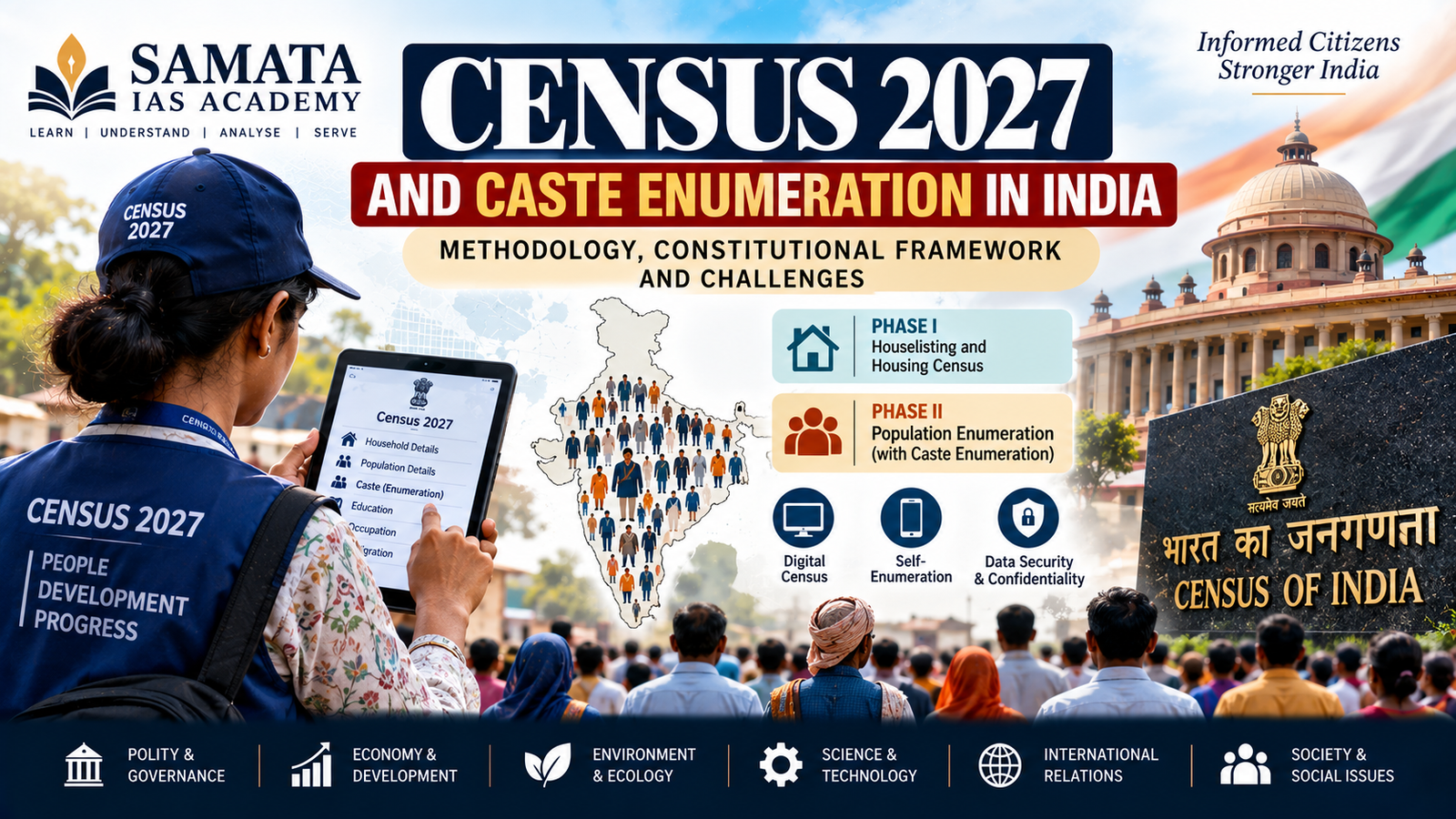
Census 2027 is set to be a major milestone in India’s demographic data architecture. It will be the 16th Census of India and the 8th since Independence, and it will introduce a major technological change: the Census will be conducted through digital means, with mobile-based data collection, self-enumeration and digital monitoring.
At the same time, Census 2027 will include comprehensive caste enumeration during the Population Enumeration phase, following the decision of the Cabinet Committee on Political Affairs in April 2025.
The combination of caste enumeration + digital data collection makes Census 2027 particularly important for the study of Indian society, social justice, governance, public policy and data governance.
The Census 2027 exercise combines population enumeration with a transition to digital data collection and monitoring.
Why Is Census 2027 Important?
The Census is not merely a process of counting the population. It generates comprehensive demographic, social, cultural and economic information that forms an important statistical foundation for planning, administration and public policy.
The Office of the Registrar General & Census Commissioner describes population Census data as providing basic information on India’s human resources, demography, culture and economic structure at local, regional and national levels.
For UPSC aspirants, the issue connects directly with UPSC Current Affairs and particularly with GS Paper I and GS Paper II.
The relevance extends from Indian society and caste to social justice, governance, constitutional institutions, federalism and evidence-based policymaking.
1. Census 2027: Two-Phase Structure
Census 2027 is being conducted in two broad phases.
| Phase | Exercise | Major focus |
|---|---|---|
| Phase I | Houselisting and Housing Census | Housing conditions, household amenities and assets |
| Phase II | Population Enumeration | Demographic, socio-economic, cultural and other individual-level information |
The first phase is being conducted during April–September 2026, while the Population Enumeration phase is scheduled for February 2027 for most of India. Ladakh and specified snow-bound areas of Jammu & Kashmir, Himachal Pradesh and Uttarakhand follow a non-synchronous schedule.
The reference date for most of India is 00:00 hours on 1 March 2027. For Ladakh and specified snow-bound areas, the reference date is 00:00 hours on 1 October 2026.
The official Census 2027 portal provides the latest Gazette notifications, questionnaires and operational information.
2. What Has Changed Regarding Caste Enumeration?
Historically, the regular Census has systematically enumerated Scheduled Castes and Scheduled Tribes, while caste-wise enumeration beyond these categories was not part of the regular Census after Independence.
Census 2027 changes this framework.
The Cabinet Committee on Political Affairs decided on 30 April 2025 to include caste enumeration in Census 2027. The Government subsequently confirmed that caste enumeration would take place during Phase II — Population Enumeration.
This makes caste enumeration one of the defining features of Census 2027.
An important current update
Earlier Government statements said that the detailed Phase II questions, including the caste question, would be notified before the commencement of the second phase.
The Office of the Registrar General & Census Commissioner has since published the Gazette notification containing the Phase II Population Enumeration questionnaire, dated 14 August 2026. The official Census repository now lists this questionnaire as “ORGI Gazette Notification_08: Questionnaire for Second Phase, Population Enumeration (PE)”.
This is an important development for current-affairs preparation because the methodology has moved beyond the earlier stage of general policy announcement towards a formally notified Population Enumeration questionnaire.
3. Caste Enumeration: Why Is It Methodologically Difficult?
Caste identity in India does not always appear in a single standardised form.
Respondents may use:
- caste names
- sub-caste names
- regional names
- synonyms
- surnames
- clan or gotra names
- different spellings
- phonetic variations
- community-specific terminology
Consequently, caste enumeration involves two distinct processes:
Collection of responses
↓
Classification and tabulation of responses
The first process is essentially an enumeration exercise.
The second is a statistical and methodological challenge.
4. Enumeration Is Not the Same as Classification
Suppose several respondents provide different names that may refer to the same broader social category.
The Census system has to determine how such responses should ultimately be represented in statistical tables.
This creates an important distinction:
Self-reported identity
What the respondent provides during enumeration.
Statistical classification
How the response is subsequently coded, grouped and tabulated.
This distinction is particularly important because India’s caste system contains substantial regional, linguistic and sub-caste variation.
The quality of the final dataset therefore depends not only on what enumerators collect but also on the classification methodology applied to the collected information.
5. What Did SECC 2011 Teach India?
The Socio-Economic and Caste Census 2011 (SECC 2011) provides an important reference point.
The Government reported that 46,73,034 distinct caste names were returned in the SECC exercise. These included caste and sub-caste names, synonyms, surnames, clan/gothra names and phonetic variations.
The experience illustrates the enormous challenge involved in converting raw caste responses into a coherent statistical classification.
The Government had also reported substantial errors in the caste returns and the need for classification and rectification.
The SECC experience therefore provides an important lesson:
A large volume of caste responses does not automatically produce a statistically usable caste database.
For Census 2027, the challenge is to ensure that the process of enumeration, coding, classification, validation and tabulation works as an integrated system.
6. Open-Ended Reporting versus Standardised Categories
Caste enumeration raises a broader methodological question: How should caste responses be recorded?
There are two broad approaches that illustrate the issue.
Open-ended reporting
Under an open-ended system, respondents can report their caste identity in their own words.
Potential advantages
- Captures local terminology.
- Preserves regional variations.
- Reduces the possibility of forcing identities into unsuitable predetermined categories.
Potential challenges
- Large number of synonyms.
- Spelling variations.
- Phonetic differences.
- Difficulty in aggregation.
- Greater requirement for subsequent classification.
Standardised categories
A predefined classification system can make statistical aggregation easier.
Potential advantages
- Greater consistency.
- Easier coding.
- Improved comparability.
- More efficient tabulation.
Potential challenges
- Local identities may not fit neatly into predetermined categories.
- Classification decisions can themselves become contested.
- Social identities can vary across regions.
Therefore, a sound methodology must distinguish between recording what people report and creating statistically meaningful categories from those reports.
7. Constitutional and Legal Framework
Census as a Union Subject
Census is a subject in the Union List of the Seventh Schedule of the Constitution.
The Census is consequently centrally coordinated, while State and Union Territory administrations have an important role in field-level implementation.
The official Government backgrounder identifies the Census Act, 1948 and Census Rules, 1990 as the principal legal framework governing Census operations.
Census Act, 1948
The Census Act, 1948 provides the statutory framework for conducting the Census.
It deals with matters including:
- appointment of Census officers;
- collection of information;
- asking Census questions;
- obligations of respondents;
- access to premises;
- penalties; and
- protection of Census records.
For UPSC preparation, the Act is particularly important because it illustrates how an apparently administrative exercise is supported by a specific statutory framework.
The complete legislation is available through India Code — Census Act, 1948.
8. Census Rules, 1990
The Census Rules, 1990, along with subsequent amendments, supplement the Census Act.
The Rules provide the operational framework for Census-related procedures, including the notification of Census schedules and questionnaires.
The official Census repository now makes the Census Act, 1948 and Census Rules, 1990 available alongside the Census 2027 Gazette notifications.
For UPSC aspirants, the relationship can be remembered as:
Constitution → Census as Union subject
Census Act, 1948 → Statutory framework
Census Rules, 1990 → Operational/regulatory framework
9. Confidentiality of Census Information
Census data involves sensitive personal information.
The Government has stated that individual Census information is kept confidential, while aggregated data at different administrative levels is published.
The confidentiality principle is particularly important in Census 2027 because the exercise involves extensive demographic and socio-economic information.
The issue becomes even more significant when the Census includes caste information.
Thus, Census data governance has two important dimensions:
Data utility
and
Data confidentiality
The objective is to make aggregated information useful for governance without compromising the confidentiality of individual responses.
10. Census 2027 and Digital Transformation
Census 2027 represents a major technological shift.
The Government describes it as India’s first Census by digital means. The exercise incorporates:
- mobile-based data collection;
- self-enumeration;
- the Census Management & Monitoring System (CMMS);
- digital mapping;
- near real-time monitoring; and
- digital data transmission.
The Office of the Registrar General & Census Commissioner also describes the forthcoming exercise as India’s transition towards a “Digital Census.”


5
Mobile-based enumeration and self-enumeration are among the major technological features of Census 2027.
The official Census Digital Library provides a searchable repository of Census tables, reports, questionnaires, methodological documents, acts, rules and other Census materials.
11. Self-Enumeration: A New Feature
Census 2027 also provides for Self-Enumeration.
Under this system, respondents can provide certain Census information through a digital platform before the enumerator’s field visit, after which the information is confirmed during the enumeration process.
The Government has described self-enumeration as a new feature of Census 2027, alongside mobile-based collection by enumerators.
This represents an important shift in public administration:
Traditional model
Enumerator → Household → Paper schedule → Processing
Digital model
Citizen/Enumerator → Mobile/Web interface → Digital transmission → Central processing
The shift can potentially improve speed, monitoring and data processing, while also creating new requirements for digital accessibility, cybersecurity and data protection.
12. Why Does Caste Data Matter for Public Policy?
Caste remains an important dimension of India’s social structure.
Reliable caste data could potentially contribute to a more detailed understanding of disparities across different population groups.
Its relevance extends to several policy areas.
Education
Caste-disaggregated data can contribute to analysis of:
- educational attainment;
- school participation;
- dropout rates;
- higher education access; and
- skill development.
Employment
It can help researchers examine:
- occupational structure;
- labour-force participation;
- formal employment;
- public-sector representation; and
- socio-economic mobility.
Social Welfare
Caste information can be studied alongside income, education, occupation, health and other indicators to understand patterns of disadvantage.
Social Justice
Reliable demographic information can provide an empirical basis for analysing social inequalities and evaluating public policy.
13. Caste Data and Reservation Policy
The relationship between caste enumeration and reservation requires careful distinction.
Caste enumeration is a statistical exercise.
Reservation policy is a constitutional, legal and administrative process.
India’s affirmative-action framework includes constitutionally recognised categories such as Scheduled Castes and Scheduled Tribes, while Other Backward Classes are governed through a separate constitutional and administrative framework.
Therefore, the publication of caste population data would not automatically determine reservation percentages or eligibility.
Census data could provide an additional empirical basis for policy analysis, but actual policy decisions involve:
- constitutional provisions;
- legislation;
- administrative decisions;
- commissions and institutional processes; and
- judicial interpretation.
This distinction is important for UPSC answers because it prevents the common analytical error of treating demographic data and policy entitlement as identical concepts.
14. Major Methodological Challenges
1. Standardisation
Different names, spellings and sub-caste identities need to be handled systematically.
2. Regional variation
A social category may have different meanings or prevalence across different regions.
3. Self-identification
The methodology needs to respect respondent identification while maintaining statistical consistency.
4. Data quality
Errors can arise from:
- respondent misunderstanding;
- enumerator error;
- spelling variations;
- incomplete responses;
- duplicate information;
- coding errors; and
- technical problems.
5. Classification
The conversion of millions of individual responses into statistically meaningful categories requires substantial methodological expertise.
6. Privacy
Caste information is socially sensitive, making confidentiality and cybersecurity particularly important.
7. Public trust
Citizens must have confidence that information supplied during Census operations will be protected under the applicable legal framework.
15. Digital Census: Opportunities and Risks
The digital transformation of Census operations creates significant opportunities.
Opportunities
Faster data transmission
Information can move electronically from field operations to central systems.
Real-time monitoring
Administrative authorities can monitor progress and identify operational gaps.
Reduced paperwork
Mobile applications reduce dependence on physical schedules.
Geographical precision
Digital mapping can assist in identifying enumeration areas and reducing omission or duplication.
Faster processing
Digital data can potentially reduce the time required between collection and statistical processing.
Challenges
However, technology does not automatically solve methodological problems.
A sophisticated application cannot by itself determine:
- how caste identities should be classified;
- how regional variations should be handled;
- how errors should be corrected;
- how ambiguous responses should be treated; or
- how the final categories should be constructed.
Therefore:
Digital technology can improve the mechanics of enumeration; methodological design determines the quality of the resulting statistics.
16. Census 2027 and Evidence-Based Governance
One of the broader objectives of Census data is to strengthen evidence-based policymaking.
The official Census 2027 backgrounder describes Census information as a foundation for informed policymaking and targeted public interventions.
The policy chain can be represented as:
Population Data
↓
Demographic and Social Understanding
↓
Identification of Disparities
↓
Policy Design
↓
Resource Allocation
↓
Implementation
↓
Evaluation
This is why the quality of Census data matters far beyond the Census exercise itself.
17. Way Forward
The success of caste enumeration should be assessed not merely by the number of responses collected but by the quality and usability of the resulting dataset.
A robust approach should focus on the following.
Standardised methodology
Clear principles should govern synonyms, sub-castes, regional terminology and spelling variations.
Strong quality control
Digital validation should be supplemented by appropriate supervisory and verification mechanisms.
Methodological transparency
The process through which raw responses become final statistical categories should be sufficiently documented.
Data protection
Strong safeguards should protect individual-level information.
Multidisciplinary expertise
Caste classification is not simply a technical data-entry problem. It requires inputs from demography, sociology, anthropology, statistics and data science.
Evidence-based policy use
Caste data should ideally be analysed alongside broader socio-economic indicators rather than treated as a standalone measure of disadvantage.
18. UPSC Prelims Pointers
| Topic | Key Fact |
|---|---|
| Census 2027 | 16th Census of India and 8th since Independence |
| Caste enumeration | Included in Census 2027 during Population Enumeration |
| Phase I | Houselisting and Housing Census |
| Phase II | Population Enumeration |
| Census subject | Union List |
| Primary legislation | Census Act, 1948 |
| Rules | Census Rules, 1990 |
| Digital Census | Census 2027 is India’s first Census by digital means |
| Self-enumeration | Introduced as a feature of Census 2027 |
| SECC 2011 | Reported 46,73,034 distinct caste names |
| Main reference date | 1 March 2027 |
| Specified snow-bound areas | 1 October 2026 reference date |
| Phase II questionnaire | Gazette notification published by ORGI in August 2026 |
The official Census 2027 document repository now contains the Gazette notification for the Phase II Population Enumeration questionnaire along with other Census 2027 documents.
19. UPSC Mains Perspective
GS Paper I – Indian Society
- Caste and social stratification
- Social diversity
- Regional variations in caste identities
- Changing nature of caste
- Social mobility
GS Paper II – Polity & Governance
- Census as a Union subject
- Constitutional and statutory institutions
- Social justice
- Affirmative action
- Evidence-based governance
- Data-driven public administration
GS Paper III – Science & Technology
- Digital governance
- Digital public infrastructure
- Data management
- Cybersecurity
- Technology-enabled administration
GS Paper IV – Ethics
- Confidentiality
- Responsible use of citizen data
- Transparency
- Accountability
- Ethical governance
For preparation, students can connect these themes with the broader UPSC Mains GS syllabus and PYQ framework on the Samata IAS Academy website.
20. Possible UPSC Mains Questions
GS Paper II
“Caste enumeration in Census 2027 can strengthen evidence-based social policy, but its utility will depend substantially on the methodology used for collecting, classifying and publishing caste data.” Discuss.
GS Paper I
Examine the methodological challenges involved in converting India’s diverse caste identities into reliable demographic statistics.
GS Paper II
Explain the constitutional and statutory framework governing the Census in India. How does reliable Census data contribute to evidence-based governance?
GS Paper III
India’s transition to a digital Census creates opportunities for improving efficiency and data quality while also raising concerns relating to cybersecurity and privacy. Discuss.
Conclusion
Census 2027 is more than a population-counting exercise. It is also a major exercise in demographic data governance.
The inclusion of caste enumeration adds a new dimension to the regular Census, while the shift to digital enumeration represents a major technological transformation.
The experience of SECC 2011 demonstrates that collecting large volumes of caste responses is only the beginning. The more difficult task is to ensure accurate classification, consistent coding, quality control and meaningful statistical tabulation.
At the same time, the digital nature of Census 2027 places additional emphasis on privacy, cybersecurity, confidentiality and public trust.
The most important principle for understanding Census 2027 is therefore:
Reliable public policy requires reliable public data — and reliable data requires sound methodology, strong institutions and public trust.
For UPSC aspirants, Census 2027 provides an unusually rich intersection of Indian Society, Social Justice, Governance, Constitutional Institutions, Digital Technology, Data Governance and Public Administration.