
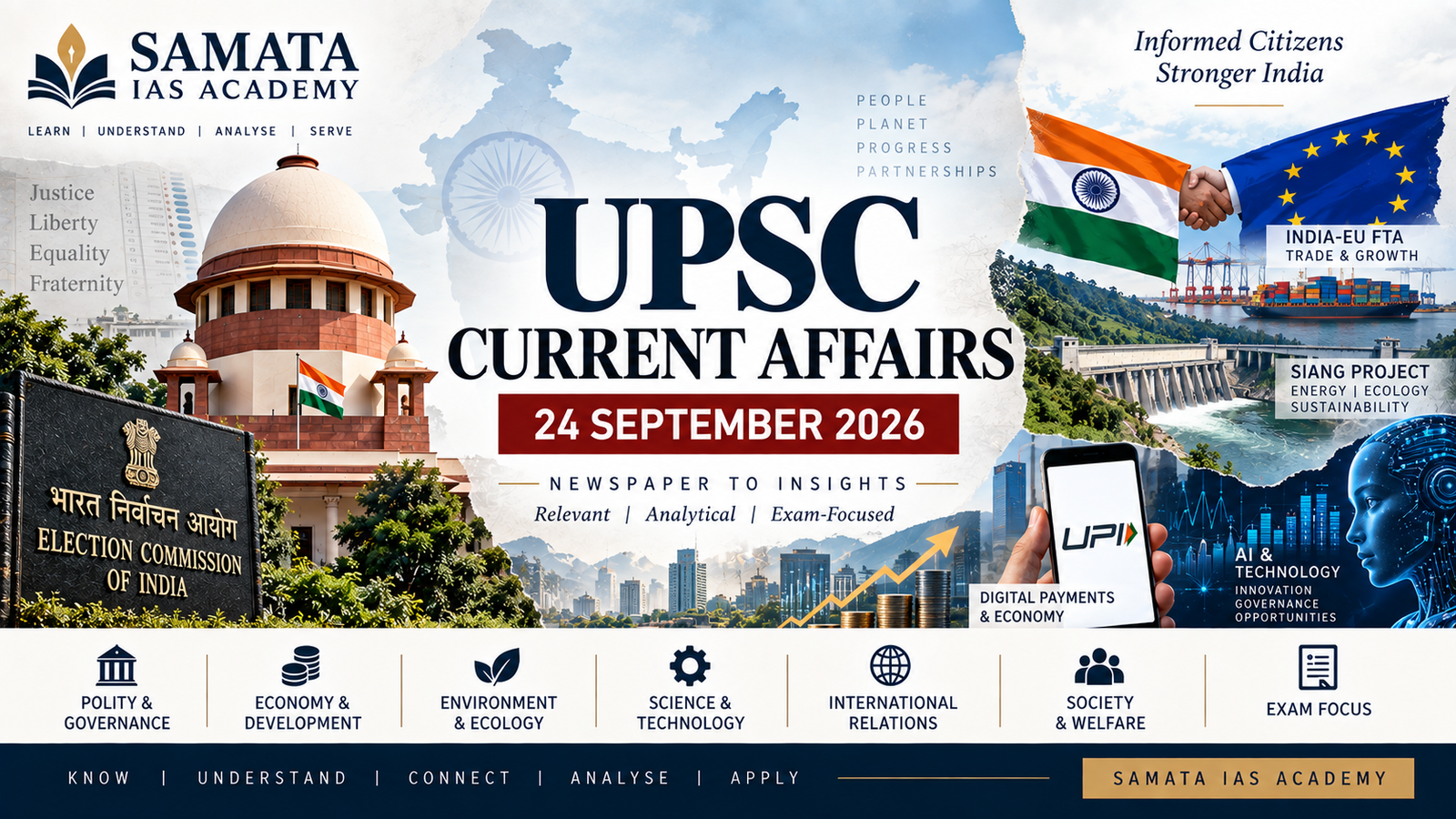
UPSC Current Affairs – 24 September 2026 | Polity, Economy, International Relations, Environment & Science
Source: The Hindu, Delhi City Edition, Thursday, 24 September 2026. The newspaper carries 20 pages.
1. 🏛️ Election Commission: Appointment Law under Supreme Court Scrutiny
A two-judge Supreme Court Bench delivered a split opinion on whether challenges to the Chief Election Commissioner and Other Election Commissioners (Appointment, Conditions of Service and Term of Office) Act, 2023 should be considered by a larger Constitution Bench.
Justice Dipankar Datta questioned whether replacing the Chief Justice of India on the selection committee with a Union Cabinet Minister affects the institutional independence and public perception of the Election Commission. The matter is to proceed before a larger Bench.
Why important?
The 2023 law provides a selection committee comprising:
- Prime Minister
- Union Cabinet Minister nominated by the Prime Minister
- Leader of Opposition in the Lok Sabha
This replaced the earlier arrangement in which the CJI was a member of the selection committee.
UPSC angle
GS-II — Constitutional Bodies
Important concepts:
- Article 324
- Independence of Election Commission
- Appointment of CEC and ECs
- Institutional checks and balances
- Separation of powers
- Electoral integrity
The Court’s concern, as reported, is not simply whether the ECI is independent in law but also whether its institutional structure appears sufficiently independent to the public.
2. 🗳️ Special Intensive Revision: Questions over Electoral-Roll Management
The controversy surrounding the Special Intensive Revision (SIR) of electoral rolls continues.
The newspaper reports that two Election Commissioners, Sukhbir Singh Sandhu and Vivek Joshi, had recorded objections on several occasions concerning decisions related to electoral-roll management. The Election Commission, however, has said that individual objections formed part of the internal decision-making process and that final decisions were taken according to the applicable procedure.
Separately, former CEC S.Y. Quraishi described the SIR process as illegal and called for its reversal. This is his stated position, not a judicial determination.
UPSC angle
GS-II
Study:
Electoral Roll → Revision → Inclusion/Deletion → Electoral Rights → Article 326 → Election Commission
Also connect with:
- Representation of the People Act
- Universal adult suffrage
- Electoral integrity
- Role of Booth Level Officers
- Digital electoral databases
- Federal dimensions of election administration
Important: The competing claims made by political actors and former officials should not be treated as established judicial findings.
3. 🇪🇺 India–EU Free Trade Agreement: Signing Expected on December 16
The Hindu reports that India and the European Union are expected to sign their FTA on December 16, 2026, following the conclusion of negotiations earlier this year.
According to the newspaper:
- EU would eliminate tariffs on 99.5% of items exported by India.
- India has offered tariff concessions covering 97.5% of traded value.
- The agreement is expected to proceed to the European Parliament after signing.
- Implementation is expected in early 2027, subject to completion of the required procedures.
The European Commission separately confirms that negotiations were concluded in January 2026 and that the agreement still has to pass through the EU’s institutional procedures and India’s own ratification/implementation process.
Why important?
The EU is one of India’s major trading partners.
Potential gains
- Greater market access
- Export diversification
- MSME opportunities
- Services exports
- Investment flows
- Technology cooperation
- Supply-chain diversification
Challenges
- Competition for Indian domestic industries
- Standards and regulatory compliance
- Agriculture and sensitive sectors
- Rules of origin
- Intellectual property
- Carbon-related trade measures
GS-II + GS-III | International Trade
4. 🇳🇿 India–New Zealand FTA
The newspaper’s editorial highlights the India–New Zealand FTA, scheduled to come into force on October 20.
According to the editorial:
- India receives duty-free access for 100% of its exports to New Zealand.
- Around 30% of India’s import lines remain outside tariff concessions.
- India retained protection for its sensitive dairy sector.
- New Zealand has committed to facilitate investments of $20 billion in India over 15 years.
- Provisions concerning worker and student mobility are also significant.
UPSC concept: Trade diversification
India’s recent trade strategy demonstrates the importance of having:
Multiple trade partners → diversified export markets → reduced dependence on individual markets → greater resilience to tariffs/geopolitical disruptions.
5. 🇺🇸 India–US Relations: Russia-Iran Sanctions Act
External Affairs Minister S. Jaishankar raised India’s concerns regarding the U.S. Lindsey O. Graham Sanctioning Russia and Iran Act of 2026 during talks with U.S. Secretary of State Marco Rubio on the sidelines of the UN General Assembly.
The legislation gives the U.S. President authority to impose significant tariffs on countries purchasing Russian oil and gas, potentially affecting India.
India has emphasised its energy-security interests.
Independent reporting also confirms that Jaishankar raised India’s concerns about the legislation with Rubio.
UPSC angle
GS-II — International Relations
GS-III — Energy Security
Important concepts:
- Strategic autonomy
- Secondary sanctions
- Energy security
- Russian crude imports
- Global oil markets
- India–US relations
- India–Russia relations
- Geopolitical risks to trade
Mains theme
“India’s foreign policy increasingly requires balancing strategic partnerships with autonomy in energy and economic decision-making.”
6. ⚡ Siang Upper Multipurpose Project — Development vs Ecology
The Arunachal Pradesh Cabinet has approved an empowered high-level committee to guide and coordinate the pre-feasibility survey for the Siang Upper Multipurpose Project (SUMP).
The proposed project is estimated to generate 11,000 MW or more of hydropower.
The project has been declared a national project by the Union government, while sections of local communities have opposed the preparation of the pre-feasibility report.
Government’s stated objectives
- Energy security
- Water security
- Flood mitigation
- Employment
- Regional development
Core policy dilemma
Hydropower development
versus
Ecological sustainability + local livelihoods + community participation
The Cabinet has stressed sustained engagement with affected communities during the survey process.
UPSC angle
GS-III — Environment + Infrastructure
Possible themes:
- Environmental Impact Assessment
- River ecology
- Himalayan hydropower
- Disaster vulnerability
- Carrying capacity
- Indigenous/local communities
- Benefit-sharing
- Sustainable infrastructure
7. 🌱 Sustainability and Green Transition
The Hindu Sustainability Summit 2026 highlighted the need to translate sustainability commitments into measurable outcomes.
Tamil Nadu’s Environment Minister emphasised:
- Coastal resilience
- Ecosystem restoration
- Energy efficiency
- Decarbonisation
- Green transition
- Waste segregation
- Renewable energy
- Circular economy
The discussion also highlighted the importance of source segregation of waste and reducing landfill dependence.
UPSC angle
GS-III
Connect:
Climate change → coastal vulnerability → urbanisation → waste management → circular economy → green transition
8. 💳 UPI: Merchant Discount Rate and the Return of MDR
This is one of today’s most important Economy topics.
The newspaper reports that traders in Madhya Pradesh observed a “No UPI Day” to protest the proposed Merchant Discount Rate (MDR).
Under the new framework:
- 0.4% MDR applies to certain person-to-merchant UPI transactions above ₹2,000.
- The framework begins from October 15, 2026.
- Person-to-person transactions remain outside this charge.
- Small vendors are also exempt under specified conditions.
The broader framework has been independently reported as keeping consumer-side UPI payments free while placing the charge on specified merchants.
What is MDR?
Merchant Discount Rate (MDR) is the fee associated with accepting digital payments, distributed among participants in the payment ecosystem.
Why was MDR important earlier?
UPI’s rapid expansion was supported by a model in which consumers could use the platform without a direct transaction fee.
The new framework raises a broader policy question:
How should India finance the long-term sustainability of digital public infrastructure?
UPSC connections
- Digital Public Infrastructure
- UPI
- Financial inclusion
- Fintech
- Network effects
- Cross-subsidisation
- Digital payments
- Formalisation of the economy
9. 🏦 Banking Sector: Avoiding Another Credit Cycle
Principal Secretary to the Prime Minister P.K. Mishra cautioned banks against returning to aggressive lending practices based on short-term optimism.
He pointed to the experience of India’s earlier bad-loan crisis, when weak credit assessment contributed to stressed assets and required substantial banking-sector clean-up.
The newspaper reports that the GNPA ratio fell below 1% in Q1 FY2027, compared with much higher levels during the earlier bad-loan crisis.
Important concept: Twin Balance Sheet Problem
The earlier crisis involved simultaneous stress in:
Corporate sector balance sheets
↓
high debt / stressed loans
and
Bank balance sheets
↓
NPAs / weak capital
↓
Reduced lending
↓
Lower investment
Policy responses
- Bank recapitalisation
- Consolidation
- Insolvency and Bankruptcy Code
- Improved recognition of NPAs
- Strengthened risk management
10. 📈 OECD Raises India’s Growth Forecast
The OECD has raised its forecast for India’s 2026–27 growth to 7.1%, compared with its June forecast of 6.3%.
The newspaper attributes India’s resilience partly to domestic demand and government policies that cushioned households and firms from higher energy prices.
UPSC angle
This provides an opportunity to distinguish:
Growth drivers
- Domestic consumption
- Investment
- Government expenditure
- Manufacturing
- Services
from
External risks
- Energy prices
- Geopolitical conflicts
- Trade restrictions
- Global financial conditions
11. 🇺🇸 US Federal Reserve Raises Interest Rate
The newspaper’s analysis notes that the U.S. Federal Reserve raised its policy rate by 25 basis points, taking the target range from 3.5–3.75% to 3.75–4%.
Why India should care
U.S. interest rates influence:
Fed rate ↑
→ Global capital becomes relatively more attractive in the U.S.
→ Capital flows can shift
→ Emerging-market currencies may face pressure
→ Borrowing costs may rise
→ Dollar strengthens
→ Imported inflationary pressures can increase.
UPSC angle
GS-III — Monetary Policy + International Economics
Know the distinction between:
- Fed Funds Rate
- RBI Repo Rate
- Capital flows
- Exchange rate
- Inflation
- Monetary policy transmission
12. 🍵 Tea Exports: Diversification Away from Iran
India is encouraging tea exporters to explore alternative markets because shipments to Iran have been affected by the West Asian conflict.
The Commerce Ministry is examining markets such as Oman, which has increased purchases of Indian tea.
Broader significance
This illustrates how geopolitical conflict can affect:
Transport routes → trade flows → export markets → commodity producers → farm incomes
UPSC angle
GS-III — Agriculture + International Trade
Relevant concept:
Export-market diversification as a tool of resilience.
13. 🏙️ Urban Governance: Safety Audits of Delhi Parks
Following a serious crime incident at Astha Kunj Park, Delhi authorities ordered safety audits of public parks.
The proposed audit covers:
- Lighting
- Security guards
- Entry and exit points
- Night-time patrolling
- CCTV
- Dark spots
- Sanitation
- Public feedback
The L-G also approved multimodal integration plans involving metro stations and road projects to improve last-mile connectivity.
UPSC angle
GS-II / GS-III
Concepts:
- Urban governance
- Safe public spaces
- Gender-sensitive urban planning
- Last-mile connectivity
- Multimodal transport
- Smart-city infrastructure
14. 🚕 UP’s Bharat Taxi and Farmer Credit Scheme
Uttar Pradesh launched Bharat Taxi and the Mukhyamantri Krishak Samriddhi Yojana.
According to the newspaper:
- Drivers can join Bharat Taxi without commission.
- Drivers receive ₹5 lakh social security.
- Interest on specified farmer loans through the UP Cooperative Gramya Vikas Bank has been reduced from 11% to 6%.
UPSC angle
Study the broader themes:
Platform economy + social security + cooperative banking + agricultural credit
15. 👩🦽 Delhi’s DURGA Scheme
The Delhi Cabinet approved the DURGA scheme, under which electric autos will be allocated exclusively to women and transgender persons.
First phase:
- 1,300 electric autos
- 1,170 for women
- 130 for transgender beneficiaries
The stated objectives include:
- Livelihood creation
- Women’s participation
- Transgender inclusion
- Last-mile connectivity
- Clean urban transport.
UPSC angle
This combines:
Social inclusion + women’s economic empowerment + green mobility + urban transport.
16. 🏔️ Ladakh: Withdrawal of Criminal Cases
The Ladakh administration announced withdrawal of criminal cases against 20 individuals connected with the protests of September 2025 relating to demands concerning statehood and Sixth Schedule status.
The decision was presented as being aimed at peace, public tranquillity and social harmony.
UPSC angle
This is useful for understanding:
- Sixth Schedule
- Tribal autonomy
- Union Territory governance
- Autonomous District Councils
- Regional identity
- Centre–UT relations
Prelims focus
The Sixth Schedule currently applies to specified tribal areas in:
Assam, Meghalaya, Tripura and Mizoram.
17. 🌐 BRICS and India’s Strategic Balancing
The newspaper’s international analysis discusses India’s balancing strategy amid tensions involving the U.S., Iran, Russia and China.
It highlights India’s engagement through:
- BRICS
- Shanghai Cooperation Organisation
- Bilateral diplomacy
- Multilateral institutions
The broader issue is how India manages relationships with competing major powers while pursuing its own interests.
UPSC concept
Strategic autonomy
It does not necessarily mean isolation from major powers. It involves maintaining sufficient policy space to pursue national interests across different partnerships.
18. 🤖 AI and Mathematical Discovery
The Science page discusses a remarkable development: AI models being used to tackle difficult open mathematical problems.
The article discusses reported AI work involving:
- Jacobian conjecture
- Erdős problems
- Planar unit distance problem
- Navier–Stokes existence and smoothness problem
It also highlights an important qualification: claims of AI-generated mathematical breakthroughs require independent human verification, particularly where AI may be building upon existing research.
UPSC significance
This goes beyond “AI can solve mathematics”.
The deeper issue is:
AI-assisted discovery → verification → reproducibility → attribution → scientific methodology
Mains angle
Can AI become a tool for scientific discovery without weakening the principles of reproducibility and peer verification?
19. 🧠 AI Governance: From Hype to Evidence
The AI story also raises an important governance principle:
Distinguish demonstrated capability from extrapolated capability.
For UPSC, this is useful in discussions on:
- AI regulation
- Scientific evidence
- Algorithmic accountability
- Responsible AI
- Human oversight
- Research integrity
The appropriate policy approach is neither uncritical optimism nor unsupported alarmism, but evidence-based assessment of risks and capabilities.
20. ⚖️ UCC and Public Consultation
A former Bombay High Court judge resigned from Maharashtra’s UCC drafting committee, citing concerns including the manner in which public feedback was being sought.
The controversy involves a larger question:
How should complex questions of personal law and social reform be subjected to public consultation?
The newspaper reports competing political claims concerning the purpose and credibility of the committee. These should be treated as political positions rather than established facts.
UPSC angle
GS-II
- Uniform Civil Code
- Article 44
- Fundamental Rights
- Personal laws
- Gender justice
- Legal pluralism
- Constitutional morality
- Law Commission
21. 🏦 Bank Strike: Five-Day Banking Week
The United Forum of Bank Unions has proposed a nationwide bank strike from September 28–30 seeking, among other demands, a five-day banking week.
The government has announced that public-sector and regional rural banks will operate normally on the preceding Sunday.
UPSC relevance
Moderate, but useful for:
- Labour reforms
- Industrial relations
- Banking-sector working structure
- Public-sector banking
22. 📊 Important Prelims Facts from Today’s Paper
| Topic | Fact to remember |
|---|---|
| India–EU FTA | Signing reported for December 16, 2026 |
| EU tariff concessions | 99.5% of India’s export items, according to the newspaper |
| India–NZ FTA | Scheduled to enter into force October 20 |
| UPI MDR | 0.4% on specified P2M transactions above ₹2,000 |
| UPI MDR implementation | October 15, 2026 |
| SUMP | Siang Upper Multipurpose Project |
| SUMP capacity | 11,000 MW or more |
| Ladakh | Sixth Schedule demand is an important constitutional issue |
| OECD growth forecast | 7.1% for India in 2026–27 |
| GNPA | Below 1% in Q1 FY2027, according to the newspaper |
| US Fed rate | 3.75–4% after 25-bp increase |
| DURGA | Delhi electric-auto scheme for women and transgender beneficiaries |
| AI mathematics | Jacobian, Erdős and Navier–Stokes problems discussed |
🔥 Most Important Topics for UPSC Today
If I were converting today’s newspaper into student reading material, I would give the following topics the most attention:
Tier 1 — Must Read
- India–EU FTA
- Election Commission: Appointment Law + Institutional Independence
- SIR and Electoral Rolls
- India–US Relations and Russia Sanctions
- UPI MDR and Digital Public Infrastructure
- Siang Multipurpose Project — Hydropower vs Ecology
- OECD Growth Forecast + Banking Sector
Tier 2 — Important
- India–New Zealand FTA
- Fed Rate and Global Monetary Transmission
- Ladakh and Sixth Schedule
- BRICS and Strategic Autonomy
- AI-assisted Mathematical Discovery
- Urban Safety and Multimodal Transport
- Green Transition and Circular Economy
📝 Mains Questions for Today
GS-II
1. The independence of electoral institutions depends not merely upon statutory safeguards but also upon the institutional architecture governing appointments and decision-making. Discuss.
2. Discuss the constitutional and administrative challenges involved in conducting large-scale revision of electoral rolls while protecting universal adult suffrage.
GS-III
3. India’s recent trade agreements indicate an attempt to diversify export markets amid growing geopolitical fragmentation. Examine.
4. What are the opportunities and risks associated with introducing commercial charges into a digital public payment infrastructure such as UPI?
5. Large hydropower projects in the Himalayas involve a complex trade-off between energy security, ecological sustainability and local community interests. Discuss with reference to the Siang project.
6. Examine how changes in U.S. monetary policy can affect emerging economies such as India through capital flows, exchange rates and inflation.
Science & Technology
7. AI-assisted mathematical discovery could transform scientific research, but raises questions concerning verification, reproducibility and attribution. Discuss.
🔑 Today’s Core Takeaway
The 24 September 2026 newspaper is particularly useful for understanding a larger structural theme:
India is simultaneously dealing with institutional questions at home and increasing geopolitical-economic fragmentation abroad.
The domestic side includes electoral institutions, federalism, digital governance, banking and environmental governance, while the external side is dominated by trade diversification, energy security, sanctions and strategic autonomy.
That makes India–EU FTA + ECI/SIR + UPI MDR + Russia sanctions + Siang Project the strongest combination for today’s UPSC preparation.
The source newspaper is dated Thursday, September 24, 2026, Delhi City Edition.