
SAMATA IAS Academy | UPSC CSE Prelims and Mains
1. Environment and Climate Change
1.1 UN climate loss-and-damage fund earmarks $21.6 million for Nepal
The United Nations climate convention’s Fund for Responding to Loss and Damage (FRLD) has provisionally earmarked $21.6 million for Nepal to address damage caused by the Bhotekoshi floods in August 2026. The newspaper describes this as the first time the fund has allocated money to a specific country for climate-related damage.
An ice-and-rock avalanche on August 26 triggered debris flows and flooding across the Bhotekoshi–Trishuli–Narayani river system. Nepal estimated its initial recovery and reconstruction requirements at a minimum of $4.71 billion, while its self-assessed economic losses were reported at approximately $5 billion.
The allocation is small compared with the estimated damage. The newspaper also notes that disbursement depends on donors fulfilling their pledges and on project-related procedures being completed.
Background: Fund for Responding to Loss and Damage
- The fund was established at COP27 in 2022.
- Its operational arrangements were agreed at COP28 in 2023.
- It is intended to help vulnerable developing countries address economic and non-economic losses associated with climate change.
- The newspaper reports pledges exceeding $820 million, with approximately $342 million promised for the fund’s start-up phase.
- The fund had received 176 requests from 119 countries, amounting to approximately $2.8 billion.
UPSC significance
The development highlights the difference between climate mitigation, adaptation and loss-and-damage support.
- Mitigation: Reducing greenhouse gas emissions or enhancing carbon sinks.
- Adaptation: Adjusting systems and communities to actual or expected climate impacts.
- Loss and damage: Addressing harms that occur despite mitigation and adaptation efforts, including losses that cannot be fully prevented.
The issue is relevant to climate justice, the principle of common but differentiated responsibilities and respective capabilities, climate finance, and negotiations between developed and developing countries.
Mains connection: GS Paper III — Environment, climate change, disaster management and international environmental agreements.
1.2 Delhi’s winter air quality shows no consistent improvement
An analysis of government data by the Centre for Research on Energy and Clean Air (CREA), as reported in the newspaper, found no consistent improvement in Delhi’s winter air quality over the preceding four years despite implementation of the Graded Response Action Plan (GRAP).
| Winter season | Mean AQI reported |
|---|---|
| 2022–23 | 280 |
| 2023–24 | 304 |
| 2024–25 | 285 |
| 2025–26 | 295 |
The median AQI followed a similar fluctuating pattern. Delhi’s air quality was also reported to remain in the “poor” category for a second consecutive day on Thursday.
Why is this important?
GRAP provides a framework for escalating pollution-control measures as air quality deteriorates. However, emergency restrictions alone may not address the structural sources of pollution, including transport emissions, industrial activity, construction dust, waste burning, and regional pollution.
The reported data raise questions about:
- Whether restrictions are implemented consistently.
- The effectiveness of inter-State coordination across the National Capital Region.
- The need to reduce emissions throughout the year rather than rely predominantly on winter interventions.
- The importance of monitoring, source apportionment and long-term pollution-control infrastructure.
The data do not, by themselves, establish that GRAP has had no effect; they show that a consistent improvement in the reported winter AQI has not occurred.
Mains connection: GS Paper III — Environmental pollution, air-quality management and public health.
1.3 Delhi launches major Yamuna and sewerage projects
The Union Home Minister inaugurated 10 water and sewerage projects worth ₹2,827.11 crore and laid foundation stones for another 33 projects worth ₹6,114.11 crore. The combined announced value was ₹8,941.22 crore.
Projects mentioned in the report include:
- A water treatment plant at Chandrawal with a capacity of 477 million litres per day.
- A water-recycling plant at Bawana with a capacity of 2 million gallons per day.
- A new sewage treatment plant at Okhla with a capacity of 124 million gallons per day.
- Upgrades to existing sewage treatment plants at Rithala and Kondli.
The government stated its goal of cleaning the Yamuna by May 2029. Claims about the extent of progress and responsibility for historical pollution were political statements reported in the article, rather than an independent assessment of river quality.
Key analytical issues
River restoration requires more than constructing treatment plants. It depends on sewage interception, household sewer connections, adequate treatment capacity, plant performance, industrial effluent control, management of solid waste, ecological flows and transparent water-quality monitoring.
Mains connection: GS Paper III — Water pollution, urban infrastructure, river conservation and environmental governance.
2. Indian Economy
2.1 Core industrial growth reaches a series high, but sustainability remains uncertain
An editorial in the newspaper examines the reported 7.9% growth in the Index of Eight Core Industries in September 2026, described as a series high and the second consecutive month of accelerating growth.
The editorial cautions against interpreting the headline figure as evidence of a sustained industrial recovery.
Important developments discussed include:
- Coal production growth accelerated sharply in September, although the sector had contracted over the April–September period.
- Electricity output recorded 11.4% growth in September.
- Iron ore production returned to double-digit growth.
- Cement and steel were identified as relatively more sustained sources of expansion, supported in part by government infrastructure spending.
- Crude oil and natural gas production remained weak, while refinery output increased.
The editorial argues that rising refinery output alongside weak domestic crude production can reflect greater dependence on imported oil. It notes that India’s oil imports rose 7% by volume in September but increased 47% in value, illustrating the effect of higher prices.
It also links elevated oil prices with pressure on foreign-exchange reserves, the rupee and the government’s fiscal position.
Conceptual clarification: Core industries
The eight core industries are coal, crude oil, natural gas, refinery products, fertilisers, steel, cement and electricity. Together, they carry a substantial weight—approximately 40.27%—in the Index of Industrial Production (IIP).
Core-sector performance is an important indicator of industrial activity, but it does not capture the entire economy. Strong output in a few infrastructure-linked sectors does not necessarily mean that manufacturing, consumption, employment and private investment are all improving.
UPSC analytical angles
- Base effects: A high growth rate may partly reflect a low comparison base.
- Energy security: Domestic production, import dependence and global price volatility affect economic stability.
- External sector: Higher oil import bills can put pressure on the current account and foreign-exchange demand.
- Fiscal space: Public investment can support growth, but persistent dependence on government expenditure raises questions about the sustainability of demand.
- Industrial diversification: A broad-based recovery requires growth across multiple manufacturing and service activities.
Mains connection: GS Paper III — Indian economy, infrastructure, industrial growth, energy security and external-sector management.
2.2 China’s export controls on tunnel-boring machinery expose supply-chain vulnerabilities
An editorial discusses China’s decision to place tunnel-boring machines (TBMs), walking excavators and high-altitude wet-shotcrete machines under export controls.
According to the editorial, new requirements would apply from November 18 to specified exports, including licensing or registration, export certification and end-use declarations. The rules are particularly relevant to destinations considered sensitive by China.
The article highlights India’s dependence on specialised machinery and components, including in large infrastructure projects. It notes that TBMs are complex machines whose design depends on geological conditions and that China has a major position in the global TBM market.
Why TBMs matter
Tunnel-boring machines are used in metro rail systems, road and railway tunnels, water-transfer infrastructure and other underground construction projects.
Restrictions on access to specialised equipment can cause delays, raise project costs and expose infrastructure planning to geopolitical risks.
Policy lessons
- Diversify import sources for critical industrial equipment.
- Develop domestic engineering, manufacturing, repair and component capabilities where economically viable.
- Build technical partnerships with multiple countries.
- Maintain strategic inventories or contingency plans for essential components.
- Avoid assuming that complete domestic production of every specialised machine will automatically be cost-effective.
The editorial also cautions that forcing all high-technology equipment into domestic production regardless of scale or economics could increase infrastructure costs.
Mains connection: GS Paper III — Industrial policy, infrastructure, technology, supply-chain resilience and economic security.
3. Polity, Constitution and Governance
3.1 Sonam Wangchuk criticises the Centre over Ladakh’s political demands
Climate activist Sonam Wangchuk criticised the Union government over what he described as a reversal of assurances concerning political autonomy and constitutional safeguards for Ladakh.
The report states that Ladakh’s political groups have sought stronger constitutional protection and greater political representation. Wangchuk referred to demands for safeguards under Article 371 and opposed what he characterised as a proposal for a council-type arrangement.
The Ladakh administration had reportedly stated earlier in October that neither Statehood nor a Union Territory with a legislature was on the agenda.
These are competing political positions, and the report does not establish that the alleged assurances were formally accepted by the government.
Constitutional background
Ladakh became a Union Territory without a legislature following the reorganisation of the former State of Jammu and Kashmir in 2019. Its demands for safeguards are connected to questions of land, employment, cultural identity, local representation and the protection of the interests of tribal communities.
Article 371 provides special provisions for certain States, but it does not automatically extend identical arrangements to every region seeking constitutional protection.
UPSC relevance
- Federalism and asymmetrical federal arrangements.
- The administration of Union Territories.
- The Sixth Schedule and debates on tribal autonomy.
- Constitutional protection of local identity and resources.
- The relationship between border security and democratic representation.
Mains connection: GS Paper II — Federalism, constitutional provisions, governance and vulnerable sections.
3.2 Election Commission faces questions over electoral-roll management
The newspaper reports developments in electoral-roll revision in Delhi, Karnataka and Uttar Pradesh.
Delhi: Revised data showed that 1,07,451 of 4,59,796 applications under Form 6—used for inclusion in electoral rolls—had been disposed of. The updated report followed an earlier newspaper report that had highlighted a much lower disposal figure. Officials said the earlier data had not correctly reflected disposals since the claims-and-objections process began.
Karnataka: The Chief Electoral Officer’s office reported that 76,176 Form 6 applications had been rejected on grounds including duplicate applications and applicants being unavailable during verification. The report also noted that more than 80 lakh names had been deleted after being categorised as shifted or absent, raising questions about the scale of net additions and deletions.
Uttar Pradesh: Officials ordered action after discrepancies were found in voter-roll entries in Pilibhit. The report said 13,779 Form 8 applications—used to correct electoral-roll entries—had been entered without corresponding physical forms in office records. The Election Commission directed that responsible officials be held accountable.
Why it matters
Electoral-roll accuracy is central to the integrity of elections. Revision exercises must balance two objectives: removing ineligible or duplicate entries and ensuring that eligible citizens are not excluded.
Key governance principles include:
- Transparent and auditable procedures.
- Verification that is fair and accessible.
- Timely processing of claims and objections.
- Clear communication of reasons for rejection.
- Accountability for data-entry and verification failures.
- Effective grievance-redress mechanisms.
The figures and allegations reported in the newspaper should be treated as developments under examination, not as proof that every disputed entry was deliberately manipulated.
Mains connection: GS Paper II — Election Commission, electoral reforms, democratic participation and institutional accountability.
3.3 High Court: Mere presence at a protest is not enough for criminal prosecution
The Delhi High Court quashed an FIR against a Staff Selection Commission aspirant booked in connection with a protest at Ramlila Maidan in August 2025.
According to the report, the court held that mere participation in a demonstration did not establish that the individual had knowingly disobeyed police directions or shared a common intention to obstruct police personnel.
The case involved allegations that some protesters remained at the venue after the permitted time and that clashes occurred. The court found that the material before it did not attribute a specific criminal act or establish the required common intention on the part of the petitioner.
The FIR had invoked provisions concerning disobedience of orders promulgated by a public servant.
Constitutional principles involved
- Article 19(1)(a): Freedom of speech and expression.
- Article 19(1)(b): Right to assemble peaceably and without arms.
- Article 19(2) and Article 19(3): Constitutional grounds for reasonable restrictions on speech and peaceful assembly respectively.
The judgment, as reported, reinforces the distinction between lawful protest, individual criminal conduct and collective responsibility.
Analytical takeaway: Public-order restrictions must be enforced lawfully, but criminal liability requires evidence satisfying the applicable legal requirements. Mere association with a gathering does not automatically establish individual guilt.
Mains connection: GS Paper II — Fundamental Rights, civil liberties, criminal justice and judicial review.
3.4 Supreme Court’s interim protection in the CMRL–Exalogic case
The newspaper reports that the Supreme Court stayed investigations into FIRs concerning the alleged CMRL–Exalogic pay-off case involving former Kerala Chief Minister Pinarayi Vijayan, his daughter T. Veena and his son-in-law P.A. Mohamed Riyas.
The published order stated that the investigation would remain stayed for ten days. This differed from the seven-day period mentioned during the court’s oral pronouncement.
The Supreme Court allowed the petitioners to pursue an appeal before a Division Bench of the Kerala High Court against a Single Judge’s order directing registration of FIRs under the Prevention of Corruption Act, 1988.
Legal significance
The Court expressly clarified that its observations concerned the petitioners’ ability to pursue the appeal and did not amount to a final view on the merits of the case.
This is an important distinction for UPSC aspirants: a temporary stay is not the same as quashing an FIR, declaring an accused innocent or deciding the substantive allegations.
Mains connection: GS Paper II — Judiciary, criminal procedure, prevention of corruption and separation of powers.
3.5 India’s public broadcaster and institutional autonomy
An editorial argues that Prasar Bharati has not fully achieved the independence expected of a public broadcaster and remains vulnerable to ministerial influence.
The subject raises questions about the role of public broadcasting in a democracy.
A public broadcaster should ideally provide reliable information, represent diverse social perspectives, maintain professional editorial standards and serve the public interest rather than simply reflect the position of the government of the day.
Issues for analysis
- The distinction between a public broadcaster and a government-controlled broadcaster.
- Editorial independence and political accountability.
- The importance of institutional safeguards, transparent appointments and stable funding.
- The need to balance independence with public oversight.
Mains connection: GS Paper II — Statutory bodies, media freedom, transparency and democratic accountability.
3.6 Review of outdated laws
The Vice-President urged States to review and repeal outdated laws, speaking at a conference on cooperative federalism and law reforms organised by the Law Commission of India.
The broader issue is how legal systems can keep pace with social, economic and technological change.
Outdated laws may increase compliance burdens, create administrative uncertainty and obstruct legitimate activity. However, repeal and simplification must be accompanied by careful examination of whether the law still serves a valid public purpose.
Mains connection: GS Paper II — Governance, law reform, ease of living and cooperative federalism.
4. International Relations and External Security
4.1 India and Poland target doubling bilateral trade by 2030
Prime Minister Narendra Modi and Polish Prime Minister Donald Tusk discussed expanding cooperation in areas including space, transport, renewable energy and technology.
The two sides set a goal of doubling bilateral trade by 2030 from the reported level of approximately $6 billion. The newspaper notes that no bilateral agreement was signed after the talks.
The discussions also covered cooperation on supply chains and India’s proposal concerning the Russia–Ukraine conflict.
Why Poland matters to India
Poland can serve as a partner in India’s engagement with Central and Eastern Europe. Cooperation could extend to:
- Advanced manufacturing and industrial technology.
- Rail transport, mining and clean-energy technologies.
- Space and digital innovation.
- Trade and investment.
- Diversification of economic partnerships within Europe.
The proposed increase in trade should be understood as a target, not an already achieved outcome.
Mains connection: GS Paper II — Bilateral relations, European engagement, trade diplomacy and strategic partnerships.
4.2 India–China border confrontations continue in Arunachal Pradesh
The Director-General of the Indo-Tibetan Border Police reportedly confirmed continuing confrontations with Chinese troops at several locations along the Arunachal Pradesh border.
Government sources told the newspaper that a stand-off had been ongoing since late July near Asaphila, close to Taksing. Chinese People’s Liberation Army personnel were reported to have pitched tents at an elevated location within the area of the Line of Actual Control perceived by India.
The report describes the situation as an ongoing border concern; it does not indicate that a new boundary agreement has been reached.
Strategic significance
- The Line of Actual Control is not a mutually settled international boundary.
- Differences in perceptions of the LAC can contribute to patrol confrontations and stand-offs.
- Border infrastructure, surveillance, logistics and diplomatic communication are important to maintaining stability.
- Military preparedness and diplomatic engagement need to operate together.
Mains connection: GS Paper II — India–China relations, border management and regional security.
4.3 Houthi attacks affect Indian nationals and pilgrims in Saudi Arabia
The newspaper reports that a Houthi attack on King Fahd International Airport in Dammam killed two people, including an Indian national, and injured eight. The Indian Embassy in Riyadh confirmed the death of the Indian citizen and reported that two Indian nationals were injured.
The Houthis also claimed that Saudi forces had targeted a yacht carrying 14 Indians near Zuqar Island in the Red Sea. That claim and the reported rescue operation were attributed to the rebels in the newspaper.
Amid the attacks, India’s missions in Riyadh and Jeddah were working with airlines and tour operators to facilitate the return of stranded Indian pilgrims. The External Affairs Ministry said approximately 3,000 stranded Umrah pilgrims had returned to India over the preceding week on available flights.
Why this matters for India
- The safety of Indian citizens abroad is a core consular responsibility.
- Instability around the Red Sea and the Arabian Peninsula can disrupt aviation and maritime connectivity.
- The region is important for energy supplies and international trade.
- Conflict-related disruptions can affect pilgrims, migrant workers, shipping and oil markets.
Mains connection: GS Paper II — West Asia, diaspora, consular diplomacy and maritime security.
4.4 Russia–Ukraine war: prospects for renewed negotiations remain uncertain
The newspaper reports that Russian President Vladimir Putin agreed “in principle” to resume three-way negotiations involving Russia, Ukraine and the United States.
However, no date had been set for the proposed talks. The report also described continued missile and drone attacks, including casualties in Ukraine and Russian claims that air defences had intercepted more than 800 Ukrainian drones.
Analytical significance
An agreement in principle to resume negotiations does not constitute a ceasefire or peace settlement. The distinction between diplomatic signals, formal negotiations and an enforceable agreement is important.
For India, the conflict continues to have implications for energy security, defence supplies, global commodity prices, diplomatic balancing and relations with major powers.
Mains connection: GS Paper II — International institutions, great-power relations and India’s foreign policy.
4.5 International Criminal Court receives the EU’s Sakharov Prize
The International Criminal Court (ICC) and its staff received the European Union’s Sakharov Prize, according to the newspaper, amid U.S. sanctions against the court linked to investigations involving the United States and its allies.
UPSC relevance
The development raises broader questions about:
- International criminal justice.
- Accountability for serious international crimes.
- The relationship between national sovereignty and international judicial institutions.
- Political resistance to international legal scrutiny.
For exam preparation, distinguish the ICC from the International Court of Justice (ICJ). The ICC prosecutes individuals for specified international crimes, while the ICJ primarily adjudicates legal disputes between States and provides advisory opinions.
5. Science, Technology and Public Health
5.1 Research examines the effect of sugar on the gut microbiome during antibiotic treatment
A health feature discusses research published in Nature examining the relationship between diet, antibiotic use and the gut microbiome in patients undergoing allogeneic haematopoietic cell transplantation.
The study analysed 9,419 meals consumed by 173 patients, alongside more than 1,000 stool samples from 158 patients.
The reported findings associated higher consumption of sweets and sugars during broad-spectrum antibiotic treatment with a sharper decline in microbial diversity.
The researchers estimated that, in the studied setting, each additional 100 grams of sweets consumed following broad-spectrum antibiotic exposure was associated with an approximately 24% reduction in mean microbial diversity relative to samples without previous antibiotic exposure. A separate macronutrient analysis reported an additional decrease of about 20.6% for every 100 grams of sugar.
These are study-specific findings, not a universal prediction of the effect of a particular amount of sugar on every person.
What is the gut microbiome?
The gut microbiome is the community of microorganisms living in the digestive tract. It plays roles in digestion, metabolism and immune function. Antibiotics can disrupt this community by affecting susceptible microorganisms, potentially reducing diversity and allowing other organisms to proliferate.
Why is the research relevant?
It illustrates the relationship between nutrition, medication and microbial ecology. It also shows why research on the microbiome must account for clinical context, the type of antibiotic used and the characteristics of the patient population.
Mains connection: GS Paper III — Biotechnology, health research, microbiology and public health.
5.2 Ebola case reported in Nigeria raises concern about wider transmission
The newspaper reports that Nigeria confirmed an imported case of Ebola virus disease, prompting a World Health Organization official to warn of a complex outbreak affecting parts of Africa.
The report highlights the geographical spread of infection and the challenges of coordinating public-health responses across borders.
UPSC concepts
- Zoonotic disease and cross-border transmission.
- Disease surveillance and laboratory diagnosis.
- Contact tracing, isolation and infection prevention.
- International coordination through the WHO and national public-health systems.
An imported case does not by itself prove sustained community transmission. The scale of an outbreak depends on further epidemiological evidence.
Mains connection: GS Paper II — Health, international organisations and public-health preparedness.
5.3 Earthquake in Tibet
A 7.0-magnitude earthquake struck a mountainous area in Tibet, according to the newspaper, with casualties reported by Chinese media. The report did not provide a confirmed casualty count.
UPSC relevance
Earthquake impacts depend on magnitude, depth, distance from populated areas, construction quality, terrain and emergency-response capacity.
Important concepts include seismic zones, earthquake-resistant construction, early warning limitations, disaster preparedness and cross-border disaster management.
Mains connection: GS Paper III — Disaster management and geological hazards.
6. Society, Culture and Education
6.1 Kashi Tamil Sangamam to focus on the Thirukkural
The fifth edition of the Kashi Tamil Sangamam is scheduled for November 28 to December 12, 2026, with the classical Tamil text Thirukkural as its central theme.
The programme seeks to strengthen cultural and educational connections between Tamil Nadu and Kashi. According to the report, around 1,400 participants from Tamil Nadu will be organised into seven groups, with programmes involving Varanasi, Prayagraj and Ayodhya.
The initiative includes educational activities, multilingual resources, school and college engagements, and wider public outreach.
Why is the Thirukkural significant?
The Thirukkural, traditionally attributed to Thiruvalluvar, is a classical Tamil work containing couplets on virtue, material life and love. Its ethical and philosophical themes have influenced discussions of morality, governance and human conduct.
UPSC significance
- India’s linguistic and cultural diversity.
- Cultural exchange as a form of national integration.
- Classical languages and preservation of literary heritage.
- The role of educational institutions in cultural dissemination.
Mains connection: GS Paper I — Indian culture, literature and the cultural dimensions of national integration.
6.2 Debate over children’s participation in political campaigning
An opinion feature discusses whether children should be involved in election campaigning. The issue arose after a petition concerning a political campaign in Tamil Nadu was dismissed by the Madras High Court, which reportedly made critical observations about the use of children to influence their parents’ voting choices.
The discussion raises a distinction between children’s right to express opinions and the use of children as instruments of organised political persuasion.
Issues for analysis
- Freedom of expression and political participation.
- Children’s rights and their evolving capacity to form independent views.
- The risk of coercion or manipulation within families.
- Ethical standards for political parties and campaigners.
The article presents a debate rather than a settled legal rule that all political discussion involving children is prohibited.
Mains connection: GS Paper I — Society; GS Paper II — Rights, elections and child protection.
6.3 Uttarakhand changes weekly holidays for recognised madrasas
The Uttarakhand government issued a circular requiring recognised madrasas to observe Sunday rather than Friday as their weekly holiday, following their integration into the State’s education system.
The report states that the government’s position is that recognised madrasas should follow the applicable education-department rules.
Governance issues
- The regulation of recognised educational institutions.
- Standardisation of academic calendars.
- Minority educational rights and administrative requirements.
- The distinction between general education rules and constitutional protections.
A balanced analysis should examine the relevant rules and legal framework rather than assume that administrative uniformity automatically resolves every constitutional question.
Mains connection: GS Paper II — Education, minority rights and governance.
7. Urban Governance and Public Infrastructure
7.1 Delhi’s voter-roll data need transparent administration
The revised figures for electoral-roll applications in Delhi highlight a basic governance lesson: official data must be accurate, consistent and publicly auditable.
When published statistics are corrected after scrutiny, authorities should explain the reason for the error, disclose the revised methodology where relevant and ensure that affected citizens can verify their own application status.
The issue is relevant not only to elections but also to public-service databases, welfare beneficiary lists and digital governance systems.
7.2 Urban air pollution and the limits of emergency measures
Delhi’s reported air-quality trends and the Yamuna infrastructure programme point to a common challenge: urban environmental problems are often the cumulative result of multiple sources and fragmented institutional responsibility.
Effective urban environmental governance requires:
- Coordination among local bodies, State governments and the Union government.
- Reliable monitoring and publicly available data.
- Adequate staffing and enforcement capacity.
- Long-term investment in sanitation, public transport and pollution control.
- Independent evaluation of whether announced projects produce measurable environmental outcomes.
Mains connection: GS Paper II — Urban local governance; GS Paper III — Pollution control and infrastructure.
8. Business and Industrial Developments
The newspaper also reports several business developments relevant to the economy and industry.
8.1 Jio Platforms’ initial public offering
Jio Platforms’ reported $3.2-billion IPO had attracted bids exceeding four times the shares on offer by Thursday, with the retail portion fully subscribed by the second day.
The issue was described in the newspaper as the largest IPO in India’s history. The subscription figures were current as of the reporting date, and the IPO was scheduled to close on Friday.
UPSC connection: Capital markets, public offerings, investor participation and financial-sector development.
8.2 Hindustan Petroleum Corporation’s quarterly results
Hindustan Petroleum Corporation Ltd. reported a 9% year-on-year decline in standalone net profit to ₹3,483 crore for the second quarter.
Its gross refining margin rose to $32.15 per barrel, compared with $8.80 per barrel in the corresponding period of the previous year. The report linked the results to volatility in crude oil prices amid renewed conflict in West Asia.
UPSC connection: Public-sector enterprises, refining margins, crude oil prices and energy security.
8.3 Apparel sector outlook
A survey by the Cloth Manufacturers Association of India found that 52% of its members expected higher festive-season sales than in the previous year. Almost 30% expected sales to remain at similar levels, while slightly fewer than 20% anticipated a decline.
The report also highlighted concerns among apparel manufacturers in Tiruppur about rising garment imports from China.
UPSC connection: Textile industry, domestic manufacturing, import competition, consumption and employment.
8.4 Bulk explosives manufacturing
IDL Explosives, a group company of Hyderabad-based Apollo Micro Systems, commissioned a bulk explosives silo plant near Asansol in West Bengal, with a reported capacity of 9,000 metric tonnes.
The facility was described as expanding the company’s network and its capacity to service orders from subsidiaries of Coal India Ltd.
UPSC connection: Industrial capacity, mining inputs and the relationship between infrastructure and domestic manufacturing.
9. Important Additional News
The following developments are worth noting, although they may require less detailed treatment than the main topics above.
- West Bengal: A BJP worker was reported shot dead in Malda, while clashes were reported during Durga Puja immersion processions in other districts. Allegations concerning responsibility for the killing remain allegations pending investigation.
- Bihar Legislative Council: Elections to eight Graduates’ and Teachers’ constituency seats were scheduled for October 23, with counting on October 27.
- Uttar Pradesh: The State’s Chief Electoral Officer ordered action over irregularities in Pilibhit electoral-roll entries.
- Delhi: Police denied permission for singer Diljit Dosanjh’s October 30 concert, citing security-related inputs and law-and-order commitments. Organisers had not announced a final cancellation or change of venue at the time of the report.
- Media and technology: An opinion article uses cyberpunk fiction to examine concerns around generative AI, surveillance, platform power, gig work and corporate influence. It is an interpretive argument, not a government finding.
- International affairs: The newspaper reported that the International Criminal Court received the EU’s Sakharov Prize amid tensions over U.S. sanctions.
- World affairs: The Alberta separatist movement in Canada was examined in a feature discussing regional identity, resource politics and national unity.
10. Editorial Analysis for UPSC Mains
10.1 Industrial growth: headline indicators versus underlying resilience
The reported rise in core-sector growth illustrates why economic analysis must go beyond a single growth rate. A temporary surge in coal or refinery output may coexist with weak domestic crude production and dependence on government-led infrastructure expenditure.
A stronger assessment of industrial recovery would examine the breadth of growth, capacity utilisation, private investment, employment, productivity, import dependence and the durability of demand.
Possible Mains question: “High growth in core industries does not necessarily indicate a broad-based industrial recovery.” Discuss with reference to energy dependence and the sustainability of infrastructure-led growth.
10.2 Climate finance: adequacy, accessibility and accountability
The provisional Nepal allocation demonstrates the importance of operationalising loss-and-damage finance. The central challenge is not simply announcing funds, but ensuring that support is adequate, predictable and delivered when affected communities need it.
At the same time, transparent project selection, financial oversight and measurable outcomes are essential to ensure that resources reach vulnerable populations.
Possible Mains question: Examine the challenges of financing climate-related loss and damage in developing countries. How can international climate-finance mechanisms become more effective?
10.3 Democratic freedoms and public order
The Delhi High Court’s reported decision on protest-related prosecution underlines the need to distinguish between participation in a public demonstration and evidence of individual criminal conduct.
Democracies must protect peaceful assembly while allowing lawful and proportionate action against violence or genuine threats to public order. Clear legal standards and judicial review are important safeguards against arbitrary enforcement.
Possible Mains question: “Maintaining public order and protecting the right to peaceful protest are complementary constitutional responsibilities.” Discuss.
10.4 Electoral-roll integrity and public trust
The reported corrections to electoral-roll data in Delhi, Karnataka and Uttar Pradesh show why electoral administration requires robust data management and effective grievance redress.
A sound revision process must prevent duplication and ineligible entries while safeguarding eligible voters from wrongful exclusion. Transparency, audit trails, timely verification and accountability are central to public trust.
Possible Mains question: Discuss the administrative and democratic challenges involved in revising electoral rolls in a large and diverse democracy.
10.5 Supply-chain resilience and strategic autonomy
China’s reported export controls on specialised tunnelling equipment illustrate how geopolitical decisions can affect infrastructure development. However, complete domestic production of every specialised product may be costly or impractical.
A balanced strategy would combine diversification of suppliers, selective domestic capability-building, international technology partnerships and risk-based planning for critical infrastructure.
Possible Mains question: How can India strengthen strategic autonomy in critical industrial supply chains without imposing excessive costs on infrastructure development?
10.6 Public broadcasting and institutional independence
The editorial on Prasar Bharati raises the broader question of how public institutions can serve citizens while remaining accountable to elected governments.
The credibility of a public broadcaster depends on editorial independence, professional standards, fair representation of diverse perspectives and transparent governance arrangements.
Possible Mains question: Examine the role of institutional autonomy in ensuring credible public broadcasting in a democracy.
11. Prelims Revision Table
| Topic | Key fact or concept |
|---|---|
| Fund for Responding to Loss and Damage | Established at COP27 in 2022; operational arrangements agreed at COP28 in 2023 |
| Climate finance | Distinguish mitigation, adaptation and loss-and-damage support |
| Eight Core Industries | Coal, crude oil, natural gas, refinery products, fertilisers, steel, cement and electricity |
| Index of Industrial Production | Core industries have a combined weight of approximately 40.27% |
| Article 19(1)(a) | Freedom of speech and expression |
| Article 19(1)(b) | Right to assemble peaceably and without arms |
| Electoral Form 6 | Application for inclusion in electoral rolls |
| Electoral Form 7 | Application relating to objection or deletion of an entry |
| Electoral Form 8 | Application for correction or specified changes to electoral-roll entries |
| Line of Actual Control | The de facto line separating Indian- and Chinese-controlled areas in the border regions; its alignment is not mutually settled throughout |
| International Criminal Court | Tries individuals for specified international crimes |
| International Court of Justice | Adjudicates disputes between States and gives advisory opinions |
| Gut microbiome | Community of microorganisms in the body, particularly the digestive tract |
| Tunnel-boring machine | Specialised equipment used to excavate tunnels |
| Thirukkural | Classical Tamil work associated with Thiruvalluvar |
12. UPSC Mains Practice Questions
1. GS II: Examine the relationship between climate justice and the operational effectiveness of international loss-and-damage finance mechanisms.
2. GS III: “A rise in core-sector output may not translate into a durable industrial recovery.” Analyse the statement in the context of energy imports, infrastructure spending and fiscal constraints.
3. GS II: Discuss the constitutional balance between the right to peaceful protest and the State’s responsibility to maintain public order.
4. GS II: Electoral-roll revision must protect both the integrity of elections and the right of eligible citizens to vote. Discuss the administrative safeguards required.
5. GS III: How can India reduce strategic vulnerabilities in critical infrastructure supply chains while preserving economic efficiency?
6. GS II: Examine the importance of institutional autonomy and accountability in public broadcasting.
7. GS II: Discuss the strategic and economic significance of India’s engagement with Poland and other Central and Eastern European countries.
8. GS III: Why do emergency measures alone often fail to deliver sustained improvements in urban air quality? Suggest a comprehensive approach.
13. Final Takeaways
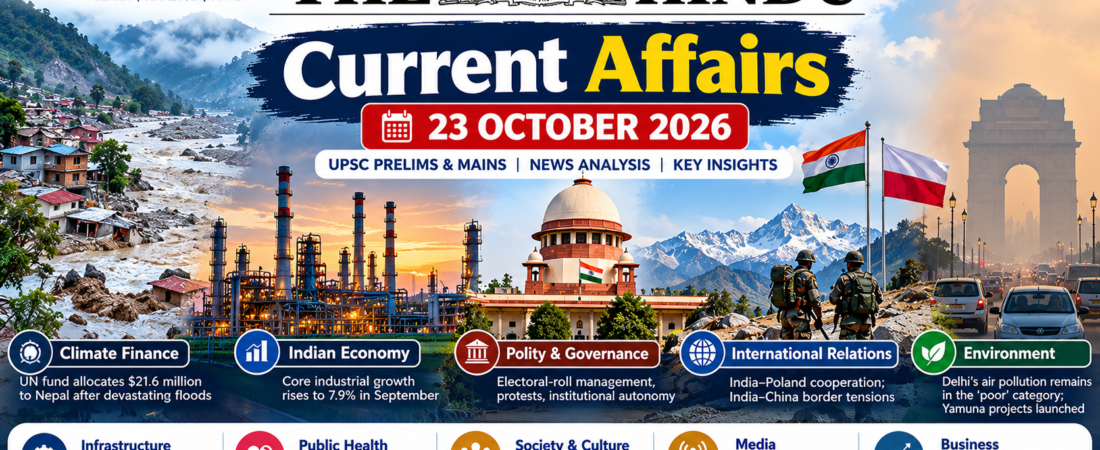
The most important themes from the 23 October 2026 edition are:
- Climate finance: Nepal’s provisional allocation from the UN loss-and-damage fund and the gap between climate-related losses and available funding.
- Economy: The distinction between headline core-sector growth and the sustainability of industrial recovery.
- Supply chains: The strategic implications of Chinese export controls on specialised infrastructure machinery.
- Constitution and governance: Electoral-roll accuracy, protest-related prosecutions and institutional independence.
- Environment: Delhi’s persistent winter air-pollution problem and the challenge of restoring the Yamuna.
- International relations: India–Poland cooperation, India–China border tensions and the impact of the West Asian conflict on Indian nationals.
- Science and health: Research on diet and the gut microbiome, along with the importance of international disease surveillance.
- Culture and society: The Thirukkural and Kashi Tamil Sangamam as examples of cultural and educational engagement.
Preparation strategy: Use the facts for Prelims, but prepare for Mains by connecting each development to the underlying institution, constitutional principle, policy framework or structural challenge. The strongest answers will distinguish short-term developments from long-term trends and reported claims from established findings.
Source note: Compiled from the uploaded The Hindu, Delhi edition, dated 23 October 2026. Allegations, political claims, study-specific findings and interim judicial directions are presented with the qualifications reflected in the report.